PyTorch: An Imperative Style, High-Performance Deep Learning Library
Pith reviewed 2026-05-24 15:12 UTC · model grok-4.3
The pith
PyTorch shows that an imperative Pythonic style can deliver both usability and performance in deep learning.
A machine-rendered reading of the paper's core claim, the machinery that carries it, and where it could break.
Core claim
PyTorch provides an imperative and Pythonic programming style that supports code as a model, makes debugging easy and is consistent with other popular scientific computing libraries, while remaining efficient and supporting hardware accelerators such as GPUs. Every aspect of PyTorch is a regular Python program under the full control of its user, and the careful pragmatic implementation of key runtime components enables them to work together for compelling performance.
What carries the argument
The imperative style in which model definition occurs through direct execution of Python code under user control, backed by runtime components that deliver efficiency and accelerator support.
If this is right
- Models can be defined and altered using ordinary Python control flow structures such as loops and conditionals.
- Debugging reduces to standard Python debugging tools and workflows.
- The library interface aligns directly with tools such as NumPy for seamless data handling.
- Hardware acceleration through GPUs is available without altering the core programming model.
- Overall system speed on standard benchmarks reaches levels competitive with other deep learning libraries.
Where Pith is reading between the lines
- The same imperative approach could be applied to libraries targeting new accelerator hardware beyond GPUs.
- Interactive model exploration in notebooks would become more reliable because changes to control flow are immediately visible.
- Other frameworks might incorporate similar Python-native model definitions to reduce the gap between research code and production code.
Load-bearing premise
The careful and pragmatic implementation of key runtime components enables them to work together to achieve compelling performance.
What would settle it
A set of benchmarks on common deep learning tasks where PyTorch runs substantially slower than alternative frameworks while still using the described imperative Python interface.
Figures

read the original abstract
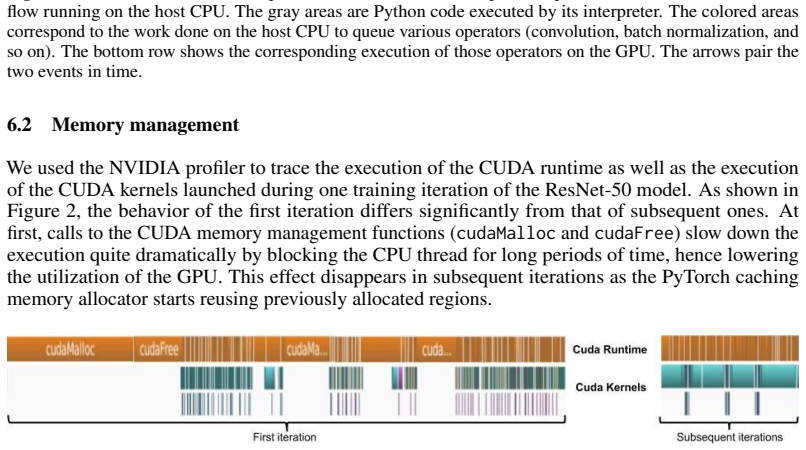
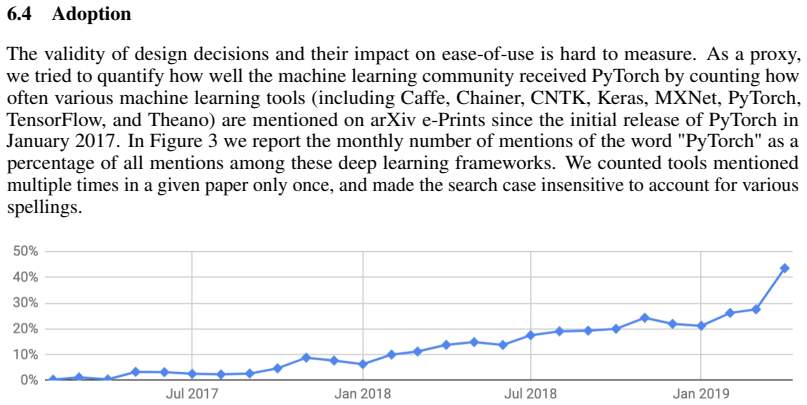
Deep learning frameworks have often focused on either usability or speed, but not both. PyTorch is a machine learning library that shows that these two goals are in fact compatible: it provides an imperative and Pythonic programming style that supports code as a model, makes debugging easy and is consistent with other popular scientific computing libraries, while remaining efficient and supporting hardware accelerators such as GPUs. In this paper, we detail the principles that drove the implementation of PyTorch and how they are reflected in its architecture. We emphasize that every aspect of PyTorch is a regular Python program under the full control of its user. We also explain how the careful and pragmatic implementation of the key components of its runtime enables them to work together to achieve compelling performance. We demonstrate the efficiency of individual subsystems, as well as the overall speed of PyTorch on several common benchmarks.
Editorial analysis
A structured set of objections, weighed in public.
Referee Report
Summary. The paper claims that PyTorch demonstrates the compatibility of usability and speed in deep learning libraries through an imperative, Pythonic interface that treats code as the model, enables straightforward debugging, maintains consistency with scientific computing libraries such as NumPy, and achieves competitive efficiency via pragmatic runtime design while supporting GPU accelerators. It details the guiding implementation principles and their reflection in the architecture, stresses that every component remains a regular Python program under user control, and reports benchmark results on individual subsystems and overall performance on common tasks.
Significance. If the architectural claims and benchmark evidence hold, the paper is significant for documenting a framework whose design choices directly enabled widespread adoption of dynamic neural network models in research. The explicit focus on full Python control and pragmatic runtime integration provides a concrete reference for balancing flexibility with performance, influencing subsequent library designs and lowering barriers to experimentation with non-static computation graphs.
minor comments (1)
- The abstract states that benchmarks demonstrate 'compelling performance' but does not name the specific tasks or hardware configurations; adding one sentence with example workloads (e.g., ResNet training throughput) would improve precision without altering the central narrative.
Simulated Author's Rebuttal
We thank the referee for their positive assessment of the manuscript and for recommending acceptance. The summary accurately captures the core claims regarding PyTorch's design principles and performance characteristics.
Circularity Check
No significant circularity; derivation is self-contained
full rationale
The paper is a systems description of a library implementation. Its central claim (imperative Pythonic interface is compatible with competitive performance) rests on explicit architecture choices, runtime details, and benchmark comparisons to external baselines. No equations, fitted parameters renamed as predictions, self-citations used as uniqueness theorems, or ansatzes smuggled via prior work appear in the provided text. The argument does not reduce any result to its own inputs by construction.
Axiom & Free-Parameter Ledger
Forward citations
Cited by 60 Pith papers
-
Efficient Training on Multiple Consumer GPUs with RoundPipe
RoundPipe achieves near-zero-bubble pipeline parallelism for LLM training on consumer GPUs by dynamically dispatching computation stages round-robin, yielding 1.48-2.16x speedups and enabling 235B model fine-tuning on...
-
Stability and Generalization in Looped Transformers
Looped transformers with recall and outer normalization produce reachable, input-dependent fixed points with stable gradients, enabling generalization, while those without recall cannot; a new internal recall variant ...
-
Traces of Helium Detected in Type Ic Supernova 2014L
Quantitative Bayesian inference using a deep-learning emulator detects 0.018-0.020 M_sun of helium in the Type Ic supernova 2014L.
-
LeLaR: The First In-Orbit Demonstration of an AI-Based Satellite Attitude Controller
First in-orbit demonstration of a DRL-trained AI satellite attitude controller that performs robust inertial pointing after sim-to-real transfer.
-
Automated discovery of heralded ballistic graph state generators for fusion-based photonic quantum computation
A two-pass optimization framework with polynomial-based simulation discovers heralded ballistic circuits for 3-5 qubit graph states achieving up to 7.5x higher success probabilities than fusion baselines, including fi...
-
Editing Models with Task Arithmetic
Task vectors from weight differences allow arithmetic operations to edit pre-trained models, improving multiple tasks simultaneously and enabling analogical inference on unseen tasks.
-
Forecasting megaelectron-volt electron flux in the Earth's outer radiation belt using supervised machine learning algorithms and a timeseries foundation model
Hybrid TimesFM plus ridge regression on covariates forecasts 1-MeV electron flux with average R² of 0.9 on out-of-sample 2024 data, outperforming linear regression, CNN, LSTM and Transformer models.
-
Reconstructing the Stripping History of the Sagittarius Stream with Neural Networks
A neural network trained on simulations infers stripping times for Sagittarius stream stars from phase-space data, measuring a 0.3 dex/Gyr metallicity gradient and estimating ages for globular clusters such as Pal 12 ...
-
Events as Triggers for Behavioral Diversity in Multi-Agent Reinforcement Learning
Events trigger on-the-fly LoRA module generation via hypernetworks over a shared team policy in MARL, paired with a Neural Manifold Diversity metric, enabling sequential role reassignment while preserving reward maximization.
-
Frequency-Space Mechanics: A Sequence and Coordinate-Free Representation for Protein Function Prediction
Vibrational mode graphs from molecular dynamics enable sequence-free protein function prediction via graph neural networks, with entrainment improving signals for collective dynamics.
-
End-to-End Population Inference from Gravitational-Wave Strain using Transformers
Dingo-Pop uses a transformer to perform amortized, end-to-end population inference from GW strain data in seconds, bypassing per-event Monte Carlo sampling.
-
Learning reveals invisible structure in low-rank RNNs
Learning in low-rank RNNs reduces to an exact low-dimensional ODE system in overlap space, where loss-invisible overlaps encode training history without affecting function.
-
Dynamical magnetotropic susceptibility as a new probe of Kitaev materials and beyond
Dynamical magnetotropic susceptibility k(ω) acts as a probe of uniform spin and charge fluctuations, with its static scaling in α-RuCl3 arising specifically from dominant Kitaev interactions in the models examined.
-
Sampling two-dimensional spin systems with transformers
Transformer networks sample up to 180x180 2D Ising systems and 64x64 Edwards-Anderson systems by generating spin groups with probability approximations, yielding ~20x higher effective sample size than prior neural sam...
-
Homogeneous Stellar Parameters from Heterogeneous Spectra with Deep Learning
A single end-to-end Transformer model unifies stellar labels from heterogeneous spectroscopic surveys into a self-consistent scale without post-hoc recalibration.
-
Big Dipper, Help Me Find A Way -- Dip-hunting at hadron colliders
Parametric neural networks learn likelihood ratios to infer top-philic scalar resonances from dip patterns caused by signal-background interference in hadron collider data.
-
Graph-Conditioned Meta-Optimizer for QAOA Parameter Generation on Multiple Problem Classes
A graph-conditioned meta-optimizer learns QAOA parameter trajectories from one problem class and transfers them to others, yielding better initializations than standard methods in an empirical study of 64 settings.
-
Rates of forgetting for the sequentially Markov coalescent
SMC forgets its initial condition geometrically in the jump chain and as 1/ℓ in continuous genetic distance, justifying independent-locus approximations.
-
Concept Graph Convolutions: Message Passing in the Concept Space
Concept Graph Convolutions perform message passing on node concepts to increase interpretability of graph neural networks without losing task performance.
-
A Non-stationary, Amortized, Transfer Learning Approach for Modeling Italian Air Quality
A neural network learns non-stationary anisotropic correlations from gridded CTM outputs and transfers the structure via LatticeKrig basis functions to station data for refined fine-scale NO2 predictions with uncertainty.
-
Probing the 3D Structures of Supernovae through IR Signatures of CO and SiO
MOFAT applied to SN2024ggi shows CO triggering inner SiO formation with a receding edge, order-of-magnitude mass drop, clumping signatures, and no dust formation.
-
Partitioning Unstructured Sparse Tensor Algebra for Load-Balanced Parallel Execution
A new partitioning algorithm that provably load-balances arbitrary sparse tensor algebra expressions by generalizing parallel merging to multi-operand, multi-dimensional hierarchical structures, implemented in a compi...
-
Tensor Memory Engine: On-the-fly Data Reorganization for Ideal Locality
The Tensor Memory Engine provides on-the-fly data reorganization to achieve ideal memory locality for CPU computations in edge systems.
-
Dual Triangle Attention: Effective Bidirectional Attention Without Positional Embeddings
Dual Triangle Attention achieves effective bidirectional attention with built-in positional inductive bias via dual triangular masks, outperforming standard bidirectional attention on position-sensitive tasks and show...
-
How pore-scale disorder controls fluid stretching in porous media
Pore-scale disorder accelerates fluid stretching in porous media, producing quadratic time growth and faster mixing than the linear growth seen in ordered structures.
-
Vibe Coding XR: Accelerating AI + XR Prototyping with XR Blocks and Gemini
XR Blocks supplies an LLM-optimized Reality Model and Vibe Coding XR workflow that converts high-level prompts into working physics-aware XR applications with high one-shot success.
-
Polarized Target Nuclear Magnetic Resonance Measurements with Deep Neural Networks
Deep neural networks reduce fitting uncertainties in CW-NMR polarization measurements for dynamically polarized targets.
-
RLGT: A reinforcement learning framework for extremal graph theory
RLGT is a modular reinforcement learning framework for extremal graph theory that handles undirected, directed, looped, and multi-colored graphs to facilitate future research.
-
Reduced-Order Surrogates for Forced Flexible Mesh Coastal-Ocean Models
Koopman autoencoders with forcings and temporal unrolling deliver accurate year-long predictions for coastal-ocean models at 300-1400x speedup, outperforming POD in two of three cases.
-
Cobble: Compiling Block Encodings for Quantum Computational Linear Algebra
Cobble is a domain-specific language for quantum block encodings that compiles high-level matrix expressions to optimized circuits using analyses and quantum singular value transformation, achieving 2.6x-25.4x speedup...
-
Atomistic Machine Learning with Irreducible Cartesian Natural Tensors
CarNet develops irreducible Cartesian natural tensors and an equivariant model that matches leading spherical-tensor performance for ML interatomic potentials and high-rank tensor predictions like elastic constants.
-
pop-cosmos: Star formation over 12 Gyr from generative modelling of a deep infrared-selected galaxy catalogue
A score-based diffusion generative model on deep infrared galaxy photometry yields a star formation rate density peaking at z=1.3 and shows distinct non-parametric star formation histories plus AGN activity peaking du...
-
Meson spectroscopy of exotic symmetries of Ising criticality in Rydberg atom arrays
Rydberg arrays realize Ising criticality with E8 mass spectra in chains and first signatures of D8^(1)-organized bound states from interchain confinement in ladders.
-
GraphGDel: Constructing and Learning Graph Representations of Genome-Scale Metabolic Models for Growth-Coupled Gene Deletion Prediction
GraphGDel builds graph representations from constraint-based metabolic models and trains a deep learning framework integrating graph structure with gene and metabolite sequences to predict growth-coupled gene deletion...
-
KernelBench: Can LLMs Write Efficient GPU Kernels?
KernelBench shows that even the best current LLMs generate correct and faster-than-baseline GPU kernels in fewer than 20 percent of realistic ML workloads.
-
Clustering in pure-attention hardmax transformers and its role in sentiment analysis
Hardmax transformers converge to leader-determined clusters, enabling an interpretable model for sentiment analysis.
-
Diffusion Models Beat GANs on Image Synthesis
Diffusion models with architecture improvements and classifier guidance achieve superior FID scores to GANs on unconditional and conditional ImageNet image synthesis.
-
Equation of State at High Baryon Densities from a Thermodynamically Informed Neural Network
A thermodynamically consistent neural-network equation of state for QCD matter at finite temperature and conserved charges that matches known low-density results and extrapolates to high baryon densities for use in re...
-
When Are Teacher Tokens Reliable? Position-Weighted On-Policy Self-Distillation for Reasoning
Position-Weighted On-Policy Self-Distillation (PW-OPSD) weights later tokens more heavily after a diagnostic shows position predicts teacher reliability better than entropy, yielding +1.0 and +1.1 Avg@12 gains on AIME...
-
Universal Jaynes-Cummings Control of an Oscillator
Experimental demonstration of universal qudit control on a cavity oscillator via compiled Jaynes-Cummings gates with a transmon ancilla, reaching 96% mean post-selected process fidelity for qutrit gates.
-
CAM-VFD: Cross-Attention Multimodal Video Forgery Detection
CAM-VFD detects video forgeries by using cross-attention to identify contradictions between CLIP appearance, VideoMAE motion, and MiDaS depth features.
-
Mechanistically Interpretable Neural Encoding Reveals Fine-Grained Functional Selectivity in Human Visual Cortex
MINE uses mechanistic interpretability on language-aligned image representations to generate per-voxel feature descriptions, validated via image generation and counterfactual edits that causally shift brain activation.
-
Events as Triggers for Behavioral Diversity in Multi-Agent Reinforcement Learning
Proposes an event-triggered MARL framework with Neural Manifold Diversity and event-based hypernetworks to enable dynamic, agent-agnostic behavioral transitions while preserving reward maximization.
-
Block-Based Double Decoders
Block-based double decoders achieve full supervision in pretraining like decoder-only models and efficient inference like encoder-decoders through doubly-causal block-based attention masks, outperforming encoder-decod...
-
Curvature-Aware Captioning:Leveraging Geodesic Attention for 3D Scene Understanding
A new framework combines self-attention on the Oblique manifold with bidirectional geodesic cross-attention on the Lorentz hyperboloid to improve both localization accuracy and descriptive coherence in 3D dense captioning.
-
POETS: Uncertainty-Aware LLM Optimization via Compute-Efficient Policy Ensembles
POETS uses compute-efficient LLM policy ensembles to implicitly perform KL-regularized Thompson sampling, delivering O(sqrt(T gamma_T)) regret bounds and state-of-the-art sample efficiency in scientific discovery task...
-
What If We Let Forecasting Forget? A Sparse Bottleneck for Cross-Variable Dependencies
MS-FLOW uses a capacity-limited sparse routing mechanism to model only critical inter-variable dependencies in time series data, achieving state-of-the-art accuracy on 12 benchmarks with fewer but more reliable connections.
-
Why Does Agentic Safety Fail to Generalize Across Tasks?
Agentic safety fails to generalize across tasks because the task-to-safe-controller mapping has a higher Lipschitz constant than the task-to-controller mapping alone, as proven in linear-quadratic control and demonstr...
-
Decoding Alignment without Encoding Alignment: A critique of similarity analysis in neuroscience
Decoding alignment metrics can remain high and unchanged even when encoding manifold topology is causally altered, so they do not imply similar function or computation across neural populations.
-
Stage Light is Sequence$^2$: Multi-Light Control via Imitation Learning
SeqLight maps music to multi-light HSV control via SkipBART for global color prediction followed by hybrid imitation learning in a goal-conditioned MDP to decompose colors across lights.
-
Euclid preparation. CosmoPostProcess: A simulation calibrated framework for weak lensing selection bias in richness-selected galaxy clusters
CosmoPostProcess delivers simulation-calibrated radial corrections for projection-induced selection bias (20-40% amplitude near 1 h^{-1} Mpc) and baryonic effects in Euclid richness-selected cluster weak lensing profiles.
-
ClarifySTL: An Interactive LLM Agent Framework for STL Transformation through Requirements Clarification
ClarifySTL uses LLM agents to interactively detect and resolve vagueness and ambiguity in natural language requirements via clarification queries before generating STL formulas, with evaluations on existing and new be...
-
Compressibility of micromagnetic solutions in tensor train format
Tensor-train compressed micromagnetic solutions for flux-closure states in soft-magnetic prisms scale as L^{1.8} and (1/a)^{1.2} by exploiting spatial sparsity in domain walls versus uniform domains.
-
Towards Generalizable Mapping of Hedges and Linear Woody Features from Earth Observation Data: a national Product for Germany
A modular deep learning workflow maps linear woody features at national scale in Germany from three different resolution EO sources using a single trained model.
-
Rendering-Aware Sparse Sampling for BRDF Acquisition
A sampler network learns to select informative sparse BRDF measurement directions by optimizing against a fixed pretrained hypernetwork reconstructor and differentiable renderer, improving low-budget reconstruction on...
-
A Physics Informed Bayesian Neural Network for the Neutron Star Equation of State
A physics-informed Bayesian neural network learns neutron-star equations of state from theoretical priors and constraints, then generates posterior mass-radius and mass-tidal-deformability distributions consistent wit...
-
Data-Driven Acceleration of Eccentricity Reduction for Binary Black Hole Simulations
A Gaussian Process Regression model trained on an archive of eccentricity-reduced binary black hole simulations predicts initial conditions that achieve low eccentricity with zero or one iteration.
-
JAX-BEM: Gradient-Based Acoustic Shape Optimisation via a Differentiable Boundary Element Method
A JAX-based differentiable BEM solver matches traditional BEM accuracy on benchmarks and supports gradient-driven acoustic geometry optimization.
-
PRiMeFlow: Capturing Complex Expression Heterogeneity in Perturbation Response Modelling
PRiMeFlow is a flow-matching model that approximates the full empirical distribution of single-cell gene expression after perturbations.
-
TCL: Enabling Fast and Efficient Cross-Hardware Tensor Program Optimization via Continual Learning
TCL delivers 16.8x faster tuning on CPU and 12.48x on GPU with modestly lower inference latency by combining RDU active sampling, a lightweight Mamba cost model, and cross-platform continual knowledge distillation.
Reference graph
Works this paper leans on
-
[1]
Caffe: Convolutional Architecture for Fast Feature Embedding
Yangqing "Jia, Evan Shelhamer, Jeff Donahue, Sergey Karayev, Jonathan Long, Ross Girshick, Sergio Guadarrama, and Trevor" Darrell. "caffe: Convolutional architecture for fast feature embedding". "arXiv preprint arXiv:1408.5093", "2014"
work page internal anchor Pith review Pith/arXiv arXiv 2014
-
[2]
Cntk: Microsoft’s open-source deep-learning toolkit
Frank Seide and Amit Agarwal. Cntk: Microsoft’s open-source deep-learning toolkit. In Proceedings of the 22Nd ACM SIGKDD International Conference on Knowledge Discovery and Data Mining, KDD ’16, pages 2135–2135, New York, NY , USA, 2016. ACM. 9
work page 2016
-
[3]
Martín Abadi, Ashish Agarwal, Paul Barham, Eugene Brevdo, Zhifeng Chen, Craig Citro, Greg S. Corrado, Andy Davis, Jeffrey Dean, Matthieu Devin, Sanjay Ghemawat, Ian Goodfellow, Andrew Harp, Geoffrey Irving, Michael Isard, Yangqing Jia, Rafal Jozefowicz, Lukasz Kaiser, Manjunath Kudlur, Josh Levenberg, Dandelion Mané, Rajat Monga, Sherry Moore, Derek Murra...
work page 2015
-
[4]
Theano: A Python framework for fast computation of mathematical expressions
Theano Development Team. Theano: A Python framework for fast computation of mathematical expressions. arXiv e-prints, abs/1605.02688, May 2016
work page internal anchor Pith review Pith/arXiv arXiv 2016
-
[5]
Chainer: a next-generation open source framework for deep learning
Seiya Tokui, Kenta Oono, Shohei Hido, and Justin Clayton. Chainer: a next-generation open source framework for deep learning. In Proceedings of Workshop on Machine Learning Systems (LearningSys) in The Twenty-ninth Annual Conference on Neural Information Processing Systems (NIPS), 2015
work page 2015
-
[6]
Torch: a modular machine learning software library
Ronan Collobert, Samy Bengio, and Johnny Mariéthoz. Torch: a modular machine learning software library. Technical report, Idiap, 2002
work page 2002
-
[7]
G. Neubig, C. Dyer, Y . Goldberg, A. Matthews, W. Ammar, A. Anastasopoulos, M. Balles- teros, D. Chiang, D. Clothiaux, T. Cohn, K. Duh, M. Faruqui, C. Gan, D. Garrette, Y . Ji, L. Kong, A. Kuncoro, G. Kumar, C. Malaviya, P. Michel, Y . Oda, M. Richardson, N. Saphra, S. Swayamdipta, and P. Yin. DyNet: The Dynamic Neural Network Toolkit. ArXiv e-prints, Jan...
work page 2017
-
[8]
Philip S. Abrams. An APL Machine. PhD thesis, Stanford University, 1970
work page 1970
-
[9]
The MathWorks, Inc., Natick, Massachusetts, United States. MATLAB and Statistics Toolbox
-
[10]
R: A Language and Environment for Statistical Computing
R Core Team. R: A Language and Environment for Statistical Computing. R Foundation for Statistical Computing, Vienna, Austria
-
[11]
Julia: A fresh approach to numerical computing
Jeff Bezanson, Alan Edelman, Stefan Karpinski, and Viral B Shah. Julia: A fresh approach to numerical computing. SIAM review, 59(1):65–98, 2017
work page 2017
-
[12]
Travis Oliphant. NumPy: A guide to NumPy. USA: Trelgol Publishing, 2006. http://www.numpy.org/
work page 2006
- [13]
-
[14]
Y LeCun and L Bottou. Lush reference manual. Technical report, code available at http://lush.sourceforge.net, 2002
work page 2002
-
[15]
Pearlmutter, Alexey Andreyevich Radul, and Jeffrey Mark Siskind
Atilim Gunes Baydin, Barak A. Pearlmutter, Alexey Andreyevich Radul, and Jeffrey Mark Siskind. Automatic differentiation in machine learning: A survey. J. Mach. Learn. Res. , 18(1):5595–5637, January 2017
work page 2017
-
[16]
Modeling, Inference and Optimization with Composable Differentiable Procedures
Dougal Maclaurin. Modeling, Inference and Optimization with Composable Differentiable Procedures. PhD thesis, Harvard University, April 2016
work page 2016
-
[17]
Matthew Johnson et. al. Jax. https://github.com/google/jax, 2018
work page 2018
-
[18]
Mike Innes et. al. Flux.jl. https://github.com/FluxML/Flux.jl, 2018
work page 2018
-
[19]
SciPy: Open source scientific tools for Python, 2001–
Eric Jones, Travis Oliphant, Pearu Peterson, et al. SciPy: Open source scientific tools for Python, 2001–. http://www.scipy.org/
work page 2001
-
[20]
Data structures for statistical computing in python
Wes McKinney. Data structures for statistical computing in python. In Proceedings of the 9th Python in Science Conference, 51-56, 2010
work page 2010
-
[21]
Eblearn: Open-source energy-based learning in c++
Pierre Sermanet, Koray Kavukcuoglu, and Yann LeCun. Eblearn: Open-source energy-based learning in c++. In2009 21st IEEE International Conference on Tools with Artificial Intelligence, pages 693–697. IEEE, 2009. 10
work page 2009
-
[22]
cuDNN: Efficient Primitives for Deep Learning
Sharan Chetlur, Cliff Woolley, Philippe Vandermersch, Jonathan D. Cohen, John Tran, Bryan Catanzaro, and Evan Shelhamer. cudnn: Efficient primitives for deep learning. CoRR, abs/1410.0759, 2014
work page internal anchor Pith review Pith/arXiv arXiv 2014
-
[23]
maxdnn: An efficient convolution kernel for deep learning with maxwell gpus, January 2015
Andrew Lavin. maxdnn: An efficient convolution kernel for deep learning with maxwell gpus, January 2015
work page 2015
-
[24]
Fast algorithms for convolutional neural networks
Andrew Lavin and Scott Gray. Fast algorithms for convolutional neural networks. 2016 IEEE Conference on Computer Vision and Pattern Recognition (CVPR), pages 4013–4021, 2016
work page 2016
-
[25]
Torch7: A matlab-like environment for machine learning
Ronan Collobert, Koray Kavukcuoglu, and Clément Farabet. Torch7: A matlab-like environment for machine learning. In NIPS 2011, 2011
work page 2011
-
[26]
Richard Gabriel. The rise of worse is better. http://dreamsongs.com/RiseOfWorseIsBetter.html
-
[27]
MNIST handwritten digit database
Yann LeCun and Corinna Cortes. MNIST handwritten digit database. http://yann.lecun.com/exdb/mnist/
-
[28]
StarCraft II: A New Challenge for Reinforcement Learning
Oriol Vinyals, Timo Ewalds, Sergey Bartunov, Petko Georgiev, Alexander Sasha Vezhnevets, Michelle Yeo, Alireza Makhzani, Heinrich Küttler, John Agapiou, Julian Schrittwieser, John Quan, Stephen Gaffney, Stig Petersen, Karen Simonyan, Tom Schaul, Hado van Hasselt, David Silver, Timothy P. Lillicrap, Kevin Calderone, Paul Keet, Anthony Brunasso, David Lawre...
work page internal anchor Pith review Pith/arXiv arXiv 2017
-
[29]
Dlpack: Open in memory tensor structure
DMLC. Dlpack: Open in memory tensor structure. https://github.com/dmlc/dlpack
-
[30]
Automatic differentiation in pytorch
Adam Paszke, Sam Gross, Soumith Chintala, Gregory Chanan, Edward Yang, Zachary DeVito, Zeming Lin, Alban Desmaison, Luca Antiga, and Adam Lerer. Automatic differentiation in pytorch. In NIPS Workshop, 2017
work page 2017
-
[31]
Automatic differentiation, C++ templates, and photogrammetry
Dan Piponi. Automatic differentiation, C++ templates, and photogrammetry. J. Graphics, GPU, & Game Tools, 9(4):41–55, 2004
work page 2004
-
[32]
Automatic differentiation facilitates of-integration into steering-angle-based road vehicle tracking
Holger Leuck and Hans-Hellmut Nagel. Automatic differentiation facilitates of-integration into steering-angle-based road vehicle tracking. In 1999 Conference on Computer Vision and Pattern Recognition (CVPR ’99), 23-25 June 1999, Ft. Collins, CO, USA, pages 2360–2365, 1999
work page 1999
-
[33]
The cpython global interpreter lock
The Python team. The cpython global interpreter lock. https://wiki.python.org/moin/GlobalInterpreterLock
- [34]
- [35]
-
[36]
G. Synnaeve, Z. Lin, J. Gehring, D. Gant, V . Mella, V . Khalidov, N. Carion, and N. Usunier. Forward modeling for partial observation strategy games - a starcraft defogger. In Advances in Neural Information Processing Systems, pages 10761–10771, 2018
work page 2018
- [37]
- [38]
-
[39]
Emery D. Berger, Kathryn S. McKinley, Robert D. Blumofe, and Paul R. Wilson. Hoard: A scalable memory allocator for multithreaded applications. In Proceedings of the Ninth International Conference on Architectural Support for Programming Languages and Operating Systems, ASPLOS IX, pages 117–128, New York, NY , USA, 2000. ACM
work page 2000
-
[40]
J. Evans. A scalable concurrent malloc(3) implementation for freebsd. In In BSDCan — The Technical BSD Conference, May 2006
work page 2006
- [41]
-
[42]
Benjamin Recht, Christopher Ré, Stephen J. Wright, and Feng Niu. Hogwild: A lock-free approach to parallelizing stochastic gradient descent. In Advances in Neural Information Processing Systems 24: 25th Annual Conference on Neural Information Processing Systems
-
[43]
Proceedings of a meeting held 12-14 December 2011, Granada, Spain., pages 693–701, 2011
work page 2011
-
[44]
Matthew Hertz and Emery D. Berger. Quantifying the performance of garbage collection vs. explicit memory management. In Proceedings of the 20th Annual ACM SIGPLAN Conference on Object-oriented Programming, Systems, Languages, and Applications, OOPSLA ’05, pages 313–326, New York, NY , USA, 2005. ACM
work page 2005
-
[45]
https://pytorch.org/docs/1.0.1/autograd.html#profiler
The PyTorch team.Pytorch Autograd Profiler. https://pytorch.org/docs/1.0.1/autograd.html#profiler. 12
discussion (0)
Sign in with ORCID, Apple, or X to comment. Anyone can read and Pith papers without signing in.