Consensus-Based Optimization with Truncated Noise
Pith reviewed 2026-05-24 06:44 UTC · model grok-4.3
The pith
Truncating the noise term in consensus-based optimization bounds higher moments of the particle law and proves convergence in expectation to the global minimizer under minimal assumptions.
A machine-rendered reading of the paper's core claim, the machinery that carries it, and where it could break.
Core claim
By replacing the unbounded noise in the CBO particle dynamics with a truncated version, the law of the interacting particles satisfies uniform bounds on moments of all orders. These bounds close the estimates needed to control the evolution of the Wasserstein-2 distance to the global minimizer, yielding convergence in expectation of the empirical measure with only minimal assumptions on the objective and the initial configuration.
What carries the argument
The truncated noise term added to each particle's drift, which caps the Gaussian increment so that the resulting measure satisfies moment bounds sufficient to close the Wasserstein-2 contraction argument.
If this is right
- The method converges in expectation for a larger set of nonconvex and nonsmooth objectives than the original CBO formulation.
- A wider interval of admissible noise strengths becomes usable without losing the convergence guarantee.
- Higher-moment control removes the need for additional regularization or projection steps that were sometimes required before.
- The same truncation technique can be inserted into other multi-particle metaheuristics whose analysis previously relied on moment bounds.
Where Pith is reading between the lines
- The truncation idea may transfer to other interacting-particle schemes used for sampling or sampling-based optimization.
- Because the proof relies only on Wasserstein-2 contraction, similar arguments could be attempted with other optimal-transport distances or with mean-field limits.
- Practical implementations could adapt the truncation threshold dynamically rather than keeping it fixed.
Load-bearing premise
The objective function and the initial particle configuration satisfy the minimal conditions that let the Wasserstein-2 distance evolution be controlled and produce convergence in expectation.
What would settle it
An objective function and initial particle configuration satisfying the stated minimal conditions for which the truncated-noise system fails to drive the Wasserstein-2 distance to zero in expectation.
Figures
read the original abstract
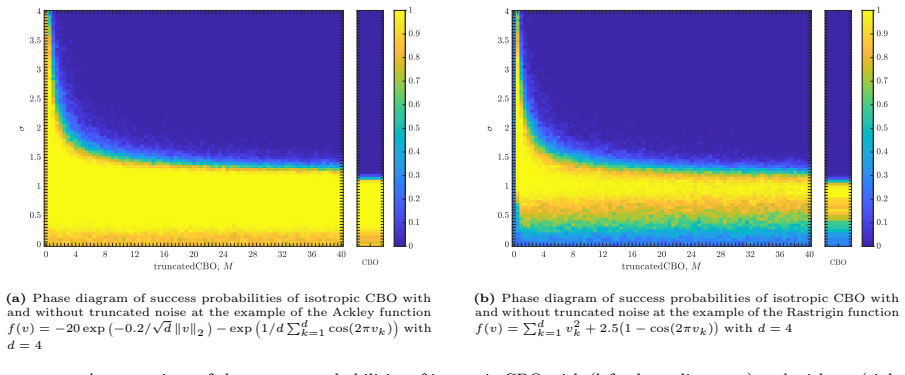
Consensus-based optimization (CBO) is a versatile multi-particle metaheuristic optimization method suitable for performing nonconvex and nonsmooth global optimizations in high dimensions. It has proven effective in various applications while at the same time being amenable to a theoretical convergence analysis. In this paper, we explore a variant of CBO, which incorporates truncated noise in order to enhance the well-behavedness of the statistics of the law of the dynamics. By introducing this additional truncation in the noise term of the CBO dynamics, we achieve that, in contrast to the original version, higher moments of the law of the particle system can be effectively bounded. As a result, our proposed variant exhibits enhanced convergence performance, allowing in particular for wider flexibility in choosing the noise parameter of the method as we confirm experimentally. By analyzing the time-evolution of the Wasserstein-$2$ distance between the empirical measure of the interacting particle system and the global minimizer of the objective function, we rigorously prove convergence in expectation of the proposed CBO variant requiring only minimal assumptions on the objective function and on the initialization. Numerical evidences demonstrate the benefit of truncating the noise in CBO.
Editorial analysis
A structured set of objections, weighed in public.
Referee Report
Summary. The paper proposes a truncated-noise variant of consensus-based optimization (CBO) that bounds higher moments of the particle system law, thereby improving well-behavedness and allowing greater flexibility in the noise parameter. Convergence in expectation is proved by deriving a differential inequality for the Wasserstein-2 distance between the empirical measure and the global minimizer, under minimal assumptions on the objective and initialization; numerical experiments support the practical benefits.
Significance. If the stated convergence result holds, the work strengthens the theoretical toolkit for CBO by supplying explicit moment control via truncation and a proof that avoids strong regularity requirements on the objective, which could widen the range of admissible noise intensities in applications.
major comments (1)
- [Abstract / Theorem statement] The abstract asserts convergence 'requiring only minimal assumptions on the objective function and on the initialization,' yet neither the abstract nor the provided description lists these assumptions explicitly. Because the entire proof strategy rests on controlling the W2 evolution under precisely these conditions, their precise statement (e.g., growth, coercivity, or initialization moment hypotheses) must appear before the main theorem.
Simulated Author's Rebuttal
We thank the referee for the careful review and the constructive comment. We address the single major comment below.
read point-by-point responses
-
Referee: [Abstract / Theorem statement] The abstract asserts convergence 'requiring only minimal assumptions on the objective function and on the initialization,' yet neither the abstract nor the provided description lists these assumptions explicitly. Because the entire proof strategy rests on controlling the W2 evolution under precisely these conditions, their precise statement (e.g., growth, coercivity, or initialization moment hypotheses) must appear before the main theorem.
Authors: We agree that the abstract does not enumerate the assumptions and that doing so would improve readability. The assumptions (unique global minimizer, coercivity at infinity with quadratic growth, and finite second-moment initialization) are stated explicitly in Assumption 2.1 and restated immediately before Theorem 3.1. To address the referee's concern we will revise the abstract to include a concise bullet list of these hypotheses and will add a short paragraph immediately preceding the theorem that recalls them verbatim. This change does not alter the proof but makes the precise conditions under which the W2 analysis holds transparent from the outset. revision: yes
Circularity Check
No significant circularity
full rationale
The central result is a direct analysis of the Wasserstein-2 distance evolution for the truncated-noise CBO dynamics, yielding an expectation convergence bound under minimal assumptions on f and the initial measure. This derivation does not reduce any quantity to a fitted parameter, self-referential definition, or load-bearing self-citation chain; the truncation is introduced explicitly to close the moment bounds needed for the differential inequality, and the proof proceeds from the SDE to the W2 evolution without importing uniqueness or ansatzes from prior author work as an external forcing step. The paper is therefore self-contained against external benchmarks.
Axiom & Free-Parameter Ledger
Reference graph
Works this paper leans on
-
[1]
E. Aarts and J. Korst. Simulated annealing and Boltzmann machines. A stochastic approach to combinatorial optimization and neural computing . Wiley-Interscience Series in Discrete Mathematics and Optimization. John Wiley & Sons, Ltd., Chichester, 1989
work page 1989
-
[2]
L. Ambrosio, N. Gigli, and G. Savar´ e.Gradient flows in metric spaces and in the space of probability measures. Lectures in Mathematics ETH Z¨ urich. Birkh¨ auser Verlag, Basel, second edition, 2008
work page 2008
- [3]
- [4]
-
[5]
C. Blum and A. Roli. Metaheuristics in combinatorial optimization: Overview and conceptual comparison. ACM Comput. Surv. , 35(3):268–308, 2003
work page 2003
- [6]
- [7]
- [8]
- [9]
-
[10]
L. Bungert, P. Wacker, and T. Roith. Polarized consensus-based dynamics for optimization and sampling. arXiv:2211.05238, 2022. 24
work page internal anchor Pith review arXiv 2022
-
[11]
J. A. Carrillo, Y.-P. Choi, C. Totzeck, and O. Tse. An analytical framework for consensus- based global optimization method. Math. Models Methods Appl. Sci. , 28(6):1037–1066, 2018
work page 2018
-
[12]
J. A. Carrillo, F. Hoffmann, A. M. Stuart, and U. Vaes. Consensus-based sampling. Stud. Appl. Math., 148(3):1069–1140, 2022
work page 2022
-
[13]
J. A. Carrillo, S. Jin, L. Li, and Y. Zhu. A consensus-based global optimization method for high dimensional machine learning problems. ESAIM Control Optim. Calc. Var. , 27(suppl.):Paper No. S5, 22, 2021
work page 2021
-
[14]
J. A. Carrillo, C. Totzeck, and U. Vaes. Consensus-based optimization and ensemble kalman inversion for global optimization problems with constraints. In Modeling and Simulation for Collective Dynamics , pages 195–230. World Scientific, 2023
work page 2023
- [15]
- [16]
-
[17]
C. Cipriani, H. Huang, and J. Qiu. Zero-inertia limit: from particle swarm optimization to consensus-based optimization. SIAM J. Appl. Math , 54(3):3091–3121, 2022
work page 2022
-
[18]
A. Dembo and O. Zeitouni. Large deviations techniques and applications , volume 38 of Applications of Mathematics (New York) . Springer-Verlag, New York, second edition, 1998
work page 1998
-
[19]
D. B. Fogel. Evolutionary computation. Toward a new philosophy of machine intelligence . IEEE Press, Piscataway, NJ, second edition, 2000
work page 2000
-
[20]
M. Fornasier, H. Huang, L. Pareschi, and P. S¨ unnen. Consensus-based optimization on hypersurfaces: Well-posedness and mean-field limit. Math. Models Methods Appl. Sci. , 30(14):2725–2751, 2020
work page 2020
-
[21]
M. Fornasier, H. Huang, L. Pareschi, and P. S¨ unnen. Consensus-based optimization on the sphere: convergence to global minimizers and machine learning. J. Mach. Learn. Res. , 22:Paper No. 237, 55, 2021
work page 2021
-
[22]
M. Fornasier, H. Huang, L. Pareschi, and P. S¨ unnen. Anisotropic diffusion in consensus-based optimization on the sphere. SIAM J. Optim. , 32(3):1984–2012, 2022
work page 1984
-
[23]
M. Fornasier, T. Klock, and K. Riedl. Consensus-based optimization methods converge globally. arXiv:2103.15130, 2021
-
[24]
M. Fornasier, T. Klock, and K. Riedl. Convergence of anisotropic consensus-based opti- mization in mean-field law. In J. L. Jim´ enez Laredo, J. I. Hidalgo, and K. O. Babaagba, editors, Applications of Evolutionary Computation , pages 738–754, Cham, 2022. Springer International Publishing
work page 2022
- [25]
-
[26]
S. Grassi and L. Pareschi. From particle swarm optimization to consensus based optimization: stochastic modeling and mean-field limit. Math. Models Methods Appl. Sci., 31(8):1625–1657, 2021. 25
work page 2021
-
[27]
S.-Y. Ha, S. Jin, and D. Kim. Convergence of a first-order consensus-based global optimiza- tion algorithm. Math. Models Methods Appl. Sci. , 30(12):2417–2444, 2020
work page 2020
-
[28]
S.-Y. Ha, S. Jin, and D. Kim. Convergence and error estimates for time-discrete consensus- based optimization algorithms. Numer. Math., 147(2):255–282, 2021
work page 2021
-
[29]
S.-Y. Ha, M. Kang, and D. Kim. Emergent behaviors of high-dimensional Kuramoto models on Stiefel manifolds. Automatica, 136:Paper No. 110072, 2022
work page 2022
-
[30]
D. J. Higham. An algorithmic introduction to numerical simulation of stochastic differential equations. SIAM Rev., 43(3):525–546, 2001
work page 2001
-
[31]
J. H. Holland. Adaptation in natural and artificial systems. An introductory analysis with applications to biology, control, and artificial intelligence . University of Michigan Press, Ann Arbor, Mich., 1975
work page 1975
-
[32]
H. Huang and J. Qiu. On the mean-field limit for the consensus-based optimization. Math. Methods Appl. Sci. , 45(12):7814–7831, 2022
work page 2022
- [33]
- [34]
- [35]
-
[36]
J. Kennedy and R. Eberhart. Particle swarm optimization. In Proceedings of ICNN’95 - International Conference on Neural Networks , volume 4, pages 1942–1948. IEEE, 1995
work page 1942
-
[37]
J. Kim, M. Kang, D. Kim, S.-Y. Ha, and I. Yang. A stochastic consensus method for nonconvex optimization on the Stiefel manifold. In 2020 59th IEEE Conference on Decision and Control (CDC) , pages 1050–1057. IEEE, 2020
work page 2020
-
[38]
K. Klamroth, M. Stiglmayr, and C. Totzeck. Consensus-based optimization for multi- objective problems: A multi-swarm approach. arXiv:2211.15737, 2022
- [39]
- [40]
-
[41]
E. Platen. An introduction to numerical methods for stochastic differential equations. In Acta numerica, 1999, volume 8 of Acta Numer., pages 197–246. Cambridge Univ. Press, Cambridge, 1999
work page 1999
-
[42]
K. Riedl. Leveraging memory effects and gradient information in consensus-based optimisa- tion: On global convergence in mean-field law. European Journal of Applied Mathematics , First View:1–32, 2023. 26
work page 2023
- [43]
-
[44]
C. Schillings, C. Totzeck, and P. Wacker. Ensemble-based gradient inference for particle methods in optimization and sampling. SIAM/ASA Journal on Uncertainty Quantification , 11(3):757–787, 2023
work page 2023
-
[45]
C. Totzeck. Trends in consensus-based optimization. In Active Particles, Volume 3: Advances in Theory, Models, and Applications , pages 201–226. Springer, 2021
work page 2021
-
[46]
C. Totzeck and M.-T. Wolfram. Consensus-based global optimization with personal best. Math. Biosci. Eng. , 17(5):6026–6044, 2020. 27
work page 2020
discussion (0)
Sign in with ORCID, Apple, or X to comment. Anyone can read and Pith papers without signing in.