COLIBRE: calibrating subgrid feedback in cosmological simulations that include a cold gas phase
Pith reviewed 2026-05-18 19:32 UTC · model grok-4.3
The pith
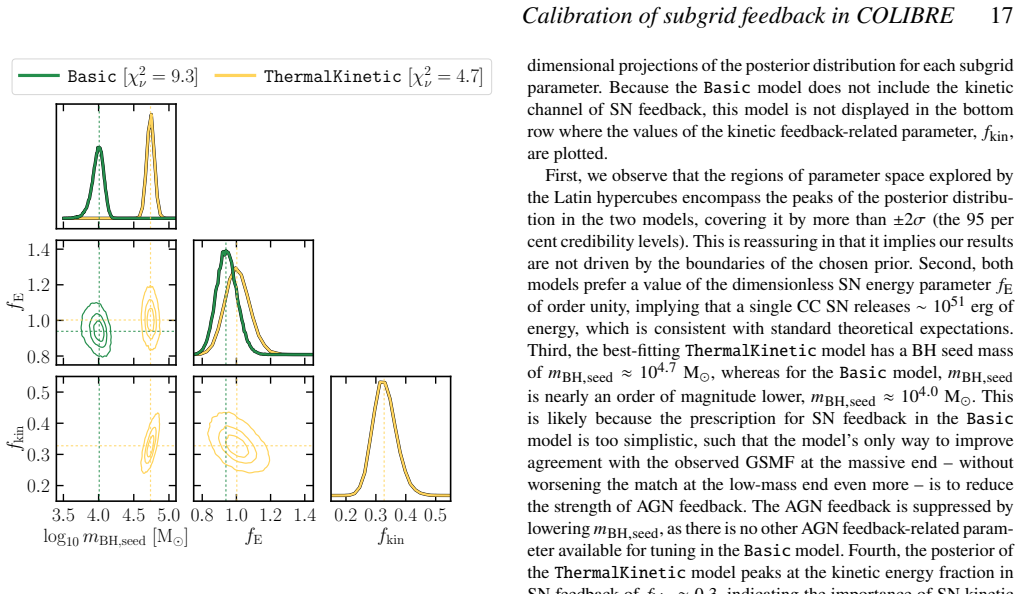
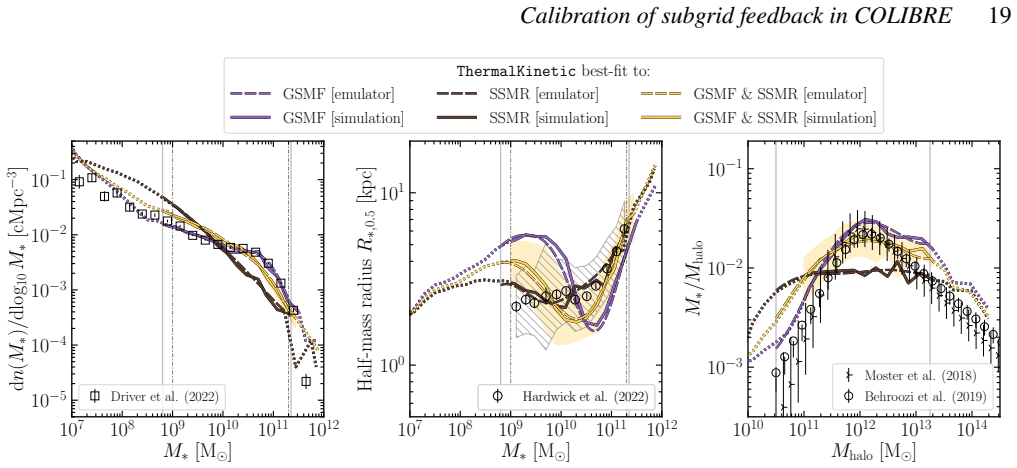
Calibrating up to four subgrid feedback parameters lets COLIBRE match both the galaxy stellar mass function and size-stellar mass relation at z=0.
A machine-rendered reading of the paper's core claim, the machinery that carries it, and where it could break.
Core claim
The calibrated m7 COLIBRE model reproduces the z=0 galaxy stellar mass function and size-stellar mass relation after fitting subgrid supernova and AGN feedback parameters with Gaussian process emulators trained on Latin hypercube samples. While each observable can be matched individually with a relatively simple supernova feedback model, reproducing both simultaneously requires a more sophisticated prescription. The trained emulators also reveal how different aspects of the feedback affect predictions. The calibrated model matches various other galaxy properties to which it was not tuned, and the m7 parameters transfer to m6 and m5 resolutions after minor adjustments.
What carries the argument
Gaussian process emulators trained on Latin hypercube samples of simulations that predict the galaxy stellar mass function and size-stellar mass relation as functions of up to four subgrid feedback parameters.
If this is right
- Matching both the galaxy stellar mass function and size-stellar mass relation at once requires a more sophisticated supernova feedback prescription than matching either target individually.
- The calibrated m7 parameters can be transferred to m6 and m5 resolutions with only slight manual adjustments while retaining similar agreement with observations.
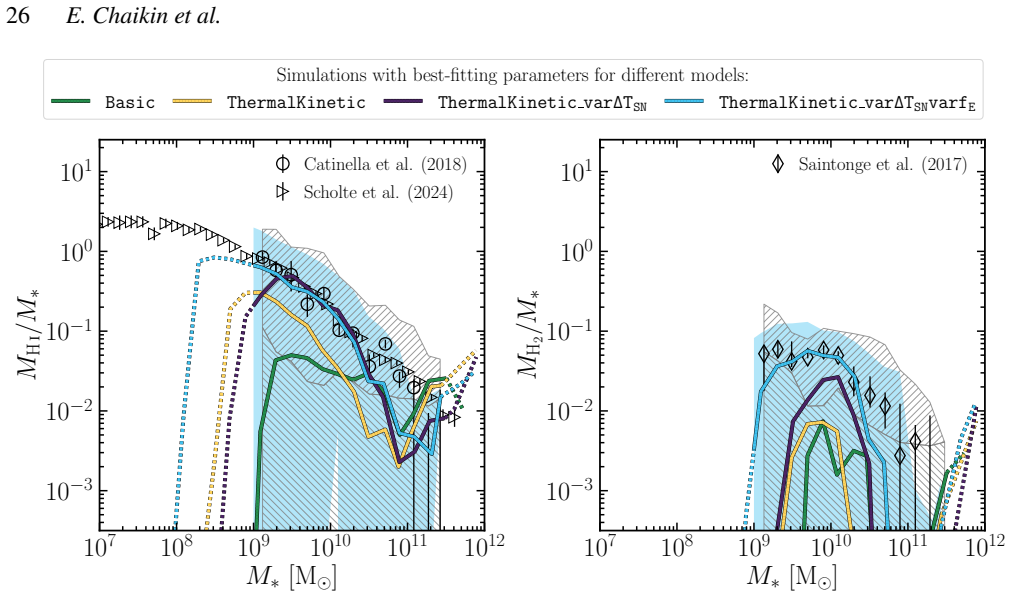
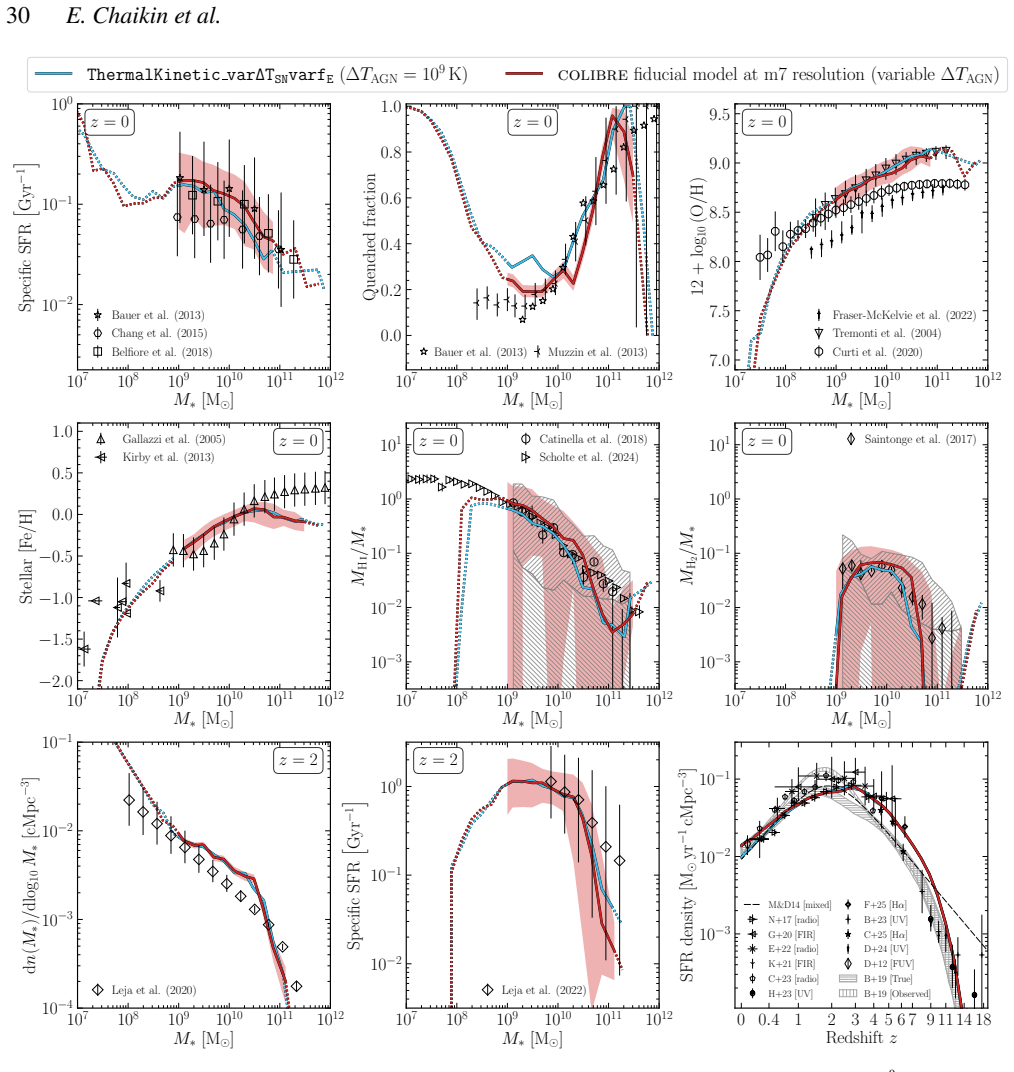
- The model reproduces additional galaxy properties beyond the two calibration targets.
- The emulators allow investigation of how specific choices in supernova and AGN feedback prescriptions affect the predicted galaxy properties.
Where Pith is reading between the lines
- The emulator-based approach could be reused to explore additional observables or parameters without running thousands of full simulations.
- Success across three resolutions suggests the subgrid model captures effects that are largely independent of numerical resolution once parameters are retuned.
- The finding that both mass and size relations need sophisticated feedback together implies that galaxy size is sensitive to the detailed implementation of supernova-driven outflows.
Load-bearing premise
That varying only up to four subgrid feedback parameters and using Gaussian process emulators on Latin hypercube samples is sufficient to capture the dominant effects needed to match both the galaxy stellar mass function and size-stellar mass relation simultaneously.
What would settle it
Running a new set of COLIBRE simulations with the emulator-derived best-fit parameters and finding that the resulting z=0 galaxy stellar mass function or size-stellar mass relation deviates significantly from the observational data used for calibration.
Figures









read the original abstract
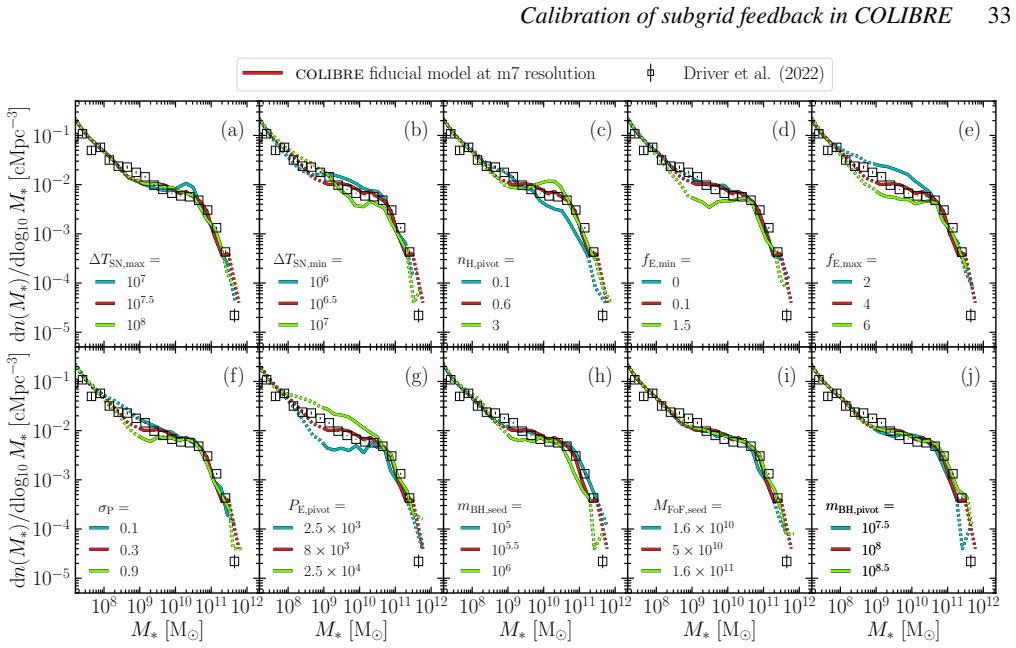
We present the calibration of stellar and active galactic nucleus (AGN) feedback in the subgrid model for the new COLIBRE hydrodynamical simulations of galaxy formation. COLIBRE directly simulates the multi-phase interstellar medium and the evolution of dust grains, which is coupled to the chemistry. COLIBRE is calibrated at three resolutions: particle masses of $m_{\rm gas} \approx m_{\rm dm} \sim 10^7$ (m7), $10^6$ (m6), and $10^5~\mathrm{M_\odot}$ (m5). To calibrate the COLIBRE feedback at m7 resolution, we run Latin hypercubes of $\approx 200$ simulations that vary up to four subgrid parameters in cosmological volumes of ($50~\mathrm{cMpc}$)$^{3}$. We train Gaussian process emulators on these simulations to predict the $z=0$ galaxy stellar mass function (GSMF) and size - stellar mass relation (SSMR) as functions of the model parameters, which we then fit to observations. The trained emulators not only provide the best-fitting parameter values but also enable us to investigate how different aspects of the prescriptions for supernova and AGN feedback affect the predictions. In particular, we demonstrate that while the observed $z=0$ GSMF and SSMR can be matched individually with a relatively simple supernova feedback model, simultaneously reproducing both necessitates a more sophisticated prescription. We show that the calibrated m7 COLIBRE model not only reproduces the calibration target observables, but also matches various other galaxy properties to which the model was not calibrated. Finally, we apply the calibrated m7 model to the m6 and m5 resolutions and, after slight manual adjustments of the subgrid parameters, achieve a similar level of agreement with the observed $z=0$ GSMF and SSMR.
Editorial analysis
A structured set of objections, weighed in public.
Referee Report
Summary. The manuscript presents the calibration of subgrid stellar and AGN feedback in the COLIBRE cosmological hydrodynamical simulations, which include a multi-phase ISM and dust evolution. Using Latin hypercube sampling of up to four feedback parameters in (50 cMpc)^3 volumes at m7 resolution, Gaussian process emulators are trained to fit the z=0 galaxy stellar mass function (GSMF) and size-stellar mass relation (SSMR) to observations. The paper demonstrates that matching both observables simultaneously requires a more complex supernova feedback prescription than matching either individually, and shows that the calibrated model reproduces additional uncalibrated galaxy properties. The calibration is then extended to higher resolutions (m6 and m5) with minor parameter adjustments.
Significance. If the calibration is robust, this work provides a valuable calibrated model for galaxy formation simulations that directly resolve the cold gas phase, with the emulator-based approach enabling efficient parameter exploration and insights into feedback mechanisms. A key strength is the explicit demonstration that the model matches several properties beyond the calibration targets, supporting its predictive capability. The use of machine-learned emulators and the investigation of how different feedback aspects affect predictions are notable methodological contributions.
major comments (2)
- [Section 3] In the simulation suite description (Section 3), the Latin hypercube runs use (50 cMpc)^3 volumes. The high-mass end of the GSMF (M_* ≳ 10^11 M_⊙) is then dominated by Poisson noise and cosmic variance given the small number of such galaxies. The manuscript does not indicate that sample variance is folded into the emulator likelihood or that the fit is restricted to the well-sampled mass range; if the best-fit parameters are influenced by noisy high-mass bins, this would undermine the reliability of the generalization to uncalibrated properties reported in Section 4.
- [Section 4.2] Section 4.2 states that a sophisticated supernova feedback prescription is required to match both the GSMF and SSMR simultaneously. However, the quantitative comparison of emulator accuracy (e.g., cross-validation errors or posterior widths) for the four-parameter space is not shown; without this, it is difficult to assess whether the claimed necessity of the more complex model is robust to emulator uncertainty.
minor comments (3)
- [Figure 3] Figure 3: the panels comparing emulator predictions to the training simulations would benefit from explicit uncertainty bands from the Gaussian process to illustrate emulator fidelity.
- [Abstract] The abstract refers to 'various other galaxy properties' without naming them; adding a short list (e.g., specific star-formation rates, gas fractions) would improve readability.
- [Section 5] Section 5: the manual adjustments for m6 and m5 resolutions are described only qualitatively; a table listing the adjusted parameter values and the resulting χ² or residual statistics relative to observations would clarify the procedure.
Simulated Author's Rebuttal
We thank the referee for their careful reading of the manuscript and for the constructive comments. We address each major comment in turn below, indicating the revisions we will make.
read point-by-point responses
-
Referee: [Section 3] In the simulation suite description (Section 3), the Latin hypercube runs use (50 cMpc)^3 volumes. The high-mass end of the GSMF (M_* ≳ 10^11 M_⊙) is then dominated by Poisson noise and cosmic variance given the small number of such galaxies. The manuscript does not indicate that sample variance is folded into the emulator likelihood or that the fit is restricted to the well-sampled mass range; if the best-fit parameters are influenced by noisy high-mass bins, this would undermine the reliability of the generalization to uncalibrated properties reported in Section 4.
Authors: We thank the referee for raising this point. The (50 cMpc)^3 volume indeed limits the sampling of the highest-mass galaxies, and we acknowledge that the manuscript does not explicitly describe how this is handled in the fitting procedure. In the revised manuscript we will restrict the GSMF fitting range to M_* < 10^{11} M_⊙ (where the number of galaxies per bin is sufficient to keep Poisson and cosmic-variance errors sub-dominant) and will add a clear statement to Section 3 explaining this choice. We will also include a brief test showing that the best-fit parameters are insensitive to modest extensions of the mass range. These changes improve the robustness of the calibration without altering the main conclusions. revision: yes
-
Referee: [Section 4.2] Section 4.2 states that a sophisticated supernova feedback prescription is required to match both the GSMF and SSMR simultaneously. However, the quantitative comparison of emulator accuracy (e.g., cross-validation errors or posterior widths) for the four-parameter space is not shown; without this, it is difficult to assess whether the claimed necessity of the more complex model is robust to emulator uncertainty.
Authors: We agree that quantitative metrics of emulator performance would strengthen the argument. In the revised manuscript we will add, in Section 4.2, a direct comparison of cross-validation errors and posterior widths obtained for the simpler versus the more sophisticated supernova feedback models within the four-parameter space. This will demonstrate that the necessity of the complex prescription is not driven by differences in emulator fidelity. The additional material will be presented as a short table or supplementary figure. revision: yes
Circularity Check
No significant circularity: explicit calibration targets distinguished from uncalibrated validation
full rationale
The paper runs Latin hypercube simulations, trains Gaussian process emulators, and fits up to four subgrid parameters to match the observed z=0 GSMF and SSMR. It then reports that the resulting model also reproduces additional galaxy properties to which it was not calibrated. Because the fitting procedure is confined to the two named calibration observables and the paper explicitly separates those from the uncalibrated diagnostics, no step reduces by construction to its own inputs. The derivation chain is therefore self-contained against external observational benchmarks.
Axiom & Free-Parameter Ledger
free parameters (1)
- subgrid feedback parameters
axioms (1)
- domain assumption A small set of subgrid parameters can adequately capture the net effect of unresolved stellar and AGN feedback on galaxy properties when tuned to z=0 observations.
Lean theorems connected to this paper
-
IndisputableMonolith/Cost/FunctionalEquation.leanwashburn_uniqueness_aczel unclear?
unclearRelation between the paper passage and the cited Recognition theorem.
We train Gaussian process emulators on these simulations to predict the z=0 galaxy stellar mass function (GSMF) and size–stellar mass relation (SSMR) as functions of the model parameters, which we then fit to observations.
-
IndisputableMonolith/Foundation/RealityFromDistinction.leanreality_from_one_distinction unclear?
unclearRelation between the paper passage and the cited Recognition theorem.
The calibrated m7 COLIBRE model not only reproduces the calibration target observables, but also matches various other galaxy properties to which the model was not calibrated.
What do these tags mean?
- matches
- The paper's claim is directly supported by a theorem in the formal canon.
- supports
- The theorem supports part of the paper's argument, but the paper may add assumptions or extra steps.
- extends
- The paper goes beyond the formal theorem; the theorem is a base layer rather than the whole result.
- uses
- The paper appears to rely on the theorem as machinery.
- contradicts
- The paper's claim conflicts with a theorem or certificate in the canon.
- unclear
- Pith found a possible connection, but the passage is too broad, indirect, or ambiguous to say the theorem truly supports the claim.
Forward citations
Cited by 7 Pith papers
-
Ripples in the baryon to dark matter ratio in $\Lambda$CDM: implications for galaxy formation
Baryon-CDM isocurvature perturbations reduce mean baryon fractions by 5% and star formation rates by 12% in resolved halos at z=8, with effects fading to 0.1% and 1% by z=0.
-
pop-cosmos: Star formation over 12 Gyr from generative modelling of a deep infrared-selected galaxy catalogue
A score-based diffusion generative model on deep infrared galaxy photometry yields a star formation rate density peaking at z=1.3 and shows distinct non-parametric star formation histories plus AGN activity peaking du...
-
The galaxy ultraviolet luminosity function from $z=7$ to $15$ in the COLIBRE simulations
COLIBRE simulations underpredict bright-end UV galaxy luminosities by 1 to 2.5 magnitudes at z=7-15 compared with observations, with the discrepancy persisting after dust attenuation and uncertainty accounting.
-
The morphologies of present-day galaxies in the COLIBRE simulations
COLIBRE simulations find kinematic galaxy morphology peaks in rotational support at stellar masses of 1-2 x 10^10 solar masses and correlates more with internal properties like gas richness than with host halo properties.
-
The evolution of the galaxy stellar mass function and star formation rates in the COLIBRE simulations from redshift 17 to 0
COLIBRE simulations match observed galaxy stellar mass functions, star formation rates, and quenched fractions from z=17 to z=0, including JWST massive quiescent galaxies at high redshift.
-
The FLAMINGO simulations data release
FLAMINGO releases >2.3 PB of hydrodynamical and gravity-only cosmological simulation data products including snapshots, halo/galaxy catalogues, HEALPix lightcones, and power spectra across multiple resolutions, cosmol...
-
Forged by Feedback: Stellar Properties of Brightest Group Galaxies in Cosmological Simulations
The OBSIDIAN simulation with its three-regime AGN feedback best reproduces the observed stellar masses, star formation rates, and ages of brightest group galaxies, unlike the other simulations which show mismatches in...
Reference graph
Works this paper leans on
-
[1]
Abbott T. M. C., et al., 2022, @doi [ ] 10.1103/PhysRevD.105.023520 , https://ui.adsabs.harvard.edu/abs/2022PhRvD.105b3520A 105, 023520
-
[2]
Accurso G., et al., 2017, @doi [ ] 10.1093/mnras/stx1556 , https://ui.adsabs.harvard.edu/abs/2017MNRAS.470.4750A 470, 4750
-
[3]
Asplund M., Grevesse N., Sauval A. J., Scott P., 2009, @doi [Annual Review of Astronomy and Astrophysics] 10.1146/annurev.astro.46.060407.145222 , 47, 481
-
[4]
Bah \'e Y. M., et al., 2016, @doi [ ] 10.1093/mnras/stv2674 , https://ui.adsabs.harvard.edu/abs/2016MNRAS.456.1115B 456, 1115
-
[5]
Bah \'e Y. M., et al., 2022, @doi [ ] 10.1093/mnras/stac1339 , https://ui.adsabs.harvard.edu/abs/2022MNRAS.516..167B 516, 167
-
[6]
Baldwin J. A., Phillips M. M., Terlevich R., 1981, @doi [Publications of the Astronomical Society of the Pacific] 10.1086/130766 , 93, 5
-
[7]
Barber C., Crain R. A., Schaye J., 2018, @doi [ ] 10.1093/mnras/sty1826 , https://ui.adsabs.harvard.edu/abs/2018MNRAS.479.5448B 479, 5448
-
[8]
Barber C., Schaye J., Crain R. A., 2019, @doi [ ] 10.1093/mnras/sty3011 , https://ui.adsabs.harvard.edu/abs/2019MNRAS.483..985B 483, 985
-
[9]
Bate M. R., Burkert A., 1997, @doi [ ] 10.1093/mnras/288.4.1060 , https://ui.adsabs.harvard.edu/abs/1997MNRAS.288.1060B 288, 1060
-
[10]
Bauer A. E., et al., 2013, @doi [ ] 10.1093/mnras/stt1011 , https://ui.adsabs.harvard.edu/abs/2013MNRAS.434..209B 434, 209
-
[11]
Behroozi P., Wechsler R. H., Hearin A. P., Conroy C., 2019, @doi [ ] 10.1093/mnras/stz1182 , https://ui.adsabs.harvard.edu/abs/2019MNRAS.488.3143B 488, 3143
-
[12]
Belfiore F., et al., 2018, @doi [ ] 10.1093/mnras/sty768 , https://ui.adsabs.harvard.edu/abs/2018MNRAS.477.3014B 477, 3014
-
[13]
B \'e thermin M., et al., 2023, @doi [ ] 10.1051/0004-6361/202348115 , https://ui.adsabs.harvard.edu/abs/2023A&A...680L...8B 680, L8
-
[14]
Bird S., Ni Y., Di Matteo T., Croft R., Feng Y., Chen N., 2022, @doi [ ] 10.1093/mnras/stac648 , https://ui.adsabs.harvard.edu/abs/2022MNRAS.512.3703B 512, 3703
-
[15]
H., 1987, Heating and Cooling of the Interstellar Gas , @doi 10.1007/978-94-009-3861-8_27
Black J. H., 1987, Heating and Cooling of the Interstellar Gas , @doi 10.1007/978-94-009-3861-8_27
-
[16]
2009, , 395, 1640, 10.1111/j.1365-2966.2009.14655.x
Booth C. M., Schaye J., 2009, @doi [ ] 10.1111/j.1365-2966.2009.15043.x , https://ui.adsabs.harvard.edu/abs/2009MNRAS.398...53B 398, 53
-
[17]
Borrow J., Borrisov A., 2020, @doi [Journal of Open Source Software] 10.21105/joss.02430 , p. 2430
-
[18]
J., 2021, arXiv e-prints, https://ui.adsabs.harvard.edu/abs/2021arXiv210605281B p
Borrow J., Kelly A. J., 2021, arXiv e-prints, https://ui.adsabs.harvard.edu/abs/2021arXiv210605281B p. arXiv:2106.05281
-
[19]
Borrow J., Schaller M., Bower R. G., Schaye J., 2022, @doi [ ] 10.1093/mnras/stab3166 , https://ui.adsabs.harvard.edu/abs/2022MNRAS.511.2367B 511, 2367
-
[20]
Borrow J., Schaller M., Bah \'e Y. M., Schaye J., Ludlow A. D., Ploeckinger S., Nobels F. S. J., Altamura E., 2023, @doi [ ] 10.1093/mnras/stad2928 , https://ui.adsabs.harvard.edu/abs/2023MNRAS.tmp.2803B
-
[21]
Bouwens R., Illingworth G., Oesch P., Stefanon M., Naidu R., van Leeuwen I., Magee D., 2023, @doi [ ] 10.1093/mnras/stad1014 , https://ui.adsabs.harvard.edu/abs/2023MNRAS.523.1009B 523, 1009
-
[22]
Bower R. G., Vernon I., Goldstein M., Benson A. J., Lacey C. G., Baugh C. M., Cole S., Frenk C. S., 2010, @doi [ ] 10.1111/j.1365-2966.2010.16991.x , https://ui.adsabs.harvard.edu/abs/2010MNRAS.407.2017B 407, 2017
-
[23]
Bregman J. N., Harrington J. P., 1986, @doi [ ] 10.1086/164652 , https://ui.adsabs.harvard.edu/abs/1986ApJ...309..833B 309, 833
-
[24]
Statistical Properties of X-ray Clusters: Analytic and Numerical Comparisons
Bryan G. L., Norman M. L., 1998, @doi [ ] 10.1086/305262 , https://ui.adsabs.harvard.edu/abs/1998ApJ...495...80B 495, 80
work page internal anchor Pith review doi:10.1086/305262 1998
-
[25]
Bundy K., et al., 2014, @doi [The Astrophysical Journal] 10.1088/0004-637X/798/1/7 , 798, 7
work page internal anchor Pith review doi:10.1088/0004-637x/798/1/7 2014
-
[26]
Cappellari M., et al., 2012, @doi [ ] 10.1038/nature10972 , https://ui.adsabs.harvard.edu/abs/2012Natur.484..485C 484, 485
-
[27]
Catinella B., et al., 2018, @doi [ ] 10.1093/mnras/sty089 , https://ui.adsabs.harvard.edu/abs/2018MNRAS.476..875C 476, 875
-
[28]
Chabrier G., 2003, @doi [ ] 10.1086/376392 , https://ui.adsabs.harvard.edu/abs/2003PASP..115..763C 115, 763
work page internal anchor Pith review doi:10.1086/376392 2003
-
[29]
Chaikin E., Schaye J., Schaller M., Bah \'e Y. M., Nobels F. S. J., Ploeckinger S., 2022, @doi [ ] 10.1093/mnras/stac1132 , https://ui.adsabs.harvard.edu/abs/2022MNRAS.514..249C 514, 249
-
[30]
Chaikin E., Schaye J., Schaller M., Ben \' tez-Llambay A., Nobels F. S. J., Ploeckinger S., 2023, @doi [ ] 10.1093/mnras/stad1626 , https://ui.adsabs.harvard.edu/abs/2023MNRAS.523.3709C 523, 3709
-
[31]
Chang Y.-Y., van der Wel A., da Cunha E., Rix H.-W., 2015, @doi [ ] 10.1088/0067-0049/219/1/8 , https://ui.adsabs.harvard.edu/abs/2015ApJS..219....8C 219, 8
-
[32]
Chen Z., Stark D. P., Endsley R., Topping M., Whitler L., Charlot S., 2023, @doi [ ] 10.1093/mnras/stac3476 , https://ui.adsabs.harvard.edu/abs/2023MNRAS.518.5607C 518, 5607
-
[33]
Cochrane R. K., et al., 2023, @doi [ ] 10.1093/mnras/stad1602 , https://ui.adsabs.harvard.edu/abs/2023MNRAS.523.6082C 523, 6082
-
[34]
Covelo-Paz A., et al., 2025, @doi [ ] 10.1051/0004-6361/202452363 , https://ui.adsabs.harvard.edu/abs/2025A&A...694A.178C 694, A178
-
[35]
Crain R. A., van de Voort F., 2023, @doi [ ] 10.1146/annurev-astro-041923-043618 , https://ui.adsabs.harvard.edu/abs/2023ARA&A..61..473C 61, 473
-
[36]
Crain R. A., et al., 2015, @doi [ ] 10.1093/mnras/stv725 , https://ui.adsabs.harvard.edu/abs/2015MNRAS.450.1937C 450, 1937
-
[37]
Curti M., Mannucci F., Cresci G., Maiolino R., 2020, @doi [ ] 10.1093/mnras/stz2910 , https://ui.adsabs.harvard.edu/abs/2020MNRAS.491..944C 491, 944
-
[38]
Dalgarno A., McCray R. A., 1972, @doi [ ] 10.1146/annurev.aa.10.090172.002111 , https://ui.adsabs.harvard.edu/abs/1972ARA&A..10..375D 10, 375
-
[39]
Dalla Vecchia C., Schaye J., 2008, @doi [ ] 10.1111/j.1365-2966.2008.13322.x , https://ui.adsabs.harvard.edu/abs/2008MNRAS.387.1431D 387, 1431
-
[40]
Dalla Vecchia C., Schaye J., 2012, @doi [ ] 10.1111/j.1365-2966.2012.21704.x , https://ui.adsabs.harvard.edu/abs/2012MNRAS.426..140D 426, 140
-
[41]
Dav \'e R., Thompson R., Hopkins P. F., 2016, @doi [ ] 10.1093/mnras/stw1862 , https://ui.adsabs.harvard.edu/abs/2016MNRAS.462.3265D 462, 3265
-
[42]
Simba: Cosmological Simulations with Black Hole Growth and Feedback
Dav \'e R., Angl \'e s-Alc \'a zar D., Narayanan D., Li Q., Rafieferantsoa M. H., Appleby S., 2019, @doi [ ] 10.1093/mnras/stz937 , https://ui.adsabs.harvard.edu/abs/2019MNRAS.486.2827D 486, 2827
work page internal anchor Pith review doi:10.1093/mnras/stz937 2019
-
[43]
Di Matteo T., Colberg J., Springel V., Hernquist L., Sijacki D., 2008, @doi [ ] 10.1086/524921 , https://ui.adsabs.harvard.edu/abs/2008ApJ...676...33D 676, 33
-
[44]
Dolag K., et al., 2025, @doi [arXiv e-prints] 10.48550/arXiv.2504.01061 , https://ui.adsabs.harvard.edu/abs/2025arXiv250401061D p. arXiv:2504.01061
-
[45]
Donnan C. T., et al., 2024, @doi [ ] 10.1093/mnras/stae2037 , https://ui.adsabs.harvard.edu/abs/2024MNRAS.533.3222D 533, 3222
-
[46]
Driver S. P., et al., 2011, @doi [ ] 10.1111/j.1365-2966.2010.18188.x , https://ui.adsabs.harvard.edu/abs/2011MNRAS.413..971D 413, 971
-
[47]
Driver S. P., et al., 2012, @doi [ ] 10.1111/j.1365-2966.2012.22036.x , https://ui.adsabs.harvard.edu/abs/2012MNRAS.427.3244D 427, 3244
-
[48]
Driver S. P., et al., 2022, @doi [ ] 10.1093/mnras/stac472 , https://ui.adsabs.harvard.edu/abs/2022MNRAS.513..439D 513, 439
-
[49]
Dubois Y., et al., 2014, @doi [ ] 10.1093/mnras/stu1227 , https://ui.adsabs.harvard.edu/abs/2014MNRAS.444.1453D 444, 1453
work page internal anchor Pith review doi:10.1093/mnras/stu1227 2014
-
[50]
Dubois Y., et al., 2021, @doi [ ] 10.1051/0004-6361/202039429 , https://ui.adsabs.harvard.edu/abs/2021A&A...651A.109D 651, A109
-
[51]
, year = 1913, month = mar, volume =
Eddington A. S., 1913, @doi [ ] 10.1093/mnras/73.5.359 , https://ui.adsabs.harvard.edu/abs/1913MNRAS..73..359E 73, 359
-
[52]
Eke V. R., Cole S., Frenk C. S., 1996, @doi [ ] 10.1093/mnras/282.1.263 , https://ui.adsabs.harvard.edu/abs/1996MNRAS.282..263E 282, 263
-
[53]
Eldridge J. J., Stanway E. R., Xiao L., McClelland L. A. S., Taylor G., Ng M., Greis S. M. L., Bray J. C., 2017, @doi [ ] 10.1017/pasa.2017.51 , https://ui.adsabs.harvard.edu/abs/2017PASA...34...58E 34, e058
work page internal anchor Pith review doi:10.1017/pasa.2017.51 2017
-
[54]
Enia A., et al., 2022, @doi [ ] 10.3847/1538-4357/ac51ca , https://ui.adsabs.harvard.edu/abs/2022ApJ...927..204E 927, 204
-
[55]
Faucher-Gigu \`e re C.-A., 2020, @doi [ ] 10.1093/mnras/staa302 , https://ui.adsabs.harvard.edu/abs/2020MNRAS.493.1614F 493, 1614
-
[56]
Feldmann R., et al., 2023, @doi [ ] 10.1093/mnras/stad1205 , https://ui.adsabs.harvard.edu/abs/2023MNRAS.522.3831F 522, 3831
-
[57]
, year = 1998, month = jul, volume =
Ferland G. J., Korista K. T., Verner D. A., Ferguson J. W., Kingdon J. B., Verner E. M., 1998, @doi [ ] 10.1086/316190 , https://ui.adsabs.harvard.edu/abs/1998PASP..110..761F 110, 761
-
[58]
Foreman-Mackey D., Hogg D. W., Lang D., Goodman J., 2013, @doi [ ] 10.1086/670067 , https://ui.adsabs.harvard.edu/abs/2013PASP..125..306F 125, 306
-
[59]
Forouhar Moreno V. J., Helly J., McGibbon R., Schaye J., Schaller M., Han J., Kugel R., 2025, @doi [arXiv e-prints] 10.48550/arXiv.2502.06932 , https://ui.adsabs.harvard.edu/abs/2025arXiv250206932F p. arXiv:2502.06932
-
[60]
Fraser-McKelvie A., et al., 2022, @doi [ ] 10.1093/mnras/stab3430 , https://ui.adsabs.harvard.edu/abs/2022MNRAS.510..320F 510, 320
-
[61]
Fu S., et al., 2025,
work page 2025
-
[62]
Gallazzi A., Charlot S., Brinchmann J., White S. D. M., Tremonti C. A., 2005, @doi [ ] 10.1111/j.1365-2966.2005.09321.x , https://ui.adsabs.harvard.edu/abs/2005MNRAS.362...41G 362, 41
-
[63]
Gardner J., et al., 2006, @doi [Space Science Reviews] 10.1007/s11214-006-8315-7 , 123, 485
-
[64]
Gim \'e nez-Arteaga C., et al., 2023, @doi [ ] 10.3847/1538-4357/acc5ea , https://ui.adsabs.harvard.edu/abs/2023ApJ...948..126G 948, 126
-
[65]
Gnedin N. Y., Kravtsov A. V., 2011, @doi [ ] 10.1088/0004-637X/728/2/88 , https://ui.adsabs.harvard.edu/abs/2011ApJ...728...88G 728, 88
-
[66]
Goodman J., Weare J., 2010, @doi [Communications in Applied Mathematics and Computational Science] 10.2140/camcos.2010.5.65 , https://ui.adsabs.harvard.edu/abs/2010CAMCS...5...65G 5, 65
-
[67]
Graaff de Graaff de Graaff A., Trayford J., Franx M., Schaller M., Schaye J., van der Wel A., 2022, @doi [ ] 10.1093/mnras/stab3510 , https://ui.adsabs.harvard.edu/abs/2022MNRAS.511.2544D 511, 2544
-
[68]
Graham A. W., Sahu N., 2023, @doi [ ] 10.1093/mnras/stac2019 , https://ui.adsabs.harvard.edu/abs/2023MNRAS.518.2177G 518, 2177
-
[69]
Greengard L., Rokhlin V., 1987, @doi [Journal of Computational Physics] 10.1016/0021-9991(87)90140-9 , https://ui.adsabs.harvard.edu/abs/1987JCoPh..73..325G 73, 325
-
[70]
Gruppioni C., et al., 2020, @doi [ ] 10.1051/0004-6361/202038487 , https://ui.adsabs.harvard.edu/abs/2020A&A...643A...8G 643, A8
-
[71]
Hahn O., Michaux M., Rampf C., Uhlemann C., Angulo R. E., 2020, MUSIC2-monofonIC: 3LPT initial condition generator , Astrophysics Source Code Library, record ascl:2008.024 ( @eprint ascl 2008.024 )
work page 2020
-
[72]
Hahn O., Rampf C., Uhlemann C., 2021, @doi [ ] 10.1093/mnras/staa3773 , https://ui.adsabs.harvard.edu/abs/2021MNRAS.503..426H 503, 426
-
[73]
Han J., Cole S., Frenk C. S., Benitez-Llambay A., Helly J., 2018, @doi [ ] 10.1093/mnras/stx2792 , https://ui.adsabs.harvard.edu/abs/2018MNRAS.474..604H 474, 604
-
[74]
A., Cortese L., Obreschkow D., Catinella B., Cook R
Hardwick J. A., Cortese L., Obreschkow D., Catinella B., Cook R. H. W., 2022, @doi [ ] 10.1093/mnras/stab3261 , https://ui.adsabs.harvard.edu/abs/2022MNRAS.509.3751H 509, 3751
-
[75]
Harikane Y., et al., 2023, @doi [ ] 10.3847/1538-4365/acaaa9 , https://ui.adsabs.harvard.edu/abs/2023ApJS..265....5H 265, 5
-
[76]
Harris C. R., et al., 2020, @doi [ ] 10.1038/s41586-020-2649-2 , https://ui.adsabs.harvard.edu/abs/2020Natur.585..357H 585, 357
-
[77]
Henden N. A., Puchwein E., Shen S., Sijacki D., 2018, @doi [ ] 10.1093/mnras/sty1780 , https://ui.adsabs.harvard.edu/abs/2018MNRAS.479.5385H 479, 5385
work page internal anchor Pith review doi:10.1093/mnras/sty1780 2018
-
[78]
Hopkins P. F., 2015, @doi [ ] 10.1093/mnras/stv195 , https://ui.adsabs.harvard.edu/abs/2015MNRAS.450...53H 450, 53
-
[79]
F., Wetzel, A., Kereˇ s, D., et al
Hopkins P. F., et al., 2018, @doi [ ] 10.1093/mnras/sty1690 , https://ui.adsabs.harvard.edu/abs/2018MNRAS.480..800H 480, 800
work page internal anchor Pith review doi:10.1093/mnras/sty1690 2018
-
[80]
[ID05] Stefan Irnich and Guy Desaulniers
Hunter J. D., 2007, @doi [Computing in Science and Engineering] 10.1109/MCSE.2007.55 , https://ui.adsabs.harvard.edu/abs/2007CSE.....9...90H 9, 90
discussion (0)
Sign in with ORCID, Apple, or X to comment. Anyone can read and Pith papers without signing in.