Impact of in situ nuclear networks and atomic opacities on neutron star merger ejecta dynamics, nucleosynthesis, and kilonovae
Pith reviewed 2026-05-16 22:52 UTC · model grok-4.3
The pith
In situ nuclear networks and frequency-dependent atomic opacities are required for accurate neutron star merger ejecta nucleosynthesis and kilonova modeling.
A machine-rendered reading of the paper's core claim, the machinery that carries it, and where it could break.
Core claim
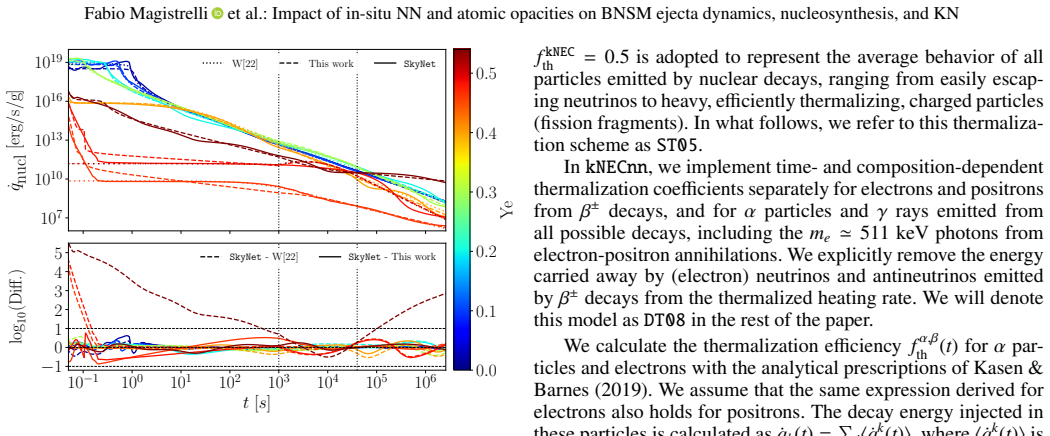
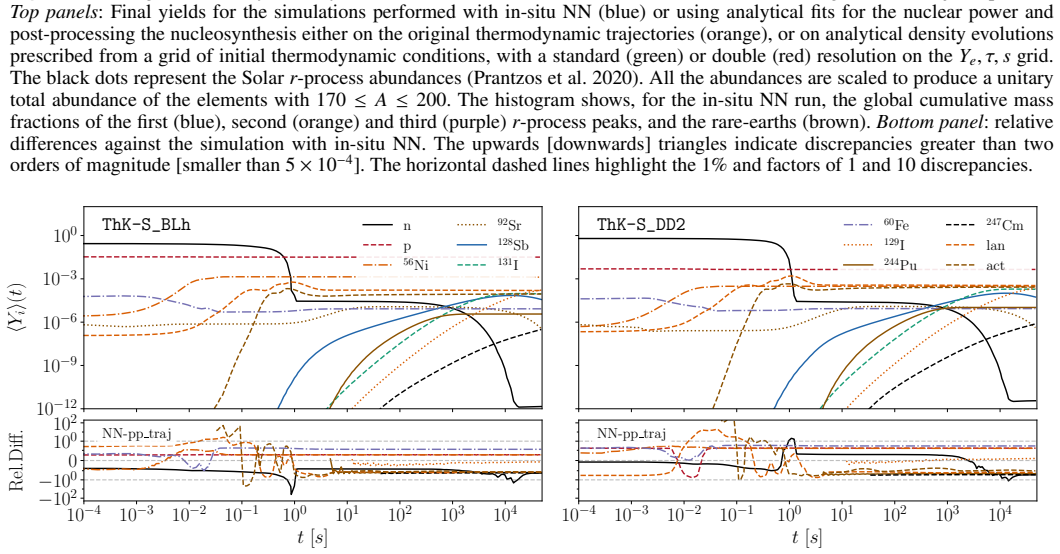
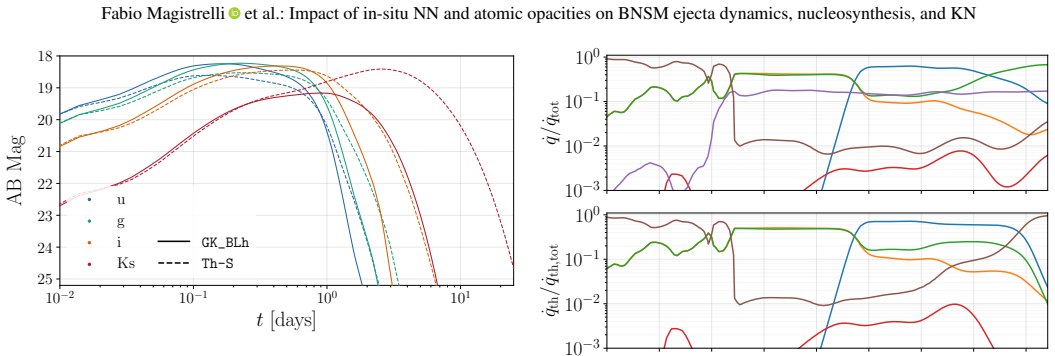
Coupling in-situ nuclear networks to hydrodynamics in BNSM ejecta simulations alters nucleosynthesis outcomes, producing a narrower second r-process peak and a third peak shifted to higher mass numbers under homologous expansion assumptions. Nuclear heating back-reaction delays and reddens early kilonova emission. Constant thermalization underestimates early luminosity and overestimates late emission, while analytical opacities yield dimmer and redder emission at early times and prolonged emission after five days. Composition-dependent thermalization and frequency-dependent atomic opacities are needed to capture ejecta temperature and kilonova brightness and color evolution correctly, though
What carries the argument
In-situ nuclear reaction networks that track energy deposition in real time, coupled to a composition-dependent thermalization scheme and frequency-dependent atomic-physics-based opacities inside a 2D ray-by-ray radiation-hydrodynamics evolution.
If this is right
- Resolving the first hundreds of milliseconds of hydrodynamics is essential for robust nucleosynthesis calculations.
- Nuclear heating back-reaction delays and reddens the early emission.
- A constant thermalization underestimates the early luminosity and overestimates the late emission.
- Analytical opacities yield dimmer and redder kilonovae at early times and prolonged emission at later times.
- Assuming homologous expansion alters the abundance evolution and produces narrower second and shifted third r-process peaks.
Where Pith is reading between the lines
- Current interpretations of kilonova observations that rely on simplified physics may need quantitative revision once detailed networks and opacities become standard.
- The results suggest that analytic nuclear-power fits remain useful for approximating density and temperature evolution even when detailed networks are used.
- Improved early-time modeling could tighten constraints on the neutron-star equation of state when gravitational-wave and electromagnetic data are combined.
- Extending the approach to three dimensions would test whether the reported differences in abundance patterns and light curves survive full geometric effects.
Load-bearing premise
The two-dimensional ray-by-ray radiation-hydrodynamics treatment and the initial ejecta profiles taken from numerical-relativity simulations are sufficiently accurate to support quantitative conclusions about nucleosynthesis and light-curve differences.
What would settle it
A three-dimensional simulation or an observed kilonova whose early-time spectrum or late-time decay deviates markedly from the detailed-opacity run while matching the simplified-opacity run would falsify the necessity of the advanced treatments.
Figures






read the original abstract
Modeling binary neutron star merger (BNSM) ejecta evolution requires simulations involving hydrodynamics, nuclear reactions, and radiative processes. The impact of nuclear burning and atomic opacity is poorly understood and often treated with simplified prescriptions. We systematically investigate different treatments of nuclear heating, thermalization, and opacities in radiation-hydrodynamics simulations of BNSM ejecta and kilonova light curves. Ejecta from long-term numerical-relativity simulations are evolved to ~30 days using a 2D ray-by-ray approach. We compare simplified heating-rates, thermalization prescriptions, and gray opacities with in-situ nuclear networks (NN) that track energy deposition, and include a composition-dependent thermalization scheme and frequency-dependent, atomic-physics-based opacities. Coupling NN and hydrodynamics affects nucleosynthesis and kilonova emission. Assuming homologous expansion alters the abundance evolution and produces a narrower second $r$-process peak and a third peak shifted to higher mass numbers. Nuclear heating back-reaction delays and reddens the early emission. A constant thermalization underestimates the early luminosity and overestimates the late emission. Analytical opacities yield dimmer and redder kilonovae at early times ($t\lesssim$ hour) and a prolonged emission at $t\gtrsim5$ days. Resolving the first hundreds of milliseconds of hydrodynamics is essential for robust nucleosynthesis calculations, and composition-dependent thermalization and frequency-dependent, atomic opacities are needed to accurately capture the ejecta temperature and kilonova brightness and color evolution. Analytic nuclear-power fits with simplified thermalization and opacities can reproduce the density and temperature evolution of the ejecta. [Abridged].
Editorial analysis
A structured set of objections, weighed in public.
Referee Report
Summary. The manuscript systematically compares simplified prescriptions for nuclear heating, thermalization, and opacities against in-situ nuclear networks, composition-dependent thermalization, and frequency-dependent atomic opacities in 2D ray-by-ray radiation-hydrodynamics simulations of neutron star merger ejecta. Using long-term numerical-relativity ejecta profiles evolved to ~30 days, it reports that coupling nuclear networks to hydrodynamics alters r-process abundance patterns (narrower second peak, shifted third peak), that nuclear heating back-reaction delays and reddens early emission, that constant thermalization underestimates early luminosity while overestimating late emission, and that analytic opacities produce dimmer/redder early kilonovae with prolonged late emission. The central conclusion is that resolving the first hundreds of milliseconds of hydrodynamics and employing detailed thermalization and opacities are required for robust nucleosynthesis and kilonova predictions.
Significance. If the results hold, the work is significant for kilonova and r-process modeling because it provides a controlled, side-by-side demonstration that common simplifications can produce order-unity errors in early light-curve timing, color, and late-time luminosity. The use of realistic NR initial conditions and in-situ networks supplies concrete benchmarks that future simulations can adopt. These findings directly inform the interpretation of upcoming multi-messenger observations.
major comments (1)
- [Abstract and Methods (2D ray-by-ray radiation-hydrodynamics)] The quantitative attribution of differences in nucleosynthesis yields and kilonova brightness/color to nuclear networks versus simplified heating, and to frequency-dependent opacities versus gray/analytic ones, rests on the 2D ray-by-ray radiation-hydrodynamics solver accurately capturing energy deposition and radiative transfer (abstract and methods description). Ray-by-ray methods neglect lateral photon transport, which can bias temperature and opacity evolution in asymmetric, optically thick ejecta during the first hours to days. This approximation may therefore contaminate the reported shifts in early luminosity and the claimed necessity of detailed physics; a direct test or error estimate against a full multi-dimensional transport scheme is required to support the central claims.
minor comments (1)
- [Abstract] The abstract states that analytic nuclear-power fits can reproduce the density and temperature evolution; a brief quantitative comparison (e.g., fractional differences in temperature at selected times) would strengthen this statement.
Simulated Author's Rebuttal
We thank the referee for their thorough review and constructive feedback on our manuscript. We address the major comment below, providing a point-by-point response. We have revised the manuscript to strengthen the discussion of methodological limitations while maintaining that our comparative results remain robust.
read point-by-point responses
-
Referee: The quantitative attribution of differences in nucleosynthesis yields and kilonova brightness/color to nuclear networks versus simplified heating, and to frequency-dependent opacities versus gray/analytic ones, rests on the 2D ray-by-ray radiation-hydrodynamics solver accurately capturing energy deposition and radiative transfer (abstract and methods description). Ray-by-ray methods neglect lateral photon transport, which can bias temperature and opacity evolution in asymmetric, optically thick ejecta during the first hours to days. This approximation may therefore contaminate the reported shifts in early luminosity and the claimed necessity of detailed physics; a direct test or error estimate against a full multi-dimensional transport scheme is required to support the central claims.
Authors: We agree that ray-by-ray radiative transfer is an approximation that neglects lateral photon transport, which can introduce biases in highly asymmetric and optically thick regions during the early phases. However, because we apply the identical 2D ray-by-ray solver to every simulation in our controlled comparison (varying only the nuclear network, thermalization, and opacity treatments), the relative differences in nucleosynthesis, temperature evolution, and kilonova light curves attributable to these physics choices are internally consistent and not contaminated by the transport method. Any systematic offset from neglecting lateral transport affects all models equally and does not alter the demonstrated impact of in-situ networks versus analytic heating or frequency-dependent opacities versus gray prescriptions. We have added a dedicated paragraph in the Methods section (new subsection 2.3) explicitly discussing the limitations of the ray-by-ray approach, referencing prior validation studies in the kilonova literature, and providing an order-of-magnitude estimate of the possible bias on early luminosity (approximately 10-20% at t < 1 day based on comparisons in the cited works). A full 3D multi-group transport comparison lies beyond the computational scope of the present study but is identified as a priority for future work. revision: partial
Circularity Check
No significant circularity detected
full rationale
The paper performs side-by-side radiation-hydrodynamics simulations of BNSM ejecta that compare independent treatments (in-situ nuclear networks vs. simplified heating rates, composition-dependent thermalization vs. constant prescriptions, frequency-dependent atomic opacities vs. gray/analytic ones). The central conclusions—that early hydrodynamics resolution and detailed opacities/thermalization affect nucleosynthesis and kilonova evolution—follow directly from the numerical differences produced by these distinct modules. No load-bearing step reduces a claimed prediction to a parameter fitted against the same data, nor does any result rest on a self-citation chain that is itself unverified. The 2D ray-by-ray transport and initial NR profiles are stated modeling choices whose accuracy is an external assumption, not a definitional tautology inside the derivation.
Axiom & Free-Parameter Ledger
axioms (2)
- domain assumption The initial density, velocity, and composition profiles from long-term numerical-relativity simulations are representative of realistic binary neutron star merger ejecta.
- domain assumption The 2D ray-by-ray radiation transport approximation captures the dominant radiative effects in the expanding ejecta.
Lean theorems connected to this paper
-
IndisputableMonolith/Cost/FunctionalEquation.leanwashburn_uniqueness_aczel unclear?
unclearRelation between the paper passage and the cited Recognition theorem.
We systematically investigate different treatments of nuclear heating, thermalization, and opacities in radiation-hydrodynamics simulations of BNSM ejecta and kilonova light curves. ... Coupling NN and hydrodynamics affects nucleosynthesis and kilonova emission.
-
IndisputableMonolith/Foundation/AlphaCoordinateFixation.leanJ_uniquely_calibrated_via_higher_derivative unclear?
unclearRelation between the paper passage and the cited Recognition theorem.
The luminosity appearing on the right-hand side of Eq. 1 is obtained as L=4πr² ∫ F_ν dν ... with flux-limiter λ_ν and composition-averaged opacity κ̄_ν.
What do these tags mean?
- matches
- The paper's claim is directly supported by a theorem in the formal canon.
- supports
- The theorem supports part of the paper's argument, but the paper may add assumptions or extra steps.
- extends
- The paper goes beyond the formal theorem; the theorem is a base layer rather than the whole result.
- uses
- The paper appears to rely on the theorem as machinery.
- contradicts
- The paper's claim conflicts with a theorem or certificate in the canon.
- unclear
- Pith found a possible connection, but the passage is too broad, indirect, or ambiguous to say the theorem truly supports the claim.
Forward citations
Cited by 2 Pith papers
-
Gamma-ray Signatures of r-Process Radioactivity from the Collapse of Magnetized White Dwarfs
Simulations predict time-dependent gamma-ray lines from r-process and iron-peak decays in accretion-induced white dwarf collapse, detectable to ~10 Mpc and absent in neutron star mergers.
-
Effects of magnetically driven shocks on nucleosynthesis and kilonovae from neutron star mergers
Magnetically driven shocks from neutron star merger remnants can reheat ejecta to nuclear statistical equilibrium, alter r-process yields, and produce observable changes in kilonova color and light curves.
Reference graph
Works this paper leans on
-
[1]
Abbott, B. P. et al. 2017 a , Astrophys. J. Lett., 848, L13
work page 2017
-
[2]
Abbott, B. P. et al. 2017 b , Phys. Rev. Lett., 119, 161101
work page 2017
-
[3]
Abbott, B. P. et al. 2017 c , Astrophys. J., 848, L12
work page 2017
-
[4]
Abbott, B. P. et al. 2019, Phys. Rev., X9, 011001
work page 2019
-
[5]
Arnett , W. D. 1982, Astrophys. J., 253, 785
work page 1982
-
[6]
Barnes, J., Kasen, D., Wu, M.-R., & Martinez-Pinedo, G. 2016, Astrophys. J., 829, 110
work page 2016
- [7]
-
[8]
Bauswein, A., Blacker, S., Vijayan, V., et al. 2020, Phys. Rev. Lett., 125, 141103
work page 2020
-
[9]
Berger, E., Fong, W., & Chornock, R. 2013, Astrophys. J. Lett., 774, L23
work page 2013
-
[10]
Berger, M. et al. 2010, [Online, accessed on July 2023], National Institute of Standards and Technology, Gaithersburg, MD
work page 2010
- [11]
- [12]
-
[13]
Bersten, M. C., Benvenuto, O., & Hamuy, M. 2011, Astrophys. J., 729, 61
work page 2011
- [14]
-
[15]
Brown, D. A. et al. 2018, Nucl. Data Sheets, 148, 1
work page 2018
-
[16]
Cheong, P. C.-K., Foucart, F., Ng, H. H.-Y., et al. 2025, Phys. Rev. D, 111, 043036
work page 2025
-
[17]
Chiesa, L., Perego, A., & Guercilena, F. M. 2024, Astrophys. J. Lett., 962, L24
work page 2024
-
[18]
Collins, C. E., Bauswein, A., Sim, S. A., et al. 2023, Mon. Not. Roy. Astron. Soc., 521, 1858
work page 2023
- [19]
-
[20]
C \^o t \'e , B. et al. 2021, Science, 371, 945
work page 2021
-
[21]
Coulter, D. A. et al. 2017, Science, 358, 1556
work page 2017
-
[22]
Cowan, J. J., Sneden, C., Lawler, J. E., et al. 2021, Rev. Mod. Phys., 93, 15002
work page 2021
-
[23]
Curtis, S., Bosch, P., M\"osta, P., et al. 2024, Astrophys. J. Lett., 961, L26
work page 2024
-
[24]
Cyburt , R. H., Amthor , A. M., Ferguson , R., et al. 2010, Astrophys.\ J.\ Suppl., 189, 240
work page 2010
-
[25]
Davis , A. M. 2022, Annual Review of Nuclear and Particle Science, 72
work page 2022
-
[26]
Dimotakis , P. E. 2005, Annual Review of Fluid Mechanics, 37, 329
work page 2005
-
[27]
Drout, M. R. et al. 2017, Science, 358, 1570
work page 2017
-
[28]
Eichler, D., Livio, M., Piran, T., & Schramm, D. N. 1989, Nature, 340, 126
work page 1989
-
[29]
Fields, J., Zhu, H., Radice, D., et al. 2025, Astrophys. J. Suppl., 276, 35
work page 2025
- [30]
-
[31]
Fontes, C. J., Fryer, C. L., Wollaeger, R. T., Mumpower, M. R., & Sprouse, T. M. 2023, Mon. Not. Roy. Astron. Soc., 519, 2862
work page 2023
-
[32]
Foucart, F., Duez, M. D., Hebert, F., et al. 2020, Astrophys. J. Lett., 902, L27
work page 2020
- [33]
-
[34]
Fryer, C. L., Hungerford, A. L., Wollaeger, R. T., et al. 2024, Astrophys. J., 961, 9
work page 2024
-
[35]
2020, Astrophys.\ J., 901, 122
Fujibayashi , S., Wanajo , S., Kiuchi , K., et al. 2020, Astrophys.\ J., 901, 122
work page 2020
-
[36]
Ghirlanda, G. et al. 2019, Science, 363, 968
work page 2019
-
[37]
Gillanders, J. H., Smartt, S. J., Sim, S. A., Bauswein, A., & Goriely, S. 2022, Mon. Not. Roy. Astron. Soc., 515, 631
work page 2022
-
[38]
Gompertz, B. P. et al. 2018, Astrophys. J., 860, 62
work page 2018
-
[39]
S., Curtis, S., M \"o sta, P., Kasen, D., & Brethauer, D
Groenewegen, L. S., Curtis, S., M \"o sta, P., Kasen, D., & Brethauer, D. 2025 [ [arXiv] 2508.00062 ]
-
[40]
M., Bhattacharya, M., Radice, D., Murase, K., & Bernuzzi, S
Gutierrez, E. M., Bhattacharya, M., Radice, D., Murase, K., & Bernuzzi, S. 2025, Phys. Rev. D, 111, 063031
work page 2025
- [41]
-
[42]
Hempel, M. & Schaffner-Bielich, J. 2010, Nucl. Phys., A837, 210
work page 2010
- [43]
-
[44]
Jacobi, M., Magistrelli, F., Loffredo, E., et al. 2025 [ [arXiv] 2503.17445 ]
- [45]
- [46]
-
[47]
Origin of the heavy elements in binary neutron-star mergers from a gravitational wave event
Kasen, D., Metzger, B., Barnes, J., Quataert, E., & Ramirez-Ruiz, E. 2017, Nature [ [arXiv] 1710.05463 ], [Nature551,80(2017)]
work page internal anchor Pith review Pith/arXiv arXiv 2017
- [48]
-
[49]
Kawaguchi, K., Fujibayashi, S., & Shibata, M. 2025, Phys. Rev. D, 111, 023015
work page 2025
-
[50]
Kawaguchi, K., Fujibayashi, S., Shibata, M., Tanaka, M., & Wanajo, S. 2021, Astrophys. J., 913, 100
work page 2021
-
[51]
Kiuchi, K., Fujibayashi, S., Hayashi, K., et al. 2023, Phys. Rev. Lett., 131, 011401
work page 2023
-
[52]
Kiuchi, K., Reboul-Salze, A., Shibata, M., & Sekiguchi, Y. 2024, Nature Astron., 8, 298
work page 2024
- [53]
- [54]
-
[55]
Korobkin, O. et al. 2021, Astrophys. J., 910, 116
work page 2021
-
[56]
Levermore , C. D. & Pomraning , G. C. 1981, , 248, 321
work page 1981
- [57]
- [58]
- [59]
-
[60]
Logoteta, D., Perego, A., & Bombaci, I. 2021, Astron. Astrophys., 646, A55
work page 2021
-
[61]
A., Somasundaram, R., McLaughlin, G
Lund, K. A., Somasundaram, R., McLaughlin, G. C., et al. 2024 [ [arXiv] 2408.07686 ]
-
[62]
Magistrelli, F., Bernuzzi, S., Perego, A., & Radice, D. 2024, Astrophys. J. Lett., 974, L5
work page 2024
-
[63]
Martin, D., Perego, A., Arcones, A., et al. 2015, Astrophys. J., 813, 2
work page 2015
- [64]
- [65]
-
[66]
2010, Mon.Not.Roy.Astron.Soc., 406, 2650
Metzger, B., Martinez-Pinedo, G., Darbha, S., et al. 2010, Mon.Not.Roy.Astron.Soc., 406, 2650
work page 2010
-
[67]
Morozova, V., Piro, A. L., Renzo, M., et al. 2015, Astrophys. J., 814, 63
work page 2015
-
[68]
Mumpower, M. R., Sprouse, T. M., Miller, J. M., et al. 2024, Astrophys. J., 970, 173
work page 2024
-
[69]
Mumpower, M. R., Surman, R., McLaughlin, G. C., & Aprahamian, A. 2016, Prog. Part. Nucl. Phys., 86, 86, [Erratum: Prog.Part.Nucl.Phys. 87, 116--116 (2016)]
work page 2016
- [70]
-
[71]
Nedora, V., Bernuzzi, S., Radice, D., et al. 2021, Astrophys. J., 906, 98
work page 2021
- [72]
- [73]
- [74]
-
[75]
Perego , A., Thielemann , F. K., & Cescutti , G. 2021, in Handbook of Gravitational Wave Astronomy, 1
work page 2021
-
[76]
Perego, A. et al. 2022, Astrophys. J., 925, 22
work page 2022
- [77]
- [78]
- [79]
- [80]
discussion (0)
Sign in with ORCID, Apple, or X to comment. Anyone can read and Pith papers without signing in.