Medium-Throughput Evaluation of Quantum Geometry-Driven Topological Transports in Altermagnets
Pith reviewed 2026-05-25 06:37 UTC · model grok-4.3
The pith
Magnetic symmetry strongly constrains transport and optical responses in altermagnets.
A machine-rendered reading of the paper's core claim, the machinery that carries it, and where it could break.
Core claim
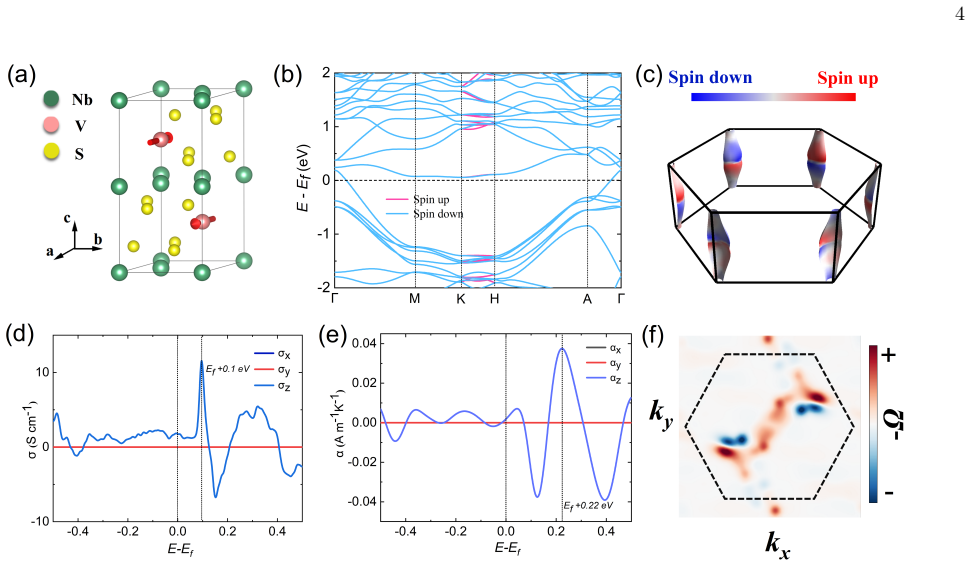
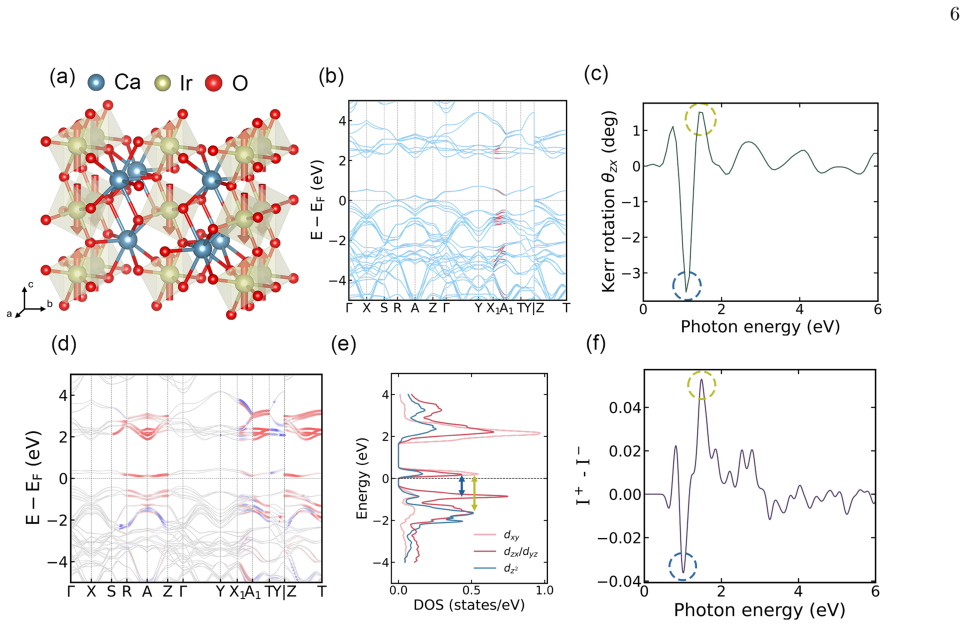
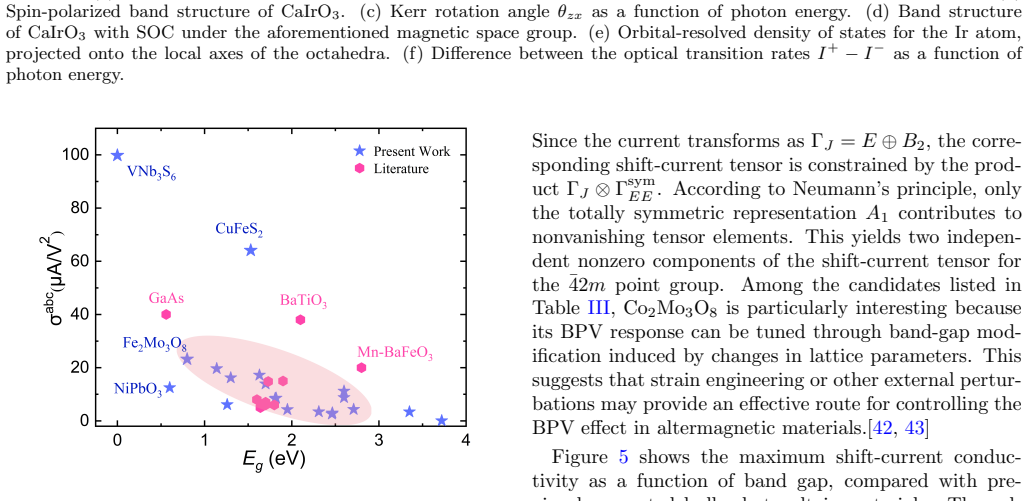
By combining density functional theory, Wannier interpolation, and symmetry analysis in a medium-throughput workflow applied to approximately 150 altermagnetic compounds from the MAGNDATA database, the responses including anomalous Hall effect, magneto-optical Kerr effect, and bulk photovoltaic effect are found to be strongly constrained by magnetic symmetry and shaped by spin-orbit coupling, band structure, and inversion symmetry breaking, with examples such as finite anomalous Hall response in metallic VNb3S6, giant Kerr rotation in insulating CaIrO3, and large shift current in non-centrosymmetric CuFeS2.
What carries the argument
The medium-throughput first-principles workflow that combines density functional theory calculations, Wannier interpolation, and magnetic symmetry analysis to evaluate linear and nonlinear responses.
If this is right
- Finite anomalous Hall response appears in metallic altermagnets such as VNb3S6.
- Giant Kerr rotation occurs in insulating altermagnets such as CaIrO3.
- Large shift current is possible in non-centrosymmetric altermagnets such as CuFeS2.
- The responses are further shaped by spin-orbit coupling, band structure details, and breaking of inversion symmetry.
Where Pith is reading between the lines
- Extending the workflow to additional altermagnets not in the current database could reveal more candidates with functional responses.
- The symmetry constraints identified may help in designing altermagnet-based spintronic or optoelectronic devices.
- Similar symmetry analysis could be applied to predict responses in other magnetic classes like ferrimagnets.
Load-bearing premise
The first-principles DFT calculations combined with Wannier interpolation and symmetry analysis are assumed to give quantitatively reliable predictions of the transport and optical responses without large errors from exchange-correlation approximations or from the completeness of the MAGNDATA database entries.
What would settle it
Experimental measurement showing zero anomalous Hall conductivity in VNb3S6 or no large shift current in CuFeS2 would challenge the predicted responses for those compounds.
Figures



read the original abstract
Altermagnets provide a promising platform for a wide spectrum of applications integrating advantages of conventional ferromagnets and antiferromagnets. In this work, we implement a medium-throughput first-principles workflow and evaluate topological transport properties driven by quantum geometry for 135 altermagnets in the MAGNDATA database. Based on automated Wannier construction, both linear and nonlinear responses, including the anomalous Hall effect, magneto-optical Kerr effect, and bulk photovoltaic effect, are evaluated with further symmetry verifications. Detailed analysis is done on representative cases like metallic VNb3S6 with enhanced anomalous Hall conductivity, CaIrO3 with giant MOKE, and CuFeS2 with large shift current in non-centrosymmetric. These results establish a symmetry-guided computational route for identifying experimentally accessible fingerprints and functional transport properties in altermagnets.
Editorial analysis
A structured set of objections, weighed in public.
Referee Report
Summary. The manuscript develops a medium-throughput first-principles workflow combining DFT, Wannier interpolation, and symmetry analysis to survey linear and nonlinear transport and optical responses (anomalous Hall effect, magneto-optical Kerr effect, bulk photovoltaic effect) across approximately 150 altermagnets drawn from the MAGNDATA database. The central finding is that these responses are strongly constrained by magnetic symmetry, with additional modulation from spin-orbit coupling, band structure details, and inversion-symmetry breaking; representative cases include finite AHE in metallic VNb3S6, giant Kerr rotation in insulating CaIrO3, and large shift current in non-centrosymmetric CuFeS2.
Significance. If the symmetry-constrained mapping holds, the work supplies a practical, symmetry-guided route for identifying altermagnetic candidates with experimentally accessible fingerprints and functional responses. The medium-throughput scope and explicit use of magnetic symmetry analysis constitute a clear strength, enabling systematic exploration rather than isolated case studies and providing a reusable framework for the field.
minor comments (3)
- [Methods] The methods section should explicitly state the exchange-correlation functional, pseudopotential type, and k-mesh convergence criteria employed for the DFT calculations, as these choices directly affect the reported response magnitudes even when the symmetry constraints themselves remain robust.
- [Results] Figure 3 (or equivalent results panel) comparing Kerr spectra across compounds would benefit from an inset or table listing the peak rotation angles alongside literature values for conventional ferromagnets to substantiate the 'giant' descriptor for CaIrO3.
- [Discussion] The discussion of the bulk photovoltaic effect in CuFeS2 would be strengthened by a brief note on the computed shift-current tensor components and their relation to the non-centrosymmetric space group, including any symmetry-allowed/forbidden elements.
Simulated Author's Rebuttal
We thank the referee for the positive summary, recognition of the medium-throughput workflow's value, and recommendation for minor revision. We appreciate the assessment that the symmetry-guided approach and scope constitute a clear strength.
Circularity Check
No significant circularity detected
full rationale
The paper's central workflow consists of direct first-principles DFT calculations, Wannier interpolation, and symmetry analysis applied to ~150 MAGNDATA entries to compute transport and optical responses. These quantities are obtained as numerical outputs of the computational pipeline rather than being fitted to the results or redefined in terms of themselves. No load-bearing self-citations, uniqueness theorems, or ansatzes imported from prior author work are invoked to force the reported findings; the symmetry constraints and example responses (AHE in VNb3S6, Kerr in CaIrO3, shift current in CuFeS2) follow from the external database and standard electronic-structure methods without reduction to the paper's own inputs.
Axiom & Free-Parameter Ledger
axioms (2)
- domain assumption Density functional theory with appropriate functionals accurately captures the electronic structure and responses of altermagnetic compounds
- domain assumption The MAGNDATA database entries correctly classify the listed compounds as altermagnets with the stated magnetic symmetries
discussion (0)
Sign in with ORCID, Apple, or X to comment. Anyone can read and Pith papers without signing in.