Spin Seebeck Effect in Normal-Metal--Chiral-Insulator Heterostructure
Pith reviewed 2026-05-08 07:41 UTC · model grok-4.3
The pith
Chiral phonons in an insulator convert their angular momentum to electron spins at a metal interface, producing a temperature-driven spin current with negative differential response and rectification.
A machine-rendered reading of the paper's core claim, the machinery that carries it, and where it could break.
Core claim
The authors establish that phonon angular momentum carried by circularly polarized atomic vibrations in the chiral insulator converts to electron spin angular momentum at the normal-metal interface, generating a spin Seebeck effect whose magnitude and direction respond nonlinearly to thermal bias. The negative differential spin Seebeck effect arises specifically from the competition between the applied thermal gradient and the increase in thermally excited electron density. The same framework produces spin-current rectification, indicating that a temperature bias can be used to enforce unidirectional spin flow.
What carries the argument
Phonon angular momentum conversion at the NM-CI interface, tracked through an effective interfacial spectral density within the nonequilibrium Green's function formalism.
If this is right
- Spin current varies with thermal bias, chemical potential in the normal metal, and presence of an extra interfacial layer.
- Negative differential spin Seebeck effect occurs when thermal excitation of electrons competes with the temperature gradient drive.
- Spin-current rectification enables a thermally controlled spin diode without charge or magnetic bias.
- All spin transport features tie directly to the shape of the effective interfacial spectral density.
Where Pith is reading between the lines
- The same interface could be engineered to filter spin currents by temperature alone in layered devices.
- Varying the chiral insulator thickness or phonon spectrum would test how angular momentum transfer scales with interface properties.
- Connection to other temperature-gradient spin effects could appear if phonon chirality is preserved across different material classes.
Load-bearing premise
Phonons carry net angular momentum through circular polarization of atomic motion and this angular momentum transfers directly into electron spin at the interface.
What would settle it
Absence of a region where spin current decreases with increasing temperature difference across the junction, while the chemical potential and interface remain fixed, would contradict the negative differential mechanism.
Figures


read the original abstract
Phonons can carry angular momentum and exhibit chirality through the circular polarization of atomic motion. This enables a phonon-mediated spin Seebeck effect (SSE) via the conversion of phonon angular momentum into electron spin angular momentum. In this Letter, we develop a theoretical framework for calculating the spin current in a normal-metal (NM)-chiral-insulator (CI) heterostructure within the nonequilibrium Green's function formalism. We discuss the influence of (i) the thermal bias across the NM-CI interface, (ii) the chemical potential of the NM, and (iii) the insertion of an additional interfacial layer, on the spin transport properties. We identify two remarkable nonlinear spin transport phenomena: negative differential SSE and spin-current rectification. The negative differential SSE arises from the competition between the thermal bias and the thermally excited electron density. The spin-current rectification suggests the possibility of realizing a thermally controlled spin diode. We also find that the spin transport behavior is closely associated with an effective interfacial spectral density. This work provides a novel route toward thermally controlled spintronic devices using chiral phonons.
Editorial analysis
A structured set of objections, weighed in public.
Referee Report
Summary. The manuscript develops a nonequilibrium Green's function (NEGF) framework to compute spin current across a normal-metal--chiral-insulator (NM-CI) interface mediated by chiral phonons. It examines the dependence of spin transport on thermal bias, NM chemical potential, and an inserted interfacial layer, and reports two nonlinear phenomena: negative differential spin Seebeck effect (SSE) arising from competition between thermal bias and thermally excited electron density, plus spin-current rectification that could enable a thermally controlled spin diode. The transport is tied to an effective interfacial spectral density.
Significance. If the central mapping from circularly polarized phonons to net spin current is robust, the work identifies potentially useful nonlinear spin-transport effects and a new route to thermally driven spintronic devices. The explicit connection between spectral density shape and the reported negative differential SSE and rectification provides concrete, falsifiable predictions that could be tested experimentally.
major comments (1)
- [NEGF model and interfacial spectral density] The interfacial coupling that converts phonon angular momentum (circular atomic motion) into electron spin current is introduced via an effective spectral density without derivation from a microscopic electron-phonon Hamiltonian that incorporates phonon polarization vectors. This assumption is load-bearing for the negative differential SSE and rectification claims, as both phenomena are shown to follow from the chosen spectral-density form and the thermal-bias/electron-density competition. A concrete microscopic derivation or explicit justification of the spin-dependent self-energy term is required to establish that the nonlinear effects are not artifacts of the model construction.
Simulated Author's Rebuttal
We are grateful to the referee for the thorough review and the valuable feedback on our manuscript. The positive assessment of the potential significance is encouraging. We address the major comment in detail below.
read point-by-point responses
-
Referee: [NEGF model and interfacial spectral density] The interfacial coupling that converts phonon angular momentum (circular atomic motion) into electron spin current is introduced via an effective spectral density without derivation from a microscopic electron-phonon Hamiltonian that incorporates phonon polarization vectors. This assumption is load-bearing for the negative differential SSE and rectification claims, as both phenomena are shown to follow from the chosen spectral-density form and the thermal-bias/electron-density competition. A concrete microscopic derivation or explicit justification of the spin-dependent self-energy term is required to establish that the nonlinear effects are not artifacts of the model construction.
Authors: We thank the referee for highlighting this important point. The effective interfacial spectral density is indeed central to our framework, as it encapsulates the spin-angular momentum conversion at the NM-CI interface. While a full microscopic derivation starting from an electron-phonon Hamiltonian including explicit phonon polarization vectors would provide additional rigor, such a derivation is technically involved and lies beyond the scope of the present Letter, which focuses on the transport phenomenology. Instead, our model is constructed based on symmetry considerations: the chiral phonons carry angular momentum due to their circular polarization, and the coupling to electrons is chosen to conserve total angular momentum, leading to a spin-dependent self-energy. The specific form of the spectral density is chosen to reflect the frequency-dependent coupling strength typical for phonon-mediated processes. We will revise the manuscript to include an expanded discussion in the methods or supplementary material justifying the effective model through symmetry arguments and referencing related works on chiral phonon-spin coupling. This will help demonstrate that the negative differential SSE and rectification arise from the general competition between thermal bias and electron density, modulated by the chiral nature of the spectral density, rather than being artifacts of an arbitrary choice. revision: partial
Circularity Check
No circularity: model outputs are independent of inputs
full rationale
The paper constructs a NEGF framework for spin current across the NM-CI interface and computes nonlinear effects (negative differential SSE, rectification) as functions of thermal bias, chemical potential, and an effective interfacial spectral density. These quantities are not fitted to the target phenomena nor defined in terms of them; the competition between thermal bias and electron density is an explicit dynamical outcome of the transport equations rather than a tautology. No self-citation chain or ansatz is invoked to force the reported results. The derivation remains self-contained against the model's stated assumptions.
Axiom & Free-Parameter Ledger
axioms (1)
- domain assumption Phonons can carry angular momentum and exhibit chirality through the circular polarization of atomic motion.
Reference graph
Works this paper leans on
-
[1]
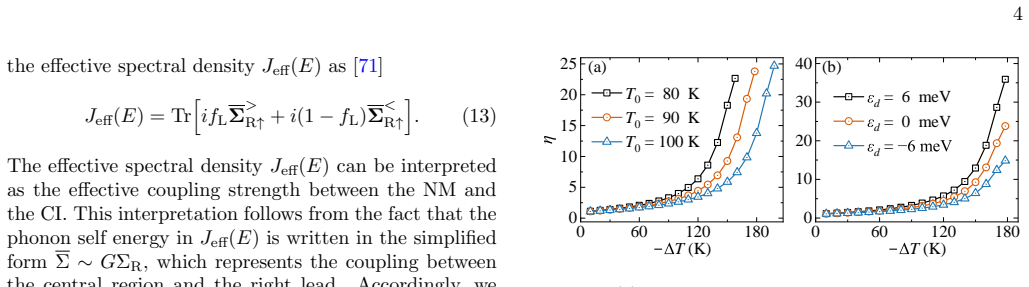
Figure 4(b) gives the rectification ratio for different εd atT 0 = 90 K andµ L = 1 meV. The results show that theηcan be enhanced (diminished) forε d >0 (ε d <0), demonstrating the effect of the interlayer in regulating the rectification efficiency. Conclusion—In summary, we propose the realization of the spin Seebeck effect by utilizing the angular mo- m...
-
[2]
I. ˇZuti´ c, J. Fabian, and S. Das Sarma, Spintronics: Fun- damentals and applications, Rev. Mod. Phys.76, 323 (2004)
work page 2004
-
[3]
S. Bader and S. Parkin, Spintronics, Annu. Rev. Con- dens. Matter Phys.1, 71 (2010)
work page 2010
-
[4]
S. Bandyopadhyay and M. Cahay,Introduction to spin- tronics(CRC press, 2008)
work page 2008
-
[5]
Y. Kajiwara, K. Harii, S. Takahashi, J.-i. Ohe, K. Uchida, M. Mizuguchi, H. Umezawa, H. Kawai, K. Ando, K. Takanashi,et al., Transmission of electrical signals by spin-wave interconversion in a magnetic insulator, Nature 464, 262 (2010)
work page 2010
-
[6]
L. J. Cornelissen, J. Liu, R. A. Duine, J. B. Youssef, and B. J. van Wees, Long-distance transport of magnon spin information in a magnetic insulator at room temperature, Nat. Phys.11, 1022 (2015)
work page 2015
-
[7]
B. Heinrich, C. Burrowes, E. Montoya, B. Kardasz, E. Girt, Y.-Y. Song, Y. Sun, and M. Wu, Spin Pump- ing at the Magnetic Insulator (YIG)/Normal Metal (Au) Interfaces, Phys. Rev. Lett.107, 066604 (2011)
work page 2011
- [8]
-
[9]
Y. Ominato, M. Yama, A. Yamakage, M. Matsuo, and T. Kato, Spin pumping into two-dimensional systems, J. Phys.: Condens. Matter37, 433001 (2025)
work page 2025
-
[10]
H. Adachi, K.-i. Uchida, E. Saitoh, and S. Maekawa, Theory of the spin Seebeck effect, Rep. Prog. Phys.76, 036501 (2013)
work page 2013
- [11]
- [12]
- [13]
- [14]
-
[15]
S. O. Valenzuela and M. Tinkham, Direct electronic mea- surement of the spin Hall effect, Nature442, 176 (2006)
work page 2006
- [16]
-
[17]
F. Mahfouzi and B. K. Nikoli´ c, Signatures of electron- magnon interaction in charge and spin currents through magnetic tunnel junctions: A nonequilibrium many-body perturbation theory approach, Phys. Rev. B90, 045115 (2014)
work page 2014
-
[18]
G. Li, H. Jin, Y. Wei, and J. Wang, Giant effec- tive electron-magnon coupling in a nonmagnetic metal– ferromagnetic insulator heterostructure, Phys. Rev. B 106, 205303 (2022)
work page 2022
- [19]
-
[20]
G. Tang, X. Chen, J. Ren, and J. Wang, Rectifying full- counting statistics in a spin Seebeck engine, Phys. Rev. B97, 081407 (2018)
work page 2018
- [21]
-
[22]
Y. H. Shen, X. S. Wang, and X. R. Wang, Thermal spin current and spin accumulation at ferromagnetic in- sulator/nonmagnetic metal interface, Phys. Rev. B94, 014403 (2016)
work page 2016
-
[23]
T. Kato, Y. Ohnuma, M. Matsuo, J. Rech, T. Jonck- heere, and T. Martin, Microscopic theory of spin trans- port at the interface between a superconductor and a ferromagnetic insulator, Phys. Rev. B99, 144411 (2019)
work page 2019
-
[24]
L. G. Johnsen, H. T. Simensen, A. Brataas, and J. Lin- der, Magnon Spin Current Induced by Triplet Cooper Pair Supercurrents, Phys. Rev. Lett.127, 207001 (2021)
work page 2021
-
[25]
M. A. Silaev, Finite-frequency spin susceptibility and spin pumping in superconductors with spin-orbit relax- ation, Phys. Rev. B102, 144521 (2020)
work page 2020
-
[26]
S. Seki, T. Ideue, M. Kubota, Y. Kozuka, R. Takagi, M. Nakamura, Y. Kaneko, M. Kawasaki, and Y. Tokura, Thermal Generation of Spin Current in an Antiferromag- net, Phys. Rev. Lett.115, 266601 (2015)
work page 2015
-
[27]
S. M. Rezende, R. L. Rodr´ ıguez-Su´ arez, and A. Azevedo, Theory of the spin Seebeck effect in antiferromagnets, Phys. Rev. B93, 014425 (2016)
work page 2016
- [28]
-
[29]
Q. Cui, B. Zeng, P. Cui, T. Yu, and H. Yang, Efficient spin Seebeck and spin Nernst effects of magnons in alter- magnets, Phys. Rev. B108, L180401 (2023)
work page 2023
-
[30]
E. W. Hodt and J. Linder, Spin pumping in an altermagnet/normal-metal bilayer, Phys. Rev. B109, 174438 (2024)
work page 2024
- [31]
-
[32]
J. Bardeen, L. N. Cooper, and J. R. Schrieffer, Theory of Superconductivity, Phys. Rev.108, 1175 (1957)
work page 1957
-
[33]
N. Li, J. Ren, L. Wang, G. Zhang, P. H¨ anggi, and B. Li, Colloquium: Phononics: Manipulating heat flow with electronic analogs and beyond, Rev. Mod. Phys.84, 1045 (2012)
work page 2012
-
[34]
T. Yamamoto and K. Watanabe, Nonequilibrium Green’s Function Approach to Phonon Transport in Defective Carbon Nanotubes, Phys. Rev. Lett.96, 255503 (2006)
work page 2006
-
[35]
J.-S. Wang, J. Wang, and N. Zeng, Nonequilibrium Green’s function approach to mesoscopic thermal trans- port, Phys. Rev. B74, 033408 (2006)
work page 2006
- [36]
- [37]
-
[38]
S. Dai, Z. Fei, Q. Ma, A. S. Rodin, M. Wagner, A. S. McLeod, M. K. Liu, W. Gannett, W. Regan, K. Watan- abe, T. Taniguchi, M. Thiemens, G. Dominguez, A. H. C. 6 Neto, A. Zettl, F. Keilmann, P. Jarillo-Herrero, M. M. Fogler, and D. N. Basov, Tunable Phonon Polaritons in Atomically Thin van der Waals Crystals of Boron Nitride, Science343, 1125 (2014)
work page 2014
-
[39]
X. G. Xu, B. G. Ghamsari, J.-H. Jiang, L. Gilburd, G. O. Andreev, C. Zhi, Y. Bando, D. Golberg, P. Berini, and G. C. Walker, One-dimensional surface phonon polari- tons in boron nitride nanotubes, Nat. Commun.5, 4782 (2014)
work page 2014
- [40]
-
[41]
L. Zhang and Q. Niu, Angular Momentum of Phonons and the Einstein–de Haas Effect, Phys. Rev. Lett.112, 085503 (2014)
work page 2014
-
[42]
L. Zhang and Q. Niu, Chiral Phonons at High-Symmetry Points in Monolayer Hexagonal Lattices, Phys. Rev. Lett. 115, 115502 (2015)
work page 2015
-
[43]
H. Ueda, M. Garc´ ıa-Fern´ andez, S. Agrestini, C. P. Ro- mao, J. van den Brink, N. A. Spaldin, K.-J. Zhou, and U. Staub, Chiral phonons in quartz probed by X-rays, Nature618, 946 (2023)
work page 2023
- [44]
-
[45]
H. Zhu, J. Yi, M.-Y. Li, J. Xiao, L. Zhang, C.-W. Yang, R. A. Kaindl, L.-J. Li, Y. Wang, and X. Zhang, Obser- vation of chiral phonons, Science359, 579 (2018)
work page 2018
- [46]
-
[47]
D. M. Juraschek, R. M. Geilhufe, H. Zhu, M. Basini, P. Baum, A. Baydin, S. Chaudhary, M. Fechner, B. Fle- bus, G. Grissonnanche, A. I. Kirilyuk, M. Lemeshko, S. F. Maehrlein, M. Mignolet, S. Murakami, Q. Niu, U. Nowak, C. P. Romao, H. Rostami, T. Satoh, N. A. Spaldin, H. Ueda, and L. Zhang, Chiral phonons, Nat. Phys.21, 1532 (2025)
work page 2025
-
[48]
D. M. Juraschek and N. A. Spaldin, Orbital magnetic mo- ments of phonons, Phys. Rev. Mater.3, 064405 (2019)
work page 2019
-
[49]
K. Ohe, H. Shishido, M. Kato, S. Utsumi, H. Matsuura, and Y. Togawa, Chirality-Induced Selectivity of Phonon Angular Momenta in Chiral Quartz Crystals, Phys. Rev. Lett.132, 056302 (2024)
work page 2024
-
[50]
Y. Nabei, C. Yang, H. Sun, H. Jones, T. Mai, T. Wang, R. Bodin, B. Pandey, Z. Wang, Y. Xiong, A. H. Comstock, B. Ewing, J. Bingen, R. Sun, D. Smirnov, W. Zhang, A. Hoffmann, R. Rao, M. Hu, Z. V. Vardeny, B. Yan, X. Li, J. Zhou, J. Liu, and D. Sun, Orbital See- beck effect induced by chiral phonons, Nat. Phys.22, 245 (2026)
work page 2026
- [51]
-
[52]
M. Che, J. Liang, Y. Cui, H. Li, B. Lu, W. Sang, X. Li, X. Dong, L. Zhao, S. Zhang, T. Sun, W. Jiang, E. Liu, F. Jin, T. Zhang, and L. Yang, Magnetic Or- der Induced Chiral Phonons in a Ferromagnetic Weyl Semimetal, Phys. Rev. Lett.134, 196906 (2025)
work page 2025
-
[53]
Yokoyama, Phonon Edelstein effect in chiral metals, Phys
T. Yokoyama, Phonon Edelstein effect in chiral metals, Phys. Rev. B112, L020406 (2025)
work page 2025
-
[54]
J. Kishine, A. S. Ovchinnikov, and A. A. Tereshchenko, Chirality-Induced Phonon Dispersion in a Noncen- trosymmetric Micropolar Crystal, Phys. Rev. Lett.125, 245302 (2020)
work page 2020
- [55]
-
[56]
H. Haug and A. P. Jauho,Quantum kinetics in trans- port and optics of semiconductors(Quantum Kinetics in Transport & Optics of Semiconductors, 2008)
work page 2008
-
[57]
G. Stefanucci and R. van Leeuwen,Nonequilibrium Many-Body Theory of Quantum Systems: A Modern In- troduction, 2nd ed. (Cambridge University Press, 2025)
work page 2025
-
[58]
R. A. Jishi,Feynman Diagram Techniques in Condensed Matter Physics(Cambridge University Press, 2013)
work page 2013
-
[59]
Y. Meir and N. S. Wingreen, Landauer formula for the current through an interacting electron region, Phys. Rev. Lett.68, 2512 (1992)
work page 1992
-
[60]
M. P. L. Sancho, J. M. L. Sancho, and J. Rubio, Quick iterative scheme for the calculation of transfer matrices: application to Mo (100), J. Phys. F: Met. Phys.14, 1205 (1984)
work page 1984
-
[61]
M. P. L. Sancho, J. M. L. Sancho, J. M. L. Sancho, and J. Rubio, Highly convergent schemes for the calculation of bulk and surface Green functions, J. Phys. F: Met. Phys.15, 851 (1985)
work page 1985
-
[62]
See Supplemental Material at XXX for the derivation of the expression of left-lead spin current, Green’s func- tion of the central region, the expression of right-lead phonon angular momentum current, the verification of current conservation, the lattice Hamiltonian of normal metal, and the spin current for different system dimen- sion, which includes Ref...
-
[63]
Weiss,Quantum Dissipative Systems(WORLD SCI- ENTIFIC, 2008)
U. Weiss,Quantum Dissipative Systems(WORLD SCI- ENTIFIC, 2008)
work page 2008
-
[64]
M. Thorwart, J. Eckel, and E. R. Mucciolo, Non- Markovian dynamics of double quantum dot charge qubits due to acoustic phonons, Phys. Rev. B72, 235320 (2005)
work page 2005
-
[65]
Q.-S. Tan, W. Wu, L. Xu, J. Liu, and L.-M. Kuang, Quantum sensing of supersensitivity for the Ohmic quan- tum reservoir, Phys. Rev. A106, 032602 (2022)
work page 2022
-
[66]
H. Wang, C. Du, P. C. Hammel, and F. Yang, Antiferro- magnonic Spin Transport from Y3Fe5O12 into NiO, Phys. Rev. Lett.113, 097202 (2014)
work page 2014
-
[67]
W. Lin, K. Chen, S. Zhang, and C. L. Chien, Enhance- ment of Thermally Injected Spin Current through an An- tiferromagnetic Insulator, Phys. Rev. Lett.116, 186601 (2016)
work page 2016
- [68]
-
[69]
B. Li, L. Wang, and G. Casati, Thermal Diode: Rectifi- cation of Heat Flux, Phys. Rev. Lett.93, 184301 (2004)
work page 2004
-
[70]
J. Ren, Predicted rectification and negative differential spin Seebeck effect at magnetic interfaces, Phys. Rev. B 88, 220406 (2013)
work page 2013
-
[71]
Datta,Electronic Transport in Mesoscopic Systems (Cambridge University Press, 1995)
S. Datta,Electronic Transport in Mesoscopic Systems (Cambridge University Press, 1995)
work page 1995
-
[72]
N. Sergueev, Q.-f. Sun, H. Guo, B. G. Wang, and J. Wang, Spin-polarized transport through a quantum dot: Anderson model with on-site Coulomb repulsion, 7 Phys. Rev. B65, 165303 (2002)
work page 2002
-
[73]
J. Ren and J.-X. Zhu, Theory of asymmetric and neg- ative differential magnon tunneling under temperature bias: Towards a spin Seebeck diode and transistor, Phys. Rev. B88, 094427 (2013)
work page 2013
-
[74]
J. Ren and J.-X. Zhu, Heat diode effect and negative differential thermal conductance across nanoscale metal- dielectric interfaces, Phys. Rev. B87, 241412 (2013)
work page 2013
- [75]
-
[76]
Z. Li, K. Yuan, and Y. Ye, High rectification ratio metal- insulator-semiconductor tunnel diode based on single- layer MoS2, Nanotechnology31, 075202 (2019)
work page 2019
- [77]
discussion (0)
Sign in with ORCID, Apple, or X to comment. Anyone can read and Pith papers without signing in.