Investigating interstellar dust along the line of sight of GX 13+1 using different dust size distributions
Pith reviewed 2026-05-08 02:21 UTC · model grok-4.3
The pith
X-ray absorption edges along the GX 13+1 line of sight favor average Galactic grain sizes over extreme diffuse or dense conditions.
A machine-rendered reading of the paper's core claim, the machinery that carries it, and where it could break.
Core claim
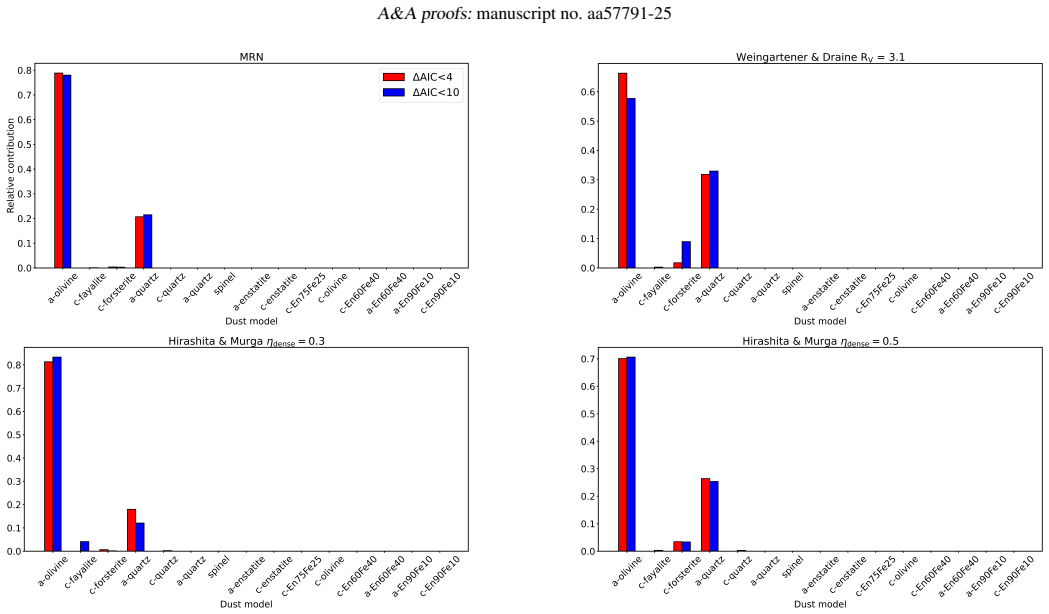
By comparing the classical Mathis et al. 1977 grain size distribution with other distributions that represent different interstellar medium densities, the analysis of the Si K and Mg K absorption edges shows that the data are best explained by grain sizes associated with average Galactic conditions. This rules out both very diffuse and very dense ISM scenarios along the line of sight. The dust composition is dominated by amorphous olivine, the crystallinity contribution is about 2 percent, and the depletion patterns and elemental abundances are consistent with prior X-ray and infrared studies.
What carries the argument
Comparison of multiple grain size distributions (including MRN and alternatives for varying ISM densities) applied to simultaneous modeling of the Si K and Mg K absorption edges in Chandra HETG spectra.
If this is right
- The interstellar medium along this line of sight has typical Galactic grain sizes rather than extreme diffuse or dense properties.
- Dust along the path is dominated by amorphous olivine with only about 2 percent crystallinity.
- Elemental depletion patterns derived from the edges align with those found in earlier X-ray and infrared work.
- More complex grain-size distributions beyond the single MRN model are required to match the data.
Where Pith is reading between the lines
- Applying the same multi-distribution fitting approach to other bright X-ray sources could map how grain sizes vary across different sightlines in the Galaxy.
- If average conditions prove common, it would imply that strong local deviations in dust properties are rare on paths of a few kiloparsecs.
- Higher-resolution future X-ray instruments could tighten the crystallinity fraction measurement and test whether small adjustments to the olivine fraction improve the fits further.
Load-bearing premise
The selected grain size distributions and dust compositions centered on amorphous olivine capture the observed absorption features without major contributions from other grain types or unmodeled spectral effects.
What would settle it
A new spectrum of GX 13+1 with higher signal-to-noise or resolution that shows edge shapes incompatible with the average-Galactic grain-size models would falsify the preference for those conditions.
Figures


read the original abstract
Context. High-resolution X-ray spectroscopy offers a powerful tool to investigate the physical and chemical properties of dust grains, especially through the analysis of absorption edges of elements such as oxygen, magnesium, silicon, and iron, which are the main constituents of interstellar dust. In all previous X-ray studies, these absorption edges have been modeled assuming the MRN grain size distribution. This model successfully reproduces the average interstellar extinction curve. However, with the advent of new observations, it shows important limitations, indicating that more complex grain-size distributions are required to fully describe interstellar dust properties. Aims. We aim to constrain the composition and size distribution of interstellar dust along the line of sight to the bright low-mass X-ray binary GX 13+1. Methods. We analyzed high-resolution X-ray spectra obtained with the Chandra HETG instrument (MEG+1 and MEG-3) and simultaneously modeled the Si K and Mg K absorption edges. For the first time, we compared the classical Mathis et al. 1977, ApJ, 217, 425 grain size distribution with other grain size distributions, thus exploring different ISM densities. Results. Our analysis rules out scenarios of both very diffuse and very dense ISM, favoring grain size distributions associated with average Galactic conditions along this line of sight. The dust composition is found to be dominated by amorphous olivine and the crystallinity contribution is about 2%. The depletion patterns and elemental abundances derived are consistent with prior X-ray and infrared studies.
Editorial analysis
A structured set of objections, weighed in public.
Referee Report
Summary. The paper investigates the properties of interstellar dust along the line of sight to the X-ray binary GX 13+1 by analyzing high-resolution Chandra HETG spectra. It models the Si K and Mg K absorption edges using the standard MRN grain size distribution as well as alternative distributions corresponding to different ISM density regimes. The results indicate that very diffuse and very dense ISM conditions are ruled out in favor of average Galactic conditions. The dust composition is dominated by amorphous olivine, with a crystallinity contribution of about 2%, and the derived depletion patterns align with previous X-ray and infrared observations.
Significance. This work is significant as it extends beyond the commonly used MRN distribution to test more complex grain size distributions in X-ray absorption studies, providing constraints on ISM conditions and dust composition for a specific line of sight. If the findings hold, they underscore the importance of considering varied grain size distributions in modeling interstellar extinction and absorption features, potentially improving interpretations of future high-resolution X-ray spectra from missions like XRISM or Athena. The consistency with prior studies adds credibility to the conclusions on olivine dominance and low crystallinity.
major comments (2)
- §3 (Methods): The description of the spectral fitting does not include the specific functional forms or parameter ranges for the alternative grain size distributions beyond the MRN model. This information is necessary to evaluate how the fits distinguish between average, diffuse, and dense ISM scenarios, as the central claim relies on these comparisons.
- §4 (Results): While the abstract states that very diffuse and dense cases are ruled out, the manuscript lacks explicit reporting of the fit statistics (e.g., reduced chi-squared values or likelihood ratios) for each distribution tested. Without these, the strength of the exclusion and the preference for average conditions cannot be fully assessed.
minor comments (2)
- Ensure that the crystallinity fraction of ~2% is accompanied by uncertainty estimates in the main text, not just the abstract.
- The context section could benefit from a brief mention of how the chosen distributions relate to specific ISM density values from literature.
Simulated Author's Rebuttal
We thank the referee for their constructive review and recommendation for minor revision. The comments identify opportunities to enhance the clarity and reproducibility of the methods and results sections, which we will address in the revised manuscript.
read point-by-point responses
-
Referee: §3 (Methods): The description of the spectral fitting does not include the specific functional forms or parameter ranges for the alternative grain size distributions beyond the MRN model. This information is necessary to evaluate how the fits distinguish between average, diffuse, and dense ISM scenarios, as the central claim relies on these comparisons.
Authors: We agree that additional detail is warranted. While the manuscript references the alternative distributions from the literature for different ISM density regimes, the explicit functional forms (e.g., power-law indices and size cutoffs) and adopted parameter ranges were not restated in §3. In the revised version we will insert these expressions and values, enabling readers to reproduce the model distinctions between the average, diffuse, and dense cases. revision: yes
-
Referee: §4 (Results): While the abstract states that very diffuse and dense cases are ruled out, the manuscript lacks explicit reporting of the fit statistics (e.g., reduced chi-squared values or likelihood ratios) for each distribution tested. Without these, the strength of the exclusion and the preference for average conditions cannot be fully assessed.
Authors: We acknowledge the value of quantitative metrics. The present text emphasizes the qualitative preference for average conditions but does not tabulate reduced chi-squared, degrees of freedom, or likelihood ratios for every tested distribution. The revised manuscript will add these statistics in §4 (or a supplementary table) to document the relative fit quality and support the exclusion of the extreme diffuse and dense scenarios. revision: yes
Circularity Check
No significant circularity; results from direct spectral fits to data
full rationale
The paper fits multiple grain-size distribution models (MRN and alternatives) simultaneously to Chandra HETG spectra at the Si K and Mg K edges. The reported conclusions—ruling out very diffuse/dense ISM in favor of average Galactic conditions, olivine dominance, and ~2% crystallinity—are outputs of those fits compared against observed absorption features. No equations or steps reduce by construction to the input data or prior fits; the MRN reference is to Mathis et al. 1977 (external). No self-citations, self-definitional loops, or fitted-input-called-prediction patterns appear in the provided abstract or methods description. The derivation is self-contained against external X-ray and IR benchmarks.
Axiom & Free-Parameter Ledger
free parameters (2)
- crystallinity fraction
- elemental depletion factors
axioms (1)
- domain assumption Absorption edges are produced solely by dust grains with the assumed compositions and size distributions
Reference graph
Works this paper leans on
-
[1]
1974, IEEE Transactions on Automatic Control, 19, 716
Akaike, H. 1974, IEEE Transactions on Automatic Control, 19, 716
work page 1974
-
[2]
Allamandola, L. J., Tielens, A. G. G. M., & Barker, J. R. 1985, ApJl, 290, L25
work page 1985
- [3]
-
[4]
Bandyopadhyay, R. M., Shahbaz, T., Charles, P. A., & Naylor, T. 1999, MNRAS, 306, 417
work page 1999
- [5]
-
[6]
Burnham, K. & Anderson, D. 2002, Model selection and Multimodel Inference: a Pratical Information-theoretic Approach, 2ed. (Berlin:Springer)
work page 2002
- [7]
- [8]
-
[9]
Clark, G. W. 2018, ApJ, 852, 121
work page 2018
-
[10]
Costantini, E. & Corrales, L. 2022, in Handbook of x-ray and gamma-ray astro- physics, ed. C. Bambi & A. Sangangelo, 40
work page 2022
- [11]
-
[12]
Costantini, E., Zeegers, S. T., Rogantini, D., et al. 2019, A&A, 629, A78 D’Aì, A., Iaria, R., Di Salvo, T., et al. 2014, A&A, 564, A62 de Plaa, J., Kaastra, J. S., Tamura, T., et al. 2004, A&A, 423, 49
work page 2019
-
[13]
Do-Duy, T., Wright, C. M., Fujiyoshi, T., et al. 2020, MNRAS, 493, 4463
work page 2020
-
[14]
Draine, B. T. 2011, ApJ, 732, 100
work page 2011
-
[15]
Draine, B. T. & Lee, H. M. 1984, ApJ, 285, 89
work page 1984
-
[16]
Fitzpatrick, E. L. 1999, PASP, 111, 63
work page 1999
-
[17]
Fogerty, S., Forrest, W., Watson, D. M., Sargent, B. A., & Koch, I. 2016, ApJ, 830, 71
work page 2016
-
[18]
Fridriksson, J. K., Homan, J., & Remillard, R. A. 2015, The Astrophysical Jour- nal, 809, 52
work page 2015
-
[19]
Fruscione, A., McDowell, J. C., Allen, G. E., et al. 2006, in Society of Photo- Optical Instrumentation Engineers (SPIE) Conference Series, V ol. 6270, Ob- servatory operations: strategies, processes, and systems, ed. D. R. Silva & R. E. Doxsey, 62701V
work page 2006
-
[20]
Gatuzz, E., Gorczyca, T. W., Hasoglu, M. F., et al. 2024, MNRAS, 527, 1648
work page 2024
- [21]
- [22]
- [23]
-
[24]
Jenkins, E. B. 2009, ApJ, 700, 1299
work page 2009
-
[25]
Johnson, H. L. 1968, in Nebulae and interstellar matter, ed. B. M. Middlehurst & L. H. Aller, 167
work page 1968
-
[26]
Kaastra, J. S. 2017, A&A, 605, A51
work page 2017
-
[27]
S., Mewe, R., & Nieuwenhuijzen, H
Kaastra, J. S., Mewe, R., & Nieuwenhuijzen, H. 1996, in Uv and x-ray spectroscopy of astrophysical and laboratory plasmas, ed. K. Yamashita & T. Watanabe, 411–414
work page 1996
-
[28]
Kemper, F., Vriend, W. J., & Tielens, A. G. G. M. 2004, ApJ, 609, 826
work page 2004
-
[29]
Kemper, F., Vriend, W. J., & Tielens, A. G. G. M. 2005, ApJ, 633, 534
work page 2005
-
[30]
Lee, J. C., Reynolds, C. S., Remillard, R., et al. 2002, ApJ, 567, 1102
work page 2002
-
[31]
2010, in Astrophysics and Space Science Proceedings, V ol
Lodders, K. 2010, in Astrophysics and Space Science Proceedings, V ol. 16, Prin- ciples and perspectives in cosmochemistry, ed. A. Goswami & B. E. Reddy, 379
work page 2010
-
[32]
Madej, O. K., Jonker, P. G., Díaz Trigo, M., & Miškovi ˇcová, I. 2013, Monthly Notices of the Royal Astronomical Society, 438, 145
work page 2013
-
[33]
Mathis, J. S., Rumpl, W., & Nordsieck, K. H. 1977, ApJ, 217, 425
work page 1977
- [34]
-
[35]
Mauche, C. W. & Gorenstein, P. 1986, ApJ, 302, 371
work page 1986
-
[36]
Min, M., Waters, L. B. F. M., de Koter, A., et al. 2007, A&A, 462, 667
work page 2007
-
[37]
S., Costantini, E., & de Vries, C
Pinto, C., Kaastra, J. S., Costantini, E., & de Vries, C. 2013, A&A, 551, A25
work page 2013
-
[38]
Pintore, F., Sanna, A., Di Salvo, T., et al. 2014, MNRAS, 445, 3745
work page 2014
- [39]
- [40]
- [41]
- [42]
-
[43]
Sargent, B. A., Forrest, W. J., Tayrien, C., et al. 2009, ApJ, 690, 1193
work page 2009
-
[44]
Schlafly, E. F., Meisner, A. M., Stutz, A. M., et al. 2016, ApJ, 821, 78
work page 2016
-
[45]
Shakura, N. I. & Sunyaev, R. A. 1973, A&A, 24, 337
work page 1973
-
[46]
Steenbrugge, K. C., Kaastra, J. S., Crenshaw, D. M., et al. 2005, A&A, 434, 569
work page 2005
-
[47]
Steenbrugge, K. C., Kaastra, J. S., de Vries, C. P., & Edelson, R. 2003, A&A, 402, 477
work page 2003
- [48]
-
[49]
2004, The Astrophysical Journal, 609, 325 van de Hulst, H
Ueda, Y ., Murakami, H., Yamaoka, K., Dotani, T., & Ebisawa, K. 2004, The Astrophysical Journal, 609, 325 van de Hulst, H. C. 1957, Light Scattering by Small Particles
work page 2004
-
[50]
Weingartner, J. C. & Draine, B. T. 2001, ApJ, 548, 296
work page 2001
- [51]
-
[52]
Whittet, D. C. B. 2022, Dust in the Galactic Environment (Third Edition), 2514- 3433 (IOP Publishing)
work page 2022
-
[53]
Yang, J., Schulz, N. S., Rogantini, D., et al. 2022, AJ, 164, 182
work page 2022
-
[54]
T., Costantini, E., de Vries, C
Zeegers, S. T., Costantini, E., de Vries, C. P., et al. 2017, A&A, 599, A117
work page 2017
-
[55]
T., Costantini, E., Rogantini, D., et al
Zeegers, S. T., Costantini, E., Rogantini, D., et al. 2019, A&A, 627, A16
work page 2019
-
[56]
Zubko, V ., Dwek, E., & Arendt, R. G. 2004, ApJS, 152, 211 Article number, page 9 of 10 A&A proofs:manuscript no. aa57791-25 Appendix A: Instrumental features near the Si K edge In previous studies (Zeegers et al. 2019; Rogantini et al. 2019, 2020), at least an emission instrumental feature near the Si K absorption edge (at 6.742 Å) was consistently obser...
work page 2004
discussion (0)
Sign in with ORCID, Apple, or X to comment. Anyone can read and Pith papers without signing in.