Environment-Conditioned Diffusion Meta-Learning for Data-Efficient WiFi Localization
Pith reviewed 2026-05-20 23:04 UTC · model grok-4.3
The pith
Environment geometry from 3D point clouds conditions a diffusion generator to supply better initial parameters for WiFi localization models when only a few samples are available in a new space.
A machine-rendered reading of the paper's core claim, the machinery that carries it, and where it could break.
Core claim
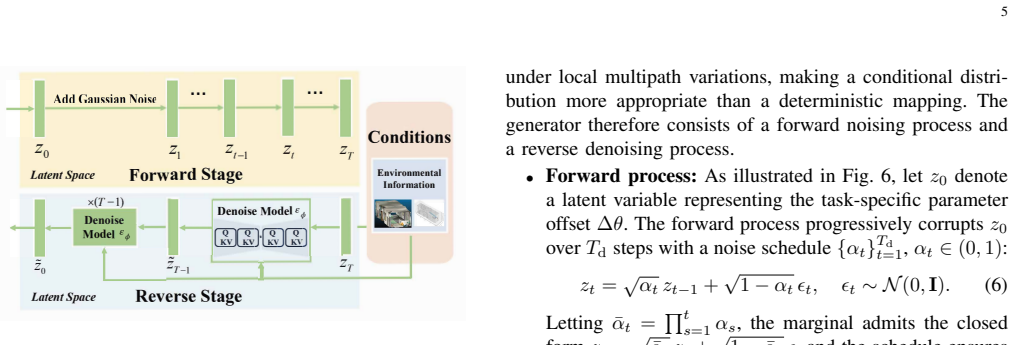
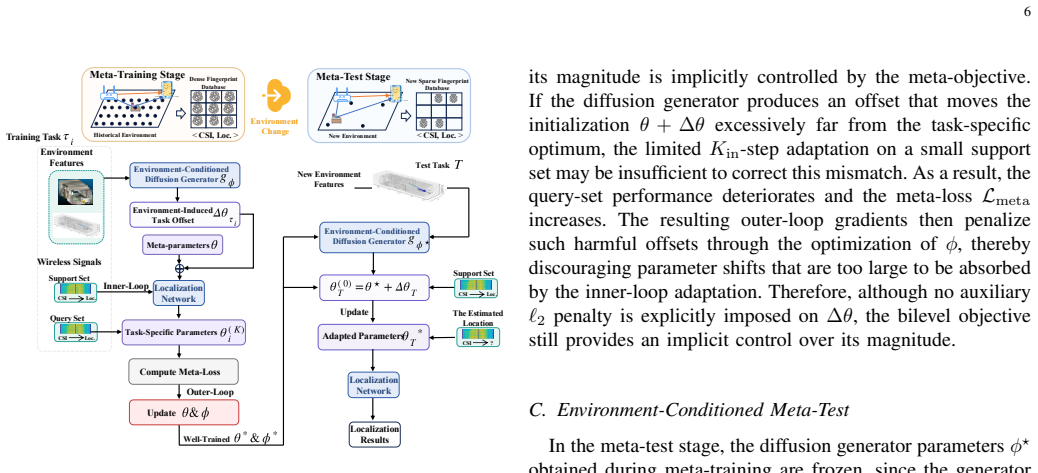
EnvCoLoc extracts structured descriptors from 3D point clouds and uses them to condition a latent diffusion generator, which produces environment-specific parameter offsets to modulate a shared meta-learned initialization. The diffusion generator and localization network are jointly optimized within a two-loop meta-learning framework to learn the stochastic mapping from coarse environmental descriptors to high-dimensional parameter corrections under limited data.
What carries the argument
Latent diffusion generator conditioned on 3D point cloud descriptors that outputs environment-specific parameter offsets for the meta-initialization.
If this is right
- The geometry-aware initialization reduces residual mismatch after few gradient steps in the inner loop of meta-adaptation.
- Excess-loss analysis for finite-step adaptation provides theoretical backing for why the conditioned offsets improve performance.
- Joint optimization of the diffusion generator and localization network allows the model to learn stochastic mappings from coarse descriptors to high-dimensional corrections.
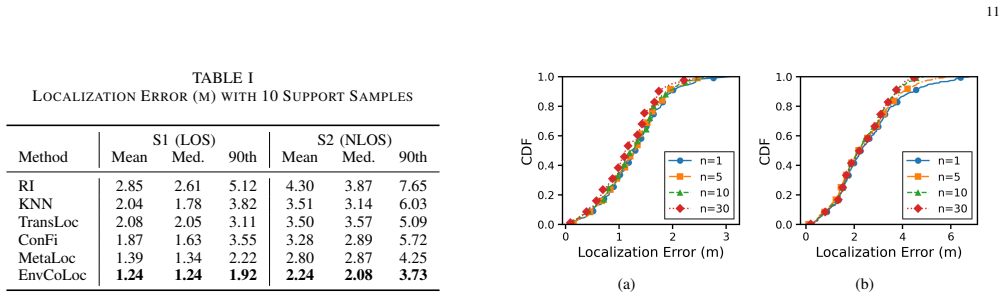
- The method shows consistent gains over baselines in real-world tests, especially in NLOS conditions with only 10 support samples.
Where Pith is reading between the lines
- The same conditioning idea could be tested on other radio technologies such as Bluetooth or UWB where environmental geometry also shapes signal behavior.
- If 3D point clouds are replaced by cheaper 2D floor plans, the performance drop would indicate how much fine-grained geometry is actually required.
- Adding material or occupancy information to the descriptors might further tighten the distribution of generated offsets.
Load-bearing premise
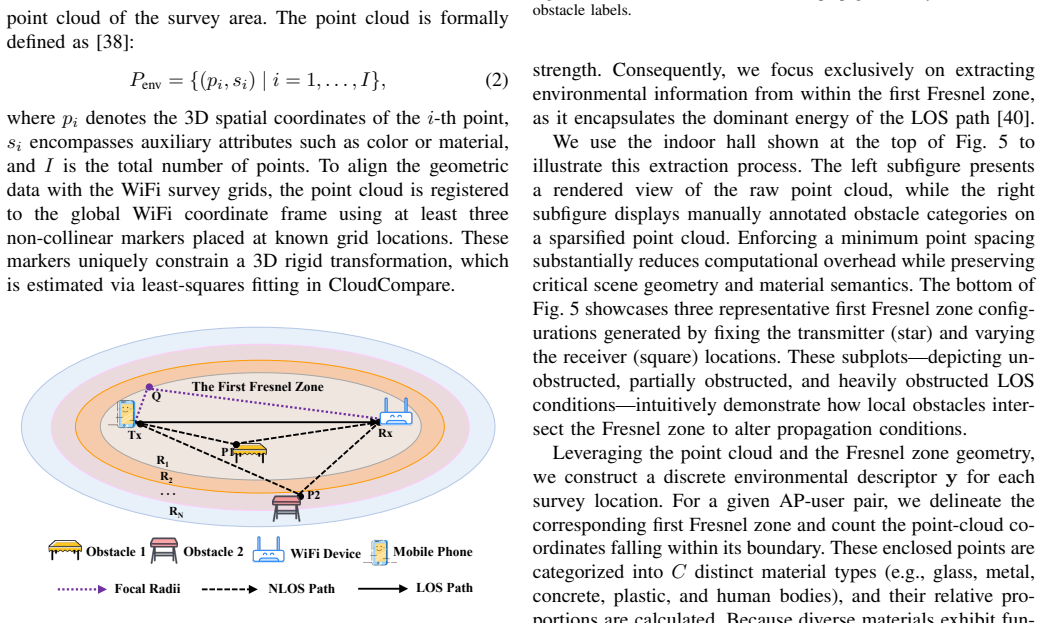
Structured descriptors taken from 3D point clouds capture enough information about multipath variations that the diffusion generator can create useful environment-specific offsets.
What would settle it
A controlled experiment that applies EnvCoLoc and the baselines to the same set of new indoor spaces using exactly 10 support samples each and measures whether the reported 20 percent error reduction in NLOS cases disappears or reverses.
Figures


read the original abstract
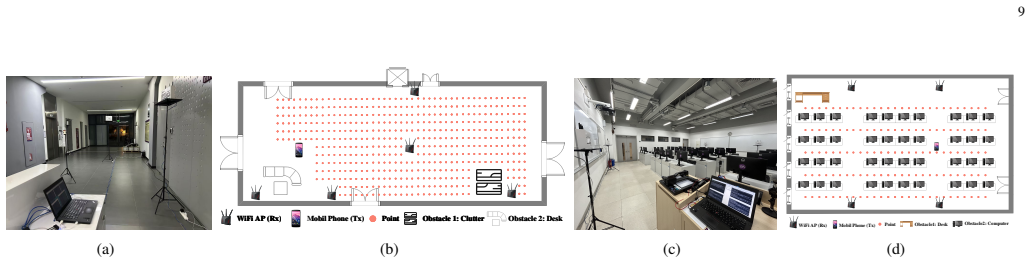
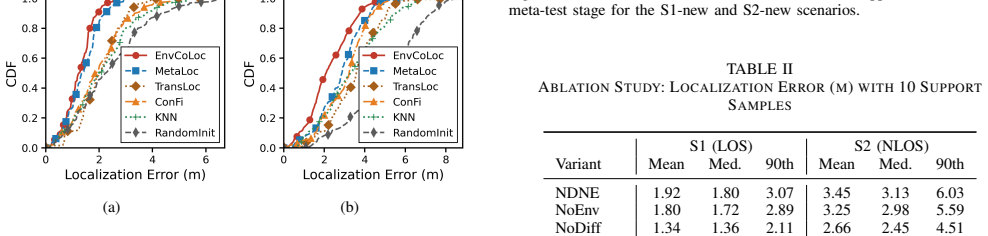
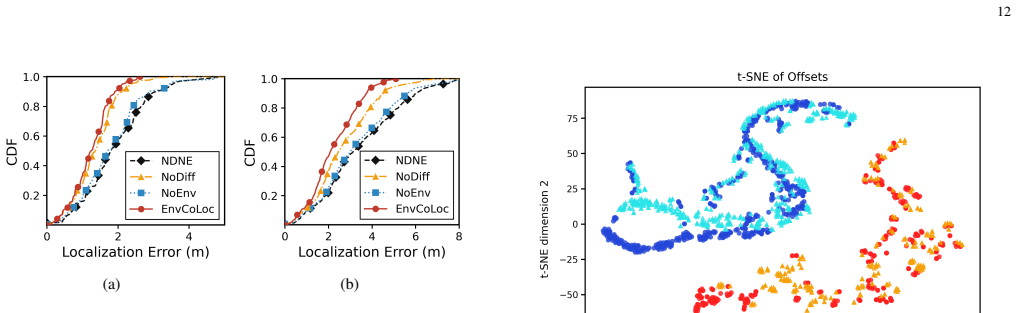
Fingerprinting-based localization often suffers from poor cross-environment generalization, especially when only a few labeled samples are available in the target environment. Existing methods mitigate distribution shifts through domain adaptation or improved signal representations, but they usually ignore environmental geometry or use it in a deterministic manner, limiting their ability to capture diverse multipath variations in complex propagation conditions. To address this issue, we propose EnvCoLoc, an environment-conditioned diffusion meta-learning framework for few-shot fingerprinting localization. EnvCoLoc extracts structured descriptors from 3D point clouds and uses them to condition a latent diffusion generator, which produces environment-specific parameter offsets to modulate a shared meta-learned initialization. This design injects geometry-aware priors into the adaptation process and provides more informative initializations for new environments. To learn the stochastic mapping from coarse environmental descriptors to high-dimensional parameter corrections under limited data, the diffusion generator and localization network are jointly optimized within a two-loop meta-learning framework. The generated offsets capture systematic environment-dependent variations, while gradient-based inner-loop adaptation further refines the model to reduce residual task-specific mismatch. We also provide an excess-loss analysis for finite-step adaptation, theoretically supporting the benefit of geometry-aware initialization. Real-world experiments show that EnvCoLoc consistently improves localization accuracy over baseline methods, achieving up to a 20.0% reduction in mean localization error in NLOS scenarios with only 10 support samples.
Editorial analysis
A structured set of objections, weighed in public.
Referee Report
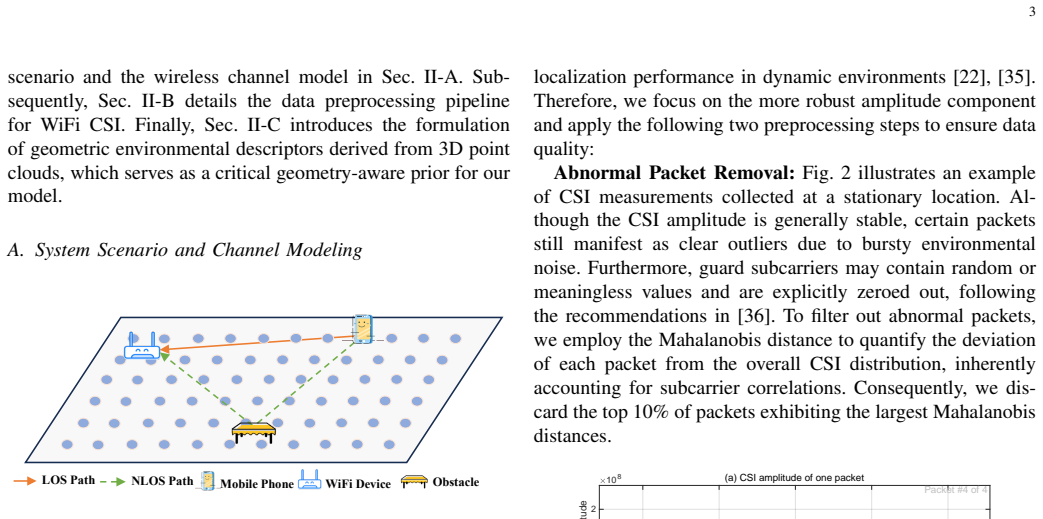
Summary. The paper proposes EnvCoLoc, an environment-conditioned diffusion meta-learning framework for few-shot fingerprinting-based WiFi localization. Structured descriptors are extracted from 3D point clouds to condition a latent diffusion generator that produces environment-specific parameter offsets modulating a shared meta-learned initialization. The diffusion generator and localization network are jointly optimized in a two-loop meta-learning framework, with an excess-loss analysis provided for finite-step adaptation. Real-world experiments report up to 20% reduction in mean localization error in NLOS scenarios using only 10 support samples.
Significance. If substantiated, the work could advance data-efficient localization by injecting geometry-aware stochastic priors into meta-learning via diffusion models, addressing distribution shifts in complex propagation environments more effectively than deterministic approaches. The joint optimization and excess-loss analysis represent constructive elements that could support the central claim of improved adaptation under limited data.
minor comments (2)
- The abstract would benefit from explicit mention of the baseline methods, data split details, and any statistical tests used to support the reported 20% error reduction.
- Clarification on the precise form of the 'structured descriptors' extracted from 3D point clouds and how they are encoded for conditioning the diffusion process would improve readability.
Simulated Author's Rebuttal
We thank the referee for the accurate summary of EnvCoLoc and for noting the potential significance of injecting geometry-aware stochastic priors into meta-learning for WiFi localization. We are encouraged by the positive view of the joint optimization and excess-loss analysis. No specific major comments were enumerated in the report, so we address the overall assessment here and remain available to expand on any points raised in a revision.
Circularity Check
No significant circularity detected
full rationale
The abstract describes a framework that extracts descriptors from 3D point clouds to condition a latent diffusion generator for parameter offsets, jointly optimizes the generator and localization network in a two-loop meta-learning setup, and provides an excess-loss analysis. No equations are presented that reduce the claimed 20% error reduction or the geometry-aware initialization benefit to quantities defined by construction from the same fitted parameters or self-citations. The performance claims rest on real-world experiments, which constitute independent empirical content rather than a self-referential derivation.
discussion (0)
Sign in with ORCID, Apple, or X to comment. Anyone can read and Pith papers without signing in.