CogniFold: Always-On Proactive Memory via Cognitive Folding
Pith reviewed 2026-05-14 19:15 UTC · model grok-4.3
The pith
CogniFold folds event streams into self-organizing graph structures that surface proactive intents at concept density thresholds.
A machine-rendered reading of the paper's core claim, the machinery that carries it, and where it could break.
Core claim
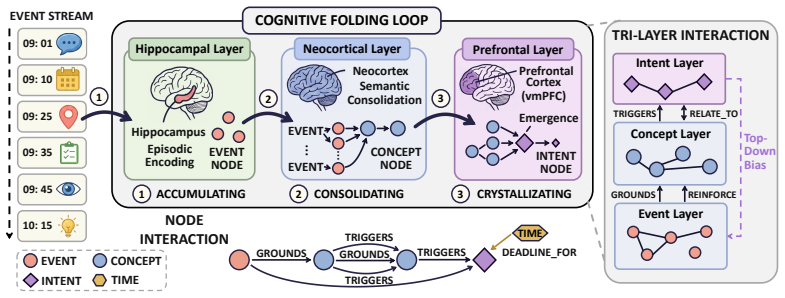
CogniFold achieves proactive memory by extending Complementary Learning Systems theory to three layers and applying graph-topology self-organization that assembles cognitive structures from fragmented events, merges semantically similar ones, decays stale information, relinks through association, and surfaces intents when concept-cluster density crosses a threshold, bootstrapping progressively higher-level cognition without additional human-specified rules.
What carries the argument
Graph-topology self-organization, which assembles, merges, decays, relinks, and surfaces intents from event streams when concept-cluster density crosses a threshold.
If this is right
- Agents bootstrap higher-level cognition directly from incoming event streams through continuous structural folding.
- Intents emerge proactively when concept clusters reach density thresholds rather than through explicit retrieval.
- Memory structures evolve via assembly, merging, decay, and relinking while preserving performance on conventional benchmarks.
- The three-layer extension of Complementary Learning Systems supports intentional control in agent decision-making.
Where Pith is reading between the lines
- The folding process could enable anticipation of user needs by associating past patterns with new contexts in real time.
- Similar self-organization rules might transfer to continual learning settings where event streams include sensor or multimodal data.
- The density threshold parameter could determine the balance between over- and under-surfacing of intents in different task environments.
Load-bearing premise
The graph-topology self-organization rules including the density threshold will produce memory structures that genuinely match cognitive expectations and enable proactive behavior without additional human-specified rules or post-hoc tuning.
What would settle it
Running CogniFold on CogEval-Bench and checking whether the generated structures match expected cognitive patterns or fail to surface appropriate intents in scenarios with clear dense concept clusters.
Figures


read the original abstract
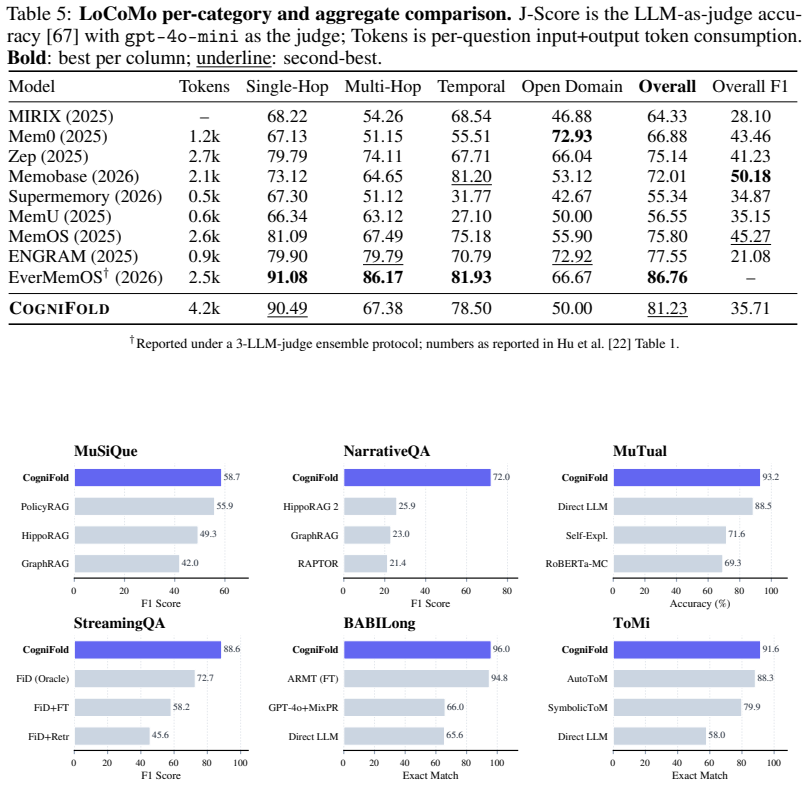
Existing agent memory remains predominantly reactive and retrieval-based, lacking the capacity to autonomously organize experience into persistent cognitive structure. Toward genuinely autonomous agents, we introduce CogniFold, a brain-inspired "always-on" agent memory designed for the next generation of proactive assistants. CogniFold continuously folds fragmented event streams into self-emerging cognitive structures, bootstrapping progressively higher-level cognition from incoming events and accumulated knowledge. We ground this by extending Complementary Learning Systems (CLS) theory from two layers (hippocampus, neocortex) to three, adding a prefrontal intent layer. Emulating the prefrontal cortex as the locus of intentional control and decision-making, CogniFold achieves this through graph-topology self-organization: cognitive structures proactively assemble under the stream, merge when semantically similar, decay when stale, relink through associative recall, and surface intents when concept-cluster density crosses a threshold. We evaluate structural formation using CogEval-Bench, demonstrating that CogniFold uniquely produces memory structures that match cognitive expectations and concept emergence. Furthermore, across 7 broad-coverage benchmarks spanning five cognitive domains, we validate that CogniFold simultaneously performs robustly on conventional memory benchmarks.
Editorial analysis
A structured set of objections, weighed in public.
Referee Report
Summary. The paper introduces Cognifold, a brain-inspired always-on agent memory system that continuously folds fragmented event streams into self-emerging cognitive structures via graph-topology self-organization (assemble, merge, decay, relink, and surface intents at a concept-cluster density threshold). It extends Complementary Learning Systems theory to three layers by adding a prefrontal intent layer and claims that the resulting structures match cognitive expectations on CogEval-Bench while delivering robust performance across 7 benchmarks spanning five cognitive domains.
Significance. If the central claims hold, Cognifold could advance proactive AI agents by enabling autonomous bootstrapping of higher-level cognition from raw events without constant external supervision. The explicit grounding in CLS theory and the dual evaluation on structural matching plus conventional benchmarks would position the work as a concrete bridge between cognitive neuroscience and agent memory design.
major comments (2)
- [Abstract] Abstract: the claim that structures 'match cognitive expectations' and 'uniquely' emerge is load-bearing for the central contribution, yet the manuscript provides no equations, pseudocode, or implementation details for the assemble/merge/decay/relink rules or the density threshold, rendering the self-organization claim unverifiable from the text.
- [Evaluation] Evaluation section: the reported robustness on 7 benchmarks is stated without error bars, statistical tests, baseline comparisons, or data-exclusion criteria, so it is impossible to determine whether performance stems from the proposed mechanisms or from post-hoc calibration of the free parameter (concept-cluster density threshold).
minor comments (1)
- [Abstract] The term 'CogEval-Bench' is introduced without a reference or description of its construction, making it difficult to assess whether the benchmark embeds definitions aligned with the proposed mechanisms.
Simulated Author's Rebuttal
We thank the referee for the detailed and constructive feedback. We agree that the current manuscript requires additional technical detail and statistical rigor to fully substantiate the central claims. Below we respond point-by-point to the major comments and outline the revisions we will make.
read point-by-point responses
-
Referee: [Abstract] Abstract: the claim that structures 'match cognitive expectations' and 'uniquely' emerge is load-bearing for the central contribution, yet the manuscript provides no equations, pseudocode, or implementation details for the assemble/merge/decay/relink rules or the density threshold, rendering the self-organization claim unverifiable from the text.
Authors: We agree that the self-organization rules must be presented with sufficient formality for independent verification. In the revised manuscript we will add an explicit subsection (and corresponding appendix) containing the mathematical definitions of the assemble, merge, decay, and relink operations, the precise density-threshold criterion, and pseudocode for the full graph-topology update cycle. These additions will make the emergence process reproducible from the text alone. revision: yes
-
Referee: [Evaluation] Evaluation section: the reported robustness on 7 benchmarks is stated without error bars, statistical tests, baseline comparisons, or data-exclusion criteria, so it is impossible to determine whether performance stems from the proposed mechanisms or from post-hoc calibration of the free parameter (concept-cluster density threshold).
Authors: We accept this criticism. The revised evaluation section will report mean performance with standard-error bars across multiple random seeds, include paired statistical tests (e.g., Wilcoxon or t-tests) against the strongest baselines, document all baseline implementations and hyper-parameter choices, and state the data-exclusion criteria. We will also describe the procedure used to select the density threshold (including any sensitivity analysis) to demonstrate that performance is not the result of post-hoc tuning. revision: yes
Circularity Check
No significant circularity in derivation chain
full rationale
The paper defines CogniFold via explicit graph-topology operations (assemble, merge, decay, relink, and density-threshold surfacing) that extend CLS theory to a prefrontal layer, then evaluates the resulting structures on CogEval-Bench plus seven external benchmarks. No equations, fitted parameters, or self-citations are presented that would make the claimed self-emergent cognitive structures equivalent to the input rules by construction. The mechanisms are author-specified (as is standard for such architectures) but the performance claims rest on independent benchmark outcomes rather than tautological re-labeling or reduction to the same inputs. The derivation therefore remains self-contained against external validation.
Axiom & Free-Parameter Ledger
free parameters (1)
- concept-cluster density threshold
axioms (1)
- domain assumption Complementary Learning Systems theory can be extended from two layers to three by adding a prefrontal intent layer that governs intentional control.
invented entities (1)
-
prefrontal intent layer
no independent evidence
Lean theorems connected to this paper
-
IndisputableMonolith/Cost/FunctionalEquation.leanwashburn_uniqueness_aczel unclear?
unclearRelation between the paper passage and the cited Recognition theorem.
surface intents when concept-cluster density crosses a threshold... graph-topology self-organization: cognitive structures proactively assemble under the stream, merge when semantically similar, decay when stale, relink through associative recall
-
IndisputableMonolith/Foundation/RealityFromDistinction.leanreality_from_one_distinction unclear?
unclearRelation between the paper passage and the cited Recognition theorem.
extending Complementary Learning Systems (CLS) theory from two layers... to three, adding a prefrontal intent layer
What do these tags mean?
- matches
- The paper's claim is directly supported by a theorem in the formal canon.
- supports
- The theorem supports part of the paper's argument, but the paper may add assumptions or extra steps.
- extends
- The paper goes beyond the formal theorem; the theorem is a base layer rather than the whole result.
- uses
- The paper appears to rely on the theorem as machinery.
- contradicts
- The paper's claim conflicts with a theorem or certificate in the canon.
- unclear
- Pith found a possible connection, but the passage is too broad, indirect, or ambiguous to say the theorem truly supports the claim.
discussion (0)
Sign in with ORCID, Apple, or X to comment. Anyone can read and Pith papers without signing in.