Response to glassy disorder in coin on spread of quantum walker
Pith reviewed 2026-05-24 13:13 UTC · model grok-4.3
The pith
Glassy disorder inserted into the coin of a one-dimensional discrete-time quantum walk inhibits ballistic spread for all tested distributions while the spread stays faster than classical random walk dispersion.
A machine-rendered reading of the paper's core claim, the machinery that carries it, and where it could break.
Core claim
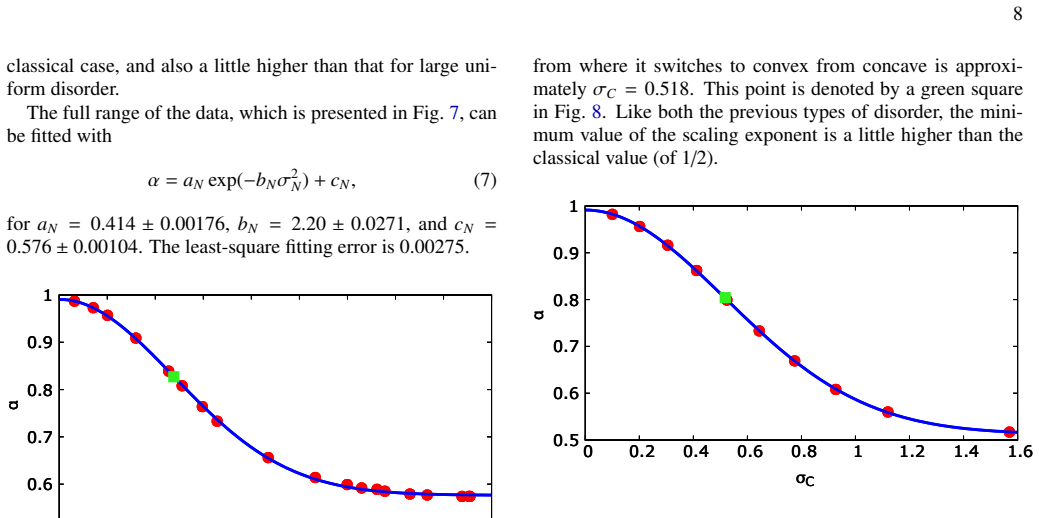
The ballistic spread of the disorder-free quantum walker is inhibited by the insertion of disorder, for all the disorder distributions that we have chosen for our investigation, but remains faster than the dispersive spread of the classical random walker. Beyond this generic feature, there are significant differences between the responses to the different types of disorder. In particular, the falloff from ballistic spread can be slow (Gaussian) or fast (parabolic) for different disorders, when the strength of the disorder is still weak. The cases of slow response always pick up speed after a point of inflection at a mid-level disorder strength.
What carries the argument
The coin operator with glassy disorder drawn from Haar-uniform, spherical normal, circular, and two spherical Cauchy-Lorentz distributions, whose effect is tracked through the resulting position probability distribution of the walker.
If this is right
- For weak disorder the reduction in spread rate follows either a slow Gaussian or fast parabolic form depending on the distribution type.
- Distributions that produce the slow Gaussian falloff exhibit a point of inflection beyond which spread rate increases again at moderate disorder strength.
- The inhibition of ballistic spread while retaining a quantum advantage holds uniformly across all four families of disorder distributions examined.
- The differences in response are traceable to the distinct statistical properties of each disorder distribution acting on the coin.
Where Pith is reading between the lines
- Engineering the coin disorder distribution could provide a tunable control knob for the effective diffusion constant of a quantum walker without destroying its advantage over classical diffusion.
- The inflection point observed in some distributions may mark a crossover between regimes dominated by different moments of the disorder measure.
- Similar disorder-response studies on higher-dimensional or continuous-time walks could test whether the generic inhibition-plus-advantage feature generalizes beyond the one-dimensional discrete case.
Load-bearing premise
The chosen disorder distributions and the numerical discretization are representative of physically relevant glassy disorder in the coin operation.
What would settle it
A simulation or experiment in which the spread under any one of the listed disorder distributions becomes equal to or slower than the classical dispersive spread would falsify the central claim.
Figures


read the original abstract
We analyze the response to incorporation of glassy disorder in the coin operation of a discrete-time quantum walk in one dimension. We find that the ballistic spread of the disorder-free quantum walker is inhibited by the insertion of disorder, for all the disorder distributions that we have chosen for our investigation, but remains faster than the dispersive spread of the classical random walker. Beyond this generic feature, there are significant differences between the responses to the different types of disorder. In particular, the falloff from ballistic spread can be slow (Gaussian) or fast (parabolic) for different disorders, when the strength of the disorder is still weak. The cases of slow response always pick up speed after a point of inflection at a mid-level disorder strength. The disorder distributions chosen for the study are Haar-uniform, spherical normal, circular, and two types of spherical Cauchy-Lorentz.
Editorial analysis
A structured set of objections, weighed in public.
Referee Report
Summary. The manuscript numerically studies the effect of glassy disorder introduced into the coin operator of a one-dimensional discrete-time quantum walk. For five specific disorder distributions (Haar-uniform, spherical normal, circular, and two spherical Cauchy-Lorentz), it reports that the second-moment spread is reduced relative to the disorder-free ballistic scaling but remains superdiffusive compared with classical random-walk diffusion. The response varies with distribution type: slow (Gaussian) versus fast (parabolic) falloff at weak disorder strength, with some cases exhibiting an inflection point at intermediate strength after which spreading accelerates again.
Significance. If reproducible, the limited-scope empirical observation that quantum spreading stays strictly between ballistic and diffusive limits for these ensembles adds a concrete data point to the literature on disordered quantum walks. The work does not claim universality, derive parameter-free relations, or supply machine-checked proofs, so its significance is primarily as a numerical survey rather than a foundational result.
major comments (2)
- [Abstract] Abstract and main text: the central claim rests on numerical integration, yet no information is supplied on lattice size, number of time steps, number of disorder realizations averaged, or error estimation on the second-moment curves. Without these, the reported inflection points and distinctions between Gaussian versus parabolic falloff cannot be assessed for statistical significance.
- [Abstract] Abstract: the statement that the chosen distributions are representative of 'glassy disorder' is not supported by any physical motivation or comparison to other ensembles; the claim is therefore restricted to the five enumerated distributions, and the manuscript should make this scope explicit rather than implying broader relevance.
minor comments (1)
- [Abstract] The abstract refers to 'the cases of slow response' without defining the quantitative criterion used to classify a response as slow versus fast.
Simulated Author's Rebuttal
We thank the referee for the constructive comments on our manuscript. We address each major comment below and have revised the manuscript to incorporate the suggested clarifications and details.
read point-by-point responses
-
Referee: [Abstract] Abstract and main text: the central claim rests on numerical integration, yet no information is supplied on lattice size, number of time steps, number of disorder realizations averaged, or error estimation on the second-moment curves. Without these, the reported inflection points and distinctions between Gaussian versus parabolic falloff cannot be assessed for statistical significance.
Authors: We agree that these numerical parameters and error estimates are necessary for reproducibility and assessing statistical significance. In the revised manuscript we have added a new subsection in the Methods section specifying the lattice size (N=1001 sites with open boundaries), maximum evolution time (T=400 steps), number of disorder realizations (M=2000 for each distribution), and error estimation procedure (standard error of the mean computed across independent realizations, with error bars now displayed on all second-moment plots). These additions allow direct evaluation of the reported inflection points and falloff behaviors. revision: yes
-
Referee: [Abstract] Abstract: the statement that the chosen distributions are representative of 'glassy disorder' is not supported by any physical motivation or comparison to other ensembles; the claim is therefore restricted to the five enumerated distributions, and the manuscript should make this scope explicit rather than implying broader relevance.
Authors: We accept that the original wording could be read as implying broader representativeness. We have revised both the abstract and the opening paragraph of the introduction to state explicitly that the results apply to the five specific distributions examined (Haar-uniform, spherical normal, circular, and the two spherical Cauchy-Lorentz distributions) and that no claim of universality or representativeness of all glassy disorder is made. revision: yes
Circularity Check
No significant circularity
full rationale
The manuscript reports numerical experiments on the second-moment growth of a one-dimensional discrete-time quantum walk under five explicitly enumerated disorder distributions in the coin operator. No analytic derivation chain, fitted-parameter prediction, or self-citation load-bearing step is present; the reported inhibition of ballistic spread relative to the disorder-free case and its comparison to classical diffusion are direct outputs of the chosen numerical integration, not quantities defined in terms of the inputs by construction.
Axiom & Free-Parameter Ledger
Lean theorems connected to this paper
-
IndisputableMonolith/Cost/FunctionalEquation.leanwashburn_uniqueness_aczel unclear?
unclearRelation between the paper passage and the cited Recognition theorem.
We analyze the response to incorporation of glassy disorder in the coin operation... scaling exponent α where ⟨σ(t)⟩ ∝ t^α... fitted with Gaussian or parabolic forms for each distribution.
-
IndisputableMonolith/Foundation/DimensionForcing.leanalexander_duality_circle_linking unclear?
unclearRelation between the paper passage and the cited Recognition theorem.
The disorder distributions chosen for the study are Haar-uniform, spherical normal, circular, and two types of spherical Cauchy-Lorentz.
What do these tags mean?
- matches
- The paper's claim is directly supported by a theorem in the formal canon.
- supports
- The theorem supports part of the paper's argument, but the paper may add assumptions or extra steps.
- extends
- The paper goes beyond the formal theorem; the theorem is a base layer rather than the whole result.
- uses
- The paper appears to rely on the theorem as machinery.
- contradicts
- The paper's claim conflicts with a theorem or certificate in the canon.
- unclear
- Pith found a possible connection, but the passage is too broad, indirect, or ambiguous to say the theorem truly supports the claim.
Reference graph
Works this paper leans on
-
[1]
The von Mises - Fisher distribution (vMFD) has been interpreted as a normal distribution on a sphere [111]. It is described using two parameters, κN, µN, and the probability measure is p(θ, φ)dθdφ = A exp(κNxT· µN) sinθdθdφ, where κN ∈ [0,∞) is called the concentration parameter and µN ≡ (µx, µy, µz)c represents the mean direction. Here, x≡ (sin θ cos φ, ...
-
[2]
Spherical Cauchy-Lorentz I The probability measure of one of them is given by p(θ, φ)dθdφ = 1 4π ln δ (δ2− 1) (δ2 + 1)− (δ2− 1)xT· µ1 sin θdθdφ. It is dependent on the two parameters, δ and µ1, acting re- spectively as a concentration parameter and the mean direc- tion. The range of δ is [0 ,∞)\{ 1}. As δ → 1, the distri- bution becomes more and more unif...
-
[3]
Spherical Cauchy-Lorentz II Another distribution on the unit sphere that has been con- sidered as a generalization of the Cauchy-Lorentz distribution can be defined again using two parameters,viz. ρ and µ2, and for which the probability measure is given by p(θ, φ)dθdφ = 1 4π (1− ρ2)2 (1 + ρ2− 2ρµT 2· x)2 sin θdθdφ, where ρ∈ [0, 1) and µ2 work as the concen...
-
[4]
Cauchy-Lorentz I The scaling of disorder averaged dispersion of the quantum walk, with respect to strength of the disorder, distributed as Cauchy-Lorentz I, is presented in Fig. 9. The data can be fitted with the parabolic function, α = a1σ2 C1 + b1σC1 + c1, (9) where a1 = 0.213± 0.00415, b1 = −0.736± 0.0118, and c1 = 1.20± 0.00773. The corresponding least...
-
[5]
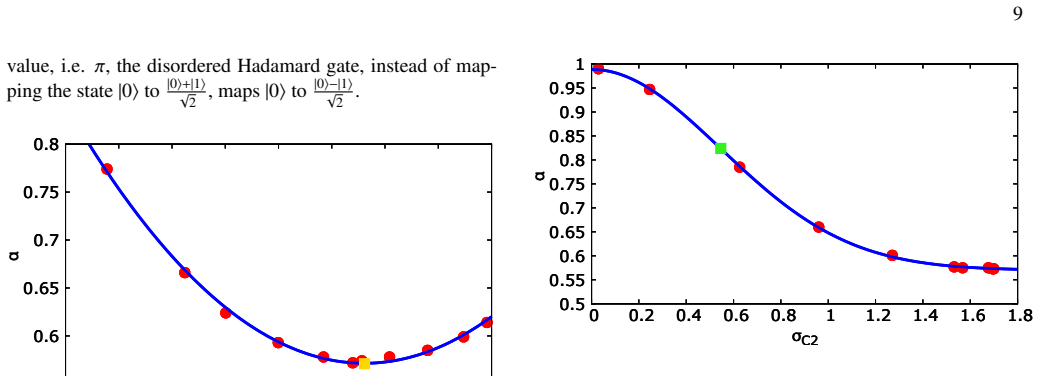
Cauchy-Lorentz II We now calculate the α in presence of Cauchy-Lorentz II disorder in the quantum coin. The results are presented in Fig. 10, in an α versus disorder strength plot. We fit the data with the relation, α = a2 exp(−b2σ2 C2) + c2, (10) where a2 = 0.419± 0.00166, b2 = 1.68± 0.0212 and c2 = 0.570± 0.000983. The corresponding least squares error i...
work page 2019
-
[6]
Y . Aharonov, L. Davidovich, and N. Zagury, Quantum random walks, Phys. Rev. A 48, 1687 (1993)
work page 1993
-
[7]
A. Nayak and A. Vishwanath, Quantum walk on the line, arXiv:quant-ph/0010117
work page internal anchor Pith review Pith/arXiv arXiv
-
[8]
A. Ambainis, E. Bach, A. Nayak, A. Vishwanath, and J. Watrous, One-dimensional quantum walks, Proceedings of STOC’01, pp. 37-49
-
[9]
Kempe, Quantum random walks - an introductory overview, Contemp
J. Kempe, Quantum random walks - an introductory overview, Contemp. Phys. 44, 307 (2003)
work page 2003
-
[10]
Kendon, Decoherence in quantum walks - a review, Math
V . Kendon, Decoherence in quantum walks - a review, Math. Struct. in Comp. Sci 17, 1169 (2006)
work page 2006
-
[11]
Topological phenomena in quantum walks; elementary introduction to the physics of topological phases
T. Kitagawa, Topological phenomena in quantum walks; el- ementary introduction to the physics of topological phases, arXiv:1112.1882
work page internal anchor Pith review Pith/arXiv arXiv
-
[12]
O. M ¨ulken and A. Blumen, Continuous-time quantum walks: models for coherent transport on complex networks, Phys. Rep. 502, 37 (2011)
work page 2011
-
[13]
T. Kitagawa, Topological phenomena in quantum walks: el- ementary introduction to the physics of topological phases, Quantum Inf. Process. 11, 1107 (2012)
work page 2012
-
[14]
S. E. Venegas-Andraca, Quantum walks: a comprehensive re- view, Quantum Inf. Process. 11, 1015 (2012)
work page 2012
-
[15]
Shikano, From discrete time quantum walk to continuous time quantum walk in limit distribution, J
Y . Shikano, From discrete time quantum walk to continuous time quantum walk in limit distribution, J. Comput. Theor. Nanosci. 10, 1558 (2013)
work page 2013
-
[16]
F. Xia, J. Liu, H. Nie, Y . Fu, L. Wan, and X. Kong, Random walks: A review of algorithms and applications, IEEE Trans- actions on Emerging Topics in Computational Intelligence, 4, 95 (2020)
work page 2020
-
[17]
B. C. Travaglione and G. J. Milburn, Implementing the quan- tum random walk, Phys. Rev. A 65, 032310 (2002)
work page 2002
-
[18]
A. M. Childs, R. Cleve, E. Deotto, E. Farhi, S. Gutmann, and D. A. Spielman, Exponential algorithmic speedup by quantum walk, Proc. 35th ACM Symposium on Theory of Computing (STOC 2003), pp. 59-68
work page 2003
-
[19]
W. Dai, n-Qubit operations on sphere and queueing scaling limits for programmable quantum computer, arXiv:2109.14266
-
[20]
S. Akmal and C. Jin, Near-optimal quantum algorithms for string problems, arXiv:2110.09696
-
[21]
C. M. Chandrashekar and T. Busch, Localized quantum walks as secured quantum memory, Europhys. Lett. 110, 10005 (2015)
work page 2015
- [22]
-
[23]
D. Aharonov, A. Ambainis, J. Kempe, and U. Vazirani, Quan- tum walks on graphs, arXiv:quant-ph/0012090
work page internal anchor Pith review Pith/arXiv arXiv
-
[24]
A. M. Childs, E. Farhi, and S. Gutmann, An example of the difference between quantum and classical random walks, Quantum Inf. Processing 1, 35 (2002)
work page 2002
-
[25]
P. Kurzy ´nski and A. W´ojcik, Discrete-time quantum walk ap- proach to state transfer, Phys. Rev. A 83, 062315 (2011)
work page 2011
-
[26]
X. Zhan, H. Qin, Z.-h. Bian, J. Li, and P. Xue, Perfect state transfer and e fficient quantum routing: a discrete-time quan- tum walk approach, Phys. Rev. A 90, 012331 (2014)
work page 2014
-
[27]
˙I. Yalc ¸ınkaya and Z. Gedik, Qubit state transfer via discrete- time quantum walks, J. Phys. A: Math. Theor. 48, 225302 (2015)
work page 2015
- [28]
-
[29]
M. Annabestani, M. Hassani, D. Tamascelli, and M. G. A. Paris, Multi-parameter quantum metrology with discrete-time quantum walks, arXiv:2110.02032
-
[30]
J. Mulherkar, R. Rajdeepak, and V . Sunitha, Quantum simu- lation of perfect state transfer on weighted cubelike graphs, arXiv:2111.00226
-
[31]
C. A. Ryan, M. Laforest, J. C. Boileau, and R. Laflamme, Experimental implementation of a discrete-time quantum ran- dom walk on an NMR quantum-information processor, Phys. Rev. A 72, 062317 (2005)
work page 2005
-
[32]
H. B. Perets, Y . Lahini, F. Pozzi, M. Sorel, R. Morandotti, and Y . Silberberg, Realization of quantum walks with negli- gible decoherence in waveguide lattices, Phys. Rev. Lett. 100, 170506 (2008)
work page 2008
- [33]
- [34]
-
[35]
Q.-Q. Wang, X.-Y . Xu, W.-W. Pan, K. Sun, J.-S. Xu, G. Chen, Y .-J. Han, C.-F. Li, and G.-C. Guo, Dynamic-disorder- induced enhancement of entanglement in photonic quantum walks, Optica 5, 1136 (2018)
work page 2018
- [36]
-
[37]
M. Gong, S. Wang, and C. Zha, Quantum walks on a pro- grammable two-dimensional 62-qubit superconducting pro- cessor, Science 372, 948 (2021)
work page 2021
-
[38]
O. L. Acevedo and T. Gobron, Quantum walks on Cayley graphs, J. Phys. A: Math. Gen. 39, 585 (2006)
work page 2006
- [39]
-
[40]
R. Portugal, R. A. M. Santos, T. D. Fernandes, and D. N. Gonc ¸alves, The staggered quantum walk model, Quantum Inf. Processing, 15, 85 (2016)
work page 2016
-
[41]
J. Jayakumar, S. Das, A. Sen(De), and U. Sen, Interference- induced localization in quantum random walk on clean cyclic graph, EPL 128, 20007 (2019)
work page 2019
-
[42]
M. Kieferova and D. Nagaj, Quantum walks on necklaces and mixing, International Journal of Quantum Information10, 1250025 (2012)
work page 2012
-
[43]
S. R. Jackson, T. J. Khoo, and F. W. Strauch, Quantum walks on trees with disorder: decay, di ffusion, and localization, Phys. Rev. A 86, 022335 (2012)
work page 2012
-
[44]
C. Benedetti, M. A. C. Rossi, and M. G. A. Paris, Continuous- time quantum walks on dynamical percolation graphs, EPL 124, 60001 (2018)
work page 2018
- [45]
-
[46]
M. S. Rudner and L. S. Levitov, Topological transition in a non-Hermitian quantum walk, Phys. Rev. Lett. 102, 065703 (2009)
work page 2009
-
[47]
T. Kitagawa, M. S. Rudner, E. Berg, and E. Demler, Explor- ing topological phases with quantum walks, Phys. Rev. A 82, 033429 (2010)
work page 2010
-
[48]
D. Bagrets, K. W. Kim, S. Barkhofen, S. De, J. Sperling, C. Silberhorn, A. Altland, and T. Micklitz, Probing the topolog- ical Anderson transition with quantum walks, Phys. Rev. Re- 11 search 3, 023183 (2021)
work page 2021
-
[49]
S. Barkhofen, T. Nitsche, F. Elster, L. Lorz, A. G ´abris, I. Jex, and C. Silberhorn, Measuring topological invariants in disor- dered discrete-time quantum walks, Phys. Rev. A 96, 033846 (2017)
work page 2017
-
[50]
X. Zhan, L. Xiao, Z. Bian, K. Wang, X. Qiu, B. C. Sanders, W. Yi, and P. Xue, Detecting topological invariants in nonunitary discrete-time quantum walks, Phys. Rev. Lett. 119, 130501 (2017)
work page 2017
-
[51]
T. Rakovszky, J. K. Asb´oth, and A. Alberti, Detecting topolog- ical invariants in chiral symmetric insulators via losses, Phys. Rev. B 95, 201407(R) (2017)
work page 2017
-
[52]
F. Cardano, A. D’Errico, A. Dauphin, M. Maffei, B. Piccirillo, C. de Lisio, G. De Filippis, V . Cataudella, E. Santamato, L. Marrucci, M. Lewenstein, and P. Massignan, Detection of zak phases and topological invariants in a chiral quantum walk of twisted photons, Nature Comm. 8, 15516 (2017)
work page 2017
- [53]
-
[54]
A. Schreiber, K. N. Cassemiro, V . Potoˇcek, A. G ´abris, I. Jex, and Ch. Silberhorn, Decoherence and disorder in quantum walks: from ballistic spread to localization, Phys. Rev. Lett. 106, 180403 (2011)
work page 2011
-
[55]
H. Lavi ˇcka, V . Potoˇcek, T. Kiss, E. Lutz, and I. Jex, Quantum walk with jumps, Eur. Phys. J. D 64, 119 (2011)
work page 2011
-
[56]
J. Svozil´ık, R. de J. Le´on-Montiel, and J. P. Torres, Implemen- tation of a spatial two-dimensional quantum random walk with tunable decoherence, Phys. Rev. A 86, 052327 (2012)
work page 2012
-
[57]
M. A. Pires and S. M. D. Queir ´os, Quantum walks with se- quential aperiodic jumps, Phys. Rev. E 102, 012104 (2020)
work page 2020
-
[58]
T. Oka, N. Konno, R. Arita, and H. Aoki, Breakdown of an electric-field driven system: a mapping to a quantum walk, Phys. Rev. Lett. 94, 100602 (2005)
work page 2005
-
[59]
R. J. Sension and R. J. Sension, Quantum path to photosyn- thesis, Nature (London) 446, 740 (2007)
work page 2007
-
[60]
M. Mohseni, P. Rebentrost, S. Lloyd, and A. Aspuru-Guzik, Environment-assisted quantum walks in photosynthetic en- ergy Transfer, J. of Chem. Phys. 129, 174106 (2008)
work page 2008
-
[61]
Aharony, Spin-flop multicritical points in systems with ran- dom fields and in spin glasses, Phys
A. Aharony, Spin-flop multicritical points in systems with ran- dom fields and in spin glasses, Phys. Rev. B18, 3328 (1978)
work page 1978
-
[62]
G. Misguich and C. Lhuillier, Two-dimensional quantum anti- ferromagnets, in frustrated spin systems, edited by H. T. Diep (World-Scientific, Singapore, 2005)
work page 2005
-
[63]
J. Villain, R. Bidaux, J.-P. Carton, and R. Conte, Order as an effect of disorder, J. Physique 41, 1263 (1980); B. J. Min- chau and R. A. Pelcovits, Two-dimensional XY model in a random uniaxial field, Phys. Rev. B 32, 3081 (1985); C. L. Henley, Ordering due to disorder in a frustrated vector anti- ferromagnet, Phys. Rev. Lett. 62, 2056 (1989); A. Moreo, E....
work page 1980
-
[64]
L. F. Santos, G. Rigolin, and C. O. Escobar, Entanglement versus chaos in disordered spin chains, Phys. Rev. A 69, 042304 (2004); C. Mej´ıa-Monasterio, G. Benenti, G. G. Carlo, and G. Casati, Entanglement across a transition to quantum chaos, Phys. Rev. A 71, 062324 (2005); A. Lakshminarayan and V . Subrahmanyam, Multipartite entanglement in a one- dimens...
work page 2004
- [65]
-
[66]
P. V . Mart´ın, J. A. Bonachela, and M. A. Mu ˜noz, Quenched disorder forbids discontinuous transitions in nonequilibrium low-dimensional systems, Phys. Rev. E 89, 012145 (2014)
work page 2014
-
[67]
A. Niederberger, T. Schulte, J. Wehr, M. Lewenstein, L. Sanchez-Palencia, and K. Sacha, Disorder-induced order in two-component Bose-Einstein condensates, Phys. Rev. Lett. 100, 030403 (2008); A. Niederberger, J. Wehr, M. Lewenstein, and K. Sacha, Disorder-induced phase control in superfluid Fermi-Bose mixtures, Europhys. Letts. 86, 26004 (2009); A. Niederb...
work page 2008
-
[68]
P. Ribeiro, P. Milman, and R. Mosseri, Aperiodic quantum random walks, Phys. Rev. Lett. 93, 190503 (2004)
work page 2004
-
[69]
M. C. Ba ˜nuls, C. Navarrete, A. P´erez, E. Rold´an, and J. C. So- riano, Quantum walk with a time-dependent coin, Phys. Rev. A 73, 062304 (2006)
work page 2006
- [70]
-
[71]
Romanelli, The fibonacci quantum walk and its classical trace map, Physica A 388, 3985 (2009)
A. Romanelli, The fibonacci quantum walk and its classical trace map, Physica A 388, 3985 (2009)
work page 2009
-
[72]
Romanelli, Driving quantum-walk spreading with the coin operator, Phys
A. Romanelli, Driving quantum-walk spreading with the coin operator, Phys. Rev. A 80, 042332 (2009)
work page 2009
-
[73]
Y . Shikano and H. Katsura, Localization and fractality in in- homogeneous quantum walks with self-duality, Phys. Rev. E 82, 031122 (2010)
work page 2010
-
[74]
C. M. Chandrashekar, Disordered-quantum-walk-induced lo- calization of a Bose-Einstein condensate, Phys. Rev. A 83, 022320 (2011)
work page 2011
-
[75]
Limit Theorems for the Disordered Quantum Walk
C. Ampadu, Limit Theorems for the Disordered quantum Walk, arXiv:1108.6110
work page internal anchor Pith review Pith/arXiv arXiv
-
[76]
A. Ahlbrecht, V . B. Scholz, and A. H. Werner, disordered quantum walks in one lattice dimension, J. Math. Phys. 52, 12 102201 (2011)
work page 2011
-
[77]
C. M. Chandrashekar, Disordered quantum walk-induced lo- calization of a Bose-Einstein condensate, Phys. Rev. A 83, 022320 (2011)
work page 2011
-
[78]
A. Ahlbrecht, C. Cedzich, R. Matjeschk, V . B. Scholz, A. H. Werner, and R. F. Werner, Asymptotic behavior of quantum walks with spatio-temporal coin fluctuations, Quantum Inf. Processing 11, 1219 (2012)
work page 2012
-
[79]
C. M. Chandrashekar, Disorder induced localization and en- hancement of entanglement in one- and two-dimensional quantum walks, arXiv:1212.5984
work page internal anchor Pith review Pith/arXiv arXiv
- [80]
discussion (0)
Sign in with ORCID, Apple, or X to comment. Anyone can read and Pith papers without signing in.