Tachyonic AdS/QCD, Determining the Strong Running Coupling and β-function in both UV and IR Regions of AdS Space
Pith reviewed 2026-05-24 11:58 UTC · model grok-4.3
The pith
A tachyon-dependent dielectric function deforms AdS space to produce one QCD running coupling valid from high to low momentum.
A machine-rendered reading of the paper's core claim, the machinery that carries it, and where it could break.
Core claim
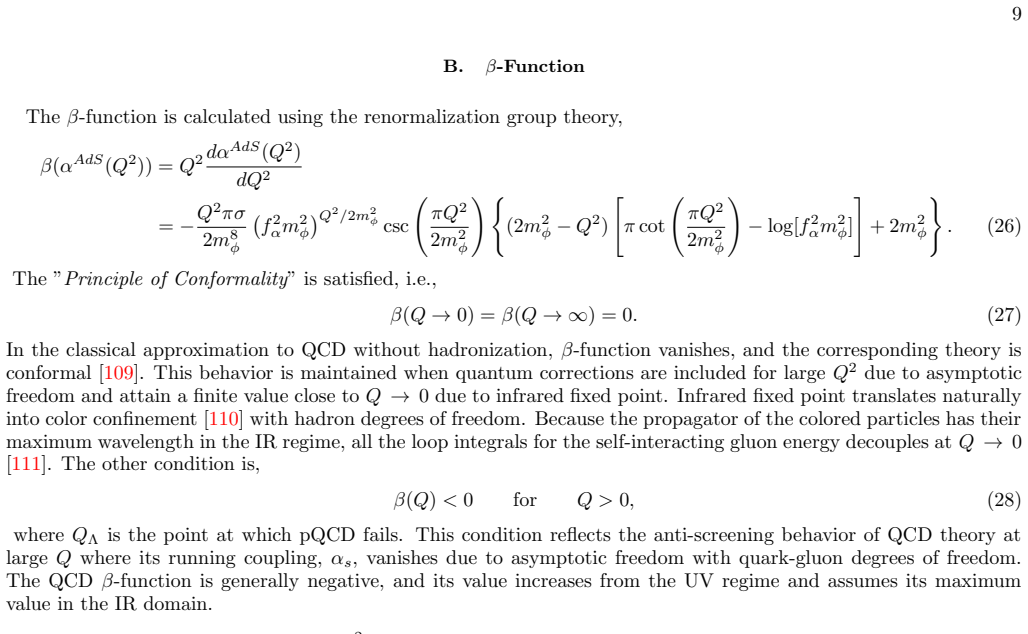
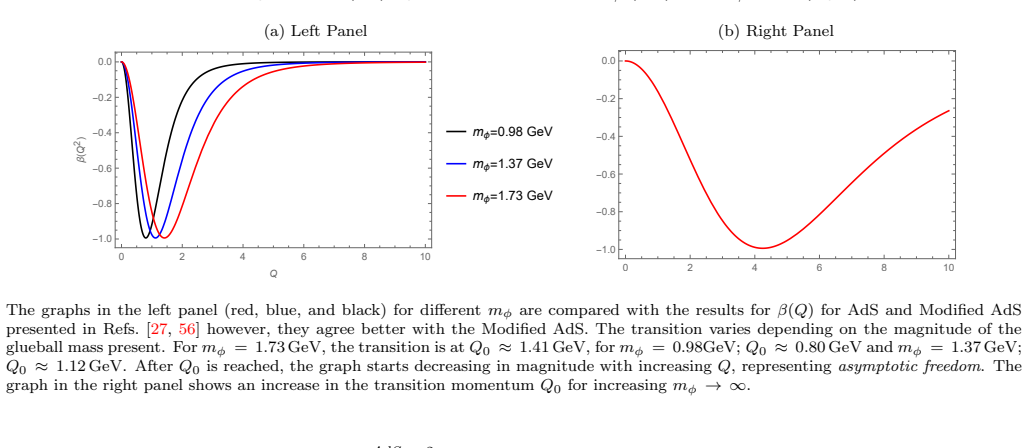
In the tachyonic AdS/QCD framework the color dielectric function G(φ(z)) modifies the bulk metric so that the effective strong coupling α_s^{AdS}(Q²) reproduces perturbative QCD features when z is small and nonperturbative QCD behavior when z is large, thereby furnishing a unified description of the running coupling and its β-function over all Q².
What carries the argument
The color dielectric function G(φ(z)) generated by the tachyon field φ(z), which deforms the AdS5 background and thereby sets the scale dependence of the coupling.
If this is right
- The β-function is obtained in closed form from UV to IR without separate matching procedures.
- The ultraviolet limit of α_s^{AdS}(Q²) agrees with perturbative QCD by construction.
- The infrared limit encodes nonperturbative effects arising from tachyon condensation.
- Intermediate-scale values of the coupling follow from the same continuous deformation.
Where Pith is reading between the lines
- The same deformed metric could be used to compute other observables such as meson masses while remaining consistent with the running coupling.
- The construction suggests that tachyon dynamics may provide a geometric account of the perturbative-to-confining transition in gauge theories.
- Predictions at specific intermediate Q² values could be confronted with lattice data to test the required form of G(φ(z)).
Load-bearing premise
A single choice of G(φ(z)) can be made that simultaneously matches perturbative running at small z and nonperturbative behavior at large z without inconsistencies or extra tuning.
What would settle it
Numerical extraction of α_s(Q²) from the model followed by direct comparison with lattice or experimental determinations of the strong coupling over a wide interval of Q².
Figures


read the original abstract
In this paper, we investigate the Quantum Chromodynamics (QCD)-like running coupling, $\alpha_s^{AdS}(Q^{2})$, and its associated $\beta$-function within a tachyonic Anti-de Sitter (AdS)/QCD framework. The $\text{AdS}_5$ bulk geometry is deformed through the introduction of a color dielectric function $G(\phi(z))$, associated with a tachyon field $\phi(z)$. This function governs the behavior of $\alpha_s^{AdS}(Q^{2})$ across all momentum scales by modifying the AdS background at both small and large values of the holographic coordinate $z$.In the ultraviolet (UV) regime (small $z$), the deformation is driven by free tachyons and reproduces features consistent with perturbative QCD. In contrast, in the infrared (IR) regime (large $z$), tachyon condensation dominates, yielding behavior characteristic of nonperturbative QCD. This construction enables a unified description of the running coupling and its $\beta$-function over the full range of momentum transfer $Q^2$, where $Q^2$ denotes the space-like momentum scale.
Editorial analysis
A structured set of objections, weighed in public.
Referee Report
Summary. The manuscript proposes a tachyonic AdS/QCD construction in which a color dielectric function G(φ(z)) associated with a tachyon field φ(z) deforms the AdS5 geometry. This deformation is used to extract a running coupling α_s^{AdS}(Q²) and its β-function that is claimed to reproduce perturbative QCD features in the UV (small z, free tachyons) and nonperturbative behavior in the IR (large z, tachyon condensation), thereby providing a unified description across all momentum scales.
Significance. A consistent, first-principles derivation of a single G(φ(z)) that simultaneously matches the known perturbative UV running and a viable nonperturbative IR form without additional scale-dependent adjustments would constitute a notable advance in holographic QCD. The manuscript does not yet demonstrate such a derivation or provide explicit equations, comparisons to data, or checks against the bulk equations of motion, so the significance remains prospective.
major comments (2)
- [Abstract] Abstract: The central claim that the deformed geometry reproduces the perturbative 1/log(Q²) UV running and a specific nonperturbative IR form rests on the functional choice of G(φ(z)), yet no explicit expression for G, no derivation of the resulting metric, and no extraction formula for α_s^{AdS}(Q²) are supplied. This leaves the construction circular by definition.
- [Introduction / Model definition] The skeptic concern is realized in the absence of any shown check that the chosen G satisfies the bulk equations of motion derived from the tachyonic action across the full z range; without this, the intermediate-Q² region may develop unphysical features or require retuning.
minor comments (1)
- [Abstract] Notation for the holographic coordinate and the precise definition of Q² in terms of the bulk radial coordinate should be stated explicitly at first use.
Simulated Author's Rebuttal
We thank the referee for their detailed reading and valuable comments on our manuscript. We address the major concerns point by point below, clarifying the construction and indicating where revisions will strengthen the presentation.
read point-by-point responses
-
Referee: [Abstract] Abstract: The central claim that the deformed geometry reproduces the perturbative 1/log(Q²) UV running and a specific nonperturbative IR form rests on the functional choice of G(φ(z)), yet no explicit expression for G, no derivation of the resulting metric, and no extraction formula for α_s^{AdS}(Q²) are supplied. This leaves the construction circular by definition.
Authors: The functional form of G(φ(z)) is introduced in the model section as the color dielectric factor tied to the tachyon profile that interpolates between the free-tachyon UV and condensed-tachyon IR regimes; the resulting metric deformation and the definition of α_s^{AdS}(Q²) via the effective coupling extracted from the deformed warp factor are also given there. Nevertheless, we agree that the abstract is overly concise and does not display these expressions. We will revise the abstract to include the explicit G(φ(z)), a one-sentence outline of the metric derivation, and the extraction formula for α_s^{AdS}(Q²), thereby removing any appearance of circularity. revision: yes
-
Referee: [Introduction / Model definition] The skeptic concern is realized in the absence of any shown check that the chosen G satisfies the bulk equations of motion derived from the tachyonic action across the full z range; without this, the intermediate-Q² region may develop unphysical features or require retuning.
Authors: The form of G(φ(z)) is chosen so that the Einstein equations and the tachyon equation of motion are satisfied analytically in the UV (small-z, free tachyon) and IR (large-z, condensed tachyon) limits. We acknowledge, however, that an explicit numerical or analytic verification of consistency with the full bulk equations of motion over the entire intermediate z interval is not provided. We will add a dedicated subsection or appendix that solves the equations of motion numerically for the selected G(φ(z)) and demonstrates that no unphysical features appear in the intermediate region. revision: yes
Circularity Check
G(φ(z)) chosen to enforce UV perturbative and IR nonperturbative limits by construction
specific steps
-
self definitional
[Abstract]
"The AdS5 bulk geometry is deformed through the introduction of a color dielectric function G(φ(z)), associated with a tachyon field φ(z). This function governs the behavior of α_s^AdS(Q²) across all momentum scales by modifying the AdS background at both small and large values of the holographic coordinate z. In the ultraviolet (UV) regime (small z), the deformation is driven by free tachyons and reproduces features consistent with perturbative QCD. In contrast, in the infrared (IR) regime (large z), tachyon condensation dominates, yielding behavior characteristic of nonperturbative QCD."
G(φ(z)) is defined and introduced precisely to produce the two desired asymptotic regimes; the resulting α_s^AdS(Q²) and β-function are therefore equivalent to the input choice of G rather than an independent derivation from the bulk action.
full rationale
The paper introduces the color dielectric function G(φ(z)) specifically to deform the AdS5 metric so that the extracted α_s^AdS(Q²) matches perturbative QCD in the UV (small z, free tachyons) and nonperturbative behavior in the IR (large z, tachyon condensation). No independent derivation or external benchmark for the functional form of G is provided; the running coupling and β-function are therefore defined by the choice of G rather than predicted from the tachyonic action alone. This reduces the central claim to a fitted interpolation. No other circular steps (self-citation chains or uniqueness theorems) are evident from the given text.
Axiom & Free-Parameter Ledger
free parameters (1)
- functional form and parameters of G(φ(z))
axioms (1)
- domain assumption The AdS/CFT correspondence can be applied to model QCD dynamics via a deformed AdS5 geometry
invented entities (2)
-
color dielectric function G(φ(z))
no independent evidence
-
tachyon field φ(z)
no independent evidence
Reference graph
Works this paper leans on
-
[1]
instead of the ’usual’ fixed time t. LF holography [22, 46–49] relates the equations of motion in AdS space to QCD Hamiltonian formalism in physical spacetime quantized on LF at τ. LFWFs in hadron physics are analogous to Schr¨ odinger wavefunctions in atomic physics [43]. The correspondence allows for a direct relationship between hadronic amplitude Φ(z) ...
-
[2]
Subsequently, we determined that the transition momentum Q0 is directly related to mφ as well
Other important results obtained from the model framework are; relationship between αAdS s (Q2), β(Q2) and mφ in both regions. Subsequently, we determined that the transition momentum Q0 is directly related to mφ as well. We determined that larger glueball masses are more likely to confine than lighter ones in relatively high momentum transfer regions. We ...
work page 2021
-
[3]
Gauge Theory Correlators from Non-Critical String Theory
S. S. Gubser, I. R. Klebanov and A. M. Polyakov, “Gauge theory correlators from noncritical string theory,” Phys. Lett. B 428, 105 (1998). [hep-th/9802109]
work page internal anchor Pith review Pith/arXiv arXiv 1998
-
[4]
Anti De Sitter Space And Holography
E. Witten, Anti-de Sitter space and holography , Adv. Theor. Math. Phys. 2 253 (1998) [hep-th/9802150]
work page internal anchor Pith review Pith/arXiv arXiv 1998
-
[5]
J. M. Maldacena, The large-N limit of superconformal field theories and supergravity, Int. J. Theor. Phys. 38, 1113 (1999) [arXiv:hep-th/9711200]
work page internal anchor Pith review Pith/arXiv arXiv 1999
-
[6]
’t Hooft, A Planar Diagram Theory for Strong Interactions , Nucl
G. ’t Hooft, A Planar Diagram Theory for Strong Interactions , Nucl. Phys. B 72, 461 (1974)
work page 1974
-
[7]
J. Polchinski, String Theory. Vol. 2 , ’Superstring Theory and Beyond ’ (Cambridge University Press, 1998)
work page 1998
-
[8]
I. R. Klebanov and M. J. Strassler, JHEP 0008, 052 (2000) [arXiv:hep-th/0007191]
work page internal anchor Pith review Pith/arXiv arXiv 2000
-
[9]
J. M. Maldacena and C. Nunez, Phys. Rev. Lett. 86, 588 (2001) [arXiv:hep-th/0008001]
work page internal anchor Pith review Pith/arXiv arXiv 2001
-
[10]
S. J. Rey and J. T. Yee, Eur. Physz. J. C 22, 379 (2001) [arXiv:hep-th/9803001]
work page internal anchor Pith review Pith/arXiv arXiv 2001
-
[11]
J. M. Maldacena, Phys. Rev. Lett. 80, 4859 (1998) [arXiv:hep-th/9803002]
work page internal anchor Pith review Pith/arXiv arXiv 1998
-
[12]
Anti-de Sitter Space, Thermal Phase Transition, And Confinement In Gauge Theories
E. Witten, Anti-de Sitter space, thermal phase transition, and confinement in gauge theories , Adv. Theor. Math. Phys. 2, 505 (1998) [arXiv:hep-th/9803131]
work page internal anchor Pith review Pith/arXiv arXiv 1998
-
[13]
S. W. Hawking and D. N. Page, Thermodynamics of Black Holes in Anti-de Sitter Space , Commun. Math. Phys. 87, 577 (1983)
work page 1983
-
[14]
A. E. Bernardini and R. da Rocha, Entropic information of dynamical AdS/QCD holographic models , Phys. Lett. B 762, 107 (2016)
work page 2016
-
[15]
A. E. Bernardini, N. R. F. Braga, and R. da Rocha, Conditional entropy of glueball states , Phys. Lett. B 765, 81 (2016)
work page 2016
-
[16]
L. F. Ferreira and R. da Rocha, Pion family in AdS/QCD: The next generation from configurational entropy , Phys. Rev. D 99, 086001 (2019); G. Karapetyan, Hadron multiplicity calculation: a configurational entropy approach to the saturation scale in QCD , Europhys. Lett. 129, 18002 (2020)
work page 2019
-
[17]
M. Gleiser and N. Stamatopoulos, Entropic Measure for Localized Energy Configurations: Kinks, Bounces, and Bubbles , Phys. Lett. B 713, 304 (2012)
work page 2012
-
[18]
M. Gleiser and N. Stamatopoulos, Information content of spontaneous symmetry breaking , Phys. Rev. D 86 , 045004 (2012)
work page 2012
-
[19]
E. D’Hoker and D. Z. Freedman, Supersymmetric Gauge Theories and the AdS/CFT Correspondence , [ arXiv:hep- th/0201253]
-
[20]
Beisert et al, Review of AdS/CFT Integrability: An Overview Lett
N. Beisert et al, Review of AdS/CFT Integrability: An Overview Lett. Math. Phys. 99, 3 (2012)
work page 2012
-
[21]
C. A. Ballon Bayona, H. Boschi-Filho, N. R. F. Braga, L. A. P. Zayas, On a Holographic Model for Confinement/Deconfinement Phys. Rev. D 77, 046002 (2008)
work page 2008
-
[22]
L. Susskind, The World as a Hologram , J. Math. Phys. 36, 6377 (1995) [arXiv:hep-th/9409089]; G. ’t Hooft, Dimensional Reduction in Quantum Gravity , Conf. Proc. C 930308, 284 (1993) [arXiv:gr-qc/9310026]
work page internal anchor Pith review Pith/arXiv arXiv 1995
-
[23]
S. J. Brodsky, G. F. de Teramond, H. G. Dosch and J. Erlich, Light-Front Holographic QCD and Emerging Confinement , Phys. Rept. 584, 1 (2015) [arXiv:1407.8131 [hep-ph]]. 16
work page internal anchor Pith review Pith/arXiv arXiv 2015
-
[24]
S. J. Brodsky and G. F. de Teramond, Hadronic Spectra and Light-Front Wavefunctions in Holographic QCD, Phys. Rev. Lett. 96, 201601 (2006) [arXiv:hep-ph/0602252]
work page internal anchor Pith review Pith/arXiv arXiv 2006
-
[25]
J. Polchinski and M. J. Strassler, Hard scattering and gauge/string duality, Phys. Rev. Lett. 88, 031601 (2002) [arXiv:hep- th/0109174]
-
[26]
J. Polchinski, M. J. Strassler, Deep inelastic scattering and gauge/string duality , JHEP 0305 , 012 (2003) [arXiv:hep- th/0209211]
-
[27]
H. B.-Filho and N. R.F. Braga, Gauge/string duality and scalar glueball mass ratios , JHEP 0305, 009 (2003) [arXiv:hep- th/0212207]
-
[28]
QCD/String holographic mapping and glueball mass spectrum
H. B.-Filho and N. R. F. Braga, QCD/string holographic mapping and glueball mass spectrum , Eur. Phys. J. C 32, 529 (2004) [arXiv:hep-th/0209080]
work page internal anchor Pith review Pith/arXiv arXiv 2004
-
[29]
S. J. Brodsky, G. D. Teramond and A. Deur, AdS/QCD, LIGHT-FRONT HOLOGRAPHY, AND THE NONPERTURBATIVE RUNNING COUPLING, Int. Jour. Mod. Phys. A 25, 5009 (2010)
work page 2010
-
[30]
S. J. Brodsky, G. F. de Teramond, Light front hadron dynamics and AdS/CFT correspondence , Phys. Lett. B 582, 211 (2004) [arXiv:hep-th/0310227]
work page internal anchor Pith review Pith/arXiv arXiv 2004
-
[31]
The (de)-confinement transition in tachyonic matter at finite temperature
A. Issifu and F. A. Brito, The (De)confinement Transition in Tachyonic Matter at Finite Temperature, Adv. High Energy Phys. 2019, 9450367 (2019) [arXiv:1706.09013[hep-th]]
work page internal anchor Pith review Pith/arXiv arXiv 2019
-
[32]
A. Issifu, Julio C.M. Rocha and F. A. Brito, Confinement of Fermions in Tachyon Matter at Finite Temperature , Adv. High Ener. Phys. 2021, 6645678 (2021)
work page 2021
-
[33]
A. Issifu and F. A. Brito, Confinement of fermions in tachyon matter , Adv. High Ener. Phys. 2021, 6645678 (2021) [arXiv:1904.02687 [hep-th]]
-
[34]
A. Issifu and F. A. Brito, An Effective Model for Glueballs and Dual Superconductivity at Finite Temperature , Adv. High Ener. Phys. 2021, 5658568 (2021) [arXiv:2105.01013 [hep-ph]]
-
[35]
Hidden SU(N) Glueball Dark Matter
A. Soni and Y. Zhang, Hidden SU(N) Glueball Dark Matter , Phys. Rev. D 93, 115025 (2016) [arXiv:1602.00714 [hep-ph]]
work page internal anchor Pith review Pith/arXiv arXiv 2016
-
[36]
Dirac-Born-Infeld Action on the Tachyon Kink and Vortex
A. Sen, Dirac-Born-Infeld action on the tachyon kink and vortex , Phs. Rev. D 68, 066008 (2003) [ arXiv:hep-th/0303057]
work page internal anchor Pith review Pith/arXiv arXiv 2003
-
[37]
J. D. Bjorken, Applications of the ChiralU(6) ×U(6) Algebra of Current Densities, Phys. Rev. 148, 1467 (1966); Erratum Phys. Rev. 160, 1582 (1967); J. D. Bjorken, Inelastic Scattering of Polarized Leptons from Polarized Nucleons , Phys. Rev. D 1, 1376 (1970)
work page 1966
-
[38]
C. Adolph, M. Aghasyan, R. Akhunzyanov, and M. G. Alexeev, et al., Final COMPASS results on the deuteron spin- dependent structure function gd 1 and the Bjorken sum rule , Phys. Lett. B 769, 34 (2017) [1612.00620 [hep-ex]]
work page internal anchor Pith review Pith/arXiv arXiv 2017
- [39]
-
[40]
A. Deur, P. Bosted, V. Burkert, G. Cates et al., Experimental Determination of the Evolution of the Bjorken Integral at LowQ2, Phys. Rev. Lett. 93, 212001 (2004) [hep-ex/0407007 [hep-ex]]. A. Deur, Y. Prok, V. Burkert, D. Crabb et al. , High precision determination of the Q2-evolution of the Bjorken Sum , Phys. Rev. D 90, 012009 (2014) [arXiv:1405.7854 [n...
work page internal anchor Pith review Pith/arXiv arXiv 2004
-
[41]
K. A. Olive et al. [Particle Data Group Collaboration], Review of Particle Physics , Chin. Phys. C 38, 090001 (2014)
work page 2014
-
[43]
The QCD Running Coupling and its Measurement
G. Altarelli, The QCD running coupling and its measurement , PoS Corfu 2012, 002 (2013) [arXiv:1303.6065 [hep-ph]]
work page internal anchor Pith review Pith/arXiv arXiv 2012
- [44]
- [46]
-
[47]
P. A. M. Dirac, Forms of Relativistic Dynamics , Rev. Mod. Phys. 21, 392 (1949)
work page 1949
-
[48]
G. F. de Teramond and S. J. Brodsky, Light-Front Holography and Gauge/Gravity Duality: The Light Meson and Baryon Spectra, Nucl. Phys. B, Proc. Suppl. 199, 89 (2010) [arXiv:0909.3900 [hep-ph]]
work page internal anchor Pith review Pith/arXiv arXiv 2010
-
[49]
S. J. Brodsky and G. F. de Teramond, Light-Front Dynamics and AdS/QCD Correspondence: The Pion Form Factor in the Space- and Time-Like Regions , Phys. Rev. D 77, 056007 (2008) [arXiv:0707.3859 [hep-ph]]
work page internal anchor Pith review Pith/arXiv arXiv 2008
-
[50]
S. J. Brodsky and G. F. de Teramond, Light-Front Dynamics and AdS/QCD Correspondence: Gravitational Form Factors of Composite Hadrons, Phys. Rev D 78, 025032 (2008) [arXiv:0804.0452 [hep-ph]]
work page internal anchor Pith review Pith/arXiv arXiv 2008
-
[51]
G. F. de Teramond and S. J. Brodsky, Light-front holography: a first approximation to QCD , Phys. Rev. Lett. 102, 081601 (2009) [arXiv:0809.4899 [hep-ph]]
work page internal anchor Pith review Pith/arXiv arXiv 2009
-
[52]
Gravitational Form Factors of Vector Mesons in an AdS/QCD Model
Z. Abidin and C. E. Carlson, Gravitational Form Factors of Vector Mesons in an AdS/QCD Model , Phys. Rev. D 77, 095007 (2008) [arXiv:0801.3839 [hep-ph]]
work page internal anchor Pith review Pith/arXiv arXiv 2008
-
[53]
J. D. Bjorken, Asymptotic Sum Rules at Infinite Momentum , Phys. Rev. 179, 1547 (1969)
work page 1969
-
[54]
D. J. Gross and F. Wilczek, Asymptotically Free Gauge Theories. I &II, Phys. Rev. D 8, 3633 (1973); Phys. Rev. D 9, 980 (974)
work page 1973
-
[55]
H. Georgi and H. D. Politzer, Electroproduction scaling in an asymptotically free theory of strong interactions , Phys. Rev. D 9, 416 (1974)
work page 1974
-
[56]
S. J. Brodsky and R. Shrock, Maximum Wavelength of Confined Quarks and Gluons and Properties of Quantum 17 Chromodynamics, Phys. Lett. B 666, 95 (2008) [arXiv:0806.1535 [hep-th]]
work page internal anchor Pith review Pith/arXiv arXiv 2008
-
[57]
J. M. Cornwall, Dynamical Mass Generation in Continuum QCD , Phys. Rev. D 26, 1453 (1982)
work page 1982
-
[58]
S. J. Brodsky, G. F. de T´ eramond and A. Deur, Nonperturbative QCD Coupling and its β-function from Light-Front Holography, Phys. Rev. D 81, 096010 (2010) [arXiv:1002.3948 [hep-ph]]
work page internal anchor Pith review Pith/arXiv arXiv 2010
-
[59]
Linear Confinement and AdS/QCD
A. Karch, E. Katz, D. T. Son and M. A. Stephanov, Linear Confinement and AdS/QCD, Phys. Rev. D 74, 015005 (2006) [arXiv:hep-ph/0602229]. S. J. Brodsky and G. F. de Teramond, Applications of AdS/QCD and Light-Front Holography to Baryon Physics , AIP Conf. Proc. 1388 1, 22 (2011) [1103.1186 [hep-ph]]
work page internal anchor Pith review Pith/arXiv arXiv 2006
-
[60]
O. Andreev and V. I. Zakharov, Heavy-quark potentials and AdS/QCD , Phys. Rev. D 74 , 025023 (2006) [arXiv:hep- ph/0604204]
-
[61]
K. K. Boddy, J. L. Feng, M. Kaplinghat and T. M. P. Tait, Self-Interacting Dark Matter from a Non-Abelian Hidden Sector, Phys. Rev. D 89, 115017 (2014) [arXiv:1402.3629 [hep-ph]]; K. K. Boddy, J. L. Feng, M. Kaplinghat, Y. Shadmi, T. M. P. Tait, SIMPle Dark Matter: Self-Interactions and keV Lines, Phys. Rev. D 90, 095016 (2014) [arXiv:1408.6532 [hep-ph]]
work page internal anchor Pith review Pith/arXiv arXiv 2014
-
[62]
D. D. Dietrich and F. Sannino, Walking in the SU(N) , Phys. Rev. D 75, 085018 (2007) [arXiv:hep-ph/0611341]
work page internal anchor Pith review Pith/arXiv arXiv 2007
-
[63]
The Phase Structure of an SU(N) Gauge Theory with N_f Flavors
T. Appelquist, A. Ratnaweera, J. Terning, and L. C. R. Wijewardhana, The Phase Structure of an SU(N) Gauge Theory with Nf Flavors, Phys. Rev. D 58, 105017 (1998) [arXiv:hep-ph/9806472]
work page internal anchor Pith review Pith/arXiv arXiv 1998
-
[64]
M. Born and L. Infeld, Foundations of the new field theory , Proc. Roy. Soc. Lond. A 144, 852, 425 (1934); J. Phys. Soc. Jap. 8, 307 (1934)
work page 1934
-
[65]
G. W. Gibbons, Born-Infeld particles and Dirichlet p-branes , Nucl. Phys. B 514, 603 (1998) []arXiv:hep-th/9709027]
work page internal anchor Pith review Pith/arXiv arXiv 1998
-
[66]
P. A. M. Dirac, An Extensible model of the electron , Proc. Roy. Soc. Lond. A 268, 57 (1962)
work page 1962
-
[67]
J. Polchinski, S. Chaudhuri and C. V. Johnson, Notes on D-Branes , [arXiv:hep-th/9602052]; J. Polchinski, TASI Lectures on D-Branes, [arXiv:hep-th/9611050]
work page internal anchor Pith review Pith/arXiv arXiv
-
[68]
Lectures on D-branes, Gauge Theory and M(atrices)
W. Taylor, Lectures on D-branes, Gauge Theory and M(atrices) , [arXiv:hep-th/9801182]
work page internal anchor Pith review Pith/arXiv arXiv
-
[69]
Stable Non-BPS Bound States of BPS D-branes
A. Sen, Stable Non-BPS Bound States of BPS D-branes , JHEP 9808, 010 (1998) []arXiv:hep-th/9805019]
work page internal anchor Pith review Pith/arXiv arXiv 1998
-
[70]
A. Sen, BPS D-branes on Non-supersymmetric Cycles , JHEP 9812, 021 (1998) [arXiv:hep-th/9812031]; Tachyon Condensation on the Brane Antibrane System , JHEP 9808, 012 (1998) [arXiv:hep-th/9805170]; Type I D-particle and its Interactions , JHEP 9810, 021 (1998) [arXiv:hep-th/9809111]
work page internal anchor Pith review Pith/arXiv arXiv 1998
-
[71]
A. Sen, SO(32) Spinors of Type I and Other Solitons on Brane-Antibrane Pair , JHEP 9809, 023 (1998) [arXiv:hep- th/9808141]
-
[72]
Boundary Deformation Theory and Moduli Spaces of D-Branes
A. Recknagel and V. Schomerus, Boundary Deformation Theory and Moduli Spaces of D-Branes , Nucl. Phys. B 545, 233 (1999) [arXiv:hep-th/9811237]; C. G. Callan, I. R. Klebanov, A. W. W. Ludwig and J. M. Maldacena, Exact Solution of a Boundary Conformal Field Theory, Nucl. Phys. B 422, 417 (1994) []arXiv:hep-th/9402113]; J. Polchinski and L. Thorlacius, Free...
work page internal anchor Pith review Pith/arXiv arXiv 1999
-
[73]
J. A. Harvey, D. Kutasov and E. J. Martinec, On the relevance of tachyons , [arXiv:hep-th/0003101]; P. Fendley, H. Saleur and N. P. Warner, Exact solution of a massless scalar field with a relevant boundary interaction , Nucl. Phys. B 430, 577 (1994) [arXiv:hep-th/9406125]; J. Majumder and A. Sen, Vortex Pair Creation on Brane-Antibrane Pair via Marginal D...
work page internal anchor Pith review Pith/arXiv arXiv 1994
-
[74]
Universality of the Tachyon Potential
A. Sen, Universality of the Tachyon Potential , JHEP 9912, 027 (1999) [arXiv:hep-th/9911116]
work page internal anchor Pith review Pith/arXiv arXiv 1999
-
[75]
Tachyon condensation in string field theory
A. Sen and B. Zwiebach, Tachyon condensation in string field theory , JHEP 0003, 002 (2000) [arXiv:hep-th/9912249]
work page internal anchor Pith review Pith/arXiv arXiv 2000
-
[76]
Expectation Values, Lorentz Invariance, and CPT in the Open Bosonic String
A. Kostelecky and R. Potting, Expectation Values, Lorentz Invariance, and CPT in the Open Bosonic String , Phys. Lett. B 381, 89 (1996) []arXiv:hep-th/9605088]; N. Berkovits, The Tachyon Potential in Open Neveu-Schwarz String Field Theory , JHEP 0004, 022 (2000) [arXiv:hep- th/0001084]; W. Taylor, D-brane effective field theory from string field theory , Nuc...
work page internal anchor Pith review Pith/arXiv arXiv 1996
-
[77]
V. A. Kostelecky and S. Samuel, The Static Tachyon Potential in the Open Bosonic String Theory , Phys. Lett. B 207, 169 (1988)
work page 1988
-
[78]
Tachyon Condensation in Superstring Field Theory
N. Berkovits, A. Sen and B. Zwiebach, Tachyon condensation in superstring field theory , Nuc. Phys. B 587, 147 (2000) [arXiv:hep-th/0002211]
work page internal anchor Pith review Pith/arXiv arXiv 2000
-
[79]
J. A. Harvey, Per Kraus, F. Larsen and E. J. Martinec, D-branes and Strings as Non-commutative Solitons , JHEP 0007, 042 (2000) [arXiv:hep-th/0005031]
work page internal anchor Pith review Pith/arXiv arXiv 2000
-
[80]
R. Gopakumar, S. Minwalla and A. Strominger, Noncommutative Solitons , JHEP 0005, 020 (2000) [arXiv:hep- th/0003160]; 18 K. Dasgupta, S. Mukhi and G. Rajesh, Noncommutative Tachyons, JHEP 0006, 022 (2000) [arXiv:hep-th/0005006]; J. A. Harvey, P. Kraus and F. Larsen, Exact Noncommutative Solitons , JHEP 0012, 024 (2000) [arXiv:hep-th/0010060]
-
[81]
A. A. Gerasimov and S. L. Shatashvili, On Exact Tachyon Potential in Open String Field Theory , JHEP 0010, 034 (2000) [arXiv:hep-th/000910]3; D. Kutasov, M. Marino and G. Moore, Some Exact Results on Tachyon Condensation in String Field Theory , JHEP 0010, 045 (2000) [arXiv:hep-th/0009148]; D. Ghoshal and A. Sen, Normalization of the Background Independen...
work page internal anchor Pith review Pith/arXiv arXiv 2000
-
[82]
String Theory and Noncommutative Geometry
E. Witten, Non-commutative geometry and string field theory , Nuc. Phys. B 268, 253 (1986); N. Seiberg and E. Witten, String Theory and Noncommutative Geometry, JHEP 9909, 032 (1999) [arXiv:hep-th/9908142]
work page internal anchor Pith review Pith/arXiv arXiv 1986
discussion (0)
Sign in with ORCID, Apple, or X to comment. Anyone can read and Pith papers without signing in.