Non-Invertible Anyon Condensation and Level-Rank Dualities
Pith reviewed 2026-05-24 05:37 UTC · model grok-4.3
The pith
Non-invertible anyon condensation generates generalized level-rank dualities for three-dimensional topological quantum field theories.
A machine-rendered reading of the paper's core claim, the machinery that carries it, and where it could break.
Core claim
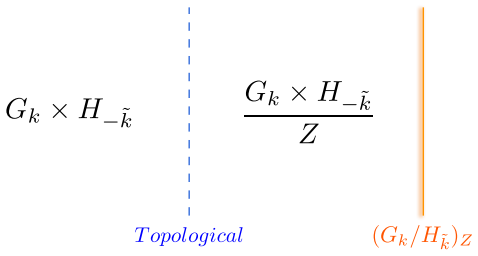
The authors derive that non-abelian anyon condensation, defined as the gauging of collections of topological lines with non-invertible fusion rules, produces new dualities that generalize level-rank dualities. This condensation unifies conformal embeddings and Maverick cosets, with examples including the parafermion theory as (SU(N)_2 × Spin(N)_{-4})/A_N, points on the c=1 orbifold as (Spin(2N)_2 × Spin(N)_{-2} × Spin(N)_{-2})/B_N, and SU(2)_N as (USp(2N)_1 × SO(N)_{-4})/C_N.
What carries the argument
non-abelian anyon condensation, the gauging of topological lines whose fusion rules are not those of a group
If this is right
- The dualities hold for infinite series involving the quotients A_N, B_N, and C_N.
- Exceptional phenomena in TQFTs and RCFTs receive a uniform explanation through this condensation.
- New presentations of known theories become available, such as the parafermion and orbifold CFTs.
- The modular data of the condensed theories match those of the dual descriptions.
Where Pith is reading between the lines
- This mechanism may classify a larger set of dualities than previously recognized.
- Computations of boundary states or correlation functions could be simplified using the new presentations.
- Extensions to other gauge groups or higher-rank cases might yield further dualities.
Load-bearing premise
That non-abelian anyon condensation can be performed consistently in these theories without producing inconsistencies in the modular data or the associated conformal field theories.
What would settle it
A mismatch between the modular S-matrix or central charge computed from the condensed theory and that of the claimed dual theory would falsify the duality.
Figures



read the original abstract
We derive new dualities of topological quantum field theories in three spacetime dimensions that generalize the familiar level-rank dualities of Chern-Simons gauge theories. The key ingredient in these dualities is non-abelian anyon condensation, which is a gauging operation for topological lines with non-group-like i.e. non-invertible fusion rules. We find that, generically, dualities involve such non-invertible anyon condensation and that this unifies a variety of exceptional phenomena in topological field theories and their associated boundary rational conformal field theories, including conformal embeddings, and Maverick cosets (those where standard algorithms for constructing a coset model fail.) We illustrate our discussion in a variety of isolated examples as well as new infinite series of dualities involving non-abelian anyon condensation including: i) a new description of the parafermion theory as $(SU(N)_{2} \times Spin(N)_{-4})/\mathcal{A}_{N},$ ii) a new presentation of a series of points on the orbifold branch of $c=1$ conformal field theories as $(Spin(2N)_{2} \times Spin(N)_{-2} \times Spin(N)_{-2})/\mathcal{B}_{N}$, and iii) a new dual form of $SU(2)_{N}$ as $(USp(2N)_{1} \times SO(N)_{-4})/\mathcal{C}_{N}$ arising from conformal embeddings, where $\mathcal{A}_{N}, \mathcal{B}_{N},$ and $\mathcal{C}_{N}$ are appropriate collections of gauged non-invertible bosons.
Editorial analysis
A structured set of objections, weighed in public.
Referee Report
Summary. The paper claims to derive new dualities of 3d TQFTs that generalize level-rank dualities of Chern-Simons theories. The key mechanism is non-abelian anyon condensation (gauging topological lines with non-group-like fusion rules). It asserts that this unifies exceptional phenomena including conformal embeddings and Maverick cosets, and provides explicit infinite families: the parafermion theory as (SU(N)_2 × Spin(N)_{-4})/A_N, c=1 orbifold points as (Spin(2N)_2 × Spin(N)_{-2} × Spin(N)_{-2})/B_N, and SU(2)_N as (USp(2N)_1 × SO(N)_{-4})/C_N, where A_N, B_N, C_N are collections of gauged non-invertible bosons.
Significance. If the non-invertible condensation constructions are shown to yield consistent TQFTs whose modular S/T matrices and central charges exactly reproduce the target theories for generic N, the result would unify a range of exceptional dualities and boundary phenomena under a single gauging operation, extending beyond abelian condensation.
major comments (2)
- [Abstract] Abstract: the claim that gauging the collections A_N, B_N, C_N produces consistent 3d TQFTs with matching modular data for the infinite families (parafermions, c=1 orbifolds, SU(2)_N) is load-bearing for the unification statement, yet the provided constructions do not include explicit verification that the resulting fusion rules remain anomaly-free and that the S-matrix and central charge reproduce the targets without post-hoc adjustments.
- [Abstract] Abstract: the assertion that 'generically, dualities involve such non-invertible anyon condensation' requires showing that the standard level-rank dualities emerge as special cases of the new construction or that the exceptional cases are covered without circular reliance on the target modular data to define the gauged lines.
minor comments (1)
- The definitions of the collections A_N, B_N, C_N are referred to only as 'appropriate collections'; explicit listing of the gauged lines and their fusion rules would improve readability.
Simulated Author's Rebuttal
We thank the referee for their careful reading and constructive feedback. We address the two major comments point by point below, proposing clarifications and additions where appropriate to strengthen the presentation of the infinite-family constructions.
read point-by-point responses
-
Referee: [Abstract] Abstract: the claim that gauging the collections A_N, B_N, C_N produces consistent 3d TQFTs with matching modular data for the infinite families (parafermions, c=1 orbifolds, SU(2)_N) is load-bearing for the unification statement, yet the provided constructions do not include explicit verification that the resulting fusion rules remain anomaly-free and that the S-matrix and central charge reproduce the targets without post-hoc adjustments.
Authors: We agree that a more explicit verification for generic N would strengthen the unification claim. The manuscript defines the collections A_N, B_N, C_N from the fusion rules of the parent theories and verifies consistency (including anomaly-freeness via the condensation procedure and central-charge matching) for representative small N in the examples; the general case follows from the topological properties of non-invertible condensation. We will add an appendix with explicit S- and T-matrix computations for additional small N together with a general argument that the post-condensation fusion rules remain consistent without reference to the target data. revision: yes
-
Referee: [Abstract] Abstract: the assertion that 'generically, dualities involve such non-invertible anyon condensation' requires showing that the standard level-rank dualities emerge as special cases of the new construction or that the exceptional cases are covered without circular reliance on the target modular data to define the gauged lines.
Authors: Section 2 and the beginning of Section 4 show that ordinary level-rank dualities are recovered when the relevant anyons become invertible (e.g., at specific small values of N where the fusion rules reduce to group-like). The lines in A_N, B_N, C_N are identified directly from the fusion category of the parent TQFTs (SU(N)_2 × Spin(N)_{-4}, etc.) prior to any reference to the target modular data, so the construction is not circular. We will add a short clarifying paragraph emphasizing this independence. revision: partial
Circularity Check
Minor self-citation not load-bearing; central derivation independent
full rationale
The paper introduces non-invertible anyon condensation as a gauging operation on topological lines and applies it to construct explicit dualities such as (SU(N)_2 × Spin(N)_{-4})/A_N for parafermions. The derivation proceeds by defining the collections A_N, B_N, C_N and verifying the resulting modular data and central charges match target theories. No equation reduces a claimed prediction to a fitted input or self-referential definition. Prior self-citations supply background on non-invertible symmetries but do not bear the load of proving consistency or uniqueness for the new families; those rest on direct construction. The result is therefore self-contained against external modular-data benchmarks.
Axiom & Free-Parameter Ledger
axioms (1)
- domain assumption Three-dimensional TQFTs admit consistent gauging operations on topological lines whose fusion rules are non-invertible.
invented entities (1)
-
Collections A_N, B_N, C_N of gauged non-invertible bosons
no independent evidence
Lean theorems connected to this paper
-
IndisputableMonolith/Foundation/RealityFromDistinction.leanreality_from_one_distinction unclear?
unclearRelation between the paper passage and the cited Recognition theorem.
non-abelian anyon condensation... gauging of topological lines with non-group-like fusion rules
-
IndisputableMonolith/Cost/FunctionalEquation.leanwashburn_uniqueness_aczel unclear?
unclearRelation between the paper passage and the cited Recognition theorem.
Maverick cosets... conformal embeddings... level-rank dualities
What do these tags mean?
- matches
- The paper's claim is directly supported by a theorem in the formal canon.
- supports
- The theorem supports part of the paper's argument, but the paper may add assumptions or extra steps.
- extends
- The paper goes beyond the formal theorem; the theorem is a base layer rather than the whole result.
- uses
- The paper appears to rely on the theorem as machinery.
- contradicts
- The paper's claim conflicts with a theorem or certificate in the canon.
- unclear
- Pith found a possible connection, but the passage is too broad, indirect, or ambiguous to say the theorem truly supports the claim.
Forward citations
Cited by 2 Pith papers
-
Generalizing quantum dimensions: Symmetry-based classification of local pseudo-Hermitian systems and the corresponding domain walls
Generalized quantum dimensions from SymTFTs classify massless and massive RG flows in pseudo-Hermitian systems and relate coset constructions to domain walls.
-
Homomorphism, substructure, and ideal: Elementary but rigorous aspects of renormalization group or hierarchical structure of topological orders
An algebraic RG formalism for topological orders uses ideals in fusion rings to encode noninvertible symmetries and condensation rules between anyons.
Reference graph
Works this paper leans on
-
[1]
T. Nakanishi and A. Tsuchiya, Level rank duality of WZW models in conformal field theory , Commun. Math. Phys. 144 (1992) 351–372
work page 1992
-
[2]
S. G. Naculich, H. A. Riggs, and H. J. Schnitzer, Group Level Duality in WZW Models and Chern-Simons Theory, Phys. Lett. B 246 (1990) 417–422
work page 1990
-
[3]
E. J. Mlawer, S. G. Naculich, H. A. Riggs, and H. J. Schnitzer, Group level duality of WZW fusion coefficients and Chern-Simons link observables , Nucl. Phys. B 352 (1991) 863–896
work page 1991
-
[4]
The Verlinde Algebra And The Cohomology Of The Grassmannian
E. Witten, The Verlinde algebra and the cohomology of the Grassmannian , [hep-th/9312104]
work page internal anchor Pith review Pith/arXiv arXiv
-
[5]
M. R. Douglas, Chern-Simons-Witten theory as a topological Fermi liquid , [hep-th/9403119]
work page internal anchor Pith review Pith/arXiv arXiv
-
[6]
S. G. Naculich and H. J. Schnitzer, Level-rank duality of the U(N) WZW model, Chern-Simons theory, and 2-D qYM theory , JHEP 06 (2007) 023, [ hep-th/0703089]
work page internal anchor Pith review Pith/arXiv arXiv 2007
-
[7]
Level/rank Duality and Chern-Simons-Matter Theories
P.-S. Hsin and N. Seiberg, Level/rank Duality and Chern-Simons-Matter Theories , JHEP 09 (2016) 095, [ arXiv:1607.07457]
work page internal anchor Pith review Pith/arXiv arXiv 2016
-
[8]
Chern-Simons-matter dualities with $SO$ and $USp$ gauge groups
O. Aharony, F. Benini, P.-S. Hsin, and N. Seiberg, Chern-Simons-matter dualities with SO and U Sp gauge groups, JHEP 02 (2017) 072, [ arXiv:1611.07874]
work page internal anchor Pith review Pith/arXiv arXiv 2017
-
[9]
C. Cordova, P.-S. Hsin, and N. Seiberg, Global Symmetries, Counterterms, and Duality in Chern-Simons Matter Theories with Orthogonal Gauge Groups , SciPost Phys. 4 (2018), no. 4 021, [ arXiv:1711.10008]
work page internal anchor Pith review Pith/arXiv arXiv 2018
-
[10]
C. C´ ordova, P.-S. Hsin, and K. Ohmori,Exceptional Chern-Simons-Matter Dualities , SciPost Phys. 7 (2019), no. 4 056, [ arXiv:1812.11705]
-
[11]
Phases Of Adjoint QCD$_3$ And Dualities
J. Gomis, Z. Komargodski, and N. Seiberg, Phases Of Adjoint QCD 3 And Dualities, SciPost Phys. 5 (2018), no. 1 007, [ arXiv:1710.03258]
work page internal anchor Pith review Pith/arXiv arXiv 2018
-
[12]
Time-Reversal Symmetry, Anomalies, and Dualities in (2+1)$d$
C. C´ ordova, P.-S. Hsin, and N. Seiberg,Time-Reversal Symmetry, Anomalies, and Dualities in (2+1) d, SciPost Phys. 5 (2018), no. 1 006, [ arXiv:1712.08639]
work page internal anchor Pith review Pith/arXiv arXiv 2018
-
[13]
Witten, Quantum Field Theory and the Jones Polynomial , Commun
E. Witten, Quantum Field Theory and the Jones Polynomial , Commun. Math. Phys. 121 (1989) 351–399
work page 1989
-
[14]
S. Elitzur, G. W. Moore, A. Schwimmer, and N. Seiberg, Remarks on the Canonical Quantization of the Chern-Simons-Witten Theory , Nucl. Phys. B 326 (1989) 108–134. 77
work page 1989
-
[15]
P. Di Francesco, P. Mathieu, and D. Senechal, Conformal Field Theory . Graduate Texts in Contemporary Physics. Springer-Verlag, New York, 1997
work page 1997
-
[16]
G. W. Moore and N. Seiberg, Taming the Conformal Zoo, Phys. Lett. B 220 (1989) 422–430
work page 1989
-
[17]
Coupling a QFT to a TQFT and Duality
A. Kapustin and N. Seiberg, Coupling a QFT to a TQFT and Duality , JHEP 04 (2014) 001, [arXiv:1401.0740]
work page internal anchor Pith review Pith/arXiv arXiv 2014
-
[18]
D. Gaiotto, A. Kapustin, N. Seiberg, and B. Willett, Generalized Global Symmetries, JHEP 02 (2015) 172, [ arXiv:1412.5148]
work page internal anchor Pith review Pith/arXiv arXiv 2015
-
[19]
P.-S. Hsin, H. T. Lam, and N. Seiberg, Comments on One-Form Global Symmetries and Their Gauging in 3d and 4d , SciPost Phys. 6 (2019), no. 3 039, [ arXiv:1812.04716]
work page internal anchor Pith review Pith/arXiv arXiv 2019
-
[20]
D. C. Dunbar and K. G. Joshi, Characters for coset conformal field theories , Int. J. Mod. Phys. A 8 (1993) 4103–4122, [ hep-th/9210122]
work page internal anchor Pith review Pith/arXiv arXiv 1993
-
[21]
D. C. Dunbar and K. G. Joshi, Maverick examples of coset conformal field theories , Mod. Phys. Lett. A 8 (1993) 2803–2814, [ hep-th/9309093]
work page internal anchor Pith review Pith/arXiv arXiv 1993
-
[22]
Correspondences of ribbon categories
J. Frohlich, J. Fuchs, I. Runkel, and C. Schweigert, Correspondences of ribbon categories, Adv. Math. 199 (2006) 192–329, [ math/0309465]
work page internal anchor Pith review Pith/arXiv arXiv 2006
-
[23]
F. A. Bais and J. K. Slingerland, Condensate induced transitions between topologically ordered phases, Phys. Rev. B 79 (2009) 045316, [ arXiv:0808.0627]
work page internal anchor Pith review Pith/arXiv arXiv 2009
-
[24]
Snowmass White Paper: Generalized Symmetries in Quantum Field Theory and Beyond
C. Cordova, T. T. Dumitrescu, K. Intriligator, and S.-H. Shao, Snowmass White Paper: Generalized Symmetries in Quantum Field Theory and Beyond , in Snowmass 2021, 5, 2022. arXiv:2205.09545
work page internal anchor Pith review Pith/arXiv arXiv 2021
-
[25]
ICTP Lectures on (Non-)Invertible Generalized Symmetries
S. Schafer-Nameki, ICTP Lectures on (Non-)Invertible Generalized Symmetries , [arXiv:2305.18296]
work page internal anchor Pith review Pith/arXiv arXiv
-
[26]
What's Done Cannot Be Undone: TASI Lectures on Non-Invertible Symmetries
S.-H. Shao, What’s Done Cannot Be Undone: TASI Lectures on Non-Invertible Symmetry , [arXiv:2308.00747]
work page internal anchor Pith review Pith/arXiv arXiv
-
[27]
TFT construction of RCFT correlators I: Partition functions
J. Fuchs, I. Runkel, and C. Schweigert, TFT construction of RCFT correlators 1. Partition functions, Nucl. Phys. B 646 (2002) 353–497, [ hep-th/0204148]
work page internal anchor Pith review Pith/arXiv arXiv 2002
-
[28]
TFT construction of RCFT correlators II: Unoriented world sheets
J. Fuchs, I. Runkel, and C. Schweigert, TFT construction of RCFT correlators. 2. Unoriented world sheets, Nucl. Phys. B 678 (2004) 511–637, [ hep-th/0306164]
work page internal anchor Pith review Pith/arXiv arXiv 2004
-
[29]
TFT construction of RCFT correlators III: Simple currents
J. Fuchs, I. Runkel, and C. Schweigert, TFT construction of RCFT correlators. 3. Simple currents, Nucl. Phys. B 694 (2004) 277–353, [ hep-th/0403157]. 78
work page internal anchor Pith review Pith/arXiv arXiv 2004
-
[30]
TFT construction of RCFT correlators IV: Structure constants and correlation functions
J. Fuchs, I. Runkel, and C. Schweigert, TFT construction of RCFT correlators IV: Structure constants and correlation functions , Nucl. Phys. B 715 (2005) 539–638, [ hep-th/0412290]
work page internal anchor Pith review Pith/arXiv arXiv 2005
-
[31]
Kramers-Wannier duality from conformal defects
J. Frohlich, J. Fuchs, I. Runkel, and C. Schweigert, Kramers-Wannier duality from conformal defects, Phys. Rev. Lett. 93 (2004) 070601, [ cond-mat/0404051]
work page internal anchor Pith review Pith/arXiv arXiv 2004
-
[32]
Duality and defects in rational conformal field theory
J. Frohlich, J. Fuchs, I. Runkel, and C. Schweigert, Duality and defects in rational conformal field theory, Nucl. Phys. B 763 (2007) 354–430, [ hep-th/0607247]
work page internal anchor Pith review Pith/arXiv arXiv 2007
-
[33]
M. M¨ uger,From subfactors to categories and topology ii. the quantum double of tensor categories and subfactors, arXiv preprint math/0111205 (2001)
work page internal anchor Pith review Pith/arXiv arXiv 2001
-
[34]
M. M¨ uger,Galois theory for braided tensor categories and the modular closure , Advances in Mathematics 150 (2000), no. 2 151–201
work page 2000
-
[35]
A. Kirillov Jr and V. Ostrik, On a q-analogue of the mckay correspondence and the ade classification of sl2 conformal field theories , Advances in Mathematics 171 (2002), no. 2 183–227
work page 2002
-
[36]
A. Davydov, M. M¨ uger, D. Nikshych, and V. Ostrik, The witt group of non-degenerate braided fusion categories, Journal f¨ ur die reine und angewandte Mathematik (Crelles Journal) 2013 (2013), no. 677 135–177
work page 2013
-
[37]
Generalized ADE Classification of Gapped Domain Walls
L.-Y. Hung and Y. Wan, Generalized ADE classification of topological boundaries and anyon condensation, JHEP 07 (2015) 120, [ arXiv:1502.02026]
work page internal anchor Pith review Pith/arXiv arXiv 2015
-
[38]
Kong, Anyon condensation and tensor categories , Nuclear Physics B 886 (2014) 436–482
L. Kong, Anyon condensation and tensor categories , Nuclear Physics B 886 (2014) 436–482
work page 2014
-
[39]
Topological Defect Lines and Renormalization Group Flows in Two Dimensions
C.-M. Chang, Y.-H. Lin, S.-H. Shao, Y. Wang, and X. Yin, Topological Defect Lines and Renormalization Group Flows in Two Dimensions , JHEP 01 (2019) 026, [arXiv:1802.04445]
work page internal anchor Pith review Pith/arXiv arXiv 2019
-
[40]
Fusion Category Symmetry I: Anomaly In-Flow and Gapped Phases
R. Thorngren and Y. Wang, Fusion Category Symmetry I: Anomaly In-Flow and Gapped Phases, [arXiv:1912.02817]
work page internal anchor Pith review arXiv 1912
-
[41]
R. Thorngren and Y. Wang, Fusion Category Symmetry II: Categoriosities at c = 1 and Beyond, [arXiv:2106.12577]
-
[42]
T.-C. Huang, Y.-H. Lin, and S. Seifnashri, Construction of two-dimensional topological field theories with non-invertible symmetries , JHEP 12 (2021) 028, [ arXiv:2110.02958]
- [43]
-
[44]
D. Gaiotto and J. Kulp, Orbifold groupoids, JHEP 02 (2021) 132, [ arXiv:2008.05960]. 79
-
[45]
D. S. Freed, G. W. Moore, and C. Teleman, Topological symmetry in quantum field theory , [arXiv:2209.07471]
work page internal anchor Pith review arXiv
- [46]
- [47]
-
[48]
L. Bhardwaj and S. Schafer-Nameki, Generalized Charges, Part II: Non-Invertible Symmetries and the Symmetry TFT , [arXiv:2305.17159]
-
[49]
L. Bhardwaj and Y. Tachikawa, On finite symmetries and their gauging in two dimensions , JHEP 03 (2018) 189, [ arXiv:1704.02330]
-
[50]
D. Gaiotto and T. Johnson-Freyd, Condensations in higher categories , [arXiv:1905.09566]
- [51]
-
[52]
Higher Gauging and Non-invertible Condensation Defects
K. Roumpedakis, S. Seifnashri, and S.-H. Shao, Higher Gauging and Non-invertible Condensation Defects, Commun. Math. Phys. 401 (2023), no. 3 3043–3107, [arXiv:2204.02407]
work page internal anchor Pith review arXiv 2023
- [53]
-
[54]
A. Perez-Lona, D. Robbins, E. Sharpe, T. Vandermeulen, and X. Yu, Notes on gauging noninvertible symmetries, part 1: Multiplicity-free cases , [arXiv:2311.16230]
- [55]
-
[56]
C. Zhang and C. C´ ordova,Anomalies of (1 + 1)D categorical symmetries, [arXiv:2304.01262]
-
[57]
C. Cordova, P.-S. Hsin, and C. Zhang, Anomalies of Non-Invertible Symmetries in (3+1)d , [arXiv:2308.11706]
-
[58]
A. Antinucci, F. Benini, C. Copetti, G. Galati, and G. Rizi, Anomalies of non-invertible self-duality symmetries: fractionalization and gauging , [arXiv:2308.11707]
-
[59]
L. Bhardwaj, L. E. Bottini, D. Pajer, and S. Schafer-Nameki, Gapped Phases with Non-Invertible Symmetries: (1+1)d , [arXiv:2310.03784]. 80
-
[60]
L. Bhardwaj, L. E. Bottini, D. Pajer, and S. Schafer-Nameki, Categorical Landau Paradigm for Gapped Phases, [arXiv:2310.03786]
-
[61]
Y. Choi, D.-C. Lu, and Z. Sun, Self-duality under gauging a non-invertible symmetry , [arXiv:2310.19867]
-
[62]
O. Diatlyk, C. Luo, Y. Wang, and Q. Weller, Gauging Non-Invertible Symmetries: Topological Interfaces and Generalized Orbifold Groupoid in 2d QFT , [arXiv:2311.17044]
-
[63]
A. N. Schellekens and N. P. Warner, Conformal subalgebras of kac-moody algebras , Phys. Rev. D 34 (Nov, 1986) 3092–3096
work page 1986
-
[64]
V. G. Ka and M. N. Sanielevici, Decompositions of representations of exceptional affine algebras with respect to conformal subalgebras , Phys. Rev. D 37 (Apr, 1988) 2231–2237
work page 1988
-
[65]
A. Boysal and C. Pauly, Strange duality for verlinde spaces of exceptional groups at level one, International Mathematics Research Notices 2010 (2010), no. 4 595–618
work page 2010
-
[66]
V. G. Kac, P. M. Frajria, P. Papi, and F. Xu, Conformal embeddings and simple current extensions, International Mathematics Research Notices 2015 (2015), no. 14 5229–5288
work page 2015
-
[67]
Commutative Algebras in Fibonacci Categories
A. Davydov and T. Booker, Commutative Algebras in Fibonacci Categories , [arXiv:1103.3537]
work page internal anchor Pith review Pith/arXiv arXiv
-
[68]
V. A. Fateev and A. B. Zamolodchikov, Parafermionic Currents in the Two-Dimensional Conformal Quantum Field Theory and Selfdual Critical Points in Z(n) Invariant Statistical Systems, Sov. Phys. JETP 62 (1985) 215–225
work page 1985
-
[69]
S. Mukhi and B. C. Rayhaun, Classification of Unitary RCFTs with Two Primaries and Central Charge Less Than 25 , Commun. Math. Phys. 401 (2023), no. 2 1899–1949, [arXiv:2208.05486]
- [70]
-
[71]
A. N. Schellekens, Meromorphic C = 24 conformal field theories , Commun. Math. Phys. 153 (1993) 159–186, [ hep-th/9205072]
work page internal anchor Pith review Pith/arXiv arXiv 1993
-
[72]
P. Goddard, A. Kent, and D. I. Olive, Virasoro Algebras and Coset Space Models , Phys. Lett. B 152 (1985) 88–92
work page 1985
-
[73]
P. Goddard, A. Kent, and D. I. Olive, Unitary Representations of the Virasoro and Supervirasoro Algebras, Commun. Math. Phys. 103 (1986) 105–119. 81
work page 1986
-
[74]
The resolution of field identification fixed points in diagonal coset theories
J. Fuchs, B. Schellekens, and C. Schweigert, The resolution of field identification fixed points in diagonal coset theories , Nucl. Phys. B 461 (1996) 371–406, [ hep-th/9509105]
work page internal anchor Pith review Pith/arXiv arXiv 1996
-
[75]
Gepner, Field Identification in Coset Conformal Field Theories , Phys
D. Gepner, Field Identification in Coset Conformal Field Theories , Phys. Lett. B 222 (1989) 207–212
work page 1989
-
[76]
A. N. Schellekens and S. Yankielowicz, Field Identification Fixed Points in the Coset Construction, Nucl. Phys. B 334 (1990) 67–102
work page 1990
-
[77]
D. Delmastro, J. Gomis, and M. Yu, Infrared phases of 2d QCD , JHEP 02 (2023) 157, [arXiv:2108.02202]
-
[78]
Z. Komargodski, K. Ohmori, K. Roumpedakis, and S. Seifnashri, Symmetries and strings of adjoint QCD2, JHEP 03 (2021) 103, [ arXiv:2008.07567]
-
[79]
Spiegelglas, Setting fusion rings in topological landau-ginzburg , Physics Letters B 274 (1992), no
M. Spiegelglas, Setting fusion rings in topological landau-ginzburg , Physics Letters B 274 (1992), no. 1 21–26
work page 1992
-
[80]
$G/G$--Topological Field Theories by Cosetting $G_k$
M. Spiegelglas and S. Yankielowicz, G / G topological field theories by cosetting G(k) , Nucl. Phys. B 393 (1993) 301–336, [ hep-th/9201036]
work page internal anchor Pith review Pith/arXiv arXiv 1993
discussion (0)
Sign in with ORCID, Apple, or X to comment. Anyone can read and Pith papers without signing in.