A non-unitary solar constraint for long-baseline neutrino experiments
Pith reviewed 2026-05-24 04:24 UTC · model grok-4.3
The pith
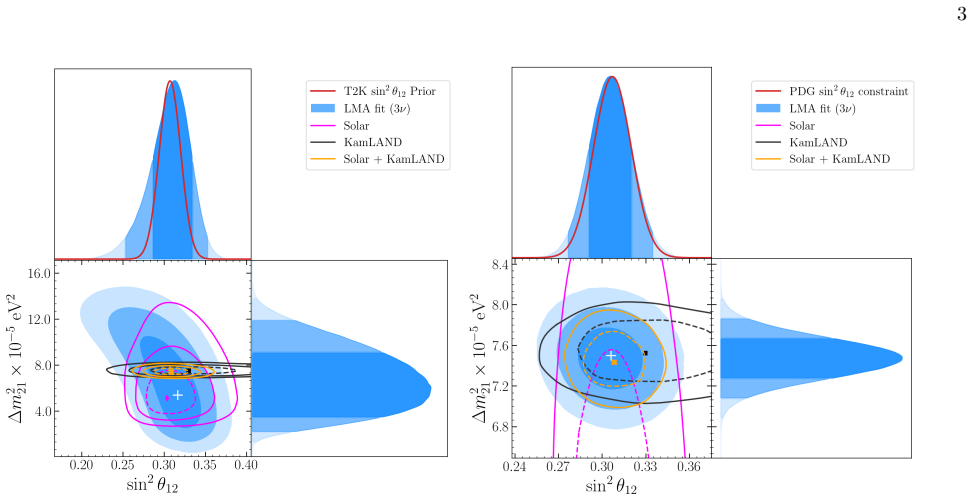
Solar neutrino data limits the non-unitary mixing parameter for electron neutrinos to below 0.046 at 99 percent credible interval.
A machine-rendered reading of the paper's core claim, the machinery that carries it, and where it could break.
Core claim
By constructing an MSW large mixing angle approximation that incorporates heavy neutral leptons through the single additional parameter alpha11, which represents the magnitude of nu_e mixing with the heavy sector, the existing solar neutrino measurements from Borexino, SNO, and KamLAND can be reinterpreted to constrain non-unitary effects. Solar data thereby limits one minus alpha11 to less than 0.046 at the 99 percent credible interval and produces a correlated bound linking the solar mass splitting to the magnitude of nu_e non-unitary mixing.
What carries the argument
The extended MSW large mixing angle approximation that adds the single parameter alpha11 to describe nu_e mixing with heavy neutral leptons.
If this is right
- Long-baseline experiments can adopt this bound as an external constraint when measuring the leptonic mixing matrix in the presence of possible heavy neutral leptons.
- The solar mass splitting and the non-unitary mixing magnitude must be treated as correlated when using the solar constraint in oscillation analyses.
- Heavy neutral lepton searches in long-baseline data can now incorporate a solar-derived limit on the size of nu_e mixing with the heavy sector.
Where Pith is reading between the lines
- If the bound holds, terrestrial long-baseline measurements of oscillation probabilities would be restricted from exhibiting large non-unitary deviations driven by electron-neutrino mixing with heavy states.
- One could test the correlation by extracting the solar mass splitting from reactor antineutrino data and checking consistency with the solar constraint under the same non-unitary model.
- Future solar neutrino detectors with higher statistics could tighten the limit on alpha11 or reveal whether the current correlation persists.
Load-bearing premise
The large mixing angle MSW description of solar neutrinos stays valid and complete when extended by one extra parameter for heavy-sector mixing, so that existing solar data can be used directly without further heavy-sector corrections.
What would settle it
A new global fit to solar neutrino data that returns an upper limit on one minus alpha11 substantially above 0.046 or that shows no correlation between the solar mass splitting and the non-unitary parameter would falsify the reported constraint.
Figures


read the original abstract
Long-baseline neutrino oscillation experiments require external constraints on $\sin^2\theta_{12}$ and $\Delta m_{21}^2$ to make precision measurements of the leptonic mixing matrix. These constraints come from measurements of the Mikheyev-Smirnov-Wolfenstein (MSW) mixing in solar neutrinos. Here we develop an MSW large mixing angle approximation in the presence of heavy neutral leptons which adds a single new parameter ($\alpha_{11}$) representing the magnitude of the mixing between the $\nu_e$ state and the heavy sector. We use data from the Borexino, SNO and KamLAND collaborations to find a solar constraint appropriate for heavy neutral lepton searches in long-baseline oscillation experiments. Solar data limits the magnitude of the non-unitary parameter to $(1-\alpha_{11}) < 0.046$ at the $99\%$ credible interval and yields a strongly correlated constraint on the solar mass splitting and the magnitude of $\nu_e$ non-unitary mixing.
Editorial analysis
A structured set of objections, weighed in public.
Referee Report
Summary. The paper develops an MSW large mixing angle approximation for solar neutrinos in the presence of heavy neutral leptons, introducing a single new parameter α11 for the magnitude of νe mixing with the heavy sector. It reinterprets data from Borexino, SNO, and KamLAND to derive the constraint (1-α11) < 0.046 at 99% credible interval, together with a strongly correlated bound on Δm21², for use as an external constraint in long-baseline neutrino oscillation experiments.
Significance. If the single-parameter extension of the MSW LMA approximation is valid, the result supplies a practical solar-derived limit on non-unitary mixing that can be directly applied to long-baseline analyses, addressing a genuine need for external constraints on sin²θ12 and Δm21². The approach of fitting existing solar data to bound a new parameter is a useful contribution when the underlying assumptions hold.
major comments (2)
- [MSW LMA approximation with α11 (abstract and derivation)] The central approximation assumes that non-unitary mixing with heavy neutral leptons introduces no extra terms in the effective Hamiltonian, no change to the adiabaticity condition, and no additional production/detection systematics beyond the rescaled mixing when the MSW LMA formula is extended by α11 alone. This assumption is load-bearing for the quoted (1-α11)<0.046 bound and its correlation with Δm21²; explicit verification that residual O(α) or phase-dependent contributions to P(νe→νe) remain negligible at solar energies and densities is required.
- [Data analysis and fit to Borexino/SNO/KamLAND] The reported 99% credible interval and the strong correlation between α11 and Δm21² are obtained by fitting the extended model to solar data. The treatment of systematic uncertainties, the precise likelihood construction, and any post-hoc choices in the fit must be shown to be robust before the bound can be adopted as an external constraint for long-baseline experiments.
minor comments (2)
- Provide the explicit functional form of the extended survival probability used in the fit, including the precise definition of α11 in terms of the non-unitary mixing matrix.
- Add a brief comparison of the new solar constraint with existing limits on non-unitary parameters from other sectors or experiments.
Simulated Author's Rebuttal
We thank the referee for their careful review of our manuscript. We address each of the major comments below and will make revisions to incorporate additional verifications and details as appropriate.
read point-by-point responses
-
Referee: The central approximation assumes that non-unitary mixing with heavy neutral leptons introduces no extra terms in the effective Hamiltonian, no change to the adiabaticity condition, and no additional production/detection systematics beyond the rescaled mixing when the MSW LMA formula is extended by α11 alone. This assumption is load-bearing for the quoted (1-α11)<0.046 bound and its correlation with Δm21²; explicit verification that residual O(α) or phase-dependent contributions to P(νe→νe) remain negligible at solar energies and densities is required.
Authors: In the manuscript, we derive the approximation by integrating out the heavy neutral leptons, showing that their contribution to the effective Hamiltonian is suppressed by their large masses, resulting in no additional terms at the order relevant for solar neutrinos. The adiabaticity is preserved because the level crossing remains between the light states. However, to explicitly address the referee's request for verification of negligible residuals, we will add numerical comparisons in the revised manuscript demonstrating that O(α) and phase-dependent effects are below the percent level for solar parameters. revision: yes
-
Referee: The reported 99% credible interval and the strong correlation between α11 and Δm21² are obtained by fitting the extended model to solar data. The treatment of systematic uncertainties, the precise likelihood construction, and any post-hoc choices in the fit must be shown to be robust before the bound can be adopted as an external constraint for long-baseline experiments.
Authors: The fit details are provided in the methods section, using the standard χ² or likelihood from the experimental papers with their systematics included. We did not make post-hoc choices. To further demonstrate robustness, we will include additional tests in the revision, such as varying the treatment of correlated systematics between experiments. revision: partial
Circularity Check
No circularity: constraint obtained via direct fit of new parameter α11 to solar data in extended MSW model
full rationale
The paper introduces a single new parameter α11 into an MSW LMA approximation for non-unitary mixing with heavy neutral leptons, then constrains it (and its correlation with Δm21²) by reinterpreting existing Borexino/SNO/KamLAND data. This is standard parameter estimation from external measurements rather than any self-definitional loop, fitted input renamed as prediction, or self-citation chain. The central result (1-α11)<0.046 at 99% CI) is the output of the fit, not equivalent to the inputs by construction. No load-bearing steps reduce to tautology.
Axiom & Free-Parameter Ledger
free parameters (1)
- α11
axioms (1)
- domain assumption MSW large mixing angle approximation remains valid when heavy neutral leptons are included via one extra mixing parameter
invented entities (1)
-
heavy neutral leptons
no independent evidence
Reference graph
Works this paper leans on
-
[1]
+ α22α32) ˆH13 = 2α3 11α31∆v(I +
-
[2]
− α11α2 33α31vnc(I −
-
[3]
(12) where we have substituted ∆ v = vcc − vnc and I ± 13 = α31 cos θ13 ± α33 sin θ13. B. Non-unitary LMA approximation In order to find an LMA approximation analogous to that of the unitary formalism, we want to write Hprop at some energy and matter density as ˆN M ˆN †, where ˆN is an effective mixing matrix of the form A ˆU with A(αij) the same lower-t...
-
[4]
B. Abi, R. Acciarri, M. A. Acero, G. Adamov, D. Adams, M. Adinolfi, Z. Ahmad, J. Ahmed, T. Alion, S. A. Mon- salve, et al. (2020), URL https://arxiv.org/abs/2002. 03005v2
work page 2020
-
[5]
H.-K. P.-C. K. Abe, H. Aihara, C. Andreopoulos, I. Anghel, A. Ariga, T. Ariga, R. Asfandiyarov, M. Ask- ins, J. J. Back, P. Ballett, et al., Progress of The- oretical and Experimental Physics 2015 (2015), URL http://arxiv.org/abs/1502.05199
work page internal anchor Pith review Pith/arXiv arXiv 2015
-
[6]
Neutrino oscillations: the rise of the PMNS paradigm
C. Giganti, S. Lavignac, and M. Zito (2017), URL http: //arxiv.org/abs/1710.00715
work page internal anchor Pith review Pith/arXiv arXiv 2017
-
[7]
M. A. Acero, P. Adamson, L. Aliaga, T. Alion, V. Al- lakhverdian, S. Altakarli, N. Anfimov, A. Antoshkin, A. Aurisano, A. Back, et al., Physical Review Let- ters 123, 25 (2019), URL http://arxiv.org/abs/1906. 04907
work page 2019
- [8]
- [9]
- [10]
-
[11]
F. J. Escrihuela, D. V. Forero, O. G. Miranda, M. Tor- tola, and J. W. F. Valle (2015), URLhttp://arxiv.org/ abs/1503.08879
work page internal anchor Pith review Pith/arXiv arXiv 2015
- [12]
- [13]
-
[14]
The Borexino detector at the Laboratori Nazionali del Gran Sasso
G. Alimonti, C. Arpesella, H. Back, M. Balata, D. Bartolomei, A. de Bellefon, G. Bellini, J. Benziger, A. Bevilacqua, D. Bondi, et al., Nuclear Instruments and Methods in Physics Research, Section A: Acceler- ators, Spectrometers, Detectors and Associated Equip- ment 600, 568 (2008), ISSN 01689002, URL https: //arxiv.org/abs/0806.2400v1
work page internal anchor Pith review Pith/arXiv arXiv 2008
-
[15]
J. Boger, R. L. Hahn, J. K. Rowley, A. L. Carter, B. Hollebone, D. Kessler, I. Blevis, F. Dalnoki-Veress, A. Dekok, J. Farine, et al., Nuclear Instruments and Methods in Physics Research Section A: Accelerators, Spectrometers, Detectors and Associated Equipment 449, 172 (2000), ISSN 0168-9002
work page 2000
-
[16]
Piepke, Nuclear Physics B - Proceedings Supplements 91, 99 (2001), ISSN 0920-5632
A. Piepke, Nuclear Physics B - Proceedings Supplements 91, 99 (2001), ISSN 0920-5632
work page 2001
-
[17]
P. B. Denton and J. Gehrlein, Journal of High Energy Physics 2023 (2023), ISSN 1029-8479, URL http://dx. doi.org/10.1007/JHEP06(2023)090
-
[18]
K. Abe, N. Abgrall, H. Aihara, Y. Ajima, J. B. Albert, D. Allan, P. A. Amaudruz, C. Andreopoulos, B. Andrieu, M. D. Anerella, et al., Nuclear Instruments and Meth- ods in Physics Research Section A: Accelerators, Spec- trometers, Detectors and Associated Equipment659, 106 (2011), ISSN 0168-9002
work page 2011
- [19]
-
[20]
M. Tanabashi, K. Hagiwara, K. Hikasa, K. Naka- mura, Y. Sumino, F. Takahashi, J. Tanaka, K. Agashe, G. Aielli, C. Amsler, et al., Physical Review D98, 030001 (2018), ISSN 24700029, URL https://journals.aps. 8 org/prd/abstract/10.1103/PhysRevD.98.030001
- [21]
-
[22]
S. Abe, T. Ebihara, S. Enomoto, K. Furuno, Y. Gando, K. Ichimura, H. Ikeda, K. Inoue, Y. Kibe, Y. Kishimoto, et al., Physical Review Letters 100 (2008), URL http: //arxiv.org/abs/0801.4589
work page internal anchor Pith review Pith/arXiv arXiv 2008
- [23]
-
[24]
M. Asplund, N. Grevesse, A. J. Sauval, and P. Scott, Ann.Rev.Astron.Astrophys. 47, 481 (2009), ISSN 00664146
work page 2009
-
[25]
J. N. Bahcall and C. Pe˜ na-Garay, New Journal of Physics 6, 1 (2004), URL http://arxiv.org/abs/ hep-ph/0404061
work page internal anchor Pith review Pith/arXiv arXiv 2004
-
[26]
T. K. Kuo, J. Pantaleone, T. K. Kuo, and J. Panta- leone, PhRvL 57, 1805 (1986), ISSN 0031-9007, URL https://ui.adsabs.harvard.edu/abs/1986PhRvL..57. 1805K/abstract
work page 1986
-
[27]
M. Agostini, K. Altenm¨ uller, S. Appel, V. Atroshchenko, Z. Bagdasarian, D. Basilico, G. Bellini, J. Benziger, D. Bick, G. Bonfini, et al., Nature 2018 562:7728 562, 505 (2018), ISSN 1476-4687, URL https://www.nature. com/articles/s41586-018-0624-y
work page 2018
-
[28]
Combined Analysis of all Three Phases of Solar Neutrino Data from the Sudbury Neutrino Observatory
S. Collaboration, B. Aharmim, S. N. Ahmed, A. E. An- thony, N. Barros, E. W. Beier, A. Bellerive, B. Bel- tran, M. Bergevin, S. D. Biller, et al., Physical Re- view C - Nuclear Physics 88, 11 (2011), URL http: //arxiv.org/abs/1109.0763
work page internal anchor Pith review Pith/arXiv arXiv 2011
-
[29]
J. N. Bahcall, A. M. Serenelli, and S. Basu, The As- trophysical Journal Supplement Series 165, 400 (2005), URL http://arxiv.org/abs/astro-ph/0511337
work page internal anchor Pith review Pith/arXiv arXiv 2005
-
[30]
N. F. Fi´ uza de Barros, Ph.D. thesis, Lisbon U. (2011)
work page 2011
- [31]
-
[32]
D. B. D. B. Collaboration, D. Adey, F. P. An, A. B. Balantekin, H. R. Band, M. Bishai, S. Blyth, D. Cao, G. F. Cao, J. Cao, et al. (2018), URL http://arxiv. org/abs/1809.02261
work page internal anchor Pith review Pith/arXiv arXiv 2018
-
[33]
M. L. Eaton and W. D. Sudderth, Journal of Statisti- cal Planning and Inference 103, 87 (2002), ISSN 0378- 3758, URL https://www.sciencedirect.com/science/ article/pii/S0378375801001999
work page 2002
-
[34]
A. Gando, Y. Gando, K. Ichimura, H. Ikeda, K. Inoue, Y. Kibe, Y. Kishimoto, M. Koga, Y. Minekawa, T. Mit- sui, et al. (The KamLAND Collaboration), Phys. Rev. D 83, 052002 (2011), URL https://link.aps.org/doi/ 10.1103/PhysRevD.83.052002
- [35]
-
[36]
F. J. Escrihuela, D. V. Forero, O. G. Miranda, M. T´ ortola, and J. W. Valle, New Journal of Physics 19, 093005 (2017), ISSN 1367-2630, URL https://iopscience.iop.org/article/10.1088/ 1367-2630/aa79ec
work page 2017
-
[37]
H. Yokomakura, K. Kimura, and A. Takamura, Physics Letters B 544, 286–294 (2002), ISSN 0370-2693, URL http://dx.doi.org/10.1016/S0370-2693(02)02545-5
-
[38]
M. C. Gonzalez-Garcia, C. N. Yang, and Y. Nir, Reviews of Modern Physics 75, 345 (2002), URL http://arxiv. org/abs/hep-ph/0202058
work page internal anchor Pith review Pith/arXiv arXiv 2002
-
[39]
E. Fernandez-Martinez, J. Hernandez-Garcia, and J. Lopez-Pavon, Journal of High Energy Physics 2016 (2016), ISSN 1029-8479, URL http://dx.doi.org/10. 1007/JHEP08(2016)033
work page 2016
-
[40]
S. Parke and M. Ross-Lonergan, Physical Review D 93 (2016), ISSN 2470-0029, URL http://dx.doi.org/10. 1103/PhysRevD.93.113009
work page 2016
-
[41]
M. Blennow, P. Coloma, E. Fernandez-Martinez, J. Hernandez-Garcia, and J. Lopez-Pavon, Journal of High Energy Physics 2017 (2017), ISSN 1029-8479, URL http://dx.doi.org/10.1007/JHEP04(2017)153
-
[42]
P. B. Denton and J. Gehrlein, Physical Review D 108 (2023), ISSN 2470-0029, URL http://dx.doi.org/10. 1103/PhysRevD.108.015009
work page 2023
-
[43]
K. Abe, Y. Haga, Y. Hayato, M. Ikeda, K. Iyogi, J. Kameda, Y. Kishimoto, L. Marti, M. Miura, S. Moriyama, et al., Physical Review D 94 (2016), ISSN 2470-0029, URL http://dx.doi.org/10.1103/ PhysRevD.94.052010
work page 2016
-
[44]
E. T. Atkin, Ph.D. thesis, Imperial Coll., London (2022)
work page 2022
- [45]
-
[46]
Parke (2016), URL http://arxiv.org/abs/1601
S. Parke (2016), URL http://arxiv.org/abs/1601. 07464
work page 2016
discussion (0)
Sign in with ORCID, Apple, or X to comment. Anyone can read and Pith papers without signing in.