An ALMA search for substructure and fragmentation in starless cores in Orion B North
Pith reviewed 2026-05-24 02:05 UTC · model grok-4.3
The pith
ALMA observations of Orion B North show its starless cores match turbulent model predictions, unlike the less bounded Chamaeleon I population where external pressure dominates binding energy.
A machine-rendered reading of the paper's core claim, the machinery that carries it, and where it could break.
Core claim
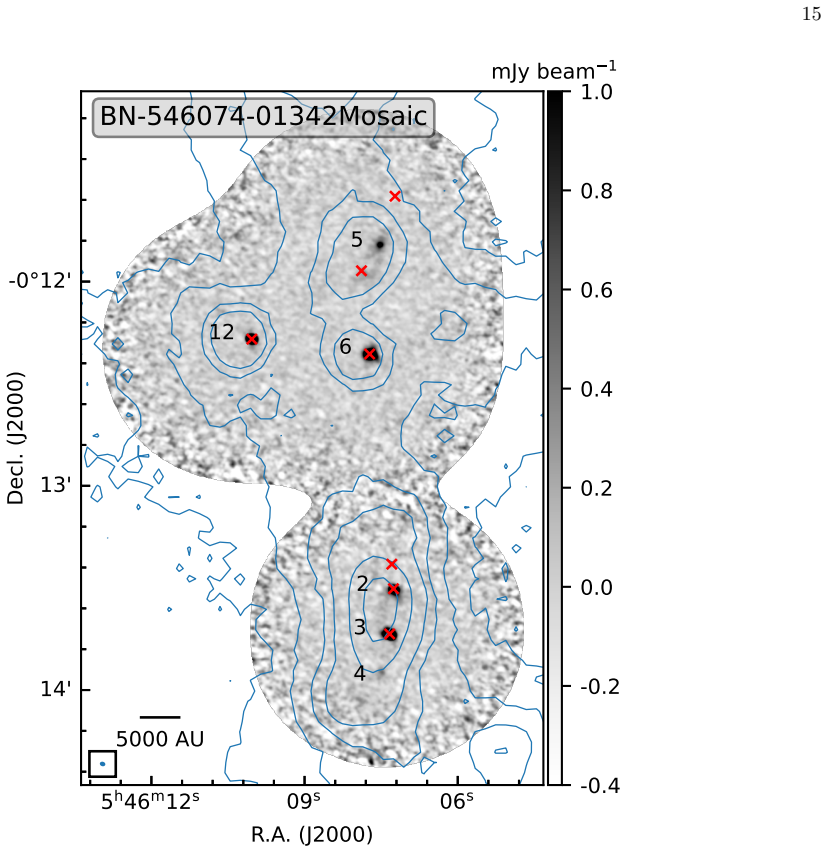
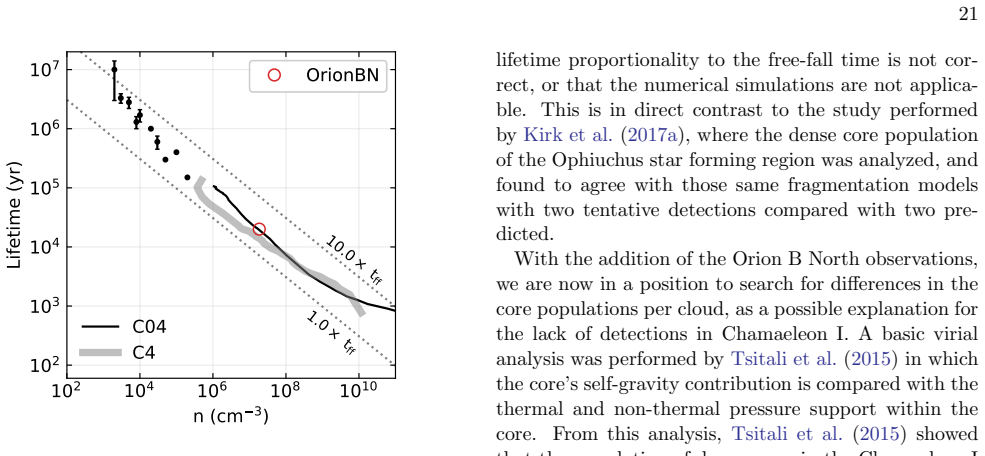
The central claim is that the Chamaeleon I starless core population is characteristically less bounded than the populations in Ophiuchus and Orion B North, with external pressure contributions dominating the binding energy of the cores. These differences may explain why the Chamaeleon I cores do not follow turbulent model predictions, while the Ophiuchus and Orion B North cores are consistent with the model. The Orion B North ALMA data detect four starless sources, a number consistent with expectations from the simulation.
What carries the argument
The virial analysis comparing gravitational binding, kinetic energy, and external pressure terms across the three regions' starless core populations.
If this is right
- Orion B North and Ophiuchus starless cores align with predictions from turbulent fragmentation models.
- Chamaeleon I cores deviate from the same models because they are less bounded and more influenced by external pressure.
- The observed number of starless cores in Orion B North matches the minimum expected from synthetic observations of a collapsing turbulent core.
- Environmental conditions in different molecular clouds can produce measurable differences in core boundedness.
Where Pith is reading between the lines
- If external pressure dominates in some regions, models of core evolution may need to incorporate cloud-scale pressure terms more explicitly to predict fragmentation outcomes.
- Measuring magnetic field strengths across these regions could test whether the current virial results change the relative boundedness ranking.
- The isolated versus clustered locations of the four Orion B North sources suggest that local environment within a cloud may also affect detectability of starless cores.
Load-bearing premise
The four continuum sources can be classified as starless solely from comparisons with other datasets, and the virial analysis accurately reflects binding energy without corrections for magnetic support or projection effects.
What would settle it
Higher-resolution infrared or X-ray observations that reveal embedded protostars in any of the four sources, or direct Zeeman measurements showing significant magnetic support in Chamaeleon I cores, would undermine the starless classification or the boundedness comparison.
Figures








read the original abstract
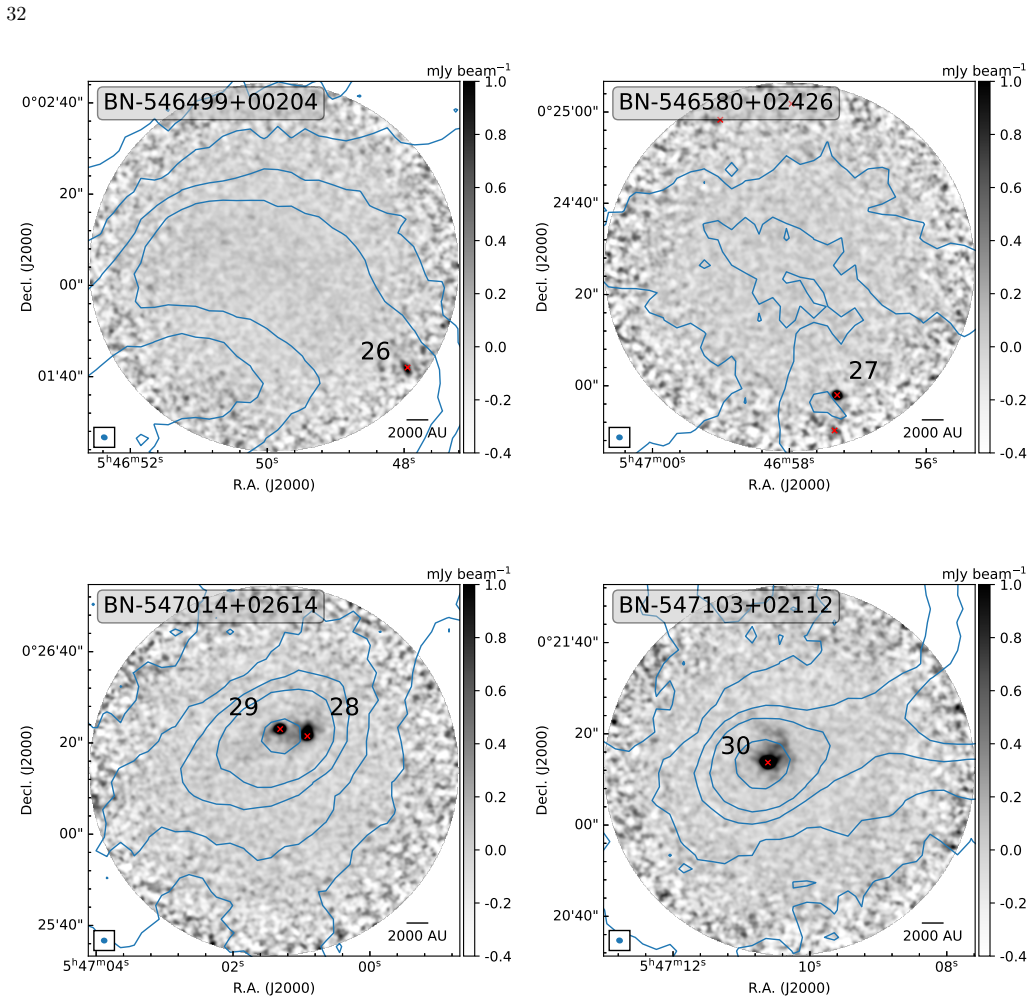
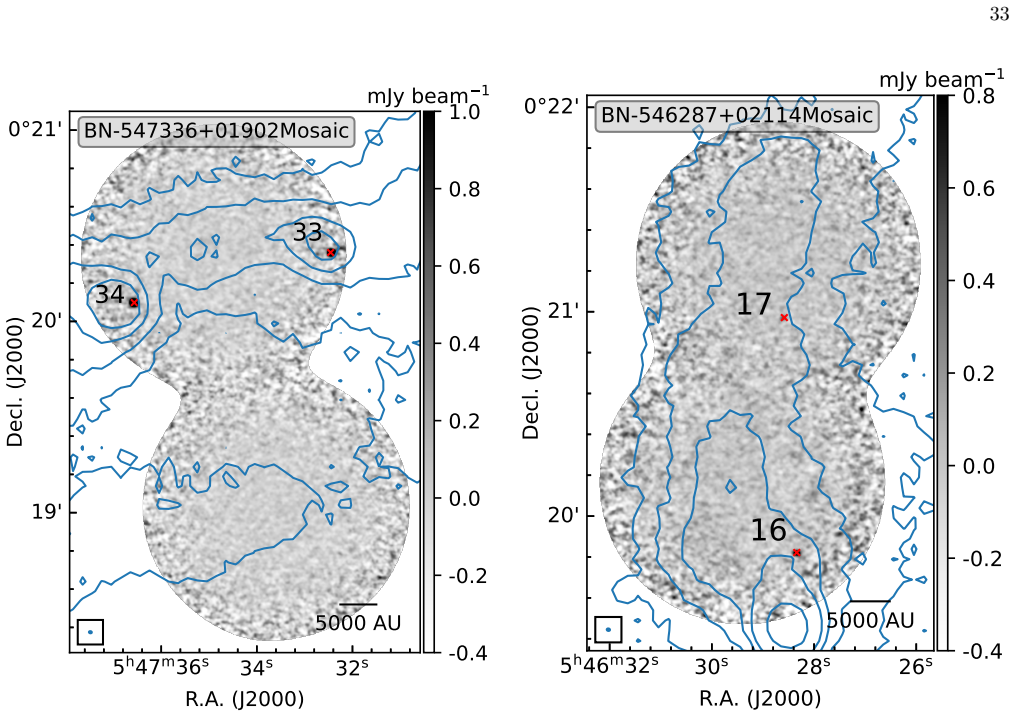
We present Atacama Large Millimeter/submillimeter Array (ALMA) Cycle 3 observations of 73 starless and protostellar cores in the Orion B North molecular cloud. We detect a total of 34 continuum sources at 106 GHz, and after comparisons with other data, 4 of these sources appear to be starless. Three of the four sources are located near groupings of protostellar sources, while one source is an isolated detection. We use synthetic observations of a simulation modeling a collapsing turbulent, magnetized core to compute the expected number of starless cores that should be detectable with our ALMA observations and find at least two (1.52) starless core should be detectable, consistent with our data. We run a simple virial analysis of the cores to put the Orion B North observations into context with similar previous ALMA surveys of cores in Chamaeleon I and Ophiuchus. We conclude that the Chamaeleon I starless core population is characteristically less bounded than the other two populations, along with external pressure contributions dominating the binding energy of the cores. These differences may explain why the Chamaeleon I cores do not follow turbulent model predictions, while the Ophiuchus and Orion B North cores are consistent with the model.
Editorial analysis
A structured set of objections, weighed in public.
Referee Report
Summary. The paper reports ALMA Cycle 3 106 GHz continuum observations toward 73 starless and protostellar cores in Orion B North. It detects 34 sources, classifies four as starless after cross-comparison with other datasets, and finds this count consistent with the number (at least 1.52–2) expected from synthetic observations of a collapsing turbulent magnetized core simulation. A simple virial analysis is then used to compare the Orion B North population with prior ALMA surveys in Chamaeleon I and Ophiuchus, leading to the conclusion that Chamaeleon I cores are characteristically less bounded, with external pressure dominating their binding energy; this difference is invoked to explain why only the Ophiuchus and Orion B North populations match turbulent model predictions.
Significance. If the starless classification and virial parameters hold, the work supplies a useful observational test of turbulent fragmentation models across clouds and highlights the possible role of external pressure in setting core boundedness. The direct comparison of observed detection statistics to synthetic observations of a simulation is a clear methodological strength that strengthens the consistency claim for Orion B North.
major comments (2)
- [Section describing continuum source classification and starless identification] The section on identification of the four 106 GHz sources as starless: classification rests entirely on comparisons with external datasets, yet the manuscript supplies no explicit criteria, contamination estimates, or uncertainty quantification. Because the count of four starless cores is used both for the simulation comparison and for the subsequent population-level boundedness claim versus Chamaeleon I, this omission is load-bearing for the central conclusions.
- [Virial analysis and population comparison] The virial analysis section (and associated figures/tables): the analysis treats kinetic plus gravitational terms as sufficient and concludes that external pressure dominates binding energy in Chamaeleon I without applying corrections for magnetic support or line-of-sight projection effects. These omissions directly affect the boundedness ranking across the three clouds and the attribution of model-consistency differences, so the comparison claim requires either the corrections or a quantitative assessment of their possible impact.
minor comments (2)
- [Abstract] Abstract: the phrasing “at least two (1.52) starless core should be detectable” is grammatically awkward and the parenthetical value is not explained; reword for clarity.
- [Figures and tables] Figure captions and text: ensure all symbols, error bars, and virial-parameter definitions are defined on first use so that the boundedness comparison can be followed without reference to external papers.
Simulated Author's Rebuttal
We thank the referee for their thoughtful and constructive report. We address each major comment below and indicate the revisions we will make to strengthen the manuscript.
read point-by-point responses
-
Referee: [Section describing continuum source classification and starless identification] The section on identification of the four 106 GHz sources as starless: classification rests entirely on comparisons with external datasets, yet the manuscript supplies no explicit criteria, contamination estimates, or uncertainty quantification. Because the count of four starless cores is used both for the simulation comparison and for the subsequent population-level boundedness claim versus Chamaeleon I, this omission is load-bearing for the central conclusions.
Authors: We agree that the classification procedure requires more explicit documentation. In the revised manuscript we will add a dedicated subsection that lists the precise criteria applied to each external dataset (e.g., absence of Spitzer/Herschel point sources above a stated flux threshold, lack of outflow tracers, and positional coincidence tolerances), together with a quantitative estimate of possible contamination by embedded protostars and the associated uncertainty on the final count of four starless cores. This addition will make the robustness of the simulation comparison and the population comparison fully transparent. revision: yes
-
Referee: [Virial analysis and population comparison] The virial analysis section (and associated figures/tables): the analysis treats kinetic plus gravitational terms as sufficient and concludes that external pressure dominates binding energy in Chamaeleon I without applying corrections for magnetic support or line-of-sight projection effects. These omissions directly affect the boundedness ranking across the three clouds and the attribution of model-consistency differences, so the comparison claim requires either the corrections or a quantitative assessment of their possible impact.
Authors: The virial analysis is presented as a simple comparison, as stated in the manuscript. We acknowledge that magnetic support and projection effects are not corrected for and could alter the relative boundedness ranking. In revision we will add a paragraph that supplies order-of-magnitude estimates of these effects (drawing on published magnetic-field strengths for the three regions and a simple geometric argument for projection) and discusses how they might change the conclusion that external pressure dominates in Chamaeleon I. Full vector corrections are beyond the scope of the available data, but the quantitative assessment will clarify the robustness of the inter-cloud comparison. revision: partial
Circularity Check
No significant circularity; claims rest on standard methods and external comparisons
full rationale
The paper applies standard virial analysis to observed line widths and masses, classifies four sources as starless via cross-checks against independent datasets, and performs a consistency check by generating synthetic ALMA observations from an external simulation of a collapsing core. The expected detection count (1.52) is computed from that simulation rather than fitted to the current data. Population comparisons to Chamaeleon I and Ophiuchus draw on prior surveys without load-bearing self-citations or uniqueness theorems. No step equates a claimed prediction or result to its own inputs by construction.
Axiom & Free-Parameter Ledger
axioms (1)
- domain assumption Virial theorem can be applied to estimate binding energy of the observed cores
Reference graph
Works this paper leans on
-
[1]
, " * write output.state after.block = add.period write newline
ENTRY address archivePrefix author booktitle chapter doi edition editor eprint howpublished institution journal key month number organization pages publisher school series title misctitle type volume year version url label extra.label sort.label short.list INTEGERS output.state before.all mid.sentence after.sentence after.block FUNCTION init.state.consts ...
-
[2]
" write newline "" before.all 'output.state := FUNCTION format.url url empty "" new.block "" url * "" * if FUNCTION format.eprint eprint empty "" archivePrefix empty "" archivePrefix "arXiv" = new.block " " eprint * " " * new.block " " eprint * " " * if if if FUNCTION format.doi doi empty "" " " doi * " " * if FUNCTION format.pid doi empty eprint empty ur...
-
[3]
? /S - i *КН譃 8N!Y) ]u m *FʼYZ ( c;&t8 0 Wʰ# KR<I)P<SҰjngϱJ d yW< ff ,CYSKpd k.Ȑ ;1'
thebibliography [1] 20pt to REFERENCES 6pt =0pt -12pt 10pt plus 3pt =0pt =0pt =1pt plus 1pt =0pt =0pt -12pt =13pt plus 1pt =20pt =13pt plus 1pt \@M =10000 =-1.0em =0pt =0pt 0pt =0pt =1.0em @enumiv\@empty 10000 10000 `\.\@m \@noitemerr \@latex@warning Empty `thebibliography' environment \@ifnextchar \@reference \@latexerr Missing key on reference command E...
-
[4]
Andr \'e , P., Di Francesco, J., Ward-Thompson , D., et al. 2014, From Filamentary Networks to Dense Cores in Molecular Clouds : Toward a New Paradigm for Star Formation (eprint: arXiv:1312.6232), 27--51, 10.2458/azu_uapress_9780816531240-ch002
work page internal anchor Pith review Pith/arXiv arXiv doi:10.2458/azu_uapress_9780816531240-ch002 2014
-
[5]
Astropy Collaboration , Robitaille, T. P., Tollerud, E. J., et al. 2013, , 558, A33, 10.1051/0004-6361/201322068
-
[6]
Astropy Collaboration , Price-Whelan , A. M., Sip o cz, B. M., et al. 2018, , 156, 123, 10.3847/1538-3881/aabc4f
-
[7]
Astropy Collaboration , Price-Whelan , A. M., Lim, P. L., et al. 2022, , 935, 167, 10.3847/1538-4357/ac7c74
work page internal anchor Pith review doi:10.3847/1538-4357/ac7c74 2022
-
[8]
Molecular Cloud Turbulence and Star Formation
Ballesteros-Paredes , J., Klessen, R. S., Mac Low, M. M., & Vazquez-Semadeni , E. 2007, Molecular Cloud Turbulence and Star Formation (eprint: arXiv:astro-ph/0603357), 63, 10.48550/arXiv.astro-ph/0603357
work page internal anchor Pith review Pith/arXiv arXiv doi:10.48550/arxiv.astro-ph/0603357 2007
-
[9]
Beichman, C. A., Myers, P. C., Emerson, J. P., et al. 1986, , 307, 337, 10.1086/164421
-
[10]
Belloche, A., Parise, B., van der Tak , F. F. S., et al. 2006, , 454, L51, 10.1051/0004-6361:20065306
-
[11]
2011, , 527, A145, 10.1051/0004-6361/201015733
Belloche, A., Schuller, F., Parise, B., et al. 2011, , 527, A145, 10.1051/0004-6361/201015733
-
[12]
Bergin, E. A., & Tafalla, M. 2007, , 45, 339, 10.1146/annurev.astro.45.071206.100404
-
[13]
Bertoldi, F., & McKee, C. F. 1992, , 395, 140, 10.1086/171638
-
[14]
Bohlin, R. C., Savage, B. D., & Drake, J. F. 1978, , 224, 132, 10.1086/156357
-
[15]
Bonnor, W. B. 1956, , 116, 351, 10.1093/mnras/116.3.351
-
[16]
Boulanger, F., Bronfman, L., Dame, T. M., & Thaddeus, P. 1998, , 332, 273
work page 1998
-
[17]
Caselli, P., Pineda, J. E., Zhao, B., et al. 2019, , 874, 89, 10.3847/1538-4357/ab0700
-
[18]
Chen, X., Arce, H. G., Zhang, Q., et al. 2013, , 768, 110, 10.1088/0004-637X/768/2/110
-
[19]
M., Hartmann, D., & Thaddeus, P
Dame, T. M., Hartmann, D., & Thaddeus, P. 2001, , 547, 792, 10.1086/318388
work page internal anchor Pith review doi:10.1086/318388 2001
-
[20]
Dame, T. M., & Thaddeus, P. 2022, , 262, 5, 10.3847/1538-4365/ac7e53
-
[21]
2021, Astronomy and Astrophysics, 649, L13, 10.1051/0004-6361/202140404
Das, I., Basu, S., & Andr \'e , P. 2021, Astronomy and Astrophysics, 649, L13, 10.1051/0004-6361/202140404
-
[22]
J., Bronfman, L., & Thaddeus, P
de Geus , E. J., Bronfman, L., & Thaddeus, P. 1990, , 231, 137
work page 1990
-
[23]
An Observational Perspective of Low-Mass Dense Cores I: Internal Physical and Chemical Properties
di Francesco , J., Evans, II, N. J., Caselli, P., et al. 2007, An Observational Perspective of Low-Mass Dense Cores I : Internal Physical and Chemical Properties (eprint: arXiv:astro-ph/0602379), 17, 10.48550/arXiv.astro-ph/0602379
work page internal anchor Pith review Pith/arXiv arXiv doi:10.48550/arxiv.astro-ph/0602379 2007
-
[24]
2007, , 661, 262, 10.1086/513708
Dib, S., Kim, J., V \'a zquez-Semadeni , E., Burkert, A., & Shadmehri, M. 2007, , 661, 262, 10.1086/513708
-
[25]
Dunham, M. M., Allen, L. E., Evans, II, N. J., et al. 2015, , 220, 11, 10.1088/0067-0049/220/1/11
-
[26]
Dunham, M. M., Offner, S. S. R., Pineda, J. E., et al. 2016, , 823, 160, 10.3847/0004-637X/823/2/160
-
[27]
2020, , 251, 20, 10.3847/1538-4365/abba26
Dutta, S., Lee, C.-F., Liu, T., et al. 2020, , 251, 20, 10.3847/1538-4365/abba26
-
[28]
1955, Zeitschrift fur Astrophysik, 37, 217
Ebert, R. 1955, Zeitschrift fur Astrophysik, 37, 217
work page 1955
-
[29]
Enoch, M. L., Glenn, J., Evans, II, N. J., et al. 2007, , 666, 982, 10.1086/520321
-
[30]
2009, , 504, 461, 10.1051/0004-6361/200912468
Fang, M., van Boekel , R., Wang, W., et al. 2009, , 504, 461, 10.1051/0004-6361/200912468
-
[31]
Federman, S., Megeath, S. T., Tobin, J. J., et al. 2023, , 944, 49, 10.3847/1538-4357/ac9f4b
-
[32]
Fielder, S., & Kirk, H. 2024, An ALMA Search for Substructure and Fragmentation in Starless Cores in Orion B North , CADC, xx.xxxxx/xx.xxxx
work page 2024
-
[33]
Fischer, W. J., Megeath, S. T., Ali, B., et al. 2010, , 518, L122, 10.1051/0004-6361/201014636
-
[34]
Flaherty, K. M., & Muzerolle, J. 2008, , 135, 966, 10.1088/0004-6256/135/3/966
-
[35]
Friesen, R. K., Pineda, J. E., co-PIs , et al. 2017, , 843, 63, 10.3847/1538-4357/aa6d58
-
[36]
2020, , 899, L10, 10.3847/2041-8213/ab9ca8
Fujishiro, K., Tokuda, K., Tachihara, K., et al. 2020, , 899, L10, 10.3847/2041-8213/ab9ca8
-
[37]
Furlan, E., Fischer, W. J., Ali, B., et al. 2016, , 224, 5, 10.3847/0067-0049/224/1/5
-
[38]
2010, in SPIE Astronomical Telescopes + Instrumentation , ed
Gaudet, S., Hill, N., Armstrong, P., et al. 2010, in SPIE Astronomical Telescopes + Instrumentation , ed. N. M. Radziwill & A. Bridger, San Diego, California, USA, 77401I, 10.1117/12.858026
-
[39]
Girichidis, P., Konstandin, L., Whitworth, A. P., & Klessen, R. S. 2014, , 781, 91, 10.1088/0004-637X/781/2/91
-
[40]
P., Nutter, D., Kroupa, P., Ward-Thompson , D., & Whitworth, A
Goodwin, S. P., Nutter, D., Kroupa, P., Ward-Thompson , D., & Whitworth, A. P. 2008, , 477, 823, 10.1051/0004-6361:20078452
-
[41]
2024, , 961, 123, 10.3847/1538-4357/ad09e2
Hirano, N., Sahu, D., Liu, S.-Y., et al. 2024, , 961, 123, 10.3847/1538-4357/ad09e2
-
[42]
Holman, K., Walch, S. K., Goodwin, S. P., & Whitworth, A. P. 2013, , 432, 3534, 10.1093/mnras/stt705
-
[43]
2009, , 691, 1560, 10.1088/0004-637X/691/2/1560
Ikeda, N., Kitamura, Y., & Sunada, K. 2009, , 691, 1560, 10.1088/0004-637X/691/2/1560
-
[44]
Jessop, N. E., & Ward-Thompson , D. 2000, , 311, 63, 10.1046/j.1365-8711.2000.03011.x
-
[45]
Jijina, J., Myers, P. C., & Adams, F. C. 1999, , 125, 161, 10.1086/313268
-
[46]
2010, , 711, 655, 10.1088/0004-637X/711/2/655
Johnstone, D., Rosolowsky, E., Tafalla, M., & Kirk, H. 2010, , 711, 655, 10.1088/0004-637X/711/2/655
-
[47]
D., Moriarty-Schieven , G., et al
Johnstone, D., Wilson, C. D., Moriarty-Schieven , G., et al. 2000, , 545, 327, 10.1086/317790
-
[48]
K., Johnstone, D., Kirk, H., & Myers, P
J rgensen, J. K., Johnstone, D., Kirk, H., & Myers, P. C. 2007, , 656, 293, 10.1086/510150
-
[49]
K., Johnstone, D., Kirk, H., et al
J rgensen, J. K., Johnstone, D., Kirk, H., et al. 2008, , 683, 822, 10.1086/589956
-
[50]
Kauffmann, J., Bertoldi, F., Bourke, T. L., Evans, II, N. J., & Lee, C. W. 2008, , 487, 993, 10.1051/0004-6361:200809481
-
[51]
2017, , 850, 3, 10.3847/1538-4357/aa93ec
Keown, J., Di Francesco, J., Kirk, H., et al. 2017, , 850, 3, 10.3847/1538-4357/aa93ec
-
[52]
2019, , 874, 147, 10.3847/1538-4357/ab0c08
Kerr, R., Kirk, H., Di Francesco, J., et al. 2019, , 874, 147, 10.3847/1538-4357/ab0c08
-
[53]
2006, , 646, 1009, 10.1086/503193
Kirk, H., Johnstone, D., & Di Francesco, J. 2006, , 646, 1009, 10.1086/503193
-
[54]
Kirk, H., Francesco, J. D., Johnstone, D., et al. 2016, , 817, 167, 10.3847/0004-637X/817/2/167
-
[55]
Kirk, H., Dunham, M. M., Di Francesco, J., et al. 2017 a , , 838, 114, 10.3847/1538-4357/aa63f8
-
[56]
Kirk, H., Friesen, R. K., Pineda, J. E., et al. 2017 b , , 846, 144, 10.3847/1538-4357/aa8631
-
[57]
M., Ward-Thompson , D., & Andr \'e , P
Kirk, J. M., Ward-Thompson , D., & Andr \'e , P. 2005, , 360, 1506, 10.1111/j.1365-2966.2005.09145.x
-
[58]
2015, , 584, A91, 10.1051/0004-6361/201525861
K \"o nyves, V., Andr \'e , Ph ., Men'shchikov, A., et al. 2015, , 584, A91, 10.1051/0004-6361/201525861
-
[59]
2020, , 635, A34, 10.1051/0004-6361/201834753
K \"o nyves, V., Andr \'e , Ph ., Arzoumanian, D., et al. 2020, , 635, A34, 10.1051/0004-6361/201834753
-
[60]
Kramer, C., Stutzki, J., Rohrig, R., & Corneliussen, U. 1998, , 329, 249
work page 1998
-
[61]
Kuruwita, R. L., & Haugb lle, T. 2023, , 674, A196, 10.1051/0004-6361/202244882
-
[62]
Lee, A. T., Offner, S. S. R., Kratter, K. M., Smullen, R. A., & Li, P. S. 2019, , 887, 232, 10.3847/1538-4357/ab584b
-
[63]
2021, The Journal of Open Source Software, 6, 3771, 10.21105/joss.03771
Li, P., Cunningham, A., Gaches, B., et al. 2021, The Journal of Open Source Software, 6, 3771, 10.21105/joss.03771
-
[64]
Lomax, O., Whitworth, A. P., Hubber, D. A., Stamatellos, D., & Walch, S. 2015, , 447, 1550, 10.1093/mnras/stu2530
-
[65]
Luo, Q.-y., Liu, T., Lee, A. T., et al. 2023, , 952, L2, 10.3847/2041-8213/acdddf
-
[66]
Mac Low, M.-M., & Klessen, R. S. 2004, Reviews of Modern Physics, 76, 125, 10.1103/RevModPhys.76.125
-
[67]
N., Inutsuka, S.-i., & Matsumoto, T
Machida, M. N., Inutsuka, S.-i., & Matsumoto, T. 2008, , 676, 1088, 10.1086/528364
-
[68]
Marton, G., T \'o th, L. V., Paladini, R., et al. 2016, , 458, 3479, 10.1093/mnras/stw398
-
[69]
McKee, C. F. 1989, , 345, 782, 10.1086/167950
-
[70]
T., Gutermuth, R., Muzerolle, J., et al
Megeath, S. T., Gutermuth, R., Muzerolle, J., et al. 2012, , 144, 192, 10.1088/0004-6256/144/6/192
-
[71]
2017, , 230, 15, 10.3847/1538-4365/aa6fb6
Moe, M., & Di Stefano, R. 2017, , 230, 15, 10.3847/1538-4365/aa6fb6
work page internal anchor Pith review doi:10.3847/1538-4365/aa6fb6 2017
- [72]
-
[73]
2007, , 476, 1243, 10.1051/0004-6361:20077843
Motte, F., Bontemps, S., Schilke, P., et al. 2007, , 476, 1243, 10.1051/0004-6361:20077843
-
[74]
Murillo, N. M., Van Dishoeck, E. F., Hacar, A., Harsono, D., & J rgensen, J. K. 2022, , 658, A53, 10.1051/0004-6361/202141250
-
[75]
2007, , 374, 1413, 10.1111/j.1365-2966.2006.11246.x
Nutter, D., & Ward-Thompson , D. 2007, , 374, 1413, 10.1111/j.1365-2966.2006.11246.x
-
[76]
Offner, S. S. R., Capodilupo, J., Schnee, S., & Goodman, A. A. 2012, , 420, L53, 10.1111/j.1745-3933.2011.01194.x
-
[77]
Offner, S. S. R., & Chaban, J. 2017, , 847, 104, 10.3847/1538-4357/aa8996
-
[78]
Offner, S. S. R., Clark, P. C., Hennebelle, P., et al. 2014, The Origin and Universality of the Stellar Initial Mass Function (eprint: arXiv:1312.5326), 53--75, 10.2458/azu_uapress_9780816531240-ch003
work page internal anchor Pith review Pith/arXiv arXiv doi:10.2458/azu_uapress_9780816531240-ch003 2014
-
[79]
Offner, S. S. R., Moe, M., Kratter, K. M., et al. 2023, 534, 275, 10.48550/arXiv.2203.10066
work page internal anchor Pith review Pith/arXiv arXiv doi:10.48550/arxiv.2203.10066 2023
-
[80]
Offner, S. S. R., Taylor, J., Markey, C., et al. 2022, , 517, 885, 10.1093/mnras/stac2734
discussion (0)
Sign in with ORCID, Apple, or X to comment. Anyone can read and Pith papers without signing in.