Doubly minimized Petz and sandwiched Renyi mutual information: Properties
Pith reviewed 2026-05-24 00:00 UTC · model grok-4.3
The pith
Doubly minimized Petz Renyi mutual information is additive for alpha in [1/2,2] and the sandwiched version is additive for alpha in [2/3,∞] via a new duality.
A machine-rendered reading of the paper's core claim, the machinery that carries it, and where it could break.
Core claim
The central claim is that the doubly minimized Petz Renyi mutual information satisfies additivity for every alpha between 1/2 and 2 inclusive. For the doubly minimized sandwiched Renyi mutual information a duality relation is established for every alpha at least 2/3 by direct application of Sion's minimax theorem to the relevant convex-concave problem over product states; this duality is then invoked to prove additivity for the same range of alpha.
What carries the argument
The doubly minimized Petz and sandwiched Renyi mutual informations, each obtained by minimizing the corresponding divergence of order alpha over all product states, together with the duality relation derived via Sion's minimax theorem for the sandwiched case.
If this is right
- Additivity reduces the evaluation of the quantity on tensor-product states to the single-copy case.
- The duality relation supplies an alternative maximin expression for the sandwiched quantity that can be used in further proofs.
- The additivity range for the sandwiched case now includes all alpha greater than or equal to 2/3 rather than only those greater than or equal to 1.
- Both quantities inherit monotonicity and other divergence properties from the underlying Petz and sandwiched divergences under the stated parameter restrictions.
Where Pith is reading between the lines
- The remaining open interval (1/2, 2/3) for the sandwiched case indicates that a separate argument would still be needed to reach the full conjectured range down to 1/2.
- Because the duality is obtained from a minimax theorem over product states, the same technique may apply to other families of quantum divergences whose minimization is likewise convex-concave.
- Additivity of these quantities would simplify the analysis of their behavior under independent uses of a quantum channel or under repeated measurements on composite systems.
Load-bearing premise
Sion's minimax theorem applies directly to the convex-concave functions that appear when the minimization is restricted to product states, without extra regularity conditions that would fail for some quantum states.
What would settle it
An explicit bipartite quantum state together with a concrete alpha value at least 2/3 for which the value of the doubly minimized sandwiched Renyi mutual information on two copies fails to equal twice the value on one copy.
Figures
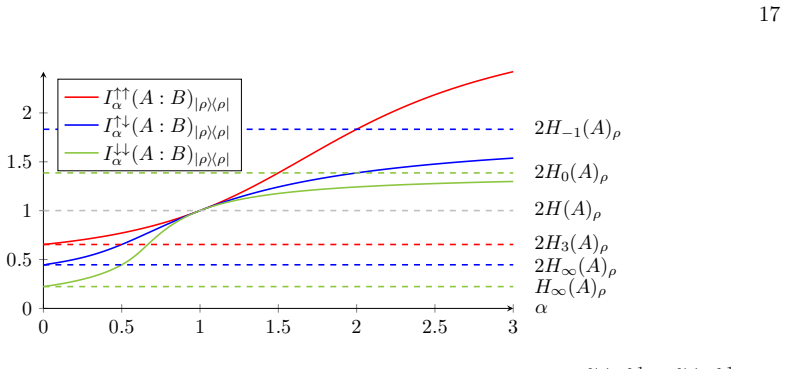

read the original abstract
The doubly minimized Petz Renyi mutual information of order $\alpha$ is defined as the minimization of the Petz divergence of order $\alpha$ of a fixed bipartite quantum state relative to any product state. The doubly minimized sandwiched Renyi mutual information is defined analogously using the sandwiched divergence in place of the Petz divergence. In this work, we establish several properties of these two types of Renyi mutual information. In particular, for the Petz case, we prove additivity for $\alpha\in [1/2,2]$. For the sandwiched case, we establish a novel duality relation for $\alpha\in [2/3,\infty]$ via Sion's minimax theorem, and we subsequently use this duality relation to prove additivity for the same range of $\alpha$. Previously, additivity for the sandwiched case was known only for $\alpha\in [1,\infty]$, but it had been conjectured to hold for $\alpha\in [1/2,\infty]$.
Editorial analysis
A structured set of objections, weighed in public.
Referee Report
Summary. The paper defines the doubly minimized Petz Renyi mutual information (minimization of Petz divergence over product states) and the analogous doubly minimized sandwiched Renyi mutual information. It proves additivity of the Petz version for α ∈ [1/2, 2] and, for the sandwiched version, derives a novel duality relation for α ∈ [2/3, ∞] via Sion's minimax theorem, from which additivity follows in the same interval (extending the previously known range α ≥ 1).
Significance. If the central derivations hold, the results extend the parameter range for additivity of these Renyi mutual informations, which are relevant to quantum channel capacities, entanglement measures, and strong converse bounds. The explicit use of Sion's minimax to obtain the duality is a technical contribution; the manuscript supplies mathematical proofs rather than numerical fits.
major comments (1)
- [§ on duality via Sion's minimax] § on duality via Sion's minimax (the section establishing the novel duality relation for sandwiched Renyi mutual information): the application of Sion's theorem for α down to 2/3 requires explicit verification that the relevant functional (sandwiched divergence or mutual-information expression) is upper/lower semi-continuous in the respective variables over the compact convex set of product states. The manuscript must confirm these regularity conditions hold at the lower endpoint; without them the duality fails and the additivity claim for α ∈ [2/3, 1) does not follow.
minor comments (2)
- [Abstract and §1] The abstract and introduction should explicitly state the finite-dimensional assumption required for compactness of the product-state set when invoking Sion's theorem.
- [§2] Notation for the doubly minimized quantities should be introduced with a displayed equation immediately after the verbal definition to improve readability.
Simulated Author's Rebuttal
We thank the referee for their detailed review and for highlighting the need to verify the regularity conditions in the application of Sion's minimax theorem. We address the single major comment below and will incorporate the requested clarification in the revised manuscript.
read point-by-point responses
-
Referee: [§ on duality via Sion's minimax] § on duality via Sion's minimax (the section establishing the novel duality relation for sandwiched Renyi mutual information): the application of Sion's theorem for α down to 2/3 requires explicit verification that the relevant functional (sandwiched divergence or mutual-information expression) is upper/lower semi-continuous in the respective variables over the compact convex set of product states. The manuscript must confirm these regularity conditions hold at the lower endpoint; without them the duality fails and the additivity claim for α ∈ [2/3, 1) does not follow.
Authors: We agree that an explicit verification of the upper/lower semi-continuity of the sandwiched Renyi divergence (and the associated mutual-information functional) over the compact convex set of product states is necessary to rigorously justify the application of Sion's minimax theorem down to α = 2/3. In the revised manuscript we will add a dedicated remark (or short appendix) confirming these conditions. The sandwiched Renyi divergence is jointly lower semi-continuous in its arguments for α ≥ 1/2 and upper semi-continuous for α > 1 in the relevant topologies; combined with compactness of the product-state set and convexity/concavity properties already established in the paper, this ensures the minimax equality holds on the closed interval [2/3, ∞]. We will explicitly check the endpoint α = 2/3 using the known continuity properties of the sandwiched divergence at that value. revision: yes
Circularity Check
No circularity: pure mathematical proofs of additivity via standard theorems
full rationale
The paper defines doubly minimized Petz and sandwiched Renyi mutual information directly from the respective divergences and then proves additivity properties for specified ranges of α. The Petz additivity proof and the sandwiched duality (via Sion's minimax) followed by additivity are self-contained derivations resting on the definitions plus the external Sion theorem; no fitted parameters, no self-citation chains, and no renaming of known results appear in the derivation chain. The work is therefore independent of its own inputs.
Axiom & Free-Parameter Ledger
axioms (1)
- domain assumption Sion's minimax theorem applies to the relevant functions on the set of product quantum states
Forward citations
Cited by 1 Pith paper
-
Doubly minimized Petz and sandwiched Renyi mutual information: Operational interpretation from binary quantum state discrimination
The direct exponent in binary quantum state discrimination for correlation detection equals the doubly minimized Petz Renyi mutual information for alpha in (1/2,1), while the strong converse exponent equals the doubly...
Reference graph
Works this paper leans on
-
[1]
Proof of (a), (b), (c), (e), (f ), (g), (h), (i), (j), (k)
Proof of Proposition 12 We prove the listed items not in alphabetical order, but in a d ifferent order. Proof of (a), (b), (c), (e), (f ), (g), (h), (i), (j), (k). These properties follow from the correspond- ing properties of the Petz divergence, see Proposition 2. In particular, (e) follows from the non- negativity of the Petz divergence because ρAB ̸⊥ σ...
-
[2]
These properties follow from the corresponding properties of the Petz divergence, see Proposition 2
Proof of Proposition 13 Proof of (a), (e), (j), (n). These properties follow from the corresponding properties of the Petz divergence, see Proposition 2. In particular, (n) follows from the additivity and positiv e definiteness of the Petz divergence. Proof of (i). I ↓ 1 (ρAB∥σA) = D(ρAB∥σA ⊗ ρB) follows from ( 2.15). Now, suppose ρA ̸⊥ σA. Then exp(− I ↓ ...
-
[3]
Proof of Proposition 3 Proof of (a). This assertion follows from the symmetry of the definition of the non-minimized PRMI in ( 2.30) with respect to A and B. Proof of (b), (c), (d), (e), (f ), (h), (i), (j), (k), (l), (m). Since I ↑↑ α (A : B)ρ = I ↑ α(ρAB∥ρA), these properties follow from the corresponding properties of the non-minimized generalized PRMI,...
-
[4]
Proof of Proposition 4 Proof of (a), (b), (c), (d), (e), (g), (h), (i), (j), (k), (l), (m), (n), (o), (r). Since I ↑↓ α (A : B)ρ = I ↓ α(ρAB∥ρA), these properties follow from the corresponding propertie s of the minimized gener- alized PRMI, see Proposition 13. Proof of (p). Let α ∈ (0, ∞ ). Case 1: α ∈ (0, 1) ∪ (1, ∞ ). Let β := 1 α . By Proposition 13 (...
-
[5]
Proof of Lemma 5 Proof. √ XA ⊗ √ YB + √ X ′ A ⊗ √ Y ′ B = (XA ⊗ 1B)#(1A ⊗ YB) + (X ′ A ⊗ 1B)#(1A ⊗ Y ′ B) (E.1) ≤ ((XA ⊗ 1B) + (X ′ A ⊗ 1B))#((1A ⊗ YB) + (1A ⊗ Y ′ B)) (E.2) = √ XA + X ′ A ⊗ √ YB + Y ′ B (E.3) The inequality follows from the subadditivity of the geomet ric operator mean
-
[6]
Let X, Y, Z ∈ L(A) be positive semidefinite and such that X ≤ Y
Proof of Theorem 6 Lemma 14 (Saturation of operator inequality from saturation of trac e inequality) . Let X, Y, Z ∈ L(A) be positive semidefinite and such that X ≤ Y . Then all of the following hold. (a) tr[XZ ] ≤ tr[Y Z ]. (b) If tr[XZ ] = tr[ Y Z ] and Y ≪ Z, then X = Y . Proof. By spectral decomposition, Z = ∑ λ∈ spec(Z) λPλ, where Pλ ∈ L (A) denotes t...
-
[7]
We will now elucidate the notation for these derivatives
Lemma for Theorem 7 (k) In order to prove the following lemma, we will use Fréchet der ivatives. We will now elucidate the notation for these derivatives. Consider BA := {XA ∈ L (A) : XA is self-adjoint } with ∥·∥∞ as 32 a Banach space over R. Similarly, consider BB := {YB ∈ L (B) : YB is self-adjoint } with ∥·∥∞ as a Banach space over R. Let U ⊆ B A be a...
-
[8]
Proof of Theorem 7 Proof of (a). This assertion follows from the symmetry of the definition of the doubly minimized PRMI in ( 2.32) with respect to A and B. Proof of (b), (e), (f ), (h), (i), (n), (r). Since I ↓↓ α (A : B)ρ = inf σA∈S (A) I ↓ α(ρAB∥σA), these proper- ties follow from corresponding properties of the minimized generalized PRMI, see Propositi...
-
[9]
Lemmas for Theorem 8 Let us define the following function of µ ∈ [0, ∞ ) for any ρAB ∈ S (AB), n ∈ N>0. ˆα′ n,ρ(µ) = min T n AnBn ∈L (AnBn): 0≤ T n AnBn ≤ 1 {tr[ρ⊗ n AB(1 − T n AnBn)] : max σAn ∈S sym(A⊗ n), τBn ∈S (Bn) tr[σAn ⊗ τBnT n AnBn ] ≤ µ} (F.1) The following lemma describes some basic properties of the f unctions ˆαiid n,ρ, ˆαn,ρ, ˆαind n,ρ, ˆα′ n...
-
[10]
It follows from Theorem 7 (q) that I ↓↓ s (A : B)ρ is right- differentiable on s ∈ (0, 1)
Proof of Theorem 8 First, we prove the bounds on R1/2. It follows from Theorem 7 (q) that I ↓↓ s (A : B)ρ is right- differentiable on s ∈ (0, 1). By the monotonicity of the doubly minimized PRMI in the Rényi order, see Theorem 7 (n), ∂ ∂s+ I ↓↓ s (A : B)ρ ≥ 0 ∀s ∈ (0, 1). (F.17) For any s ∈ (0, 1) and any fixed (σA, τB) ∈ arg min(σ′ A,τ ′ B )∈S (A)×S (B) Ds...
-
[11]
(F.43) We will now construct a counterexample for the consideratio n in Remark
Example for Remark 4 Before we begin constructing a counterexample, let us note th at for any ρAB ∈ S (AB), n ∈ N>0, µ ∈ [0, ∞ ), ˆαind n,ρ(µ) = min T n AnBn ∈L (AnBn): 0≤ T n AnBn ≤ 1 {tr[ρ⊗ n AB(1 − T n AnBn)] : max m∈ N>0 max σ(i) An ∈S (An),τ (i) Bn ∈S (Bn), (pi)i∈ [m]∈ [0,1]× m: ∑ i∈ [m] pi=1 ∑ i∈ [m] pi tr[σ(i) An ⊗ τ (i) BnT n AnBn] ≤ µ}. (F.43) We...
-
[12]
Let p ∈ ( 1 2 , 1) and let ρAB := p|0, 0⟩ ⟨0, 0|AB + (1 − p)|1, 1⟩ ⟨1, 1|AB
Suppose dA ≥ 2, dB ≥ 2, and let {|i⟩A}1 i=0, {|i⟩B}1 i=0 be orthonormal vectors in A, B. Let p ∈ ( 1 2 , 1) and let ρAB := p|0, 0⟩ ⟨0, 0|AB + (1 − p)|1, 1⟩ ⟨1, 1|AB . By Theorem 7 (v), R1/2 := I ↓↓ 1/2(A : B)ρ − 1 4 ∂ ∂s+ I ↓↓ s (A : B)ρ ⏐ ⏐ s= 1 2 = − log p − 1 4 (− 4 log max(p, 1 − p)) = 0 . (F.44) Consider now the left-hand side of ( 3.30) with ˆαn,ρ r...
-
[13]
Let ρAB ∈ S (AB) and let R ∈ (−∞ , I(A : B)ρ)
Proof of Corollary 9 Proof. Let ρAB ∈ S (AB) and let R ∈ (−∞ , I(A : B)ρ). By Lemma 17 (b), 0 ≤ lim inf n→∞ ˆαn,ρ(e− nR) ≤ lim sup n→∞ ˆαn,ρ(e− nR). (F.47) We will now prove that limn→∞ ˆαn,ρ(e− nR) = 0 by cases. Case 1: R ∈ (0, I(A : B)ρ). By the proof of achievability for Theorem 8, see ( F.23), lim inf n→∞ − 1 n log ˆαn,ρ(e− nR) ≥ sup s∈ ( 1 2 ,1) 1 − ...
-
[14]
Let ρAB ∈ S (AB) and let R be defined as in (3.32)
Proof of Corollary 10 Lemma 19. Let ρAB ∈ S (AB) and let R be defined as in (3.32). Let a, b ∈ [ 1 2 , 1] be such that a < b . Then, (a, b) → [0, ∞ ), s ↦→ I ↓↓ s (A : B)ρ is constant iff (a, b) → [0, ∞ ), s ↦→ R(s) is constant. Proof. Suppose (a, b) → [0, ∞ ), s ↦→ I ↓↓ s (A : B)ρ is constant, i.e., ∃c ∈ R such that I ↓↓ s (A : B)ρ = c for all s ∈ (a, b). ...
-
[15]
Let ρAB ∈ S (AB) be such that V (A : B)ρ ̸= 0
Proof for Remark 5 Proof. Let ρAB ∈ S (AB) be such that V (A : B)ρ ̸= 0. By Theorem 7 (n), (p) it follows that there exists α0 ∈ ( 1 2 , 1) such that I ↓↓ α (A : B)ρ is strictly monotonically increasing for α ∈ [α0, 1]. Let R be defined as in ( 3.32). By Lemma 19 and Corollary 10, it follows that R(α) is strictly monotonically increasing for α ∈ [α0, 1]. T...
-
[16]
The proof for ˆαiid n,ρ is analogous due to Lemma 17 and Corollary 10
Proof of Corollary 11 For simplicity, we will prove the assertion for ˆαn,ρ only. The proof for ˆαiid n,ρ is analogous due to Lemma 17 and Corollary 10. The proof is divided into two parts: a proof of achievabilit y and a proof of optimality. a. Proof of achievability Let ρAB ∈ S (AB). In the following, we will show that R(f ) 0 (β)ρ ≥ I ↓↓ 1 1− β (A : B)...
-
[17]
Amos Lapidoth and Christoph Pfister. Two Measures of Depe ndence. Entropy, 21(778), 2019. DOI: 10.3390/e21080778
-
[18]
Robin Sibson. Information radius. Zeitschrift für Wahrscheinlichkeitstheorie und Verwandte Geb iete, 14:149–160, 1969. DOI: 10.1007/BF00537520
-
[19]
Generalized Cutoff Rates and Rényi’s Infor mation Measures
Imre Csiszár. Generalized Cutoff Rates and Rényi’s Infor mation Measures. IEEE Transactions on Information Theory, 41(1):26–34, 1995. DOI: 10.1109/18.370121
-
[20]
Convexity/Concavity of Ren yi Entropy and α-Mutual Informa- tion
Siu-Wai Ho and Sergio Verdú. Convexity/Concavity of Ren yi Entropy and α-Mutual Informa- tion. In 2015 IEEE International Symposium on Information Theory (ISIT) , pages 745–749, 2015. DOI: 10.1109/ISIT.2015.7282554
-
[21]
Sergio Verdú. α-Mutual Information. In 2015 Information Theory and Applications Workshop (ITA) ,
work page 2015
-
[22]
DOI: 10.1109/ITA.2015.7308959
-
[23]
Error Exponents and α-Mutual Information
Sergio Verdú. Error Exponents and α-Mutual Information. Entropy, 23(2):199, 2021. DOI: 10.3390/e23020199
-
[24]
On Sibson’s α-Mutual Information
Amedeo Roberto Esposito, Adrien Vandenbroucque, and Mi chael Gastpar. On Sibson’s α-Mutual Information. In 2022 IEEE International Symposium on Information Theory (ISIT) , pages 2904–2909,
work page 2022
-
[25]
DOI: 10.1109/ISIT50566.2022.9834428
-
[26]
Sibson’s α-Mutual Information and its Variational Representations, 2024
Amedeo Roberto Esposito, Michael Gastpar, and Ibrahim I ssa. Sibson’s α-Mutual Information and its Variational Representations, 2024. DOI: 10.48550/arXiv.2405.08352
-
[27]
Marco Tomamichel and Masahito Hayashi. Operational Int erpretation of Rényi Information Measures via Composite Hypothesis Testing Against Product and Marko v Distributions. IEEE Transactions on Information Theory, 64(2):1064–1082, 2018. DOI: 10.1109/TIT.2017.2776900
-
[28]
Asymptotically optimal tests for mu ltinomial distributions
Wassily Hoeffding. Asymptotically optimal tests for mu ltinomial distributions. The Annals of Mathe- matical Statistics , 36(2):369–401, 1965. DOI: 10.1214/AoMS/1177700150
-
[29]
On probabilities of large deviation s
Wassily Hoeffding. On probabilities of large deviation s. Proceedings of the Fifth Berkeley Symposium on Mathematical Statistics and Probability , 5(1):203–219, 1967
work page 1967
-
[30]
On the error exponent f or source coding and for testing simple statistical hypotheses
Imre Csiszár and Giuseppe Longo. On the error exponent f or source coding and for testing simple statistical hypotheses. Studia Scientiarum Mathematicarum Hungarica , 6:181–191, 1971. 51
work page 1971
-
[31]
Hypothesis Testing and Information Th eory
Richard Blahut. Hypothesis Testing and Information Th eory. IEEE Transactions on Information Theory, 20(4):405–417, 1974. DOI: 10.1109/TIT.1974.1055254
-
[32]
Koenraad M. R. Audenaert, Michael Nussbaum, Arleta Szk oła, and Frank Verstraete. Asymptotic Error Rates in Quantum Hypothesis Testing. Communications in Mathematical Physics , 279(1):251– 283, 2008. DOI: 10.1007/s00220-008-0417-5
-
[33]
Correlation de tection and an operational interpre- tation of the Rényi mutual information
Masahito Hayashi and Marco Tomamichel. Correlation de tection and an operational interpre- tation of the Rényi mutual information. Journal of Mathematical Physics , 57(102201), 2016. DOI: 10.1063/1.4964755
-
[34]
Testing Against In dependence and a Rényi Information Measure
Amos Lapidoth and Christoph Pfister. Testing Against In dependence and a Rényi Information Measure. In 2018 IEEE Information Theory Workshop (ITW) , 2018. DOI: 10.1109/ITW.2018.8613520
-
[35]
Manish K. Gupta and Mark M. Wilde. Multiplicativity of C ompletely Bounded p-Norms Implies a Strong Converse for Entanglement-Assisted Capacity. Communications in Mathematical Physics , 334(2):867–887, 2014. DOI: 10.1007/s00220-014-2212-9
-
[36]
Alexander McKinlay and Marco Tomamichel. Decompositi on rules for quantum Rényi mutual infor- mation with an application to information exclusion relati ons. Journal of Mathematical Physics , 61(7),
-
[37]
DOI: 10.1063/1.5143862
-
[38]
Quasi-entropies for finite quantum systems
Dénes Petz. Quasi-entropies for finite quantum systems . Reports on Mathematical Physics, 23(1):57–65,
-
[39]
DOI: 10.1016/0034-4877(86)90067-4
-
[40]
Wilde, Andreas Winter, and Dong Yang
Mark M. Wilde, Andreas Winter, and Dong Yang. Strong Con verse for the Classical Capacity of Entanglement-Breaking and Hadamard Channels via a Sandwic hed Rényi Relative Entropy. Commu- nications in Mathematical Physics , 331(2):593–622, 2014. DOI: 10.1007/s00220-014-2122-x
-
[41]
On quan- tum Rényi entropies: A new generalization and some properti es
Martin Müller-Lennert, Frédéric Dupuis, Oleg Szehr, S erge Fehr, and Marco Tomamichel. On quan- tum Rényi entropies: A new generalization and some properti es. Journal of Mathematical Physics , 54(12):122203, 2013. DOI: 10.1063/1.4838856
-
[42]
Rényi m utual information in quantum field theory, tensor networks, and gravity, 2023
Jonah Kudler-Flam, Laimei Nie, and Akash Vijay. Rényi m utual information in quantum field theory, tensor networks, and gravity, 2023. DOI: 10.48550/arXiv.2308.08600
-
[43]
Rényi Mutual Information in Quantu m Field Theory
Jonah Kudler-Flam. Rényi Mutual Information in Quantu m Field Theory. Physical Review Letters , 130(021603), 2023. DOI: 10.1103/PhysRevLett.130.021603
-
[44]
Simple and Tighter Derivation of Achi evability for Classical Communication Over Quantum Channels
Hao-Chung Cheng. Simple and Tighter Derivation of Achi evability for Classical Communication Over Quantum Channels. PRX Quantum , 4:040330, 2023. DOI: 10.1103/PRXQuantum.4.040330
-
[45]
Tight One-Shot Analysis for Convex Splitting with Applications in Quantum Information Theory, 2023
Hao-Chung Cheng and Li Gao. Tight One-Shot Analysis for Convex Splitting with Applications in Quantum Information Theory, 2023. DOI: 10.48550/arXiv.2304.12055
-
[46]
Error Exponent and Strong Co nverse for Quantum Soft Covering
Hao-Chung Cheng and Li Gao. Error Exponent and Strong Co nverse for Quantum Soft Covering. IEEE Transactions on Information Theory , 70(5):3499–3511, 2024. DOI: 10.1109/TIT.2023.3307437
-
[47]
Mario Berta, Fernando G. S. L. Brandão, and Christoph Hi rche. On Composite Quan- tum Hypothesis Testing. Communications in Mathematical Physics , 385(1):55–77, 2021. DOI: 10.1007/s00220-021-04133-8
-
[48]
Chain rules for a mut ual information based on Rényi zero- relative entropy
Yuan Zhai, Bo Yang, and Zhengjun Xi. Chain rules for a mut ual information based on Rényi zero- relative entropy. Physical Review A , 108(1):012413, 2023. DOI: 10.1103/PhysRevA.108.012413
-
[49]
Masahito Hayashi. Error exponent in asymmetric quantu m hypothesis testing and its application to classical-quantum channel coding. Physical Review A , 76(6), 2007. DOI: 10.1103/PhysRevA.76.062301
-
[50]
The Converse Part of The Theorem for Quantum Hoeffding Bound
Hiroshi Nagaoka. The Converse Part of The Theorem for Qu antum Hoeffding Bound, 2006. DOI: 10.48550/arXiv.quant-ph/0611289
work page internal anchor Pith review Pith/arXiv arXiv doi:10.48550/arxiv.quant-ph/0611289 2006
-
[51]
The strong converse theo rem for hypothesis testing
Te Sun Han and Kingo Kobayashi. The strong converse theo rem for hypothesis testing. IEEE Trans- actions on Information Theory , 35(1):178–180, 1989. DOI: 10.1109/18.42188
-
[52]
On the Converse Theore m in Statistical Hypothesis Testing
Kenji Nakagawa and Fumio Kanaya. On the Converse Theore m in Statistical Hypothesis Testing. IEEE Transactions on Information Theory , 39(2):623–628, 1993. DOI: 10.1109/18.212293
-
[53]
Milán Mosonyi and Tomohiro Ogawa. Quantum Hypothesis T esting and the Operational Interpretation of the Quantum Rényi Relative Entropies. Communications in Mathematical Physics, 334(3):1617–1648,
-
[54]
DOI: 10.1007/s00220-014-2248-x
-
[55]
Milán Mosonyi and Tomohiro Ogawa. Two Approaches to Obt ain the Strong Converse Exponent of Quantum Hypothesis Testing for General Sequences of Quan tum States. IEEE Transactions on Information Theory, 61(12):6975–6994, 2015. DOI: 10.1109/TIT.2015.2489259. 52
-
[56]
Laura Burri. Doubly minimized sandwiched Rényi mutual information: Properties and operational interpretation from strong converse exponent, 2024. DOI: 10.48550/arXiv.2406.03213
work page internal anchor Pith review Pith/arXiv arXiv doi:10.48550/arxiv.2406.03213 2024
-
[57]
Wiesław Pusz and Stanisław L. Woronowicz. Functional c alculus for sesquilinear forms and the purification map. Reports on Mathematical Physics , 8(2):159–170, 1975. DOI: 10.1016/0034-4877(75)90061-0
-
[58]
Tsuyoshi Ando. On some operator inequalities. Mathematische Annalen , 279(1):157–159, 1987. DOI: BF01456197
work page 1987
-
[59]
Means of positive linear o perators
Fumio Kubo and Tsuyoshi Ando. Means of positive linear o perators. Mathematische Annalen , 246(3):205–224, 1980. DOI: 10.1007/BF01371042
-
[60]
Security of Quantum Key Distribution
Renato Renner. Security of Quantum Key Distribution, 2 006. DOI: 10.48550/arXiv.quant-ph/0512258
work page internal anchor Pith review Pith/arXiv arXiv doi:10.48550/arxiv.quant-ph/0512258
-
[61]
Postselection Technique for Quantum Channels with Applications to Quantum Cryptography
Matthias Christandl, Robert König, and Renato Renner. Postselection Technique for Quantum Channels with Applications to Quantum Cryptography. Physical Review Letters , 102(2), 2009. DOI: 10.1103/PhysRevLett.102.020504
-
[62]
A Hierarchy of I nformation Quantities for Finite Block Length Analysis of Quantum Tasks
Marco Tomamichel and Masahito Hayashi. A Hierarchy of I nformation Quantities for Finite Block Length Analysis of Quantum Tasks. IEEE Transactions on Information Theory , 59(11):7693–7710,
-
[63]
DOI: 10.1109/TIT.2013.2276628
-
[64]
Second-order asymptotics for quantum hypothesi s testing
Ke Li. Second-order asymptotics for quantum hypothesi s testing. The Annals of Statistics , 42(1):171– 189, 2014. DOI: 10.1214/13-AoS1185
-
[65]
Masanori Ohya and Dénes Petz. Quantum Entropy and Its Use . Springer, Berlin, 1993
work page 1993
-
[66]
The Chernoff lower b ound for symmetric quantum hypothesis testing
Michael Nussbaum and Arleta Szkoła. The Chernoff lower b ound for symmetric quantum hypothesis testing. The Annals of Statistics , 37(2):1040–1057, 2009. DOI: 10.1214/08-AoS593
-
[67]
Simon M. Lin and Marco Tomamichel. Investigating prope rties of a family of quantum Rényi diver- gences. Quantum Information Processing , 14(4):1501–1512, 2015. DOI: 10.1007/s11128-015-0935-y
-
[68]
Quantum Information Processing with Finite Resources
Marco Tomamichel. Quantum Information Processing with Finite Resources . Springer, 2016. DOI: 10.1007/978-3-319-21891-5
-
[69]
On an inequality of Lieb and Thirring
Huzihiro Araki. On an inequality of Lieb and Thirring. Letters in Mathematical Physics , 19:167–170,
-
[70]
DOI: 10.1007/BF01045887
-
[71]
Elliott H. Lieb and Walter E. Thirring. Inequalities for the Moments of the Eigenvalues of the Schrödinger Hamiltonian and Their Relation to Sobolev Inequ alities, pages 135–169. Springer Berlin Heidelberg, Berlin, Heidelberg, 1991. DOI: 10.1007/978-3-662-02725-7
-
[72]
Rajendra Bhatia. Matrix Analysis . Springer. DOI: 10.1007/978-1-4612-0653-8
-
[73]
On the Error Exponents of Binary State Dis- crimination With Composite Hypotheses
Milán Mosonyi, Zsombor Szilágyi, and Mihály Weiner. On the Error Exponents of Binary State Dis- crimination With Composite Hypotheses. IEEE Transactions on Information Theory , 68(2):1032–1067,
-
[74]
DOI: 10.1109/TIT.2021.3125683
-
[75]
Samuel O. Scalet, Álvaro M. Alhambra, Georgios Styliar is, and J. Ignacio Cirac. Com- putable Rényi mutual information: Area laws and correlatio ns. Quantum, 5:541, 2021. DOI: 10.22331/q-2021-09-14-541
-
[76]
Sumeet Khatri and Mark M. Wilde. Principles of Quantum C ommunication Theory: A Modern Ap- proach, 2024. DOI: 10.48550/arXiv.2011.04672
-
[77]
Csiszár’s Cutoff Rates for the General Hy- pothesis Testing Problem
Fady Alajaji, Po-Ning Chen, and Ziad Rached. Csiszár’s Cutoff Rates for the General Hy- pothesis Testing Problem. IEEE Transactions on Information Theory , 50(4):663–678, 2004. DOI: 10.1109/TIT.2004.825040
-
[78]
Propertie s of Noncommutative Rényi and Augustin Information
Hao-Chung Cheng, Li Gao, and Min-Hsiu Hsieh. Propertie s of Noncommutative Rényi and Augustin Information. Communications in Mathematical Physics , 390:501–544, 2022. DOI: 10.1007/s00220-022-04319-8
-
[79]
Rajendra Bhatia. Positive Definite Matrices . Princeton University Press, 2007
work page 2007
-
[80]
Convexity of a certain operator trace functional
Eric Evert, Scott McCullough, Tea Štrekelj, and Anna Ve rshynina. Convexity of a certain operator trace functional. Linear Algebra and its Applications, 643:218–234, 2022. DOI: 10.1016/J.LAA.2022.02.033
discussion (0)
Sign in with ORCID, Apple, or X to comment. Anyone can read and Pith papers without signing in.