T-odd Wigner Distributions in boost-invariant longitudinal position space and Spin-momentum correlation in proton
Pith reviewed 2026-05-23 22:23 UTC · model grok-4.3
The pith
T-odd GTMDs transformed to boost-invariant σ-space display oscillatory patterns sensitive to total momentum transfer squared -t, with interference from transverse momenta.
A machine-rendered reading of the paper's core claim, the machinery that carries it, and where it could break.
Core claim
In boost-invariant longitudinal position space the T-odd Wigner distributions exhibit oscillatory patterns whose period and amplitude depend on the square of the total momentum transfer -t, with an additional modulation caused by interference between the transverse momentum transfer bfd and the quark transverse momentum bfp; the same σ-space framework also displays the spin-momentum correlations encoded in the Sivers and Boer-Mulders functions.
What carries the argument
The Fourier transform of T-odd GTMDs to the boost-invariant longitudinal position variable σ (conjugate to skewness ξ), performed in the DGLAP region with both longitudinal and transverse momentum transfers present.
If this is right
- The oscillatory σ-space patterns provide a direct probe of the momentum-transfer dependence of T-odd GTMDs.
- Interference between bfd and bfp introduces a measurable correction to the diffraction-like pattern.
- Sivers and Boer-Mulders Wigner distributions in σ-space encode explicit spin-transverse-momentum correlations inside the proton.
- The optical analogy suggests that position-space distributions can be interpreted as wave diffraction in the proton.
Where Pith is reading between the lines
- The same σ-space method could be applied to other twist-two GTMDs to extract longitudinal position information.
- Future collider data sensitive to skewness and transverse momentum transfer could test the predicted interference term.
- If the diffraction analogy holds, it may link to wave-like features in other QCD observables such as diffraction in exclusive processes.
Load-bearing premise
The chosen parametrization of the T-odd GTMDs remains valid throughout the DGLAP region once both longitudinal and transverse momentum transfers are included.
What would settle it
A measurement of the σ-space distributions that shows no oscillatory dependence on -t or no additional modulation from the interference between bfd and bfp would falsify the reported patterns.
Figures


read the original abstract
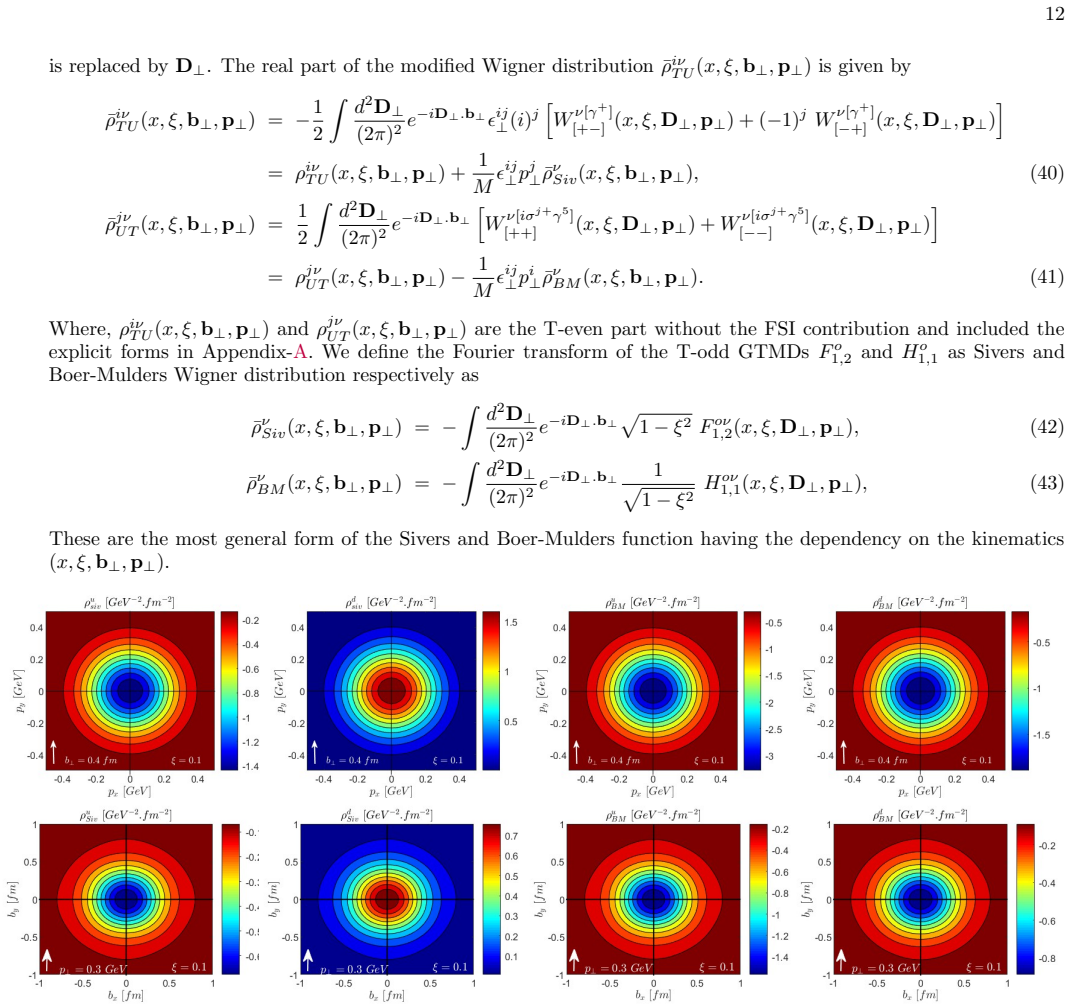
The boost invariant longitudinal position space variable $\sigma$, which is the Fourier conjugate to skewness $\xi$, unravels the longitudinal impact parameter information in a proton. Here, we investigate the skewness sensitivity of T-odd leading twist GTMDs within the Dokshitzer Gribov Lipatov Altarelli Parisi (DGLAP) region, considering a momentum transfer to longitudinal as well as transverse direction. The $\sigma$-space distributions of the T-odd sector show oscillatory patterns that are sensitive to the square of the total momentum transfer $-t$, which is analogous to the diffraction scattering of waves in Optics. An additional effect on the diffraction pattern is reported, caused by interference between transverse momentum transfer $\bfd$ to the transverse momentum $\bfp$ of quarks. We also present the correlation of proton spin to the transverse momentum of constituents through Sivers and Boer-Mulders Wigner Distributions in boost invariant longitudinal position space.
Editorial analysis
A structured set of objections, weighed in public.
Referee Report
Summary. The paper investigates the skewness sensitivity of T-odd leading-twist GTMDs in the DGLAP region (|x| > |ξ|) for a proton, incorporating momentum transfers in both longitudinal (via skewness ξ) and transverse directions. Using the boost-invariant longitudinal position-space variable σ (Fourier conjugate to ξ), it reports that the resulting σ-space distributions of the T-odd sector exhibit oscillatory patterns whose amplitude and form depend on the squared total momentum transfer −t, with an analogy drawn to optical diffraction. An additional modulation of these patterns is attributed to interference between the transverse momentum transfer Δ⊥ and the quark transverse momentum p⊥. The work also computes the Sivers and Boer-Mulders Wigner distributions in σ-space to illustrate spin-momentum correlations.
Significance. If the reported oscillatory behavior and interference survive changes in parametrization, the results would supply a concrete illustration of how longitudinal position-space information encoded in GTMDs can produce diffraction-like signatures, potentially guiding future phenomenological studies of T-odd distributions at facilities sensitive to skewness and transverse momentum. The explicit construction of σ-space Wigner distributions for Sivers and Boer-Mulders functions adds a useful visualization tool, though its impact remains tied to the underlying model assumptions.
major comments (1)
- [Abstract] Abstract and main text: The oscillatory patterns in σ-space and the bfd–bfp interference are obtained after Fourier transformation of a chosen parametrization of the T-odd GTMDs. The manuscript assumes this parametrization remains valid across the DGLAP region when both ξ and t are simultaneously non-zero, yet supplies no model-independent argument or general property of GTMDs demonstrating that the diffraction-like oscillations and interference term persist under alternative functional forms for the transverse-momentum dependence.
Simulated Author's Rebuttal
We thank the referee for the careful reading and constructive feedback. We address the major comment below.
read point-by-point responses
-
Referee: The oscillatory patterns in σ-space and the bfd–bfp interference are obtained after Fourier transformation of a chosen parametrization of the T-odd GTMDs. The manuscript assumes this parametrization remains valid across the DGLAP region when both ξ and t are simultaneously non-zero, yet supplies no model-independent argument or general property of GTMDs demonstrating that the diffraction-like oscillations and interference term persist under alternative functional forms for the transverse-momentum dependence.
Authors: We agree that the reported oscillatory patterns and interference arise from the Fourier transform of our chosen parametrization of the T-odd GTMDs (a standard dipole-like form commonly employed for such phenomenological studies). No model-independent proof is provided because the work is explicitly phenomenological. The oscillations are a direct consequence of the Fourier conjugate relation between ξ and σ combined with the support properties in the DGLAP region; the bfd–bfp interference follows from the bilinear structure in transverse momenta. To address the point we have added explicit statements in the abstract, Section 3, and conclusions acknowledging the model dependence and noting that while amplitudes may change with alternative forms, the qualitative diffraction-like features are tied to the Fourier transform itself. We have also referenced related literature using different parametrizations that exhibit similar behavior. revision: yes
Circularity Check
No significant circularity; derivation uses explicit model inputs without self-referential reduction
full rationale
The provided abstract and skeptic summary describe Fourier transformation of a chosen parametrization of T-odd GTMDs to obtain σ-space distributions and interference effects. No quoted equations or sections exhibit self-definition (e.g., a quantity defined in terms of its own output), fitted parameters renamed as predictions, or load-bearing self-citations that reduce the central claim to prior author work by construction. The DGLAP-region assumption and parametrization validity are stated as model inputs rather than derived results. The oscillatory patterns and bfd–bfp interference are direct computational outputs from those inputs. This is the common case of a self-contained model calculation; no load-bearing step collapses to its own inputs.
Axiom & Free-Parameter Ledger
Lean theorems connected to this paper
-
IndisputableMonolith/Cost/FunctionalEquation.leanwashburn_uniqueness_aczel unclear?
unclearRelation between the paper passage and the cited Recognition theorem.
The σ-space distributions of the T-odd sector show oscillatory patterns that are sensitive to the square of the total momentum transfer −t, analogous to the diffraction scattering of waves in Optics. An additional effect on the diffraction pattern is reported, caused by interference between transverse momentum transfer Δ⊥ to the transverse momentum p⊥ of quarks.
-
IndisputableMonolith/Foundation/DimensionForcing.leanalexander_duality_circle_linking unclear?
unclearRelation between the paper passage and the cited Recognition theorem.
The Fourier transform of GTMDs with respect to the skewness variable ξ yields the Wigner distributions in the longitudinal position space σ.
What do these tags mean?
- matches
- The paper's claim is directly supported by a theorem in the formal canon.
- supports
- The theorem supports part of the paper's argument, but the paper may add assumptions or extra steps.
- extends
- The paper goes beyond the formal theorem; the theorem is a base layer rather than the whole result.
- uses
- The paper appears to rely on the theorem as machinery.
- contradicts
- The paper's claim conflicts with a theorem or certificate in the canon.
- unclear
- Pith found a possible connection, but the passage is too broad, indirect, or ambiguous to say the theorem truly supports the claim.
Reference graph
Works this paper leans on
-
[2]
Aν 2(x′′)Aν 1(x′) x′′ − ∆2 ⊥ 2M2 N ν F14 ξ (1 − ξ2)3/2 (1 − x) x′′x′ (χ′′ 2 − χ′
-
[3]
Aν 2(x′′)Aν 2(x′) exp − ˜a(x′′)p′′2 ⊥ − ˜a(x′)p′2 ⊥ , (23) H(o)ν 1,1 (x, ξ, ∆2 ⊥, p2 ⊥, ∆⊥.p⊥) = N ν H11 1 16π3 p 1 − ξ2 (χ′′ 1 − χ′
-
[4]
Aν 1(x′′)Aν 2(x′) x′ − (χ′′ 2 − χ′
-
[5]
(26) The contribution from imaginary part of the wave function is denoted by (χ′′ 1 − χ′
Aν 2(x′′)Aν 1(x′) x′′ × exp − ˜a(x′′)p′′2 ⊥ − ˜a(x′)p′2 ⊥ , (24) Where, Aν i (x) = 4π κ r log(1/x) 1 − x xaν i (1 − x)bν i , (25) ˜a(x) = log(1/x) 2κ2(1 − x)2 ; and a(x) = 2˜a(x). (26) The contribution from imaginary part of the wave function is denoted by (χ′′ 1 − χ′
-
[6]
= 1 2 CF αS ln 1 + p′′2 ⊥ B(x′′) + B(x′) p′2 ⊥ ln 1 + p′2 ⊥ B(x′) , (27) (χ′′ 2 − χ′
-
[7]
= −1 2 CF αS B(x′′) p′′2 ⊥ ln 1 + p′′2 ⊥ B(x′′) + ln 1 + p′2 ⊥ B(x′) , (28) (χ′′ 2 − χ′
-
[8]
= −1 2 CF αS B(x′′) p′′2 ⊥ ln 1 + p′′2 ⊥ B(x′′) − B(x′) p′2 ⊥ ln 1 + p′2 ⊥ B(x′) . (29) These combinations cancel out the divergent part of the integration function g1 and g2 and produced finite contribution. At ξ = 0 limit, difference in longitudinal fractions of incoming and outgoing partons vanishes x′ = x′′ = x and the exponential term becomes indepen...
-
[9]
term like Sivers distribution. The lower row of Fig.6 represents the model results when p⊥ and ∆⊥ are perpendicular to each other and the distribution becomes symmetric as expected. V. SIVERS AND BOER-MULDERS DISTRIBUTION IN b ⊥-SPACE For completeness, in this section we present the Sivers and Boer-Mulders WDs in transverse impact parameter space denoted ...
work page 2023
- [10]
-
[11]
Transverse Polarisation of Quarks in Hadrons
V. Barone, A. Drago, and P. G. Ratcliffe, Phys. Rept. 359, 1 (2002), hep-ph/0104283
work page internal anchor Pith review Pith/arXiv arXiv 2002
-
[12]
Semi-inclusive deep inelastic scattering at small transverse momentum
A. Bacchetta, M. Diehl, K. Goeke, A. Metz, P. J. Mulders, and M. Schlegel, JHEP 02, 093 (2007), hep-ph/0611265
work page internal anchor Pith review Pith/arXiv arXiv 2007
-
[13]
S. J. Brodsky, D. S. Hwang, and I. Schmidt, Phys. Lett. B 530, 99 (2002), hep-ph/0201296
work page internal anchor Pith review Pith/arXiv arXiv 2002
-
[14]
A. Bacchetta, F. Delcarro, C. Pisano, M. Radici, and A. Signori, JHEP 06, 081 (2017), [Erratum: JHEP 06, 051 (2019)], 1703.10157
work page internal anchor Pith review Pith/arXiv arXiv 2017
-
[15]
Deeply Virtual Compton Scattering
X.-D. Ji, Phys. Rev. D 55, 7114 (1997), hep-ph/9609381
work page internal anchor Pith review Pith/arXiv arXiv 1997
-
[16]
Generalized Parton Distributions
M. Diehl, Phys. Rept. 388, 41 (2003), hep-ph/0307382
work page internal anchor Pith review Pith/arXiv arXiv 2003
-
[17]
A. V. Belitsky and A. V. Radyushkin, Phys. Rept. 418, 1 (2005), hep-ph/0504030
work page internal anchor Pith review Pith/arXiv arXiv 2005
-
[18]
Hard Exclusive Reactions and the Structure of Hadrons
K. Goeke, M. V. Polyakov, and M. Vanderhaeghen, Prog. Part. Nucl. Phys. 47, 401 (2001), hep-ph/0106012
work page internal anchor Pith review Pith/arXiv arXiv 2001
-
[19]
D. W. Sivers, Phys. Rev. D 41, 83 (1990)
work page 1990
-
[20]
Time-reversal odd distribution functions in leptoproduction
D. Boer and P. J. Mulders, Phys. Rev. D 57, 5780 (1998), hep-ph/9711485
work page internal anchor Pith review Pith/arXiv arXiv 1998
-
[21]
S. Bhattacharya, A. Metz, and J. Zhou, Phys. Lett. B 771, 396 (2017), [Erratum: Phys.Lett.B 810, 135866 (2020)], 1702.04387
-
[22]
Probing the Small-$x$ Gluon Tomography in Correlated Hard Diffractive Dijet Production in DIS
Y. Hatta, B.-W. Xiao, and F. Yuan, Phys. Rev. Lett. 116, 202301 (2016), 1601.01585
work page internal anchor Pith review Pith/arXiv arXiv 2016
-
[23]
X. Ji, F. Yuan, and Y. Zhao, Phys. Rev. Lett. 118, 192004 (2017), 1612.02438
work page internal anchor Pith review Pith/arXiv arXiv 2017
-
[24]
Gluon orbital angular momentum at small-$x$
Y. Hatta, Y. Nakagawa, F. Yuan, Y. Zhao, and B. Xiao, Phys. Rev. D 95, 114032 (2017), 1612.02445
work page internal anchor Pith review Pith/arXiv arXiv 2017
- [25]
-
[26]
Accessing the gluon Wigner distribution in ultraperipheral $pA$ collisions
Y. Hagiwara, Y. Hatta, R. Pasechnik, M. Tasevsky, and O. Teryaev, Phys. Rev. D 96, 034009 (2017), 1706.01765
work page internal anchor Pith review Pith/arXiv arXiv 2017
-
[27]
The elliptic gluon GTMD inside a large nucleus
J. Zhou, Phys. Rev. D 94, 114017 (2016), 1611.02397
work page internal anchor Pith review Pith/arXiv arXiv 2016
-
[28]
Generalized parton distributions in impact parameter space
M. Diehl, Eur. Phys. J. C 25, 223 (2002), [Erratum: Eur.Phys.J.C 31, 277–278 (2003)], hep-ph/0205208
work page internal anchor Pith review Pith/arXiv arXiv 2002
-
[29]
Impact Parameter Space Interpretation for Generalized Parton Distributions
M. Burkardt, Int. J. Mod. Phys. A 18, 173 (2003), hep-ph/0207047
work page internal anchor Pith review Pith/arXiv arXiv 2003
-
[30]
J. P. Ralston and B. Pire, Phys. Rev. D 66, 111501 (2002), hep-ph/0110075
work page internal anchor Pith review Pith/arXiv arXiv 2002
-
[31]
N. Kaur, N. Kumar, C. Mondal, and H. Dahiya, Nucl. Phys. B 934, 80 (2018), 1807.01076
work page internal anchor Pith review Pith/arXiv arXiv 2018
-
[32]
Quark Wigner distributions and spin-spin correlations
D. Chakrabarti, T. Maji, C. Mondal, and A. Mukherjee, Phys. Rev. D 95, 074028 (2017), 1701.08551
work page internal anchor Pith review Pith/arXiv arXiv 2017
-
[33]
Viewing the Proton Through "Color"-Filters
X.-d. Ji, Phys. Rev. Lett. 91, 062001 (2003), hep-ph/0304037
work page internal anchor Pith review Pith/arXiv arXiv 2003
-
[34]
The quark orbital angular momentum from Wigner distributions and light-cone wave functions
C. Lorce, B. Pasquini, X. Xiong, and F. Yuan, Phys. Rev. D 85, 114006 (2012), 1111.4827
work page internal anchor Pith review Pith/arXiv arXiv 2012
-
[35]
Quark Wigner Distributions and Orbital Angular Momentum
C. Lorce and B. Pasquini, Phys. Rev. D 84, 014015 (2011), 1106.0139
work page internal anchor Pith review Pith/arXiv arXiv 2011
-
[36]
C. Lorce, B. Pasquini, and M. Vanderhaeghen, JHEP 05, 041 (2011), 1102.4704
work page internal anchor Pith review Pith/arXiv arXiv 2011
-
[37]
Quark Wigner Distributions and Orbital Angular Momentum in Light-front Dressed Quark Model
A. Mukherjee, S. Nair, and V. K. Ojha, Phys. Rev. D 90, 014024 (2014), 1403.6233
work page internal anchor Pith review Pith/arXiv arXiv 2014
-
[38]
Wigner Distributions for Gluons in Light-front Dressed Quark Model
A. Mukherjee, S. Nair, and V. K. Ojha, Phys. Rev. D 91, 054018 (2015), 1501.03728
work page internal anchor Pith review Pith/arXiv arXiv 2015
-
[39]
J. More, A. Mukherjee, and S. Nair, Phys. Rev. D 95, 074039 (2017), 1701.00339
work page internal anchor Pith review Pith/arXiv arXiv 2017
-
[40]
Quark Wigner distributions in a light-cone spectator model
T. Liu and B.-Q. Ma, Phys. Rev. D 91, 034019 (2015), 1501.07690
work page internal anchor Pith review Pith/arXiv arXiv 2015
-
[41]
Wigner distributions and orbital angular momentum of a proton
D. Chakrabarti, T. Maji, C. Mondal, and A. Mukherjee, Eur. Phys. J. C 76, 409 (2016), 1601.03217
work page internal anchor Pith review Pith/arXiv arXiv 2016
-
[42]
D. Chakrabarti, N. Kumar, T. Maji, and A. Mukherjee, Eur. Phys. J. Plus 135, 496 (2020), 1902.07051
-
[43]
Nucleon parton distributions in a light-front quark model
T. Gutsche, V. E. Lyubovitskij, and I. Schmidt, Eur. Phys. J. C 77, 86 (2017), 1610.03526
work page internal anchor Pith review Pith/arXiv arXiv 2017
-
[44]
S. Kaur and H. Dahiya, Adv. High Energy Phys. 2020, 9429631 (2020), 1906.04662
-
[45]
Wigner distributions for an electron
N. Kumar and C. Mondal, Nucl. Phys. B 931, 226 (2018), 1705.03183
work page internal anchor Pith review Pith/arXiv arXiv 2018
-
[46]
Twist-2 Generalized TMDs and the Spin/Orbital Structure of the Nucleon
K. Kanazawa, C. Lorc´ e, A. Metz, B. Pasquini, and M. Schlegel, Phys. Rev. D 90, 014028 (2014), 1403.5226
work page internal anchor Pith review Pith/arXiv arXiv 2014
-
[47]
Quark Wigner distribution of the pion meson in light-cone quark model
Z.-L. Ma and Z. Lu, Phys. Rev. D 98, 054024 (2018), 1808.00140
work page internal anchor Pith review Pith/arXiv arXiv 2018
- [48]
- [49]
- [50]
- [51]
-
[52]
Chiral odd GPDs in transverse and longitudinal impact parameter spaces
D. Chakrabarti, R. Manohar, and A. Mukherjee, Phys. Rev. D 79, 034006 (2009), 0811.0521
work page internal anchor Pith review Pith/arXiv arXiv 2009
-
[53]
Generalized Parton Distributions for the Proton in Position Space : Non-Zero Skewness
R. Manohar, A. Mukherjee, and D. Chakrabarti, Phys. Rev. D 83, 014004 (2011), 1012.2627
work page internal anchor Pith review Pith/arXiv arXiv 2011
-
[54]
N. Kumar and H. Dahiya, Int. J. Mod. Phys. A 30, 1550010 (2015), 1501.04745
work page internal anchor Pith review Pith/arXiv arXiv 2015
- [55]
- [56]
- [57]
-
[58]
C. Mondal and D. Chakrabarti, Eur. Phys. J. C 75, 261 (2015), 1501.05489
work page internal anchor Pith review Pith/arXiv arXiv 2015
-
[59]
Helicity-dependent generalized parton distributions for nonzero skewness
C. Mondal, Eur. Phys. J. C 77, 640 (2017), 1709.06877
work page internal anchor Pith review Pith/arXiv arXiv 2017
-
[60]
Chiral-odd generalized parton distributions for proton in a light-front quark-diquark model
D. Chakrabarti and C. Mondal, Phys. Rev. D 92, 074012 (2015), 1509.00598
work page internal anchor Pith review Pith/arXiv arXiv 2015
- [61]
-
[62]
A light front quark-diquark model for the nucleons
T. Maji and D. Chakrabarti, Phys. Rev. D 94, 094020 (2016), 1608.07776
work page internal anchor Pith review Pith/arXiv arXiv 2016
-
[63]
T. Maji, C. Mondal, D. Chakrabarti, and O. V. Teryaev, JHEP 01, 165 (2016), 1506.04560
work page internal anchor Pith review Pith/arXiv arXiv 2016
-
[64]
Transverse structure of proton in a light-front quark-diquark model
T. Maji and D. Chakrabarti, Phys. Rev. D 95, 074009 (2017), 1702.04557
work page internal anchor Pith review Pith/arXiv arXiv 2017
-
[65]
T. Maji, C. Mondal, and D. Chakrabarti, Phys. Rev. D 96, 013006 (2017), 1702.02493
work page internal anchor Pith review Pith/arXiv arXiv 2017
-
[66]
T. Maji, D. Chakrabarti, and O. V. Teryaev, Phys. Rev. D 96, 114023 (2017), 1711.01746
work page internal anchor Pith review Pith/arXiv arXiv 2017
-
[67]
T. Maji, D. Chakrabarti, and A. Mukherjee, Phys. Rev. D 97, 014016 (2018), 1711.02930
work page internal anchor Pith review Pith/arXiv arXiv 2018
-
[68]
Gravitational form factors and angular momentum densities in light-front quark-diquark model
N. Kumar, C. Mondal, and N. Sharma, Eur. Phys. J. A 53, 237 (2017), 1712.02110
work page internal anchor Pith review Pith/arXiv arXiv 2017
-
[69]
Modelling quark distribution and fragmentation functions
R. Jakob, P. J. Mulders, and J. Rodrigues, Nucl. Phys. A 626, 937 (1997), hep-ph/9704335
work page internal anchor Pith review Pith/arXiv arXiv 1997
-
[70]
Transverse-momentum distributions in a diquark spectator model
A. Bacchetta, F. Conti, and M. Radici, Phys. Rev. D 78, 074010 (2008), 0807.0323
work page internal anchor Pith review Pith/arXiv arXiv 2008
-
[71]
G. P. Lepage and S. J. Brodsky, Phys. Rev. D 22, 2157 (1980)
work page 1980
-
[72]
J. R. Ellis, D. S. Hwang, and A. Kotzinian, Phys. Rev. D 80, 074033 (2009), 0808.1567
work page internal anchor Pith review Pith/arXiv arXiv 2009
-
[73]
S. J. Brodsky and G. F. de Teramond, Phys. Rev. D 77, 056007 (2008), 0707.3859
work page internal anchor Pith review Pith/arXiv arXiv 2008
-
[74]
G. F. de Teramond and S. J. Brodsky, in Ferrara International School Niccol` o Cabeo 2011: Hadronic Physics(2011), pp. 54–109, 1203.4025
work page internal anchor Pith review Pith/arXiv arXiv 2011
-
[75]
Nucleon and flavor form factors in a light front quark model in AdS/QCD
D. Chakrabarti and C. Mondal, Eur. Phys. J. C 73, 2671 (2013), 1307.7995
work page internal anchor Pith review Pith/arXiv arXiv 2013
-
[76]
Generalized Parton Distributions for the Proton in AdS/QCD
D. Chakrabarti and C. Mondal, Phys. Rev. D 88, 073006 (2013), 1307.5128
work page internal anchor Pith review Pith/arXiv arXiv 2013
-
[77]
Generalized parton correlation functions for a spin-0 hadron
S. Meissner, A. Metz, M. Schlegel, and K. Goeke, JHEP 08, 038 (2008), 0805.3165
work page internal anchor Pith review Pith/arXiv arXiv 2008
-
[78]
Generalized parton correlation functions for a spin-1/2 hadron
S. Meissner, A. Metz, and M. Schlegel, JHEP 08, 056 (2009), 0906.5323
work page internal anchor Pith review Pith/arXiv arXiv 2009
-
[79]
S. J. Brodsky, M. Diehl, and D. S. Hwang, Nucl. Phys. B 596, 99 (2001), hep-ph/0009254
work page internal anchor Pith review Pith/arXiv arXiv 2001
-
[80]
D. Chakrabarti, P. Choudhary, B. Gurjar, T. Maji, C. Mondal, and A. Mukherjee, Phys. Rev. D 109, 114040 (2024), 2402.16503
-
[81]
X.-D. Ji, W. Melnitchouk, and X. Song, Phys. Rev. D 56, 5511 (1997), hep-ph/9702379
work page internal anchor Pith review Pith/arXiv arXiv 1997
discussion (0)
Sign in with ORCID, Apple, or X to comment. Anyone can read and Pith papers without signing in.