A systematic framework for generating novel experimental hypotheses from language models
Pith reviewed 2026-05-23 21:51 UTC · model grok-4.3
The pith
Language models can simulate nonexistent child experiments to generate new hypotheses about how kids generalize verbs.
A machine-rendered reading of the paper's core claim, the machinery that carries it, and where it could break.
Core claim
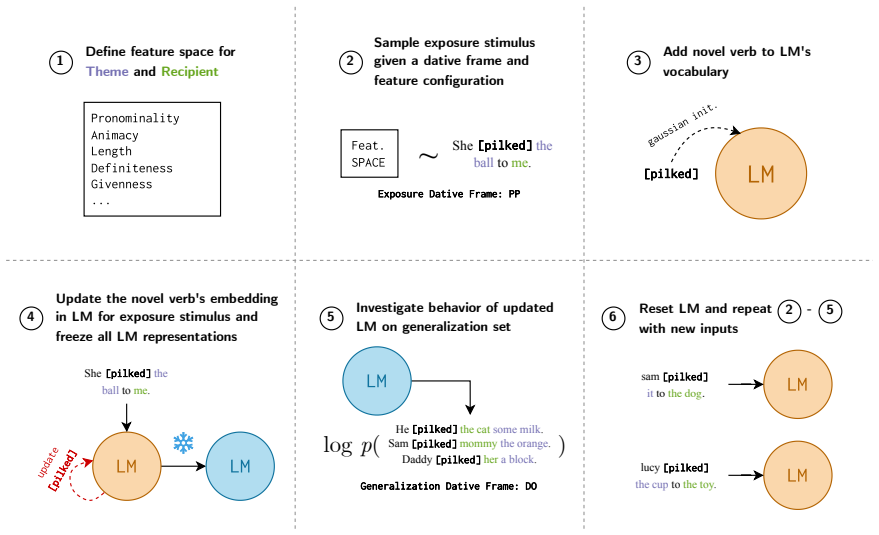
The authors claim that their framework, when instantiated on dative verb acquisition, produces the novel hypothesis that alignment between argument ordering and discourse prominence features of exposure contexts modulates how children generalize new verbs to unobserved structures, and they supply concrete experimental designs for testing this claim with children.
What carries the argument
A systematic framework that treats language models as simulated learners to predict outcomes of future behavioral experiments.
If this is right
- The match between argument ordering and discourse prominence in exposure sentences modulates children's cross-structural generalization of dative verbs.
- A set of lab experiments with children can be run to test the generated hypotheses.
- The same simulation approach can be applied to other open questions in language acquisition.
Where Pith is reading between the lines
- If the simulations prove reliable, researchers could generate candidate hypotheses faster by querying models before committing to child studies.
- The method might surface cases where model predictions diverge from actual child data, highlighting specific limits of current language models as cognitive simulators.
- Similar simulation pipelines could be tried in non-language domains of cognitive development where behavioral experiments are costly.
Load-bearing premise
Language models can accurately simulate how children would respond in language-learning experiments.
What would settle it
Running the proposed experiments with children and finding that alignment between argument ordering and discourse prominence does not affect generalization rates.
Figures


read the original abstract
Neural language models (LMs) have been shown to capture complex linguistic patterns, yet their utility in understanding human language and more broadly, human cognition, remains debated. While existing work in this area often evaluates human-machine alignment, few studies attempt to translate findings from this enterprise into novel insights about humans. To this end, we propose a systematic framework for hypothesis generation that uses LMs to simulate outcomes of experiments that do not yet exist in the literature. We instantiate this framework in the context of a specific research question in child language development: dative verb acquisition and cross-structural generalization. Through this instantiation, we derive novel, untested hypotheses: the alignment between argument ordering and discourse prominence features of exposure contexts modulates how children generalize new verbs to unobserved structures. Additionally, we also design a set of experiments that can test these hypotheses in the lab with children. This work contributes both a domain-general framework for systematic hypothesis generation via simulated learners and domain-specific, lab-testable hypotheses for child language acquisition research.
Editorial analysis
A structured set of objections, weighed in public.
Referee Report
Summary. The paper proposes a systematic framework that uses language models to simulate the outcomes of experiments that have not yet been run, with the goal of generating novel, testable hypotheses about human cognition. It instantiates the framework in the domain of child dative verb acquisition and cross-structural generalization, derives the hypothesis that alignment between argument ordering and discourse prominence in exposure contexts modulates generalization to unobserved structures, and outlines a set of corresponding child experiments.
Significance. If the framework can be shown to produce hypotheses that are both novel and grounded in faithful simulation of known human patterns, it would provide a domain-general method for accelerating hypothesis generation in cognitive science and language acquisition research. The concrete experimental designs offered are a practical contribution that could be directly implemented.
major comments (2)
- [Instantiation section] Instantiation section (framework application to dative acquisition): The central claim that the LM-derived hypotheses are valid outputs of the framework rather than model artifacts requires demonstrating that the LM reproduces established patterns from existing child dative acquisition studies (e.g., verb-class effects or dative alternation preferences). No such validation, comparison to published child data, or error analysis is reported, leaving the mapping from LM outputs to human generalization unsupported.
- [Hypothesis derivation step] Hypothesis derivation step: The abstract and described instantiation state that novel hypotheses were obtained via simulation, yet no model outputs, simulation parameters, or quantitative results from the LM runs are supplied. This absence makes it impossible to evaluate whether the reported hypothesis about argument ordering and discourse prominence follows from the simulation or from other sources.
minor comments (1)
- The abstract refers to 'a set of experiments that can test these hypotheses' but provides no details on design, stimuli, or predicted outcomes; moving a brief outline to the main text would improve clarity.
Simulated Author's Rebuttal
We thank the referee for their constructive comments, which highlight important aspects for strengthening the presentation of our framework. We respond to each major comment below and will revise the manuscript accordingly.
read point-by-point responses
-
Referee: [Instantiation section] Instantiation section (framework application to dative acquisition): The central claim that the LM-derived hypotheses are valid outputs of the framework rather than model artifacts requires demonstrating that the LM reproduces established patterns from existing child dative acquisition studies (e.g., verb-class effects or dative alternation preferences). No such validation, comparison to published child data, or error analysis is reported, leaving the mapping from LM outputs to human generalization unsupported.
Authors: We agree with the referee that demonstrating the LM's fidelity to known human patterns is essential to support the claim that the derived hypotheses are valid outputs of the framework. The current version of the manuscript focuses on the novel hypotheses and experimental designs but does not include this validation step. In the revision, we will add a validation subsection that applies the framework to existing child dative acquisition studies, comparing LM outputs to published data on verb-class effects and dative alternation preferences, along with quantitative metrics and error analysis. revision: yes
-
Referee: [Hypothesis derivation step] Hypothesis derivation step: The abstract and described instantiation state that novel hypotheses were obtained via simulation, yet no model outputs, simulation parameters, or quantitative results from the LM runs are supplied. This absence makes it impossible to evaluate whether the reported hypothesis about argument ordering and discourse prominence follows from the simulation or from other sources.
Authors: We acknowledge that the manuscript does not provide the specific LM outputs, simulation parameters, or quantitative results, which limits the ability to trace the hypothesis derivation. This was an oversight in the presentation. We will revise by including a detailed description of the simulation setup, example model outputs, and the step-by-step derivation process in a new section or appendix, ensuring transparency in how the hypothesis about argument ordering and discourse prominence was obtained from the simulations. revision: yes
Circularity Check
No circularity: forward simulation framework with no reduction to inputs by construction
full rationale
The paper proposes a domain-general framework that uses LMs to simulate outcomes of non-existent experiments in order to generate novel hypotheses about child dative generalization. The abstract and described instantiation contain no equations, fitted parameters, or self-citations that reduce the derived hypotheses to the LM training data or prior results by construction. The central output (alignment between argument ordering and discourse prominence modulating generalization) is presented as an emergent prediction from the simulation rather than a renaming or refit of known patterns. No uniqueness theorems, ansatzes smuggled via citation, or self-definitional loops are invoked. The derivation chain remains self-contained as a methodological proposal.
Axiom & Free-Parameter Ledger
axioms (1)
- domain assumption Language models can simulate outcomes of child language experiments with sufficient accuracy to generate valid novel hypotheses about human generalization.
Forward citations
Cited by 2 Pith papers
-
Collocational bootstrapping: A hypothesis about the learning of subject-verb agreement in humans and neural networks
Collocational bootstrapping via co-occurrence regularities enables neural networks to learn subject-verb agreement robustly when input variability matches child-directed speech, indicating it as a viable acquisition strategy.
-
Filling in the Mechanisms: How do LMs Learn Filler-Gap Dependencies under Developmental Constraints?
LMs develop shared yet item-sensitive filler-gap mechanisms with limited data but require substantially more data than humans to match generalizations.
Reference graph
Works this paper leans on
-
[1]
" write newline "" before.all 'output.state := FUNCTION n.dashify 't := "" t empty not t #1 #1 substring "-" = t #1 #2 substring "--" = not "--" * t #2 global.max substring 't := t #1 #1 substring "-" = "-" * t #2 global.max substring 't := while if t #1 #1 substring * t #2 global.max substring 't := if while FUNCTION word.in bbl.in ":" * " " * FUNCTION f...
-
[2]
" write newline "" before.all 'output.state := FUNCTION n.dashify 't := "" t empty not t #1 #1 substring "-" = t #1 #2 substring "--" = not "--" * t #2 global.max substring 't := t #1 #1 substring "-" = "-" * t #2 global.max substring 't := while if t #1 #1 substring * t #2 global.max substring 't := if while FUNCTION word.in bbl.in ":" * " " * FUNCTION f...
-
[3]
" write newline "" before.all 'output.state := FUNCTION n.dashify 't := "" t empty not t #1 #1 substring "-" = t #1 #2 substring "--" = not "--" * t #2 global.max substring 't := t #1 #1 substring "-" = "-" * t #2 global.max substring 't := while if t #1 #1 substring * t #2 global.max substring 't := if while FUNCTION word.in bbl.in ":" * " " * FUNCTION f...
-
[4]
author Aissen, J. , year 1999 . title Markedness and Subject Choice in Optimality Theory . journal Natural Language & Linguistic Theory volume 17 , pages 673--711
work page 1999
-
[5]
author Aissen, J. , year 2003 . title Differential Object Marking: Iconicity vs. Economy . journal Natural Language & Linguistic Theory volume 21 , pages 435--483
work page 2003
-
[6]
author Ambridge, B. , year 2020 . title Abstractions made of exemplars or ‘You’re all right, and I’ve changed my mind’: Response to commentators . journal First Language volume 40 , pages 640--659
work page 2020
-
[7]
author Ambridge, B. , author Bidgood, A. , author Twomey, K.E. , author Pine, J.M. , author Rowland, C.F. , author Freudenthal, D. , year 2015 . title Preemption versus entrenchment: Towards a construction-general solution to the problem of the retreat from verb argument structure overgeneralization . journal PloS one volume 10 , pages e0123723
work page 2015
-
[8]
author Ambridge, B. , author Pine, J.M. , author Rowland, C.F. , author Chang, F. , year 2012 . title The roles of verb semantics, entrenchment, and morphophonology in the retreat from dative argument-structure overgeneralization errors . journal Language volume 88 , pages 45--81
work page 2012
-
[9]
author Ambridge, B. , author Pine, J.M. , author Rowland, C.F. , author Young, C.R. , year 2008 . title The effect of verb semantic class and verb frequency (entrenchment) on children’s and adults’ graded judgements of argument-structure overgeneralization errors . journal Cognition volume 106 , pages 87--129
work page 2008
-
[10]
author Arnold, J.E. , author Lao, S.Y.C. , year 2008 . title Put in last position something previously unmentioned: Word order effects on referential expectancy and reference comprehension . journal Language and Cognitive Processes volume 23 , pages 282--295
work page 2008
-
[11]
author Arnold, J.E. , author Losongco, A. , author Wasow, T. , author Ginstrom, R. , year 2000 . title Heaviness vs. newness: The effects of structural complexity and discourse status on constituent ordering . journal Language volume 76 , pages 28--55
work page 2000
-
[12]
author Aronoff, M. , year 1976 . title Word formation in generative grammar . journal Linguistic Inquiry Monographs , pages 1--134
work page 1976
-
[13]
author Arunachalam, S. , year 2017 . title Preschoolers' Acquisition of Novel Verbs in the Double Object Dative . journal Cognitive science volume 41 , pages 831--854
work page 2017
-
[14]
author Baker, C.L. , year 1979 . title Syntactic theory and the projection problem . journal Linguistic Inquiry volume 10 , pages 533--581
work page 1979
-
[15]
author Baroni, M. , year 2020 . title Linguistic generalization and compositionality in modern artificial neural networks . journal Philosophical Transactions of the Royal Society B volume 375 , pages 20190307
work page 2020
-
[16]
author Bates, D. , author M \"a chler, M. , author Bolker, B. , author Walker, S. , year 2015 . title Fitting Linear Mixed-Effects Models Using lme4 . journal Journal of Statistical Software volume 67 , pages 1--48 . :10.18637/jss.v067.i01
-
[17]
author Beavers, J. , year 2011 . title An Aspectual Analysis of Ditransitive Verbs of Caused Possession in English . journal Journal of Semantics volume 28 , pages 1--54
work page 2011
-
[18]
author Behaghel, O. , year 1909 . title Beziehungen zwischen umfang und reihenfolge von satzgliedern . journal Indogermanische Forschungen volume 25 , pages 110
work page 1909
-
[19]
author Birch, S.L. , author Albrecht, J.E. , author Myers, J.L. , year 2000 . title Syntactic focusing structures influence discourse processing . journal Discourse Processes volume 30 , pages 285--304
work page 2000
-
[20]
author Birch, S.L. , author Garnsey, S.M. , year 1995 . title The effect of focus on memory for words in sentences . journal Journal of Memory and Language volume 34 , pages 232--267
work page 1995
-
[21]
author Bock, J.K. , year 1986 . title Syntactic persistence in language production . journal Cognitive Psychology volume 18 , pages 355--387
work page 1986
-
[22]
author Boyd, J.K. , author Goldberg, A.E. , year 2011 . title Learning what not to say: The role of statistical preemption and categorization in a-adjective production . journal Language volume 87 , pages 55--83
work page 2011
-
[23]
author Bresnan, J. , author Cueni, A. , author Nikitina, T. , author Baayen, R.H. , year 2007 . title Predicting the dative alternation , in: booktitle Cognitive foundations of interpretation . publisher KNAW , pp. pages 69--94
work page 2007
-
[24]
author Bresnan, J. , author Nikitina, T. , year 2009 . title The Gradience of the Dative Alternation . journal Reality exploration and discovery: Pattern interaction in language and life , pages 161--184
work page 2009
-
[25]
author Brooks, P.J. , author Tomasello, M. , year 1999 . title How children constrain their argument structure constructions . journal Language volume 75 , pages 720--738
work page 1999
-
[26]
author Citko, B. , author Embley Emonds, J. , author Whitney, R. , year 2017 . title Double Object Constructions . journal The Wiley Blackwell Companion to Syntax, Second Edition , pages 1--46
work page 2017
-
[27]
author Clark, H.H. , author Clark, E.V. , year 1977 . title Psychology and language: an introduction to psycholinguistics . publisher Harcourt Brace Jovanovich New York
work page 1977
-
[28]
author Collins, P. , year 1995 . title The indirect object construction in english: an informational approach . journal Linguistics volume 33 , pages 35--49
work page 1995
-
[29]
author Conwell, E. , year 2019 . title The effects of the pronoun me on dative comprehension . journal Journal of Child Language volume 46 , pages 1127--1141
work page 2019
-
[30]
author Conwell, E. , author Demuth, K. , year 2007 . title Early syntactic productivity: Evidence from dative shift . journal Cognition volume 103 , pages 163--179
work page 2007
-
[31]
author Conwell, E. , author O’Donnell, T.J. , author Snedeker, J. , year 2011 . title Frozen chunks and generalized representations: The case of the english dative alternation , in: booktitle Proceedings of the 35th Boston University conference on language development , organization Citeseer . pp. pages 132--144
work page 2011
-
[32]
author Coppock, E. , year 2009 . title The logical and empirical foundations of Baker's paradox . Ph.D. thesis. Stanford University
work page 2009
-
[33]
author De Marneffe, M.C. , author Grimm, S. , author Arnon, I. , author Kirby, S. , author Bresnan, J. , year 2012 . title A statistical model of the grammatical choices in child production of dative sentences . journal Language and cognitive processes volume 27 , pages 25--61
work page 2012
-
[34]
author De Marneffe, M.C. , author Manning, C.D. , author Nivre, J. , author Zeman, D. , year 2021 . title Universal dependencies . journal Computational linguistics volume 47 , pages 255--308
work page 2021
-
[35]
author Devlin, J. , author Chang, M.W. , author Lee, K. , author Toutanova, K. , year 2019 . title BERT : Pre-training of deep bidirectional T ransformers for language understanding , in: booktitle NAACL 2019 , pp. pages 4171--4186
work page 2019
-
[36]
author Dupoux, E. , year 2018 . title Cognitive science in the era of artificial intelligence: A roadmap for reverse-engineering the infant language-learner . journal Cognition volume 173 , pages 43--59
work page 2018
-
[37]
author Elman, J.L. , year 1990 . title Finding structure in time . journal Cognitive science volume 14 , pages 179--211
work page 1990
-
[38]
author Fodor, J.A. , author Pylyshyn, Z.W. , year 1988 . title Connectionism and cognitive architecture: A critical analysis . journal Cognition volume 28 , pages 3--71
work page 1988
-
[39]
author Foraker, S. , author McElree, B. , year 2007 . title The role of prominence in pronoun resolution: Active versus passive representations . journal Journal of Memory and Language volume 56 , pages 357--383
work page 2007
-
[40]
author Frank, M.C. , year 2023 . title Bridging the data gap between children and large language models . journal Trends in Cognitive Sciences volume 27 , pages 990--992
work page 2023
-
[41]
author Goldberg, A.E. , year 1995 . title Constructions: A construction grammar approach to argument structure . publisher University of Chicago Press
work page 1995
-
[42]
author Goldberg, A.E. , year 2011 . title Corpus evidence of the viability of statistical preemption . journal Cognitive Linguistics volume 22 , pages 131--153
work page 2011
-
[43]
author Goldberg, A.E. , year 2016 . title Partial productivity of linguistic constructions: Dynamic categorization and statistical preemption . journal Language and cognition volume 8 , pages 369--390
work page 2016
-
[44]
author Goldstein, A. , author Zada, Z. , author Buchnik, E. , author Schain, M. , author Price, A. , author Aubrey, B. , author Nastase, S.A. , author Feder, A. , author Emanuel, D. , author Cohen, A. , et al., year 2022 . title Shared computational principles for language processing in humans and deep language models . journal Nature Neuroscience volume ...
work page 2022
-
[45]
author Goodkind, A. , author Bicknell, K. , year 2018 . title Predictive power of word surprisal for reading times is a linear function of language model quality , in: editor Sayeed, A. , editor Jacobs, C. , editor Linzen, T. , editor van Schijndel, M. (Eds.), booktitle Proceedings of the 8th Workshop on Cognitive Modeling and Computational Linguistics ( ...
-
[46]
author Gropen, J. , author Pinker, S. , author Hollander, M. , author Goldberg, R. , author Wilson, R. , year 1989 . title The learnability and acquisition of the dative alternation in english . journal Language volume 65 , pages 203--257
work page 1989
-
[47]
author Guest, O. , author Martin, A.E. , year 2023 . title On logical inference over brains, behaviour, and artificial neural networks . journal Computational Brain & Behavior volume 6 , pages 213--227
work page 2023
-
[48]
author Gundel, J.K. , year 1988 . title Universals of topic-comment structure . journal Studies in syntactic typology volume 17 , pages 209--239
work page 1988
-
[49]
author Hadley, R.F. , year 1997 . title Cognition, systematicity and nomic necessity . journal Mind & language volume 12 , pages 137--153
work page 1997
-
[50]
author Hahn, U. , author Oaksford, M. , year 2008 . title Inference from absence in language and thought . journal The probabilistic mind: Prospects for Bayesian cognitive science , pages 121--42
work page 2008
-
[51]
author Hart, B. , author Risley, T.R. , year 2003 . title The early catastrophe: The 30 million word gap by age 3 . journal American educator volume 27 , pages 4--9
work page 2003
-
[52]
author Hawkins, R. , author Yamakoshi, T. , author Griffiths, T. , author Goldberg, A. , year 2020 . title Investigating representations of verb bias in neural language models , in: editor Webber, B. , editor Cohn, T. , editor He, Y. , editor Liu, Y. (Eds.), booktitle Proceedings of the 2020 Conference on Empirical Methods in Natural Language Processing (...
-
[53]
author Hewitt, J. , year 2021 . title Initializing new word embeddings for pretrained language models . https:/nlp.stanford.edu/ johnhew//vocab-expansion.html
work page 2021
-
[54]
author Hochreiter, S. , author Schmidhuber, J. , year 1997 . title Long short-term memory . journal Neural computation volume 9 , pages 1735--1780
work page 1997
-
[55]
author H \"o hle, B. , author Weissenborn, J. , author Kiefer, D. , author Schulz, A. , author Schmitz, M. , year 2004 . title Functional Elements in Infants’ Speech Processing: The Role of Determiners in the Syntactic Categorization of Lexical Elements . journal Infancy volume 5 , pages 341--353
work page 2004
-
[56]
author Honnibal, M. , author Montani, I. , author Van Landeghem, S. , author Boyd, A. , year 2020 . title spaCy : Industrial-strength natural language processing in python . :10.5281/zenodo.1212303
-
[57]
author Huebner, P.A. , author Sulem, E. , author Cynthia, F. , author Roth, D. , year 2021 . title B aby BERT a: Learning more grammar with small-scale child-directed language , in: editor Bisazza, A. , editor Abend, O. (Eds.), booktitle Proceedings of the 25th Conference on Computational Natural Language Learning , publisher Association for Computational...
-
[58]
author Huebner, P.A. , author Willits, J.A. , year 2018 . title Structured semantic knowledge can emerge automatically from predicting word sequences in child-directed speech . journal Frontiers in Psychology volume 9 , pages 133
work page 2018
-
[59]
author Huebner, P.A. , author Willits, J.A. , year 2021 . title Using lexical context to discover the noun category: Younger children have it easier , in: booktitle Psychology of learning and motivation . publisher Elsevier . volume volume 75 , pp. pages 279--331
work page 2021
-
[60]
author Jackendoff, R. , year 1990 . title On larson's treatment of the double object construction . journal Linguistic inquiry volume 21 , pages 427--456
work page 1990
-
[61]
author Jara-Ettinger, J. , author Levy, R. , author Sakel, J. , author Huanca, T. , author Gibson, E. , year 2022 . title The origins of the shape bias: Evidence from the tsimane’. journal Journal of Experimental Psychology: General volume 151 , pages 2437
work page 2022
-
[62]
author Jumelet, J. , author Zuidema, W. , author Sinclair, A. , year 2024 . title Do language models exhibit human-like structural priming effects? journal arXiv:2406.04847
-
[63]
author Kember, H. , author Choi, J. , author Yu, J. , author Cutler, A. , year 2021 . title The Processing of Linguistic Prominence . journal Language and Speech volume 64 , pages 413--436
work page 2021
-
[64]
author Kim, N. , author Linzen, T. , year 2020 . title COGS : A compositional generalization challenge based on semantic interpretation , in: editor Webber, B. , editor Cohn, T. , editor He, Y. , editor Liu, Y. (Eds.), booktitle Proceedings of the 2020 Conference on Empirical Methods in Natural Language Processing (EMNLP) , publisher Association for Compu...
-
[65]
author Kim, N. , author Smolensky, P. , year 2021 . title Testing for grammatical category abstraction in neural language models . journal Proceedings of the Society for Computation in Linguistics volume 4 , pages 467--470
work page 2021
-
[66]
author Kim, N. , author Smolensky, P. , year 2024 . title Structural generalization of modification in adult learners of an artificial language , in: booktitle Proceedings of the Annual Meeting of the Cognitive Science Society , pp. pages 856--863
work page 2024
-
[67]
author Kiparsky, P. , year 1982 . title Lexical phonology and morphology . journal Linguistics in the Morning Calm
work page 1982
-
[68]
author Kodner, J. , author Payne, S. , author Heinz, J. , year 2023 . title Why linguistics will thrive in the 21st century: A reply to Piantadosi (2023) . journal arXiv:2308.03228
-
[69]
author Lakretz, Y. , author Hupkes, D. , author Vergallito, A. , author Marelli, M. , author Baroni, M. , author Dehaene, S. , year 2021 . title Mechanisms for handling nested dependencies in neural-network language models and humans . journal Cognition volume 213 , pages 104699
work page 2021
-
[70]
author Lenth, R.V. , year 2023 . title emmeans: Estimated Marginal Means, aka Least-Squares Means . https://CRAN.R-project.org/package=emmeans. note r package version 1.9.0
work page 2023
-
[71]
author Levin, B. , year 1993 . title English verb classes and alternations: A preliminary investigation . publisher University of Chicago press
work page 1993
-
[72]
RoBERTa: A Robustly Optimized BERT Pretraining Approach
author Liu, Y. , author Ott, M. , author Goyal, N. , author Du, J. , author Joshi, M. , author Chen, D. , author Levy, O. , author Lewis, M. , author Zettlemoyer, L. , author Stoyanov, V. , year 2019 . title RoBERTa : A robustly optimized bert pretraining approach . journal arXiv:1907.11692
work page internal anchor Pith review Pith/arXiv arXiv 2019
-
[73]
author MacWhinney, B. , year 2000 . title The CHILDES project: Tools for analyzing talk, Volume I: Transcription format and programs . publisher Psychology Press
work page 2000
-
[74]
author Massaro, D.W. , year 1988 . title Some criticisms of connectionist models of human performance . journal Journal of Memory and Language volume 27 , pages 213--234
work page 1988
-
[75]
author McClelland, J.L. , year 1988 . title Connectionist models and psychological evidence . journal Journal of Memory and Language volume 27 , pages 107--123
work page 1988
-
[76]
author McCloskey, M. , year 1991 . title Networks and Theories: The Place of Connectionism in Cognitive Science . journal Psychological science volume 2 , pages 387--395
work page 1991
-
[77]
author McGrath, S. , author Russin, J. , author Pavlick, E. , author Feiman, R. , year 2023 . title How can deep neural networks inform theory in psychological science? osf.io/preprints/psyarxiv/j5ckf, :10.31234/osf.io/j5ckf
-
[78]
author Misra, K. , year 2022 . title minicons: Enabling flexible behavioral and representational analyses of transformer language models . journal arXiv:2203.13112
-
[79]
author Misra, K. , author Kim, N. , year 2023 . title Abstraction via exemplars? A representational case study on lexical category inference in BERT , in: booktitle BUCLD 48: Proceedings of the 48th annual Boston University Conference on Language Development , address Boston, USA
work page 2023
-
[80]
author Misra, K. , author Mahowald, K. , year 2024 . title Language Models Learn Rare Phenomena from Less Rare Phenomena: The Case of the Missing AANNs . journal arXiv:2403.19827
discussion (0)
Sign in with ORCID, Apple, or X to comment. Anyone can read and Pith papers without signing in.