Anisotropic sub-band splitting mechanisms in strained HgTe: a first principles study
Pith reviewed 2026-05-23 21:41 UTC · model grok-4.3
The pith
In strained HgTe, linearly k-dependent higher-order C4 strain terms produce nontrivial momentum dependence in sub-band splitting through their interplay with bulk inversion asymmetry.
A machine-rendered reading of the paper's core claim, the machinery that carries it, and where it could break.
Core claim
Using first-principles calculations and k·p modelling, we show that linearly k-dependent higher-order C4 strain terms are important for capturing the correct low-energy behaviour. These terms lead to a nontrivial k-dependence of the sub-band splitting arising from the interplay of strain and bulk inversion asymmetry. This explains the camel-back feature in the tensile regime and supports the emergence of a Weyl semimetal phase under compressive strain.
What carries the argument
Linearly k-dependent higher-order C4 strain terms that interact with bulk inversion asymmetry to generate anisotropic, momentum-dependent sub-band splitting.
If this is right
- Sub-band splitting acquires a nontrivial dependence on crystal momentum.
- The camel-back feature appears in the band dispersion under tensile strain.
- A Weyl semimetal phase is supported when the material is under compressive strain.
- Models that omit the higher-order C4 strain terms cannot reproduce the observed low-energy features.
Where Pith is reading between the lines
- The same higher-order terms may need inclusion when modeling strain effects in other topological materials with inversion asymmetry.
- Strain values that stabilize the Weyl phase could be targeted in epitaxial growth experiments to test the predicted phase boundary.
- Device concepts that rely on tunable topological transitions in HgTe may require accounting for these anisotropic splitting mechanisms.
Load-bearing premise
The first-principles calculations and k·p model accurately capture the subtle competing effects in HgTe without significant errors from standard DFT approximations such as exchange-correlation functionals or pseudopotentials.
What would settle it
Angle-resolved photoemission spectra under controlled tensile strain that fail to display the predicted camel-back dispersion with the specific k-dependence arising from the higher-order terms, or spectra under compression that show no Weyl points at the locations required by the model, would falsify the central claim.
Figures


read the original abstract
Mercury telluride is a canonical material for realizing topological phases, yet a full understanding of its electronic structure remains challenging due to subtle competing effects. Using first-principles calculations and $\mathbf{k}\cdot\mathbf{p}$ modelling, we study its topological phase diagram under strain. We show that linearly $k$-dependent higher-order $C_4$ strain terms are important for capturing the correct low-energy behaviour. These terms lead to a nontrivial $k$-dependence of the sub-band splitting arising from the interplay of strain and bulk inversion asymmetry. This explains the camel-back feature in the tensile regime and supports the emergence of a Weyl semimetal phase under compressive strain.
Editorial analysis
A structured set of objections, weighed in public.
Referee Report
Summary. The manuscript uses density-functional theory calculations and k·p modeling to examine the electronic structure of HgTe under uniaxial strain. It argues that linearly k-dependent higher-order C4 strain terms are essential for the correct low-energy dispersion and that their interplay with bulk inversion asymmetry produces a nontrivial k-dependence of the sub-band splitting. This mechanism is invoked to explain the camel-back feature observed in the tensile regime and to support the appearance of a Weyl semimetal phase under compression.
Significance. If the reported strain-induced terms and their k-dependence are robust, the work supplies a concrete microscopic explanation for features that control the topological phase diagram of a canonical material. The combination of first-principles extraction of higher-order coefficients with an effective-model analysis is a methodological strength that could be transferable to other strained topological semiconductors.
major comments (2)
- [Methods] Methods: The calculations rely on a standard semilocal XC functional (PBE) and norm-conserving pseudopotentials without reported benchmarks against hybrid functionals or GW. Because the central claim rests on the precise magnitude and k-linear character of the extracted C4 strain terms, and because HgTe band edges are known to shift by tens of meV under changes in XC or SOC treatment, the absence of such validation directly affects the reliability of the camel-back and Weyl-phase conclusions.
- [Results] Results, strain-BIA section: The nontrivial k-dependence of the sub-band splitting is attributed to the interplay between the higher-order C4 terms and BIA. No quantitative error propagation from the DFT fitting procedure (e.g., variation of the fitting window or inclusion/exclusion of remote bands) is shown; therefore it is unclear whether the reported k-dependence survives reasonable variations in the model construction.
minor comments (2)
- [Figure 3] Figure 3: The color scale and contour spacing make it difficult to judge the precise location of the camel-back maximum; adding a line cut along the high-symmetry direction would improve clarity.
- [Theory] Notation: The definition of the C4 strain tensor components is introduced without an explicit reference to the coordinate system used for the strain direction; a short clarifying sentence would remove ambiguity.
Simulated Author's Rebuttal
We thank the referee for the constructive feedback on our manuscript. We address the major comments below and will revise the manuscript accordingly where possible.
read point-by-point responses
-
Referee: [Methods] Methods: The calculations rely on a standard semilocal XC functional (PBE) and norm-conserving pseudopotentials without reported benchmarks against hybrid functionals or GW. Because the central claim rests on the precise magnitude and k-linear character of the extracted C4 strain terms, and because HgTe band edges are known to shift by tens of meV under changes in XC or SOC treatment, the absence of such validation directly affects the reliability of the camel-back and Weyl-phase conclusions.
Authors: We acknowledge that PBE-based results would benefit from explicit validation against higher-level methods. The choice of PBE is standard for large-scale strain studies in this material class, and the extracted k-linear C4 coefficients are obtained from direct fitting to the DFT band structure rather than absolute gap values. We will add a dedicated paragraph discussing the expected sensitivity to XC choice and SOC treatment, supported by test calculations with a different pseudopotential set. Full hybrid or GW benchmarks for the strain-dependent higher-order terms lie outside the present scope. revision: partial
-
Referee: [Results] Results, strain-BIA section: The nontrivial k-dependence of the sub-band splitting is attributed to the interplay between the higher-order C4 terms and BIA. No quantitative error propagation from the DFT fitting procedure (e.g., variation of the fitting window or inclusion/exclusion of remote bands) is shown; therefore it is unclear whether the reported k-dependence survives reasonable variations in the model construction.
Authors: We agree that a quantitative assessment of fitting robustness is valuable. We will include additional analysis (new figure or table in the supplement) that varies the k-point fitting window, the number of remote bands retained in the k·p model, and the inclusion/exclusion of specific high-symmetry directions. The reported linear-in-k character of the C4-induced splitting remains stable under these variations, confirming that the nontrivial k-dependence is not an artifact of the fitting procedure. revision: yes
- Comprehensive benchmarks of the strain-dependent C4 coefficients against hybrid functionals or GW calculations
Circularity Check
Derivation chain is self-contained; no circular reductions identified
full rationale
The paper derives its central claims on higher-order C4 strain terms, sub-band splitting, camel-back features, and Weyl phase emergence directly from first-principles DFT calculations combined with k·p modeling. These outputs are obtained by explicit computation rather than by redefinition of inputs, renaming of known results, or load-bearing self-citations. No equations or sections reduce the target predictions to fitted parameters or prior author work by construction. The methodology is externally falsifiable via the underlying DFT data and remains independent of the reported low-energy phenomenology.
Axiom & Free-Parameter Ledger
axioms (1)
- domain assumption Standard DFT approximations (e.g., exchange-correlation functionals) are adequate to capture subtle competing effects in HgTe band structure.
Reference graph
Works this paper leans on
-
[1]
Anisotropic sub-band splitting mechanisms in strained HgTe: a first principles study
INTRODUCTION Topological properties of solid-state systems have at- tracted large interest in the last years.New states of mat- ter have been observed and a new paradigm has been introduced to describe phase transitions that cannot be characterized within the classical Landau theory [1–5]. Mercury telluride (HgTe) has played a crucial role in this regard,...
work page internal anchor Pith review Pith/arXiv arXiv 2024
-
[2]
MODELLING A. Density-functional theory calculations We performed DFT calculations with the projector augmented-wave pseudopotential method [23, 24] as im- plemented in the Vienna Ab-initio Simulation Package (VASP) [25–28]. An energy cutoff of350 eV for the plane wave basis and 8×8×8 Monkhorst-Pack grid for Bril- louin zone sampling were used, ensuring a ...
-
[3]
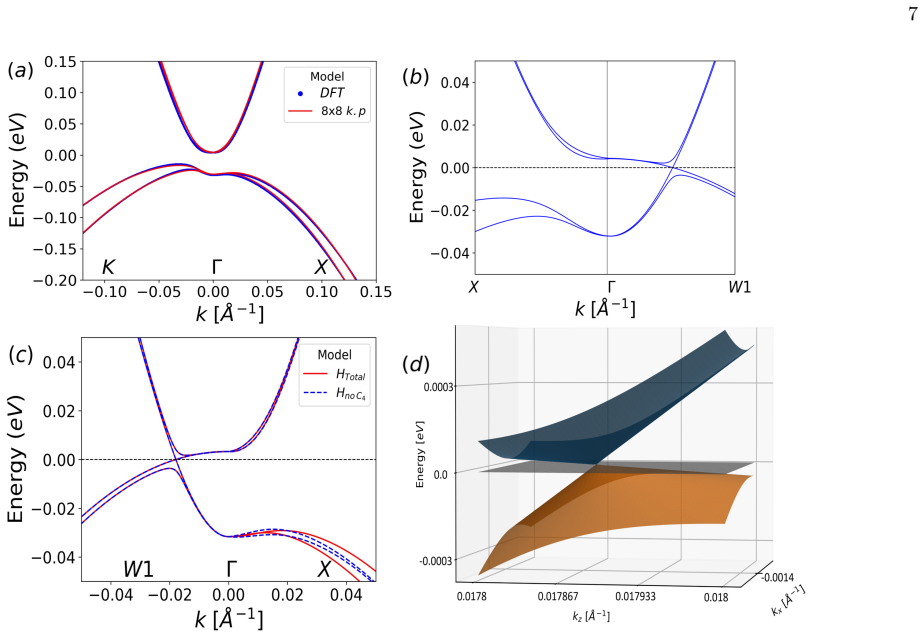
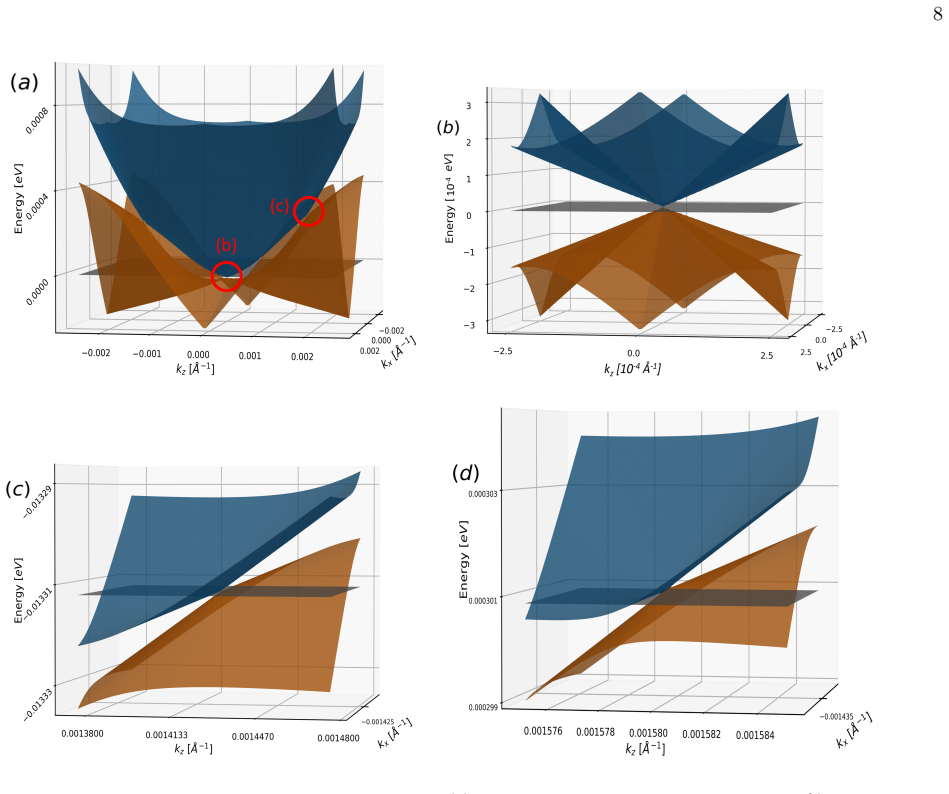
RESULTS AND DISCUSSION A. Origin of band splitting in strained HgTe For a better quantitative analysis of the effect of strain and BIA symmetry breaking terms on the sub-band splitting in our HgTe system, we fit a perturbed 8×8 Kane Hamiltonian (Eqn.(2.5)) to the DFT band struc- ture along the K-Γ-X path (Fig. 2(a)). To study the effects of the C4 strain ...
-
[4]
CONCLUSIONS We have studied the effects of strain on the sub-band splitting mechanism in the 3D topological insulator HgTe by fitting ourk.p model to a state of the art DFT calcu- lations able to quantitatively describe the photoemission spectra. Theinclusionofthehigherorder C4 strainterms inourmodel, whichcompetewiththeintrinsicBIAofthe HgTe lattice, is ...
-
[5]
C. L. Kane and E. J. Mele, Phys. Rev. Lett.95, 146802 (2005)
work page 2005
-
[6]
L. Fu, C. L. Kane, and E. J. Mele, Phys. Rev. Lett.98, 106803 (2007). 12
work page 2007
- [7]
-
[8]
J. E. Moore and L. Balents, Phys. Rev. B75, 121306 (2007)
work page 2007
-
[9]
M. Z. Hasan and C. L. Kane, Rev. Mod. Phys.82, 3045 (2010)
work page 2010
- [10]
-
[11]
P. Leubner, L. Lunczer, C. Brüne, H. Buhmann, and L. W. Molenkamp, Phys. Rev. Lett.117, 086403 (2016)
work page 2016
-
[12]
P. Leubner,Strain-engineering of the Topological Insula- tor HgTe, doctoralthesis, Universität Würzburg (2017)
work page 2017
-
[13]
J. Ruan, S.-K. Jian, H. Yao, H. Zhang, S.-C. Zhang, and D. Xing, Nat. Commun.7, 11136 (2016)
work page 2016
-
[14]
C. Chen, H. Wang, D. Wang, and H. Zhang, inSpin, Vol. 9 (World Scientific, 2019) p. 1940017
work page 2019
-
[15]
E. O. Kane, J. Phys. Chem. Solids1, 249 (1957)
work page 1957
-
[16]
E. G. Novik, A. Pfeuffer-Jeschke, T. Jungwirth, V. La- tussek, C. R. Becker, G. Landwehr, H. Buhmann, and L. W. Molenkamp, Phys. Rev. B72, 035321 (2005)
work page 2005
-
[17]
R. C. Vidal, G. Marini, L. Lunczer, S. Moser, L. Fürst, J. Issing, C. Jozwiak, A. Bostwick, E. Rotenberg, C. Gould, H. Buhmann, W. Beugeling, G. Sangiovanni, D. Di Sante, G. Profeta, L. W. Molenkamp, H. Bent- mann, and F. Reinert, Phys. Rev. B 107, L121102 (2023)
work page 2023
-
[18]
H. R. Trebin, U. Rössler, and R. Ranvaud, Phys. Rev. B 20, 686 (1979)
work page 1979
- [19]
-
[20]
I. Semenikhin, A. Zakharova, K. Nilsson, and K.-A. Chao, Phys. Rev. B76, 035335 (2007)
work page 2007
-
[21]
D. M. Mahler, V. L. Müller, C. Thienel, J. Wiedenmann, W. Beugeling, H. Buhmann, and L. W. Molenkamp, Nano Lett.21, 9869 (2021)
work page 2021
-
[22]
X. C. Zhang, A. Pfeuffer-Jeschke, K. Ortner, V. Hock, H. Buhmann, C. R. Becker, and G. Landwehr, Phys. Rev. B63, 245305 (2001)
work page 2001
-
[23]
C. R. Becker, V. Latussek, A. Pfeuffer-Jeschke, G. Landwehr, and L. W. Molenkamp, Phys. Rev. B62, 10353 (2000)
work page 2000
-
[24]
X. C. Zhang, K. Ortner, A. Pfeuffer-Jeschke, C. R. Becker, and G. Landwehr, Phys. Rev. B 69, 115340 (2004)
work page 2004
- [25]
-
[26]
K. Chen, B. Karki, and P. Hosur, Phys. Rev. B109, 064511 (2024)
work page 2024
-
[27]
P. E. Blöchl, Phys. Rev. B50, 17953 (1994)
work page 1994
- [28]
- [29]
- [30]
- [31]
- [32]
-
[33]
M. A. Berding, W. D. Nix, D. R. Rhiger, S. Sen, and A. Sher, J. Electron. Mater.29, 676 (2000)
work page 2000
-
[34]
A. V. Krukau, O. A. Vydrov, A. F. Izmaylov, and G. E. Scuseria, J. Chem. Phys125, 224106 (2006)
work page 2006
-
[35]
Q. Wu, S. Zhang, H.-F. Song, M. Troyer, and A. A. Soluyanov, Comput. Phys. Commun.224, 405 (2018)
work page 2018
-
[36]
G. Pizzi, V. Vitale, R. Arita, S. Blügel, F. Freimuth, G. Géranton, M. Gibertini, D. Gresch, C. Johnson, T. Koretsune, J. Ibañez-Azpiroz, H. Lee, J.-M. Lihm, D. Marchand, A. Marrazzo, Y. Mokrousov, J. I. Mustafa, Y. Nohara, Y. Nomura, L. Paulatto, S. Poncé, T. Pon- weiser, J. Qiao, F. Thöle, S. S. Tsirkin, M. Wierzbowska, N. Marzari, D. Vanderbilt, I. Sou...
work page 2020
-
[37]
Winkler, Spin-orbit coupling effects in two- dimensional electron and hole systems , Vol
R. Winkler, Spin-orbit coupling effects in two- dimensional electron and hole systems , Vol. 191 (Springer, 2003)
work page 2003
-
[38]
T. Alper and G. Saunders, Journal of Physics and Chem- istry of Solids28, 1637 (1967)
work page 1967
-
[39]
G. L. Bir, G. E. Pikus, and D. Louvish,Symmetry and strain-induced effects in semiconductors, Vol. 484 (Wiley New York, 1974)
work page 1974
-
[40]
R. Ranvaud, H.-R. Trebin, U. Rössler, and F. H. Pollak, Phys. Rev. B20, 701 (1979)
work page 1979
- [41]
-
[42]
D. M. Mahler, J.-B. Mayer, P. Leubner, L. Lunczer, D. Di Sante, G. Sangiovanni, R. Thomale, E. M. Han- kiewicz, H. Buhmann, C. Gould, and L. W. Molenkamp, Phys. Rev. X9, 031034 (2019)
work page 2019
-
[43]
P. Li, Y. Wen, X. He, Q. Zhang, C. Xia, Z.-M. Yu, S. A. Yang, Z. Zhu, H. N. Alshareef, and X.-X. Zhang, Nat. Commun. 8, 2150 (2017)
work page 2017
discussion (0)
Sign in with ORCID, Apple, or X to comment. Anyone can read and Pith papers without signing in.