Act in Collusion: Distributed Multi-Target Backdoor Attacks in Federated Learning
Pith reviewed 2026-05-23 17:20 UTC · model grok-4.3
The pith
One attacker controlling multiple clients can implant several distinct backdoors in federated learning that all retain high success rates after aggregation.
A machine-rendered reading of the paper's core claim, the machinery that carries it, and where it could break.
Core claim
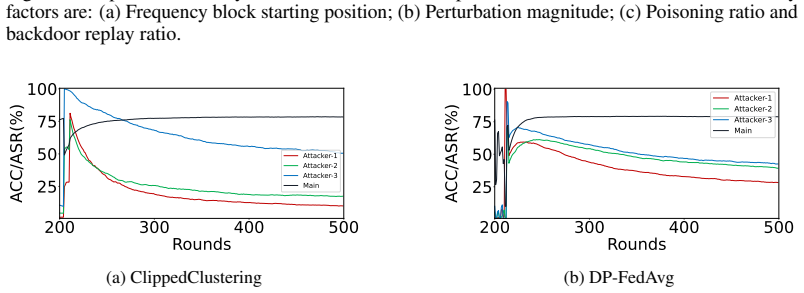
DMBA ensures attack success rates above 80 percent for all implanted backdoors by using Backdoor Replay to reduce discrepancies among malicious gradients and Channel-Frequency Composite Trigger to improve trigger distinguishability and reduce local interference, whereas baseline distributed backdoor methods often see rates drop below 50 percent or approach zero under the same multi-target aggregation.
What carries the argument
Distributed Multi-Target Backdoor Attack (DMBA) that combines Backdoor Replay to align malicious updates and Channel-Frequency Composite Trigger to preserve distinguishability.
If this is right
- Malicious clients can pursue different target labels at once without their updates cancelling during aggregation.
- Existing single-target or centralized multi-target defenses may leave federated systems open to coordinated distributed attacks.
- Attack success stays high even when the server mixes updates from many benign clients.
- The same client-control model can be extended to other distributed training settings that use gradient averaging.
Where Pith is reading between the lines
- Detection systems may need to watch for coordinated but non-identical update patterns across multiple clients rather than looking for one repeated trigger.
- The approach could be tested on networks with hundreds of clients to check whether the alignment steps remain stable at larger scale.
- Similar replay and composite-trigger ideas might transfer to other aggregation-based learning protocols beyond the federated case examined here.
Load-bearing premise
A single adversarial entity can control multiple distributed malicious clients, assign them distinct triggers and targets, and run Backdoor Replay and Channel-Frequency Composite Trigger without the server detecting the pattern or the triggers losing effectiveness under real aggregation.
What would settle it
In a federated learning run that applies the proposed Backdoor Replay and Channel-Frequency Composite Trigger, if the attack success rate for any one backdoor falls below 80 percent after server aggregation, the central effectiveness claim is refuted.
Figures



read the original abstract
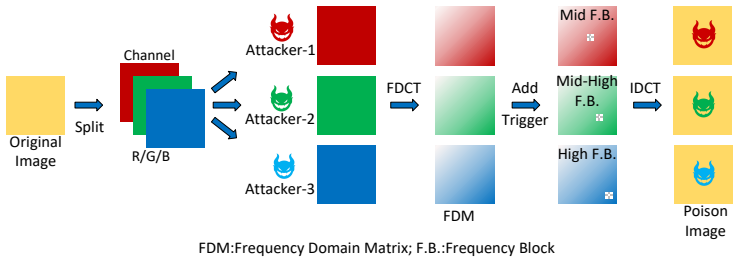
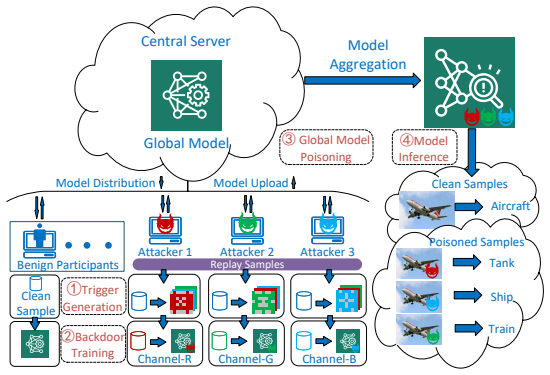
Federated learning (FL) is widely used in Internet-of-Things (IoT) systems, but its distributed training process also exposes it to backdoor attacks. Existing studies mainly consider single-target or centralized multi-target settings, while coordinated distributed multi-target attacks remain underexplored. In practical IoT scenarios, one adversarial entity may control multiple distributed malicious clients and assign each client distinct triggers and target labels. Under this setting, existing distributed backdoor methods often fail to preserve the effectiveness of all backdoors because malicious updates conflict during aggregation. To address this issue, we propose a Distributed Multi-Target Backdoor Attack (DMBA) for FL. DMBA introduces a Backdoor Replay (BR) mechanism to reduce discrepancies among malicious gradients and a Channel-Frequency Composite Trigger (CFCT) strategy to improve trigger distinguishability and alleviate local interference. Experiments on multiple datasets show that DMBA ensures attack success rates above 80% for all implanted backdoors, whereas some baseline backdoors fall below 50% and may even approach 0.
Editorial analysis
A structured set of objections, weighed in public.
Referee Report
Summary. The manuscript proposes DMBA, a distributed multi-target backdoor attack for federated learning. Under a threat model where one adversarial entity controls multiple malicious clients each assigned distinct triggers and targets, DMBA uses a Backdoor Replay (BR) mechanism to reduce malicious gradient discrepancies during aggregation and a Channel-Frequency Composite Trigger (CFCT) strategy to improve trigger distinguishability. Experiments on multiple datasets report that DMBA maintains attack success rates above 80% for all implanted backdoors under standard FedAvg, while baseline distributed backdoor methods often fall below 50% or approach 0.
Significance. If the empirical results hold under the stated threat model, the work demonstrates a practical coordinated attack that preserves effectiveness across multiple distinct backdoors, filling a gap between single-target and centralized multi-target settings in FL security literature. The explicit empirical demonstration of BR + CFCT under FedAvg provides a concrete, falsifiable baseline for future defense research in IoT-oriented federated systems.
minor comments (2)
- [Abstract] Abstract and experimental sections should include at least one table or paragraph summarizing dataset names, number of clients, fraction of malicious clients, and key hyperparameters (e.g., learning rate, trigger size) to support the reported ASR numbers.
- [Experiments] Clarify whether statistical significance (e.g., standard deviation over multiple runs) is reported for the >80% ASR figures or whether single-run results are presented.
Simulated Author's Rebuttal
We thank the referee for the positive summary, significance assessment, and recommendation of minor revision. No specific major comments were listed in the report.
Circularity Check
No significant circularity
full rationale
The paper is an empirical study proposing DMBA (with BR and CFCT mechanisms) and reporting measured attack success rates from experiments on standard datasets under FedAvg. No derivation chain, first-principles model, or predictive equations are present; results are presented as observed outcomes rather than outputs computed from the paper's own fitted parameters or self-referential definitions. No load-bearing self-citations or uniqueness theorems are invoked to force the central claims.
Axiom & Free-Parameter Ledger
Lean theorems connected to this paper
-
IndisputableMonolith/Foundation/RealityFromDistinction.leanreality_from_one_distinction unclear?
unclearRelation between the paper passage and the cited Recognition theorem.
We propose a Distributed Multi-Target Backdoor Attack (DMBA) for FL.
What do these tags mean?
- matches
- The paper's claim is directly supported by a theorem in the formal canon.
- supports
- The theorem supports part of the paper's argument, but the paper may add assumptions or extra steps.
- extends
- The paper goes beyond the formal theorem; the theorem is a base layer rather than the whole result.
- uses
- The paper appears to rely on the theorem as machinery.
- contradicts
- The paper's claim conflicts with a theorem or certificate in the canon.
- unclear
- Pith found a possible connection, but the passage is too broad, indirect, or ambiguous to say the theorem truly supports the claim.
Reference graph
Works this paper leans on
-
[1]
Alharbi, S., Guo, Y ., and Yu, W. (2024). Collusive backdoor attacks in federated learning frameworks for iot systems. IEEE Internet of Things Journal
work page 2024
-
[2]
Bagdasaryan, E., Veit, A., Hua, Y ., Estrin, D., and Shmatikov, V . (2020). How to backdoor federated learning. In International conference on artificial intelligence and statistics, pages 2938–2948. PMLR
work page 2020
-
[3]
Barni, M., Kallas, K., and Tondi, B. (2019). A new backdoor attack in cnns by training set corruption without label poisoning. In 2019 IEEE International Conference on Image Processing (ICIP), pages 101–105. IEEE
work page 2019
-
[4]
Baruch, G., Baruch, M., and Goldberg, Y . (2019). A little is enough: Circumventing defenses for distributed learning. Advances in Neural Information Processing Systems, 32
work page 2019
-
[5]
N., Chakraborty, S., Mittal, P., and Calo, S
Bhagoji, A. N., Chakraborty, S., Mittal, P., and Calo, S. (2019). Analyzing federated learning through an adversarial lens. In International Conference on Machine Learning, pages 634–643. PMLR
work page 2019
-
[6]
Chellapandi, V . P., Yuan, L.,˙Zak, S. H., and Wang, Z. (2023). A survey of federated learning for connected and automated vehicles. In 2023 IEEE 26th International Conference on Intelligent Transportation Systems (ITSC), pages 2485–2492. IEEE
work page 2023
-
[7]
Chen, X., Liu, C., Li, B., Lu, K., and Song, D. (2017). Targeted backdoor attacks on deep learning systems using data poisoning. arXiv preprint arXiv:1712.05526
work page internal anchor Pith review Pith/arXiv arXiv 2017
-
[8]
Chen, Z., Badrinarayanan, V ., Lee, C.-Y ., and Rabinovich, A. (2018). Gradnorm: Gradient normalization for adaptive loss balancing in deep multitask networks. In International conference on machine learning, pages 794–803. PMLR
work page 2018
-
[9]
Feng, Y ., Ma, B., Zhang, J., Zhao, S., Xia, Y ., and Tao, D. (2022). Fiba: Frequency-injection based backdoor attack in medical image analysis. In Proceedings of the IEEE/CVF Conference on Computer Vision and Pattern Recognition, pages 20876–20885
work page 2022
-
[10]
Mitigating sybils in federated learning poisoning,
Fung, C., Yoon, C. J., and Beschastnikh, I. (2018). Mitigating sybils in federated learning poisoning. arXiv preprint arXiv:1808.04866
-
[11]
Differentially Private Federated Learning: A Client Level Perspective
Geyer, R. C., Klein, T., and Nabi, M. (2017). Differentially private federated learning: A client level perspective. arXiv preprint arXiv:1712.07557
work page internal anchor Pith review Pith/arXiv arXiv 2017
-
[12]
Gong, X., Chen, Y ., Wang, Q., and Kong, W. (2022). Backdoor attacks and defenses in federated learning: State-of-the-art, taxonomy, and future directions. IEEE Wireless Communications, 30(2):114–121. 10
work page 2022
-
[13]
Gu, T., Dolan-Gavitt, B., and Garg, S. (2017). Badnets: Identifying vulnerabilities in the machine learning model supply chain. arXiv preprint arXiv:1708.06733
work page internal anchor Pith review Pith/arXiv arXiv 2017
-
[14]
He, K., Zhang, X., Ren, S., and Sun, J. (2016). Deep residual learning for image recognition. InProceedings of the IEEE conference on computer vision and pattern recognition, pages 770–778
work page 2016
-
[15]
Hessel, M., Modayil, J., Van Hasselt, H., Schaul, T., Ostrovski, G., Dabney, W., Horgan, D., Piot, B., Azar, M., and Silver, D. (2018). Rainbow: Combining improvements in deep reinforcement learning. In Proceedings of the AAAI conference on artificial intelligence, volume 32
work page 2018
- [16]
-
[17]
Jiang, W., Li, H., Xu, G., and Zhang, T. (2023). Color backdoor: A robust poisoning attack in color space. In Proceedings of the IEEE/CVF Conference on Computer Vision and Pattern Recognition, pages 8133–8142
work page 2023
-
[18]
Kendall, A., Gal, Y ., and Cipolla, R. (2018). Multi-task learning using uncertainty to weigh losses for scene geometry and semantics. In Proceedings of the IEEE conference on computer vision and pattern recognition, pages 7482–7491
work page 2018
-
[19]
Federated Learning: Strategies for Improving Communication Efficiency
Konecn`y, J., McMahan, H. B., Yu, F. X., Richtárik, P., Suresh, A. T., and Bacon, D. (2016). Federated learning: Strategies for improving communication efficiency. arXiv preprint arXiv:1610.05492, 8
work page internal anchor Pith review Pith/arXiv arXiv 2016
-
[20]
Krizhevsky, A., Hinton, G., et al. (2009). Learning multiple layers of features from tiny images
work page 2009
-
[21]
Kwon, H. (2022). Multi-model selective backdoor attack with different trigger positions. IEICE TRANS- ACTIONS on Information and Systems, 105(1):170–174
work page 2022
-
[22]
Kwon, H., Roh, J., Yoon, H., and Park, K.-W. (2020a). Targetnet backdoor: attack on deep neural network with use of different triggers. In Proceedings of the 2020 5th International Conference on Intelligent Information Technology, pages 140–145
work page 2020
-
[23]
Kwon, H., Yoon, H., and Park, K.-W. (2020b). Multi-targeted backdoor: Indentifying backdoor attack for multiple deep neural networks. IEICE TRANSACTIONS on Information and Systems, 103(4):883–887
- [24]
-
[25]
Li, S., Ngai, E. C.-H., and V oigt, T. (2023). An experimental study of byzantine-robust aggregation schemes in federated learning. IEEE Transactions on Big Data
work page 2023
-
[26]
Li, Y . (2023). Poisoning-based backdoor attacks in computer vision. InProceedings of the AAAI Conference on Artificial Intelligence, volume 37, pages 16121–16122
work page 2023
-
[27]
Liu, S., Johns, E., and Davison, A. J. (2019). End-to-end multi-task learning with attention. In Proceedings of the IEEE/CVF conference on computer vision and pattern recognition, pages 1871–1880
work page 2019
-
[28]
Liu, T., Wang, Z., He, H., Shi, W., Lin, L., An, R., and Li, C. (2023). Efficient and secure federated learning for financial applications. Applied Sciences, 13(10):5877
work page 2023
-
[29]
Liu, T., Zhang, Y ., Feng, Z., Yang, Z., Xu, C., Man, D., and Yang, W. (2024). Beyond traditional threats: A persistent backdoor attack on federated learning. In Proceedings of the AAAI Conference on Artificial Intelligence, volume 38, pages 21359–21367
work page 2024
-
[30]
Mamba Kabala, D., Hafiane, A., Bobelin, L., and Canals, R. (2023). Image-based crop disease detection with federated learning. Scientific Reports, 13(1):19220
work page 2023
-
[31]
McMahan, B., Moore, E., Ramage, D., Hampson, S., and y Arcas, B. A. (2017a). Communication-efficient learning of deep networks from decentralized data. In Artificial intelligence and statistics, pages 1273–1282. PMLR
-
[32]
Learning Differentially Private Recurrent Language Models
McMahan, H. B., Ramage, D., Talwar, K., and Zhang, L. (2017b). Learning differentially private recurrent language models. arXiv preprint arXiv:1710.06963
work page internal anchor Pith review Pith/arXiv arXiv
-
[33]
Mnih, V ., Kavukcuoglu, K., Silver, D., Rusu, A. A., Veness, J., Bellemare, M. G., Graves, A., Riedmiller, M., Fidjeland, A. K., Ostrovski, G., et al. (2015). Human-level control through deep reinforcement learning. nature, 518(7540):529–533. 11
work page 2015
-
[34]
D., Nguyen, T., Le Nguyen, P., Pham, H
Nguyen, T. D., Nguyen, T., Le Nguyen, P., Pham, H. H., Doan, K. D., and Wong, K.-S. (2024). Backdoor attacks and defenses in federated learning: Survey, challenges and future research directions. Engineering Applications of Artificial Intelligence, 127:107166
work page 2024
-
[35]
Paszke, A., Gross, S., Massa, F., Lerer, A., Bradbury, J., Chanan, G., Killeen, T., Lin, Z., Gimelshein, N., Antiga, L., et al. (2019). Pytorch: An imperative style, high-performance deep learning library. Advances in neural information processing systems, 32
work page 2019
-
[36]
Salem, A., Wen, R., Backes, M., Ma, S., and Zhang, Y . (2022). Dynamic backdoor attacks against machine learning models. In 2022 IEEE 7th European Symposium on Security and Privacy (EuroS&P), pages 703–718. IEEE
work page 2022
-
[37]
Schaul, T., Quan, J., Antonoglou, I., and Silver, D. (2015). Prioritized experience replay. arXiv preprint arXiv:1511.05952
work page internal anchor Pith review Pith/arXiv arXiv 2015
-
[38]
R., Najibi, M., Suciu, O., Studer, C., Dumitras, T., and Goldstein, T
Shafahi, A., Huang, W. R., Najibi, M., Suciu, O., Studer, C., Dumitras, T., and Goldstein, T. (2018). Poison frogs! targeted clean-label poisoning attacks on neural networks. Advances in neural information processing systems, 31
work page 2018
-
[39]
Shannon, C. E. (1949). Communication theory of secrecy systems. The Bell system technical journal, 28(4):656–715
work page 1949
-
[40]
Shejwalkar, V ., Houmansadr, A., Kairouz, P., and Ramage, D. (2022). Back to the drawing board: A critical evaluation of poisoning attacks on production federated learning. In 2022 IEEE Symposium on Security and Privacy (SP), pages 1354–1371. IEEE
work page 2022
-
[41]
Sheller, M. J., Edwards, B., Reina, G. A., Martin, J., Pati, S., Kotrotsou, A., Milchenko, M., Xu, W., Marcus, D., Colen, R. R., et al. (2020). Federated learning in medicine: facilitating multi-institutional collaborations without sharing patient data. Scientific reports, 10(1):12598
work page 2020
-
[42]
E., Güler, B., Jiao, J., and Avestimehr, A
So, J., Ali, R. E., Güler, B., Jiao, J., and Avestimehr, A. S. (2023). Securing secure aggregation: Mitigating multi-round privacy leakage in federated learning. In Proceedings of the AAAI Conference on Artificial Intelligence, volume 37, pages 9864–9873
work page 2023
-
[43]
Stallkamp, J., Schlipsing, M., Salmen, J., and Igel, C. (2011). The german traffic sign recognition benchmark: a multi-class classification competition. In The 2011 international joint conference on neural networks, pages 1453–1460. IEEE
work page 2011
-
[44]
Tolpegin, V ., Truex, S., Gursoy, M. E., and Liu, L. (2020). Data poisoning attacks against federated learning systems. In Computer Security–ESORICS 2020: 25th European Symposium on Research in Computer Security, ESORICS 2020, Guildford, UK, September 14–18, 2020, Proceedings, Part I 25, pages 480–501. Springer
work page 2020
-
[45]
Wang, H., Sreenivasan, K., Rajput, S., Vishwakarma, H., Agarwal, S., Sohn, J.-y., Lee, K., and Papail- iopoulos, D. (2020). Attack of the tails: Yes, you really can backdoor federated learning. Advances in Neural Information Processing Systems, 33:16070–16084
work page 2020
- [46]
-
[47]
Wang, T., Yao, Y ., Xu, F., An, S., Tong, H., and Wang, T. (2022a). An invisible black-box backdoor attack through frequency domain. In European Conference on Computer Vision, pages 396–413. Springer
-
[48]
Wang, Y ., Zhao, M., Li, S., Yuan, X., and Ni, W. (2022b). Dispersed pixel perturbation-based imperceptible backdoor trigger for image classifier models. IEEE Transactions on Information Forensics and Security, 17:3091–3106
-
[49]
Wang, Z. and Bovik, A. C. (2002). A universal image quality index. IEEE signal processing letters , 9(3):81–84
work page 2002
-
[50]
Wang, Z., Bovik, A. C., Sheikh, H. R., and Simoncelli, E. P. (2004). Image quality assessment: from error visibility to structural similarity. IEEE transactions on image processing, 13(4):600–612
work page 2004
- [51]
- [52]
-
[53]
Xie, C., Huang, K., Chen, P.-Y ., and Li, B. (2019). Dba: Distributed backdoor attacks against federated learning. In International conference on learning representations
work page 2019
-
[54]
Xue, M., He, C., Wang, J., and Liu, W. (2020). One-to-n & n-to-one: Two advanced backdoor attacks against deep learning models. IEEE Transactions on Dependable and Secure Computing, 19(3):1562–1578
work page 2020
- [55]
-
[56]
Yang, Q., Liu, Y ., Chen, T., and Tong, Y . (2019). Federated machine learning: Concept and applications. ACM Transactions on Intelligent Systems and Technology (TIST), 10(2):1–19
work page 2019
-
[57]
Yu, Y ., Wang, Y ., Yang, W., Lu, S., Tan, Y .-P., and Kot, A. C. (2023). Backdoor attacks against deep image compression via adaptive frequency trigger. In Proceedings of the IEEE/CVF Conference on Computer Vision and Pattern Recognition, pages 12250–12259
work page 2023
-
[58]
A., Shechtman, E., and Wang, O
Zhang, R., Isola, P., Efros, A. A., Shechtman, E., and Wang, O. (2018). The unreasonable effectiveness of deep features as a perceptual metric. In Proceedings of the IEEE conference on computer vision and pattern recognition, pages 586–595
work page 2018
-
[59]
Zhang, Z., Cao, X., Jia, J., and Gong, N. Z. (2022a). Fldetector: Defending federated learning against model poisoning attacks via detecting malicious clients. InProceedings of the 28th ACM SIGKDD Conference on Knowledge Discovery and Data Mining, pages 2545–2555
-
[60]
Zhang, Z., Panda, A., Song, L., Yang, Y ., Mahoney, M., Mittal, P., Kannan, R., and Gonzalez, J. (2022b). Neurotoxin: Durable backdoors in federated learning. In International Conference on Machine Learning, pages 26429–26446. PMLR. A Details of the Experiment in Fig. 1 In the initial phase of our investigation, extensive explorations were conducted to as...
work page 2018
discussion (0)
Sign in with ORCID, Apple, or X to comment. Anyone can read and Pith papers without signing in.