Hitting the slopes: A spectroscopic view of UV continuum slopes of galaxies reveals a reddening at z > 9.5
Pith reviewed 2026-05-23 17:05 UTC · model grok-4.3
The pith
The average UV continuum slope of galaxies begins to redden at redshifts above 9.5, which high-temperature nebular emission can reproduce without dust.
A machine-rendered reading of the paper's core claim, the machinery that carries it, and where it could break.
Core claim
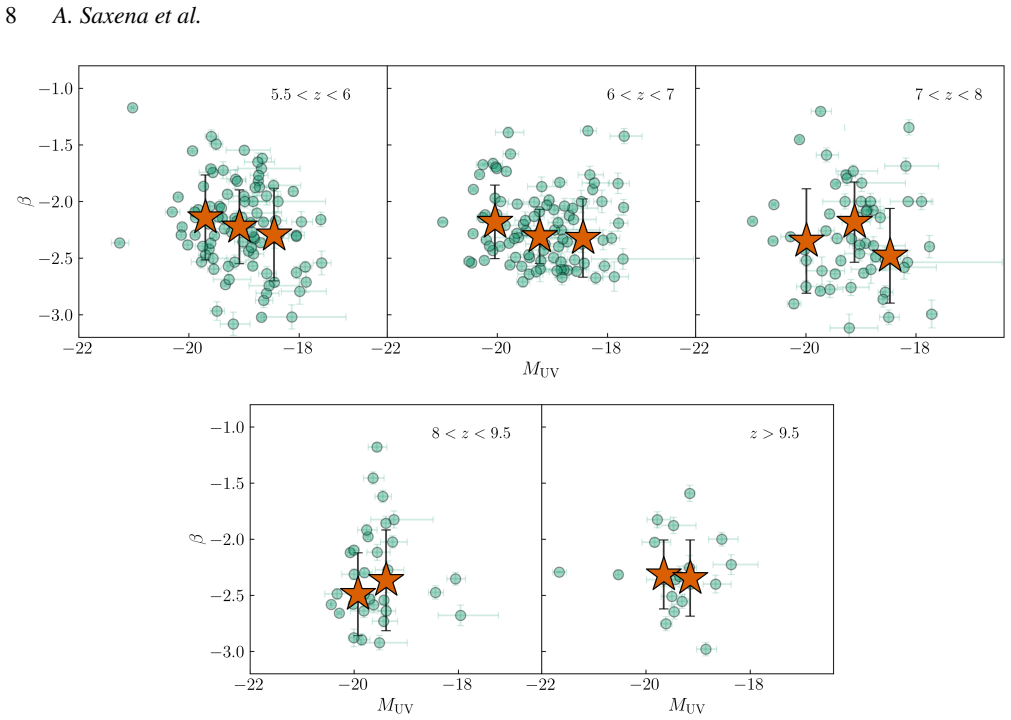
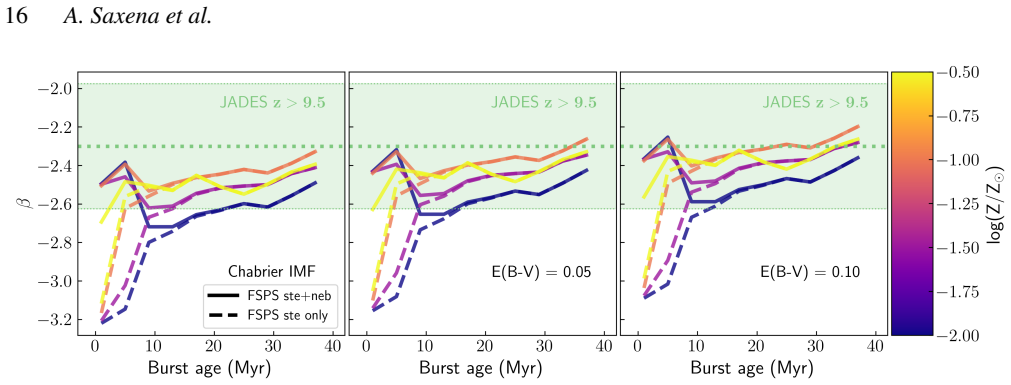
The central claim is that the average β at z > 9.5 begins to redden, breaking the trend of increasing blueness seen at lower redshifts. Stacked spectra link bluer β directly to reduced dust attenuation, while six individual galaxies with β < -3.0 display spectroscopic signs of Lyman-continuum leakage. In the absence of dust, nebular continuum emission from gas at temperatures above 15,000 K reproduces the full range of observed β values; higher temperatures driven by massive stars can simultaneously account for the bright UV luminosities recorded at z > 10.
What carries the argument
The UV continuum slope β, measured directly from NIRSpec/PRISM spectra and tracked across redshift and magnitude bins; nebular continuum emission at gas temperatures above 15,000 K is the mechanism proposed to generate redder β without requiring dust.
If this is right
- Rapid dust production or a large nebular-continuum contribution must operate by z > 9.5 to explain the observed slopes.
- Very blue galaxies are expected to leak a significant fraction of their ionizing photons.
- Hotter gas temperatures from massive stars would simultaneously boost nebular emission and help produce the bright UV luminosities seen at z > 10.
Where Pith is reading between the lines
- If high gas temperatures are common, models of early star formation may need to include a larger fraction of very massive stars than assumed at lower redshifts.
- The same nebular contribution that reddens β could alter inferred star-formation rates and ionizing-photon budgets used in reionization calculations.
- Future deeper spectra of individual z > 10 galaxies can test whether the stacked reddening trend persists or is an artifact of sample selection.
Load-bearing premise
The reddening trend at z > 9.5 and the nebular explanation both rest on the premise that the highest-redshift bin contains enough galaxies and that stacking plus fitting introduce no systematic bias that could fake a reddening signal.
What would settle it
Individual β measurements for a larger sample of galaxies at z > 10 that show continued bluing instead of reddening, or spectroscopic line ratios indicating gas temperatures below 15,000 K in the same objects.
Figures






read the original abstract
The UV continuum slope of galaxies, $\beta$, is a powerful diagnostic. Understanding the redshift evolution of $\beta$ and its dependence on key galaxy properties can shed light on the evolution of galaxy physical properties over cosmic time. In this study, we present $\beta$ measurements for 295 spectroscopically confirmed galaxies at $5.5<z<14.3$ selected primarily from JADES, where $\beta$ has been measured from high quality JWST NIRSpec/PRISM spectra. We find a median $\beta=-2.3$ across our full sample, and find mild increase in blueness of $\beta$ with increasing redshift and fainter UV magnitudes. Interestingly, we find evidence for the average $\beta$ at $z > 9.5$ to begin to redden, deviating from the trend observed at $z < 9.5$. By producing stacked spectra in bins of redshift and $\beta$, we derive trends between $\beta$ and dust attenuation, metallicity, ionization parameter, and stellar age indicators directly from spectra, finding a lack of dust attenuation to be the dominant driver of bluer $\beta$ values. We further report six galaxies with $\beta<-3.0$, which show a range of spectroscopic properties and signs of significant LyC photon leakage. Finally, we show that the redder $\beta$ values at $z > 9.5$ may require rapid build-up of dust reservoirs in the very early Universe or a significant contribution from the nebular continuum emission to the observed UV spectra, with the nebular continuum fraction depending on the gas temperatures and densities. Our modeling shows that in the absence of dust, nebular emission at $T > 15,000$ K can reproduce the range of $\beta$ that we see in our sample. Higher gas temperatures driven by hot, massive stars can boost the fraction of nebular continuum emission, potentially explaining the observed $\beta$ values as well as bright UV magnitudes seen across galaxies at $z > 10$.
Editorial analysis
A structured set of objections, weighed in public.
Referee Report
Summary. The manuscript measures UV continuum slopes β directly from JWST NIRSpec/PRISM spectra for 295 spectroscopically confirmed galaxies at 5.5 < z < 14.3 (primarily JADES). It reports a sample median β = −2.3, a mild trend toward bluer β with increasing redshift and fainter M_UV up to z ≈ 9.5, but evidence that the average β reddens at z > 9.5. Stacked spectra link β trends to dust attenuation, metallicity, ionization parameter and stellar age; six objects with β < −3.0 are highlighted. Nebular-continuum modeling at T > 15 000 K is shown to reproduce the observed high-z β range in the absence of dust.
Significance. Direct spectroscopic β measurements at z > 9 provide a valuable anchor for early-galaxy studies. If the z > 9.5 reddening and its nebular explanation are robust, the work constrains the timing of dust production and the contribution of hot gas to UV light, with implications for reionization and galaxy-formation models. The stacking analysis that ties β to physical parameters from the same spectra is a clear strength.
major comments (3)
- [§4] §4 (redshift-binned trends): the claim that average β reddens at z > 9.5 rests on the highest-redshift bin; the exact number of galaxies per bin must be stated and the stability of the median β against Poisson noise or single-object removal must be quantified (e.g., via bootstrap resampling).
- [§3] §3 (PRISM β fitting): the continuum-fitting procedure used to extract β from rest-frame ~1200–3000 Å PRISM spectra at z > 10 has reduced wavelength leverage and potentially increased line contamination; explicit tests (mock spectra or alternative fitting windows) are required to rule out redshift-dependent systematic bias that could mimic the reported reddening.
- [§5] §5 (nebular modeling): the demonstration that T > 15 000 K nebular continuum reproduces the observed β range assumes this temperature without independent constraints from the spectra; the manuscript should test whether plausible variations in density or ionization parameter alone can produce comparable β shifts.
minor comments (2)
- [Figure 4] Figure 4 (stacked spectra): the wavelength ranges and bin labels should be annotated directly on the panels for clarity.
- [Abstract] Abstract: the statement of a “mild increase in blueness” should be accompanied by the measured dβ/dz or equivalent quantitative slope.
Simulated Author's Rebuttal
We thank the referee for their constructive and detailed review, which has helped us identify areas to strengthen the robustness of our analysis. We address each major comment below and will incorporate the suggested additions and tests in the revised manuscript.
read point-by-point responses
-
Referee: [§4] §4 (redshift-binned trends): the claim that average β reddens at z > 9.5 rests on the highest-redshift bin; the exact number of galaxies per bin must be stated and the stability of the median β against Poisson noise or single-object removal must be quantified (e.g., via bootstrap resampling).
Authors: We agree that explicitly stating the number of galaxies per redshift bin and quantifying the stability of the median β is essential for supporting the reddening claim at z > 9.5. In the revised manuscript, we will add the exact counts for each bin in §4 and include bootstrap resampling results to assess sensitivity to Poisson noise and individual object removal. These additions will confirm that the trend is robust and not an artifact of small-number statistics. revision: yes
-
Referee: [§3] §3 (PRISM β fitting): the continuum-fitting procedure used to extract β from rest-frame ~1200–3000 Å PRISM spectra at z > 10 has reduced wavelength leverage and potentially increased line contamination; explicit tests (mock spectra or alternative fitting windows) are required to rule out redshift-dependent systematic bias that could mimic the reported reddening.
Authors: We acknowledge that the reduced wavelength coverage at z > 10 could introduce potential biases from limited leverage or line contamination. To rule this out, the revised §3 will include explicit tests using mock spectra (with realistic line contamination and redshift-dependent coverage) and alternative fitting windows. These tests will demonstrate that any systematic redshift-dependent bias is negligible and does not drive the observed reddening trend. revision: yes
-
Referee: [§5] §5 (nebular modeling): the demonstration that T > 15 000 K nebular continuum reproduces the observed β range assumes this temperature without independent constraints from the spectra; the manuscript should test whether plausible variations in density or ionization parameter alone can produce comparable β shifts.
Authors: The referee is correct that our current modeling emphasizes temperature as the key parameter. While high temperatures are physically motivated by hot stellar populations at these redshifts, we will expand §5 to test independent variations in gas density and ionization parameter. This will clarify whether these factors alone can produce comparable β shifts or if temperature remains the primary driver, providing a fuller assessment of nebular contributions. revision: yes
Circularity Check
No circularity: β measured directly from spectra; nebular modeling is explanatory check, not fitted prediction
full rationale
The paper measures β directly from JWST NIRSpec/PRISM spectra of 295 galaxies (abstract and methods). Trends with redshift, dust, metallicity etc. are extracted from stacked spectra. The statement that nebular continuum at T>15,000 K can reproduce observed β values is presented as a forward model check, not a parameter fit to the same β data that then 'predicts' the input. No self-citation chains, uniqueness theorems, or ansatzes imported from prior author work are invoked as load-bearing. The derivation chain is self-contained against external spectral data.
Axiom & Free-Parameter Ledger
axioms (1)
- domain assumption Standard assumptions in NIRSpec/PRISM spectral calibration and continuum fitting hold for these high-redshift sources.
Forward citations
Cited by 4 Pith papers
-
Resolving dust and Ly{\alpha} emission in a lensed galaxy at the epoch of reionization with JWST/CANUCS
Spatially resolved JWST observations of lensed LAE HCM 6A at z=6.57 reveal Lyα escaping from a dust-cleared central clump in the youngest region, with age-dependent Calzetti-like attenuation curves.
-
Lyman-alpha Radiation Pressure in Dense Star Clusters: Implications for Star Formation and Winds at Cosmic Dawn
Lyα radiation pressure mildly reduces gas-to-star conversion efficiency in dense high-redshift clusters while dominating the launch of rapid outflows.
-
SPURS: Bursty Star Formation in an Extremely Luminous Weak Emission Line Galaxy at $z=9.3$
A massive galaxy at z=9.3 shows bursty star formation with a recent downturn and sits in a small ionized bubble in a neutral IGM.
-
JWST Advanced Deep Extragalactic Survey (JADES) Data Release 5: Photometrically Selected Galaxy Candidates at z > 8
JADES DR5 delivers 2081 z_phot > 8 galaxy candidates with UV slope trends, morphological evidence of clumpy growth, and improved photo-z methods tested on a spectroscopic subsample.
Reference graph
Works this paper leans on
-
[1]
" write newline "" before.all 'output.state := FUNCTION fin.entry write newline FUNCTION new.block output.state before.all = 'skip after.block 'output.state := if FUNCTION new.sentence output.state after.block = 'skip output.state before.all = 'skip after.sentence 'output.state := if if FUNCTION not #0 #1 if FUNCTION and 'skip pop #0 if FUNCTION or pop #1...
-
[2]
Adams N. J., et al., 2024, @doi [ ] 10.3847/1538-4357/ad2a7b , https://ui.adsabs.harvard.edu/abs/2024ApJ...965..169A 965, 169
-
[3]
Arrabal Haro P., et al., 2023, @doi [ ] 10.3847/2041-8213/acdd54 , https://ui.adsabs.harvard.edu/abs/2023ApJ...951L..22A 951, L22
-
[4]
Astropy Collaboration et al., 2013, @doi [ ] 10.1051/0004-6361/201322068 , http://adsabs.harvard.edu/abs/2013A
-
[5]
Astropy Collaboration et al., 2018, @doi [ ] 10.3847/1538-3881/aabc4f , https://ui.adsabs.harvard.edu/abs/2018AJ....156..123A 156, 123
-
[6]
Austin D., et al., 2024, @doi [arXiv e-prints] 10.48550/arXiv.2404.10751 , https://ui.adsabs.harvard.edu/abs/2024arXiv240410751A p. arXiv:2404.10751
-
[7]
Bastian N., Covey K. R., Meyer M. R., 2010, @doi [ ] 10.1146/annurev-astro-082708-101642 , https://ui.adsabs.harvard.edu/abs/2010ARA&A..48..339B 48, 339
-
[8]
Baumgardt H., H \'e nault-Brunet V., Dickson N., Sollima A., 2023, @doi [ ] 10.1093/mnras/stad631 , https://ui.adsabs.harvard.edu/abs/2023MNRAS.521.3991B 521, 3991
-
[9]
Bhatawdekar R., Conselice C. J., 2021, @doi [ ] 10.3847/1538-4357/abdd3f , https://ui.adsabs.harvard.edu/abs/2021ApJ...909..144B 909, 144
-
[10]
Bolamperti A., et al., 2023, @doi [ ] 10.1093/mnras/stad3114 , https://ui.adsabs.harvard.edu/abs/2023MNRAS.526.5263B 526, 5263
-
[11]
Bouwens R. J., et al., 2009, @doi [ ] 10.1088/0004-637X/705/1/936 , https://ui.adsabs.harvard.edu/abs/2009ApJ...705..936B 705, 936
-
[12]
Bouwens R. J., et al., 2010, @doi [ ] 10.1088/2041-8205/708/2/L69 , https://ui.adsabs.harvard.edu/abs/2010ApJ...708L..69B 708, L69
-
[13]
Bouwens R. J., et al., 2014, @doi [ ] 10.1088/0004-637X/793/2/115 , https://ui.adsabs.harvard.edu/abs/2014ApJ...793..115B 793, 115
-
[14]
Bouwens R., Illingworth G., Oesch P., Stefanon M., Naidu R., van Leeuwen I., Magee D., 2023a, @doi [ ] 10.1093/mnras/stad1014 , https://ui.adsabs.harvard.edu/abs/2023MNRAS.523.1009B 523, 1009
-
[15]
Bouwens R. J., et al., 2023b, @doi [ ] 10.1093/mnras/stad1145 , https://ui.adsabs.harvard.edu/abs/2023MNRAS.523.1036B 523, 1036
-
[16]
Bunker A. J., NIRSPEC Instrument Science Team JAESs Collaboration 2020, in da Cunha E., Hodge J., Afonso J., Pentericci L., Sobral D., eds, Vol. 352, Uncovering Early Galaxy Evolution in the ALMA and JWST Era. pp 342--346 ( @eprint arXiv 2112.15207 ), @doi 10.1017/S1743921319009463
-
[17]
Bunker A. J., et al., 2023a, @doi [arXiv e-prints] 10.48550/arXiv.2306.02467 , https://ui.adsabs.harvard.edu/abs/2023arXiv230602467B p. arXiv:2306.02467
-
[18]
Bunker A. J., et al., 2023b, @doi [ ] 10.1051/0004-6361/202346159 , https://ui.adsabs.harvard.edu/abs/2023A&A...677A..88B 677, A88
-
[19]
Byler N., Dalcanton J. J., Conroy C., Johnson B. D., 2017, @doi [ ] 10.3847/1538-4357/aa6c66 , https://ui.adsabs.harvard.edu/abs/2017ApJ...840...44B 840, 44
-
[20]
Calabr \`o A., et al., 2021, @doi [ ] 10.1051/0004-6361/202039244 , https://ui.adsabs.harvard.edu/abs/2021A&A...646A..39C 646, A39
-
[21]
Calzetti D., Kinney A. L., Storchi-Bergmann T., 1994, @doi [ ] 10.1086/174346 , https://ui.adsabs.harvard.edu/abs/1994ApJ...429..582C 429, 582
-
[22]
J., Katz H., Witten C., Saxena A., Laporte N., Bunker A
Cameron A. J., Katz H., Witten C., Saxena A., Laporte N., Bunker A. J., 2023a, @doi [arXiv e-prints] 10.48550/arXiv.2311.02051 , https://ui.adsabs.harvard.edu/abs/2023arXiv231102051C p. arXiv:2311.02051
-
[24]
Cameron A. J., Katz H., Rey M. P., 2023c, @doi [ ] 10.1093/mnrasl/slad046 , https://ui.adsabs.harvard.edu/abs/2023MNRAS.522L..89C 522, L89
-
[25]
C., et al., 2018, @doi [ ] 10.1093/mnras/sty2169 , 480, 4379
Carnall A. C., McLure R. J., Dunlop J. S., Dav \'e R., 2018, @doi [ ] 10.1093/mnras/sty2169 , https://ui.adsabs.harvard.edu/abs/2018MNRAS.480.4379C 480, 4379
work page internal anchor Pith review doi:10.1093/mnras/sty2169 2018
-
[26]
Eisenstein, Peter Jakob- sen, Joris Witstok, Benjamin D
Carniani S., et al., 2024, @doi [arXiv e-prints] 10.48550/arXiv.2405.18485 , https://ui.adsabs.harvard.edu/abs/2024arXiv240518485C p. arXiv:2405.18485
-
[27]
Castellano M., et al., 2024, @doi [arXiv e-prints] 10.48550/arXiv.2403.10238 , https://ui.adsabs.harvard.edu/abs/2024arXiv240310238C p. arXiv:2403.10238
-
[28]
Chabrier G., 2003, @doi [ ] 10.1086/376392 , https://ui.adsabs.harvard.edu/abs/2003PASP..115..763C 115, 763
work page internal anchor Pith review doi:10.1086/376392 2003
-
[29]
Chemerynska I., et al., 2024, @doi [ ] 10.1093/mnras/stae1260 , https://ui.adsabs.harvard.edu/abs/2024MNRAS.531.2615C 531, 2615
-
[30]
Chisholm J., et al., 2022, @doi [ ] 10.1093/mnras/stac2874 , https://ui.adsabs.harvard.edu/abs/2022MNRAS.517.5104C 517, 5104
-
[31]
Choi J., Dotter A., Conroy C., Cantiello M., Paxton B., Johnson B. D., 2016, @doi [ ] 10.3847/0004-637X/823/2/102 , https://ui.adsabs.harvard.edu/abs/2016ApJ...823..102C 823, 102
work page internal anchor Pith review doi:10.3847/0004-637x/823/2/102 2016
-
[32]
Choustikov N., et al., 2024, @doi [ ] 10.1093/mnras/stae776 , https://ui.adsabs.harvard.edu/abs/2024MNRAS.529.3751C 529, 3751
-
[33]
Conroy C., Gunn J. E., 2010, @doi [ ] 10.1088/0004-637X/712/2/833 , https://ui.adsabs.harvard.edu/abs/2010ApJ...712..833C 712, 833
work page internal anchor Pith review doi:10.1088/0004-637x/712/2/833 2010
-
[34]
Conroy C., Gunn J. E., White M., 2009, @doi [ ] 10.1088/0004-637X/699/1/486 , https://ui.adsabs.harvard.edu/abs/2009ApJ...699..486C 699, 486
work page internal anchor Pith review doi:10.1088/0004-637x/699/1/486 2009
-
[35]
Cullen F., et al., 2021, @doi [ ] 10.1093/mnras/stab1340 , https://ui.adsabs.harvard.edu/abs/2021MNRAS.505..903C 505, 903
-
[36]
Cullen F., et al., 2023a, @doi [ ] 10.1093/mnras/stad073 , https://ui.adsabs.harvard.edu/abs/2023MNRAS.tmp...87C
-
[37]
Cullen F., et al., 2023b, @doi [arXiv e-prints] 10.48550/arXiv.2311.06209 , https://ui.adsabs.harvard.edu/abs/2023arXiv231106209C p. arXiv:2311.06209
-
[38]
Curti M., Mannucci F., Cresci G., Maiolino R., 2020, @doi [ ] 10.1093/mnras/stz2910 , https://ui.adsabs.harvard.edu/abs/2020MNRAS.491..944C 491, 944
-
[39]
Curti M., et al., 2023, @doi [ ] 10.1093/mnras/stac2737 , https://ui.adsabs.harvard.edu/abs/2023MNRAS.518..425C 518, 425
-
[40]
Curtis-Lake E., et al., 2023, @doi [Nature Astronomy] 10.1038/s41550-023-01918-w , https://ui.adsabs.harvard.edu/abs/2023NatAs...7..622C 7, 622
-
[41]
D'Eugenio F., et al., 2023, @doi [arXiv e-prints] 10.48550/arXiv.2311.09908 , https://ui.adsabs.harvard.edu/abs/2023arXiv231109908D p. arXiv:2311.09908
-
[42]
D'Eugenio F., et al., 2024, @doi [arXiv e-prints] 10.48550/arXiv.2404.06531 , https://ui.adsabs.harvard.edu/abs/2024arXiv240406531D p. arXiv:2404.06531
-
[43]
Dabringhausen J., Kroupa P., Baumgardt H., 2009, @doi [ ] 10.1111/j.1365-2966.2009.14425.x , https://ui.adsabs.harvard.edu/abs/2009MNRAS.394.1529D 394, 1529
-
[44]
Dekel A., Sarkar K. C., Birnboim Y., Mandelker N., Li Z., 2023, @doi [ ] 10.1093/mnras/stad1557 , https://ui.adsabs.harvard.edu/abs/2023MNRAS.523.3201D 523, 3201
-
[45]
Donnan C. T., et al., 2024, @doi [arXiv e-prints] 10.48550/arXiv.2403.03171 , https://ui.adsabs.harvard.edu/abs/2024arXiv240303171D p. arXiv:2403.03171
-
[46]
Dotter A., 2016, @doi [ ] 10.3847/0067-0049/222/1/8 , https://ui.adsabs.harvard.edu/abs/2016ApJS..222....8D 222, 8
work page internal anchor Pith review doi:10.3847/0067-0049/222/1/8 2016
-
[47]
Dunlop J. S., McLure R. J., Robertson B. E., Ellis R. S., Stark D. P., Cirasuolo M., de Ravel L., 2012, @doi [ ] 10.1111/j.1365-2966.2011.20102.x , https://ui.adsabs.harvard.edu/abs/2012MNRAS.420..901D 420, 901
-
[48]
Overview of the JWST Advanced Deep Extragalactic Survey (JADES)
Eisenstein D. J., et al., 2023a, @doi [arXiv e-prints] 10.48550/arXiv.2306.02465 , https://ui.adsabs.harvard.edu/abs/2023arXiv230602465E p. arXiv:2306.02465
work page internal anchor Pith review Pith/arXiv arXiv doi:10.48550/arxiv.2306.02465
-
[49]
Eisenstein D. J., et al., 2023b, @doi [arXiv e-prints] 10.48550/arXiv.2310.12340 , https://ui.adsabs.harvard.edu/abs/2023arXiv231012340E p. arXiv:2310.12340
-
[50]
Eldridge J. J., Stanway E. R., Xiao L., McClelland L. A. S., Taylor G., Ng M., Greis S. M. L., Bray J. C., 2017, @doi [ ] 10.1017/pasa.2017.51 , https://ui.adsabs.harvard.edu/abs/2017PASA...34...58E 34, e058
work page internal anchor Pith review doi:10.1017/pasa.2017.51 2017
-
[51]
Endsley R., Stark D. P., Whitler L., Topping M. W., Chen Z., Plat A., Chisholm J., Charlot S., 2023, @doi [ ] 10.1093/mnras/stad1919 , https://ui.adsabs.harvard.edu/abs/2023MNRAS.524.2312E 524, 2312
-
[52]
Falc \'o n-Barroso J., S \'a nchez-Bl \'a zquez P., Vazdekis A., Ricciardelli E., Cardiel N., Cenarro A. J., Gorgas J., Peletier R. F., 2011, @doi [ ] 10.1051/0004-6361/201116842 , https://ui.adsabs.harvard.edu/abs/2011A&A...532A..95F 532, A95
-
[53]
Faucher-Gigu \`e re C.-A., 2018, @doi [ ] 10.1093/mnras/stx2595 , https://ui.adsabs.harvard.edu/abs/2018MNRAS.473.3717F 473, 3717
-
[54]
Ferrara A., 2024, @doi [arXiv e-prints] 10.48550/arXiv.2405.20370 , https://ui.adsabs.harvard.edu/abs/2024arXiv240520370F p. arXiv:2405.20370
-
[55]
Ferruit P., et al., 2022, @doi [ ] 10.1051/0004-6361/202142673 , https://ui.adsabs.harvard.edu/abs/2022A&A...661A..81F 661, A81
-
[56]
L., Papovich C., Giavalisco M., Reddy N
Finkelstein S. L., Papovich C., Giavalisco M., Reddy N. A., Ferguson H. C., Koekemoer A. M., Dickinson M., 2010, @doi [ ] 10.1088/0004-637X/719/2/1250 , https://ui.adsabs.harvard.edu/abs/2010ApJ...719.1250F 719, 1250
-
[57]
Finkelstein S. L., et al., 2012, @doi [ ] 10.1088/0004-637X/756/2/164 , https://ui.adsabs.harvard.edu/abs/2012ApJ...756..164F 756, 164
-
[58]
Finkelstein S. L., et al., 2022, @doi [ ] 10.3847/2041-8213/ac966e , https://ui.adsabs.harvard.edu/abs/2022ApJ...940L..55F 940, L55
-
[59]
Fosbury R. A. E., et al., 2003, @doi [ ] 10.1086/378228 , https://ui.adsabs.harvard.edu/abs/2003ApJ...596..797F 596, 797
-
[60]
Fukushima H., Yajima H., 2023, @doi [ ] 10.1093/mnras/stad1956 , https://ui.adsabs.harvard.edu/abs/2023MNRAS.524.1422F 524, 1422
-
[61]
Furlanetto S. R., Mirocha J., 2022, @doi [ ] 10.1093/mnras/stac310 , https://ui.adsabs.harvard.edu/abs/2022MNRAS.511.3895F 511, 3895
-
[62]
J., Shuntov M., Atek H., Zitrin A., Richard J., Lehnert M
Furtak L. J., Shuntov M., Atek H., Zitrin A., Richard J., Lehnert M. D., Chevallard J., 2023, @doi [ ] 10.1093/mnras/stac3717 , https://ui.adsabs.harvard.edu/abs/2023MNRAS.519.3064F 519, 3064
-
[63]
Gall C., Hjorth J., Andersen A. C., 2011, @doi [ ] 10.1007/s00159-011-0043-7 , https://ui.adsabs.harvard.edu/abs/2011A&ARv..19...43G 19, 43
-
[64]
2007, , 374, 1413, 10.1111/j.1365-2966.2006.11246.x
H \"a gele G. F., P \'e rez-Montero E., D \' az \'A . I., Terlevich E., Terlevich R., 2006, @doi [ ] 10.1111/j.1365-2966.2006.10856.x , https://ui.adsabs.harvard.edu/abs/2006MNRAS.372..293H 372, 293
-
[65]
Hainline K. N., et al., 2024, @doi [arXiv e-prints] 10.48550/arXiv.2404.04325 , https://ui.adsabs.harvard.edu/abs/2024arXiv240404325H p. arXiv:2404.04325
-
[66]
J., Saldana-Lopez A., Citro A., James B
Hayes M. J., Saldana-Lopez A., Citro A., James B. L., Mingozzi M., Scarlata C., Martinez Z., Berg D. A., 2024, @doi [arXiv e-prints] 10.48550/arXiv.2411.09262 , https://ui.adsabs.harvard.edu/abs/2024arXiv241109262H p. arXiv:2411.09262
-
[67]
Heintz K. E., et al., 2024, @doi [arXiv e-prints] 10.48550/arXiv.2404.02211 , https://ui.adsabs.harvard.edu/abs/2024arXiv240402211H p. arXiv:2404.02211
-
[68]
D., 2007, Computing In Science & Engineering, 9, 90
Hunter J. D., 2007, Computing In Science & Engineering, 9, 90
work page 2007
-
[69]
Inayoshi K., Harikane Y., Inoue A. K., Li W., Ho L. C., 2022, @doi [ ] 10.3847/2041-8213/ac9310 , https://ui.adsabs.harvard.edu/abs/2022ApJ...938L..10I 938, L10
-
[70]
Isobe Y., Ouchi M., Nakajima K., Harikane Y., Ono Y., Xu Y., Zhang Y., Umeda H., 2023, @doi [ ] 10.3847/1538-4357/acf376 , https://ui.adsabs.harvard.edu/abs/2023ApJ...956..139I 956, 139
-
[71]
Jakobsen P., et al., 2022, @doi [ ] 10.1051/0004-6361/202142663 , https://ui.adsabs.harvard.edu/abs/2022A&A...661A..80J 661, A80
work page internal anchor Pith review doi:10.1051/0004-6361/202142663 2022
-
[72]
Jaskot A. E., Oey M. S., 2013, @doi [ ] 10.1088/0004-637X/766/2/91 , https://ui.adsabs.harvard.edu/abs/2013ApJ...766...91J 766, 91
-
[73]
Jaskot A. E., et al., 2024, @doi [ ] 10.3847/1538-4357/ad5557 , https://ui.adsabs.harvard.edu/abs/2024ApJ...973..111J 973, 111
-
[74]
Jin Y., Kewley L. J., Sutherland R. S., 2022, @doi [ ] 10.3847/2041-8213/ac80f3 , https://ui.adsabs.harvard.edu/abs/2022ApJ...934L...8J 934, L8
-
[75]
Johnson B., et al., 2024, dfm/python-fsps: v0.4.7, @doi 10.5281/zenodo.12447779 , https://doi.org/10.5281/zenodo.12447779
-
[76]
Katz H., et al., 2022, @doi [arXiv e-prints] 10.48550/arXiv.2211.04626 , https://ui.adsabs.harvard.edu/abs/2022arXiv221104626K p. arXiv:2211.04626
-
[77]
Katz H., et al., 2023, @doi [ ] 10.1093/mnras/stac2657 , https://ui.adsabs.harvard.edu/abs/2023MNRAS.518..592K 518, 592
-
[78]
Katz H., et al., 2024, @doi [arXiv e-prints] 10.48550/arXiv.2408.03189 , https://ui.adsabs.harvard.edu/abs/2024arXiv240803189K p. arXiv:2408.03189
-
[79]
Klessen R. S., Glover S. C. O., 2023, @doi [ ] 10.1146/annurev-astro-071221-053453 , https://ui.adsabs.harvard.edu/abs/2023ARA&A..61...65K 61, 65
-
[80]
Laseter I. H., et al., 2024, @doi [ ] 10.1051/0004-6361/202347133 , https://ui.adsabs.harvard.edu/abs/2024A&A...681A..70L 681, A70
-
[81]
Lecroq M., et al., 2024, @doi [ ] 10.1093/mnras/stad3838 , https://ui.adsabs.harvard.edu/abs/2024MNRAS.527.9480L 527, 9480
discussion (0)
Sign in with ORCID, Apple, or X to comment. Anyone can read and Pith papers without signing in.