Demonstration of a quantum C-NOT Gate in a Time-Multiplexed fully reconfigurable photonic processor
Pith reviewed 2026-05-23 08:05 UTC · model grok-4.3
The pith
A time-multiplexed photonic processor implements a post-selected C-NOT gate at 93.8 percent fidelity.
A machine-rendered reading of the paper's core claim, the machinery that carries it, and where it could break.
Core claim
We adopt a scalable time-multiplexed approach in order to build a fully reconfigurable architecture capable of implementing a post-selected C-NOT gate with a fidelity of (93.8 ± 1.4)%. We then show how our time-multiplexed platform can be employed to combine a C-NOT and a single qubit gate in order to generate the four Bell states.
What carries the argument
The time-multiplexed fully reconfigurable photonic processor, which performs gate operations by routing photons through shared hardware at successive time slots.
If this is right
- The architecture can realize arbitrary quantum circuits by combining the demonstrated C-NOT with single-qubit operations.
- The same processor hardware can generate entangled states such as the four Bell states without additional components.
- Time multiplexing reduces the need for parallel spatial paths, supporting larger circuits on a single device.
Where Pith is reading between the lines
- Extending the method to deeper circuits would require verifying that timing jitter does not accumulate across many multiplexed steps.
- The approach could lower the physical resource cost relative to fully spatial photonic implementations.
- Independent verification of the gate without post-selection would be needed before claiming readiness for fault-tolerant algorithms.
Load-bearing premise
Post-selection on photon detection events gives an unbiased measure of the gate's actual performance.
What would settle it
A measurement of the C-NOT output probabilities that includes all trials rather than only the detected ones, or a direct check for unaccounted timing or path-length mismatches in the multiplexed routes.
Figures


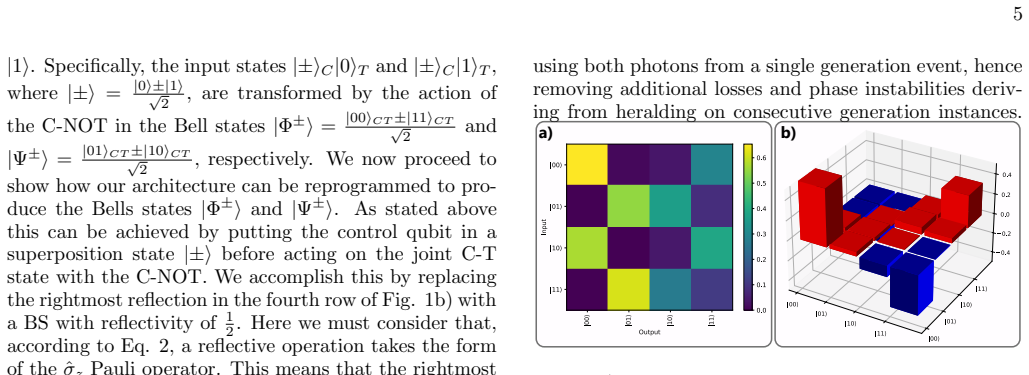
read the original abstract
The two-qubit controlled-not (C-NOT) gate is an essential component for gate-based quantum circuits. In fact, its operation, combined with single qubit rotations allows to realise any quantum circuit. Several strategies have been adopted in order to build quantum gates. Among them, photonics offers the dual advantage of excellent isolation from the environment and ease of manipulation at the single qubit level. Here we adopt a scalable time-multiplexed approach in order to build a fully reconfigurable architecture capable of implementing a post-selected C-NOT gate with a fidelity of $(93.8 \pm 1.4)\%$. We then show how our time-multiplexed platform can be employed to combine a C-NOT and a single qubit gate in order to generate the four Bell states.
Editorial analysis
A structured set of objections, weighed in public.
Referee Report
Summary. The manuscript reports an experimental demonstration of a post-selected C-NOT gate realized in a time-multiplexed, fully reconfigurable photonic processor, with a reported fidelity of (93.8 ± 1.4)%. The authors further combine this gate with a single-qubit operation to generate the four Bell states.
Significance. If the experimental results hold after detailed validation, the work would be significant for photonic quantum information processing by demonstrating a scalable time-multiplexed architecture that supports reconfigurability and achieves competitive post-selected gate fidelity. The Bell-state generation provides a direct test of the gate's utility for quantum circuits.
major comments (1)
- Abstract: the fidelity of (93.8 ± 1.4)% is presented without any accompanying information on error sources, post-selection efficiency, detection uniformity across time bins, or baseline comparisons; these details are load-bearing for assessing whether the reported value accurately reflects gate performance or is inflated by selection bias.
Simulated Author's Rebuttal
We thank the referee for their constructive comment. We address it directly below and agree that a modest expansion of the abstract will improve clarity without altering the manuscript's core claims.
read point-by-point responses
-
Referee: [—] Abstract: the fidelity of (93.8 ± 1.4)% is presented without any accompanying information on error sources, post-selection efficiency, detection uniformity across time bins, or baseline comparisons; these details are load-bearing for assessing whether the reported value accurately reflects gate performance or is inflated by selection bias.
Authors: We agree the abstract would benefit from additional context. In the revised version we will expand the abstract to explicitly note the post-selection procedure, the dominant error sources (phase instability and detection timing jitter) quantified in Section IV, and the post-selection efficiency of approximately 1/4 arising from the two-photon coincidence requirement. Detection uniformity across the four time bins is shown to be within 3% in Figure 3 and the supplementary material; baseline comparisons against the classical limit (50%) and prior photonic C-NOT demonstrations are provided in Table I. These elements are already fully developed in the main text and supplementary information, so the fidelity value is not inflated by undisclosed selection bias. The title and abstract already qualify the result as post-selected, but we accept that a single additional sentence will make this transparent at first reading. revision: yes
Circularity Check
No significant circularity in experimental demonstration
full rationale
This is an experimental demonstration paper reporting a measured post-selected C-NOT gate fidelity of (93.8 ± 1.4)% in a time-multiplexed photonic processor. The central claim is an empirical result obtained from photon detection statistics under post-selection, not a theoretical derivation or fitted model that reduces to its own inputs by construction. No equations, ansatzes, uniqueness theorems, or self-citations are invoked that would make the reported fidelity equivalent to the experimental inputs. The result is externally falsifiable via independent replication of the optical setup and detection protocol, satisfying the criteria for a non-circular experimental claim.
Axiom & Free-Parameter Ledger
axioms (1)
- standard math Linear optical elements and single-photon interference behave according to standard quantum mechanics.
Lean theorems connected to this paper
-
IndisputableMonolith/Foundation/AlexanderDuality.leanalexander_duality_circle_linking unclear?
unclearRelation between the paper passage and the cited Recognition theorem.
post-selected interferometric scheme that implements the C-NOT operation with a fidelity of (93.8 ± 1.4)% ... time-multiplexed approach ... EOM3 ... reflectivities prescribed by the C-NOT interferometric scheme
-
IndisputableMonolith/Cost/FunctionalEquation.leanwashburn_uniqueness_aczel unclear?
unclearRelation between the paper passage and the cited Recognition theorem.
We use our experimental platform to generate the four Bell states
What do these tags mean?
- matches
- The paper's claim is directly supported by a theorem in the formal canon.
- supports
- The theorem supports part of the paper's argument, but the paper may add assumptions or extra steps.
- extends
- The paper goes beyond the formal theorem; the theorem is a base layer rather than the whole result.
- uses
- The paper appears to rely on the theorem as machinery.
- contradicts
- The paper's claim conflicts with a theorem or certificate in the canon.
- unclear
- Pith found a possible connection, but the passage is too broad, indirect, or ambiguous to say the theorem truly supports the claim.
Forward citations
Cited by 2 Pith papers
-
Resource-efficient universal photonic processor based on time-multiplexed hybrid architectures
A protocol maps arbitrary linear transformations to coin and step operators of a quantum walk, then to experimental settings in a time-multiplexed hybrid photonic platform, with claims of scalability and resilience to...
-
Hardware-Efficient Universal Linear Transformations for Optical Modes in the Synthetic Time Dimension
A synthetic time-domain photonic processor achieves exponential hardware reduction for universal linear transformations and exceeds cluster-state quantum computation thresholds in benchmarks on boosted Bell state meas...
Reference graph
Works this paper leans on
-
[1]
have been employed. For scaling systems time-multiplexing (TM) has been ex- plored in the recent years [21, 23, 26, 27] and has actually been harnessed to achieve quantum computation advan- tages in the scope of Gaussian boson sampling [20]. Yet, these systems are intrinsically not capable of achieving universal quantum computation, which requires C-NOT o...
work page internal anchor Pith review Pith/arXiv arXiv 2024
-
[2]
For the BS operations we take into account unitaries with no imaginary phases where depending on the reflectivity setting ±R we have the transformation: ˆBS ±R = ± √ R √ 1 − R√ 1 − R ∓ √ R , (2) Interaction between C and T subsystems is possible by means of HOM-like interference happening between two single photons in the C 1 an T input states. Bunching e...
-
[3]
2, a reflective operation takes the form of the ˆσz Pauli operator
Here we must consider that, according to Eq. 2, a reflective operation takes the form of the ˆσz Pauli operator. This means that the rightmost reflective switch of the last round-trip of Fig. 1b) will leave the |0⟩C component of the state unchanged, while |1⟩C is sent to - |1⟩C. The presence of this phase results in the following mapping for the Bell stat...
-
[4]
Bennett, Richard Cleve, David P
Adriano Barenco, Charles H. Bennett, Richard Cleve, David P. DiVincenzo, Norman Margolus, Peter Shor, Ty- cho Sleator, John A. Smolin, and Harald Weinfurter. El- ementary gates for quantum computation. Physical Re- view A , 52(5):3457–3467, November 1995
work page 1995
-
[5]
Conditional quantum dynamics and logic gates
Adriano Barenco, David Deutsch, Artur Ekert, and Richard Jozsa. Conditional quantum dynamics and logic gates. Phys. Rev. Lett. , 74:4083–4086, May 1995
work page 1995
-
[6]
Commu- nication via one-and two-particle operators on einstein- podolsky-rosen states
Charles H Bennett and Stephen J Wiesner. Commu- nication via one-and two-particle operators on einstein- podolsky-rosen states. Physical review letters , 69(20): 2881, 1992
work page 1992
-
[7]
Teleporting an unknown quantum state via dual classi- cal and einstein-podolsky-rosen channels
Charles H Bennett, Gilles Brassard, Claude Cr´ epeau, Richard Jozsa, Asher Peres, and William K Wootters. Teleporting an unknown quantum state via dual classi- cal and einstein-podolsky-rosen channels. Physical review letters, 70(13):1895, 1993
work page 1993
-
[8]
High fidelity quantum gates with vibrational qubits
Eduardo Berrios, Martin Gruebele, Dmytro Shyshlov, Lei Wang, and Dmitri Babikov. High fidelity quantum gates with vibrational qubits. The Journal of Physical Chem- istry A , 116(46):11347–11354, 2012
work page 2012
-
[9]
J. I. Cirac and P. Zoller. Quantum computations with cold trapped ions. Phys. Rev. Lett. , 74:4091–4094, May 1995
work page 1995
-
[10]
Proposed experiment to test local hidden-variable theories
John F Clauser, Michael A Horne, Abner Shimony, and Richard A Holt. Proposed experiment to test local hidden-variable theories. Physical review letters , 23(15): 880, 1969
work page 1969
-
[11]
Optimal design for universal multiport interferometers
William R Clements, Peter C Humphreys, Benjamin J Metcalf, W Steven Kolthammer, and Ian A Walmsley. Optimal design for universal multiport interferometers. Optica, 3(12):1460–1465, 2016
work page 2016
-
[12]
Integrated pho- tonic quantum gates for polarization qubits
Andrea Crespi, Roberta Ramponi, Roberto Osellame, Linda Sansoni, Irene Bongioanni, Fabio Sciarrino, Giuseppe Vallone, and Paolo Mataloni. Integrated pho- tonic quantum gates for polarization qubits. Nature com- munications, 2(1):566, 2011
work page 2011
-
[13]
Quantum cryptography based on bell’s theorem
Artur K Ekert. Quantum cryptography based on bell’s theorem. Physical review letters , 67(6):661, 1991
work page 1991
-
[14]
Superconducting quantum computing: a review
He-Liang Huang, Dachao Wu, Daojin Fan, and Xiaobo Zhu. Superconducting quantum computing: a review. Science China Information Sciences , 63(8), July 2020
work page 2020
-
[15]
Linear op- tical quantum computing in a single spatial mode
Peter C Humphreys, Benjamin J Metcalf, Justin B Spring, Merritt Moore, Xian-Min Jin, Marco Barbieri, W Steven Kolthammer, and Ian A Walmsley. Linear op- tical quantum computing in a single spatial mode. Phys- ical review letters , 111(15):150501, 2013
work page 2013
-
[16]
J. A. Jones and M. Mosca. Implementation of a quan- tum algorithm on a nuclear magnetic resonance quan- tum computer. The Journal of Chemical Physics , 109 (5):1648–1653, 08 1998
work page 1998
-
[17]
A.Yu. Kitaev. Fault-tolerant quantum computation by anyons. Annals of Physics , 303(1):2–30, January 2003
work page 2003
-
[18]
A scheme for efficient quantum computation with linear optics
Emanuel Knill, Raymond Laflamme, and Gerald J Mil- burn. A scheme for efficient quantum computation with linear optics. nature, 409(6816):46–52, 2001
work page 2001
-
[19]
Pieter Kok, William J Munro, Kae Nemoto, Timothy C Ralph, Jonathan P Dowling, and Gerard J Milburn. Lin- ear optical quantum computing with photonic qubits.Re- views of modern physics , 79(1):135–174, 2007
work page 2007
-
[20]
Linear optical cnot gate with orbital angular momentum and polarization
JH Lopes, WC Soares, Bert´ ulio de Lima Bernardo, DP Caetano, and Askery Canabarro. Linear optical cnot gate with orbital angular momentum and polarization. Quantum information processing , 18:1–10, 2019
work page 2019
-
[21]
A controlled-not gate for frequency-bin qubits
Hsuan-Hao Lu, Joseph M Lukens, Brian P Williams, Poolad Imany, Nicholas A Peters, Andrew M Weiner, and Pavel Lougovski. A controlled-not gate for frequency-bin qubits. npj Quantum Information , 5(1):24, 2019
work page 2019
-
[22]
Building a controlled-not gate between polarization and frequency
Hsuan-Hao Lu, Joseph M Lukens, Muneer Alshowkan, Brian T Kirby, and Nicholas A Peters. Building a controlled-not gate between polarization and frequency. Optica Quantum, 2(4):282–287, 2024
work page 2024
-
[23]
Quantum computational advantage with a programmable photonic processor
Lars S Madsen, Fabian Laudenbach, Mohsen Falamarzi Askarani, Fabien Rortais, Trevor Vincent, Jacob FF Bul- mer, Filippo M Miatto, Leonhard Neuhaus, Lukas G Helt, Matthew J Collins, et al. Quantum computational advantage with a programmable photonic processor. Na- ture, 606(7912):75–81, 2022
work page 2022
-
[24]
Thomas Nitsche, Fabian Elster, Jaroslav Novotn` y, Aur´ el G´ abris, Igor Jex, Sonja Barkhofen, and Christine Silber- horn. Quantum walks with dynamical control: graph engineering, initial state preparation and state transfer. New Journal of Physics , 18(6):063017, 2016
work page 2016
-
[25]
Demonstration of an all-optical quantum controlled-not gate
Jeremy L O’Brien, Geoffrey J Pryde, Andrew G White, Timothy C Ralph, and David Branning. Demonstration of an all-optical quantum controlled-not gate. Nature, 426(6964):264–267, 2003
work page 2003
-
[26]
Dynamic con- ditioning of two particle discrete-time quantum walks
Federico Pegoraro, Philip Held, Sonja Barkhofen, Ben- jamin Brecht, and Christine Silberhorn. Dynamic con- ditioning of two particle discrete-time quantum walks. Physica Scripta, 98(3):034005, 2023
work page 2023
-
[27]
T. B. Pittman, B. C. Jacobs, and J. D. Franson. Prob- abilistic quantum logic operations using polarizing beam splitters. Phys. Rev. A , 64:062311, Nov 2001
work page 2001
-
[28]
Linear optical controlled-not gate in the co- incidence basis
Timothy C Ralph, Nathan K Langford, TB Bell, and AG White. Linear optical controlled-not gate in the co- incidence basis. Physical Review A , 65(6):062324, 2002
work page 2002
-
[29]
Decoherence and disorder in quan- tum walks: from ballistic spread to localization
A Schreiber, KN Cassemiro, V Potoˇ cek, A G´ abris, I Jex, and Ch Silberhorn. Decoherence and disorder in quan- tum walks: from ballistic spread to localization. Physical review letters, 106(18):180403, 2011
work page 2011
-
[30]
Photons walking the line: a quantum walk with adjustable coin operations
Andreas Schreiber, Katiuscia N Cassemiro, V´ aclav Potoˇ cek, Aur´ el G´ abris, Peter James Mosley, Erika An- dersson, Igor Jex, and Ch Silberhorn. Photons walking the line: a quantum walk with adjustable coin operations. Physical review letters , 104(5):050502, 2010
work page 2010
-
[31]
Lieven M. K. Vandersypen and Mark A. Eriksson. Quan- tum computing with semiconductor spins. Physics To- day, 72(8):38–45, 08 2019
work page 2019
-
[32]
Integrated-optics heralded controlled-not gate for polarization-encoded qubits
Jonas Zeuner, Aditya N Sharma, Max Tillmann, Ren´ e Heilmann, Markus Gr¨ afe, Amir Moqanaki, Alexander Szameit, and Philip Walther. Integrated-optics heralded controlled-not gate for polarization-encoded qubits. npj Quantum Information , 4(1):13, 2018
work page 2018
-
[33]
Femtosecond laser direct writing of an integrated path-encoded cnot quan- tum gate
Qian Zhang, Meng Li, Yang Chen, Xifeng Ren, Roberto Osellame, Qihuang Gong, and Yan Li. Femtosecond laser direct writing of an integrated path-encoded cnot quan- tum gate. Optical Materials Express , 9(5):2318–2326, 2019
work page 2019
-
[34]
Zhi Zhao, An-Ning Zhang, Yu-Ao Chen, Han Zhang, Jiang-Feng Du, Tao Yang, and Jian-Wei Pan. Experi- 1 mental demonstration of a nondestructive controlled-not quantum gate for two independent photon qubits. Phys. Rev. Lett., 94:030501, Jan 2005. Supplemental information: Demonstration of a Photonic Time-Multiplexed C-NOT Gate V. MODELLING OF BEAMSPLITTERS A...
work page 2005
discussion (0)
Sign in with ORCID, Apple, or X to comment. Anyone can read and Pith papers without signing in.