Shadow of the Scalar Hairy Black Hole with Inverted Higgs Potential
Pith reviewed 2026-05-23 06:05 UTC · model grok-4.3
The pith
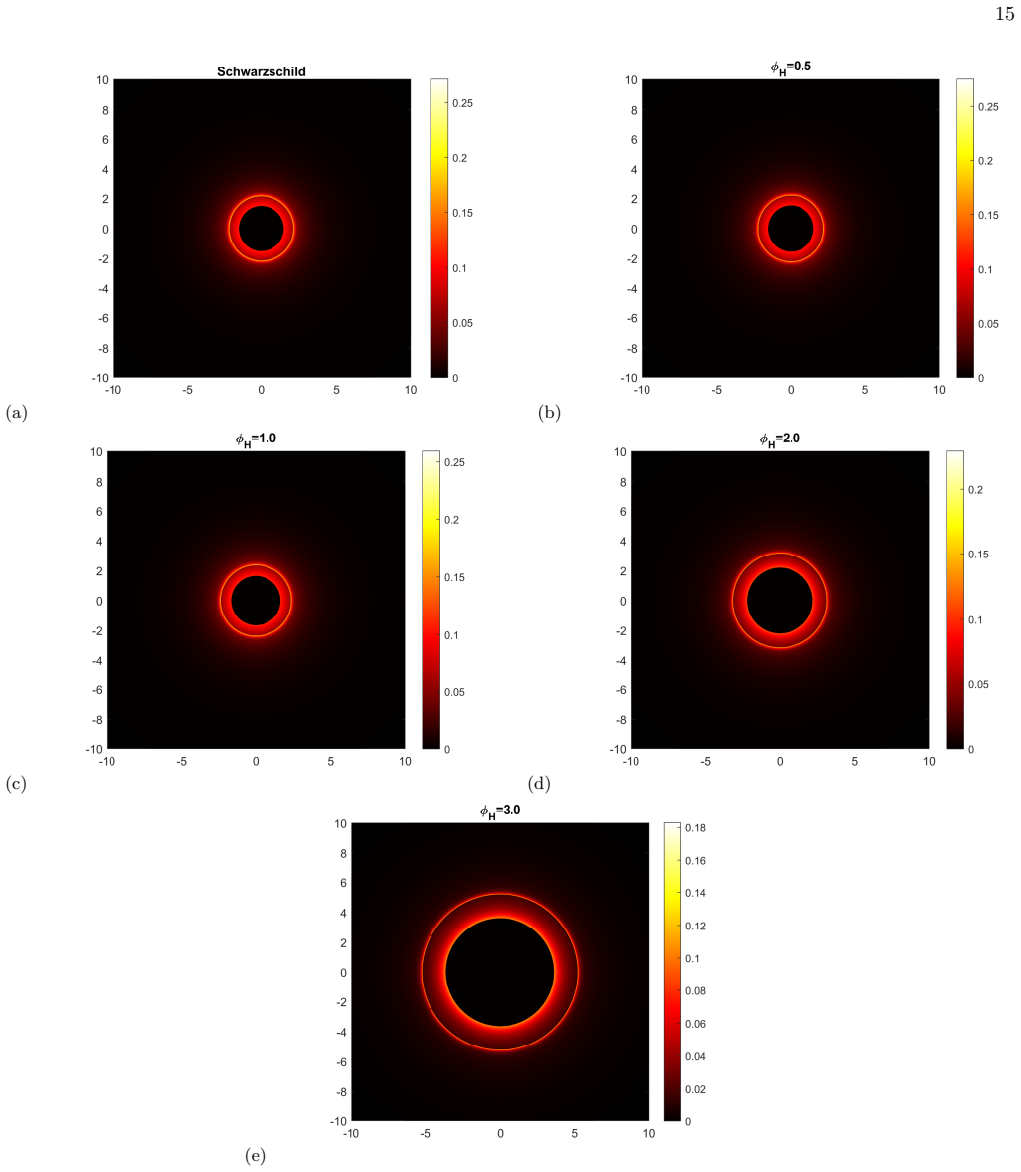
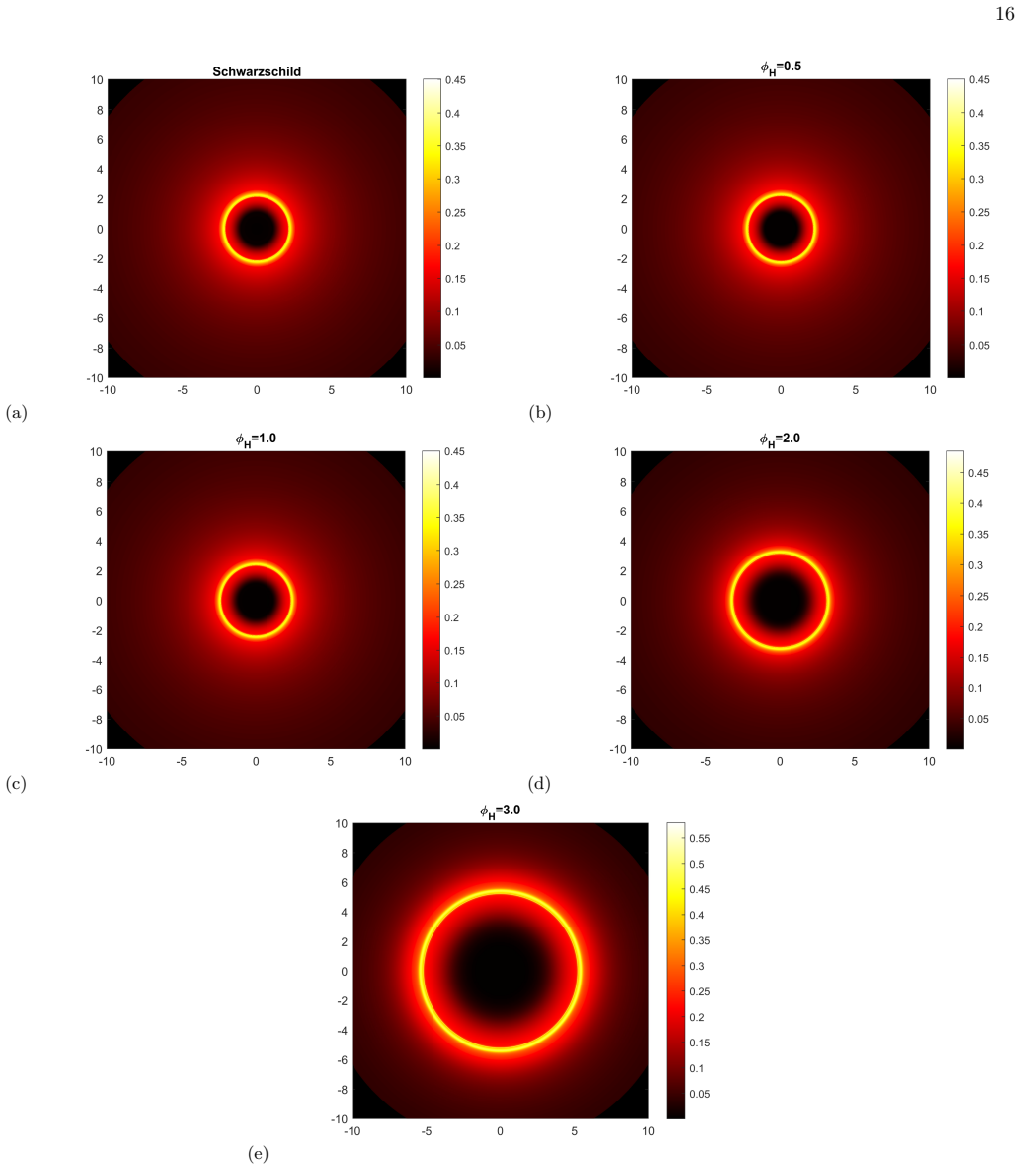
A hairy black hole with scalar field at the horizon produces a larger shadow and accretion disk than a Schwarzschild black hole of equal horizon radius, while ring brightness stays nearly the same.
A machine-rendered reading of the paper's core claim, the machinery that carries it, and where it could break.
Core claim
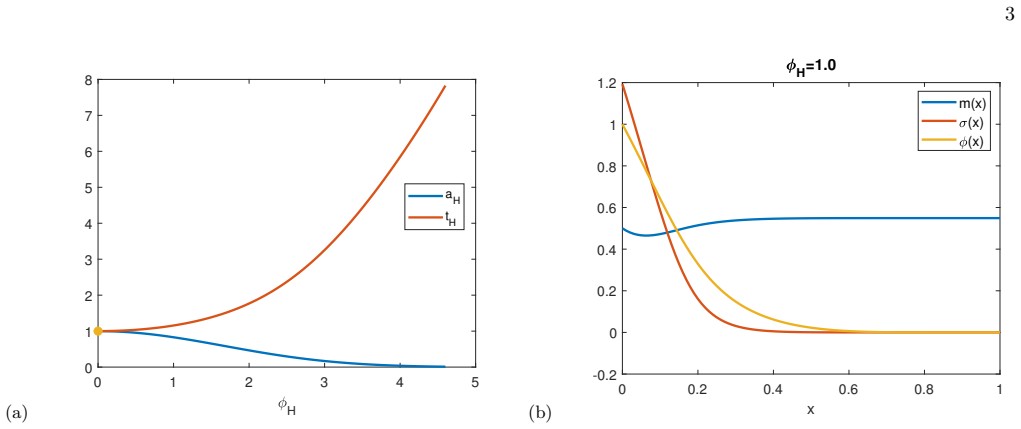
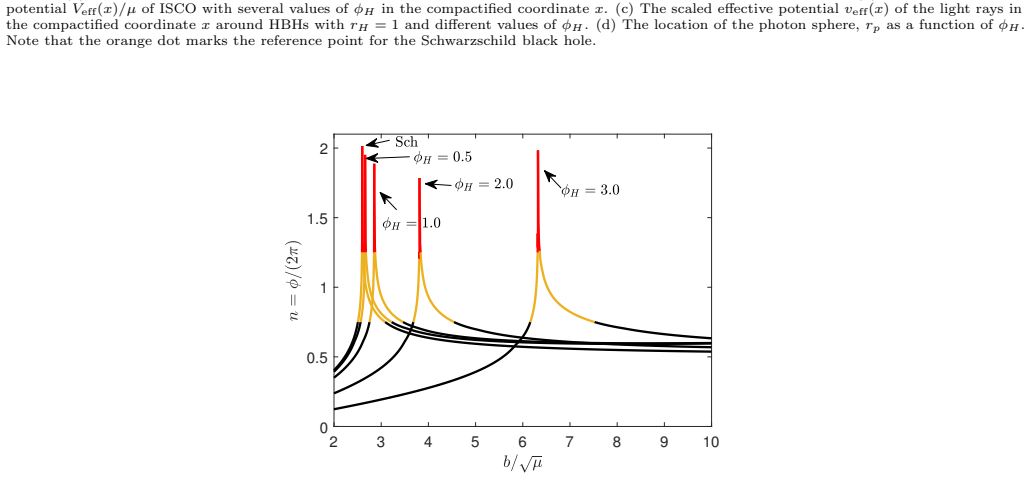
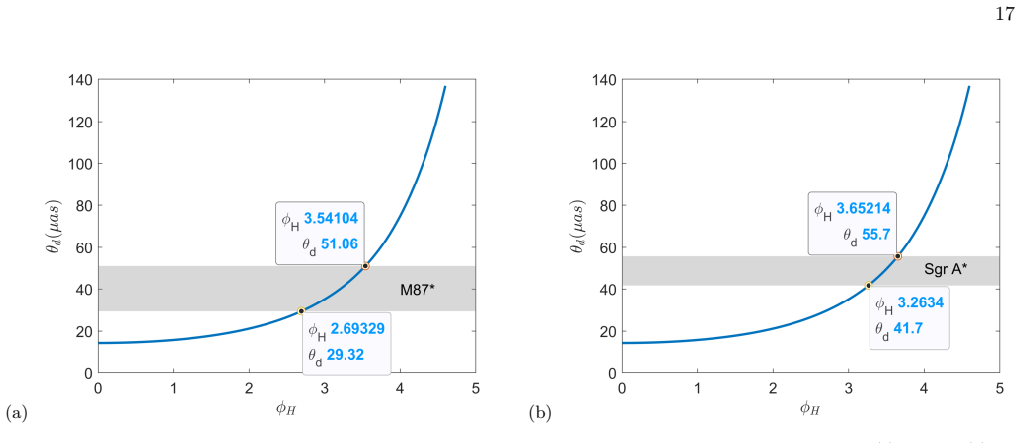
In the Einstein-Klein-Gordon theory with potential V(φ) = -Λ φ⁴ + μ φ², a hairy black hole carrying nonzero scalar field φ_H at the horizon has a shadow and accretion disk whose sizes increase with φ_H; the brightness of the direct, lensed, and photon-ring emissions remains nearly unaffected, so that the hairy black hole can reproduce the optical appearance of a Schwarzschild black hole when its horizon radius is adjusted accordingly; the model also supplies observational bounds on Λ from M87 and Sgr A* data.
What carries the argument
Ray-tracing classification of photon trajectories into direct, lensed, and photon-ring classes around the hairy black hole metric derived from the Einstein-Klein-Gordon action.
If this is right
- Shadow and accretion-disk sizes increase with the horizon scalar value φ_H at fixed horizon radius.
- Brightness of the direct, lensed, and photon-ring features remains nearly independent of φ_H.
- The hairy black hole can reproduce Schwarzschild-like images by suitable choice of horizon radius.
- The coefficient Λ in the scalar potential is bounded by existing images of M87 and Sgr A*.
Where Pith is reading between the lines
- Independent measurement of horizon radius would turn the reported size difference into a practical test for scalar hair.
- Current Event Horizon Telescope data may already be consistent with a range of hairy solutions once horizon radius is allowed to vary.
- The same ray-tracing setup could be applied to other scalar potentials to map which ones produce observable deviations.
Load-bearing premise
The three chosen models of optically and geometrically thin accretion disks capture the essential differences in optical appearance between the hairy black hole and Schwarzschild without further adjustments when horizon radius is held fixed.
What would settle it
A measurement showing that shadow diameter stays constant rather than increasing with horizon scalar value φ_H at fixed horizon radius would disprove the reported size dependence.
Figures




read the original abstract
We study the imaging of a hairy black hole (HBH) in the Einstein-Klein-Gordon theory, where Einstein gravity is minimally coupled to a scalar potential $V(\phi)=-\Lambda \phi^4 + \mu \phi^2$ with $\Lambda$ and $\mu$ are constants. As a consequence, a nontrivial scalar field at the event horizon $\phi_H$ allows the HBH to evade the no-hair theorem, bifurcate from the Schwarzschild black hole by acquiring some new properties, which can affect the shadow of the HBH received by a distant observer. The framework of ray-tracing is adopted to investigate the optical appearance of the HBH, thus the trajectories of light rays around the HBH can be classified into three emissions: direct, lensed and photon ring. Employing three models of optically and geometrically thin accretion disk, we compare the differences between the Schwarzschild black hole and HBH with same horizon radius in a specific model, and find that the size of the shadow and accretion disk increases as $\phi_H$ increases, but the brightness of the rings remain nearly unaffected, this implies our HBH can potentially mimic the Schwarzschild black hole if we vary the horizon radius of the HBH. Finally, we also constraint the parameter $\Lambda$ from the observations of supermassive black holes in the galactic center of M87 and Sgr A$^{*}$, which could offer new insights for imaging of black holes and astrophysical observations.
Editorial analysis
A structured set of objections, weighed in public.
Referee Report
Summary. The paper examines the shadow and optical appearance of a scalar hairy black hole (HBH) in Einstein-Klein-Gordon theory with inverted Higgs potential V(ϕ) = −Λϕ⁴ + μϕ². Employing ray-tracing to classify photon trajectories into direct, lensed, and photon-ring emissions, and applying three standard models of optically and geometrically thin accretion disks, the authors compare the HBH to Schwarzschild at fixed horizon radius. They report that shadow and accretion-disk sizes increase with ϕ_H while ring brightness remains nearly constant, suggesting that the HBH can mimic Schwarzschild by suitable choice of horizon radius, and derive an observational constraint on Λ from M87* and Sgr A* data.
Significance. If the numerical results and parameter constraint hold, the work supplies a concrete example of how scalar hair can alter shadow size while preserving apparent ring brightness, offering a potential route to test the no-hair theorem with EHT-style imaging and to bound the inverted-Higgs parameters.
major comments (2)
- [Abstract] The mimicry claim (shadow and disk size grow with ϕ_H at fixed r_h while brightness is unaffected) rests on freely varying the horizon radius after ϕ_H is fixed; the abstract presents the Λ constraint as an independent observational limit, yet the derivation details and independence from the r_h choice are not supplied, leaving open whether the constraint is circular with the fit.
- [Comparison of accretion-disk models] The three thin-disk models are applied directly to the HBH metric; the non-trivial scalar hair modifies the lapse and redshift factors relative to Schwarzschild, yet no explicit check is given that the emission profiles and ray-tracing intensities require no metric-specific rescaling before the brightness comparison at fixed r_h can be drawn.
minor comments (2)
- [Abstract] The abstract states that 'the brightness of the rings remain nearly unaffected' but supplies neither quantitative error estimates nor the precise intensity ratios used to reach this conclusion.
- [Abstract] Notation for the potential parameters (Λ, μ) and the horizon value ϕ_H is introduced without an explicit statement of the ranges explored or the numerical method used to solve the Einstein-Klein-Gordon system.
Simulated Author's Rebuttal
We appreciate the referee's detailed review and valuable suggestions. Below we provide point-by-point responses to the major comments. We will make revisions to address the concerns raised.
read point-by-point responses
-
Referee: [Abstract] The mimicry claim (shadow and disk size grow with ϕ_H at fixed r_h while brightness is unaffected) rests on freely varying the horizon radius after ϕ_H is fixed; the abstract presents the Λ constraint as an independent observational limit, yet the derivation details and independence from the r_h choice are not supplied, leaving open whether the constraint is circular with the fit.
Authors: We thank the referee for pointing this out. In the manuscript, the mimicry is demonstrated by comparing HBH and Schwarzschild at the same horizon radius r_h, showing that shadow and disk sizes increase with ϕ_H while ring brightness stays nearly constant. To mimic the Schwarzschild case, one can adjust r_h for a given ϕ_H to match the observed shadow size. The constraint on Λ is obtained by requiring that the HBH shadow size matches the observed values for M87* and Sgr A* for various ϕ_H, which determines the allowed range for Λ independent of a specific r_h choice, as r_h is adjusted accordingly. However, we agree that the abstract and the relevant section lack sufficient detail on this procedure. We will revise the abstract and add explicit steps in the text explaining how the Λ constraint is derived and why it is not circular. revision: yes
-
Referee: [Comparison of accretion-disk models] The three thin-disk models are applied directly to the HBH metric; the non-trivial scalar hair modifies the lapse and redshift factors relative to Schwarzschild, yet no explicit check is given that the emission profiles and ray-tracing intensities require no metric-specific rescaling before the brightness comparison at fixed r_h can be drawn.
Authors: The ray-tracing code computes the photon trajectories and intensities using the specific metric of the HBH, incorporating the modified lapse and redshift factors through the geodesic equations and the redshift factor in the intensity calculation. The thin-disk models provide the emission profile in the rest frame of the disk, and the observed intensity is obtained by integrating along the null geodesics without additional rescaling, as the metric effects are already included in the ray-tracing. Nevertheless, we acknowledge that an explicit verification or comparison of the redshift factors between the two metrics at fixed r_h would strengthen the presentation. We will add a paragraph or appendix providing this check in the revised version. revision: yes
Circularity Check
No circularity: metric, ray-tracing, and observational bounds are independent of target claims
full rationale
The derivation proceeds from the Einstein-Klein-Gordon action with the stated inverted-Higgs potential to obtain the HBH metric, then applies standard ray-tracing and three thin-disk emission models (direct/lensed/photon-ring classification) to compute images at fixed horizon radius. The reported trends (shadow/disk size growth with ϕ_H, near-constant ring brightness) and the subsequent statement that r_h variation can produce mimicry are direct numerical outputs of that pipeline, not reductions of the output to the input by definition or by a fitted parameter renamed as prediction. The Λ bound is extracted from external EHT shadow-diameter data on M87* and Sgr A*, which lie outside the model’s fitted quantities. No self-citation chain, ansatz smuggling, or uniqueness theorem imported from the authors’ prior work is load-bearing for the central claims. The calculation is therefore self-contained against external benchmarks.
Axiom & Free-Parameter Ledger
free parameters (3)
- Lambda
- mu
- phi_H
axioms (2)
- domain assumption Einstein gravity is minimally coupled to a real scalar field with potential V(ϕ) = −Λϕ⁴ + μϕ²
- domain assumption Ray-tracing accurately classifies light trajectories into direct, lensed, and photon-ring emissions for the purpose of imaging
invented entities (1)
-
Scalar hairy black hole with inverted Higgs potential
no independent evidence
Lean theorems connected to this paper
-
IndisputableMonolith/Foundation/RealityFromDistinction.leanreality_from_one_distinction unclear?
unclearRelation between the paper passage and the cited Recognition theorem.
We study the imaging of a hairy black hole (HBH) in the Einstein-Klein-Gordon theory... ray-tracing... three models of optically and geometrically thin accretion disk
-
IndisputableMonolith/Cost/FunctionalEquation.leanwashburn_uniqueness_aczel unclear?
unclearRelation between the paper passage and the cited Recognition theorem.
V(ϕ)=-Λϕ⁴+µϕ²... numerical construction... impact parameter b... transfer functions r_m(b)
What do these tags mean?
- matches
- The paper's claim is directly supported by a theorem in the formal canon.
- supports
- The theorem supports part of the paper's argument, but the paper may add assumptions or extra steps.
- extends
- The paper goes beyond the formal theorem; the theorem is a base layer rather than the whole result.
- uses
- The paper appears to rely on the theorem as machinery.
- contradicts
- The paper's claim conflicts with a theorem or certificate in the canon.
- unclear
- Pith found a possible connection, but the passage is too broad, indirect, or ambiguous to say the theorem truly supports the claim.
Reference graph
Works this paper leans on
-
[1]
Israel, Event horizons in static vacuum space-times, Phys
W. Israel, Event horizons in static vacuum space-times, Phys. Rev. 164, 1776 (1967)
work page 1967
-
[2]
Carter, Axisymmetric Black Hole Has Only Two Degrees of Freedom, Phys
B. Carter, Axisymmetric Black Hole Has Only Two Degrees of Freedom, Phys. Rev. Lett. 26, 331 (1971)
work page 1971
-
[3]
R. Ruffini and J. A. Wheeler, Introducing the black hole, Phys. Today 24, 30 (1971)
work page 1971
-
[4]
Scalar hairy black holes and scalarons in the isolated horizons formalism
A. Corichi, U. Nucamendi, and M. Salgado, Scalar hairy black holes and scalarons in the isolated horizons formalism, Phys. Rev. D 73, 084002 (2006), arXiv:gr-qc/0504126
work page internal anchor Pith review Pith/arXiv arXiv 2006
- [5]
- [6]
-
[7]
S. R. Coleman and F. De Luccia, Gravitational Effects on and of Vacuum Decay, Phys. Rev. D 21, 3305 (1980)
work page 1980
-
[8]
S. S. Gubser, Phase transitions near black hole horizons, Class. Quant. Grav. 22, 5121 (2005), arXiv:hep-th/0505189
work page internal anchor Pith review Pith/arXiv arXiv 2005
- [9]
- [10]
-
[11]
Exact Black-Hole Solution With Self-Interacting Scalar Field
O. Bechmann and O. Lechtenfeld, Exact black hole solution with selfinteracting scalar field, Class. Quant. Grav. 12, 1473 (1995), arXiv:gr-qc/9502011
work page internal anchor Pith review Pith/arXiv arXiv 1995
-
[12]
Scalar Deformations of Schwarzschild Holes and Their Stability
H. Dennhardt and O. Lechtenfeld, Scalar deformations of Schwarzschild holes and their stability, Int. J. Mod. Phys. A 13, 741 (1998), arXiv:gr-qc/9612062
work page internal anchor Pith review Pith/arXiv arXiv 1998
-
[13]
K. A. Bronnikov and G. N. Shikin, Spherically symmetric scalar vacuum: No go theorems, black holes and solitons, Grav. Cosmol. 8, 107 (2002), arXiv:gr-qc/0109027
work page internal anchor Pith review Pith/arXiv arXiv 2002
-
[14]
Exact black hole solution with a minimally coupled scalar field
C. Martinez, R. Troncoso, and J. Zanelli, Exact black hole solution with a minimally coupled scalar field, Phys. Rev. D 70, 084035 (2004), arXiv:hep-th/0406111
work page internal anchor Pith review Pith/arXiv arXiv 2004
-
[15]
V. V. Nikonov, J. V. Tchemarina, and A. N. Tsirulev, A two-parameter family of exact asymptotically flat solutions to the Einstein-scalar field equations, Class. Quant. Grav. 25, 138001 (2008)
work page 2008
-
[16]
Exact Hairy Black Holes and their Modification to the Universal Law of Gravitation
A. Anabalon and J. Oliva, Exact Hairy Black Holes and their Modification to the Universal Law of Gravitation, Phys. Rev. D 86, 107501 (2012), arXiv:1205.6012 [gr-qc]
work page internal anchor Pith review Pith/arXiv arXiv 2012
-
[17]
O. S. Stashko and V. I. Zhdanov, Spherically symmetric configurations of General Relativity in presence of scalar field: separation of test body circular orbits, Gen. Rel. Grav. 50, 105 (2018), arXiv:1702.02800 [gr-qc]
work page internal anchor Pith review Pith/arXiv arXiv 2018
- [18]
-
[19]
T. Karakasis, G. Koutsoumbas, and E. Papantonopoulos, Black holes with scalar hair in three dimensions, Phys. Rev. D 107, 124047 (2023), arXiv:2305.00686 [gr-qc]
- [20]
- [21]
- [22]
- [23]
- [24]
-
[25]
J. Kunz and Y. Shnir, Charged hairy black holes in the gauged Einstein-Friedberg-Lee-Sirlin model, Phys. Rev. D 107, 104062 (2023), arXiv:2303.16562 [hep-th]
- [26]
-
[27]
Y. Brihaye, F. Buisseret, B. Hartmann, and O. Layfield, Boson stars and black holes with (complex and) real scalar hair, arXiv preprint (2024), arXiv:2410.22231 [gr-qc]
-
[28]
C. Herdeiro, E. Radu, and E. dos Santos Costa Filho, Spinning Proca-Higgs balls, stars and hairy black holes, JCAP 07, 081, arXiv:2406.03552 [gr-qc]
-
[29]
P. Kocherlakota et al. (Event Horizon Telescope), Constraints on black-hole charges with the 2017 EHT observations of M87*, Phys. Rev. D 103, 104047 (2021), arXiv:2105.09343 [gr-qc]
-
[30]
K. Akiyama et al. (Event Horizon Telescope), First Sagittarius A* Event Horizon Telescope Results. I. The Shadow of the Supermassive Black Hole in the Center of the Milky Way, Astrophys. J. Lett. 930, L12 (2022), arXiv:2311.08680 [astro-ph.HE]
work page internal anchor Pith review Pith/arXiv arXiv 2022
-
[31]
K. Akiyama et al. (Event Horizon Telescope), First Sagittarius A* Event Horizon Telescope Results. VI. Testing the Black Hole Metric, Astrophys. J. Lett. 930, L17 (2022), arXiv:2311.09484 [astro-ph.HE]
-
[32]
Testing the No-Hair Theorem with Observations of Black Holes in the Electromagnetic Spectrum
T. Johannsen, Testing the No-Hair Theorem with Observations of Black Holes in the Electromagnetic Spectrum, Class. Quant. Grav. 33, 124001 (2016), arXiv:1602.07694 [astro-ph.HE]
work page internal anchor Pith review Pith/arXiv arXiv 2016
-
[33]
The Current Ability to Test Theories of Gravity with Black Hole Shadows
Y. Mizuno, Z. Younsi, C. M. Fromm, O. Porth, M. De Laurentis, H. Olivares, H. Falcke, M. Kramer, and L. Rezzolla, The Current Ability to Test Theories of Gravity with Black Hole Shadows, Nature Astron. 2, 585 (2018), arXiv:1804.05812 [astro-ph.GA]
work page internal anchor Pith review Pith/arXiv arXiv 2018
- [34]
- [35]
-
[36]
S. Vagnozzi et al., Horizon-scale tests of gravity theories and fundamental physics from the Event Horizon Telescope image of Sagittarius A, Class. Quant. Grav. 40, 165007 (2023), arXiv:2205.07787 [gr-qc]
work page internal anchor Pith review Pith/arXiv arXiv 2023
-
[37]
Experimental studies of black holes: status and fu- ture prospects,
R. Genzel, F. Eisenhauer, and S. Gillessen, Experimental studies of black holes: status and future prospects, Astron. Astrophys. Rev. 32, 3 (2024), arXiv:2404.03522 [astro-ph.GA]
-
[38]
D. Ayzenberg et al., Fundamental Physics Opportunities with the Next-Generation Event Horizon Telescope, arXiv preprint (2023), arXiv:2312.02130 [astro-ph.HE]. 19
-
[39]
N. Afshordi et al., Black Holes Inside and Out 2024: visions for the future of black hole physics (2024) arXiv:2410.14414 [gr-qc]
-
[40]
J. C. McKinney, A. Tchekhovskoy, and R. D. Blandford, General Relativistic Magnetohydrodynamic Simulations of Magnetically Choked Accretion Flows around Black Holes, Mon. Not. Roy. Astron. Soc. 423, 3083 (2012), arXiv:1201.4163 [astro-ph.HE]
work page internal anchor Pith review Pith/arXiv arXiv 2012
-
[41]
General relativistic magnetohydrodynamical simulations of the jet in M87
M. Moscibrodzka, H. Falcke, and H. Shiokawa, General relativistic magnetohydrodynamical simulations of the jet in M 87, Astron. Astrophys. 586, A38 (2016), arXiv:1510.07243 [astro-ph.HE]
work page internal anchor Pith review Pith/arXiv arXiv 2016
-
[42]
K. Chatterjee, Z. Younsi, M. Liska, A. Tchekhovskoy, S. B. Markoff, D. Yoon, D. van Eijnatten, C. Hesp, A. Ingram, and M. van der Klis, Observational signatures of disc and jet misalignment in images of accreting black holes, Mon. Not. Roy. Astron. Soc. 499, 362 (2020), arXiv:2002.08386 [astro-ph.GA]
- [43]
-
[44]
S. E. Gralla, D. E. Holz, and R. M. Wald, Black Hole Shadows, Photon Rings, and Lensing Rings, Phys. Rev. D 100, 024018 (2019), arXiv:1906.00873 [astro-ph.HE]
work page internal anchor Pith review Pith/arXiv arXiv 2019
- [45]
- [46]
-
[47]
S. Vagnozzi and L. Visinelli, Hunting for extra dimensions in the shadow of M87*, Phys. Rev. D 100, 024020 (2019), arXiv:1905.12421 [gr-qc]
-
[48]
I. Banerjee, S. Chakraborty, and S. SenGupta, Silhouette of M87*: A New Window to Peek into the World of Hidden Dimensions, Phys. Rev. D 101, 041301 (2020), arXiv:1909.09385 [gr-qc]
- [49]
-
[50]
R. A. Konoplya, Shadow of a black hole surrounded by dark matter, Phys. Lett. B 795, 1 (2019), arXiv:1905.00064 [gr-qc]
work page internal anchor Pith review Pith/arXiv arXiv 2019
- [51]
-
[52]
X.-X. Zeng and H.-Q. Zhang, Influence of quintessence dark energy on the shadow of black hole, Eur. Phys. J. C 80, 1058 (2020), arXiv:2007.06333 [gr-qc]
-
[53]
R. Kumar and S. G. Ghosh, Rotating black holes in 4 D Einstein-Gauss-Bonnet gravity and its shadow, JCAP 07, 053, arXiv:2003.08927 [gr-qc]
-
[54]
Innermost stable circular orbit and shadow of the 4 D Einstein–Gauss–Bonnet black hole,
M. Guo and P.-C. Li, Innermost stable circular orbit and shadow of the 4 D Einstein–Gauss–Bonnet black hole, Eur. Phys. J. C 80, 588 (2020), arXiv:2003.02523 [gr-qc]
-
[55]
X.-X. Zeng, H.-Q. Zhang, and H. Zhang, Shadows and photon spheres with spherical accretions in the four-dimensional Gauss–Bonnet black hole, Eur. Phys. J. C 80, 872 (2020), arXiv:2004.12074 [gr-qc]
-
[56]
G.-P. Li and K.-J. He, Shadows and rings of the Kehagias-Sfetsos black hole surrounded by thin disk accretion, JCAP 06, 037, arXiv:2105.08521 [gr-qc]
-
[57]
M. Guerrero, G. J. Olmo, D. Rubiera-Garcia, and D. S.-C. G´ omez, Shadows and optical appearance of black bounces illuminated by a thin accretion disk, JCAP 08, 036, arXiv:2105.15073 [gr-qc]
-
[58]
M. Khodadi, G. Lambiase, and D. F. Mota, No-hair theorem in the wake of Event Horizon Telescope, JCAP 09, 028, arXiv:2107.00834 [gr-qc]
- [59]
- [60]
-
[61]
Y.-Z. Li and X.-M. Kuang, Precession of bounded orbits and shadow in quantum black hole spacetime, Phys. Rev. D 107, 064052 (2023)
work page 2023
-
[62]
Z. Li, Observational Features of Thin Accretion Disk Around Rotating Regular Black Hole, arXiv preprint (2024), arXiv:2412.08447 [gr-qc]
-
[63]
M. Guerrero, The optical appearance of compact stars: Shadows and luminous rings, in Gravity, Cosmology, and Astrophysics: A Journey of Exploration and Discovery with Female Pioneers , edited by B. Hartmann and J. Kunz (Springer Nature Switzerland, 2023) pp. 101–121
work page 2023
- [64]
- [65]
- [66]
- [67]
- [68]
-
[69]
Y. Meng, X.-M. Kuang, X.-J. Wang, B. Wang, and J.-P. Wu, Images from disk and spherical accretions of hairy Schwarzschild black holes, Phys. Rev. D 108, 064013 (2023), arXiv:2306.10459 [gr-qc]. 20
-
[70]
X.-X. Zeng, K.-J. He, J. Pu, G.-p. Li, and Q.-Q. Jiang, Holographic Einstein rings of a Gauss–Bonnet AdS black hole, Eur. Phys. J. C 83, 897 (2023), arXiv:2302.03692 [gr-qc]
- [71]
- [72]
- [73]
- [74]
- [75]
-
[76]
R. Kumar Walia, S. G. Ghosh, and S. D. Maharaj, Testing Rotating Regular Metrics with EHT Results of Sgr A*, Astrophys. J. 939, 77 (2022), arXiv:2207.00078 [gr-qc]
-
[77]
H.-B. Zheng, M.-Q. Wu, G.-P. Li, and Q.-Q. Jiang, Shadow and accretion disk images of Kerr-Newman black hole in modified gravity theory, arXiv preprint (2024), arXiv:2411.10315 [gr-qc]
-
[78]
Wang, Shadows and rings of a de Sitter–Schwarzschild black hole, Eur
Z.-L. Wang, Shadows and rings of a de Sitter–Schwarzschild black hole, Eur. Phys. J. Plus138, 1131 (2023), arXiv:2307.12361 [gr-qc]
- [79]
- [80]
discussion (0)
Sign in with ORCID, Apple, or X to comment. Anyone can read and Pith papers without signing in.