A Sample of Active Galactic Nuclei with Intermediate-mass Black Holes Extended to z approx 0.6
Pith reviewed 2026-05-23 00:03 UTC · model grok-4.3
The pith
A sample of 930 AGNs with intermediate-mass black holes extends redshift coverage to z ≈ 0.57 and shows declining accretion rates at lower redshifts.
A machine-rendered reading of the paper's core claim, the machinery that carries it, and where it could break.
Core claim
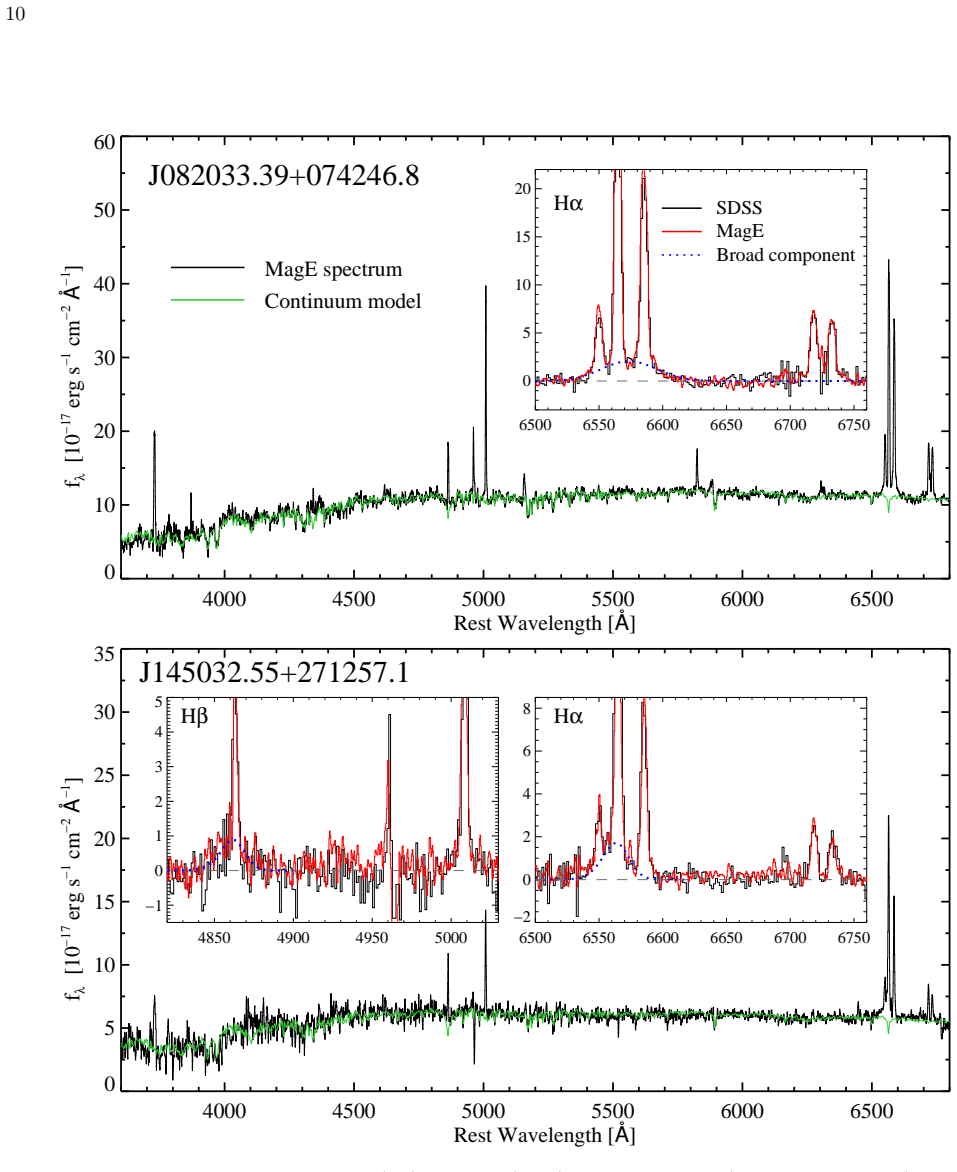
We present a sample of 930 intermediate-mass black hole (IMBH) active galactic nuclei (AGNs) with black hole masses of M_BH ≤ 2 × 10^6 M_⊙, uniformly selected from the Seventeenth Data Release of the Sloan Digital Sky Survey, based on the detection of broad Hα or Hβ emission lines. Taking advantage of the wide wavelength coverage of BOSS/eBOSS spectroscopy, our sample extends the redshift coverage of low-z IMBH AGNs to z ≤ 0.57. This sample encompasses black hole masses from 10^{4.0} to 10^{6.3} M_⊙, with Eddington ratios ranging from 0.01 to 1.9. Among the z > 0.3 subset, 24 sources exhibit detectable broad Mg II λλ2796,2803 emission lines. A preliminary analysis reveals a marked decline in
What carries the argument
Virial black hole mass estimates derived from the width of broad emission lines and continuum luminosities, used to isolate systems with M_BH ≤ 2 × 10^6 M_⊙ from SDSS spectra.
If this is right
- The catalog supplies a statistically useful set of low-mass black hole AGNs at intermediate redshifts for demographic studies.
- The observed decline in maximum Eddington ratio and Hα luminosity with decreasing redshift indicates possible cosmic evolution in accretion activity at the low-mass end.
- Detection of broad Mg II lines in a subset of higher-redshift objects allows direct comparison of emission-line properties across different species.
- Uniform selection from a single large survey reduces heterogeneity compared with earlier compilations limited to lower redshifts.
Where Pith is reading between the lines
- If the redshift trend persists in larger samples, it could link the growth of low-mass black holes to the broader pattern of galaxy downsizing.
- Cross-checks with future wide-field surveys such as DESI could test whether the decline continues or flattens at still higher redshifts.
- A subset of objects with multiple emission lines offers a starting point for reverberation-mapping campaigns to calibrate virial masses at the low-mass end.
Load-bearing premise
The virial black hole mass estimates derived from broad-line widths and continuum luminosities correctly identify objects with M_BH ≤ 2 × 10^6 M_⊙ without substantial contamination from higher-mass systems or non-virial motions.
What would settle it
Independent mass measurements, such as stellar velocity dispersion in the host galaxies, showing that a substantial fraction of the selected objects have true black hole masses above 2 × 10^6 solar masses.
Figures





read the original abstract
We present a sample of 930 intermediate-mass black hole (IMBH) active galactic nuclei (AGNs) with black hole masses of $M_\mathrm{BH} \leqslant 2 \times 10^{6}$ M$_{\odot}$, uniformly selected from the Seventeenth Data Release of the Sloan Digital Sky Survey, based on the detection of broad H$\alpha$ or H$\beta$ emission lines. Taking advantage of the wide wavelength coverage of BOSS/eBOSS spectroscopy, our sample extends the redshift coverage of low-$z$ IMBH AGNs to $z\leqslant0.57$, significantly improving upon previous studies that where generally limited to $z\leqslant0.35$. This sample encompasses black hole masses from $10^{4.0}$ to $10^{6.3}$ M$_{\odot}$, with Eddington ratios ranging from 0.01 to 1.9. Among the $z>0.3$ subset, 24 sources exhibit detectable broad Mg II $\lambda\lambda2796,2803$ emission lines, including eight confirmed by independent DESI spectra. A preliminary analysis reveals a marked decline in both the maximum accretion rate ($L/L_\mathrm{Edd}$) and broad H$\alpha$ luminosity with decreasing redshift, possibly reflecting a cosmic evolution of accretion activity at the low-mass end, akin to the ``downsizing'' evolutionary trend seen in high-mass AGNs.
Editorial analysis
A structured set of objections, weighed in public.
Referee Report
Summary. The manuscript constructs a sample of 930 IMBH AGNs (M_BH ≤ 2×10^6 M_⊙) uniformly selected from SDSS DR17 via detection of broad Hα or Hβ lines, extending the redshift range to z ≤ 0.57. It additionally reports a preliminary decline in maximum Eddington ratio and broad Hα luminosity toward lower redshift, interpreted as possible downsizing at the low-mass end.
Significance. If the virial mass selection proves robust, the sample size and extended redshift coverage would represent a useful expansion of existing low-mass AGN catalogs, enabling statistical studies of accretion at M_BH ~10^4–10^6 M_⊙ and providing an observational test of evolutionary trends previously seen only in higher-mass systems.
major comments (2)
- [Sample selection and black-hole mass estimation] Sample construction: The M_BH ≤ 2×10^6 M_⊙ cut is applied using single-epoch virial estimators calibrated on reverberation-mapped AGNs with M_BH ≳ 10^7 M_⊙. The manuscript provides no quantitative assessment of extrapolation errors in the R–L relation or virial factor f at the low-mass end, nor any test for non-virial contributions to line width; this directly affects sample purity and the validity of the reported redshift trends in L/L_Edd and L_Hα.
- [Results and preliminary analysis] Trend analysis: The abstract states that a 'preliminary analysis reveals a marked decline' in maximum accretion rate and broad Hα luminosity with decreasing redshift, yet the text supplies no completeness corrections, selection-function modeling, or error budget that would allow the reader to evaluate whether the trend is robust against Malmquist bias or redshift-dependent detection thresholds.
minor comments (2)
- [Abstract] Abstract: 'where generally limited' should read 'were generally limited'.
- [Sample description] The eight sources with independent DESI confirmation of Mg II are noted but not compared quantitatively to the SDSS-based mass and luminosity estimates.
Simulated Author's Rebuttal
We thank the referee for their thorough review and valuable comments on our manuscript. We address each major comment below in detail and have revised the manuscript to incorporate clarifications and additional discussion where appropriate.
read point-by-point responses
-
Referee: [Sample selection and black-hole mass estimation] Sample construction: The M_BH ≤ 2×10^6 M_⊙ cut is applied using single-epoch virial estimators calibrated on reverberation-mapped AGNs with M_BH ≳ 10^7 M_⊙. The manuscript provides no quantitative assessment of extrapolation errors in the R–L relation or virial factor f at the low-mass end, nor any test for non-virial contributions to line width; this directly affects sample purity and the validity of the reported redshift trends in L/L_Edd and L_Hα.
Authors: We agree that the single-epoch virial estimators are calibrated primarily on higher-mass systems and that extrapolation to the IMBH regime carries uncertainties in the R–L relation and virial factor. The manuscript employs the standard Greene & Ho (2005) and subsequent calibrations widely used in the literature for low-mass AGN samples. In the revised version, we have added a dedicated subsection in the methods discussing these extrapolation uncertainties, referencing studies on low-mass virial mass estimates (e.g., recent works on IMBH candidates). We also note that our selection is based on the presence of broad lines rather than mass alone, which mitigates some purity issues, but we acknowledge that quantitative error budgets for f at low masses are not provided here. Such detailed tests are deferred to a follow-up study focused on mass validation, as this paper primarily presents the catalog. revision: partial
-
Referee: [Results and preliminary analysis] Trend analysis: The abstract states that a 'preliminary analysis reveals a marked decline' in maximum accretion rate and broad Hα luminosity with decreasing redshift, yet the text supplies no completeness corrections, selection-function modeling, or error budget that would allow the reader to evaluate whether the trend is robust against Malmquist bias or redshift-dependent detection thresholds.
Authors: The trends are explicitly labeled as 'preliminary' in both the abstract and main text to reflect the absence of full selection-function modeling. We concur that Malmquist bias and redshift-dependent detection thresholds could influence the observed decline in maximum L/L_Edd and L_Hα. In the revision, we have expanded the discussion section to include a qualitative assessment of these potential biases and added explicit caveats stating that the trends are suggestive only. We have also clarified that a quantitative analysis incorporating completeness corrections and error budgets is beyond the scope of this catalog paper but is planned for a subsequent work. This addresses the referee's concern without overstating the current results. revision: yes
Circularity Check
No circularity: observational catalog with standard estimators
full rationale
The paper constructs a sample by applying established single-epoch virial mass estimators (cited from prior literature) to SDSS spectra and reports observed trends in the resulting catalog. No derivation, model fitting, or prediction is presented that reduces to its own inputs by construction. The M_BH ≤ 2×10^6 M_⊙ cut is a selection threshold, not a self-referential output. Self-citations, if present, are not load-bearing for any claimed result.
Axiom & Free-Parameter Ledger
free parameters (1)
- Black hole mass upper limit
axioms (1)
- domain assumption Broad Hα or Hβ line widths and luminosities yield reliable virial black hole mass estimates
Reference graph
Works this paper leans on
-
[1]
Abazajian, K. N., Adelman-McCarthy, J. K., Ag¨ ueros, M. A., et al. 2009, ApJS, 182, 543, doi: 10.1088/0067-0049/182/2/543 Abdurro’uf, Accetta, K., Aerts, C., et al. 2022, ApJS, 259, 35, doi: 10.3847/1538-4365/ac4414
work page internal anchor Pith review doi:10.1088/0067-0049/182/2/543 2009
-
[2]
2019, ApJ, 875, 50, doi: 10.3847/1538-4357/ab100d
Bahk, H., Woo, J.-H., & Park, D. 2019, ApJ, 875, 50, doi: 10.3847/1538-4357/ab100d
-
[3]
Baldwin, J. A., Phillips, M. M., & Terlevich, R. 1981, PASP, 93, 5, doi: 10.1086/130766
-
[4]
Barth, A. J., Ho, L. C., Rutledge, R. E., & Sargent, W. L. W. 2004, ApJ, 607, 90, doi: 10.1086/383302
-
[5]
2009, ApJ, 697, 160, doi: 10.1088/0004-637X/697/1/160 Bogd´ an,´A., Goulding, A
Vestergaard, M. 2009, ApJ, 697, 160, doi: 10.1088/0004-637X/697/1/160 Bogd´ an,´A., Goulding, A. D., Natarajan, P., et al. 2024, Nature Astronomy, 8, 126, doi: 10.1038/s41550-023-02111-9
-
[6]
2003, , 341, 501, 10.1046/j.1365-8711.2003.06431.x
Bruzual, G., & Charlot, S. 2003, MNRAS, 344, 1000, doi: 10.1046/j.1365-8711.2003.06897.x
-
[7]
Chilingarian, I. V., Katkov, I. Y., Zolotukhin, I. Y., et al. 2018, ApJ, 863, 1, doi: 10.3847/1538-4357/aad184
-
[8]
2024, ApJ, 969, 93, doi: 10.3847/1538-4357/ad4966
Cho, H., & Woo, J.-H. 2024, ApJ, 969, 93, doi: 10.3847/1538-4357/ad4966
-
[9]
Cowie, L. L., Songaila, A., Hu, E. M., & Cohen, J. G. 1996, AJ, 112, 839, doi: 10.1086/118058
-
[10]
The Baryon Oscillation Spectroscopic Survey of SDSS-III
Dawson, K. S., Schlegel, D. J., Ahn, C. P., et al. 2013, AJ, 145, 10, doi: 10.1088/0004-6256/145/1/10
work page internal anchor Pith review doi:10.1088/0004-6256/145/1/10 2013
-
[11]
The DESI Experiment Part I: Science,Targeting, and Survey Design
Dawson, K. S., Kneib, J.-P., Percival, W. J., et al. 2016, AJ, 151, 44, doi: 10.3847/0004-6256/151/2/44 DESI Collaboration, Aghamousa, A., Aguilar, J., et al. 2016, arXiv e-prints, arXiv:1611.00036, doi: 10.48550/arXiv.1611.00036 DESI Collaboration, Abdul-Karim, M., Adame, A. G., et al. 2025, arXiv e-prints, arXiv:2503.14745, doi: 10.48550/arXiv.2503.14745
work page internal anchor Pith review Pith/arXiv arXiv doi:10.3847/0004-6256/151/2/44 2016
-
[12]
M., Mandelbaum R., Ishak M., Seljak U., Nichol R., Pimbblet K
Dong, X., Wang, T., Wang, J., et al. 2008, MNRAS, 383, 581, doi: 10.1111/j.1365-2966.2007.12560.x
-
[13]
Dong, X.-B., Ho, L. C., Yuan, W., et al. 2012, ApJ, 755, 167, doi: 10.1088/0004-637X/755/2/167
-
[14]
Dong, X.-B., Wang, J.-G., Ho, L. C., et al. 2011, ApJ, 736, 86, doi: 10.1088/0004-637X/736/2/86
-
[15]
Filippenko, A. V., & Ho, L. C. 2003, ApJL, 588, L13, doi: 10.1086/375361
-
[16]
Filippenko, A. V., Ho, L. C., & Sargent, W. L. W. 1993, ApJL, 410, L75, doi: 10.1086/186883
-
[17]
Fitzpatrick, E. L. 1999, PASP, 111, 63, doi: 10.1086/316293
-
[18]
Greene, J. E., & Ho, L. C. 2004, ApJ, 610, 722, doi: 10.1086/421719 —. 2005, ApJ, 630, 122, doi: 10.1086/431897 —. 2007a, ApJ, 667, 131, doi: 10.1086/520497 —. 2007b, ApJ, 670, 92, doi: 10.1086/522082
-
[19]
Greene, J. E., Strader, J., & Ho, L. C. 2020, ARA&A, 58, 257, doi: 10.1146/annurev-astro-032620-021835
work page internal anchor Pith review doi:10.1146/annurev-astro-032620-021835 2020
-
[20]
2005, A&A, 441, 417, doi: 10.1051/0004-6361:20042134
Hasinger, G., Miyaji, T., & Schmidt, M. 2005, A&A, 441, 417, doi: 10.1051/0004-6361:20042134
-
[21]
Heckman, T. M. 1980, A&A, 87, 152
work page 1980
-
[22]
M., Kauffmann, G., Brinchmann, J., et al
Heckman, T. M., Kauffmann, G., Brinchmann, J., et al. 2004, Astrophys. J., 613, 109, doi: 10.1086/422872
-
[23]
Ho, L. C. 2008, ARA&A, 46, 475, doi: 10.1146/annurev.astro.45.051806.110546 —. 2009, ApJ, 699, 626, doi: 10.1088/0004-637X/699/1/626
work page internal anchor Pith review Pith/arXiv arXiv doi:10.1146/annurev.astro.45.051806.110546 2008
-
[24]
Ho, L. C., Filippenko, A. V., & Sargent, W. L. W. 1997a, ApJS, 112, 315, doi: 10.1086/313041 —. 1997b, ApJ, 487, 568, doi: 10.1086/304638
-
[25]
Ho, L. C., Filippenko, A. V., Sargent, W. L. W., & Peng, C. Y. 1997c, ApJS, 112, 391, doi: 10.1086/313042
-
[26]
Ho, L. C., & Kim, M. 2014, ApJ, 789, 17, doi: 10.1088/0004-637X/789/1/17 —. 2015, ApJ, 809, 123, doi: 10.1088/0004-637X/809/2/123
-
[27]
2020, ARA&A, 58, 27, doi: 10.1146/annurev-astro-120419-014455
Inayoshi, K., Visbal, E., & Haiman, Z. 2020, ARA&A, 58, 27, doi: 10.1146/annurev-astro-120419-014455
-
[28]
2003, , 341, 501, 10.1046/j.1365-8711.2003.06431.x
Kauffmann, G., Heckman, T. M., White, S. D. M., et al. 2003a, MNRAS, 341, 33, doi: 10.1046/j.1365-8711.2003.06291.x
-
[29]
Kauffmann, G., Heckman, T. M., Tremonti, C., et al. 2003b, MNRAS, 346, 1055, doi: 10.1111/j.1365-2966.2003.07154.x
-
[30]
Kewley, L. J., Dopita, M. A., Sutherland, R. S., Heisler, C. A., & Trevena, J. 2001, ApJ, 556, 121, doi: 10.1086/321545
work page internal anchor Pith review doi:10.1086/321545 2001
-
[31]
2007, , 374, 1413, 10.1111/j.1365-2966.2006.11246.x
Kewley, L. J., Groves, B., Kauffmann, G., & Heckman, T. 2006, MNRAS, 372, 961, doi: 10.1111/j.1365-2966.2006.10859.x
-
[32]
Kormendy, J., & Ho, L. C. 2013, ARA&A, 51, 511, doi: 10.1146/annurev-astro-082708-101811 17
work page internal anchor Pith review doi:10.1146/annurev-astro-082708-101811 2013
-
[33]
Kraemer, S. B., Ho, L. C., Crenshaw, D. M., Shields, J. C., & Filippenko, A. V. 1999, ApJ, 520, 564, doi: 10.1086/307486
-
[34]
Laor, A., Jannuzi, B. T., Green, R. F., & Boroson, T. A. 1997, ApJ, 489, 656, doi: 10.1086/304816
-
[35]
Le, H. A. N., Woo, J.-H., & Xue, Y. 2020, ApJ, 901, 35, doi: 10.3847/1538-4357/abada0
-
[36]
2019, ApJS, 243, 21, doi: 10.3847/1538-4365/ab298b
Liu, H.-Y., Liu, W.-J., Dong, X.-B., et al. 2019, ApJS, 243, 21, doi: 10.3847/1538-4365/ab298b
-
[37]
2018, ApJS, 235, 40, doi: 10.3847/1538-4365/aab88e
Liu, H.-Y., Yuan, W., Dong, X.-B., Zhou, H., & Liu, W.-J. 2018, ApJS, 235, 40, doi: 10.3847/1538-4365/aab88e
-
[38]
2021, ApJ, 915, 63, doi: 10.3847/1538-4357/abf82c
Liu, W.-J., Lira, P., Yao, S., et al. 2021, ApJ, 915, 63, doi: 10.3847/1538-4357/abf82c
-
[39]
2006, AJ, 131, 790, doi: 10.1086/498711
Lu, H., Zhou, H., Wang, J., et al. 2006, AJ, 131, 790, doi: 10.1086/498711
-
[40]
2024, Nature, 627, 59, doi: 10.1038/s41586-024-07052-5
Maiolino, R., Scholtz, J., Witstok, J., et al. 2024, Nature, 627, 59, doi: 10.1038/s41586-024-07052-5
-
[41]
Markwardt, C. B. 2009, in Astronomical Society of the Pacific Conference Series, Vol. 411, Astronomical Data Analysis Software and Systems XVIII, ed. D. A
work page 2009
-
[42]
Non-linear Least Squares Fitting in IDL with MPFIT
Bohlender, D. Durand, & P. Dowler, 251, doi: 10.48550/arXiv.0902.2850
work page internal anchor Pith review Pith/arXiv arXiv doi:10.48550/arxiv.0902.2850
-
[43]
Marshall, J. L., Burles, S., Thompson, I. B., et al. 2008, in Society of Photo-Optical Instrumentation Engineers (SPIE) Conference Series, Vol. 7014, Ground-based and Airborne Instrumentation for Astronomy II, ed. I. S. McLean & M. M. Casali, 701454, doi: 10.1117/12.789972
-
[44]
2025, ApJ, 982, 10, doi: 10.3847/1538-4357/adb1dd
Pucha, R., Juneau, S., Dey, A., et al. 2025, ApJ, 982, 10, doi: 10.3847/1538-4357/adb1dd
-
[45]
Reines, A. E., Greene, J. E., & Geha, M. 2013, ApJ, 775, 116, doi: 10.1088/0004-637X/775/2/116
work page internal anchor Pith review doi:10.1088/0004-637x/775/2/116 2013
-
[46]
Runnoe, J. C., Brotherton, M. S., & Shang, Z. 2012, MNRAS, 422, 478, doi: 10.1111/j.1365-2966.2012.20620.x
-
[47]
Schlegel, D. J., Finkbeiner, D. P., & Davis, M. 1998, ApJ, 500, 525, doi: 10.1086/305772
work page internal anchor Pith review doi:10.1086/305772 1998
-
[48]
Shen, Y., & Kelly, B. C. 2012, ApJ, 746, 169, doi: 10.1088/0004-637X/746/2/169
-
[49]
2006, ApJ, 650, 57, doi: 10.1086/506376
Tsuzuki, Y., Kawara, K., Yoshii, Y., et al. 2006, ApJ, 650, 57, doi: 10.1086/506376
-
[50]
2003, ApJ, 598, 886, doi: 10.1086/378940 Vanden Berk, D
Ueda, Y., Akiyama, M., Ohta, K., & Miyaji, T. 2003, ApJ, 598, 886, doi: 10.1086/378940 Vanden Berk, D. E., Richards, G. T., Bauer, A., et al. 2001, AJ, 122, 549, doi: 10.1086/321167
-
[51]
Veilleux, S., & Osterbrock, D. E. 1987, ApJS, 63, 295, doi: 10.1086/191166 V´ eron-Cetty, M. P., Joly, M., & V´ eron, P. 2004, A&A, 417, 515, doi: 10.1051/0004-6361:20035714
-
[52]
2021, Nature Reviews Physics, 3, 732, doi: 10.1038/s42254-021-00364-9
Volonteri, M., Habouzit, M., & Colpi, M. 2021, Nature Reviews Physics, 3, 732, doi: 10.1038/s42254-021-00364-9
-
[53]
2009, ApJ, 707, 1334, doi: 10.1088/0004-637X/707/2/1334
Wang, J.-G., Dong, X.-B., Wang, T.-G., et al. 2009, ApJ, 707, 1334, doi: 10.1088/0004-637X/707/2/1334
-
[54]
Woo, J.-H., Le, H. A. N., Karouzos, M., et al. 2018, ApJ, 859, 138, doi: 10.3847/1538-4357/aabf3e
-
[55]
Xiao, T., Barth, A. J., Greene, J. E., et al. 2011, ApJ, 739, 28, doi: 10.1088/0004-637X/739/1/28
-
[56]
2006, ApJS, 166, 128, doi: 10.1086/504869
Zhou, H., Wang, T., Yuan, W., et al. 2006, ApJS, 166, 128, doi: 10.1086/504869
discussion (0)
Sign in with ORCID, Apple, or X to comment. Anyone can read and Pith papers without signing in.