Characteristic determinant approach to the spectrum of one-dimensional mathcal{P}mathcal{T}-symmetric systems
Pith reviewed 2026-05-22 22:43 UTC · model grok-4.3
The pith
A characteristic determinant yields the closed-form energy spectrum for one-dimensional PT-symmetric systems with periodic two-delta potentials.
A machine-rendered reading of the paper's core claim, the machinery that carries it, and where it could break.
Core claim
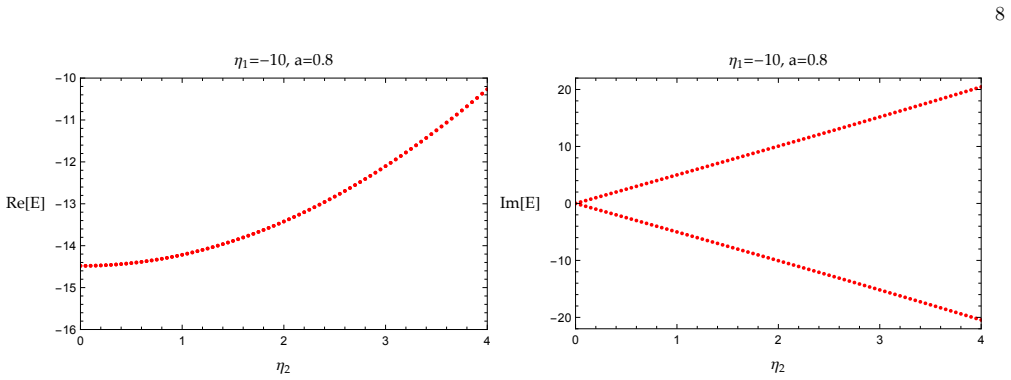
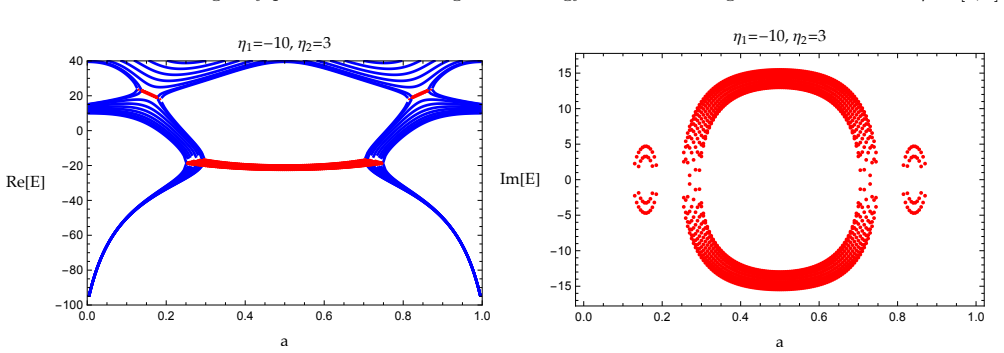
We obtain a closed form expression for the energy spectrum of PT-symmetric superlattice systems with complex potentials of periodic sets of two δ-potentials in the elementary cell. In the presence of periodic gain and loss the diatomic crystal model is analyzed by varying scatterer distances or potential heights, revealing that topological states can disappear at a critical imaginary amplitude at the PT-symmetry breaking points.
What carries the argument
The characteristic determinant constructed from the two-delta unit cell, which encodes the spectrum condition for the infinite superlattice.
Load-bearing premise
The determinant derived from one unit cell continues to describe the entire infinite chain even when the imaginary potential strength pushes the system past exceptional points.
What would settle it
For a specific choice of parameters where the closed form predicts state disappearance at a given imaginary strength, direct diagonalization of a large finite lattice Hamiltonian should show the same disappearance or mismatch if the assumption fails.
Figures


read the original abstract
We obtain a closed form expression for the energy spectrum of $\mathcal{P}\mathcal{T}$-symmetric superlattice systems with complex potentials of periodic sets of two $\delta$-potentials in the elementary cell. In the presence of periodic gain and loss we analyzed in detail a diatomic crystal model, varying either the scatterer distances or the potential heights. It is shown that at a certain critical value of the imaginary part of the complex amplitude, topological states depending on the lattice size and the configuration of the unit cell can disappear. This may happened at the $\mathcal{PT}$-symmetry breaking (exceptional) points.
Editorial analysis
A structured set of objections, weighed in public.
Referee Report
Summary. The manuscript develops a characteristic determinant method using the 2×2 transfer matrix of a PT-symmetric diatomic unit cell (two complex delta potentials) to obtain a closed-form expression for the energy spectrum of infinite one-dimensional superlattices. It analyzes the dependence on scatterer distances or potential heights and reports that size- and configuration-dependent topological states disappear at PT-symmetry breaking exceptional points.
Significance. If the closed-form spectrum expression remains valid through the exceptional-point regime, the approach would supply an analytic handle on PT-symmetric periodic systems that complements numerical diagonalization and could clarify how exceptional points terminate topological features. The reliance on standard transfer-matrix scattering theory for periodic potentials is a methodological strength, though the absence of an explicit benchmark against finite-chain spectra limits immediate applicability.
major comments (2)
- [Abstract / diatomic crystal model analysis] Abstract and the diatomic-crystal analysis section: the central claim that topological states disappear at the PT-breaking point rests on setting the characteristic determinant (constructed from the cell transfer matrix) to zero. At an exceptional point the transfer matrix ceases to be diagonalizable; the manuscript does not demonstrate that the det(T(E) − λI) = 0 condition continues to register the correct algebraic multiplicity or avoids spurious roots in this non-diagonalizable regime.
- [Analysis of topological states at critical imaginary amplitude] The reported disappearance of lattice-size-dependent states is presented as a direct consequence of the closed-form spectrum. No independent verification (e.g., exact diagonalization of a large but finite chain or an alternative scattering formulation) is supplied to confirm that the analytic expression survives the transition through the exceptional point.
minor comments (1)
- [Abstract] The abstract states a closed-form result is obtained but does not display the explicit determinant or the final spectrum formula; including the key expression would improve readability.
Simulated Author's Rebuttal
We thank the referee for the careful reading and constructive comments. Below we respond point by point to the two major comments.
read point-by-point responses
-
Referee: [Abstract / diatomic crystal model analysis] Abstract and the diatomic-crystal analysis section: the central claim that topological states disappear at the PT-breaking point rests on setting the characteristic determinant (constructed from the cell transfer matrix) to zero. At an exceptional point the transfer matrix ceases to be diagonalizable; the manuscript does not demonstrate that the det(T(E) − λI) = 0 condition continues to register the correct algebraic multiplicity or avoids spurious roots in this non-diagonalizable regime.
Authors: The characteristic determinant is the characteristic polynomial det(T(E) − λI) of the transfer matrix. By definition this polynomial yields the eigenvalues together with their algebraic multiplicities, irrespective of whether T is diagonalizable. The secular equation for the allowed energies of the infinite periodic system is obtained directly from this polynomial and does not presuppose a complete set of eigenvectors. We will insert a short clarifying paragraph in the revised manuscript stating this fact and noting that no additional roots are introduced at the exceptional point. revision: partial
-
Referee: [Analysis of topological states at critical imaginary amplitude] The reported disappearance of lattice-size-dependent states is presented as a direct consequence of the closed-form spectrum. No independent verification (e.g., exact diagonalization of a large but finite chain or an alternative scattering formulation) is supplied to confirm that the analytic expression survives the transition through the exceptional point.
Authors: We agree that an explicit numerical benchmark would strengthen the claim. In the revised version we will add a short subsection comparing the analytic spectrum with exact diagonalization of finite but large chains (N ≈ 100–200 cells) at and across the critical imaginary amplitudes, confirming that the size-dependent topological states indeed terminate at the exceptional points identified by the closed-form expression. revision: yes
Circularity Check
No circularity: spectrum from standard transfer-matrix determinant on PT-symmetric cell
full rationale
The derivation constructs the characteristic determinant directly from the 2×2 transfer matrix of the two-δ unit cell and sets it to zero to obtain the closed-form spectrum condition. This is the conventional Bloch-matching step in one-dimensional scattering theory and does not reduce to a fitted parameter, self-definition, or a self-citation chain. The paper applies the same algebraic procedure both inside and outside the PT-broken regime; no equation is shown to be equivalent to its own input by construction, and no load-bearing uniqueness theorem is imported from the authors’ prior work. The result is therefore self-contained against the transfer-matrix formalism.
Axiom & Free-Parameter Ledger
Reference graph
Works this paper leans on
-
[1]
Real spectra in non-hermitian hamiltonians having PT symmetry,
Carl M. Bender and Stefan Boettcher, “Real spectra in non-hermitian hamiltonians having PT symmetry,” Phys. Rev. Lett. 80, 5243–5246 (1998)
work page 1998
-
[2]
The energy spectrum of complex periodic potentials of the kronig–penney type,
H.F Jones, “The energy spectrum of complex periodic potentials of the kronig–penney type,” Physics Letters A 262, 242–244 (1999)
work page 1999
-
[3]
Giant faraday rotation in single- and multilayer graphene,
Iris Crassee, Julien Levallois, Andrew L. Walter, Markus Ostler, Aaron Bostwick, Eli Rotenberg, Thomas Seyller, Dirk van der Marel, and Alexey B. Kuzmenko, “Giant faraday rotation in single- and multilayer graphene,” Na- ture Physics 7, 48–51 (2011)
work page 2011
-
[4]
Observation of PT -symmetry break- ing in complex optical potentials,
A. Guo, G. J. Salamo, D. Duchesne, R. Morandotti, M. Volatier-Ravat, V. Aimez, G. A. Siviloglou, and D. N. Christodoulides, “Observation of PT -symmetry break- ing in complex optical potentials,” Phys. Rev. Lett. 103, 093902 (2009)
work page 2009
-
[5]
A A Zyablovsky, A P Vinogradov, A A Pukhov, A V Do- rofeenko, and A A Lisyansky, “Pt-symmetry in optics,” Physics-Uspekhi 57, 1063 (2014)
work page 2014
-
[6]
Beam dynamics in PT symmetric optical lattices,
K. G. Makris, R. El-Ganainy, D. N. Christodoulides, and Z. H. Musslimani, “Beam dynamics in PT symmetric optical lattices,” Phys. Rev. Lett. 100, 103904 (2008)
work page 2008
-
[7]
Raj Kumar Dani, Hongwang Wang, Stefan H. Boss- mann, Gary Wysin, and Viktor Chikan, “Fara- day rotation enhancement of gold coated fe2o3 nanoparticles: Comparison of experiment and theory,” The Journal of Chemical Physics 135, 224502 (2011), https://pubs.aip.org/aip/jcp/article- pdf/doi/10.1063/1.3665138/15445749/224502 1 online.pdf
-
[8]
Non-hermitian physics and pt symmetry,
Ramy El-Ganainy, Konstantinos G. Makris, Mercedeh Khajavikhan, Ziad H. Musslimani, Stefan Rotter, and Demetrios N. Christodoulides, “Non-hermitian physics and pt symmetry,” Nature Physics 14, 11–19 (2018)
work page 2018
-
[10]
Piao-Piao Huang, Jing He, Jia-Rui Li, Hai-Na Wu, Lian- Lian Zhang, Zhao Jin, and Wei-Jiang Gong, “Trans- mission through a one-dimensional photonic lattice mod- ulated by the side-coupled pt-symmetric non-hermitian su–schrieffer–heeger chain,” J. Opt. Soc. Am. B38, 1331– 1340 (2021)
work page 2021
-
[11]
Singular properties generated by finite periodic pt-symmetric optical waveguide network,
Jian Zheng, Xiangbo Yang, Dongmei Deng, and Hongzhan Liu, “Singular properties generated by finite periodic pt-symmetric optical waveguide network,” Opt. Express 27, 1538–1552 (2019)
work page 2019
-
[12]
Li Ge, Y. D. Chong, and A. D. Stone, “Conservation relations and anisotropic transmission resonances in one- dimensional PT -symmetric photonic heterostructures,” Phys. Rev. A 85, 023802 (2012)
work page 2012
-
[13]
Light scattering in pseudopassive media with uniformly balanced gain and loss,
A. Basiri, I. Vitebskiy, and T. Kottos, “Light scattering in pseudopassive media with uniformly balanced gain and loss,” Phys. Rev. A 91, 063843 (2015)
work page 2015
-
[14]
Friedel formula and Krein’s theorem in complex potential scattering the- ory,
Peng Guo and Vladimir Gasparian, “Friedel formula and Krein’s theorem in complex potential scattering the- ory,” Phys. Rev. Res. 4, 023083 (2022), arXiv:2202.12465 [cond-mat.other]
-
[15]
Tunneling time in PT - symmetric systems,
Peng Guo, Vladimir Gasparian, Esther J´ odar, and Christopher Wisehart, “Tunneling time in PT - symmetric systems,” Phys. Rev. A 107, 032210 (2023)
work page 2023
-
[16]
Tunneling time and faraday/kerr ef- fects in PT -symmetric systems,
Vladimir Gasparian, Peng Guo, Antonio P´ erez-Garrido, and Esther J´ odar, “Tunneling time and faraday/kerr ef- fects in PT -symmetric systems,” Europhysics Letters 143, 66001 (2023)
work page 2023
-
[17]
Tunneling time in coupled-channel systems
Peng Guo, Vladimir Gasparian, Antonio P´ erez-Garrido, and Esther J´ odar, “Tunneling time in coupled- channel systems,” Phys. Rev. Res. 6, 043032 (2024), arXiv:2407.17981 [cond-mat.other]
work page internal anchor Pith review Pith/arXiv arXiv 2024
-
[18]
Anomalous Faraday effect in a PT-symmetric di- electric slab,
Vladimir Gasparian, Peng Guo, and Esther J´ odar, “Anomalous Faraday effect in a PT-symmetric di- electric slab,” Phys. Lett. A 453, 128473 (2022), 11 arXiv:2205.09871 [cond-mat.mes-hall]
-
[19]
Polar magneto-optic kerr and faraday effects in finite periodic PT -symmetric systems,
Antonio Perez-Garrido, Peng Guo, Vladimir Gasparian, and Esther J´ odar, “Polar magneto-optic kerr and faraday effects in finite periodic PT -symmetric systems,” Phys. Rev. A 107, 053504 (2023)
work page 2023
-
[20]
Resistance of one-dimensional chains in kronig-penny-like models,
V.M. Gasparian, B.L. Altshuler, A.G. Aronov, and Z.A. Kasamanian, “Resistance of one-dimensional chains in kronig-penny-like models,” Physics Letters A 132, 201– 205 (1988)
work page 1988
-
[21]
V. Gasparian and M. Pollak, “B¨ uttiker-landauer char- acteristic barrier-interaction times for one-dimensional random layered systems,” Phys. Rev. B 47, 2038–2041 (1993)
work page 2038
-
[23]
A. F. Tzortzakakis, A. Katsaris, N. E. Palaiodimopou- los, P. A. Kalozoumis, G. Theocharis, F. K. Diakonos, and D. Petrosyan, “Topological edge states of the PT - symmetric su-schrieffer-heeger model: An effective two- state description,” Phys. Rev. A 106, 023513 (2022)
work page 2022
-
[24]
Topological phases and edge states in a non-Hermitian trimerized optical lattice
L. Jin, “Topological phases and edge states in a non- Hermitian trimerized optical lattice,” Phys. Rev. A 96, 032103 (2017), arXiv:1803.06672 [cond-mat.mes-hall]
work page internal anchor Pith review Pith/arXiv arXiv 2017
-
[25]
On the theory of impurity levels,
Z.A. Kasamanian, “On the theory of impurity levels,” Sov. Phys. JETP 34, 648 (1972), [Zh. Eksp. Teor. Fiz. 61, 1215-1220(1971)]
work page 1972
-
[26]
E.N. Economou, Green’s Functions in Quantum Physics, Springer Series in Solid-State Sciences (Springer Berlin Heidelberg, 2006)
work page 2006
-
[27]
Local density of states in a model variable-band semiconductor,
Z. A. Kasamanyan, “Local density of states in a model variable-band semiconductor,” Soviet Physics Journal 24, 525–530 (1981)
work page 1981
-
[28]
Charge pumping in one-dimensional kronig-penney models,
V. Gasparian, B. Altshuler, and M. Ortu˜ no, “Charge pumping in one-dimensional kronig-penney models,” Phys. Rev. B 72, 195309 (2005)
work page 2005
-
[29]
Transmission of waves through one-dimensional random layered systems,
A G Aronov, V M Gasparian, and Ute Gummich, “Transmission of waves through one-dimensional random layered systems,” Journal of Physics: Condensed Matter 3, 3023 (1991)
work page 1991
-
[30]
Tunneling and dwell time for one- dimensional generalized kronig-penney model,
V. Gasparian, Ute Gummich, E. J´ odar, J. Ruiz, and M. Ortu˜ no, “Tunneling and dwell time for one- dimensional generalized kronig-penney model,” Physica B: Condensed Matter 233, 72–77 (1997)
work page 1997
-
[31]
A bipartite kronig–penney model with dirac-delta potential scatterers,
Thomas Benjamin Smith and Alessandro Principi, “A bipartite kronig–penney model with dirac-delta potential scatterers,” Journal of Physics: Condensed Matter 32, 055502 (2019)
work page 2019
-
[32]
Topological states in the kronig–penney model with arbitrary scattering potentials,
Irina Reshodko, Albert Benseny, Judit Romh´ anyi, and Thomas Busch, “Topological states in the kronig–penney model with arbitrary scattering potentials,” New Journal of Physics 21, 013010 (2019)
work page 2019
-
[33]
M. Belloni and R.W. Robinett, “The infinite well and dirac delta function potentials as pedagogical, mathemat- ical and physical models in quantum mechanics,” Physics Reports 540, 25–122 (2014), the infinite well and Dirac delta function potentials as pedagogical, mathematical and physical models in quantum mechanics
work page 2014
-
[34]
Exact solutions of a particle in a box with a delta function potential: The factorization method,
Pouria Pedram and M. Vahabi, “Exact solutions of a particle in a box with a delta function potential: The factorization method,” American Journal of Physics 78, 839–841 (2010), https://pubs.aip.org/aapt/ajp/article- pdf/78/8/839/13098733/839 1 online.pdf
work page 2010
-
[35]
Modulated kronig-penney model in superspace,
C. De Lange and T. Janssen, “Modulated kronig-penney model in superspace,” Physica A: Statistical Mechanics and its Applications 127, 125–140 (1984)
work page 1984
-
[36]
Topological phase in a non-hermitian pt symmetric system,
C. Yuce, “Topological phase in a non-hermitian pt symmetric system,” Physics Letters A 379, 1213–1218 (2015)
work page 2015
-
[37]
Tamm states of fractal surfaces,
B. L. Oksengendler, V. N. Nikiforov, and S. E. Maksi- mov, “Tamm states of fractal surfaces,” Doklady Physics 62, 281–283 (2017)
work page 2017
-
[38]
Transparency of the complex pt-symmetric potentials for coherent injection,
Zafar Ahmed, Joseph Amal Nathan, and Dona Ghosh, “Transparency of the complex pt-symmetric potentials for coherent injection,” Physics Letters A 380, 562–566 (2016)
work page 2016
-
[39]
Energy band structure due to a complex, periodic, pt-invariant potential,
Zafar Ahmed, “Energy band structure due to a complex, periodic, pt-invariant potential,” Physics Letters A 286, 231–235 (2001)
work page 2001
-
[40]
Spectral signatures of nontrivial topol- ogy in a superconducting circuit,
L. Peyruchat, R. H. Rodriguez, J.-L. Smirr, R. Leone, and C ¸ .¨O. Girit, “Spectral signatures of nontrivial topol- ogy in a superconducting circuit,” Phys. Rev. X 14, 041041 (2024)
work page 2024
-
[41]
Edge states and topological phases in non-Hermitian systems
Kenta Esaki, Masatoshi Sato, Kazuki Hasebe, and Mahito Kohmoto, “Edge states and topological phases in non-Hermitian systems,” Phys. Rev. B 84, 205128 (2011), arXiv:1107.2079 [cond-mat.mes-hall]
work page internal anchor Pith review Pith/arXiv arXiv 2011
-
[42]
PT - symmetry breaking and laser-absorber modes in optical scattering systems,
Y. D. Chong, Li Ge, and A. Douglas Stone, “ PT - symmetry breaking and laser-absorber modes in optical scattering systems,” Phys. Rev. Lett.106, 093902 (2011)
work page 2011
-
[43]
Scattering by finite periodic PT -symmetric structures,
V. Achilleos, Y. Aur´ egan, and V. Pagneux, “Scattering by finite periodic PT -symmetric structures,” Phys. Rev. Lett. 119, 243904 (2017)
work page 2017
-
[44]
Non-hermitian scattering on a tight-binding lattice,
Phillip C. Burke, Jan Wiersig, and Masudul Haque, “Non-hermitian scattering on a tight-binding lattice,” Phys. Rev. A 102, 012212 (2020)
work page 2020
-
[45]
Bound states, scattering states, and resonant states in PT -symmetric open quantum sys- tems,
Savannah Garmon, Mariagiovanna Gianfreda, and Naomichi Hatano, “Bound states, scattering states, and resonant states in PT -symmetric open quantum sys- tems,” Phys. Rev. A 92, 022125 (2015)
work page 2015
-
[46]
Non-hermitian fabry-p´ erot reso- nances in a pt-symmetric system,
Ken Shobe, Keiichi Kuramoto, Ken-Ichiro Imura, and Naomichi Hatano, “Non-hermitian fabry-p´ erot reso- nances in a pt-symmetric system,” Phys. Rev. Res. 3, 013223 (2021)
work page 2021
-
[47]
Solutions of PT -symmetric tight- binding chain and its equivalent hermitian counterpart,
L. Jin and Z. Song, “Solutions of PT -symmetric tight- binding chain and its equivalent hermitian counterpart,” Phys. Rev. A 80, 052107 (2009)
work page 2009
-
[48]
J.G. Muga, J.P. Palao, B. Navarro, and I.L. Egusquiza, “Complex absorbing potentials,” Physics Reports 395, 357–426 (2004)
work page 2004
discussion (0)
Sign in with ORCID, Apple, or X to comment. Anyone can read and Pith papers without signing in.