Estimating the best separable approximation of non-pure spin-squeezed states
Pith reviewed 2026-05-22 20:23 UTC · model grok-4.3
The pith
Spin-squeezing inequalities yield a lower bound on the best separable approximation distance for collective spin states without witness optimization.
A machine-rendered reading of the paper's core claim, the machinery that carries it, and where it could break.
Core claim
From the complete set of spin-squeezing inequalities, which form nonlinear entanglement criteria based on collective spin variances for states of N spin-1/2 particles, one obtains a lower bound to the best separable approximation, a distance-based entanglement monotone. Combined with symmetry-exploiting optimization for upper bounds, this enables quantitative entanglement analysis for thermal states on fully-connected graphs, including across phases of the XXZ model at nonzero temperature.
What carries the argument
The complete set of spin-squeezing inequalities as nonlinear criteria based on collective spin variances that directly lower-bound the best separable approximation distance.
If this is right
- Lower bounds to the best separable approximation are obtained directly from the spin-squeezing inequalities without optimizing over witnesses.
- Symmetry-exploiting iteration finds the closest separable state for collective spin states.
- Entanglement is quantified in thermal states of the fully-connected XXZ model, including at nonzero temperature in the ordered phase.
- The lower bound is often tight at zero temperature and at the temperature where entanglement disappears.
Where Pith is reading between the lines
- The method could apply to other symmetric many-body states beyond fully-connected graphs.
- Quantitative bounds may help detect entanglement in out-of-equilibrium spin systems.
- Tightness at entanglement disappearance temperatures indicates the inequalities capture the transition precisely in these models.
Load-bearing premise
The spin-squeezing inequalities provide a complete set of nonlinear entanglement criteria for collective states of N spin-1/2 particles.
What would settle it
A thermal state of the XXZ model for which the actual best separable approximation distance computed by other means falls below the lower bound obtained from the spin-squeezing inequalities would disprove the claimed bound.
Figures


read the original abstract
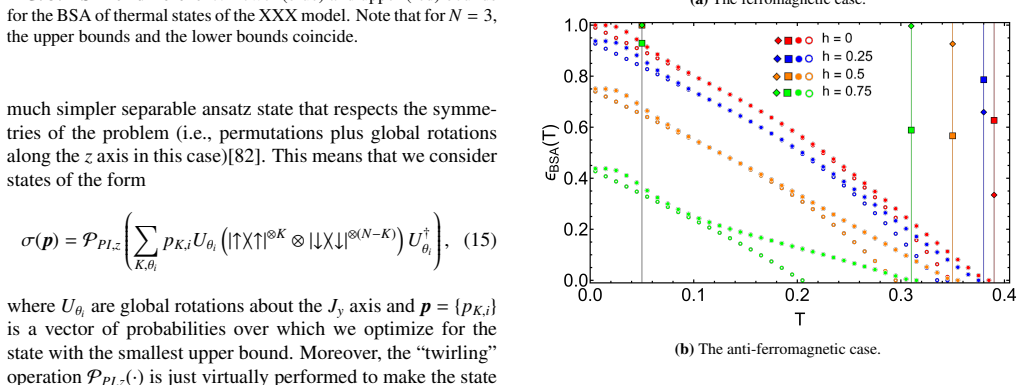
We discuss the estimation of the distance of a given mixed many-body quantum state to the set of fully separable states, applied to the concrete scenario of collective spin states. Concretely, we discuss lower bounds to distances from the set of fully separable states based on entanglement criteria and upper bounds to those distances using an iterative algorithm to find the optimal separable state closest to the target. Focusing on collective states of $N$ spin-$1/2$ particles, we consider spin-squeezing inequalities (SSIs), which provide a complete set of nonlinear entanglement criteria based on collective spin variances. First, we find a lower bound to distance-based entanglement monotones, specifically the so-called best separable approximation (BSA) from the complete set of SSIs, thereby bypassing entirely a numerical optimization over a (potentially very large) set of linear entanglement witnesses. Then, we improve current algorithms to iteratively find the closest separable state to a given target state, exploiting the symmetry of the system. These results allow us to study entanglement quantitatively on thermal states of spin systems on fully-connected graphs at nonzero temperature, as well as potentially similar states arising in out-of-equilibrium situations. We thus apply our methods to investigate entanglement across different phases of a fully-connected XXZ model. We observe that our lower bound becomes often tight for zero temperature as well as for the temperature at which entanglement disappears, both of which are thus precisely captured by the SSIs. We further observe, among other things, that entanglement can arise at nonzero temperature even in the ordered phase, where the ground state is separable, revealing the potential usefulness of entanglement quantification also beyond the ground state paradigm.
Editorial analysis
A structured set of objections, weighed in public.
Referee Report
Summary. The manuscript claims that the complete set of spin-squeezing inequalities (SSIs) yields a computable lower bound on the best separable approximation (BSA) distance for collective spin states of N spin-1/2 particles, thereby avoiding optimization over linear entanglement witnesses. It further presents a symmetry-exploiting improvement to iterative algorithms for computing the closest separable state (upper bound on the distance) and applies both to thermal states of the fully-connected XXZ model, reporting that the lower bound is often tight at T=0 and at the entanglement-disappearance temperature.
Significance. If the claimed lower bound construction holds, the work supplies a practical, witness-optimization-free route to quantitative entanglement measures for symmetric collective states at finite temperature. The symmetry reduction in the iterative search is a concrete algorithmic improvement. The observation that SSIs capture the exact disappearance temperature in the XXZ model is a falsifiable prediction that strengthens the utility beyond ground-state studies.
major comments (1)
- [Introduction and the section presenting the lower-bound derivation] The central construction of the lower bound on the BSA distance from the maximal SSI violation is stated in the abstract and introduction but the explicit mapping (how the violation quantity is converted into a distance lower bound) is not shown with intermediate steps or an equation; without this, it is impossible to verify that the bound is indeed obtained solely from the SSIs without hidden optimization or additional assumptions.
minor comments (2)
- [Algorithm section] The description of the improved iterative algorithm would benefit from an explicit statement of the symmetry reduction (e.g., which variables are fixed or eliminated) and a convergence criterion or iteration count used in the XXZ numerics.
- [Results section / figures] Figure captions for the temperature-dependent plots should explicitly mark the ordered and disordered phases of the XXZ model and the entanglement-disappearance temperature to make the tightness observations immediately readable.
Simulated Author's Rebuttal
We thank the referee for their careful reading of the manuscript and for the constructive feedback. We address the major comment below.
read point-by-point responses
-
Referee: [Introduction and the section presenting the lower-bound derivation] The central construction of the lower bound on the BSA distance from the maximal SSI violation is stated in the abstract and introduction but the explicit mapping (how the violation quantity is converted into a distance lower bound) is not shown with intermediate steps or an equation; without this, it is impossible to verify that the bound is indeed obtained solely from the SSIs without hidden optimization or additional assumptions.
Authors: We agree that the explicit mapping requires clearer presentation. In the revised manuscript we will insert a dedicated paragraph (or short subsection) immediately following the statement of the complete set of SSIs. This paragraph will contain the intermediate algebraic steps that convert the maximal SSI violation into a lower bound on the BSA distance, together with the resulting explicit inequality relating the two quantities. The added material will make transparent that the bound follows directly from the SSIs without any auxiliary optimization or extra assumptions. revision: yes
Circularity Check
No significant circularity detected
full rationale
The derivation starts from the established completeness of spin-squeezing inequalities (SSIs) as an external input and constructs a lower bound on the best separable approximation distance directly from maximal SSI violation; this step does not reduce by the paper's own equations to a fitted parameter, self-definition, or self-citation chain. The subsequent iterative algorithm improvement rests on symmetry properties of collective spin states and is independent of the bound. No self-definitional, fitted-input, or ansatz-smuggling patterns appear in the load-bearing steps.
Axiom & Free-Parameter Ledger
axioms (1)
- domain assumption Spin-squeezing inequalities provide a complete set of nonlinear entanglement criteria based on collective spin variances for collective states of N spin-1/2 particles.
Reference graph
Works this paper leans on
-
[1]
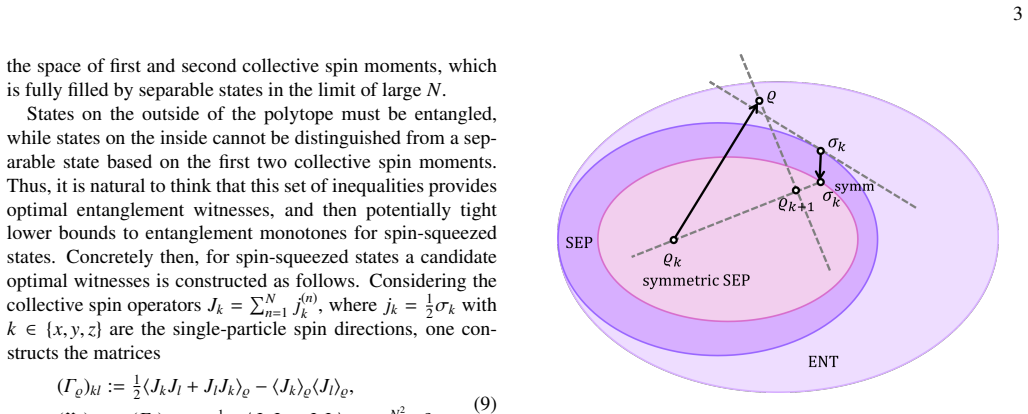
Consider the separable state σK−1 from previous itera- tion (initial point can be, e.g., σ0 = 1/2N)
-
[2]
ψN⟩K maximizing the “overlap” with ϱ − σK−1
Choose a new product state|ψ1 . . . ψN⟩K maximizing the “overlap” with ϱ − σK−1
-
[3]
Add the product state to the ensemble
-
[4]
Find new probabilities {pk} by minimizing D(ϱ, σK). The concrete form of the “overlap” and distance functions de- termine the di fferent ways to concretely implement this it- eration optimally. For example, in the case of the BSA a procedure to ideally calculate the optimal ensemble is de- scribed in Refs. [41, 42]. However for better numerical sta- bilit...
-
[5]
R. Horodecki, P. Horodecki, M. Horodecki, and K. Horodecki, Quantum entanglement, Rev. Mod. Phys. 81, 865 (2009), arXiv:quant-ph/0702225
work page internal anchor Pith review Pith/arXiv arXiv 2009
-
[6]
Entanglement in Many-Body Systems
L. Amico, R. Fazio, A. Osterloh, and V . Vedral, Entangle- ment in many-body systems, Rev. Mod. Phys. 80, 517 (2008), arXiv:quant-ph/0703044
work page internal anchor Pith review Pith/arXiv arXiv 2008
-
[7]
Quantum entanglement in condensed matter systems
N. Laflorencie, Quantum entanglement in condensed matter systems, Phys. Rep. 646, 1 (2016), arXiv:1512.03388
work page internal anchor Pith review Pith/arXiv arXiv 2016
-
[8]
Sachdev, Quantum Phase Transitions(Cambridge University Press, 2011)
S. Sachdev, Quantum Phase Transitions(Cambridge University Press, 2011)
work page 2011
-
[9]
S. M. Girvin and K. Yang, Modern Condensed Matter Physics (Cambridge University Press, 2019)
work page 2019
-
[10]
O. G ¨uhne and G. T´oth, Entanglement detection, Phys. Rep.474, 1 (2009), arXiv:0811.2803
work page internal anchor Pith review Pith/arXiv arXiv 2009
-
[11]
Entanglement Certification $-$ From Theory to Experiment
N. Friis, G. Vitagliano, M. Malik, and M. Huber, Entanglement certification from theory to experiment, Nat. Rev. Phys. 1, 72 (2018), arXiv:1906.10929
work page internal anchor Pith review Pith/arXiv arXiv 2018
-
[12]
Entanglement Measures and Purification Procedures
V . Vedral and M. B. Plenio, Entanglement measures and pu- rification procedures, Phys. Rev. A 57, 1619–1633 (1998), arXiv:quant-ph/9707035
work page internal anchor Pith review Pith/arXiv arXiv 1998
- [13]
-
[14]
Area laws for the entanglement entropy - a review
J. Eisert, M. Cramer, and M. B. Plenio, Colloquium: Area laws for the entanglement entropy, Rev. Mod. Phys. 82, 277 (2010), arXiv:0808.3773
work page internal anchor Pith review Pith/arXiv arXiv 2010
-
[15]
The density-matrix renormalization group
U. Schollw ¨ock, The density-matrix renormalization group, Rev. Mod. Phys. 77, 259 (2005), arXiv:cond-mat/0409292
work page internal anchor Pith review Pith/arXiv arXiv 2005
-
[16]
The density-matrix renormalization group in the age of matrix product states
U. Schollw ¨ock, The density-matrix renormalization group in the age of matrix product states, Ann. Phys. 326, 96 (2011), arXiv:1008.3477
work page internal anchor Pith review Pith/arXiv arXiv 2011
-
[17]
Or ´us, Tensor networks for complex quantum systems, Nat
R. Or ´us, Tensor networks for complex quantum systems, Nat. Rev. Phys. 1, 538 (2019), arXiv:1812.04011
- [18]
- [19]
-
[20]
Fidelity and Concurrence of conjugated states
A. Uhlmann, Fidelity and concurrence of conjugated states, Phys. Rev. A 62, 032307 (2000), arXiv:quant-ph/9909060
work page internal anchor Pith review Pith/arXiv arXiv 2000
-
[21]
R. Lohmayer, A. Osterloh, J. Siewert, and A. Uhlmann, En- tangled three-qubit states without concurrence and three-tangle, Phys. Rev. Lett. 97, 260502 (2006)
work page 2006
-
[22]
Three-tangle for mixtures of generalized GHZ and generalized W states
C. Eltschka, A. Osterloh, J. Siewert, and A. Uhlmann, Three- tangle for mixtures of generalized GHZ and generalized W states, New J. Phys. 10, 043014 (2008), arXiv:0711.4477
work page internal anchor Pith review Pith/arXiv arXiv 2008
-
[23]
Tangles of superpositions and the convex-roof extension
A. Osterloh, J. Siewert, and A. Uhlmann, Tangles of superposi- tions and the convex-roof extension, Phys. Rev. A 77, 032310 (2008), arXiv:0710.5909
work page internal anchor Pith review Pith/arXiv arXiv 2008
-
[24]
J. Siewert and C. Eltschka, Quantifying Tripartite Entangle- ment of Three-Qubit Generalized Werner States, Phys. Rev. Lett. 108, 230502 (2012)
work page 2012
-
[25]
V . Vedral, M. B. Plenio, M. A. Rippin, and P. L. Knight, Quan- tifying entanglement, Phys. Rev. Lett. 78, 2275–2279 (1997), arXiv:quant-ph/9702027
work page internal anchor Pith review Pith/arXiv arXiv 1997
-
[26]
In particular, it has been shown that also the geometric measure of entanglement can be expressed in this form, even though it was introduced with a different convex-roof construction [85]
-
[27]
M. Kitagawa and M. Ueda, Squeezed spin states, Phys. Rev. A 47, 5138 (1993)
work page 1993
-
[28]
Many-particle entanglement with Bose--Einstein condensates
A. Sørensen, L.-M. Duan, J. I. Cirac, and P. Zoller, Many- particle entanglement with Bose-Einstein condensates, Nature 409, 63 (2001), arXiv:quant-ph/0006111
work page internal anchor Pith review Pith/arXiv arXiv 2001
-
[29]
A. Sørensen and K. Mølmer, Entanglement and Extreme Spin Squeezing, Phys. Rev. Lett. 86, 4431– (2001), arXiv:quant- ph/0011035
- [30]
-
[31]
Spin squeezing and entanglement
G. T ´oth, C. Knapp, O. G ¨uhne, and H. J. Briegel, Spin squeezing and entanglement, Phys. Rev. A 79, 042334 (2009), arXiv:0806.1048
work page internal anchor Pith review Pith/arXiv arXiv 2009
-
[32]
J. Ma, X. Wang, C. P. Sun, and F. Nori, Quantum spin squeez- ing, Phys. Rep. 509, 89 (2011), arXiv:1011.2978 [quant-ph]
work page internal anchor Pith review Pith/arXiv arXiv 2011
-
[33]
Spin squeezing inequalities for arbitrary spin
G. Vitagliano, P. Hyllus, I. L. Egusquiza, and G. T ´oth, Spin Squeezing Inequalities for Arbitrary Spin, Phys. Rev. Lett.107, 240502 (2011), arXiv:1104.3147
work page internal anchor Pith review Pith/arXiv arXiv 2011
-
[34]
Spin squeezing and entanglement for arbitrary spin
G. Vitagliano, I. Apellaniz, I. L. Egusquiza, and G. T ´oth, Spin squeezing and entanglement for an arbitrary spin, Phys. Rev. A 89, 032307 (2014), arXiv:1310.2269
work page internal anchor Pith review Pith/arXiv arXiv 2014
-
[35]
Entanglement and extreme spin squeezing of unpolarized states
G. Vitagliano, I. Apellaniz, M. Kleinmann, B. L ¨ucke, C. Klempt, and G. T ´oth, Entanglement and extreme spin squeezing of unpolarized states, New J. Phys. 19, 013027 (2017), arXiv:1605.07202
work page internal anchor Pith review Pith/arXiv arXiv 2017
-
[36]
Multiparticle entanglement criteria for nonsymmetric collective variances
O. Marty, M. Cramer, G. Vitagliano, G. T´oth, and M. B. Plenio, Multiparticle entanglement criteria for nonsymmetric collective variances (2017), arXiv:1708.06986 [quant-ph]
work page internal anchor Pith review Pith/arXiv arXiv 2017
-
[37]
Quantum metrology with nonclassical states of atomic ensembles
L. Pezz `e, A. Smerzi, M. K. Oberthaler, R. Schmied, and P. Treutlein, Quantum metrology with nonclassical states of atomic ensembles, Rev. Mod. Phys. 90, 035005 (2018), arXiv:1609.01609
work page internal anchor Pith review Pith/arXiv arXiv 2018
- [38]
-
[39]
Multipartite entanglement detection via structure factors
P. Krammer, H. Kampermann, D. Bruß, R. A. Bertlmann, L. C. Kwek, and C. Macchiavello, Multipartite Entanglement Detec- tion via Structure Factors, Phys. Rev. Lett.103, 100502 (2009), arXiv:0904.3860
work page internal anchor Pith review Pith/arXiv arXiv 2009
-
[40]
Measuring entanglement in condensed matter systems
M. Cramer, M. B. Plenio, and H. Wunderlich, Measuring En- tanglement in Condensed Matter Systems, Phys. Rev. Lett.106, 020401 (2011), arXiv:1009.2956
work page internal anchor Pith review Pith/arXiv arXiv 2011
-
[41]
Quantifying entanglement with scattering experiments
O. Marty, M. Epping, H. Kampermann, D. Bruß, M. B. Plenio, and M. Cramer, Quantifying entanglement with scattering ex- periments, Phys. Rev. B 89, 125117 (2014), arXiv:1310.0929
work page internal anchor Pith review Pith/arXiv arXiv 2014
- [42]
- [43]
- [44]
-
[45]
Separability and entanglement of composite quantum systems
M. Lewenstein and A. Sanpera, Separability and Entanglement of Composite Quantum Systems, Phys. Rev. Lett. 80, 2261 (1998), arXiv:quant-ph/9707043
work page internal anchor Pith review Pith/arXiv arXiv 1998
-
[46]
Separable approximations of density matrices of composite quantum systems
S. Karnas and M. Lewenstein, Separable approximations of density matrices of composite quantum systems, J. Phys. A: 14 Math. Gen. 34, 6919 (2001), arXiv:quant-ph/0011066
work page internal anchor Pith review Pith/arXiv arXiv 2001
-
[47]
Genralized Robustness of Entanglement
M. Steiner, Generalized robustness of entanglement, Phys. Rev. A 67, 054305 (2003), arXiv:quant-ph/0304009
work page internal anchor Pith review Pith/arXiv arXiv 2003
- [48]
-
[49]
Quantitative entanglement witnesses
J. Eisert, F. G. S. L. Brand ˜ao, and K. M. R. Audenaert, Quan- titative entanglement witnesses, New J. Phys. 9, 46 (2007), arXiv:quant-ph/0607167
work page internal anchor Pith review Pith/arXiv arXiv 2007
-
[50]
Estimating entanglement measures in experiments
O. G ¨uhne, M. Reimpell, and R. F. Werner, Estimating Entan- glement Measures in Experiments, Phys. Rev. Lett. 98, 110502 (2007), arXiv:quant-ph/0607163
work page internal anchor Pith review Pith/arXiv arXiv 2007
-
[51]
Lower bounds on entanglement measures from incomplete information
O. G ¨uhne, M. Reimpell, and R. F. Werner, Lower bounds on en- tanglement measures from incomplete information, Phys. Rev. A 77, 052317 (2008), arXiv:0802.1734
work page internal anchor Pith review Pith/arXiv arXiv 2008
-
[52]
See supplemental material for details
-
[53]
Spatial entanglement of bosons in optical lattices
M. Cramer, A. Bernard, N. Fabbri, L. Fallani, C. Fort, S. Rosi, F. Caruso, M. Inguscio, and M. B. Plenio, Spatial entanglement of bosons in optical lattices, Nat. Commun. 4, 2161 (2013), arXiv:1302.4897
work page internal anchor Pith review Pith/arXiv arXiv 2013
-
[54]
A complete criterion for separability detection
M. Navascu ´es, M. Owari, and M. B. Plenio, Complete criterion for separability detection, Phys. Rev. Lett. 103, 160404 (2009), arXiv:0906.2735
work page internal anchor Pith review Pith/arXiv arXiv 2009
-
[55]
J. T. Barreiro, P. Schindler, O. G ¨uhne, T. Monz, M. Chwalla, C. F. Roos, M. Hennrich, and R. Blatt, Experimental multiparti- cle entanglement dynamics induced by decoherence, Nat. Phys. 6, 943 (2010), arXiv:1005.1965
work page internal anchor Pith review Pith/arXiv arXiv 2010
-
[56]
Optimal Detection of Entanglement in GHZ States
A. Kay, Optimal detection of entanglement in Greenberger- Horne-Zeilinger states, Phys. Rev. A 83, 020303 (2011), arXiv:1006.5197
work page internal anchor Pith review Pith/arXiv arXiv 2011
-
[57]
Entanglement criteria and full separability of multi-qubit quantum states
O. G ¨uhne, Entanglement criteria and full separability of multi-qubit quantum states, Phys. Lett. A 375, 406 (2011), arXiv:1009.3782
work page internal anchor Pith review Pith/arXiv arXiv 2011
-
[58]
H. Kampermann, O. G ¨uhne, C. Wilmott, and D. Bruß, Algo- rithm for characterizing stochastic local operations and classi- cal communication classes of multiparticle entanglement, Phys. Rev. A 86, 032307 (2012), arXiv:1203.5872
work page internal anchor Pith review Pith/arXiv arXiv 2012
-
[59]
Convex separation from convex optimization for large-scale problems
S. Brierley, M. Navascues, and T. Vertesi, Convex separa- tion from convex optimization for large-scale problems (2017), arXiv:1609.05011 [quant-ph]
work page internal anchor Pith review Pith/arXiv arXiv 2017
-
[60]
Convex optimization over classes of multiparticle entanglement
J. Shang and O. G ¨uhne, Convex optimization over classes of multiparticle entanglement, Phys. Rev. Lett. 120, 050506 (2018), arXiv:1707.02958
work page internal anchor Pith review Pith/arXiv arXiv 2018
-
[61]
T.-A. Ohst, X.-D. Yu, O. G ¨uhne, and H. C. Nguyen, Certifying quantum separability with adaptive polytopes, SciPost Phys.16, 063 (2024), arXiv:2210.10054
-
[62]
Pairwise entanglement in symmetric multi-qubit systems
X. Wang and K. Mølmer, Pairwise entanglement in sym- metric multi-qubit systems, Eur. Phys. J. D 18, 385 (2002), arXiv:quant-ph/0106145
work page internal anchor Pith review Pith/arXiv arXiv 2002
-
[63]
X. Wang and B. C. Sanders, Spin squeezing and pairwise en- tanglement for symmetric multiqubit states, Phys. Rev. A 68, 012101 (2003)
work page 2003
-
[64]
Entanglement and the Phase Transition in Single Mode Superradiance
N. Lambert, C. Emary, and T. Brandes, Entanglement and the phase transition in single-mode superradiance, Phys. Rev. Lett. 92, 073602 (2004), arXiv:quant-ph/0309027
work page internal anchor Pith review Pith/arXiv arXiv 2004
-
[65]
Entanglement in a second order quantum phase transition
J. Vidal, G. Palacios, and R. Mosseri, Entanglement in a second-order quantum phase transition, Phys. Rev. A 69, 022107 (2004), arXiv:cond-mat/0305573
work page internal anchor Pith review Pith/arXiv arXiv 2004
-
[66]
Entanglement dynamics in the Lipkin-Meshkov-Glick model
J. Vidal, G. Palacios, and C. Aslangul, Entanglement dynamics in the Lipkin-Meshkov-Glick model, Phys. Rev. A 70, 062304 (2004), arXiv:cond-mat/0406481
work page internal anchor Pith review Pith/arXiv arXiv 2004
-
[67]
Entanglement in a first order quantum phase transition
J. Vidal, R. Mosseri, and J. Dukelsky, Entanglement in a first-order quantum phase transition, Phys. Rev. A 69, 054101 (2004), arXiv:cond-mat/0312130
work page internal anchor Pith review Pith/arXiv arXiv 2004
-
[68]
J. I. Latorre, R. Or ´us, E. Rico, and J. Vidal, Entanglement en- tropy in the Lipkin-Meshkov-Glick model, Phys. Rev. A 71 (2005), arXiv:cond-mat/0409611
work page internal anchor Pith review Pith/arXiv arXiv 2005
-
[69]
N. Lambert, C. Emary, and T. Brandes, Entanglement and en- tropy in a spin-boson quantum phase transition, Phys. Rev. A 71, 053804 (2005)
work page 2005
-
[70]
Concurrence in collective models
J. Vidal, Concurrence in collective models, Phys. Rev. A 73, 062318 (2006), arXiv:quant-ph/0603108
work page internal anchor Pith review Pith/arXiv arXiv 2006
-
[71]
Entanglement Entropy beyond the Free Case
T. Barthel, S. Dusuel, and J. Vidal, Entanglement entropy beyond the free case, Phys. Rev. Lett. 97, 220402 (2006), arXiv:cond-mat/0606436
work page internal anchor Pith review Pith/arXiv arXiv 2006
-
[72]
Entanglement entropy in collective models
J. Vidal, S. Dusuel, and T. Barthel, Entanglement entropy in collective models, J. Stat. Mech.: Theo. Exp. , P01015 (2007), arXiv:cond-mat/0610833
work page internal anchor Pith review Pith/arXiv arXiv 2007
-
[73]
Universal geometric entanglement close to quantum phase transitions
R. Or ´us, Universal geometric entanglement close to quan- tum phase transitions, Phys. Rev. Lett. 100, 130502 (2008), arXiv:0711.2556
work page internal anchor Pith review Pith/arXiv arXiv 2008
-
[74]
Geometric Entanglement in a One-Dimensional Valence Bond Solid State
R. Or ´us, Geometric entanglement in a one-dimensional valence-bond solid state, Phys. Rev. A 78, 062332 (2008), arXiv:0808.0938
work page internal anchor Pith review Pith/arXiv arXiv 2008
-
[75]
Equivalence of critical scaling laws for many-body entanglement in the Lipkin-Meshkov-Glick model
R. Or ´us, S. Dusuel, and J. Vidal, Equivalence of Critical Scaling Laws for Many-Body Entanglement in the Lipkin- Meshkov-Glick Model, Phys. Rev. Lett. 101, 025701 (2008), arXiv:0803.3151
work page internal anchor Pith review Pith/arXiv arXiv 2008
-
[76]
Visualizing elusive phase transitions with geometric entanglement
R. Or ´us and T.-C. Wei, Visualizing elusive phase transi- tions with geometric entanglement, Phys. Rev. B 82 (2010), arXiv:0910.2488
work page internal anchor Pith review Pith/arXiv arXiv 2010
-
[77]
X. Wang, J. Ma, L. Song, X. Zhang, and X. Wang, Spin squeezing, negative correlations, and concurrence in the quan- tum kicked top model, Phys. Rev. E 82, 056205 (2010), arXiv:1010.0109
work page internal anchor Pith review Pith/arXiv arXiv 2010
-
[78]
X. Yin, X. Wang, J. Ma, and X. Wang, Spin squeezing and con- currence, J. Phys. B: At. Mol. Opt. Phys. 44, 015501 (2011), arXiv:0912.1752
work page internal anchor Pith review Pith/arXiv arXiv 2011
-
[79]
J. K. Korbicz, J. I. Cirac, and M. Lewenstein, Spin squeezing inequalities and entanglement of n qubit states, Phys. Rev. Lett. 95, 120502 (2005), arXiv:quant-ph/0504005
work page internal anchor Pith review Pith/arXiv arXiv 2005
-
[80]
J. K. Korbicz, O. G¨uhne, M. Lewenstein, H. H¨affner, C. F. Roos, and R. Blatt, Generalized spin-squeezing inequalities inn-qubit systems: Theory and experiment, Phys. Rev. A 74, 052319 (2006), arXiv:quant-ph/0601038
work page internal anchor Pith review Pith/arXiv arXiv 2006
discussion (0)
Sign in with ORCID, Apple, or X to comment. Anyone can read and Pith papers without signing in.