Efficient witnessing and testing of magic in mixed quantum states
Pith reviewed 2026-05-22 18:39 UTC · model grok-4.3
The pith
Stabilizer Rényi entropy provides efficient witnesses that detect and quantify magic in mixed quantum states.
A machine-rendered reading of the paper's core claim, the machinery that carries it, and where it could break.
Core claim
Stabilizer Rényi entropy serves as an efficient witness for magic in mixed states that robustly indicates its presence, quantitatively estimates magic monotones, and supports property testing algorithms to distinguish high-magic from low-magic states under a bounded-entropy assumption.
What carries the argument
Stabilizer Rényi entropy, used as a witness that measures nonstabilizerness and enables both detection and quantitative estimation in mixed states.
If this is right
- The number of noisy T-gates can be certified under a wide class of noise models.
- Magic persists in noisy random circuits even under exponentially strong noise.
- Subsystems of many-body states can contain extensive magic despite entanglement.
- Mimicking high-magic states with little actual magic requires an extensive amount of entropy.
Where Pith is reading between the lines
- The observed noise robustness suggests magic resources may survive in realistic quantum devices more readily than expected.
- The witnesses could be combined with existing quantum verification protocols to certify computational resources without full state tomography.
- Similar entropy-based witnesses might extend to other nonclassical resources such as contextuality.
Load-bearing premise
Property testing reliably separates high-magic from low-magic states only when the stabilizer Rényi entropy remains bounded.
What would settle it
An explicit mixed state known to contain high magic, with bounded stabilizer Rényi entropy, that the testing algorithm nonetheless classifies as low-magic.
Figures

read the original abstract
Nonstabilizerness or `magic' is a crucial resource for quantum computers which can be distilled from noisy quantum states. However, determining the magic of mixed quantum has been a notoriously difficult task. Here, we provide efficient witnesses of magic based on the stabilizer R\'enyi entropy which robustly indicate the presence of magic and quantitatively estimate magic monotones. We also design efficient property testing algorithms to reliably distinguish states with high and low magic, assuming the entropy is bounded. We apply our methods to certify the number of noisy T-gates under a wide class of noise models. Additionally, using the IonQ quantum computer, we experimentally verify the magic of noisy random quantum circuits. Surprisingly, we find that magic is highly robust, persisting even under exponentially strong noise. Our witnesses can also be efficiently computed for matrix product states, revealing that subsystems of many-body quantum states can contain extensive magic despite entanglement. Finally, our work also has direct implications for cryptography and pseudomagic: To mimic high magic states with as little magic as possible, one requires an extensive amount of entropy. This implies that entropy is a necessary resource to hide magic from eavesdroppers. Our work uncovers powerful tools to verify and study the complexity of noisy quantum systems.
Editorial analysis
A structured set of objections, weighed in public.
Referee Report
Summary. The manuscript claims to develop efficient witnesses for nonstabilizerness (magic) in mixed quantum states based on the stabilizer Rényi entropy; these witnesses indicate the presence of magic and quantitatively estimate magic monotones. It further designs efficient property testing algorithms to distinguish high- from low-magic states under a bounded-entropy assumption. The methods are applied to certify the number of noisy T-gates under various noise models, experimentally verified on the IonQ quantum computer (showing magic persists under exponentially strong noise), extended to matrix product states (revealing extensive magic in subsystems despite entanglement), and used to derive cryptographic implications that entropy is required to hide magic from eavesdroppers.
Significance. If the central constructions and experimental claims hold after clarification, the work would supply practical, efficiently computable tools for verifying magic in noisy quantum systems, directly relevant to resource theories, fault-tolerant quantum computing, and many-body physics. The reported robustness of magic and the MPS results would be notable strengths; the cryptographic link provides a broader implication for pseudomagic and entropy as a hiding resource.
major comments (2)
- [Property testing algorithms] Property testing algorithms section: the claim of efficient distinction between high- and low-magic mixed states is conditioned on the assumption that the stabilizer Rényi entropy is bounded. For generic noisy states this bound is not known a priori; the manuscript does not supply an efficient subroutine that both enforces and verifies the bound internally, rendering the 'efficient' label conditional on an external promise rather than unconditionally guaranteed.
- [Experimental verification] Experimental verification section: the IonQ experiments are presented as verifying magic in noisy random circuits and demonstrating robustness under strong noise, yet the manuscript provides neither full derivations of the witness quantities, detailed error analysis, nor the underlying data tables. This absence prevents independent verification of the quantitative robustness claim.
minor comments (1)
- [Abstract] Abstract: the qualifier 'assuming the entropy is bounded' is stated without a quantitative definition or reference to the precise bound used in the algorithms; a brief clarification would improve readability.
Simulated Author's Rebuttal
We thank the referee for their careful reading of our manuscript and for the constructive comments, which have helped us clarify several points. We address each major comment below and indicate the revisions made.
read point-by-point responses
-
Referee: [Property testing algorithms] Property testing algorithms section: the claim of efficient distinction between high- and low-magic mixed states is conditioned on the assumption that the stabilizer Rényi entropy is bounded. For generic noisy states this bound is not known a priori; the manuscript does not supply an efficient subroutine that both enforces and verifies the bound internally, rendering the 'efficient' label conditional on an external promise rather than unconditionally guaranteed.
Authors: We agree that the efficiency of the property testing algorithms is conditional on the bounded stabilizer Rényi entropy assumption, which is explicitly stated in the relevant section of the manuscript. This is a standard formulation in property testing, where the promise enables efficient distinction between high- and low-magic states. We do not claim an unconditional efficient algorithm that works for arbitrary mixed states without any promise on the entropy. The manuscript does not include an internal subroutine to enforce or verify the bound because such a subroutine would generally require additional assumptions on state preparation and is outside the scope of the current algorithms. We have added a clarifying paragraph in the revised version to emphasize the conditional nature of the efficiency claim and to discuss how the bound might be estimated in practice under specific noise models. revision: partial
-
Referee: [Experimental verification] Experimental verification section: the IonQ experiments are presented as verifying magic in noisy random circuits and demonstrating robustness under strong noise, yet the manuscript provides neither full derivations of the witness quantities, detailed error analysis, nor the underlying data tables. This absence prevents independent verification of the quantitative robustness claim.
Authors: We appreciate the referee's point that additional details are needed for independent verification of the experimental results. In the revised manuscript and supplementary material, we now include the full derivations of the witness quantities computed from the IonQ data, a detailed error analysis accounting for the dominant noise sources, and the underlying data tables. These additions allow readers to reproduce the quantitative claims regarding the persistence of magic under strong noise. revision: yes
Circularity Check
No circularity: witnesses and testers built on established entropy definition under explicit assumption
full rationale
The paper defines efficient witnesses directly from the stabilizer Rényi entropy (an externally established monotone) and presents property-testing algorithms whose efficiency is conditioned on a stated bounded-entropy promise. No equation or algorithm reduces by construction to a fitted parameter, self-referential definition, or load-bearing self-citation chain. The central claims retain independent algorithmic content once the assumption is granted; verification of the bound itself is outside the claimed scope and does not create a hidden circular loop.
Axiom & Free-Parameter Ledger
Lean theorems connected to this paper
-
IndisputableMonolith/Cost/FunctionalEquation.leanwashburn_uniqueness_aczel (J-cost uniqueness) unclear?
unclearRelation between the paper passage and the cited Recognition theorem.
W_α(ρ) = 1/(1−α) ln A_α(ρ) − (1−2α)/(1−α) S₂(ρ) with A_α = 2^{-n} ∑_P |tr(ρP)|^{2α}
-
IndisputableMonolith/Foundation/RealityFromDistinction.leanreality_from_one_distinction unclear?
unclearRelation between the paper passage and the cited Recognition theorem.
Efficient testing under S₂ = O(log n) promise; pseudomagic gap Θ(n) vs ω(log n)
What do these tags mean?
- matches
- The paper's claim is directly supported by a theorem in the formal canon.
- supports
- The theorem supports part of the paper's argument, but the paper may add assumptions or extra steps.
- extends
- The paper goes beyond the formal theorem; the theorem is a base layer rather than the whole result.
- uses
- The paper appears to rely on the theorem as machinery.
- contradicts
- The paper's claim conflicts with a theorem or certificate in the canon.
- unclear
- Pith found a possible connection, but the passage is too broad, indirect, or ambiguous to say the theorem truly supports the claim.
Forward citations
Cited by 7 Pith papers
-
Triangle Criterion: a mixed-state magic criterion with applications in distillation and detection
The Triangle Criterion detects mixed-state magic, proves multi-qubit distillation is strictly stronger than single-qubit schemes, and identifies a purity bound plus undetectable unfaithful magic states.
-
Operational interpretation of the Stabilizer Entropy
The stabilizer Rényi entropy governs the exponential rate at which Clifford orbits become indistinguishable from Haar-random states and sets the optimal distinguishability from stabilizer states in property testing.
-
Rise and fall of nonstabilizerness via random measurements
Analytical and numerical study of stabilizer nullity and Rényi entropies in monitored Clifford circuits shows quantized decay for computational measurements and size-dependent relaxation to a non-trivial steady state ...
-
An Algorithm for Estimating $\alpha$-Stabilizer R\'enyi Entropies via Purity
Introduces a purity-encoding algorithm for estimating α-Stabilizer Rényi Entropies of unknown quantum states for integer α > 1, with benchmarks and a non-stabilizerness/entanglement link.
-
Nonstabilizerness and Error Resilience in Noisy Quantum Circuits
Amplitude damping generates nonstabilizerness in qubit systems unlike depolarizing noise, with local injection washed out collectively after encoding, decoding, and postselection.
-
Optimal quantum reservoir learning in proximity to universality
A tunable mixing parameter p in random quantum circuits controls the transition from classically simulable to expressive quantum reservoir dynamics via entanglement and nonstabilizer content.
-
Quantum Complexity and New Directions in Nuclear Physics and High-Energy Physics Phenomenology
A review of how quantum information science is expected to provide new tools and insights for nuclear and high-energy physics phenomenology and quantum simulations.
Reference graph
Works this paper leans on
-
[1]
Each datapoint is averaged over 10 random circuit instances
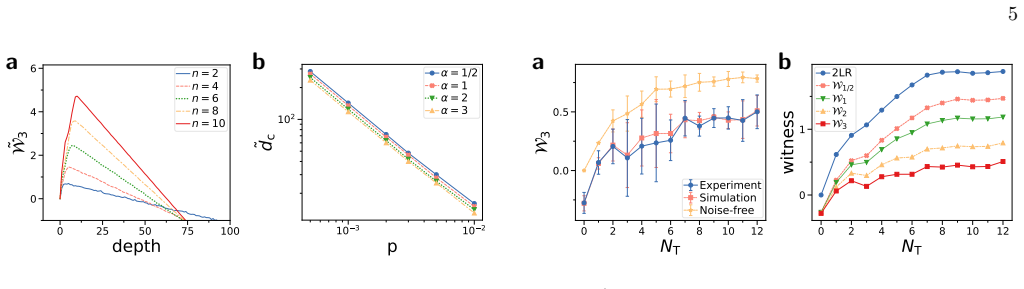
By fitting we find dc ∝ p−η with η ≈ 0.96. Each datapoint is averaged over 10 random circuit instances. interleaved with NT T-gates T = diag(1, e−iπ/4) [12, 64] |ψ(NT)⟩ = U(0) C [ NTY k=1 (T ⊗ In−1)U(k) C ] |0⟩ . (11) For experimental convenience, we compressed the circuits such that for all NT we have the same circuit depth and thus similar purity. We sh...
-
[2]
S. Bravyi and A. Kitaev, Universal quantum computa- tion with ideal clifford gates and noisy ancillas, Phys. Rev. A 71, 022316 (2005)
work page 2005
- [3]
-
[4]
Gottesman, Stabilizer Codes and Quantum Error Correction, Ph.D
D. Gottesman, Stabilizer codes and quantum error correc- tion. Caltech Ph. D , Ph.D. thesis, Thesis, eprint: quant- ph/9705052 (1997)
-
[5]
M. A. Nielsen and I. L. Chuang, Quantum Computa- tion and Quantum Information: 10th Anniversary Edi- tion (Cambridge University Press, 2011)
work page 2011
-
[6]
A. Y. Kitaev, Fault-tolerant quantum computation by anyons, Ann. Phys. 303, 2 (2003)
work page 2003
-
[7]
B. Eastin and E. Knill, Restrictions on transversal en- coded quantum gate sets, Phys. Rev. Lett. 102, 110502 (2009)
work page 2009
- [8]
-
[9]
Litinski, Magic state distillation: Not as costly as you think, Quantum 3, 205 (2019)
D. Litinski, Magic state distillation: Not as costly as you think, Quantum 3, 205 (2019)
work page 2019
- [10]
- [11]
-
[12]
T. Haug and M. Kim, Scalable measures of magic re- source for quantum computers, PRX Quantum4, 010301 (2023)
work page 2023
-
[13]
T. Haug, S. Lee, and M. S. Kim, Efficient quantum al- gorithms for stabilizer entropies, Phys. Rev. Lett. 132, 240602 (2024)
work page 2024
-
[14]
T. Haug and L. Piroli, Quantifying nonstabilizerness of matrix product states, Phys. Rev. B 107, 035148 (2023)
work page 2023
-
[15]
T. Haug and L. Piroli, Stabilizer entropies and nonstabi- lizerness monotones, Quantum 7, 1092 (2023)
work page 2023
- [16]
-
[17]
G. Lami and M. Collura, Nonstabilizerness via perfect pauli sampling of matrix product states, Phys. Rev. Lett. 131, 180401 (2023)
work page 2023
- [18]
- [19]
- [20]
-
[21]
S. Arunachalam, S. Bravyi, and A. Dutt, A note on polynomial-time tolerant testing stabilizer states, arXiv preprint arXiv:2410.22220 (2024)
-
[22]
V. Iyer and D. Liang, Tolerant testing of stabilizer states with mixed state inputs, arXiv preprint arXiv:2411.08765 (2024)
-
[23]
M. Hinsche and J. Helsen, Single-copy stabilizer testing, arXiv preprint arXiv:2410.07986 (2024)
-
[24]
D. Bluvstein, S. J. Evered, A. A. Geim, S. H. Li, H. Zhou, T. Manovitz, S. Ebadi, M. Cain, M. Kalinowski, D. Hangleiter, et al., Logical quantum processor based on reconfigurable atom arrays, Nature 626, 58 (2024)
work page 2024
-
[25]
S. F. E. Oliviero, L. Leone, A. Hamma, and S. Lloyd, Measuring magic on a quantum processor, npj Quantum Information 8, 148 (2022)
work page 2022
-
[26]
P. Niroula, C. D. White, Q. Wang, S. Johri, D. Zhu, C. Monroe, C. Noel, and M. J. Gullans, Phase transition in magic with random quantum circuits, arXiv:2304.10481 (2023)
-
[27]
H. Dai, S. Fu, and S. Luo, Detecting magic states via characteristic functions, International Journal of Theo- 9 retical Physics 61, 35 (2022)
work page 2022
- [28]
- [30]
-
[31]
R. Rubinfeld and M. Sudan, Robust characterizations of polynomials with applications to program testing, SIAM Journal on Computing 25, 252 (1996)
work page 1996
-
[32]
O. Goldreich, S. Goldwasser, and D. Ron, Property test- ing and its connection to learning and approximation, Journal of the ACM (JACM) 45, 653 (1998)
work page 1998
-
[33]
H. Buhrman, L. Fortnow, I. Newman, and H. R¨ ohrig, Quantum property testing, SIAM Journal on Computing 37, 1387 (2008)
work page 2008
-
[34]
A Survey of Quantum Property Testing
A. Montanaro and R. de Wolf, A survey of quantum prop- erty testing, arXiv preprint arXiv:1310.2035 (2013)
work page internal anchor Pith review Pith/arXiv arXiv 2035
-
[35]
N. Bansal, W.-K. Mok, K. Bharti, D. E. Koh, and T. Haug, Pseudorandom density matrices, arXiv preprint arXiv:2407.11607 (2024)
- [36]
- [37]
-
[38]
S. F. E. Oliviero, L. Leone, and A. Hamma, Magic-state resource theory for the ground state of the transverse- field ising model, Phys. Rev. A 106, 042426 (2022)
work page 2022
-
[39]
P. S. Tarabunga, E. Tirrito, T. Chanda, and M. Dal- monte, Many-body magic via pauli-markov chains—from criticality to gauge theories, PRX Quantum 4, 040317 (2023)
work page 2023
- [40]
- [41]
- [42]
-
[43]
S. Aaronson, A. Bouland, B. Fefferman, S. Ghosh, U. Vazirani, C. Zhang, and Z. Zhou, Quantum pseudoen- tanglement, arXiv preprint arXiv:2211.00747 (2022)
- [44]
-
[45]
A. Gu, L. Leone, S. Ghosh, J. Eisert, S. F. Yelin, and Y. Quek, Pseudomagic quantum states, Physical Review Letters 132, 210602 (2024)
work page 2024
-
[46]
A. Tanggara, M. Gu, and K. Bharti, Near-term pseudorandom and pseudoresource quantum states, arXiv:2504.17650 (2025)
- [47]
- [48]
- [49]
-
[50]
E. T. Campbell, Catalysis and activation of magic states in fault-tolerant architectures, Phys. Rev. A 83, 032317 (2011)
work page 2011
-
[51]
M. Howard and E. Campbell, Application of a resource theory for magic states to fault-tolerant quantum com- puting, Phys. Rev. Lett. 118, 090501 (2017)
work page 2017
-
[52]
P. Rall, D. Liang, J. Cook, and W. Kretschmer, Simu- lation of qubit quantum circuits via pauli propagation, Phys. Rev. A 99, 062337 (2019)
work page 2019
- [53]
-
[54]
R. Rubboli, R. Takagi, and M. Tomamichel, Mixed-state additivity properties of magic monotones based on quan- tum relative entropies for single-qubit states and beyond, Quantum 8, 1492 (2024)
work page 2024
-
[55]
A. J. Baldwin and J. A. Jones, Efficiently computing the uhlmann fidelity for density matrices, Physical Review A 107, 012427 (2023)
work page 2023
- [56]
-
[57]
B. Eastin and E. Knill, Restrictions on transversal en- coded quantum gate sets, Physical review letters 102, 110502 (2009)
work page 2009
-
[58]
Wright, How to learn a quantum state , Ph.D
J. Wright, How to learn a quantum state , Ph.D. thesis, Carnegie Mellon University (2016)
work page 2016
-
[60]
F. G. Brandao, A. W. Harrow, and M. Horodecki, Local random quantum circuits are approximate polynomial- designs, Communications in Mathematical Physics 346, 397 (2016)
work page 2016
- [61]
- [62]
-
[63]
S. Wang, E. Fontana, M. Cerezo, K. Sharma, A. Sone, L. Cincio, and P. J. Coles, Noise-induced barren plateaus in variational quantum algorithms, Nature communica- tions 12, 6961 (2021)
work page 2021
-
[64]
S. Chen, J. Cotler, H.-Y. Huang, and J. Li, The complex- ity of nisq, Nature Communications 14, 6001 (2023)
work page 2023
-
[65]
J. Haferkamp, F. Montealegre-Mora, M. Heinrich, J. Eis- ert, D. Gross, and I. Roth, Efficient unitary designs with a system-size independent number of non-clifford gates, Communications in Mathematical Physics , 1 (2022)
work page 2022
-
[66]
P. S. Tarabunga, E. Tirrito, M. C. Ba˜ nuls, and M. Dal- monte, Nonstabilizerness via matrix product states in the pauli basis, Phys. Rev. Lett. 133, 010601 (2024)
work page 2024
-
[67]
L. Leone and L. Bittel, Stabilizer entropies are monotones for magic-state resource theory, Physical Review A 110, L040403 (2024)
work page 2024
-
[68]
F. Wei and Z.-W. Liu, Long-range nonstabilizerness from topology and correlation, arxiv:2503.04566 (2025). 10
-
[69]
T. Schuster, J. Haferkamp, and H.-Y. Huang, Ran- dom unitaries in extremely low depth, arXiv preprint arXiv:2407.07754 (2024)
-
[70]
A. Elben, R. Kueng, H.-Y. R. Huang, R. van Bij- nen, C. Kokail, M. Dalmonte, P. Calabrese, B. Kraus, J. Preskill, P. Zoller, and B. Vermersch, Mixed-state en- tanglement from local randomized measurements, Physi- cal Review Letters 125, 10.1103/physrevlett.125.200501 (2020)
- [71]
-
[72]
E. Tirrito, P. S. Tarabunga, G. Lami, T. Chanda, L. Leone, S. F. Oliviero, M. Dalmonte, M. Collura, and A. Hamma, Quantifying nonstabilizerness through en- tanglement spectrum flatness, Physical Review A 109, L040401 (2024)
work page 2024
-
[73]
X. Turkeshi, M. Schir` o, and P. Sierant, Measuring non- stabilizerness via multifractal flatness, Physical Review A 108, 042408 (2023)
work page 2023
- [74]
-
[75]
X.-D. Yu, S. Imai, and O. G¨ uhne, Optimal entan- glement certification from moments of the partial transpose, Physical Review Letters 127, 10.1103/phys- revlett.127.060504 (2021)
-
[76]
A. Neven, J. Carrasco, V. Vitale, C. Kokail, A. El- ben, M. Dalmonte, P. Calabrese, P. Zoller, B. Vermer- sch, R. Kueng, and B. Kraus, Symmetry-resolved en- tanglement detection using partial transpose moments, npj Quantum Information 7, 10.1038/s41534-021-00487- y (2021)
- [77]
-
[78]
P. S. Tarabunga, Critical behaviors of non-stabilizerness in quantum spin chains, Quantum 8, 1413 (2024)
work page 2024
-
[79]
M. Fishman, S. White, and E. Stoudenmire, The itensor software library for tensor network calculations, SciPost Physics Codebases , 004 (2022)
work page 2022
-
[80]
S. M. Lin and M. Tomamichel, Investigating properties of a family of quantum r´ enyi divergences, Quantum In- formation Processing 14, 1501 (2015)
work page 2015
-
[81]
J. R. Seddon, B. Regula, H. Pashayan, Y. Ouyang, and E. T. Campbell, Quantifying quantum speedups: Im- proved classical simulation from tighter magic mono- tones, PRX Quantum 2, 010345 (2021)
work page 2021
-
[82]
E. Chen, A brief introduction to olympiad in- equalities, https://ghoshadi.wordpress.com/wp- content/uploads/2018/05/evan-chens-notes.pdf (2014)
work page 2018
discussion (0)
Sign in with ORCID, Apple, or X to comment. Anyone can read and Pith papers without signing in.