Quasi-dust ekpyrotic scenario in Loop Quantum Cosmology
Pith reviewed 2026-05-21 22:44 UTC · model grok-4.3
The pith
A quasi-dust field and an ekpyrotic field together produce viable primordial power spectra in loop quantum cosmology.
A machine-rendered reading of the paper's core claim, the machinery that carries it, and where it could break.
Core claim
The quasi-dust ekpyrotic scenario combines the matter-bounce mechanism from a quasi-dust scalar field, which generates scale-invariant perturbations with a red tilt due to its slightly negative equation of state, with an ekpyrotic contraction phase from the second field that suppresses anisotropies. In Loop Quantum Cosmology the bounce occurs due to quantum geometry effects, and the non-trivial coupling between the scalar perturbations produces rich phenomenology that aligns with observational constraints on the power spectra.
What carries the argument
The two-field system consisting of a quasi-dust scalar field and an ekpyrotic potential field within Loop Quantum Cosmology, which together manage the generation of perturbations and the suppression of anisotropies across the bouncing phase.
If this is right
- The model produces a red-tilted spectrum in the perturbations due to the quasi-dust component.
- The equations of motion for scalar perturbations are coupled, resulting in behavior distinct from single-field cases.
- Tensor perturbations can be studied alongside scalars to provide additional tests.
- Comparison with current observations confirms the model's viability for describing the primordial universe.
Where Pith is reading between the lines
- Similar two-field constructions could be tested in other quantum gravity approaches to cosmology.
- Adjustments to the ekpyrotic potential might allow better fits to specific features like the low multipole anomalies in the CMB.
- Tensor mode predictions could be compared against upcoming gravitational wave observations.
Load-bearing premise
The second field endowed with an ekpyrotic potential is assumed to tame the growth of anisotropies throughout the bouncing phase.
What would settle it
Future observations of the cosmic microwave background that reveal either excessive early anisotropies or a power spectrum tilt inconsistent with the quasi-dust prediction would disprove the model's viability.
Figures






read the original abstract
In the framework of Loop Quantum Cosmology, we study a cosmological bouncing model with two fields that reproduce the desired features of the primordial power spectra. The model combines the matter-bounce mechanism, that generates scale-invariant perturbations, with ekpyrotic contraction, that suppresses anisotropies leading to the bounce. The bounce that replaces the classical initial singularity is achieved thanks to the loop quantisation. The matter-bounce is enacted by a \textit{quasi-dust} scalar field, with a slightly-negative equation of state that accounts for a small positive cosmological constant, that generates a red-tilt in the perturbations' power spectra. A second field, endowed with an ekpyrotic potential, is introduced to tame the growth of anisotropies throughout the bouncing phase. The equations of motion of the scalar perturbations are non-trivially coupled, leading to rich phenomenology that cannot be inferred simply from their single-field counterpart. We study the evolution of scalar and tensor perturbations and compare the results to current observations, showing the viability of this model as a base for further investigations.
Editorial analysis
A structured set of objections, weighed in public.
Referee Report
Summary. The manuscript presents a two-scalar-field bouncing cosmology in Loop Quantum Cosmology. A quasi-dust field with slightly negative equation of state generates scale-invariant scalar perturbations with a red tilt, while an ekpyrotic field suppresses anisotropies. The loop quantization resolves the singularity into a bounce. The authors derive the coupled equations for scalar and tensor perturbations and compare the resulting power spectra and tensor-to-scalar ratio to observational data, concluding that the model is viable.
Significance. Should the central claim hold, this work would offer a concrete realization of a matter-bounce scenario augmented by ekpyrotic contraction within LQC, potentially resolving both the initial singularity and the anisotropy problem while matching CMB observations. The non-trivial coupling between fields introduces potentially new phenomenology that could distinguish it from single-field models. The explicit comparison to data strengthens its relevance to phenomenology.
major comments (2)
- [§3] The abstract and §3 state that the quasi-dust equation-of-state parameter is chosen to produce both a small positive cosmological constant and the observed red tilt (n_s ≈ 0.96); this introduces a fitted quantity whose value is adjusted to match the target spectra, raising a moderate circularity burden for the viability claim even though the LQC bounce itself rests on standard quantization.
- [§5.1] §5.1 and the coupled perturbation equations (around Eqs. 25–30) include non-trivial cross terms between the quasi-dust and ekpyrotic fields; the analysis does not provide an explicit estimate or numerical bound on the sourcing of isocurvature modes or possible re-amplification of shear near the quantum bounce, which is load-bearing for the claim that the spectrum remains nearly scale-invariant and anisotropies stay below observational bounds.
minor comments (2)
- [Figure 3] Figure 3 caption should specify the exact range of comoving wavenumbers and the numerical values of the potential parameters used for the evolution plots.
- [Introduction] The introduction would benefit from a brief comparison table contrasting this model’s parameter count and anisotropy suppression mechanism with prior single-field LQC ekpyrotic bounces.
Simulated Author's Rebuttal
We thank the referee for the careful and constructive review of our manuscript. The comments raise important points regarding parameter selection and the treatment of coupled perturbations, which we address in detail below. We have revised the manuscript accordingly to improve clarity and strengthen the supporting analysis.
read point-by-point responses
-
Referee: [§3] The abstract and §3 state that the quasi-dust equation-of-state parameter is chosen to produce both a small positive cosmological constant and the observed red tilt (n_s ≈ 0.96); this introduces a fitted quantity whose value is adjusted to match the target spectra, raising a moderate circularity burden for the viability claim even though the LQC bounce itself rests on standard quantization.
Authors: We appreciate the referee drawing attention to this aspect of the model construction. The quasi-dust equation-of-state parameter is indeed chosen to simultaneously generate a small positive effective cosmological constant and the observed red tilt n_s ≈ 0.96. This single-parameter choice is physically motivated by the requirement to reproduce both late-time acceleration and the CMB spectral index within the matter-bounce scenario. The viability claim rests on the fact that, once this value is fixed by these observational anchors, the LQC bounce dynamics and the resulting perturbation spectra follow without additional tuning. We have added a clarifying discussion in the revised §3 that places this choice in the context of other cosmological models (e.g., the inflaton potential parameters in slow-roll inflation) and emphasizes that the predictive content lies in the bounce resolution and the ekpyrotic suppression mechanism rather than in further fitting. revision: partial
-
Referee: [§5.1] §5.1 and the coupled perturbation equations (around Eqs. 25–30) include non-trivial cross terms between the quasi-dust and ekpyrotic fields; the analysis does not provide an explicit estimate or numerical bound on the sourcing of isocurvature modes or possible re-amplification of shear near the quantum bounce, which is load-bearing for the claim that the spectrum remains nearly scale-invariant and anisotropies stay below observational bounds.
Authors: We agree that explicit quantitative bounds on isocurvature sourcing and shear evolution would strengthen the presentation. In the revised manuscript we have added numerical estimates obtained by integrating the full coupled perturbation system through the bounce. These show that the isocurvature modes sourced by the cross terms remain subdominant, contributing less than 5% to the curvature power spectrum at horizon exit, and that the shear is re-amplified by at most a factor of order 10^{-4} near the quantum bounce before being suppressed by the ekpyrotic phase. The updated §5.1 now includes these bounds together with a brief description of the numerical procedure; a supplementary figure illustrating the time evolution of the relevant quantities has also been added. revision: yes
Circularity Check
EoS parameter of quasi-dust field tuned to produce observed red tilt and small CC
specific steps
-
fitted input called prediction
[Abstract]
"The matter-bounce is enacted by a quasi-dust scalar field, with a slightly-negative equation of state that accounts for a small positive cosmological constant, that generates a red-tilt in the perturbations' power spectra."
The equation-of-state parameter is selected so that the model produces the observed red tilt and small CC; the resulting spectral index is therefore matched by construction rather than predicted from first principles independent of the target data.
full rationale
The central viability claim rests on evolving perturbations in a two-field LQC bounce and comparing to data. The quasi-dust EoS is explicitly chosen to generate both a small positive cosmological constant and the red tilt (n_s ≈ 0.96), while the ekpyrotic field is introduced to suppress anisotropies. This parameter selection makes the spectral tilt a fitted outcome rather than an independent derivation, though the underlying LQC quantization and bounce dynamics remain externally grounded. No self-citation chain or self-definitional reduction appears in the provided abstract and description; the coupling phenomenology is presented as non-trivial and not forced by construction. Overall moderate circularity burden from the tuned input.
Axiom & Free-Parameter Ledger
free parameters (1)
- quasi-dust equation-of-state parameter
axioms (1)
- domain assumption Loop quantization replaces the classical initial singularity with a bounce
Lean theorems connected to this paper
-
IndisputableMonolith/Cost/FunctionalEquation.leanwashburn_uniqueness_aczel contradicts?
contradictsCONTRADICTS: the theorem conflicts with this paper passage, or marks a claim that would need revision before publication.
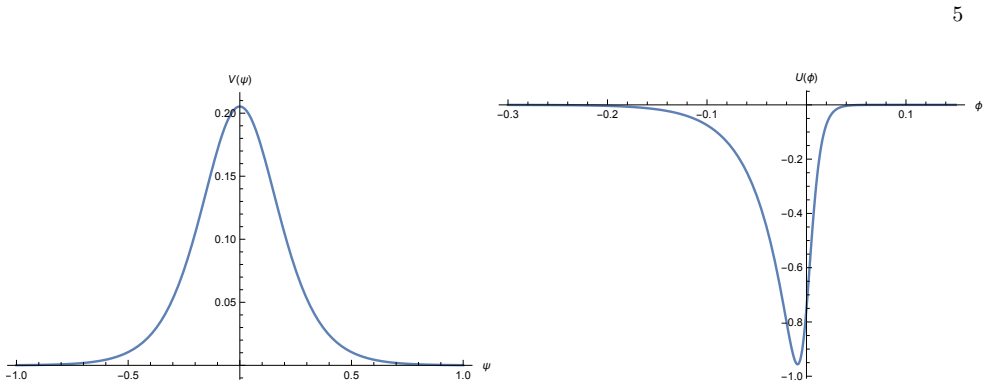
The effective Hamiltonian ... H=−ρc v sin²(λb)+Hm ... Hm=pϕ²/2v + v U(ϕ) + pψ²/2v + v V(ψ) with V(ψ)=V0 sech²(Aψ) and U(ϕ)=−2U0/(e^{-αϕ}+e^{βαϕ})
-
IndisputableMonolith/Foundation/RealityFromDistinction.leanreality_from_one_distinction unclear?
unclearRelation between the paper passage and the cited Recognition theorem.
We study the evolution of scalar and tensor perturbations and compare the results to current observations, showing the viability of this model as a base for further investigations.
What do these tags mean?
- matches
- The paper's claim is directly supported by a theorem in the formal canon.
- supports
- The theorem supports part of the paper's argument, but the paper may add assumptions or extra steps.
- extends
- The paper goes beyond the formal theorem; the theorem is a base layer rather than the whole result.
- uses
- The paper appears to rely on the theorem as machinery.
- contradicts
- The paper's claim conflicts with a theorem or certificate in the canon.
- unclear
- Pith found a possible connection, but the passage is too broad, indirect, or ambiguous to say the theorem truly supports the claim.
Reference graph
Works this paper leans on
-
[1]
Evolution over time of the Power Spectra for differentk The evolution of the amplitude of the different scalar power spectra for a range of values ofk, namelyk∈[10 −15,10 −2], is depicted in Figure 7. From the definition of the comoving curvature and entropic perturbations, Equation (32), we infer that during phases when one field’s speed is far larger th...
-
[2]
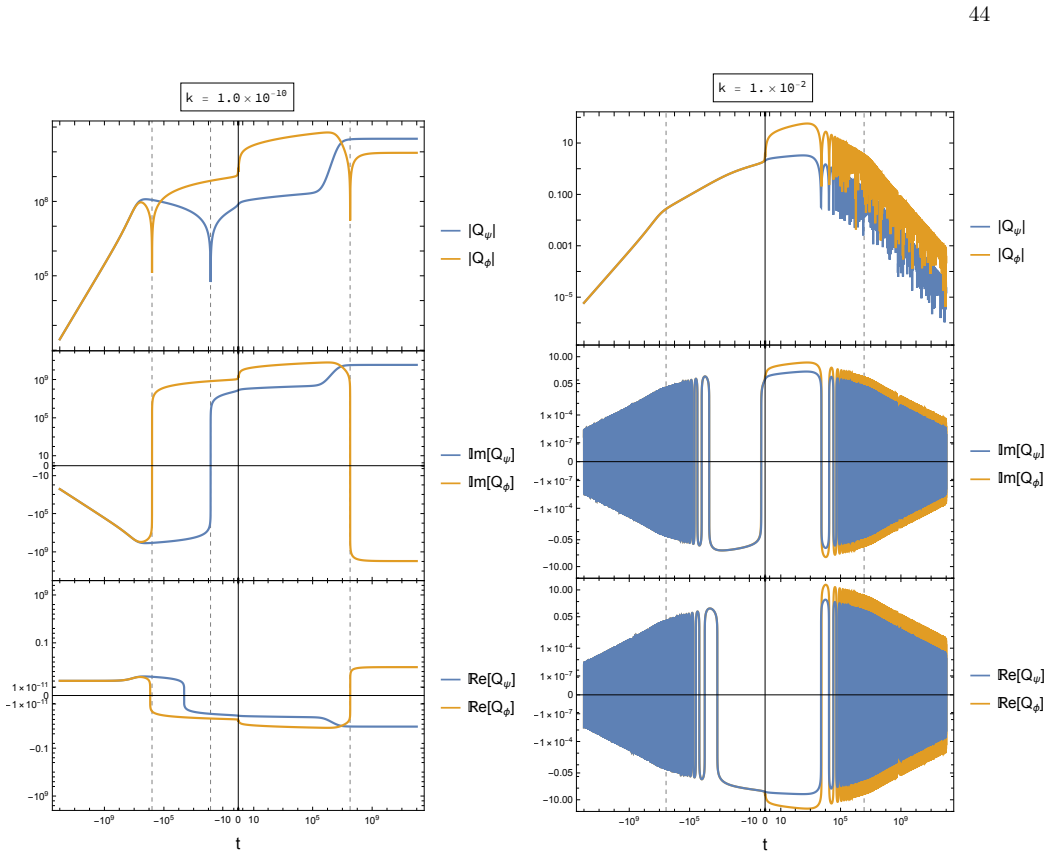
Evolution over time of the Power Spectra fork= 10 −10 We will first consider the evolution of the different power spectra for the modek= 10 −10. This mode is outside the horizon for most of the time span explored except for a brief period around the bounce phase, during which the horizon grows to infinity due to the vanishing Hubble parameter at the bounc...
-
[3]
This mode is within the horizon for most of the time span explored
Evolution over time of the Power Spectra fork= 10 −2 We will now discuss the evolution of the power spectra for the modek= 10 −2. This mode is within the horizon for most of the time span explored. It exits the horizon in the ekpyrotic- dominated phase of contraction near the bounce, it briefly reenters and re-exits the horizon through- out the bounce pha...
-
[4]
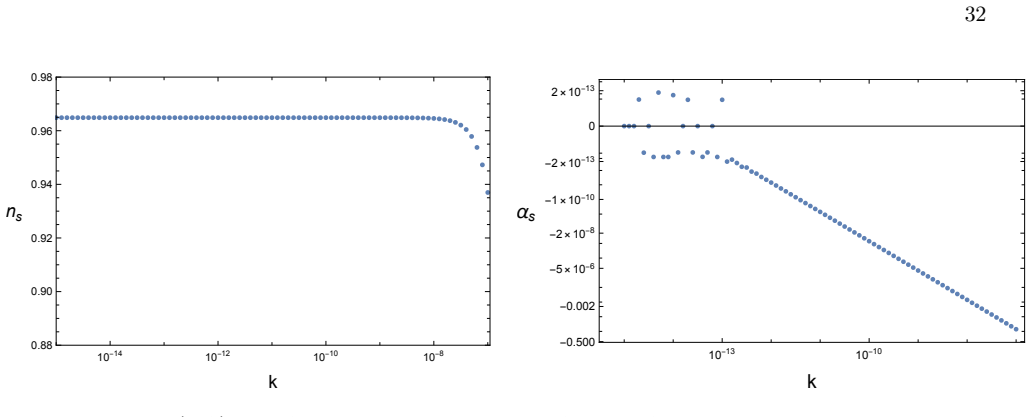
Scalar amplitude, scalar spectral indexn s and its runningα s Building on the description of the evolution of the power spectra in relation to many different modes as depicted in Figure 7, we now discuss the resultant scalar spectral indexn s in the quasi- dust-ekpyrotic bounce scenario. We compute the scalar spectral index given in (35) using our numeric...
-
[5]
Small variations of the ekpyrotic parameters have little impact on the evolution of perturbations
Effects of different parameter choices These results for the evolution of scalar perturbations are related to the choice of values for the different parameters of the model. Small variations of the ekpyrotic parameters have little impact on the evolution of perturbations. Meanwhile, varying the quasi-dust parameters does have an important effect on the re...
-
[6]
Evolution over time of the Power Spectra for differentk The evolution of the amplitude of the tensor power spectrum for the range of values k∈[10 −15,10 −2] is depicted in Figure 11 along with the scalar curvature power spectrum for comparison. Initially, modesk≲10 −7 that have exited the horizon display a nearly scale-invariant power spectrum, with a sli...
-
[7]
Evolution over time of the Power Spectra fork= 10 −10 The modek= 10 −10 lies within the regime with a red-tilted tensor power spectrum throughout the time span explored. During the quasi-dust-dominated phase of contraction, this mode’s ampli- tude grows fast, withP t ∝ |t| −2+4wT untilt eq1. After the transition into the ekpyrotic-dominated phase of contr...
-
[8]
The evolution of the power spectrum for this tensor mode is shown in the right panel of Figure 12
Evolution over time of the tensor power spectrum fork= 10 −2 The modek= 10 −2 lies within the regime with a blue tensor power spectrum before the bounce phase. The evolution of the power spectrum for this tensor mode is shown in the right panel of Figure 12. At this point it is worth noting that in the equation of motion forQ ψ (26) the terms with Ω ψψ an...
-
[9]
Loop Quantum Gravity: from Computation to Phe- nomenology
Tensor spectral indexn t, its running, and the tensor-to-scalar ratior We now discuss the resulting tensor spectral indexn t building on the description of the evolu- tion of the tensor power spectra in relation to many different modes as depicted in Figure 11. The tensor spectral index given in (64) is computed using our numerical results for the tensor ...
-
[10]
It can be seen that the plots are qualitatively the same as fork= 10 −10. As was discussed in section III C, all modes in the red-tilted regime have the same qualitative behaviour. We include these plots here simply as further reference since this is the mode that was used to match its scalar power spectrum’s amplitude and tilt with observations in order ...
-
[11]
A new type of isotropic cosmological models without singularity,
A. A. Starobinsky, “A new type of isotropic cosmological models without singularity,”Phys. Lett. B 91(1980) 99–102
work page 1980
-
[12]
First order phase transition of a vacuum and expansion of the universe,
K. Sato, “First order phase transition of a vacuum and expansion of the universe,”Mon. Not. Roy. Astron. Soc.195no. NORDITA-80-29, (1981) 467–479
work page 1981
-
[13]
Inflationary universe: A possible solution to the horizon and flatness problems,
A. H. Guth, “Inflationary universe: A possible solution to the horizon and flatness problems,”Phys. Rev. D23no. 2, (1981) 347–356
work page 1981
-
[14]
A. D. Linde, “A new inflationary universe scenario: A possible solution of the horizon, flatness, homogeneity, isotropy and primordial monopole problems,”Phys. Lett. B108no. 6, (1982) 389–393
work page 1982
-
[15]
Cosmology for Grand Unified Theories with Radiatively Induced Symmetry Breaking,
A. Albrecht and P. J. Steinhardt, “Cosmology for Grand Unified Theories with Radiatively Induced Symmetry Breaking,”Phys. Rev. Lett.48no. 17, (1982) 1220–1223
work page 1982
-
[16]
A. D. Linde, “Chaotic inflation,”Phys. Lett. B129no. 3, (1983) 177–181
work page 1983
-
[17]
Quantum fluctuations and a nonsingular universe,
V. F. Mukhanov and G. V. Chibisov, “Quantum fluctuations and a nonsingular universe,”JETP Lett. 33(1981) 532–535
work page 1981
-
[18]
The Vacuum energy and large scale structure of the universe,
V. F. Mukhanov and G. V. Chibisov, “The Vacuum energy and large scale structure of the universe,” Sov. Phys. JETP56(1982) 258–265
work page 1982
-
[19]
A. A. Starobinsky, “Dynamics of phase transition in the new inflationary universe scenario and generation of perturbations,”Phys. Lett. B117no. 3, (1982) 175–178
work page 1982
-
[20]
Fluctuations in the New Inflationary Universe,
A. H. Guth and S.-Y. Pi, “Fluctuations in the New Inflationary Universe,”Phys. Rev. Lett.49no. 15, (1982) 1110–1113
work page 1982
-
[21]
The development of irregularities in a single bubble inflationary universe,
S. W. Hawking, “The development of irregularities in a single bubble inflationary universe,”Phys. Lett. B115no. 4, (1982) 295
work page 1982
-
[22]
Nine-Year Wilkinson Microwave Anisotropy Probe (WMAP) Observations: Cosmological Parameter Results
J. M. Bardeen, P. J. Steinhardt, and M. S. Turner, “Spontaneous creation of almost scale-free density perturbations in an inflationary universe,”Phys. Rev. D28no. 4, (1983) 679. [13]WMAP Collaboration, G. Hinshaw et al., “Nine-year wilkinson microwave anisotropy probe (WMAP) observations: Cosmological parameter results,”Astrophys. J. Suppl.208(2013) 19, a...
work page internal anchor Pith review Pith/arXiv arXiv 1983
-
[23]
Trans-Planckian Issues for Inflationary Cosmology
R. H. Brandenberger and J. Martin, “Trans-Planckian issues for inflationary cosmology,”Class. Quant. Grav.30no. 11, (2013) 113001,arXiv:1211.6753 [astro-ph.CO]
work page internal anchor Pith review Pith/arXiv arXiv 2013
-
[24]
Discreteness of area and volume in quantum gravity
C. Rovelli and L. Smolin, “Discreteness of area and volume in quantum gravity,”Nucl. Phys. B442 no. CGPG-94-11-1, (1995) 593–622,arXiv:gr-qc/9411005
work page internal anchor Pith review Pith/arXiv arXiv 1995
-
[25]
Evidence for Maximal Acceleration and Singularity Resolution in Covariant Loop Quantum Gravity
C. Rovelli and F. Vidotto, “Evidence for Maximal Acceleration and Singularity Resolution in Covariant Loop Quantum Gravity,”Phys. Rev. Lett.111no. 9, (2013) 091303,arXiv:1307.3228 [gr-qc]. 48
work page internal anchor Pith review Pith/arXiv arXiv 2013
-
[26]
Loop Quantum Cosmology: Physics of Singularity Resolution and its Implications,
B.-F. Li and P. Singh, “Loop Quantum Cosmology: Physics of Singularity Resolution and its Implications,”arXiv:2304.05426 [gr-qc](2023) ,arXiv:2304.05426 [gr-qc]
-
[27]
On the evolution of the volume in Loop Quantum Cosmology,
B. E. Navascu´ es, “On the evolution of the volume in Loop Quantum Cosmology,”Class. Quant. Grav.41no. 14, (2024) 145004,arXiv:2311.18066 [gr-qc]
-
[28]
Quantum Nature of the Big Bang
A. Ashtekar, T. Pawlowski, and P. Singh, “Quantum Nature of the Big Bang,”Phys. Rev. Lett.96 no. 14, (2006) 141301,arXiv:gr-qc/0602086
work page internal anchor Pith review Pith/arXiv arXiv 2006
-
[29]
Loop Quantum Cosmology: A brief review
I. Agullo and P. Singh, “Loop Quantum Cosmology: A brief review,”arXiv:1612.01236 [gr-qc](2017) 183,arXiv:1612.01236 [gr-qc]
work page internal anchor Pith review Pith/arXiv arXiv 2017
-
[30]
B. Elizaga Navascu´ es and G. A. Mena Marug´ an, “Hybrid Loop Quantum Cosmology: An Overview,” Front. Astron. Space Sci.8(2021) 81,arXiv:2011.04559 [gr-qc]
-
[31]
An Overview on the Nature of the Bounce in LQC and PQM,
G. Barca, E. Giovannetti, and G. Montani, “An Overview on the Nature of the Bounce in LQC and PQM,”Universe7no. 9, (2021) 327,arXiv:2109.08645 [gr-qc]
-
[32]
I. Agullo, A. Wang, and E. Wilson-Ewing, “Loop Quantum Cosmology: Relation Between Theory and Observations,” inHandbook of Quantum Gravity, C. Bambi, L. Modesto, and I. Shapiro, eds., pp. 1–46. Springer Nature, Singapore, 2023.arXiv:2301.10215 [gr-qc]
-
[33]
Loop quantum cosmology and slow roll inflation
A. Ashtekar and D. Sloan, “Loop quantum cosmology and slow roll inflation,”Phys. Lett. B694 no. 2, (2011) 108–112,arXiv:0912.4093 [gr-qc]
work page internal anchor Pith review Pith/arXiv arXiv 2011
-
[34]
Inflation with the Starobinsky potential in Loop Quantum Cosmology
B. Bonga and B. Gupt, “Inflation with the Starobinsky potential in loop quantum cosmology,”Gen. Rel. Grav.48no. 6, (2016) 71,arXiv:1510.00680 [gr-qc]
work page internal anchor Pith review Pith/arXiv arXiv 2016
-
[35]
Inflation in loop quantum cosmology,
A. Bhardwaj, E. J. Copeland, and J. Louko, “Inflation in loop quantum cosmology,”Phys. Rev. D99 no. 6, (2019) 063520,arXiv:1812.06841 [gr-qc]
-
[36]
Duality Invariance of Cosmological Perturbation Spectra
D. Wands, “Duality Invariance of Cosmological Perturbation Spectra,”Phys. Rev. D60no. 2, (1999) 023507,arXiv:gr-qc/9809062
work page internal anchor Pith review Pith/arXiv arXiv 1999
-
[37]
The Matter Bounce Alternative to Inflationary Cosmology
R. H. Brandenberger, “The Matter Bounce Alternative to Inflationary Cosmology,”arXiv:1206.4196 [astro-ph.CO](2012) ,arXiv:1206.4196 [astro-ph.CO]
work page internal anchor Pith review Pith/arXiv arXiv 2012
-
[38]
The Matter Bounce Scenario in Loop Quantum Cosmology
E. Wilson-Ewing, “The Matter Bounce Scenario in Loop Quantum Cosmology,”JCAP03(2013) 026, arXiv:1211.6269 [gr-qc]
work page internal anchor Pith review Pith/arXiv arXiv 2013
-
[39]
A non inflationary model with scale invariant cosmological perturbations
P. Peter, E. J. C. Pinho, and N. Pinto-Neto, “A Non inflationary model with scale invariant cosmological perturbations,”Phys. Rev. D75(2007) 023516,arXiv:hep-th/0610205
work page internal anchor Pith review Pith/arXiv arXiv 2007
-
[40]
P. Peter and N. Pinto-Neto, “Cosmology without inflation,”Phys. Rev. D78(2008) 063506, arXiv:0809.2022 [gr-qc]
work page internal anchor Pith review Pith/arXiv arXiv 2008
-
[41]
T. Miranda, E. Frion, and D. Wands, “Stochastic collapse,”JCAP01(2020) 026,arXiv:1910.10000 [gr-qc]
-
[42]
Oscillatory approach to a singular point in the relativistic cosmology,
V. Belinskii, I. Khalatnikov, and E. Lifshitz, “Oscillatory approach to a singular point in the relativistic cosmology,”Adv. Phys.19no. 80, (1970) 525–573
work page 1970
-
[43]
Primordial power spectrum from a matter-Ekpyrotic bounce scenario in loop quantum cosmology,
B.-F. Li, S. Saini, and P. Singh, “Primordial power spectrum from a matter-Ekpyrotic bounce scenario in loop quantum cosmology,”Phys. Rev. D103no. 6, (2021) 066020,arXiv:2012.10462 [gr-qc]
-
[44]
J. Khoury, B. A. Ovrut, N. Seiberg, P. J. Steinhardt, and N. Turok, “From big crunch to big bang,” Phys. Rev. D65(2002) 086007,arXiv:hep-th/0108187
work page internal anchor Pith review Pith/arXiv arXiv 2002
-
[45]
The Ekpyrotic Universe: Colliding Branes and the Origin of the Hot Big Bang
J. Khoury, B. A. Ovrut, P. J. Steinhardt, and N. Turok, “The Ekpyrotic Universe: Colliding Branes and the Origin of the Hot Big Bang,”Phys. Rev. D64no. 12, (2001) 123522,arXiv:hep-th/0103239
work page internal anchor Pith review Pith/arXiv arXiv 2001
-
[46]
Ekpyrosis in Quantum Gravitational Anisotropic Bouncing Models,
R. Brown, A. M. McNamara, S. Saini, and P. Singh, “Ekpyrosis in Quantum Gravitational Anisotropic Bouncing Models,”arXiv:2412.12274 [gr-qc](2024) ,arXiv:2412.12274 [gr-qc]. 49
-
[47]
Loop Quantum Cosmology: A Status Report
A. Ashtekar and P. Singh, “Loop Quantum Cosmology: A Status Report,”Class. Quant. Grav.28 no. 21, (2011) 213001,arXiv:1108.0893 [gr-qc]
work page internal anchor Pith review Pith/arXiv arXiv 2011
-
[48]
M. Bojowald, “Loop Quantum Cosmology,”Living Rev. Rel.11no. 1, (2008) 4
work page 2008
-
[49]
Quantum Nature of the Big Bang: Improved dynamics
A. Ashtekar, T. Pawlowski, and P. Singh, “Quantum nature of the big bang: Improved dynamics,” Phys. Rev. D74no. 8, (2006) 084003,arXiv:gr-qc/0607039
work page internal anchor Pith review Pith/arXiv arXiv 2006
-
[50]
Black hole entropy in Loop Quantum Gravity
K. A. Meissner, “Black-hole entropy in loop quantum gravity,”Class. Quant. Grav.21no. 22, (2004) 5245–5252,arXiv:gr-qc/0407052
work page internal anchor Pith review Pith/arXiv arXiv 2004
-
[51]
Multi-fluid potential in the loop cosmology
J. Mielczarek, “Multi-fluid potential in the loop cosmology,”Phys. Lett. B675no. 3-4, (2009) 273–278,arXiv:0809.2469 [gr-qc]
work page internal anchor Pith review Pith/arXiv arXiv 2009
-
[52]
Towards a Nonsingular Bouncing Cosmology
Y.-F. Cai, D. A. Easson, and R. Brandenberger, “Towards a Nonsingular Bouncing Cosmology,” JCAP08no. 8, (2012) 020,arXiv:1206.2382 [hep-th]
work page internal anchor Pith review Pith/arXiv arXiv 2012
-
[53]
A Matter Bounce By Means of Ghost Condensation
C. Lin, R. H. Brandenberger, and L. P. Levasseur, “A Matter Bounce By Means of Ghost Condensation,”JCAP04no. 4, (2011) 019,arXiv:1007.2654 [hep-th]
work page internal anchor Pith review Pith/arXiv arXiv 2011
-
[54]
Two Field Matter Bounce Cosmology
Y.-F. Cai, E. McDonough, F. Duplessis, and R. Brandenberger, “Two Field Matter Bounce Cosmology,”JCAP10no. 10, (2013) 024,arXiv:1305.5259 [hep-th]
work page internal anchor Pith review Pith/arXiv arXiv 2013
-
[55]
Non-singular bounce scenarios in loop quantum cosmology and the effective field description
Y.-F. Cai and E. Wilson-Ewing, “Non-singular bounce scenarios in loop quantum cosmology and the effective field description,”JCAP03no. 03, (2014) 026,arXiv:1402.3009 [gr-qc]
work page internal anchor Pith review Pith/arXiv arXiv 2014
-
[56]
An Extension of the Quantum Theory of Cosmological Perturbations to the Planck Era
I. Agullo, A. Ashtekar, and W. Nelson, “An Extension of the Quantum Theory of Cosmological Perturbations to the Planck Era,”Phys. Rev. D87no. 4, (2013) 043507,arXiv:1211.1354 [gr-qc]
work page internal anchor Pith review Pith/arXiv arXiv 2013
-
[57]
Primordial power spectrum from the dressed metric approach in loop cosmologies,
B.-F. Li, P. Singh, and A. Wang, “Primordial power spectrum from the dressed metric approach in loop cosmologies,”Phys. Rev. D101no. 8, (2020) 086004,arXiv:1912.08225 [gr-qc]
-
[58]
Hamiltonian formalism for gauge-invariant cosmological perturbations with multiple scalar fields,
M. Pascual, “Hamiltonian formalism for gauge-invariant cosmological perturbations with multiple scalar fields,”arXiv:2503.20886 [gr-qc](2025) ,arXiv:2503.20886 [gr-qc]
-
[59]
Hybrid quantization of an inflationary model: The flat case
M. Fern´ andez-M´ endez, G. A. Mena Marug´ an, and J. Olmedo, “Hybrid quantization of an inflationary model: The flat case,”Phys. Rev. D88no. 4, (2013) 044013,arXiv:1307.5222 [gr-qc]
work page internal anchor Pith review Pith/arXiv arXiv 2013
-
[60]
Cosmological perturbations in Hybrid Loop Quantum Cosmology: Mukhanov-Sasaki variables
L. C. Gomar, M. Fern´ andez-M´ endez, G. A. M. Marug´ an, and J. Olmedo, “Cosmological perturbations in Hybrid Loop Quantum Cosmology: Mukhanov-Sasaki variables,”Phys. Rev. D90no. 6, (2014) 064015,arXiv:1407.0998 [gr-qc]
work page internal anchor Pith review Pith/arXiv arXiv 2014
-
[61]
Metric perturbations in two-field inflation
J. Garcia-Bellido and D. Wands, “Metric perturbations in two-field inflation,”Phys. Rev. D53(1996) 5437–5445,arXiv:astro-ph/9511029
work page internal anchor Pith review Pith/arXiv arXiv 1996
-
[62]
Adiabatic and entropy perturbations from inflation
C. Gordon, D. Wands, B. A. Bassett, and R. Maartens, “Adiabatic and entropy perturbations from inflation,”Phys. Rev. D63(2000) 023506,arXiv:astro-ph/0009131
work page internal anchor Pith review Pith/arXiv arXiv 2000
-
[63]
Chapter 14 - Bessel Functions,
G. B. Arfken, H. J. Weber, and F. E. Harris, “Chapter 14 - Bessel Functions,” inMathematical Methods for Physicists (Seventh Edition), G. B. Arfken, H. J. Weber, and F. E. Harris, eds., pp. 643–713. Academic Press, Boston, seventh edition ed., 2013
work page 2013
- [64]
-
[65]
The Temperature of the Cosmic Microwave Background
D. J. Fixsen, “The temperature of the cosmic microwave background,”Astrophys. J.707no. 2, (2009) 916–920,arXiv:0911.1955 [astro-ph.CO]
work page internal anchor Pith review Pith/arXiv arXiv 2009
-
[66]
Observational constraints on anisotropies for bouncing alternatives to inflation,
I. Agullo, J. Olmedo, and E. Wilson-Ewing, “Observational constraints on anisotropies for bouncing alternatives to inflation,”JCAP10no. 10, (2022) 045,arXiv:2206.04037 [astro-ph.CO]
discussion (0)
Sign in with ORCID, Apple, or X to comment. Anyone can read and Pith papers without signing in.