Nevanlinna-Pick interpolation from uncertain data
Pith reviewed 2026-05-21 21:28 UTC · model grok-4.3
The pith
Nevanlinna-Pick interpolation can be extended to propagate both statistical and systematic errors from lattice QCD data through the process.
A machine-rendered reading of the paper's core claim, the machinery that carries it, and where it could break.
Core claim
The authors show that both statistical and systematic errors accompanying lattice QCD data can be propagated through Nevanlinna-Pick interpolation by studying their effect on a simplified multiparticle spectral function, thereby extending prior work toward applications in inclusive heavy-particle decays.
What carries the argument
Error propagation through Nevanlinna-Pick interpolation applied to lattice QCD data that carries both statistical and systematic uncertainties.
If this is right
- Error bands on the interpolated spectral function become available for use in decay rate calculations.
- Both statistical fluctuations and systematic shifts from the lattice input can be tracked to the final result.
- The approach targets inclusive heavy-particle decays where many-particle final states make direct calculation hard.
- The method remains applicable even when the underlying lattice data include the usual sources of uncertainty.
Where Pith is reading between the lines
- Similar error tracking could be applied to other Euclidean-to-Minkowski reconstructions beyond the current example.
- Comparing the size of statistical versus systematic contributions in the output might guide future lattice improvement priorities.
- If the propagation remains stable under modest increases in complexity, the technique could reduce reliance on model-dependent assumptions in inclusive rate predictions.
Load-bearing premise
The simplified multiparticle spectral function example captures the error propagation behavior that would appear in realistic lattice QCD calculations of inclusive decays.
What would settle it
Running the same interpolation on a more complex spectral function extracted from an actual lattice simulation and checking whether the predicted error bands match the observed spread would test the claim.
Figures


read the original abstract
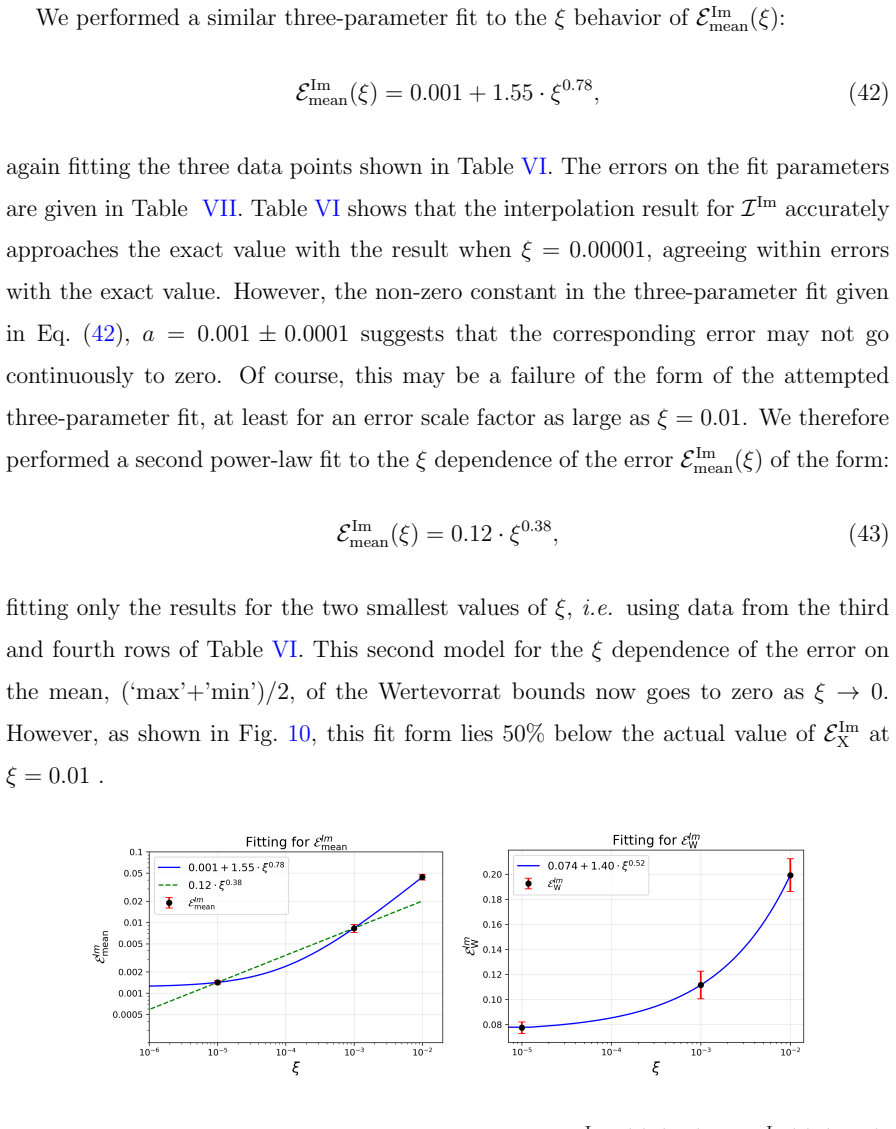
The calculation of inclusive processes that involve the production of many particles is a challenge for lattice QCD, a Euclidean-space method that is far removed from real-time, multiparticle production. A new approach to this problem based on Nevanlinna-Pick interpolation has been proposed by Bergamaschi et al. Here we extend their method by exploring the propagation of the statistical and systematic errors that accompany a lattice QCD calculation through this interpolation process. A simplified example of a multiparticle spectral function is studied with a focus on the possible applications of these methods to the calculation of inclusive heavy-particle decays.
Editorial analysis
A structured set of objections, weighed in public.
Referee Report
Summary. The paper extends the Nevanlinna-Pick interpolation method of Bergamaschi et al. for reconstructing spectral functions from lattice QCD data by explicitly propagating statistical and systematic errors through the interpolation procedure. The extension is demonstrated on a simplified multiparticle spectral function example, with discussion of potential applications to inclusive heavy-particle decays.
Significance. If the error-propagation formalism is robust and the toy model proves representative, the work would supply a practical framework for uncertainty quantification in Nevanlinna-Pick reconstructions of multiparticle spectral functions. The controlled toy-model setting allows clear isolation of propagation effects, which is a methodological strength, but the overall significance hinges on whether the demonstrated procedure generalizes to the correlated, discretized, and contaminated data structures typical of realistic lattice calculations.
major comments (1)
- [Simplified example (Section 4)] The central extension claim rests on the assertion that error propagation through Nevanlinna-Pick interpolation can be reliably studied with the chosen simplified multiparticle spectral function. However, this toy model omits correlated covariances between Euclidean-time data points, discretization artifacts, and excited-state contamination that dominate realistic lattice QCD calculations of inclusive decays. Without a quantitative argument or additional test showing that these omissions do not alter the leading error-propagation features, the applicability to heavy-particle decays remains unestablished.
minor comments (2)
- [Method] Notation for the error-propagation matrices is introduced without an explicit comparison to the covariance matrices used in the original Bergamaschi et al. work; adding a short table or equation block that maps the two conventions would improve readability.
- [Results] Figure captions for the error-band plots do not state whether the bands represent 1σ statistical errors only or include systematic contributions; this should be clarified.
Simulated Author's Rebuttal
We thank the referee for their careful reading of the manuscript and for highlighting the limitations of the simplified example. We address the major comment below and have revised the text accordingly.
read point-by-point responses
-
Referee: [Simplified example (Section 4)] The central extension claim rests on the assertion that error propagation through Nevanlinna-Pick interpolation can be reliably studied with the chosen simplified multiparticle spectral function. However, this toy model omits correlated covariances between Euclidean-time data points, discretization artifacts, and excited-state contamination that dominate realistic lattice QCD calculations of inclusive decays. Without a quantitative argument or additional test showing that these omissions do not alter the leading error-propagation features, the applicability to heavy-particle decays remains unestablished.
Authors: We agree that the toy model in Section 4 is deliberately simplified and therefore omits correlated covariances, discretization effects, and excited-state contamination that are important in realistic lattice QCD data. The purpose of this example is to isolate the propagation of input uncertainties through the Nevanlinna-Pick procedure itself under controlled conditions where the underlying spectral function is known exactly. In the revised manuscript we have added a paragraph in Section 4 that provides a qualitative argument for why the leading error-propagation features observed in the toy model are expected to remain relevant even when these additional lattice effects are present, while explicitly stating that a full quantitative validation on realistic, correlated lattice data is left for future work. revision: partial
Circularity Check
No circularity; error propagation explored numerically on explicit toy model
full rationale
The manuscript extends Bergamaschi et al. by numerically propagating statistical and systematic lattice errors through Nevanlinna-Pick interpolation. It studies this propagation on an explicitly simplified multiparticle spectral function without presenting any derivation, ansatz, or uniqueness claim that reduces to fitted inputs or prior self-citations by construction. The reference to the earlier method is external, the toy-model limitation is stated openly, and no load-bearing step equates a claimed result to its own definition or fit. The work is therefore self-contained as a computational exploration rather than a tautological derivation.
Axiom & Free-Parameter Ledger
Lean theorems connected to this paper
-
IndisputableMonolith/Cost/FunctionalEquation.leanwashburn_uniqueness_aczel unclear?
unclearRelation between the paper passage and the cited Recognition theorem.
We then adjust each of these values making them Pick-consistent while also requiring that they remain within the error volume... gradient ascent procedure... Pick matrix
-
IndisputableMonolith/Foundation/AlexanderDuality.leanalexander_duality_circle_linking unclear?
unclearRelation between the paper passage and the cited Recognition theorem.
the Pick criterion... positive semi-definite... Wertevorrat
What do these tags mean?
- matches
- The paper's claim is directly supported by a theorem in the formal canon.
- supports
- The theorem supports part of the paper's argument, but the paper may add assumptions or extra steps.
- extends
- The paper goes beyond the formal theorem; the theorem is a base layer rather than the whole result.
- uses
- The paper appears to rely on the theorem as machinery.
- contradicts
- The paper's claim conflicts with a theorem or certificate in the canon.
- unclear
- Pith found a possible connection, but the passage is too broad, indirect, or ambiguous to say the theorem truly supports the claim.
Forward citations
Cited by 2 Pith papers
-
The Causal Bootstrap: Bounding Smeared Spectral Functions from Non-Perturbative Euclidean Data
The causal bootstrap computes rigorous bounds on smeared spectral functions from non-perturbative Euclidean data by optimizing over the convex set of compatible positive spectral densities and reducing dual problems t...
-
Spectral reconstruction from Euclidean lattice correlators through singular value decomposition
SVD truncation of the exp(-ωt) kernel reconstructs smeared spectral functions from lattice correlators with controlled uncertainties and approaches the Mellin transform in the continuum limit.
Reference graph
Works this paper leans on
-
[1]
The simple example studied was constructed from a Gaussian spectral density. In a realistic problem this density would grow with increasing energy and require careful treatment of a difficult asymptotic behavior
-
[2]
In this exploratory study we have not identified specific physical quantities to which these interpolation methods can be competitively applied
-
[3]
Nevanlinna-Pick interpolation typically fails for quantities integrated on complex contours which intersect the real axis. Likely all physically interesting examples involve such an intersection and may then represent a portion of the calculation that must be done using other methods
-
[4]
The naive lattice error volume sampled in this study is a simple hypercube with no correlations between the lattice data values. Incorporating an appropriate correlation matrix may lead to a reduction in the resulting errors since additional lattice input data has been provided
-
[5]
Since the Green’s function being determined by interpolation is defined in the entire upper half plane, it may be advantageous to include additional interpolation data from points at large complex energies that can be determined accurately from QCD perturbation theory. 38 Considering the above difficulties and opportunities, the next step should be to app...
-
[6]
A. Rothkopf, Inverse problems, real-time dynamics and lattice simulations, EPJ Web Conf.274, 01004 (2022), arXiv:2211.10680 [hep-lat]
-
[7]
A. Rothkopf, Bayesian inference of real-time dynamics from lattice QCD, Front. Phys. 10, 1028995 (2022), arXiv:2208.13590 [hep-lat]
- [8]
-
[9]
L. Del Debbio, A. Lupo, M. Panero, and N. Tantalo, Approaches to the Inverse Problem, inEuroPLEx Final Conference(2024) arXiv:2410.09944 [hep-lat]. 39
-
[10]
M. T. Hansen, H. B. Meyer, and D. Robaina, From deep inelastic scattering to heavy- flavor semileptonic decays: Total rates into multihadron final states from lattice QCD, Phys. Rev. D96, 094513 (2017), arXiv:1704.08993 [hep-lat]
work page internal anchor Pith review Pith/arXiv arXiv 2017
-
[11]
J. Bulava and M. T. Hansen, Scattering amplitudes from finite-volume spectral functions, Phys. Rev. D100, 034521 (2019)
work page 2019
- [12]
- [13]
-
[14]
P. Gambino, S. Hashimoto, S. M¨ achler, M. Panero, F. Sanfilippo, S. Simula, A. Smecca, and N. Tantalo, Lattice QCD study of inclusive semileptonic decays of heavy mesons, JHEP07, 083, arXiv:2203.11762 [hep-lat]
- [15]
- [16]
-
[17]
A. Patella and N. Tantalo, Scattering amplitudes from Euclidean correlators: Haag- Ruelle theory and approximation formulae, JHEP01, 091, arXiv:2407.02069 [hep-lat]
-
[18]
L. Del Debbio, A. Lupo, M. Panero, and N. Tantalo, Bayesian solution to the inverse problem and its relation to Backus–Gilbert methods, Eur. Phys. J. C85, 185 (2025), arXiv:2409.04413 [hep-lat]
-
[19]
T. Bergamaschi, W. I. Jay, and P. R. Oare, Hadronic structure, conformal maps, and analytic continuation, Phys. Rev. D108, 074516 (2023), arXiv:2305.16190 [hep-lat]
- [20]
-
[21]
S. Iskakov, A. Hampel, N. Wentzell, and E. Gull, TRIQS/Nevanlinna: Implementation of the Nevanlinna Analytic Continuation method for noise-free data, Comput. Phys. Commun.304, 109299 (2024), arXiv:2309.01407 [physics.comp-ph]. 40
-
[22]
L. Huang and S. Liang, Reconstructing lattice QCD spectral functions with stochastic pole expansion and Nevanlinna analytic continuation, Phys. Rev. D109, 054508 (2024), arXiv:2309.11114 [hep-lat]
- [23]
-
[24]
M. A. Shifman, A. I. Vainshtein, and V. I. Zakharov, QCD and Resonance Physics. Theoretical Foundations, Nucl. Phys. B147, 385 (1979)
work page 1979
-
[25]
M. A. Shifman, A. I. Vainshtein, and V. I. Zakharov, QCD and Resonance Physics: Applications, Nucl. Phys. B147, 448 (1979)
work page 1979
-
[26]
M. A. Shifman, A. I. Vainshtein, and V. I. Zakharov, QCD and Resonance Physics. The rho-omega Mixing, Nucl. Phys. B147, 519 (1979)
work page 1979
-
[27]
E. Braaten, S. Narison, and A. Pich, QCD analysis of the tau hadronic width, Nucl. Phys. B373, 581 (1992)
work page 1992
-
[28]
F. Le Diberder and A. Pich, Testing QCD with tau decays, Phys. Lett. B289, 165 (1992)
work page 1992
-
[29]
Novel $|V_{us}|$ Determination Using Inclusive Strange $\tau$ Decay and Lattice HVPs
P. Boyle, R. J. Hudspith, T. Izubuchi, A. J¨ uttner, C. Lehner, R. Lewis, K. Maltman, H. Ohki, A. Portelli, and M. Spraggs (RBC, UKQCD), Novel —Vus— Determination Using Inclusive StrangeτDecay and Lattice Hadronic Vacuum Polarization Functions, Phys. Rev. Lett.121, 202003 (2018), arXiv:1803.07228 [hep-lat]
work page internal anchor Pith review Pith/arXiv arXiv 2018
-
[30]
C. Alexandrouet al.(Extended Twisted Mass), Inclusive Hadronic Decay Rate of theτ Lepton from Lattice QCD: The u¯s Flavor Channel and the Cabibbo Angle, Phys. Rev. Lett.132, 261901 (2024), arXiv:2403.05404 [hep-lat]
-
[31]
Nicolau, The nevanlinna-pick interpolation problem,22(2016)
A. Nicolau, The nevanlinna-pick interpolation problem,22(2016)
work page 2016
- [32]
-
[33]
T. mpmath development team,mpmath: a Python library for arbitrary-precision floating- point arithmetic (version 1.2.1)(2020),http://mpmath.org/. 41
work page 2020
discussion (0)
Sign in with ORCID, Apple, or X to comment. Anyone can read and Pith papers without signing in.