Development of a dual-phase xenon time projection chamber prototype for the RELICS experiment
Pith reviewed 2026-05-17 05:52 UTC · model grok-4.3
The pith
A prototype dual-phase xenon time projection chamber for RELICS reaches the sub-keV energy threshold needed for reactor neutrino scattering.
A machine-rendered reading of the paper's core claim, the machinery that carries it, and where it could break.
Core claim
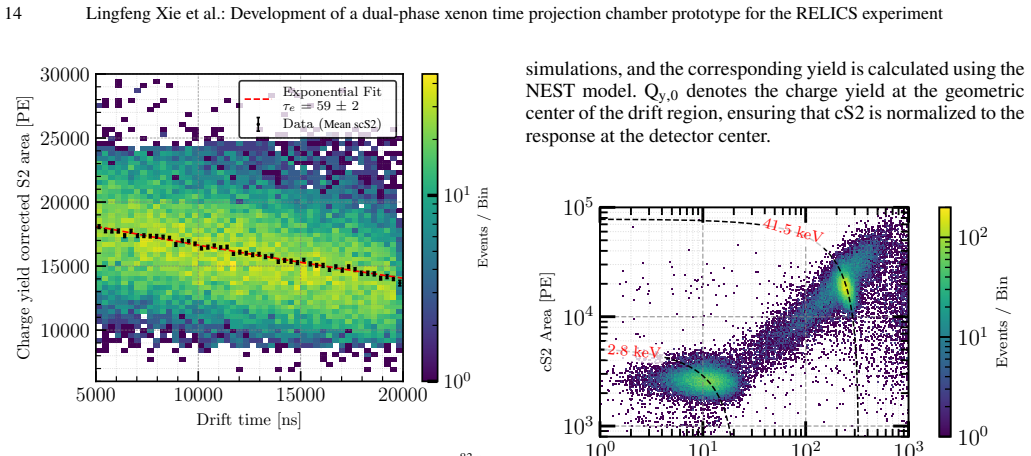
The prototype dual-phase xenon time projection chamber was successfully constructed and operated, demonstrating the sub-keV energy threshold required for the RELICS physics program through a measured single electron gain of 34.30 plus or minus 0.01 photoelectrons per electron and the detection of 0.27 keV L-shell decay events from 37Ar, while also establishing essential data analysis techniques and simulation frameworks for future operations.
What carries the argument
The dual-phase xenon time projection chamber prototype, which uses liquid xenon scintillation and gas-phase electron amplification to reconstruct low-energy interactions with high sensitivity.
If this is right
- The core technologies including the TPC, cryogenic system, xenon purification, and data acquisition are feasible for the full-scale RELICS detector.
- Validated analysis techniques and simulation frameworks now provide the methodological basis for processing data in the larger experiment.
- The demonstrated energy threshold enables detection of the tiny nuclear recoils from coherent elastic neutrino-nucleus scattering off xenon.
- Reliable single-electron response supports the low-background requirements of the reactor neutrino measurement program.
Where Pith is reading between the lines
- If scaling succeeds, the experiment could yield new limits on neutrino non-standard interactions or electromagnetic properties at low energies.
- The low-threshold operation methods may transfer to other xenon-based searches for dark matter or solar neutrinos.
- Similar staged prototype programs could reduce technical risk for future large liquid-noble detectors.
Load-bearing premise
The performance metrics and subsystem reliability observed in the small prototype will scale without major new problems in background control, xenon purity, or electric-field uniformity when the detector volume increases to the full RELICS size.
What would settle it
A repeat calibration run that fails to detect 0.27 keV 37Ar L-shell events or measures a single-electron gain below 30 photoelectrons per electron would show that the claimed sub-keV threshold capability has not been achieved.
Figures





read the original abstract
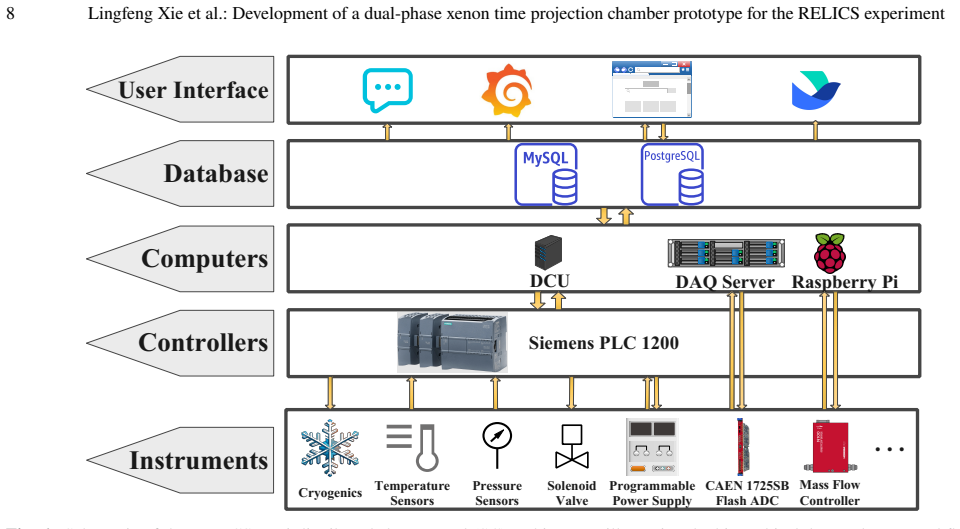
The RELICS (REactor neutrino LIquid xenon Coherent elastic Scattering) experiment aims to detect coherent elastic neutrino-nucleus scattering from reactor antineutrinos using a dual-phase xenon time projection chamber. To validate the detector concept and ensure technical reliability for the full-scale experiment, a dedicated prototype was designed, constructed, and operated. This work presents an overview of the design, construction, and operational performance of the prototype, with emphasis on its major subsystems, including the TPC, cryogenic and xenon purification systems, slow control, and data acquisition. During operation, the detector demonstrated the capability to achieve a sub-keV energy threshold required for the RELICS physics program, as reflected by a measured single electron gain of 34.30~$\pm$~0.01~(stat.)~PE/e$^-$ and the successful detection of 0.27~keV L-shell decay events from $^{37}$Ar. In addition, essential data analysis techniques and simulation frameworks were developed and validated, establishing the methodological foundation for future RELICS operations. The successful construction and operation of this prototype confirm the feasibility of the core technologies and provide a crucial experimental basis for the final RELICS detector.
Editorial analysis
A structured set of objections, weighed in public.
Referee Report
Summary. The manuscript reports the design, construction, and operation of a prototype dual-phase xenon time projection chamber for the RELICS experiment. It describes major subsystems (TPC, cryogenics, purification, slow control, DAQ) and presents operational results including a measured single-electron gain of 34.30 ± 0.01 (stat.) PE/e− together with detection of 0.27 keV 37Ar L-shell events, from which the authors conclude that the prototype has demonstrated the sub-keV threshold required for the RELICS physics program and has confirmed the feasibility of the core technologies.
Significance. If the reported gain and threshold performance are reproducible and the associated systematics are under control, the work supplies a concrete experimental benchmark for dual-phase xenon TPC operation at the sub-keV level. This benchmark, together with the developed analysis techniques and simulation frameworks, constitutes a necessary technical milestone for any future reactor-neutrino coherent-scattering search that relies on the same detector architecture.
major comments (1)
- [Abstract] Abstract: The claim that the prototype 'confirm[s] the feasibility of the core technologies' for the full-scale RELICS detector is load-bearing for the paper's central message, yet no quantitative discussion, simulation, or extrapolation is supplied that addresses how xenon purity, electric-field uniformity, or background rates will behave when the active volume is increased by the factor required for the final detector. This omission directly weakens the link between the prototype metrics and the stated physics program.
minor comments (2)
- [Abstract] The numerical value of the single-electron gain is given with a statistical uncertainty of ±0.01 but without any accompanying systematic uncertainty or description of the fit procedure used to extract it; this information is needed to assess the robustness of the sub-keV threshold claim.
- The manuscript would benefit from an explicit statement of the active target mass or fiducial volume of the prototype so that readers can judge the scale factor to the final RELICS detector.
Simulated Author's Rebuttal
We thank the referee for their careful reading and constructive feedback on our manuscript. We address the major comment below.
read point-by-point responses
-
Referee: [Abstract] Abstract: The claim that the prototype 'confirm[s] the feasibility of the core technologies' for the full-scale RELICS detector is load-bearing for the paper's central message, yet no quantitative discussion, simulation, or extrapolation is supplied that addresses how xenon purity, electric-field uniformity, or background rates will behave when the active volume is increased by the factor required for the final detector. This omission directly weakens the link between the prototype metrics and the stated physics program.
Authors: We agree that the abstract claim would benefit from more precise wording to better reflect the manuscript's scope. This work reports the design, construction, and operation of the prototype, including demonstration of a single-electron gain of 34.30 ± 0.01 (stat.) PE/e− and detection of 0.27 keV 37Ar L-shell events that establish sub-keV threshold performance. The manuscript does not include quantitative extrapolations or simulations for xenon purity, electric-field uniformity, or background rates at the full RELICS detector scale, as such detailed scaling analyses require additional engineering studies and are planned for future publications. We will revise the abstract to state that the prototype confirms the feasibility of the core technologies at the demonstrated scale and provides an essential experimental foundation for the RELICS program. A brief note on the need for future scaling studies will be added to the conclusions. revision: yes
Circularity Check
No circularity: direct experimental report of prototype performance
full rationale
This is an experimental hardware paper reporting the design, construction, and measured operation of a xenon TPC prototype. The central results are direct measurements (single-electron gain of 34.30 ± 0.01 PE/e− and detection of 0.27 keV 37Ar events) obtained during prototype running; no equations, fits, or predictions are presented that reduce by construction to parameters defined from the same data. Subsystem descriptions and simulation validation are presented as supporting methodology rather than load-bearing derivations. The report is therefore self-contained against external benchmarks of detector performance and contains no self-definitional, fitted-input, or self-citation chains that collapse the claimed results.
Axiom & Free-Parameter Ledger
axioms (1)
- domain assumption Xenon can be purified and maintained at levels that allow single-electron sensitivity in a dual-phase TPC.
Lean theorems connected to this paper
-
IndisputableMonolith/Cost/FunctionalEquation.leanwashburn_uniqueness_aczel unclear?
unclearRelation between the paper passage and the cited Recognition theorem.
measured single electron gain of 34.30 ± 0.01 (stat.) PE/e− and the successful detection of 0.27 keV L-shell decay events from 37Ar
-
IndisputableMonolith/Foundation/AlexanderDuality.leanalexander_duality_circle_linking unclear?
unclearRelation between the paper passage and the cited Recognition theorem.
electric field uniformity... field-shaping rings... COMSOL simulation
What do these tags mean?
- matches
- The paper's claim is directly supported by a theorem in the formal canon.
- supports
- The theorem supports part of the paper's argument, but the paper may add assumptions or extra steps.
- extends
- The paper goes beyond the formal theorem; the theorem is a base layer rather than the whole result.
- uses
- The paper appears to rely on the theorem as machinery.
- contradicts
- The paper's claim conflicts with a theorem or certificate in the canon.
- unclear
- Pith found a possible connection, but the passage is too broad, indirect, or ambiguous to say the theorem truly supports the claim.
Reference graph
Works this paper leans on
-
[1]
Freedman,Coherent Neutrino Nucleus Scattering as a Probe of the Weak Neutral Current, Phys
D.Z. Freedman,Coherent Neutrino Nucleus Scattering as a Probe of the Weak Neutral Current, Phys. Rev. D9, 1389(1974)
work page 1974
-
[2]
Coloma, et al.,Curtailing the Dark Side in Non-Standard Neu- trino Interactions, JHEP04, 116(2017)
P. Coloma, et al.,Curtailing the Dark Side in Non-Standard Neu- trino Interactions, JHEP04, 116(2017)
work page 2017
-
[3]
K. Patton, et al.,Neutrino-nucleus coherent scattering as a probe of neutron density distributions, Phys. Rev. C86, 024612(2012)
work page 2012
-
[4]
A. Chattaraj, et al.,Probing conventional and new physics at the ESS with coherent elastic neutrino-nucleus scattering, JHEP05, 064(2025)
work page 2025
-
[5]
Horowitz, et al.,Neutrino-nucleon scattering in super- nova matter from the virial expansion, Phys
C.J. Horowitz, et al.,Neutrino-nucleon scattering in super- nova matter from the virial expansion, Phys. Rev. C95(2), 025801(2017)
work page 2017
-
[6]
D. Akimov, et al.,Observation of coherent elastic neutrino- nucleus scattering, Science357(6356), 1123(2017)
work page 2017
-
[7]
Akimov, et al.,First Measurement of Coherent Elastic Neutrino-Nucleus Scattering on Argon, Phys
D. Akimov, et al.,First Measurement of Coherent Elastic Neutrino-Nucleus Scattering on Argon, Phys. Rev. Lett.126(1), 012002(2021)
work page 2021
-
[8]
S. Adamski, et al.,Evidence of Coherent Elastic Neutrino-Nucleus Scattering with COHERENT’s Germanium Array, Phys. Rev. Lett. 134, 231801(2025)
work page 2025
-
[9]
N. Ackermann, et al.,Direct observation of coherent elastic an- tineutrino–nucleus scattering, Nature643(8074), 1229(2025)
work page 2025
-
[10]
E. Aprile, et al.,First Indication of Solar 8BNeutrinos via Co- herent Elastic Neutrino-Nucleus Scattering with XENONnT, Phys. Rev. Lett.133(19), 191002(2024)
work page 2024
-
[11]
Z. Bo, et al.,First Indication of Solar 8BNeutrinos through Co- herent Elastic Neutrino-Nucleus Scattering in PandaX-4T, Phys. Rev. Lett.133(19), 191001(2024)
work page 2024
-
[12]
Cai, et al.,Reactor neutrino liquid xenon coherent elastic scat- tering experiment, Phys
C. Cai, et al.,Reactor neutrino liquid xenon coherent elastic scat- tering experiment, Phys. Rev. D110(7), 072011(2024)
work page 2024
- [13]
- [14]
-
[15]
Aprile, et al.,Emission of single and few electrons in XENON1T and limits on light dark matter, Phys
E. Aprile, et al.,Emission of single and few electrons in XENON1T and limits on light dark matter, Phys. Rev. D106(2), 022001(2022)
work page 2022
-
[16]
Aprile, et al.,XENONnT analysis: Signal reconstruction, cali- bration, and event selection, Phys
E. Aprile, et al.,XENONnT analysis: Signal reconstruction, cali- bration, and event selection, Phys. Rev. D111(6), 062006(2025)
work page 2025
-
[17]
Kravitz, et al.,Measurements of angle-resolved reflectivity of PTFE in liquid xenon with IBEX, Eur
S. Kravitz, et al.,Measurements of angle-resolved reflectivity of PTFE in liquid xenon with IBEX, Eur. Phys. J. C80(3), 262(2020)
work page 2020
-
[18]
Hu, et al.,Development of the Liquid Level Meters for the PandaX Dark Matter Detector, Chin
J. Hu, et al.,Development of the Liquid Level Meters for the PandaX Dark Matter Detector, Chin. Phys. C38(5), 056002(2014)
work page 2014
-
[19]
M. Szydagis, et al.,A review of NEST models for liquid xenon and an exhaustive comparison with other approaches, Front. Detect. Sci. Technol.2, 1480975(2024)
work page 2024
-
[20]
Aprile, et al.,Material radiopurity control in the XENONnT experiment, Eur
E. Aprile, et al.,Material radiopurity control in the XENONnT experiment, Eur. Phys. J. C82(7), 599(2022) 21.COMSOL Multiphysics ® v6.1. COMSOL AB, Stockholm, Swe- den
work page 2022
-
[21]
Xu, et al.,Electron extraction efficiency study for dual- phase xenon dark matter experiments, Phys
J. Xu, et al.,Electron extraction efficiency study for dual- phase xenon dark matter experiments, Phys. Rev. D99(10), 103024(2019)
work page 2019
-
[22]
L. Zhao, et al.,The cryogenics and xenon handling system for the PandaX-4T experiment, JINST16(06), T06007(2021)
work page 2021
-
[23]
E. Aprile, et al.,Performance of a cryogenic system prototype for the XENON1T detector, Journal of Instrumentation7(10), P10001(2012)
work page 2012
-
[24]
Cryotronics,Appendix F: PID Temperature Control
L.S. Cryotronics,Appendix F: PID Temperature Control. URL https://www.lakeshore.com/docs/default-source/ temperature-catalog/lstc_appendixf_l.pdf
-
[25]
J. Aalbers, et al., Axfoundation/strax: v1.6.4 (2024). DOI 10.5281/ zenodo.11355772. URLhttps://doi.org/10.5281/zenodo. 11355772
-
[26]
X.N. Guo, et al., Preparation and measurement of an 37Ar source for liquid xenon detector calibration (2025). arXiv:2509.04829
-
[27]
D. Zhang, et al., 83Rb/83𝑚Krproduction and cross-section mea- surement with 3.4 MeV and 20 MeV proton beams, Phys. Rev. C 105, 014604(2022)
work page 2022
-
[28]
X. Guo, et al., A domain adaptive position reconstruction method for time projection chamber based on deep neural network, (2025). arXiv:2510.24329
-
[29]
Agostinelli, et al.,Geant4—a simulation toolkit, Nucl
S. Agostinelli, et al.,Geant4—a simulation toolkit, Nucl. Instrum. Methods Phys. Res. A506(3), 250(2003)
work page 2003
-
[30]
X. Chen, et al.,BambooMC — A Geant4-based simulation pro- gram for the PandaX experiments, JINST16(09), T09004(2021)
work page 2021
-
[31]
A. Hitachi, et al.,New approach to the calculation of the re- fractive index of liquid and solid xenon, J. Chem. Phys.123(23), 234508(2005)
work page 2005
-
[32]
G.M. Seidel, R.E. Lanou, W. Yao,Rayleigh scattering in rare gas liquids, Nucl. Instrum. Meth. A489, 189(2002)
work page 2002
-
[33]
S. Bricola, et al.,Noble-gas liquid detectors: Measurement of light diffusion and reflectivity on commonly adopted inner surface materials, Nucl. Phys. B Proc. Suppl.172, 260(2007)
work page 2007
-
[34]
H. Schindler, R. Veenhof,Garfield++: Simulation of gaseous detectors, J. Phys.: Conf. Ser.1616, 012001(2023)
work page 2023
discussion (0)
Sign in with ORCID, Apple, or X to comment. Anyone can read and Pith papers without signing in.