proto-Lightspeed: a high-speed, ultra-low read noise imager on the Magellan Clay Telescope
Pith reviewed 2026-05-21 14:55 UTC · model grok-4.3
The pith
proto-Lightspeed enables 6600 Hz imaging with sub-electron read noise on Magellan Clay Telescope
A machine-rendered reading of the paper's core claim, the machinery that carries it, and where it could break.
Core claim
Proto-Lightspeed demonstrates that a high-speed imager built with off-the-shelf components can deliver deep sub-electron read noise and seeing-limited image quality at frame rates up to 6600 Hz when mounted on the Nasmyth port of the Magellan Clay Telescope, as verified through commissioning observations.
What carries the argument
The ORCA-Quest 2 camera combined with re-imaging optics that provide adjustable magnification for pixel scales between 0.017 and 0.050 arcseconds while preserving low read noise.
Load-bearing premise
The commercial re-imaging lenses and ORCA-Quest 2 camera maintain their specified performance without unexpected optical or mechanical degradation from the Nasmyth East port environment.
What would settle it
Commissioning data showing read noise above one electron or image quality significantly worse than seeing-limited would falsify the performance claims.
Figures




read the original abstract
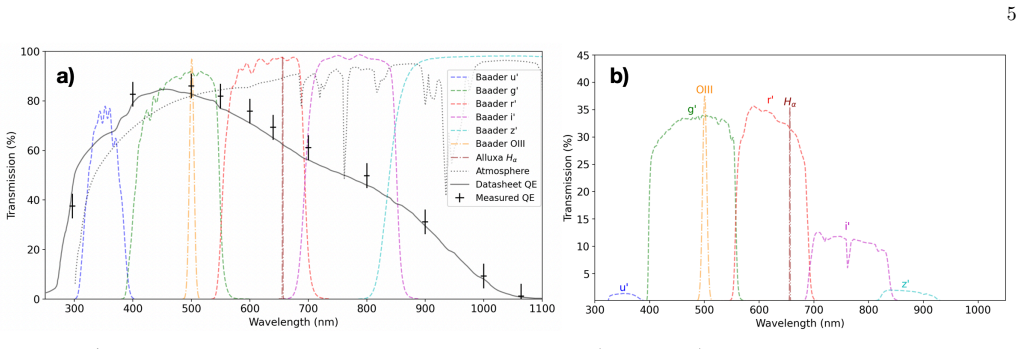
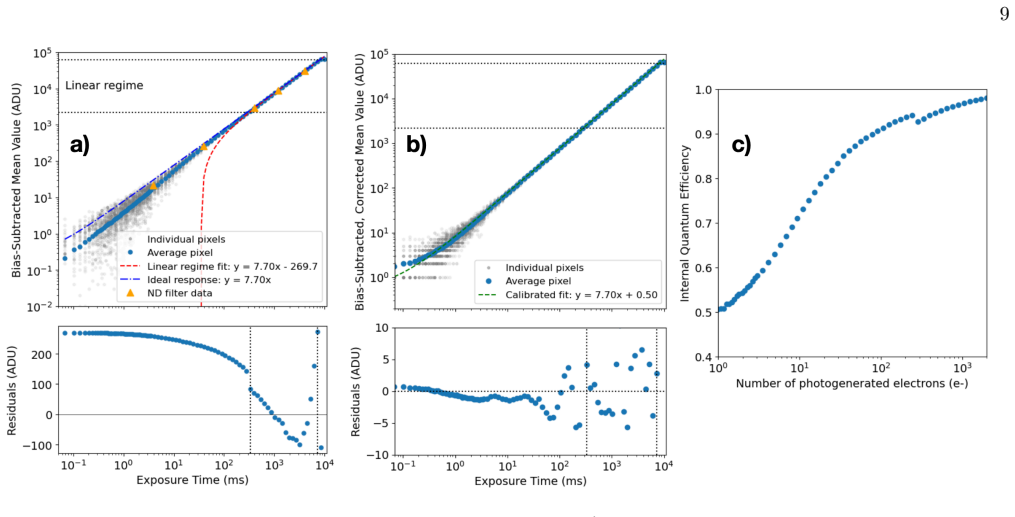
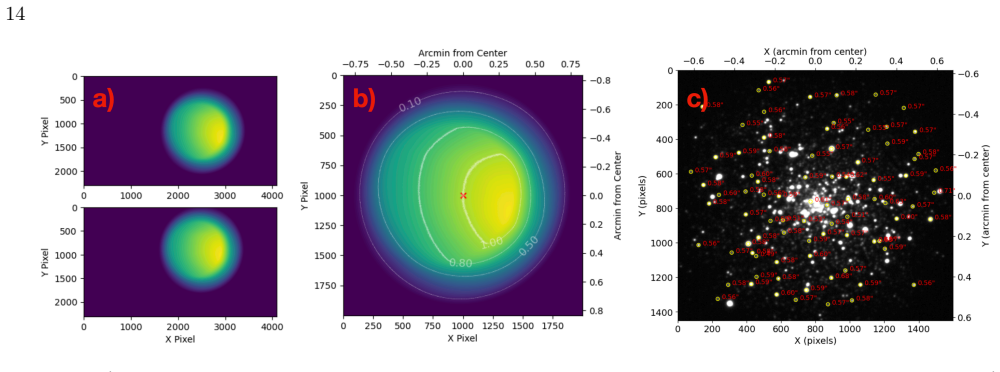
proto-Lightspeed is a new instrument that has been commissioned on the Nasmyth East port of the Magellan Clay Telescope at Las Campanas Observatory to deliver high-speed optical imaging with deep sub-electron read noise. Making use of commercial re-imaging lenses and the ORCA-Quest 2 camera from Hamamatsu, proto-Lightspeed images a field $1'$ in diameter at up to $200$ Hz or windowed fields at higher rates, up to 6600 Hz for a $1.6''\times 1'$ field of view. proto-Lightspeed delivers seeing-limited image quality in the $g'$, $r'$, and $i'$ bands and adjustable magnification for pixel scales between $0.017''-0.050''$. proto-Lightspeed is well suited to studying compact binary systems, exoplanet transits, rapid flaring associated with accretion, periodic optical emission from pulsars, occultations of background stars by small trans-Neptunian Objects, and any other rapidly variable source. proto-Lightspeed will be a P.I. instrument beginning in 2026B, available for use by members of the Magellan Consortium. In this paper, we discuss the design and performance of the instrument, results from its two commissioning runs, and plans for a facility instrument, Lightspeed, to support simultaneous multicolor imaging across a $7'\times4'$ field.
Editorial analysis
A structured set of objections, weighed in public.
Referee Report
Summary. The manuscript describes the design, commissioning on the Nasmyth East port of the Magellan Clay Telescope, and on-sky performance of proto-Lightspeed, a high-speed imager built from commercial re-imaging lenses and the Hamamatsu ORCA-Quest 2 camera. It reports concrete measured capabilities including full-frame rates up to 200 Hz (or 6600 Hz for a 1.6'' × 1' window), adjustable pixel scales of 0.017''–0.050'', sub-electron read noise, and seeing-limited image quality in the g', r', and i' bands. Results are drawn from two commissioning runs; the paper also outlines plans for a future facility-class Lightspeed instrument enabling simultaneous multicolor imaging over a 7' × 4' field. The instrument is positioned for studies of compact binaries, exoplanet transits, accretion flares, pulsars, and TNO occultations, and will become available as a PI instrument in 2026B.
Significance. If the reported on-sky metrics hold, proto-Lightspeed supplies a practical high-cadence, low-noise optical capability on a 6.5 m telescope that is currently underserved. The empirical validation from actual telescope runs (rather than datasheet extrapolations) directly supports its utility for time-domain programs, and the explicit roadmap to a wider-field multicolor facility instrument adds long-term value to the Magellan user community.
minor comments (2)
- [Commissioning results section] Commissioning results section: the summarized performance numbers (frame rates, read noise, image quality) would be more verifiable if accompanied by a table listing measured values with uncertainties from the two runs together with direct side-by-side comparison to the ORCA-Quest 2 laboratory specifications.
- [Design and performance sections] Design and performance sections: the mechanism for achieving the quoted range of magnifications and pixel scales is described at a high level; a short optical layout diagram or ray-trace summary would clarify any vignetting or image-quality trade-offs across the range.
Simulated Author's Rebuttal
We thank the referee for their positive and accurate summary of our manuscript on proto-Lightspeed, including its design, on-sky commissioning results, and future plans. We appreciate the recognition of the instrument's practical value for time-domain observations on Magellan and the recommendation for minor revision. We will incorporate any minor suggestions into the revised manuscript. No specific major comments were listed in the report, so we provide no point-by-point responses below.
Circularity Check
No significant circularity identified
full rationale
The paper is a commissioning report for the proto-Lightspeed instrument that presents measured on-sky performance data from two runs, comparisons to manufacturer specifications for the ORCA-Quest 2 camera and commercial re-imaging lenses, and design details for pixel scales, frame rates, and sub-electron read noise. No equations or first-principles derivations are present that reduce claimed quantities to quantities fitted from the same data; the central performance assertions rest on direct empirical measurements against external benchmarks rather than any self-referential loop or self-citation chain.
Axiom & Free-Parameter Ledger
axioms (1)
- domain assumption Commercial camera and lens specifications remain valid after integration and mounting on the telescope.
Reference graph
Works this paper leans on
-
[1]
R., Licandro, J., Serra-Ricart, M., et al
Alarcon, M. R., Licandro, J., Serra-Ricart, M., et al. 2023, Publications of the Astronomical Society of the Pacific, 135, 055001, doi: 10.1088/1538-3873/acd04a
-
[2]
F., Argudo-Fernández, M., et al
Almeida, A., Anderson, S. F., Argudo-Fernández, M., et al. 2023, ApJS, 267, 44, doi: 10.3847/1538-4365/acda98
-
[3]
2017, Nature Astronomy, 1, 854–858, doi: 10.1038/s41550-017-0266-2
Ambrosino, F., Papitto, A., Stella, L., et al. 2017, Nature Astronomy, 1, 854–858, doi: 10.1038/s41550-017-0266-2
-
[4]
Baker, I., Bradford, A., Hicks, M., et al. 2024, Journal of Astronomical Telescopes, Instruments, and Systems, 11, 011204, doi: 10.1117/1.JATIS.11.1.011204
-
[5]
Zampieri, L. 2019, in The La Silla Observatory - From the Inauguration to the Future, 4, doi: 10.5281/zenodo.3245246
-
[6]
Bellm, E. C., Kulkarni, S. R., Graham, M. J., et al. 2019, PASP, 131, 018002, doi: 10.1088/1538-3873/aaecbe
- [7]
-
[8]
Bochinski, J. J., Haswell, C. A., Marsh, T. R., Dhillon, V. S., & Littlefair, S. P. 2015, ApJL, 800, L21, doi: 10.1088/2041-8205/800/2/L21 22
-
[9]
2024, astropy/photutils: 2.0.2, 2.0.2, Zenodo, doi: 10.5281/zenodo.13989456
Bradley, L., Sipőcz, B., Robitaille, T., et al. 2024, astropy/photutils: 2.0.2, 2.0.2, Zenodo, doi: 10.5281/zenodo.13989456
-
[10]
T., Chakraborty, J., Burdge, K
Chickles, E. T., Chakraborty, J., Burdge, K. B., et al. 2026, arXiv e-prints, arXiv:2601.07925, doi: 10.48550/arXiv.2601.07925
-
[11]
Cho, K. B., & Johnson, B. 2023, Int. Image Sensors Society, doi: https://doi.org/10.60928/kjuq-vezm
-
[12]
M., Mandelbaum R., Ishak M., Seljak U., Nichol R., Pimbblet K
Dhillon, V. S., Marsh, T. R., Stevenson, M. J., et al. 2007, MNRAS, 378, 825, doi: 10.1111/j.1365-2966.2007.11881.x
-
[13]
S., Bezawada, N., Black, M., et al
Dhillon, V. S., Bezawada, N., Black, M., et al. 2021, Monthly Notices of the Royal Astronomical Society, 507, 350, doi: 10.1093/mnras/stab2130
-
[14]
2010, AJ, 139, 1628, doi: 10.1088/0004-6256/139/4/1628
Doi, M., Tanaka, M., Fukugita, M., et al. 2010, AJ, 139, 1628, doi: 10.1088/0004-6256/139/4/1628
-
[15]
2016, Sensors, 16, doi: 10.3390/s16081260
Zizza, R. 2016, Sensors, 16, doi: 10.3390/s16081260
-
[16]
Fried, D. L. 1978, J. Opt. Soc. Am., 68, 1651, doi: 10.1364/JOSA.68.001651
-
[17]
Furesz, G., Simcoe, R. A., Egan, M., et al. 2020, in Society of Photo-Optical Instrumentation Engineers (SPIE) Conference Series, Vol. 11447, Ground-based and Airborne Instrumentation for Astronomy VIII, ed. C. J
work page 2020
-
[18]
Evans, J. J. Bryant, & K. Motohara, 114470A, doi: 10.1117/12.2562803 Gaia Collaboration, Vallenari, A., Brown, A. G. A., et al. 2023, Astronomy & Astrophysics, 674, A1, doi: 10.1051/0004-6361/202243940
-
[19]
P., Buntic, L., Alexani, E., et al
Gallagher, J. P., Buntic, L., Alexani, E., et al. 2024, in
work page 2024
-
[20]
Gandhi, P., Makishima, K., Durant, M., et al. 2008, MNRAS, 390, L29, doi: 10.1111/j.1745-3933.2008.00529.x
-
[21]
Gandhi, P., Dhillon, V. S., Durant, M., et al. 2010, MNRAS, 407, 2166, doi: 10.1111/j.1365-2966.2010.17083.x Gänsicke, B. T., Aungwerojwit, A., Marsh, T. R., et al. 2016, ApJL, 818, L7, doi: 10.3847/2041-8205/818/1/L7
-
[22]
J., Timmermans, M., Pozuelos, F
Garcia, L. J., Timmermans, M., Pozuelos, F. J., et al. 2022, MNRAS, 509, 4817, doi: 10.1093/mnras/stab3113
-
[23]
Gradari, S., Barbieri, M., Barbieri, C., et al. 2011, MNRAS, 412, 2689, doi: 10.1111/j.1365-2966.2010.18103.x Hamamatsu Photonics. 2025, ORCA-Quest 2 qCMOS Camera (Model C15550-22UP) Catalog, https://www.hamamatsu.com/content/dam/ hamamatsu-photonics/sites/documents/99_SALES_ LIBRARY/sys/SCAS0166E_C15550-22UP.pdf
-
[24]
K., Hallinan, G., Milburn, J., et al
Harding, L. K., Hallinan, G., Milburn, J., et al. 2016, Monthly Notices of the Royal Astronomical Society, 457, 3036–3049, doi: 10.1093/mnras/stw094
-
[25]
Hunter, J. D. 2007, Computing in Science & Engineering, 9, 90, doi: 10.1109/MCSE.2007.55 Ivezić, Ž., Kahn, S. M., Tyson, J. A., et al. 2019, ApJ, 873, 111, doi: 10.3847/1538-4357/ab042c
- [26]
-
[27]
Energy, Optical, and Infrared Detectors for Astronomy II, ed. D. A. Dorn & A. D. Holland, Vol. 6276, International Society for Optics and Photonics (SPIE), 62760M, doi: 10.1117/12.678867
- [28]
-
[29]
X-Ray, Optical, and Infrared Detectors for Astronomy XI, ed. A. D. Holland & K. Minoglou (SPIE), 40, doi: 10.1117/12.3018522
-
[30]
Kilpatrick, C. D., Tejos, N., Andersen, B. C., et al. 2024, ApJ, 964, 121, doi: 10.3847/1538-4357/ad2687
-
[31]
F., Mathioudakis, M., Hawley, S
Kowalski, A. F., Mathioudakis, M., Hawley, S. L., et al. 2016, ApJ, 820, 95, doi: 10.3847/0004-637X/820/2/95
-
[32]
Krisciunas, K., & Schaefer, B. E. 1991, PASP, 103, 1033, doi: 10.1086/132921
-
[33]
Kupfer, T., Bauer, E. B., Marsh, T. R., et al. 2020, ApJ, 891, 45, doi: 10.3847/1538-4357/ab72ff
-
[34]
W., Mierle, K., Blanton, M., & Roweis, S
Lang, D., Hogg, D. W., Mierle, K., Blanton, M., & Roweis, S. 2010, AJ, 139, 1782, doi: 10.1088/0004-6256/139/5/1782
-
[35]
Law, N. M., Mackay, C. D., & Baldwin, J. E. 2006, Astronomy and Astrophysics, 446, 739–745, doi: 10.1051/0004-6361:20053695
-
[36]
Layden, C., Juneau, J., Pettersson, G., et al. 2025, Journal of Astronomical Telescopes, Instruments, and Systems, 11, 026003, doi: 10.1117/1.JATIS.11.2.026003
-
[37]
2024, PASP, 136, 114504, doi: 10.1088/1538-3873/ad89af
Lucas, M., Norris, B., Guyon, O., et al. 2024, PASP, 136, 114504, doi: 10.1088/1538-3873/ad89af
-
[38]
Lyne, A. G., Pritchard, R. S., & Graham Smith, F. 1993, Monthly Notices of the Royal Astronomical Society, 265, 1003, doi: 10.1093/mnras/265.4.1003
-
[39]
Ma, J., Chan, S., & Fossum, E. R. 2022, IEEE Transactions on Electron Devices, 69, 2824, doi: 10.1109/TED.2022.3166716
-
[40]
Marsh, T. R., Gänsicke, B. T., Hümmerich, S., et al. 2016, Nature, 537, 374, doi: 10.1038/nature18620 Mata Sánchez, D., Kennedy, M. R., Clark, C. J., et al. 2023, MNRAS, 520, 2217, doi: 10.1093/mnras/stad203
-
[41]
E., Sicardy, B., Braga-Ribas, F., et al
Morgado, B. E., Sicardy, B., Braga-Ribas, F., et al. 2023, Nature, 614, 239, doi: 10.1038/s41586-022-05629-6
-
[42]
2009, A&A, 508, 531, doi: 10.1051/0004-6361/200912862 23
Naletto, G., Barbieri, C., Occhipinti, T., et al. 2009, A&A, 508, 531, doi: 10.1051/0004-6361/200912862 23
-
[43]
2013, The Cerro Paranal Advanced Sky Model, VLT-MAN-ESO-19550-5339
Noll, S., Kausch, W., Barden, M., et al. 2013, The Cerro Paranal Advanced Sky Model, VLT-MAN-ESO-19550-5339
work page 2013
-
[44]
1997, A&AS, 123, 589, doi: 10.1051/aas:1997175
Oliva, E. 1997, A&AS, 123, 589, doi: 10.1051/aas:1997175
-
[45]
2008, A&A, 488, 271, doi: 10.1051/0004-6361:200809751
Oosterbroek, T., Cognard, I., Golden, A., et al. 2008, A&A, 488, 271, doi: 10.1051/0004-6361:200809751
-
[46]
Osborn, J., Föhring, D., Dhillon, V. S., & Wilson, R. W. 2015, Monthly Notices of the Royal Astronomical Society, 452, 1707, doi: 10.1093/mnras/stv1400
-
[47]
2003, in Polarimetry in Astronomy, ed
Pernechele, C., Giro, E., & Fantinel, D. 2003, in Polarimetry in Astronomy, ed. S. Fineschi, Vol. 4843, International Society for Optics and Photonics (SPIE), 156 – 163, doi: 10.1117/12.466129
-
[48]
Ramsay, G., Kolotkov, D., Doyle, J. G., & Doyle, L. 2021, SoPh, 296, 162, doi: 10.1007/s11207-021-01899-x
-
[49]
Journal of Astronomical Telescopes, Instruments, and Systems , year = 2015, month = jan, volume =
Ricker, G. R., Winn, J. N., Vanderspek, R., et al. 2015, Journal of Astronomical Telescopes, Instruments, and Systems, 1, 014003, doi: 10.1117/1.JATIS.1.1.014003
work page internal anchor Pith review doi:10.1117/1.jatis.1.1.014003 2015
-
[50]
2003, IEEE Transactions on Electron Devices, 50, 1227, doi: 10.1109/TED.2003.813462
Robbins, M., & Hadwen, B. 2003, IEEE Transactions on Electron Devices, 50, 1227, doi: 10.1109/TED.2003.813462
-
[51]
M., Roje, P., Vješnica, S., et al
Roth, M. M., Roje, P., Vješnica, S., et al. 2025, arXiv e-prints, arXiv:2512.14279, doi: 10.48550/arXiv.2512.14279
-
[52]
Roy, A., Feldman, S., Klupar, P., et al. 2026
work page 2026
-
[53]
Scott, N. J., Howell, S. B., Gnilka, C. L., et al. 2021, Frontiers in Astronomy and Space Sciences, Volume 8 - 2021, doi: 10.3389/fspas.2021.716560
-
[54]
2010, Astrobiology, 10, 751, doi: 10.1089/ast.2009.0376
Hawley, S. 2010, Astrobiology, 10, 751, doi: 10.1089/ast.2009.0376
-
[55]
J., Birrer, S., Treu, T., et al
Shajib, A. J., Birrer, S., Treu, T., et al. 2018, Monthly Notices of the Royal Astronomical Society, 483, 5649, doi: 10.1093/mnras/sty3397 Słowikowska, A., Kanbach, G., Kramer, M., & Stefanescu, A. 2009, MNRAS, 397, 103, doi: 10.1111/j.1365-2966.2009.14935.x
-
[56]
Stefanov, K. D. 2022, CMOS Image Sensors, 2053-2563 (IOP Publishing), doi: 10.1088/978-0-7503-3235-4 STScI Development Team. 2018, synphot: Synthetic photometry using Astropy, Astrophysics Source Code Library, record ascl:1811.001. http://ascl.net/1811.001
-
[57]
Tiffenberg, J., Sofo-Haro, M., Drlica-Wagner, A., et al. 2017, Phys. Rev. Lett., 119, 131802, doi: 10.1103/PhysRevLett.119.131802
-
[58]
Tulloch, S. M., & Dhillon, V. S. 2011, MNRAS, 411, 211, doi: 10.1111/j.1365-2966.2010.17675.x
-
[59]
Wong, M. H., Simon, A. A., Tollefson, J. W., et al. 2020, ApJS, 247, 58, doi: 10.3847/1538-4365/ab775f
-
[60]
2024, ApJ, 962, 92, doi: 10.3847/1538-4357/ad17ba
Xie, F., Wong, J., La Monaca, F., et al. 2024, ApJ, 962, 92, doi: 10.3847/1538-4357/ad17ba
-
[61]
Young, A. T. 1967, The Astronomical Journal, 72, 747, doi: 10.1086/110303
-
[62]
Zhang, Q., Hallinan, G. W., Saini, N. S., et al. 2023, AJ, 166, 242, doi: 10.3847/1538-3881/ad03e3
discussion (0)
Sign in with ORCID, Apple, or X to comment. Anyone can read and Pith papers without signing in.