Theory and interpretability of Quantum Extreme Learning Machines: a Pauli-transfer matrix approach
Pith reviewed 2026-05-15 20:23 UTC · model grok-4.3
The pith
The Pauli transfer matrix formalism converts quantum extreme learning machines into interpretable nonlinear vector regression models that approximate dynamical flow maps.
A machine-rendered reading of the paper's core claim, the machinery that carries it, and where it could break.
Core claim
The PTM formalism yields a nonlinear vector (auto-)regression model as an interpretable classical representation of a QELM. Operator spreading under unitary evolution determines decodability of the Pauli features generated by encoding. Structured Hamiltonians reduce readout rank when their symmetries align with the chosen observables. In the forecasting application, a QELM trained on trajectories learns a surrogate approximation to the underlying flow map of the dynamical system.
What carries the argument
The Pauli transfer matrix representation of the quantum channel, which linearly maps the nonlinear Pauli features produced by the encoding step.
If this is right
- Optimizing a QELM reduces to choosing measurement operators that decode task-relevant features after the channel transformations have been applied.
- The spreading of operators under the unitary evolution sets which nonlinear features remain accessible to the regressor.
- Hamiltonian symmetries produce low-rank readouts for certain observable families, directly limiting model expressivity.
- Temporal multiplexing of measurements can be analyzed as additional linear combinations that enlarge the set of decodable features.
Where Pith is reading between the lines
- If the PTM reduction holds, one could deliberately select Hamiltonians lacking the identified symmetries to raise readout rank and increase capacity for harder forecasting tasks.
- The classical nonlinear regression form opens the possibility of importing standard regularization or feature-selection methods from statistics to improve QELM training.
- The same framework might be used to predict how modest amounts of decoherence would degrade the learned flow-map approximation, providing a concrete target for hardware experiments.
Load-bearing premise
The continuous-time unitary reservoir dynamics and chosen measurement operators allow the PTM to fully capture all relevant nonlinear features without decoherence, noise, or finite-sampling effects altering the effective transformations.
What would settle it
A direct comparison, on the same training trajectories, between the PTM-predicted feature transformations and the actual measurement statistics obtained from the quantum device; any systematic mismatch would show that the classical regression model fails to represent the QELM.
Figures




read the original abstract
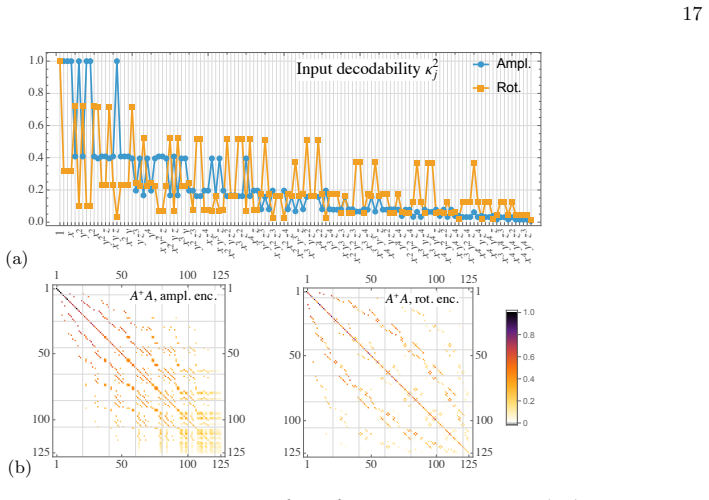
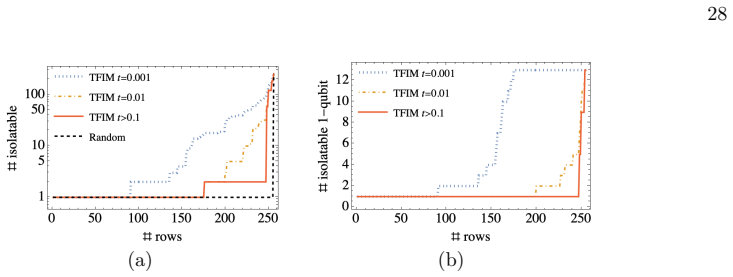
Quantum reservoir computers (QRCs) have emerged as a promising approach to quantum machine learning, since they utilize the natural dynamics of quantum systems for data processing and are simple to train. Here, we consider $n$-qubit quantum extreme learning machines (QELMs) with initial-state encoding and continuous-time reservoir dynamics. We apply the Pauli transfer matrix (PTM) formalism to theoretically analyze the influence of encoding, reservoir dynamics, and measurement operations (including temporal multiplexing) on the QELM performance. This formalism reveals the complete set of (nonlinear) features generated by the encoding, and shows how the subsequent quantum channels linearly transform these Pauli features before they are probed by the chosen measurement operators. Optimizing such a QELM can therefore be cast as a decoding problem in which one shapes the channel-induced transformations such that task-relevant features become available to the regressor, effectively reversing the information scrambling of a unitary. Operator spreading under unitary evolution determines decodability of Pauli features, which underlies the nonlinear processing capacity of the reservoir. When paired with certain observables, structured Hamiltonians can reduce model expressivity, as reflected in a low readout rank. We trace this effect to Hamiltonian symmetries and derive asymptotic rank estimates for symmetry-resolved observable families. The PTM formalism yields a nonlinear vector (auto-)regression model as an interpretable classical representation of a QELM. As a specific application, we focus on forecasting nonlinear dynamical systems and show that a QELM trained on such trajectories learns a surrogate-approximation to the underlying flow map.
Editorial analysis
A structured set of objections, weighed in public.
Referee Report
Summary. The manuscript develops a Pauli transfer matrix (PTM) formalism for analyzing n-qubit quantum extreme learning machines (QELMs) with initial-state encoding and continuous-time unitary reservoir dynamics. It shows that encoding generates a complete set of nonlinear Pauli features that are linearly transformed by the quantum channels before being probed by measurement operators (including temporal multiplexing). This yields an explicit nonlinear vector autoregression model as the classical interpretable representation of the QELM. The formalism is applied to forecasting nonlinear dynamical systems, where the trained QELM learns a surrogate approximation to the underlying flow map. Symmetry-resolved rank bounds for observables are derived from Hamiltonian symmetries.
Significance. If the central derivations hold, the work provides a rigorous algebraic bridge between quantum reservoir dynamics and classical nonlinear regression, enabling interpretability and design guidance for QELMs. The exact equivalence in the ideal unitary, infinite-shot limit (with no hidden parameters or fitted quantities) and the symmetry-based rank estimates are notable strengths that could inform practical reservoir engineering for time-series tasks.
major comments (2)
- [§4] §4 (PTM-derived regression model): the mapping to the nonlinear vector autoregression is derived algebraically for the ideal case, but the manuscript should explicitly bound the deviation when finite-shot sampling or weak decoherence is present, as these alter the effective channel transformations and could affect the surrogate flow-map claim for dynamical systems.
- [§5.2] §5.2 (dynamical systems forecasting): the surrogate-approximation result is shown via training on trajectories, but the rank estimates for symmetry-resolved observables (derived in §3) are not quantitatively linked to the observed prediction accuracy; a direct comparison of readout rank versus forecast error would strengthen the expressivity analysis.
minor comments (2)
- [Throughout] Notation for the PTM elements and feature vectors should be unified across sections to avoid redefinition of symbols such as the encoding map and channel superoperators.
- [Figure captions] Figure captions for the dynamical systems examples should include the specific Hamiltonian and observable choices used to generate the rank bounds.
Simulated Author's Rebuttal
We thank the referee for the constructive report and positive evaluation of the work. We address each major comment below and describe the revisions we will implement in the next version of the manuscript.
read point-by-point responses
-
Referee: [§4] §4 (PTM-derived regression model): the mapping to the nonlinear vector autoregression is derived algebraically for the ideal case, but the manuscript should explicitly bound the deviation when finite-shot sampling or weak decoherence is present, as these alter the effective channel transformations and could affect the surrogate flow-map claim for dynamical systems.
Authors: We agree that explicit bounds on deviations from the ideal unitary, infinite-shot limit would strengthen the practical interpretation. In the revised manuscript we will add a short subsection to §4 that derives first-order perturbative bounds: shot-noise deviations via Hoeffding-type concentration on the empirical PTM entries, and weak decoherence via a first-order expansion in the Lindblad operators. These bounds will be connected to the resulting error in the learned surrogate flow map for the dynamical-systems examples. revision: yes
-
Referee: [§5.2] §5.2 (dynamical systems forecasting): the surrogate-approximation result is shown via training on trajectories, but the rank estimates for symmetry-resolved observables (derived in §3) are not quantitatively linked to the observed prediction accuracy; a direct comparison of readout rank versus forecast error would strengthen the expressivity analysis.
Authors: We accept this suggestion. The original text presents the symmetry-resolved rank bounds in §3 but does not numerically correlate them with forecasting performance. In the revision we will augment §5.2 with a new figure that reports the effective readout rank (computed for each symmetry class of observables) alongside the corresponding mean forecast error on the tested dynamical systems, thereby providing a direct quantitative link between the theoretical rank analysis and the observed accuracy. revision: yes
Circularity Check
No significant circularity detected in PTM derivation
full rationale
The paper applies the standard Pauli transfer matrix formalism as an external analytical tool to map QELM encoding, continuous-time unitary dynamics, and measurements onto an explicit nonlinear vector autoregression model. All load-bearing steps are algebraic identities that hold exactly in the stated ideal unitary, infinite-shot limit; the surrogate flow-map claim follows directly from training the resulting classical regressor on trajectory data without any reduction to fitted parameters, self-definitional loops, or load-bearing self-citations. No uniqueness theorems or ansatzes are imported from the authors' prior work, and symmetry-based rank bounds are derived directly from the PTM representation itself. The derivation is therefore self-contained against external benchmarks.
Axiom & Free-Parameter Ledger
axioms (2)
- domain assumption The n-qubit reservoir evolves under continuous-time unitary dynamics generated by a time-independent Hamiltonian.
- domain assumption Measurements are performed via expectation values of chosen observables, possibly with temporal multiplexing.
Lean theorems connected to this paper
-
IndisputableMonolith/Cost/FunctionalEquation.leanwashburn_uniqueness_aczel unclear?
unclearRelation between the paper passage and the cited Recognition theorem.
The PTM formalism yields a nonlinear vector (auto-)regression model as an interpretable classical representation of a QELM... f(x) = wᵀ T_E^{(m)} ϕ(x)
-
IndisputableMonolith/Foundation/AlexanderDuality.leanalexander_duality_circle_linking unclear?
unclearRelation between the paper passage and the cited Recognition theorem.
Operator spreading under unitary evolution determines decodability of Pauli features... asymptotic rank estimates for symmetry-resolved observable families
What do these tags mean?
- matches
- The paper's claim is directly supported by a theorem in the formal canon.
- supports
- The theorem supports part of the paper's argument, but the paper may add assumptions or extra steps.
- extends
- The paper goes beyond the formal theorem; the theorem is a base layer rather than the whole result.
- uses
- The paper appears to rely on the theorem as machinery.
- contradicts
- The paper's claim conflicts with a theorem or certificate in the canon.
- unclear
- Pith found a possible connection, but the passage is too broad, indirect, or ambiguous to say the theorem truly supports the claim.
Reference graph
Works this paper leans on
-
[1]
Nonlinear monomials at readout Raw monomials inu α are often relevant features for practical applications, such as autoregressive learning of dynamical systems. Let thusB(u) ={1, u 1, . . . , u1u2, . . . ,Q α ur α}be the vector of size bof monomials of{u α}1≤α≤D up to degreer. The order-rTaylor expansion of the Pauli features {ϕj(u)}1≤j≤q within a small r...
work page 2000
-
[2]
For Clifford unitaries,T U is a signed permutation of Pauli strings
Unitary channels For a unitary channelU(ρ) =U ρU †, one has TU,αβ = 1 2n tr Pα U PβU † ,(D1) Trace preservation and unitality imply the form TU = 10 ⊤ 0Ω U ! ,(D2) i.e., the traceless coefficients undergo a real orthogonal rotation with Ω U ∈SO(d 2 −1). For Clifford unitaries,T U is a signed permutation of Pauli strings. Consider aseparablereservoir Hamil...
-
[3]
General quantum channels: affine action on the Bloch part Consider a channelEthat is completely positive and trace-preserving (CPTP) and has associated Kraus operators{K ℓ}. Then TE,αβ = 1 2n X ℓ tr PαKℓPβK † ℓ ,(D7) which corresponds in block form (compatible withϕ= (1,s)) to TE = 10 ⊤ tΩ ! ,s ′ =t+ Ωs,(D8) wheret=0for unital channels. For a single qubit...
-
[4]
Heisenberg sectors of the relevant observables For the TFIM in the form Eq. (2.5b), we introduce Jordan–Wigner Majorana quasiparticle op- erators γ2j−1 = Y m<j Zm Xj, γ 2j = Y m<j Zm Yj, j= 1, . . . , n,(E1) resulting in Hxx-z TFIM =iJ n−1X j=1 γ2jγ2j+1 +ih nX j=1 γ2j−1γ2j.(E2) Since the Hamiltonian is quadratic in the Majoranas, Heisenberg evolution acts...
-
[5]
Denote byR L the effective PTM in Eq
Asymptotic rank of the temporally multiplexed PTM We now connect the above Heisenberg-sector structure to the effective PTM in temporal mul- tiplexing. Denote byR L the effective PTM in Eq. (4.1) evaluated forLmultiplexing steps and 34 L(·) =i[H,·]. For generic couplingsJ, h̸= 0 and generic sampling times{t ℓ}, the large-Lrank is the dimension of the Heis...
-
[6]
A HamiltonianHinduces the Heisenberg evolutionO (H)(t) =e tLOwith LiouvillianL(O) =i[H, O]
Operator-space formulation of the effective PTM LetHbe ad-dimensional Hilbert space and letObe the associated operator space equipped with the Hilbert–Schmidt inner product⟨A, B⟩= 1 dtr(A†B). A HamiltonianHinduces the Heisenberg evolutionO (H)(t) =e tLOwith LiouvillianL(O) =i[H, O]. Given a selected observable familyS, the “seed” space of measurement oper...
-
[7]
Invariant sectors induced by symmetries Assume a symmetry of the Liouvillian described by the superoperator Γ :O → Osatisfying [Γ,L] = 0.(F6) In the physically relevant cases of a unitary or Hermitian Γ, the spectral theorem yields Γ =P α λαΠα, where the Π α are mutually orthogonal spectral projectors. These render the orthogonal decomposition O= M α Oα,Π...
-
[8]
(F16) determines only the maximal accessible dimension
Hamiltonian criteria for underexploration The symmetry decomposition in Eq. (F16) determines only the maximal accessible dimension. Whether a populated sector is fully explored depends on the restricted generatorL| Oα and on the choice of seed subspaceM α. LetO α be a symmetry-compatible invariant sector andL α :=L| Oα. As above, we consider the spectral ...
-
[9]
We set thusF=Oand choose a one-dimensional seed spaceM= span{O}for a single observableO
Single-observable limit We now apply the above formalism, to the Krylov grade of a single observable, recovering a key result in [47]. We set thusF=Oand choose a one-dimensional seed spaceM= span{O}for a single observableO. Then the Krylov gradeMis the dimension of the minimal Liouvillian Krylov space generated byO[47], M:= dim span{O,L(O),L 2(O), . . .}=...
-
[10]
Hilbert-space symmetries Consider an ordinary Hilbert-space symmetries withU HU † =H
Examples of symmetry-induced rank bounds a. Hilbert-space symmetries Consider an ordinary Hilbert-space symmetries withU HU † =H. Then the superoperator ΓU(O) =U OU † (F29) is unitary onOand satisfies [Γ U ,L] = 0. Similarly, for aZ 2 symmetry withU 2 =I, the corre- sponding superoperator is Π± = 1 2(I O ±Γ U).(F30) IfQ= P q qPq is a conserved charge with...
-
[11]
Consequences for PTM analysis and feature decodability In a symmetry-adapted orthonormal operator basis, the unitary PTM becomes block diagonal, V(t) = M α Vα(t),(F36) Accordingly, the temporally multiplexed effective PTM (4.1) can be brought into a block form RL ∼ M α RL,α,(F37) and the projector defined in Eq. (4.18) decomposes as R+ L RL ∼ M α R+ L,αRL...
-
[12]
K. Fujii and K. Nakajima, Harnessing Disordered-Ensemble Quantum Dynamics for Machine Learn- ing, Phys. Rev. Applied8, 024030 (2017). 40
work page 2017
-
[13]
A. Sakurai, M. P. Estarellas, W. J. Munro, and K. Nemoto, Quantum Extreme Reservoir Computation Utilizing Scale-Free Networks, Phys. Rev. Applied17, 064044 (2022)
work page 2022
-
[14]
M. Kornjaˇ ca, H.-Y. Hu, C. Zhao, J. Wurtz, P. Weinberg, M. Hamdan, A. Zhdanov, S. H. Cantu, H. Zhou, R. A. Bravo, K. Bagnall, J. I. Basham, J. Campo, A. Choukri, R. DeAngelo, P. Frederick, D. Haines, J. Hammett, N. Hsu, M.-G. Hu, F. Huber, P. N. Jepsen, N. Jia, T. Karolyshyn, M. Kwon, J. Long, J. Lopatin, A. Lukin, T. Macr` ı, O. Markovi´ c, L. A. Mart´ ...
-
[15]
A. Sakurai, A. Hayashi, W. J. Munro, and K. Nemoto, Simple Hamiltonian dynamics is a powerful quantum processing resource (2025), arXiv:2405.14245 [quant-ph]
- [16]
-
[17]
J. Chen, H. I. Nurdin, and N. Yamamoto, Temporal Information Processing on Noisy Quantum Computers, Phys. Rev. Applied14, 024065 (2020)
work page 2020
- [18]
- [19]
- [20]
- [21]
-
[22]
P. Pfeffer, F. Heyder, and J. Schumacher, Hybrid quantum-classical reservoir computing of thermal convection flow, Phys. Rev. Research4, 033176 (2022), arXiv:2204.13951 [quant-ph]
-
[23]
P. Pfeffer, F. Heyder, and J. Schumacher, Reduced-order modeling of two-dimensional turbulent Rayleigh-B´ enard flow by hybrid quantum-classical reservoir computing, Phys. Rev. Research5, 043242 (2023), arXiv:2307.03053 [physics]
-
[24]
A. Suprano, D. Zia, L. Innocenti, S. Lorenzo, V. Cimini, T. Giordani, I. Palmisano, E. Polino, N. Spagnolo, F. Sciarrino, G. M. Palma, A. Ferraro, and M. Paternostro, Experimental Property Reconstruction in a Photonic Quantum Extreme Learning Machine, Phys. Rev. Lett.132, 160802 (2024)
work page 2024
-
[25]
M. Vetrano, G. Lo Monaco, L. Innocenti, S. Lorenzo, and G. M. Palma, State estimation with quantum extreme learning machines beyond the scrambling time, npj Quantum Information11, 20 (2025)
work page 2025
-
[26]
D. Zia, L. Innocenti, G. Minati, S. Lorenzo, A. Suprano, R. D. Bartolo, N. Spagnolo, T. Giordani, V. Cimini, G. M. Palma, A. Ferraro, F. Sciarrino, and M. Paternostro, Quantum reservoir com- puting for photonic entanglement witnessing, Science Advances11, 10.1126/sciadv.ady7987 (2025), arXiv:2502.18361 [quant-ph]
- [27]
-
[28]
J. R. McClean, S. Boixo, V. N. Smelyanskiy, R. Babbush, and H. Neven, Barren plateaus in quantum neural network training landscapes, Nature Communications9, 4812 (2018)
work page 2018
-
[29]
M. Larocca, S. Thanasilp, S. Wang, K. Sharma, J. Biamonte, P. J. Coles, L. Cincio, J. R. McClean, Z. Holmes, and M. Cerezo, Barren Plateaus in Variational Quantum Computing, Nature Reviews Physics7, 174 (2025), arXiv:2405.00781 [quant-ph]
-
[30]
L. Domingo, G. Carlo, and F. Borondo, Taking advantage of noise in quantum reservoir computing (2023), arXiv:2301.06814 [quant-ph]
-
[31]
D. Fry, A. Deshmukh, S. Y.-C. Chen, V. Rastunkov, and V. Markov, Optimizing quantum noise- induced reservoir computing for nonlinear and chaotic time series prediction, Scientific Reports13, 19326 (2023). 41
work page 2023
- [32]
-
[33]
F. Monzani, E. Ricci, L. Nigro, and E. Prati, Non-unital noise in a superconducting quantum computer as a computational resource for reservoir computing (2024), arXiv:2409.07886 [quant-ph]
- [34]
-
[35]
J. Nokkala, R. Mart´ ınez-Pe˜ na, G. L. Giorgi, V. Parigi, M. C. Soriano, and R. Zambrini, Gaussian states of continuous-variable quantum systems provide universal and versatile reservoir computing, Communications Physics4, 53 (2021)
work page 2021
-
[36]
L. C. G. Govia, G. J. Ribeill, G. E. Rowlands, and T. A. Ohki, Nonlinear input transformations are ubiquitous in quantum reservoir computing, Neuromorphic Computing and Engineering2, 014008 (2022)
work page 2022
-
[37]
J. Chen and H. I. Nurdin, Learning Nonlinear Input-Output Maps with Dissipative Quantum Systems, Quantum Information Processing18, 198 (2019), arXiv:1901.01653 [quant-ph]
- [38]
-
[39]
R. Mart´ ınez-Pe˜ na and J.-P. Ortega, Quantum reservoir computing in finite dimensions, Phys. Rev. E 107, 035306 (2023)
work page 2023
-
[40]
F. Monzani and E. Prati, Universality conditions of unified classical and quantum reservoir computing (2024), arXiv:2401.15067 [quant-ph]
-
[41]
L. Gonon and A. Jacquier, Universal Approximation Theorem and Error Bounds for Quantum Neural Networks and Quantum Reservoirs, IEEE Transactions on Neural Networks and Learning Systems 36, 11355 (2025)
work page 2025
-
[42]
M. Schuld, Supervised quantum machine learning models are kernel methods, Journal of Machine Learning Research 10.1145/3451902.3451903 (2021)
-
[43]
M. Gross and H.-M. Rieser, Kernel-based optimization of measurement operators for quantum reser- voir computers (2026), arXiv:2602.14677 [quant-ph]
-
[44]
A. Canatar, E. Peters, C. Pehlevan, and S. Wild, Bandwidth enables generalization in quantum kernel models, Trans. Mach. Learn. Res.2023(2022)
work page 2023
-
[45]
M. Gross, M. Lange, B. Bujnowski, and H.-M. Rieser, Expressivity vs. Generalization in Quantum Kernel Methods, in33rd European Symposium on Artificial Neural Networks, Computational Intel- ligence and Machine Learning, ESANN 2025, edited by M. Verleysen (Ciaco - i6doc.com, Bruges, Belgium, 2025) pp. 543–548
work page 2025
-
[46]
M. Kempkes, A. Ijaz, E. Gil-Fuster, C. Bravo-Prieto, J. Spiegelberg, E. van Nieuwenburg, and V. Dun- jko, Double descent in quantum kernel methods, PRX Quantum7, 010312 (2026), arXiv:2501.10077 [quant-ph]
-
[47]
K. Fujii and K. Nakajima, Quantum reservoir computing: A reservoir approach toward quantum machine learning on near-term quantum devices (2020), arXiv:2011.04890 [quant-ph]
- [48]
- [49]
-
[50]
G.-B. Huang, Q.-Y. Zhu, and C.-K. Siew, Extreme learning machine: Theory and applications, Neu- rocomputing Neural Networks,70, 489 (2006)
work page 2006
-
[51]
A. Rahimi and B. Recht, Random Features for Large-Scale Kernel Machines, inAdvances in Neural Information Processing Systems, Vol. 20 (Curran Associates, Inc., 2007)
work page 2007
-
[52]
R. Mart´ ınez-Pe˜ na, G. L. Giorgi, J. Nokkala, M. C. Soriano, and R. Zambrini, Dynamical Phase Transitions in Quantum Reservoir Computing, Phys. Rev. Lett.127, 100502 (2021). 42
work page 2021
-
[53]
L. Domingo, G. Carlo, and F. Borondo, Optimal quantum reservoir computing for the noisy intermediate-scale quantum era, Phys. Rev. E106, L043301 (2022)
work page 2022
-
[54]
A. Hayashi, A. Sakurai, S. Nishio, W. J. Munro, and K. Nemoto, Impact of the form of weighted networks on the quantum extreme reservoir computation, Phys. Rev. A108, 042609 (2023), arXiv:2211.07841 [quant-ph]
-
[55]
N. G¨ otting, F. Lohof, and C. Gies, Exploring quantumness in quantum reservoir computing, Phys. Rev. A108, 052427 (2023)
work page 2023
-
[56]
L. Innocenti, S. Lorenzo, I. Palmisano, A. Ferraro, M. Paternostro, and G. M. Palma, Potential and limitations of quantum extreme learning machines, Communications Physics6, 118 (2023)
work page 2023
-
[57]
S. Kobayashi, Q. H. Tran, and K. Nakajima, Coherence influx is indispensable for quantum reservoir computing (2024), arXiv:2409.12693 [quant-ph]
-
[58]
S. ˇCindrak, L. Jaurigue, and K. L¨ udge, Engineering Quantum Reservoirs through Krylov Complexity, Expressivity and Observability (2025), arXiv:2409.12079 [quant-ph]
-
[59]
Expressiv- ity limits of quantum reservoir computing, 2025
N.-E. Sch¨ utte, N. G¨ otting, H. M¨ untinga, M. List, D. Brunner, and C. Gies, Expressivity Limits of Quantum Reservoir Computing (2025), arXiv:2501.15528 [quant-ph]
-
[60]
R. Mart´ ınez-Pe˜ na and J.-P. Ortega, Input-dependence in quantum reservoir computing, Phys. Rev. E111, 065306 (2025)
work page 2025
-
[61]
A. D. Lorenzis, M. P. Casado, N. L. Gullo, T. Lux, F. Plastina, and A. Riera, Entanglement and Classical Simulability in Quantum Extreme Learning Machines (2025), arXiv:2509.06873 [quant-ph]
work page internal anchor Pith review Pith/arXiv arXiv 2025
- [62]
- [63]
- [64]
- [65]
-
[66]
R. Mart´ ınez-Pe˜ na, J. Nokkala, G. L. Giorgi, R. Zambrini, and M. C. Soriano, Information Processing Capacity of Spin-Based Quantum Reservoir Computing Systems, Cognitive Computation15, 1440 (2023)
work page 2023
-
[67]
Z. Shumaylov, P. Zaika, P. Scholl, G. Kutyniok, L. Horesh, and C.-B. Sch¨ onlieb, When is a System Discoverable from Data? Discovery Requires Chaos (2025), arXiv:2511.08860 [math]
- [68]
-
[69]
C. Weedbrook, S. Pirandola, R. Garcia-Patron, N. J. Cerf, T. C. Ralph, J. H. Shapiro, and S. Lloyd, Gaussian Quantum Information, Reviews of Modern Physics84, 621 (2012), arXiv:1110.3234 [quant- ph]
work page internal anchor Pith review Pith/arXiv arXiv 2012
- [70]
-
[71]
M. Schuld and F. Petruccione,Machine Learning with Quantum Computers(Springer, Cham, 2021)
work page 2021
- [72]
-
[73]
L. Hantzko, L. Binkowski, and S. Gupta, Fast generation of Pauli transfer matrices utilizing tensor product structure, Physica Scripta100, 075125 (2025), arXiv:2411.00526 [quant-ph]
-
[74]
A. Angrisani, A. Schmidhuber, M. S. Rudolph, M. Cerezo, Z. Holmes, and H.-Y. Huang, Classically estimating observables of noiseless quantum circuits (2025), arXiv:2409.01706 [quant-ph]
-
[75]
H. So, K. W. Chan, Y. Chan, and K. Ho, Linear prediction approach for efficient frequency estimation of multiple real sinusoids: Algorithms and analyses, IEEE Transactions on Signal Processing53, 2290 (2005)
work page 2005
-
[76]
S. V. Vaseghi,Advanced Digital Signal Processing and Noise Reduction(Wiley, Chichester, U.K, 2008). 43
work page 2008
-
[77]
E. Peters and M. Schuld, Generalization despite overfitting in quantum machine learning models, Quantum6, 777 (2022)
work page 2022
-
[78]
S. ˇCindrak, B. Donvil, K. L¨ udge, and L. Jaurigue, Enhancing the performance of quantum reservoir computing and solving the time-complexity problem by artificial memory restriction, Phys. Rev. Research6, 013051 (2024)
work page 2024
-
[79]
S. ˇCindrak, K. L¨ udge, and L. Jaurigue, From Krylov Complexity to Observability: Capturing Phase Space Dimension with Applications in Quantum Reservoir Computing (2025), arXiv:2502.12157 [quant-ph]
-
[80]
J. Steinegger and C. R¨ ath, Predicting three-dimensional chaotic systems with four qubit quantum systems, Scientific Reports15, 6201 (2025), arXiv:2501.15191 [quant-ph]
discussion (0)
Sign in with ORCID, Apple, or X to comment. Anyone can read and Pith papers without signing in.