Qubit discretizations of d=3 conformal field theories
Pith reviewed 2026-05-15 15:41 UTC · model grok-4.3
The pith
Scaling dimensions of three-dimensional conformal field theories can be read from the low-energy spectrum of small qubit systems on polyhedral lattices.
A machine-rendered reading of the paper's core claim, the machinery that carries it, and where it could break.
Core claim
By tuning the couplings of a quantum many-body Hamiltonian on a polyhedral lattice, the low-lying spectrum of a modest number of qubits directly encodes the scaling dimensions of the corresponding d=3 conformal field theory through the state-operator correspondence, as demonstrated by accurate extraction of several operators in the Ising CFT from a 20-qubit system.
What carries the argument
The conformal state-operator correspondence observed in the spectrum of a qubit Hamiltonian on a polyhedral lattice with couplings tuned for maximal accuracy.
If this is right
- Scaling dimensions of multiple operators in the 3D Ising CFT are recoverable to a few percent accuracy from the spectrum of a 20-qubit system.
- The same protocol applies to other d=3 CFTs with only the assumption of conformal invariance.
- Near-term quantum platforms can address 3D CFT problems that are computationally hard on classical hardware.
- Implementation requires polyhedral lattice geometries and precise coupling tuning on qubit devices.
Where Pith is reading between the lines
- Quantum simulators could access CFT data for models lacking exact solutions by direct spectrum measurement.
- The polyhedral lattice choice may generalize to other dimensions or lattice geometries for improved accuracy.
- Direct comparison of simulated spectra against known CFT tables would provide a near-term experimental test.
- The method could be combined with variational quantum eigensolvers to reach larger system sizes.
Load-bearing premise
Specific choices of couplings on the polyhedral lattice make the conformal state-operator correspondence visible most accurately in the low-energy spectrum.
What would settle it
Measuring the low-lying spectrum of the 20-qubit Ising Hamiltonian at the proposed couplings and finding extracted scaling dimensions that differ from known CFT values by far more than a few percent.
Figures



read the original abstract
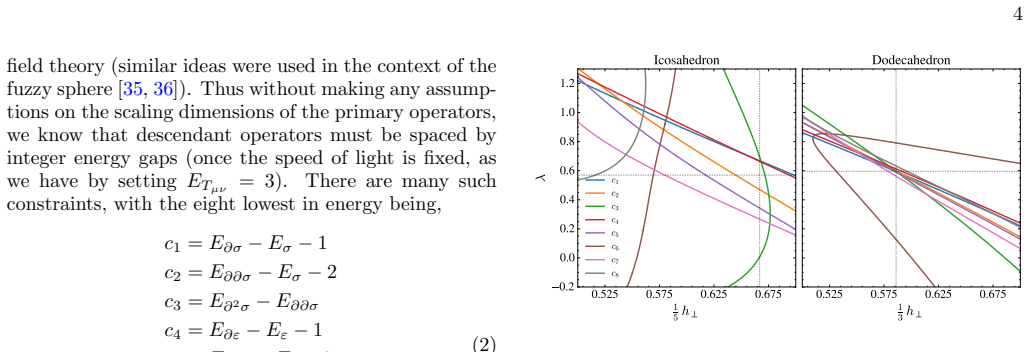
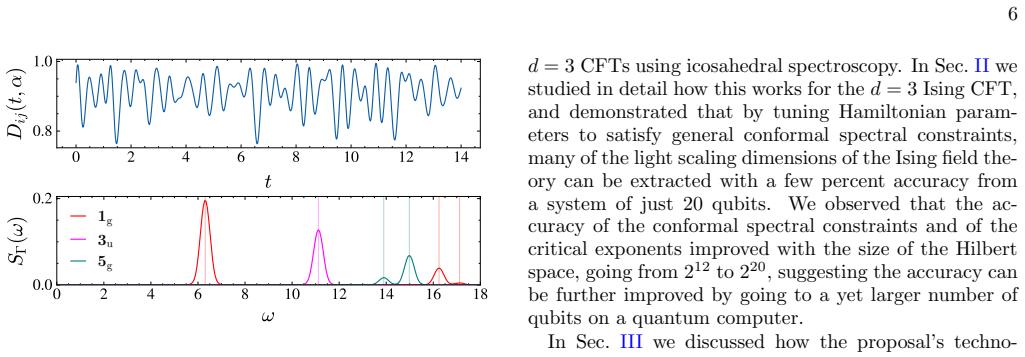
We propose that scaling dimensions of d=3 conformal field theories can be studied on a system of qubits with near term quantum simulation platforms. Our proposal chooses couplings of quantum many-body problems on a polyhedral lattice at which the conformal state-operator correspondence can be observed most accurately in the spectrum. We validate our protocol on the Ising model where we extract the scaling dimensions of a number of scaling operators with a few percent accuracy from the spectrum of a system of just 20 qubits. The procedure makes only minor assumptions beyond general conformal invariance -- it may hence be applied widely. Requirements and challenges to realize this proposal on quantum computers are discussed. Our results demonstrate that for current or near term qubit platforms, three dimensional conformal field theories present a unique opportunity -- a forefront problem that is difficult on classical computers but may be solved through quantum simulation.
Editorial analysis
A structured set of objections, weighed in public.
Referee Report
Summary. The paper proposes that scaling dimensions of d=3 CFTs can be extracted from the low-lying spectrum of qubit Hamiltonians on polyhedral lattices by tuning couplings to optimize the conformal state-operator correspondence. It validates the protocol on the 3D Ising CFT, reporting few-percent accuracy in extracted dimensions from a 20-qubit system, and claims the method relies only on minor assumptions beyond general conformal invariance, making it suitable for near-term quantum simulators.
Significance. If the coupling-selection procedure can be made non-circular and the error analysis strengthened, the approach could enable quantum simulation of 3D CFT data that remains challenging for classical methods such as conformal bootstrap or Monte Carlo. The Ising validation with small qubit counts demonstrates a concrete advantage for current hardware, and the emphasis on polyhedral lattices provides a clear discretization route.
major comments (2)
- [Protocol section] Protocol section (likely §3): the claim that couplings are chosen 'at which the conformal state-operator correspondence can be observed most accurately' lacks an explicit, non-circular algorithm. The Ising validation uses the known critical point; without a concrete optimization criterion or search method that does not presuppose the target spectrum, the procedure cannot be applied to unknown CFTs as asserted.
- [Ising validation] Ising validation (likely §4): the reported few-percent accuracy in scaling dimensions is presented without a full error budget, including finite-size corrections, lattice discretization artifacts, and the precise matching procedure between eigenstates and operators. This undermines quantitative assessment of the central claim.
minor comments (2)
- [Abstract] Abstract: the description of spectrum extraction and coupling choice remains high-level; a sentence clarifying the non-circular selection criterion would improve readability.
- [Methods] Notation: the definition of the polyhedral lattice Hamiltonian and the precise form of the state-operator map should be stated explicitly with an equation number for reproducibility.
Simulated Author's Rebuttal
We thank the referee for their thorough review and constructive feedback. We appreciate the recognition of the potential of our approach for quantum simulation of 3D CFTs. Below, we address the major comments point by point and outline the revisions we will make to the manuscript.
read point-by-point responses
-
Referee: [Protocol section] Protocol section (likely §3): the claim that couplings are chosen 'at which the conformal state-operator correspondence can be observed most accurately' lacks an explicit, non-circular algorithm. The Ising validation uses the known critical point; without a concrete optimization criterion or search method that does not presuppose the target spectrum, the procedure cannot be applied to unknown CFTs as asserted.
Authors: We agree that an explicit, non-circular algorithm for selecting the couplings is essential for the protocol to be applicable to unknown CFTs. In the current manuscript, the Ising validation indeed uses the known critical couplings of the model. To address this, we will revise §3 to include a concrete optimization procedure: we propose scanning the coupling space and selecting the point that maximizes the 'conformality' measure, defined as the alignment of the spectrum with expected CFT features such as the appearance of degenerate multiplets corresponding to spin and parity quantum numbers, and the approximate satisfaction of the state-operator correspondence without assuming the numerical values of the dimensions. This criterion does not presuppose the target spectrum values but relies on the structural properties of conformal invariance. We believe this makes the method non-circular and suitable for broader application. revision: yes
-
Referee: [Ising validation] Ising validation (likely §4): the reported few-percent accuracy in scaling dimensions is presented without a full error budget, including finite-size corrections, lattice discretization artifacts, and the precise matching procedure between eigenstates and operators. This undermines quantitative assessment of the central claim.
Authors: We concur that a full error budget is necessary to substantiate the few-percent accuracy claim. In the revised version, we will expand §4 to provide a detailed breakdown of errors, including estimates of finite-size corrections based on the polyhedral lattice size, discretization artifacts arising from the qubit encoding of the continuum fields, and a step-by-step description of the eigenstate-to-operator matching procedure using conserved quantum numbers and degeneracy patterns. This will enable a more rigorous quantitative evaluation of the results. revision: yes
Circularity Check
No significant circularity; proposal grounded in general conformal invariance with independent Ising validation
full rationale
The paper proposes selecting couplings on polyhedral lattices to observe the conformal state-operator correspondence most accurately in the qubit spectrum, then validates by extracting known Ising CFT scaling dimensions to a few percent accuracy from a 20-qubit system. This relies on general conformal invariance with only minor additional assumptions and does not reduce the extracted dimensions to fitted parameters or self-definitions by construction. No load-bearing steps collapse to self-citations, ansatze smuggled via prior work, or renaming of known results; the central claim remains independent of the validation data and is presented as applicable to unknown d=3 CFTs.
Axiom & Free-Parameter Ledger
free parameters (1)
- polyhedral-lattice couplings
axioms (1)
- domain assumption conformal invariance of the target d=3 theory
Lean theorems connected to this paper
-
IndisputableMonolith/Foundation/AlexanderDuality.leanalexander_duality_circle_linking echoes?
echoesECHOES: this paper passage has the same mathematical shape or conceptual pattern as the Recognition theorem, but is not a direct formal dependency.
We propose that scaling dimensions of d=3 conformal field theories can be studied on a system of qubits... polyhedral lattice at which the conformal state-operator correspondence can be observed most accurately
-
IndisputableMonolith/Foundation/AlexanderDuality.leanD3_admits_circle_linking echoes?
echoesECHOES: this paper passage has the same mathematical shape or conceptual pattern as the Recognition theorem, but is not a direct formal dependency.
the largest discrete subgroup of O(3) is Ih... icosahedron (12 qubits) and dodecahedron (20 qubits)
What do these tags mean?
- matches
- The paper's claim is directly supported by a theorem in the formal canon.
- supports
- The theorem supports part of the paper's argument, but the paper may add assumptions or extra steps.
- extends
- The paper goes beyond the formal theorem; the theorem is a base layer rather than the whole result.
- uses
- The paper appears to rely on the theorem as machinery.
- contradicts
- The paper's claim conflicts with a theorem or certificate in the canon.
- unclear
- Pith found a possible connection, but the passage is too broad, indirect, or ambiguous to say the theorem truly supports the claim.
Reference graph
Works this paper leans on
-
[1]
J. Cardy,Scaling and Renormalization in Statistical Physics, Cambridge Lecture Notes in Physics (Cam- bridge University Press, 1996)
work page 1996
-
[2]
P. Di Francesco, P. Mathieu, and D. Senechal,Conformal Field Theory, Graduate Texts in Contemporary Physics (Springer-Verlag, New York, 1997)
work page 1997
-
[3]
Applied Conformal Field Theory
P. Ginsparg, Applied conformal field theory (1988), arXiv:hep-th/9108028 [hep-th]
work page internal anchor Pith review Pith/arXiv arXiv 1988
-
[4]
K. G. Wilson, The renormalization group and critical phenomena, Rev. Mod. Phys.55, 583 (1983)
work page 1983
-
[5]
A. Pelissetto and E. Vicari, Critical phenomena and renormalization-group theory, Physics Reports368, 549 (2002)
work page 2002
-
[6]
M. Hasenbusch, Finite size scaling study of lattice models in the three-dimensional ising universality class, Phys. Rev. B82, 174433 (2010)
work page 2010
-
[7]
A. M. Polyakov, Conformal symmetry of critical fluctu- ations, JETP Lett.12, 381 (1970)
work page 1970
-
[8]
S. Rychkov,EPFL Lectures on Conformal Field Theory in D≥33 Dimensions(Springer International Publish- ing, 2017)
work page 2017
-
[9]
S. El-Showk, M. F. Paulos, D. Poland, S. Rychkov, D. Simmons-Duffin, and A. Vichi, Solving the 3d ising model with the conformal bootstrap, Phys. Rev. D86, 025022 (2012)
work page 2012
-
[10]
D. Poland, S. Rychkov, and A. Vichi, The conformal bootstrap: Theory, numerical techniques, and applica- tions, Reviews of Modern Physics91, 10.1103/revmod- phys.91.015002 (2019)
-
[11]
S. Rychkov, Conformal bootstrap: From polyakov to our times, International Journal of Modern Physics A40, 10.1142/s0217751x25300212 (2025)
-
[12]
W. Zhu, C. Han, E. Huffman, J. S. Hofmann, and Y.- C. He, Uncovering conformal symmetry in the 3d ising transition: State-operator correspondence from a quan- tum fuzzy sphere regularization, Physical Review X13, 10.1103/physrevx.13.021009 (2023)
-
[13]
R. P. Feynman, Simulating physics with computers, in Feynman and computation(cRc Press, 2018) pp. 133– 153
work page 2018
-
[14]
I. Georgescu, S. Ashhab, and F. Nori, Quantum simula- tion, Reviews of Modern Physics86, 153–185 (2014). 8
work page 2014
-
[15]
E. Altman, K. R. Brown, G. Carleo, L. D. Carr, E. Dem- ler, C. Chin, B. DeMarco, S. E. Economou, M. A. Eriks- son, K.-M. C. Fu, M. Greiner, K. R. Hazzard, R. G. Hulet, A. J. Koll´ ar, B. L. Lev, M. D. Lukin, R. Ma, X. Mi, S. Misra, C. Monroe, K. Murch, Z. Nazario, K.-K. Ni, A. C. Potter, P. Roushan, M. Saffman, M. Schleier- Smith, I. Siddiqi, R. Simmonds,...
work page 2021
- [16]
-
[17]
Y. Kim, A. Eddins, S. Anand, K. X. Wei, E. Van Den Berg, S. Rosenblatt, H. Nayfeh, Y. Wu, M. Zale- tel, K. Temme,et al., Evidence for the utility of quan- tum computing before fault tolerance, Nature618, 500 (2023)
work page 2023
-
[18]
H. Bernien, S. Schwartz, A. Keesling, H. Levine, A. Om- ran, H. Pichler, S. Choi, A. S. Zibrov, M. Endres, M. Greiner, V. Vuleti´ c, and M. D. Lukin, Probing many- body dynamics on a 51-atom quantum simulator, Nature 551, 579–584 (2017)
work page 2017
-
[19]
S. Ebadi, T. T. Wang, H. Levine, A. Keesling, G. Se- meghini, A. Omran, D. Bluvstein, R. Samajdar, H. Pich- ler, W. W. Ho, S. Choi, S. Sachdev, M. Greiner, V. Vuleti´ c, and M. D. Lukin, Quantum phases of matter on a 256-atom programmable quantum simulator, Nature 595, 227–232 (2021)
work page 2021
- [20]
-
[21]
Y. Salath´ e, M. Mondal, M. Oppliger, J. Heinsoo, P. Kurpiers, A. Potoˇ cnik, A. Mezzacapo, U. Las Heras, L. Lamata, E. Solano, S. Filipp, and A. Wallraff, Digital quantum simulation of spin models with circuit quantum electrodynamics, Phys. Rev. X5, 021027 (2015)
work page 2015
-
[22]
B.-X. Lao and S. Rychkov, 3d ising cft and exact di- agonalization on icosahedron: The power of conformal perturbation theory, SciPost Physics15, 10.21468/sci- postphys.15.6.243 (2023)
-
[23]
E. Arguello Cruz, I. R. Klebanov, G. Tarnopolsky, and Y. Xin, Yang-lee quantum criticality in various dimen- sions, Phys. Rev. X16, 011022 (2026)
work page 2026
-
[24]
J. L. Cardy, Conformal invariance and universality in finite-size scaling, J. Phys. A17, L385 (1984)
work page 1984
-
[25]
J. L. Cardy, Universal amplitudes in finite-size scaling: generalisation to arbitrary dimensionality, J. Phys. A18, L757 (1985)
work page 1985
-
[26]
J. L. Cardy, Operator content of two-dimensional con- formally invariant theories, Nuclear Physics B270, 186 (1986)
work page 1986
-
[27]
N. V. Cohan, The spherical harmonics with the symme- try of the icosahedral group, Mathematical Proceedings of the Cambridge Philosophical Society54, 286 (1958)
work page 1958
- [28]
-
[29]
M. Schuler, S. Whitsitt, L.-P. Henry, S. Sachdev, and A. M. L¨ auchli, Universal signatures of quantum critical points from finite-size torus spectra: A window into the operator content of higher-dimensional conformal field theories, Phys. Rev. Lett.117, 210401 (2016)
work page 2016
-
[30]
M. Suzuki, Relationship between d-Dimensional Quan- tal Spin Systems and (d+1)-Dimensional Ising Systems: Equivalence, Critical Exponents and Systematic Approx- imants of the Partition Function and Spin Correlations, Prog. Theor. Phys.56, 1454 (1976)
work page 1976
-
[31]
Sachdev,Quantum phase transitions, second ed
S. Sachdev,Quantum phase transitions, second ed. ed. (Cambridge University Press, Cambridge, 2011)
work page 2011
-
[32]
F. Alcaraz and H. Herrmann, Numerical difficulties in ob- taining 3d critical exponents from platonic solids, Journal of Physics A: Mathematical and General20, 5735 (1987)
work page 1987
-
[33]
M. Weigel and W. Janke, Universal amplitude-exponent relation for the ising model on sphere-like lattices, Euro- physics Letters (EPL)51, 578–583 (2000)
work page 2000
-
[34]
J.-M. Dong, Y. Zhang, K.-W. Huang, H.-H. Tu, and Y.- H. Wu, Numerical extraction of crosscap coefficients in microscopic models for (2 + 1)D conformal field theory, Phys. Rev. D112, L121701 (2025)
work page 2025
-
[35]
Z. Zhou and Y.-C. He, 3d conformal field theories with Sp(n) global symmetry on a fuzzy sphere, Phys. Rev. Lett.135, 026504 (2025)
work page 2025
-
[36]
Z. Zhou, Fuzzified : Julia package for numerics on the fuzzy sphere (2025), arXiv:2503.00100 [cond-mat.str-el]
- [37]
-
[38]
P. R. Cromwell,Polyhedra(Cambridge University Press, 1997)
work page 1997
- [39]
-
[40]
D. Barredo, V. Lienhard, S. de L´ es´ eleuc, T. Lahaye, and A. Browaeys, Synthetic three-dimensional atomic structures assembled atom by atom, Nature561, 79–82 (2018)
work page 2018
-
[41]
R. Lin, H.-S. Zhong, Y. Li, Z.-R. Zhao, L.-T. Zheng, T.-R. Hu, H.-M. Wu, Z. Wu, W.-J. Ma, Y. Gao, Y.-K. Zhu, Z.-F. Su, W.-L. Ouyang, Y.-C. Zhang, J. Rui, M.- C. Chen, C.-Y. Lu, and J.-W. Pan, Ai-enabled parallel assembly of thousands of defect-free neutral atom arrays, Phys. Rev. Lett.135, 060602 (2025)
work page 2025
-
[42]
A. Byun, M. Kim, and J. Ahn, Finding the maximum independent sets of platonic graphs using rydberg atoms, PRX Quantum3, 030305 (2022)
work page 2022
-
[43]
B. Gr¨ unbaum, V. Klee, M. A. Perles, and G. C. Shep- hard,Convex polytopes, Vol. 16 (Springer, 1967)
work page 1967
-
[44]
A. Periwal, E. S. Cooper, P. Kunkel, J. F. Wienand, E. J. Davis, and M. Schleier-Smith, Programmable in- teractions and emergent geometry in an array of atom clouds, Nature600, 630–635 (2021)
work page 2021
-
[45]
M. Valentini, M. W. van Mourik, F. Butt, J. Wahl, M. Di- etl, M. Pfeifer, F. Anmasser, Y. Colombe, C. R¨ ossler, P. C. Holz, R. Blatt, A. Bermudez, M. M¨ uller, T. Monz, and P. Schindler, Demonstration of two-dimensional con- nectivity for a scalable error-corrected ion-trap quantum processor architecture, Phys. Rev. X15, 041023 (2025)
work page 2025
-
[46]
Science Advances 6(25), 4935 (2020) https://doi.org/ 10.1126/sciadv.aba4935
K. Xu, Z.-H. Sun, W. Liu, Y.-R. Zhang, H. Li, H. Dong, W. Ren, P. Zhang, F. Nori, D. Zheng, H. Fan, and H. Wang, Probing dynamical phase transitions with a superconducting quantum sim- ulator, Science Advances6, eaba4935 (2020), https://www.science.org/doi/pdf/10.1126/sciadv.aba4935
-
[47]
M. Will, T. A. Cochran, E. Rosenberg, B. Jobst, N. M. Eassa, P. Roushan, M. Knap, A. Gammon-Smith, and F. Pollmann, Probing non-equilibrium topological order 9 on a quantum processor, Nature645, 348–353 (2025)
work page 2025
-
[48]
T. I. Andersen, N. Astrakhantsev, A. H. Karamlou, J. Berndtsson, J. Motruk, A. Szasz, J. A. Gross, A. Schuckert, T. Westerhout, Y. Zhang, E. Forati, D. Rossi, B. Kobrin, A. D. Paolo, A. R. Klots, I. Droz- dov, V. D. Kurilovich, A. Petukhov, L. B. Ioffe, A. Elben, A. Rath, V. Vitale, B. Vermersch, R. Acharya, L. A. Beni, K. Anderson, M. Ansmann, F. Arute, ...
work page 2025
-
[49]
S. J. Evered, M. Kalinowski, A. A. Geim, T. Manovitz, D. Bluvstein, S. H. Li, N. Maskara, H. Zhou, S. Ebadi, M. Xu, J. Campo, M. Cain, S. Ostermann, S. F. Yelin, S. Sachdev, M. Greiner, V. Vuleti´ c, and M. D. Lukin, Probing the kitaev honeycomb model on a neutral-atom quantum computer, Nature645, 341–347 (2025)
work page 2025
-
[50]
L. M. K. Vandersypen and I. L. Chuang, Nmr techniques for quantum control and computation, Rev. Mod. Phys. 76, 1037 (2005)
work page 2005
- [51]
-
[52]
M. L. Baez, M. Goihl, J. Haferkamp, J. Bermejo-Vega, M. Gluza, and J. Eisert, Dynamical structure factors of dynamical quantum simulators, Proceedings of the Na- tional Academy of Sciences117, 26123–26134 (2020)
work page 2020
- [53]
-
[54]
P. Roushan, C. Neill, J. Tangpanitanon, V. M. Bastidas, A. Megrant, R. Barends, Y. Chen, Z. Chen, B. Chiaro, A. Dunsworth, A. Fowler, B. Foxen, M. Giustina, E. Jef- frey, J. Kelly, E. Lucero, J. Mutus, M. Neeley, C. Quin- tana, D. Sank, A. Vainsencher, J. Wenner, T. White, H. Neven, D. G. Angelakis, and J. Martinis, Spectro- scopic signatures of localizat...
work page 2017
- [55]
- [56]
-
[57]
S. Chandrasekharan and U.-J. Wiese, Quantum link models: A discrete approach to gauge theories, Nuclear Physics B492, 455–471 (1997)
work page 1997
-
[58]
Defect production in nonlinear quench across a quantum critical point,
A. L¨ auchli, L. Herviou, P. Wilhelm, and S. Rychkov, Exact diagonalization, matrix product states and con- formal perturbation theory study of a 3d ising fuzzy sphere model, SciPost Physics19, 10.21468/scipost- phys.19.3.076 (2025)
-
[59]
Tinkham,Group theory and quantum mechanics (Courier Corporation, 2003)
M. Tinkham,Group theory and quantum mechanics (Courier Corporation, 2003)
work page 2003
-
[60]
S. G. Tabrizi, Symmetry-induced universal momentum- transfer dependencies for inelastic neutron scattering on anisotropic spin clusters, Phys. Rev. B104, 014416 (2021)
work page 2021
discussion (0)
Sign in with ORCID, Apple, or X to comment. Anyone can read and Pith papers without signing in.