CogBlender: Towards Continuous Cognitive Intervention in Text-to-Image Generation
Pith reviewed 2026-05-21 11:11 UTC · model grok-4.3
The pith
CogBlender achieves continuous control of cognitive properties in text-to-image outputs by blending velocity fields from discrete cognition-aware prompts.
A machine-rendered reading of the paper's core claim, the machinery that carries it, and where it could break.
Core claim
CogBlender constructs discrete cognition-aware rewritten prompts that represent distinct extreme cognitive states and translates these into continuous control signals by interpolating within the velocity-field domain of flow-matching models. Dynamically blending the velocity fields predicted from these prompts according to target cognitive scores smoothly steers the generative trajectory to realize the desired cognitive properties in the final image.
What carries the argument
Velocity field blending in flow-matching models, which combines predictions from multiple rewritten prompts to achieve continuous interpolation between cognitive extremes.
If this is right
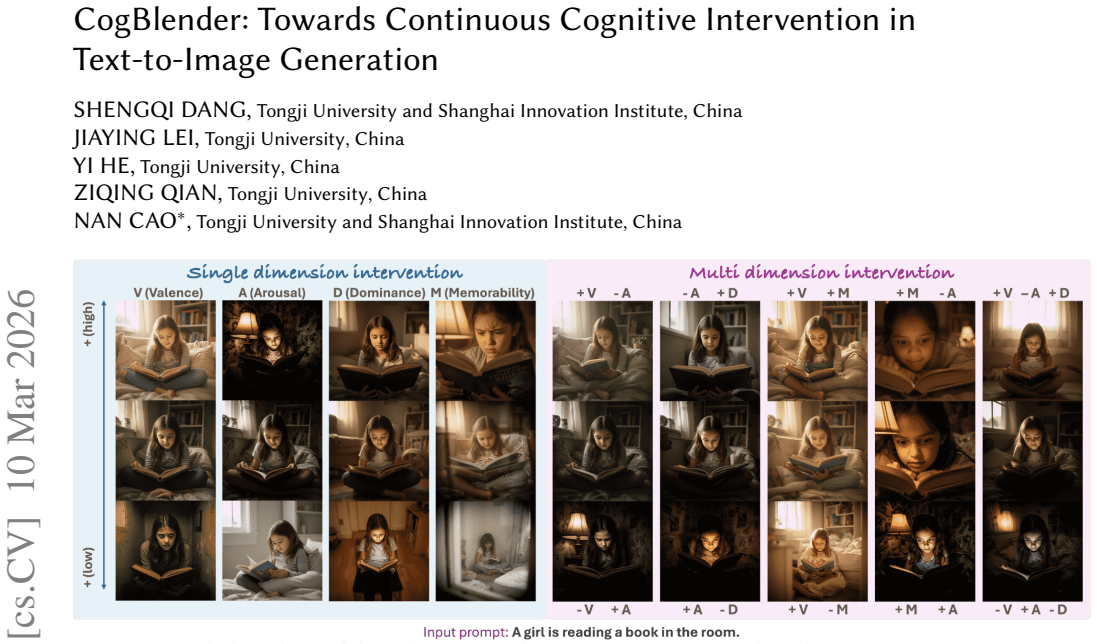
- Cognitive properties including valence, arousal, dominance, and memorability can be adjusted continuously and independently in the output image.
- The method preserves semantic content from the original prompt while modifying only the cognitive attributes.
- Experiments show effective intervention across the four tested cognitive dimensions without requiring model retraining.
- Multi-dimensional control is possible by specifying a vector of target cognitive scores.
Where Pith is reading between the lines
- This blending technique could be adapted to other diffusion or flow-based models for similar property control.
- Future work might test whether the same interpolation applies to controlling additional properties like perceived realism or aesthetic appeal.
- Applications could include generating images for psychological studies or personalized content with specific emotional impacts.
Load-bearing premise
That rewriting prompts to capture extreme cognitive states and then linearly blending their velocity fields will result in predictable and continuous shifts in the actual cognitive properties of the generated images.
What would settle it
Generating a series of images with gradually increasing target memorability scores and then having human raters score the actual memorability to check if it increases monotonically and smoothly as predicted.
Figures


read the original abstract
Beyond conveying semantic information, images also possess cognitive properties that elicit specific psychological responses from viewers, such as memory encoding or emotional reactions. Although modern text-to-image (T2I) models generate semantically coherent content effectively, they struggle to control cognitive properties (e.g., valence, memorability) and often fail to align with the user's psychological intent. To bridge the gap, we introduce CogBlender, an algorithm that enables continuous and multi-dimensional intervention on cognitive properties through a novel two-stage approach. First, we construct discrete cognition-aware rewritten prompts-variants of the input prompt that represent distinct extreme cognitive states. Second, we translate these discrete prompts into continuous control signals by interpolating within the velocity-field domain of flow-matching models. By dynamically blending the velocity fields predicted from these prompts according to the target cognitive scores, CogBlender smoothly steers the generative trajectory to realize the desired cognitive properties in the final image. Extensive experiments across four cognitive properties (i.e., valence, arousal, dominance, and memorability) demonstrate that CogBlender achieves effective cognitive intervention.
Editorial analysis
A structured set of objections, weighed in public.
Referee Report
Summary. The paper introduces CogBlender, a two-stage method for continuous multi-dimensional control of cognitive properties (valence, arousal, dominance, memorability) in text-to-image generation using flow-matching models. Stage one rewrites the input prompt into discrete variants representing extreme cognitive states; stage two dynamically blends the predicted velocity fields according to target cognitive scores to steer the generative trajectory.
Significance. If the central claim holds with supporting quantitative evidence, the work would offer a practical algorithmic construction for psychological control in T2I outputs that goes beyond semantic prompting. The velocity-field interpolation approach in flow-matching models is a technically interesting direction that could generalize to other controllable generation tasks.
major comments (3)
- [§3.2] §3.2 (velocity-field blending): the claim that linear interpolation v = Σ w_i v_i with weights w_i derived from target scores produces continuous, monotonic, and predictable shifts in cognitive properties lacks supporting analysis or verification. The manuscript must demonstrate that the resulting trajectory actually traverses the desired cognitive manifold rather than an arbitrary path in latent space.
- [§4] §4 (experiments): the abstract asserts effective intervention across four properties, yet the provided description supplies no quantitative results, error bars, baselines, or ablation studies on prompt rewriting versus velocity blending. Without these, the effectiveness claim cannot be evaluated against the paper's own data.
- [§3.1] §3.1 (prompt rewriting): the assumption that discrete cognition-aware rewritten prompts accurately isolate distinct extreme cognitive states is load-bearing but untested for entanglement between semantic content and cognitive labels; a concrete test (e.g., human ratings or metric correlation) is required to support the discrete-to-continuous translation.
minor comments (2)
- [§3.2] Notation for the blending weights w_i and the precise definition of the target cognitive scores should be formalized with an equation in §3.2 for reproducibility.
- Figure captions and axis labels in the experimental results should explicitly state the cognitive property being measured and the baseline methods compared.
Simulated Author's Rebuttal
We thank the referee for their constructive and detailed feedback, which has helped us identify areas where the manuscript can be strengthened. We address each major comment below and describe the revisions we will make.
read point-by-point responses
-
Referee: [§3.2] §3.2 (velocity-field blending): the claim that linear interpolation v = Σ w_i v_i with weights w_i derived from target scores produces continuous, monotonic, and predictable shifts in cognitive properties lacks supporting analysis or verification. The manuscript must demonstrate that the resulting trajectory actually traverses the desired cognitive manifold rather than an arbitrary path in latent space.
Authors: We agree that additional verification is required to substantiate the properties of the interpolated trajectories. In the revised manuscript we will add quantitative analysis in §3.2 and a new figure showing measured cognitive property values (via both automated metrics and human ratings) at multiple points along sample trajectories for varying target scores. This will demonstrate continuity and monotonicity with respect to the target cognitive manifold. revision: yes
-
Referee: [§4] §4 (experiments): the abstract asserts effective intervention across four properties, yet the provided description supplies no quantitative results, error bars, baselines, or ablation studies on prompt rewriting versus velocity blending. Without these, the effectiveness claim cannot be evaluated against the paper's own data.
Authors: We acknowledge that the experimental presentation in the current version does not include sufficient quantitative detail. The full manuscript contains results from experiments on the four properties, but we will substantially revise §4 to include: (i) tables reporting mean cognitive scores with standard deviations for each property, (ii) comparisons against baselines including direct prompting and classifier-based guidance, and (iii) ablations that isolate the contributions of the prompt-rewriting stage versus the velocity-blending stage. These additions will be accompanied by error bars and statistical significance tests. revision: yes
-
Referee: [§3.1] §3.1 (prompt rewriting): the assumption that discrete cognition-aware rewritten prompts accurately isolate distinct extreme cognitive states is load-bearing but untested for entanglement between semantic content and cognitive labels; a concrete test (e.g., human ratings or metric correlation) is required to support the discrete-to-continuous translation.
Authors: We recognize that empirical validation of the prompt-rewriting stage is necessary to rule out semantic-cognitive entanglement. We will add a dedicated validation subsection (or appendix) that reports: human ratings of cognitive properties on images generated from the extreme rewritten prompts, and correlation coefficients between the intended cognitive labels and both human ratings and available automated cognitive metrics, while controlling for semantic similarity via CLIP embeddings. This will directly support the discrete-to-continuous mapping. revision: yes
Circularity Check
No significant circularity; CogBlender is an explicit algorithmic construction
full rationale
The paper defines CogBlender directly as a two-stage procedure: (1) rewriting the input prompt into discrete variants that represent extreme cognitive states, and (2) linearly blending the velocity fields predicted by a flow-matching model according to target cognitive scores. No equations, derivations, or predictions are shown that reduce the claimed continuous control back to a fitted parameter, self-referential definition, or load-bearing self-citation. Effectiveness is asserted via experiments on valence, arousal, dominance, and memorability rather than by mathematical equivalence to the inputs. The derivation chain is therefore self-contained and does not exhibit any of the enumerated circularity patterns.
Axiom & Free-Parameter Ledger
Lean theorems connected to this paper
-
IndisputableMonolith/Cost/FunctionalEquationwashburn_uniqueness_aczel unclear?
unclearRelation between the paper passage and the cited Recognition theorem.
v(x_t, t, p, s) = 1/2 (sum_{k=1}^{2^n} w_k(s) · v̂(x_t, t, P_k) + v_θ(x_t, t, p)) with w_k(s) = ∏_i (s_i a^k_i + (1-s_i)(1-a^k_i))
-
IndisputableMonolith/Foundation/RealityFromDistinctionreality_from_one_distinction unclear?
unclearRelation between the paper passage and the cited Recognition theorem.
Cognitive Space S = [0,1]^n with anchors as vertices; Semantic Manifold M_p via polarized prompts
What do these tags mean?
- matches
- The paper's claim is directly supported by a theorem in the formal canon.
- supports
- The theorem supports part of the paper's argument, but the paper may add assumptions or extra steps.
- extends
- The paper goes beyond the formal theorem; the theorem is a base layer rather than the whole result.
- uses
- The paper appears to rely on the theorem as machinery.
- contradicts
- The paper's claim conflicts with a theorem or certificate in the canon.
- unclear
- Pith found a possible connection, but the passage is too broad, indirect, or ambiguous to say the theorem truly supports the claim.
Reference graph
Works this paper leans on
-
[1]
Zoya Bylinskii, Lore Goetschalckx, Anelise Newman, and Aude Oliva
Measuring emotion: the self-assessment manikin and the semantic differential.Journal of behavior therapy and experimental psychiatry25, 1 (1994), 49–59. Zoya Bylinskii, Lore Goetschalckx, Anelise Newman, and Aude Oliva
work page 1994
-
[2]
Yiming Chen, Junlin Han, Tianyi Bai, Shengbang Tong, Filippos Kokkinos, and Philip Torr
Visual cognition.Vision research51, 13 (2011), 1538–1551. Yiming Chen, Junlin Han, Tianyi Bai, Shengbang Tong, Filippos Kokkinos, and Philip Torr
work page 2011
-
[3]
From Pixels to Feelings: Aligning MLLMs with Human Cognitive Per- ception of Images. arXiv:2511.22805 Mihai Gabriel Constantin, Liviu-Daniel Ştefan, Bogdan Ionescu, Ngoc QK Duong, Claire-Héléne Demarty, and Mats Sjöberg
-
[4]
Shengqi Dang, Yi He, Long Ling, Ziqing Qian, Nanxuan Zhao, and Nan Cao
Visual interestingness prediction: A benchmark framework and literature review.International Journal of Computer Vision129, 5 (2021), 1526–1550. Shengqi Dang, Yi He, Long Ling, Ziqing Qian, Nanxuan Zhao, and Nan Cao
work page 2021
-
[5]
Proceedings of the National Academy of Sciences120, 28 (2023), e2302389120
Memory for artwork is predictable. Proceedings of the National Academy of Sciences120, 28 (2023), e2302389120. Charles D Gilbert and Wu Li
work page 2023
-
[6]
Lore Goetschalckx, Alex Andonian, Aude Oliva, and Phillip Isola
Top-down influences on visual processing.Nature reviews neuroscience14, 5 (2013), 350–363. Lore Goetschalckx, Alex Andonian, Aude Oliva, and Phillip Isola
work page 2013
-
[7]
Gans trained by a two time-scale update rule converge to a local nash equilibrium.Advances in neural information processing systems30 (2017). Jonathan Ho and Tim Salimans
work page 2017
-
[8]
InNeurIPS 2021 Workshop on Deep Generative Models and Downstream Applications
Classifier-Free Diffusion Guidance. InNeurIPS 2021 Workshop on Deep Generative Models and Downstream Applications. Jingyang Jia, Kai Shu, Gang Yang, Long Xing, Xun Chen, and Aiping Liu
work page 2021
-
[9]
arXiv:2511.19982 Aditya Khosla, Akhil S Raju, Antonio Torralba, and Aude Oliva
EmoFeedback2: Reinforcement of Continuous Emotional Image Generation via LVLM-based Reward and Textual Feedback. arXiv:2511.19982 Aditya Khosla, Akhil S Raju, Antonio Torralba, and Aude Oliva
-
[10]
The roles of sensory perceptions and mental imagery in consumer decision-making.Journal of Retailing and Consumer Services61 (2021), 102517. Ronak Kosti, Jose M. Alvarez, Adria Recasens, and Agata Lapedriza
work page 2021
-
[11]
Introducing the open affective standardized image set (OASIS).Behavior research methods49, 2 (2017), 457–470. Black Forest Labs
work page 2017
-
[12]
InProceedings of IEEE Conference on Computer Vision and Pattern Recognition
AVA: A large-scale database for aesthetic visual analysis. InProceedings of IEEE Conference on Computer Vision and Pattern Recognition. 2408–2415. Ulric Neisser. 2014.Cognitive psychology: Classic edition. Psychology press. Dustin Podell, Zion English, Kyle Lacey, Andreas Blattmann, Tim Dockhorn, Jonas Müller, Joe Penna, and Robin Rombach
work page 2014
-
[13]
Remigiusz Szczepanowski, Jakub Traczyk, Michał Wierzchoń, and Axel Cleeremans
The effectiveness of advertising im- ages in promoting experiential offerings: An emotional response approach.Journal of Business Research122 (2021), 344–352. Remigiusz Szczepanowski, Jakub Traczyk, Michał Wierzchoń, and Axel Cleeremans
work page 2021
-
[14]
Consciousness and cognition22, 1 (2013), 212–220
The perception of visual emotion: comparing different measures of awareness. Consciousness and cognition22, 1 (2013), 212–220. Jianyi Wang, Kelvin CK Chan, and Chen Change Loy
work page 2013
-
[15]
VisRecall: Quantifying information visualisation recallability via question answering.IEEE Transactions on Visualization and Computer Graphics28, 12 (2022), 4995–5005. An Yang, Anfeng Li, Baosong Yang, Beichen Zhang, Binyuan Hui, Bo Zheng, Bowen Yu, Chang Gao, Chengen Huang, Chenxu Lv, et al. 2025a. Qwen3 Technical Report. arXiv:2505.09388 Jingyuan Yang, ...
work page internal anchor Pith review Pith/arXiv arXiv 2022
-
[16]
EmoCtrl: Controllable Emotional Image Content Generation
EmoGen: Emotional Image Content Generation with Text-to-Image Diffusion Models. InProceedings of the IEEE/CVF Conference on Computer Vision and Pattern Recognition. IEEE, 6358–6368. Jingyuan Yang, Weibin Luo, and Hui Huang. 2025b. EmoCtrl: Controllable Emotional Image Content Generation. arXiv:2512.22437 Hu Ye, Jun Zhang, Sibo Liu, Xiao Han, and Wei Yang
work page internal anchor Pith review Pith/arXiv arXiv
-
[17]
IP-Adapter: Text Compatible Image Prompt Adapter for Text-to-Image Diffusion Models
IP-Adapter: Text Compatible Image Prompt Adapter for Text-to-Image Diffusion Models. arXiv:2308.06721 Lvmin Zhang, Anyi Rao, and Maneesh Agrawala
work page internal anchor Pith review Pith/arXiv arXiv
-
[18]
Pattern Recognition154 (2024), 110584
Emotion- aware hierarchical interaction network for multimodal image aesthetics assessment. Pattern Recognition154 (2024), 110584. ACM Trans. Graph., Vol. 1, No. 1, Article . Publication date: March
work page 2024
-
[19]
Continuous cognitive interpolation. Smooth transition from high valence and arousal (V=0.7, A=0.7) to low valence and arousal (V=0.1, A=0.1). The results showcase a consistent shift in visual atmosphere and emotional impact along a continuous trajectory while maintaining subject stability. ACM Trans. Graph., Vol. 1, No. 1, Article . Publication date: March 2026
work page 2026
discussion (0)
Sign in with ORCID, Apple, or X to comment. Anyone can read and Pith papers without signing in.