Calibrating Microgrid Simulations for Energy-Aware Computing Systems
Pith reviewed 2026-05-15 11:56 UTC · model grok-4.3
The pith
A self-calibrating testbed integrates real computing nodes with Vessim microgrid simulations to achieve accurate power approximations using Kepler estimates refined by socket meter measurements.
A machine-rendered reading of the paper's core claim, the machinery that carries it, and where it could break.
Core claim
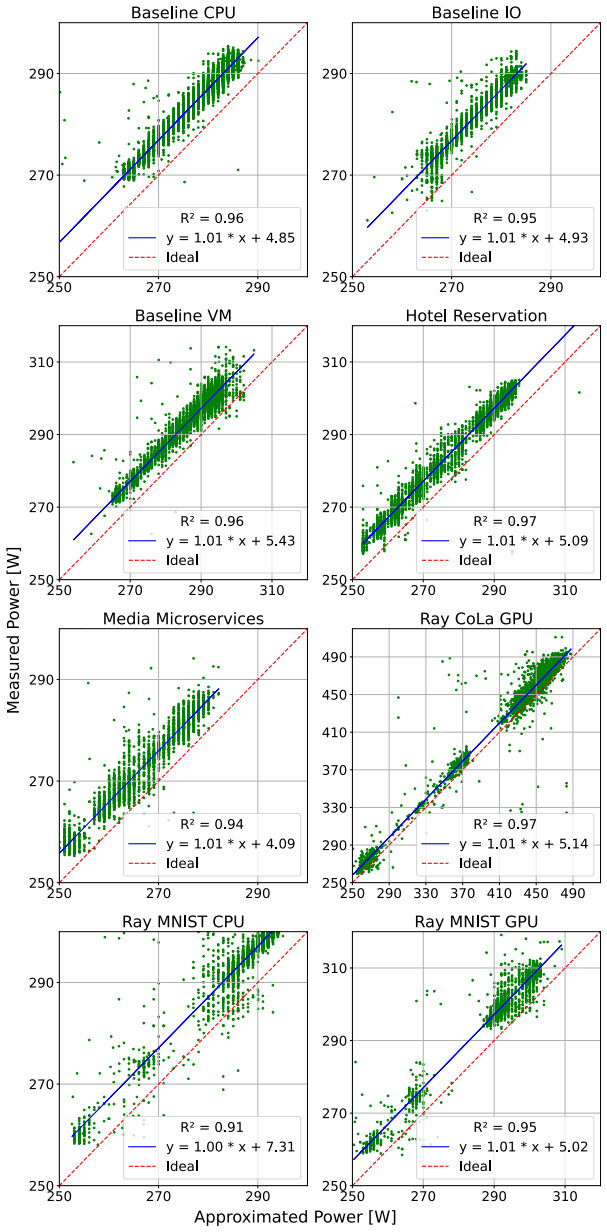
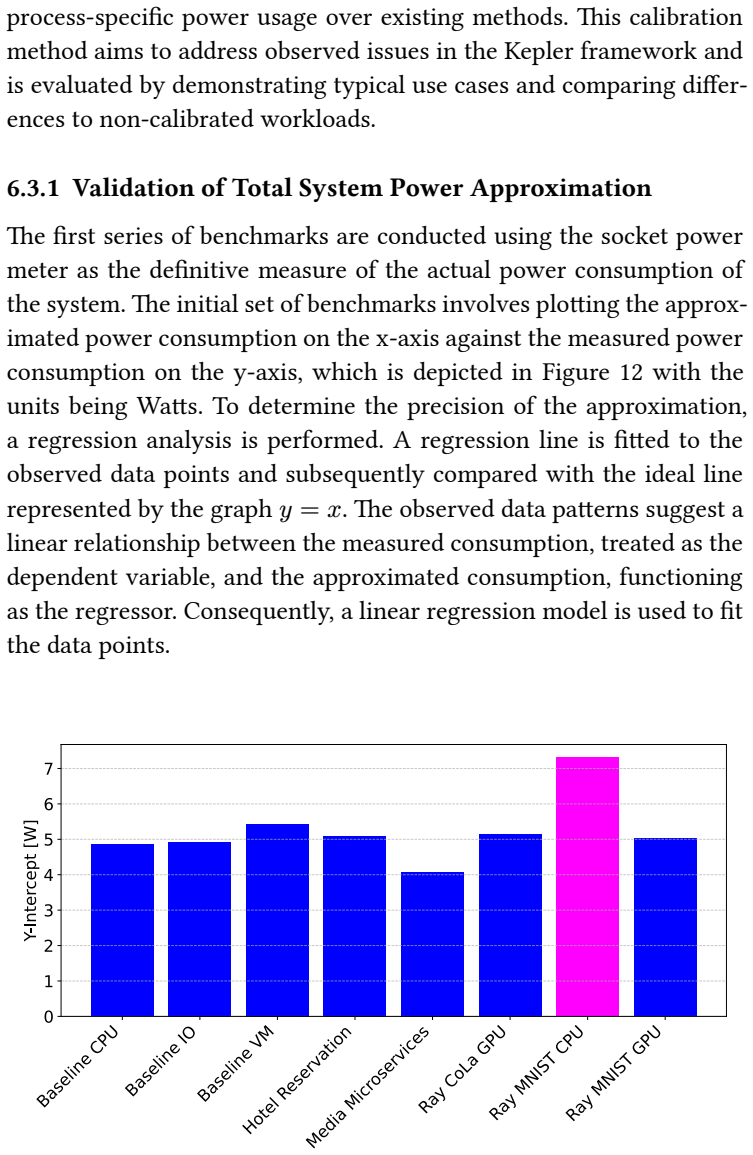
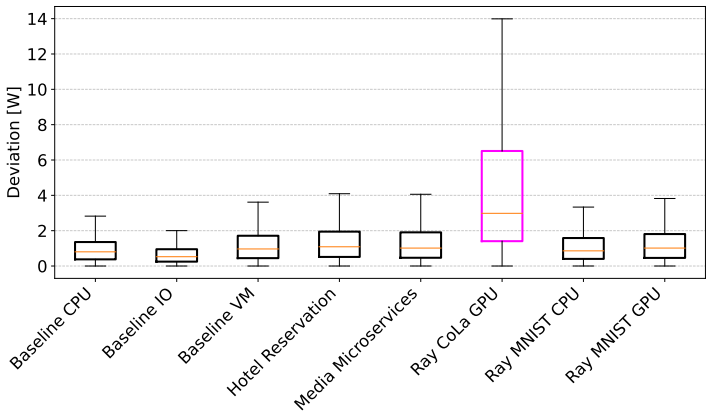
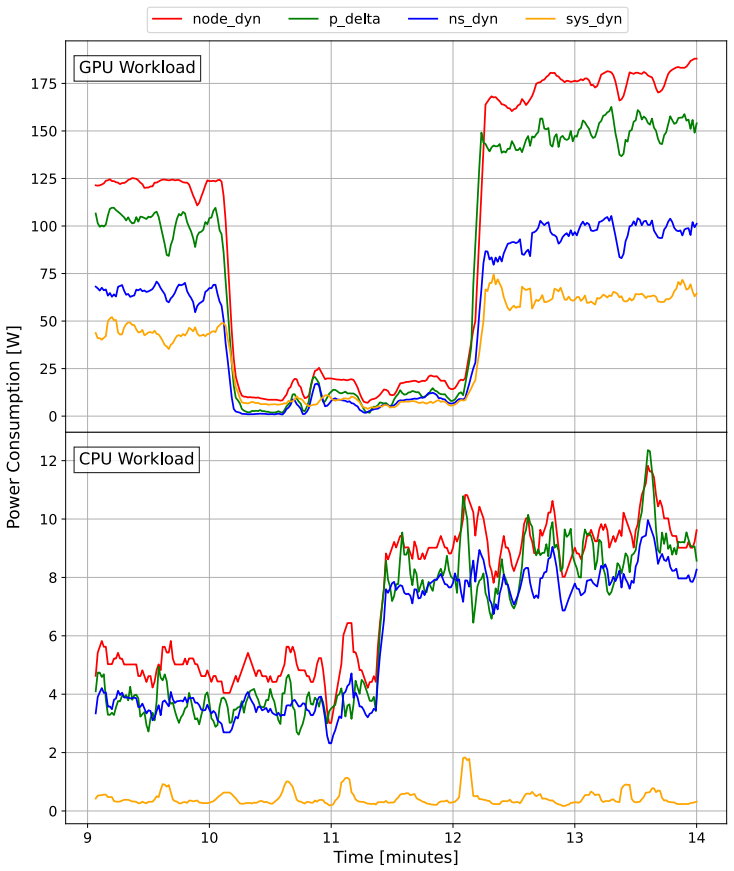
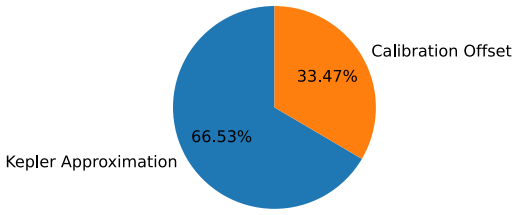
The Kepler framework supplies a fairly accurate whole-node power approximation with an average regression coefficient of 1.01 and R-squared values of 0.95 across tested workloads, although machine learning tasks exhibit higher deviation; an average static y-intercept of 5.23 W reveals idle-power gaps. Dynamic per-process calibration against the external socket meter then raises accuracy by roughly 50 percent for GPU workloads and 3.5 percent for CPU workloads.
What carries the argument
Self-calibration loop that feeds Kepler per-process power estimates into Vessim microgrid simulation and corrects them in real time against external socket power meter readings treated as definitive system-level truth.
If this is right
- Developers can test carbon-aware scheduling policies on simulated renewables while the hardware side reflects live node power draw.
- GPU-heavy AI workloads become the primary targets for calibration gains, suggesting focused refinement on those workloads first.
- Static idle-power offsets of roughly 5 W indicate a clear target for improving Kepler's baseline estimates.
- The overall approach lowers the barrier to experimenting with renewable-aligned computing without maintaining costly physical microgrids.
Where Pith is reading between the lines
- The same calibration pattern could be applied to other simulators or frameworks that currently lack hardware-in-the-loop grounding.
- If idle-power inaccuracies persist, future work might combine the socket meter with additional sensors at the CPU and GPU level to isolate the source.
- Real-time versions of this calibration might allow production systems to adapt power models on the fly as workload mixes change.
Load-bearing premise
The external socket power meter supplies an unbiased ground-truth measurement that transfers directly to calibrate internal per-process approximations without introducing new systematic errors from real-time node fluctuations.
What would settle it
Re-run the same GPU and CPU workloads while logging simulated versus measured power traces at one-second resolution; the central claim fails if the post-calibration regression coefficient deviates from 1.0 by more than 0.05 or if R-squared drops below 0.90 on previously high-accuracy workloads.
Figures





read the original abstract
The surge for computing resource demand is increasing global electricity consumption in data centers which is expected to exceed 1000 TWh by 2026, mainly attributable to adoption of new AI technologies. Carbon-aware computing strategies can mitigate their environmental impact by aligning power consumption with the production of low-carbon renewable energy, but they face challenges due to the scarcity of development environments. Existing solutions either rely on costly and complex physical system architectures that are difficult to integrate and maintain or on full simulations that, while more economical, often lack realism by ignoring system overheads, and real-time node power consumption and resource fluctuations. This thesis remediates these issues by proposing a self-calibrating energy-aware software testbed that uses the Software-in-the-Loop co-simulation framework Vessim to integrate renewable energy production simulators, while including real computing nodes. The application-level power consumption of these are first approximated by the Kepler framework and then calibrated within Vessim's microgrid simulation using an external socket power meter as a definitive measurement source on the system-level. The evaluation of the testbed with GPU and CPU intensive workloads reveal fairly accurate power approximation of the whole computing node by the Kepler framework, with an average regression coefficient of 1.01 and R^2 values of 0.95, though certain machine learning workloads showed higher deviation. The average static y-intercept of the regression line of ~5.23 W indicate inaccuracies in the idle power approximation. Calibration of dynamic per-process power consumption improved accuracy for GPU workloads by ~50%, while CPU workloads saw a modest improvement of ~3.5%.
Editorial analysis
A structured set of objections, weighed in public.
Referee Report
Summary. The paper proposes a self-calibrating energy-aware software testbed that integrates the Vessim microgrid co-simulation framework with real computing nodes. Application-level power is first approximated via the Kepler framework and then calibrated inside Vessim using an external socket power meter as ground truth. Evaluation on GPU- and CPU-intensive workloads reports an average Kepler regression coefficient of 1.01 and R² of 0.95, with dynamic per-process calibration yielding ~50% accuracy improvement for GPU workloads and ~3.5% for CPU workloads; a static y-intercept of ~5.23 W is noted as indicating idle-power inaccuracies.
Significance. If the calibration transfer from aggregate socket measurements to per-process dynamic terms is robust, the approach would offer a practical middle ground between expensive physical microgrid testbeds and purely simulated environments, enabling more realistic development of carbon-aware scheduling strategies that account for renewable variability and node-level fluctuations.
major comments (1)
- [Evaluation] Evaluation section: the headline accuracy claim (regression coefficient 1.01, R² 0.95, ~50% GPU improvement) rests on treating the socket-meter total as unbiased ground truth for scaling dynamic per-process terms, yet the reported static y-intercept of 5.23 W already signals idle-model error; no explicit additivity test or cross-validation on held-out mixed workloads is described to confirm that real-time node fluctuations (thermal, PSU efficiency, shared rails) do not introduce systematic offsets between calibration and deployment traces.
minor comments (2)
- [Abstract] Abstract: the statement that 'certain machine learning workloads showed higher deviation' is left unspecified; naming the workloads and reporting the magnitude of those deviations would strengthen the claim of overall accuracy.
- [Abstract] Abstract: no error bars, standard deviations, or confidence intervals accompany the reported regression coefficient, R² values, or percentage improvements, limiting assessment of statistical reliability.
Simulated Author's Rebuttal
We thank the referee for the constructive feedback on our manuscript. We address the single major comment point-by-point below and indicate the planned revisions.
read point-by-point responses
-
Referee: [Evaluation] Evaluation section: the headline accuracy claim (regression coefficient 1.01, R² 0.95, ~50% GPU improvement) rests on treating the socket-meter total as unbiased ground truth for scaling dynamic per-process terms, yet the reported static y-intercept of 5.23 W already signals idle-model error; no explicit additivity test or cross-validation on held-out mixed workloads is described to confirm that real-time node fluctuations (thermal, PSU efficiency, shared rails) do not introduce systematic offsets between calibration and deployment traces.
Authors: We agree that the reported static y-intercept of ~5.23 W signals inaccuracies in the idle-power component of the Kepler model, as already stated in the manuscript. The socket power meter is treated as ground truth for aggregate node power, and the linear regression (coefficient 1.01, R² 0.95) is used solely to scale the dynamic per-process terms; the intercept is not propagated into the dynamic calibration. Nevertheless, the manuscript does not include explicit additivity tests or cross-validation on held-out mixed workloads that would quantify possible systematic offsets arising from thermal drift, PSU efficiency curves, or shared power rails. We will revise the evaluation section to (1) explicitly discuss these assumptions and their potential impact on calibration transfer, (2) report the per-workload intercept values alongside the dynamic scaling factors, and (3) add a short paragraph on the limitations of the current validation. Because new mixed-workload experiments would require additional hardware time, we treat this as a partial revision focused on improved exposition rather than new empirical results. revision: partial
Circularity Check
No significant circularity; calibration anchored to independent external meter
full rationale
The paper calibrates Kepler per-process approximations inside Vessim by direct comparison to physical socket-meter readings treated as ground truth. Reported metrics (regression coefficient 1.01, R² 0.95, ~50% GPU improvement) are computed from these external measurements rather than from any internal fit or self-referential loop. No self-definitional equations, fitted-input predictions, or load-bearing self-citations appear in the derivation chain. The approach is therefore self-contained against an external benchmark.
Axiom & Free-Parameter Ledger
free parameters (1)
- static y-intercept
axioms (2)
- domain assumption Kepler framework supplies usable initial power estimates for CPU and GPU processes
- domain assumption Socket power meter readings constitute an unbiased system-level ground truth
Lean theorems connected to this paper
-
IndisputableMonolith/Cost/FunctionalEquation.leanwashburn_uniqueness_aczel unclear?
unclearRelation between the paper passage and the cited Recognition theorem.
Kepler Ratio Power Model divides dynamic power consumption c_dyn by calculating the ratio of a process’s p resource utilization r_util_p to the total system utilization
What do these tags mean?
- matches
- The paper's claim is directly supported by a theorem in the formal canon.
- supports
- The theorem supports part of the paper's argument, but the paper may add assumptions or extra steps.
- extends
- The paper goes beyond the formal theorem; the theorem is a base layer rather than the whole result.
- uses
- The paper appears to rely on the theorem as machinery.
- contradicts
- The paper's claim conflicts with a theorem or certificate in the canon.
- unclear
- Pith found a possible connection, but the passage is too broad, indirect, or ambiguous to say the theorem truly supports the claim.
Reference graph
Works this paper leans on
-
[1]
Exponential laws of computing growth,
P. J. Denning and T. G. Lewis, “Exponential laws of computing growth, ” Communications of the ACM , vol. 60, no. 1, pp. 54–65, 2016
work page 2016
-
[2]
Tracking Clean En- ergy Progress,
International Energy Agency (IEA), “Tracking Clean En- ergy Progress, ” 2023. [Online]. Available: https://www.iea.org/ reports/tracking-clean-energy-progress-2023
work page 2023
-
[3]
Language Models are Few-Shot Learners,
T. Brown et al. , “Language Models are Few-Shot Learners, ” in Advances in Neural Information Processing Systems, Volume 33 (NeurIPS), Curran Associates, Inc., 2020, pp. 1877–1901
work page 2020
-
[4]
arXiv preprint arXiv:2311.16863 , year=
A. S. Luccioni, Y. Jernite, and E. Strubell, “Power hungry process- ing: Watts driving the cost of ai deployment?. ” arXiv preprint arXiv:2311.16863, 2023
-
[5]
A. S. Luccioni, S. Viguier, and A.-L. Ligozat, Journal of Machine Learning Research, vol. 24, no. 253, pp. 1–15, 2023
work page 2023
-
[6]
Reducing the Carbon Impact of Generative AI In- ference (today and in 2035),
A. A. Chien, L. Lin, H. Nguyen, V. Rao, T. Sharma, and R. Wi- jayawardana, “Reducing the Carbon Impact of Generative AI In- ference (today and in 2035), ” in Proceedings of the 2nd Workshop on Sustainable Computer Systems (HotCarbon), Boston, MA, USA: Association for Computing Machinery, 2023
work page 2035
-
[7]
International Energy Agency (IEA), “Electricity 2024, ” 2024. [On- line]. Available: https://www.iea.org/reports/electricity-2024
work page 2024
-
[8]
ICT sector electricity consumption and greenhouse gas emis- 61 sions--2020 outcome,
J. Malmodin, N. Lövehagen, P. Bergmark, and D. Lundén, “ICT sector electricity consumption and greenhouse gas emis- 61 sions--2020 outcome, ” Telecommunications Policy, vol. 48, no. 3, Art. no. 102701, 2024
work page 2020
-
[9]
The real climate and transformative impact of ICT: A critique of estimates, trends, and regulations,
C. Freitag, M. Berners-Lee, K. Widdicks, B. Knowles, G. S. Blair, and A. Friday, “The real climate and transformative impact of ICT: A critique of estimates, trends, and regulations, ” Patterns, vol. 2, no. 9, Art. no. 100576, 2021
work page 2021
-
[10]
Uptime Insti- tute Global Data Center Survey 2021,
D. Bizo, R. Ascierto, A. Lawrence, and J. Davis, “Uptime Insti- tute Global Data Center Survey 2021, ” Uptime Institute, New York, 2021. [Online]. Available: https://uptimeinstitute.com/ resources/asset/2021-data-center-industry-survey
work page 2021
-
[11]
Carbon-Aware Computing for Datacen- ters,
A. Radovanović et al., “Carbon-Aware Computing for Datacen- ters, ” IEEE Transactions on Power Systems, vol. 38, no. 2, pp. 1270– 1280, 2022
work page 2022
-
[12]
Carbon Explorer: A Holistic Framework for De- signing Carbon Aware Datacenters,
B. Acun et al., “Carbon Explorer: A Holistic Framework for De- signing Carbon Aware Datacenters, ” in Proceedings of the 28th ACM International Conference on Architectural Support for Pro- gramming Languages and Operating Systems, Volume 2 (ASP- LOS), Vancouver, Canada: Association for Computing Machin- ery, 2023, pp. 118–132
work page 2023
-
[13]
Ecovisor: A Virtual Energy System for Carbon- Efficient Applications,
A. Souza et al., “Ecovisor: A Virtual Energy System for Carbon- Efficient Applications, ” in Proceedings of the 28th ACM Interna- tional Conference on Architectural Support for Programming Lan- guages and Operating Systems, Volume 2 (ASPLOS) , Vancouver, Canada: Association for Computing Machinery, 2023, pp. 252– 265
work page 2023
-
[14]
Treehouse: A case for carbon-aware datacenter software,
T. Anderson, A. Belay, M. Chowdhury, A. Cidon, and I. Zhang, “Treehouse: A case for carbon-aware datacenter software, ” ACM SIGENERGY Energy Informatics Review , vol. 3, no. 3, pp. 64–70, 2023
work page 2023
-
[15]
Let's wait awhile: how temporal workload shifting can re- duce carbon emissions in the cloud,
P. Wiesner, I. Behnke, D. Scheinert, K. Gontarska, and L. Tham- sen, “Let's wait awhile: how temporal workload shifting can re- duce carbon emissions in the cloud, ” in Proceedings of the 22nd International Middleware Conference (Middleware) , Québec city, 62 Canada: Association for Computing Machinery, 2021, pp. 260– 272
work page 2021
-
[16]
Enabling sustainable clouds: The case for virtu- alizing the energy system,
N. Bashir et al., “Enabling sustainable clouds: The case for virtu- alizing the energy system, ” in Proceedings of the ACM Symposium on Cloud Computing (SoCC) , Seattle, WA, USA: Association for Computing Machinery, 2021, pp. 350–358
work page 2021
-
[17]
Sustainable com- puting-without the hot air,
N. Bashir, D. Irwin, P. Shenoy, and A. Souza, “Sustainable com- puting-without the hot air, ” ACM SIGENERGY Energy Informatics Review, vol. 3, no. 3, pp. 47–52, 2023
work page 2023
-
[18]
FedZero: Leveraging Renewable Excess Energy in Fed- erated Learning,
P. Wiesner, R. Khalili, D. Grinwald, P. Agrawal, L. Thamsen, and O. Kao, “FedZero: Leveraging Renewable Excess Energy in Fed- erated Learning, ” in Proceedings of the 15th ACM International Conference on Future and Sustainable Energy Systems (e-Energy) , Singapore: Association for Computing Machinery, 2024, pp. 37– 49
work page 2024
-
[19]
G. Fridgen, M.-F. Körner, S. Walters, and M. Weibelzahl, “Not all doom and gloom: How energy-intensive and temporally flexible data center applications may actually promote renewable energy sources, ” Business & Information Systems Engineering , vol. 63, 2021
work page 2021
-
[20]
Mitigating curtailment and carbon emissions through load migration between data centers,
J. Zheng, A. A. Chien, and S. Suh, “Mitigating curtailment and carbon emissions through load migration between data centers, ” Joule, vol. 4, no. 10, pp. 2208–2222, 2020
work page 2020
-
[21]
LACS: Learning-Augmented Algorithms for Carbon-Aware Resource Scaling with Uncertain Demand
R. Bostandoost, A. Lechowicz, W. A. Hanafy, N. Bashir, P. Shenoy, and M. Hajiesmaili, “LACS: Learning-Augmented Algorithms for Carbon-Aware Resource Scaling with Uncertain Demand. ” arXiv preprint arXiv:2404.15211, 2024
-
[22]
Vessim: A Testbed for Carbon-Aware Applications and Systems,
P. Wiesner, I. Behnke, P. Kilian, M. Steinke, and O. Kao, “Vessim: A Testbed for Carbon-Aware Applications and Systems, ” in Pro- ceedings of the 3rd Workshop on Sustainable Computer Systems (HotCarbon), New York, NY, USA: Association for Computing Machinery, 2024. 63
work page 2024
-
[23]
Soft- ware-in-the-loop simulation for developing and testing carbon- aware applications,
P. Wiesner, M. Steinke, H. Nickel, Y. Kitana, and O. Kao, “Soft- ware-in-the-loop simulation for developing and testing carbon- aware applications, ” Software: Practice and Experience, vol. 53, no. 12, pp. 2362–2376, 2023
work page 2023
-
[24]
Kepler: A framework to calculate the energy consumption of containerized applications,
M. Amaral et al., “Kepler: A framework to calculate the energy consumption of containerized applications, ” in IEEE 16th Interna- tional Conference on Cloud Computing (CLOUD), Chicago, Illinois USA: IEEE, 2023, pp. 69–71
work page 2023
-
[25]
RAPL: Memory power estimation and capping,
H. David, E. Gorbatov, U. R. Hanebutte, R. Khanna, and C. Le, “RAPL: Memory power estimation and capping, ” in Proceedings of the 16th ACM/IEEE international symposium on Low power elec- tronics and design, 2010, pp. 189–194
work page 2010
-
[26]
Measuring energy consumption for short code paths using RAPL,
M. Hähnel, B. Döbel, M. Völp, and H. Härtig, “Measuring energy consumption for short code paths using RAPL, ” ACM SIGMET- RICS Performance Evaluation Review , vol. 40, no. 3, pp. 13–17, 2012
work page 2012
-
[27]
Power measurement techniques on standard compute nodes: A quantitative comparison,
D. Hackenberg, T. Ilsche, R. Schöne, D. Molka, M. Schmidt, and W. E. Nagel, “Power measurement techniques on standard compute nodes: A quantitative comparison, ” in 2013 IEEE International Symposium on Performance Analysis of Systems and Software (IS- PASS), 2013, pp. 194–204
work page 2013
-
[28]
An Energy Efficiency Feature Survey of the Intel Haswell Processor,
D. Hackenberg, R. Schöne, T. Ilsche, D. Molka, J. Schuchart, and R. Geyer, “An Energy Efficiency Feature Survey of the Intel Haswell Processor, ” in 2015 IEEE International Parallel and Distributed Pro- cessing Symposium Workshop, 2015, pp. 896–904
work page 2015
-
[29]
Measuring GPU power with the K20 built-in sensor,
M. Burtscher, I. Zecena, and Z. Zong, “Measuring GPU power with the K20 built-in sensor, ” in Proceedings of Workshop on Gen- eral Purpose Processing Using GPUs, 2014, pp. 28–36
work page 2014
-
[30]
Part-time Power Mea- surements: nvidia-smi's Lack of Attention,
Z. Yang, K. Adamek, and W. Armour, “Part-time Power Mea- surements: nvidia-smi's Lack of Attention, ” arXiv preprint arXiv:2312.02741, 2023
-
[31]
NVIDIA Management Library (NVML) API Reference,
“NVIDIA Management Library (NVML) API Reference, ” NVIDIA Corporation, 2024. 64
work page 2024
-
[32]
The benefits of event: driven energy accounting in power-sensitive systems,
F. Bellosa, “The benefits of event: driven energy accounting in power-sensitive systems, ” in Proceedings of the 9th workshop on ACM SIGOPS European workshop: beyond the PC: new challenges for the operating system, 2000, pp. 37–42
work page 2000
-
[33]
SmartWatts: Self-calibrat- ing software-defined power meter for containers,
G. Fieni, R. Rouvoy, and L. Seinturier, “SmartWatts: Self-calibrat- ing software-defined power meter for containers, ” in 2020 20th IEEE/ACM International Symposium on Cluster, Cloud and Inter- net Computing (CCGRID), 2020, pp. 479–488
work page 2020
-
[34]
WattScope: Non- intrusive application-level power disaggregation in datacenters,
X. Guan, N. Bashir, D. Irwin, and P. Shenoy, “WattScope: Non- intrusive application-level power disaggregation in datacenters, ” Performance Evaluation, vol. 162, Art. no. 102369, 2023
work page 2023
-
[35]
Process-level power estimation in vm-based systems,
M. Colmant, M. Kurpicz, P. Felber, L. Huertas, R. Rouvoy, and A. Sobe, “Process-level power estimation in vm-based systems, ” in Proceedings of the Tenth European Conference on Computer Sys- tems, 2015
work page 2015
-
[36]
How to build valid and credible simulation models,
A. M. Law, “How to build valid and credible simulation models, ” in 2022 Winter Simulation Conference (WSC) , 2022, pp. 1283– 1295
work page 2022
-
[37]
A. M. Law, W. D. Kelton, and W. D. Kelton, Simulation modeling and analysis, vol. 3. New York: Mcgraw-hill New York, 2007
work page 2007
-
[38]
An introduction to regression analysis,
A. O. Sykes, “An introduction to regression analysis, ” 1993
work page 1993
-
[39]
Bayesian calibration of com- puter models,
M. C. Kennedy and A. O'Hagan, “Bayesian calibration of com- puter models, ” Journal of the Royal Statistical Society: Series B (S- tatistical Methodology), vol. 63, no. 3, pp. 425–464, 2001
work page 2001
-
[40]
D. E. Olivares et al., “Trends in microgrid control, ” IEEE Transac- tions on smart grid, vol. 5, no. 4, pp. 1905–1919, 2014
work page 1905
-
[41]
En- hancing smart grid with microgrids: Challenges and opportuni- ties,
Y. Yoldaş, A. Önen, S. Muyeen, A. V. Vasilakos, and I. Alan, “En- hancing smart grid with microgrids: Challenges and opportuni- ties, ” Renewable and Sustainable Energy Reviews, vol. 72, pp. 205– 214, 2017
work page 2017
-
[42]
L. Canale, A. R. Di Fazio, M. Russo, A. Frattolillo, and M. Del- l’Isola, “An overview on functional integration of hybrid renew- 65 able energy systems in multi-energy buildings, ” Energies, vol. 14, no. 4, Art. no. 1078, 2021
work page 2021
-
[43]
Distributed real-time energy man- agement in data center microgrids,
L. Yu, T. Jiang, and Y. Zou, “Distributed real-time energy man- agement in data center microgrids, ” IEEE Transactions on Smart Grid, vol. 9, no. 4, pp. 3748–3762, 2016
work page 2016
-
[44]
Cpes testing with mosaik: Co-simulation planning, execution and analysis,
C. Steinbrink et al. , “Cpes testing with mosaik: Co-simulation planning, execution and analysis, ” Applied Sciences, vol. 9, no. 5, Art. no. 923, 2019
work page 2019
-
[45]
RAPL in Action: Experiences in Using RAPL for Power Measurements,
K. N. Khan, M. Hirki, T. Niemi, J. K. Nurminen, and Z. Ou, “RAPL in Action: Experiences in Using RAPL for Power Measurements, ” ACM Transactions on Modeling and Performance Evaluation of Computing Systems, vol. 3, no. 2, Art. no. 9, 2018
work page 2018
-
[46]
Advanced Configuration and Power Interface (ACPI) Specifica- tion Release 6.5,
“Advanced Configuration and Power Interface (ACPI) Specifica- tion Release 6.5, ” UEFI Forum Inc, 2022
work page 2022
-
[47]
Intelligent Platform Management Interface Specification v2.0 rev. 1.1,
“Intelligent Platform Management Interface Specification v2.0 rev. 1.1, ” Intel Corporation, Hewlett-Packard Company, NEC Corporation, Dell Inc, 2013
work page 2013
-
[48]
Redfish Specification DSP0266 Whitepaper,
“Redfish Specification DSP0266 Whitepaper, ” DMTF, 2024
work page 2024
-
[49]
Virtual machine power metering and provisioning,
A. Kansal, F. Zhao, J. Liu, N. Kothari, and A. A. Bhattacharya, “Virtual machine power metering and provisioning, ” in Proceed- ings of the 1st ACM symposium on Cloud computing , 2010, pp. 39–50
work page 2010
-
[50]
HaPPy: Hy- perthread-aware Power Profiling Dynamically,
Y. Zhai, X. Zhang, S. Eranian, L. Tang, and J. Mars, “HaPPy: Hy- perthread-aware Power Profiling Dynamically, ” in 2014 USENIX annual technical conference (USENIX ATC 14), 2014, pp. 211–217
work page 2014
-
[51]
Bitwatts: A process-level power monitoring middleware,
M. Colmant, M. Kurpicz, P. Felber, L. Huertas, R. Rouvoy, and A. Sobe, “Bitwatts: A process-level power monitoring middleware, ” in Proceedings of the Posters and Demos Session of the 15th Inter- national Middleware Conference, 2014, pp. 41–42
work page 2014
-
[52]
K. Shen, A. Shriraman, S. Dwarkadas, X. Zhang, and Z. Chen, “Power containers: An OS facility for fine-grained power and 66 energy management on multicore servers, ” ACM SIGARCH Com- puter Architecture News, vol. 41, no. 1, pp. 65–76, 2013
work page 2013
-
[53]
Pow- erapi: A software library to monitor the energy consumed at the process-level,
A. Bourdon, A. Noureddine, R. Rouvoy, and L. Seinturier, “Pow- erapi: A software library to monitor the energy consumed at the process-level, ” ERCIM News, vol. 92, 2013
work page 2013
-
[54]
Process-Based Efficient Power Level Exporter,
M. Amaral et al., “Process-Based Efficient Power Level Exporter, ” in 2024 IEEE 17th International Conference on Cloud Computing (CLOUD), 2024, pp. 456–467
work page 2024
-
[55]
Exploring Kepler's potentials: unveil- ing cloud application power consumption,
M. Amaral, S. Choochotkaew, E. K. Lee, Chen Huamin, and Eilam Tamar, “Exploring Kepler's potentials: unveil- ing cloud application power consumption, ” Cloud Native Computing Foundation (CNCF) Blog Post. Accessed: Aug. 17, 2024. [Online]. Available: https://www.cncf.io/blog/2023/ 10/11/exploring-keplers-potentials-unveiling-cloud-application- power-consumption/
work page 2024
-
[56]
ICT Sector Guidance built on the GHG Protocol Product Life Cycle Accounting and Reporting Standard,
G. Protocol, “ICT Sector Guidance built on the GHG Protocol Product Life Cycle Accounting and Reporting Standard, ” Global: GHG Protocol, 2017
work page 2017
-
[57]
Car- bonscaler: Leveraging cloud workload elasticity for optimizing carbon-efficiency,
W. A. Hanafy, Q. Liang, N. Bashir, D. Irwin, and P. Shenoy, “Car- bonscaler: Leveraging cloud workload elasticity for optimizing carbon-efficiency, ” Proceedings of the ACM on Measurement and Analysis of Computing Systems, vol. 7, no. 3, Art. no. 57, 2023
work page 2023
-
[58]
Energy-Aware Process Schedul- ing in Linux,
F. Qiao, Y. Fang, and A. Cidon, “Energy-Aware Process Schedul- ing in Linux, ” in Proceedings of the 3rd Workshop on Sustainable Computer Systems (HotCarbon), New York, NY, USA: Association for Computing Machinery, 2024
work page 2024
-
[59]
ghost: Fast & flexible user-space delega- tion of linux scheduling,
J. T. Humphries et al., “ghost: Fast & flexible user-space delega- tion of linux scheduling, ” in Proceedings of the ACM SIGOPS 28th Symposium on Operating Systems Principles, 2021, pp. 588–604
work page 2021
-
[60]
Dynamic power budget redistribution under a power cap on multi-application environ- ments,
L. Costero, F. D. Igual, and K. Olcoz, “Dynamic power budget redistribution under a power cap on multi-application environ- ments, ” Sustainable Computing: Informatics and Systems , vol. 38, Art. no. 100865, 2023. 67
work page 2023
-
[61]
OpenMP: an industry standard API for shared-memory programming,
L. Dagum and R. Menon, “OpenMP: an industry standard API for shared-memory programming, ” IEEE computational science and engineering, vol. 5, no. 1, 1998
work page 1998
-
[62]
An Alloca- tion Model for Attributing Emissions in Multi-tenant Cloud Data Centers,
R. Westerhof, R. Atherton, and V. Andrikopoulos, “An Alloca- tion Model for Attributing Emissions in Multi-tenant Cloud Data Centers, ” arXiv preprint arXiv:2305.10439, 2023
-
[63]
carbond: An Operating-System Daemon for Carbon Awareness,
A. Schmidt, G. Stock, R. Ohs, L. Gerhorst, B. Herzog, and T. Hönig, “carbond: An Operating-System Daemon for Carbon Awareness, ” in Proceedings of the 2nd Workshop on Sustainable Computer Systems (HotCarbon) , Boston, MA, USA: Association for Computing Machinery, 2023
work page 2023
-
[64]
Towards Game-The- oretic Approaches to Attributing Carbon in Cloud Data Centers,
L. Han, J. Kakadia, B. C. Lee, and U. Gupta, “Towards Game-The- oretic Approaches to Attributing Carbon in Cloud Data Centers, ” in Proceedings of the 3rd Workshop on Sustainable Computer Sys- tems (HotCarbon), New York, NY, USA: Association for Comput- ing Machinery, 2024
work page 2024
-
[65]
EnergAt: Fine- Grained Energy Attribution for Multi-Tenancy,
Hé Hongyu, M. Friedman, and T. Rekatsinas, “EnergAt: Fine- Grained Energy Attribution for Multi-Tenancy, ” in Proceedings of the 2nd Workshop on Sustainable Computer Systems (HotCarbon), Boston, MA, USA: Association for Computing Machinery, 2023
work page 2023
-
[66]
Advancing Cloud Sustainability: A Ver- satile Framework for Container Power Model Training,
S. Choochotkaew et al., “Advancing Cloud Sustainability: A Ver- satile Framework for Container Power Model Training, ” in 2023 31st International Symposium on Modeling, Analysis, and Simu- lation of Computer and Telecommunication Systems (MASCOTS) , 2023
work page 2023
-
[67]
M. Bender, E. Kirdan, M.-O. Pahl, and G. Carle, “Open-source mqtt evaluation, ” in 2021 IEEE 18th Annual Consumer Communi- cations & Networking Conference (CCNC), 2021, pp. 1–4
work page 2021
-
[68]
F. Desbiens, “Mqtt, ” Building Enterprise IoT Solutions with Eclipse IoT Technologies: An Open Source Approach to Edge Computing . Springer, pp. 67–101, 2022
work page 2022
-
[69]
NVIDIA A100 Tensor Core GPU: Performance and Inno- 68 vation,
J. Choquette, W. Gandhi, O. Giroux, N. Stam, and R. Krashin- sky, “NVIDIA A100 Tensor Core GPU: Performance and Inno- 68 vation, ” IEEE Micro, vol. 41, no. 2, pp. 29–35, 2021, doi: 10.1109/ MM.2021.3061394
-
[70]
Dockercap: A software-level power capping orchestrator for docker contain- ers,
A. Asnaghi, M. Ferroni, and M. D. Santambrogio, “Dockercap: A software-level power capping orchestrator for docker contain- ers, ” in 2016 IEEE Intl Conference on Computational Science and Engineering (CSE) and IEEE Intl Conference on Embedded and Ubiquitous Computing (EUC) and 15th Intl Symposium on Dis- tributed Computing and Applications for Business E...
work page 2016
-
[71]
PRESTO: a latency-aware power-capping orchestrator for cloud-native microservices,
R. Brondolin and M. D. Santambrogio, “PRESTO: a latency-aware power-capping orchestrator for cloud-native microservices, ” in 2020 IEEE International Conference on Autonomic Computing and Self-Organizing Systems (ACSOS), 2020, pp. 11–20
work page 2020
-
[72]
Thunderbolt:Throughput-Optimized, Quality-of-Ser- vice-Aware Power Capping at Scale,
S. Li et al., “Thunderbolt:Throughput-Optimized, Quality-of-Ser- vice-Aware Power Capping at Scale, ” in 14th USENIX Symposium on Operating Systems Design and Implementation (OSDI) , 2020, pp. 1241–1255
work page 2020
-
[73]
Multi-Process Service Release r550,
“Multi-Process Service Release r550, ” NVIDIA Corporation, 2024
work page 2024
-
[74]
NVIDIA Multi-Instance GPU and NVIDIA Virtual Compute Server,
“NVIDIA Multi-Instance GPU and NVIDIA Virtual Compute Server, ” NVIDIA Corporation, 2020
work page 2020
-
[75]
EPC 8041/8045 Series User Manual
“EPC 8041/8045 Series User Manual. ” 2022. [Online]. Avail- able: https://gude-systems.com/app/uploads/2022/05/manual- epc8041-series.pdf
work page 2022
-
[76]
A. R. Hambley, Electrical engineering: principles and applications, vol. 4. Prentice Hall, 2017
work page 2017
-
[77]
D. Bermbach, E. Wittern, and S. Tai, Cloud service benchmarking. Springer, 2017
work page 2017
-
[78]
D. M. Ritchie and K. Thompson, “The UNIX time-sharing system, ” Communications of the ACM, vol. 17, no. 7, pp. 365–375, 1974
work page 1974
-
[79]
Kernelet: High-throughput GPU kernel ex- ecutions with dynamic slicing and scheduling,
J. Zhong and B. He, “Kernelet: High-throughput GPU kernel ex- ecutions with dynamic slicing and scheduling, ” IEEE Transactions 69 on Parallel and Distributed Systems, vol. 25, no. 6, pp. 1522–1532, 2013
work page 2013
-
[80]
Y. Gan et al., “An open-source benchmark suite for microservices and their hardware-software implications for cloud & edge sys- tems, ” in Proceedings of the Twenty-Fourth International Confer- ence on Architectural Support for Programming Languages and Operating Systems (ASPLOS), 2019, pp. 3–18
work page 2019
discussion (0)
Sign in with ORCID, Apple, or X to comment. Anyone can read and Pith papers without signing in.