SPATE: Spiking-Phase Adaptive Temporal Encoding for Quantum Machine Learning
Pith reviewed 2026-05-10 16:14 UTC · model grok-4.3
The pith
SPATE encodes tabular data as spike trains from leaky integrate-and-fire neurons and maps the resulting spike statistics to quantum phase rotations to build temporal feature representations.
A machine-rendered reading of the paper's core claim, the machinery that carries it, and where it could break.
Core claim
SPATE is a spike-driven temporal encoding method that converts real-valued tabular features into leaky integrate-and-fire spike trains and maps spike statistics to quantum rotations, augmented with a small set of temporal qubits through controlled phase operations, providing a practical spike-to-phase interface for building more informative quantum feature representations under constrained resources.
What carries the argument
The SPATE pipeline that first generates leaky integrate-and-fire spike trains from input features and then translates spike timing and rate statistics into quantum phase angles via additional controlled-phase gates on temporal qubits.
If this is right
- Quantum feature maps can now carry explicit temporal ordering information extracted from ordinary tabular columns.
- Hybrid quantum-classical models can reach stronger decision boundaries while staying inside tight qubit limits.
- Representation quality can be measured before training begins, allowing direct comparison of encoding schemes.
- The same spike-to-phase bridge can be inserted into other quantum pipelines that currently rely on static feature maps.
Where Pith is reading between the lines
- The approach may extend naturally to time-series or event-based data where spiking is already the native format.
- It suggests a route for combining neuromorphic hardware outputs directly with quantum processors without intermediate dense vector conversion.
- One open question is whether the temporal qubits can be reused or shared across multiple input channels to further reduce overhead.
Load-bearing premise
Converting features to LIF spike trains and mapping spike statistics to quantum phases produces genuinely superior temporal representations without hidden biases from hyperparameter choices or metric selection.
What would settle it
A side-by-side replication on the same datasets that finds static angle or amplitude encodings achieve equivalent or higher separability scores and downstream accuracy under identical qubit budgets would show the spike-to-phase step is not required.
Figures


read the original abstract
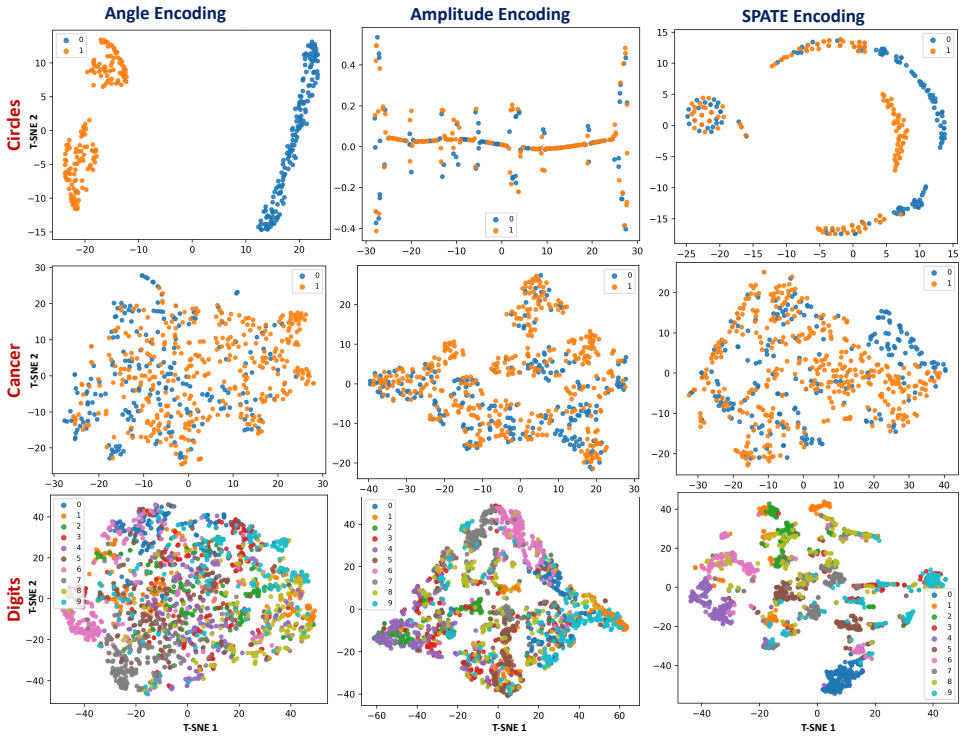
Most quantum machine learning (QML) pipelines still rely on static encodings such as angle and amplitude maps, and this limits their ability to handle temporal information. To address this limitation, this paper uses spike-based data representation as an effective encoding mechanism that incorporates temporal structure into quantum feature preparation. Specifically, we propose Spiking-Phase Adaptive Temporal Encoding (SPATE), a novel spike-driven temporal encoding method that converts real-valued tabular features into leaky integrate-and-fire spike trains and maps spike statistics to quantum rotations, augmented with a small set of temporal qubits through controlled phase operations. An encoding-centric evaluation protocol is also introduced to assess representation quality independently of the classifier, covering centered kernel-target alignment (CKTA), Fisher-style separability, inter/intra-class distance ratios, silhouette score, normalized entropy, and pairwise total-variation (TVpair) collapse indicators. Under stratified cross-validation, SPATE yields stronger representations across multiple datasets. For example, SPATE reaches a CKTA of 0.966 and a Fisher score of 7.37 on Blobs, compared with a CKTA of 0.632 and a Fisher score of 0.70 using angle encoding, and achieves a CKTA of 0.506 on Moons, compared with 0.015 using angle or amplitude encoding. These gains translate into stronger hybrid quantum neural network performance within a fixed qubit budget across several tasks, including an accuracy of 0.826 and an AUC of 0.978 for Wine, as well as an accuracy of 0.840 and an AUC of 0.923 for Moons. These results demonstrate that SPATE provides a practical spike-to-phase interface for building more informative quantum feature representations under constrained resources.
Editorial analysis
A structured set of objections, weighed in public.
Referee Report
Summary. The paper introduces Spiking-Phase Adaptive Temporal Encoding (SPATE), which converts tabular features into leaky integrate-and-fire (LIF) spike trains and maps spike statistics (firing rate and timing moments) to quantum rotation angles via controlled-phase gates on a small set of temporal qubits. It proposes an encoding-centric evaluation protocol using centered kernel-target alignment (CKTA), Fisher separability, silhouette score, normalized entropy, and pairwise total-variation metrics to compare representations independently of the downstream classifier. The central claim is that SPATE produces stronger quantum feature representations than standard angle or amplitude encoding, yielding higher metric scores (e.g., CKTA 0.966 and Fisher 7.37 on Blobs vs. 0.632 and 0.70 for angle encoding) and improved hybrid QNN accuracy/AUC on Wine and Moons under fixed qubit budgets.
Significance. If the performance gaps prove robust under globally fixed LIF parameters and a fully specified experimental protocol, SPATE would offer a concrete spike-to-phase interface for injecting temporal structure into QML encodings, which is valuable given the prevalence of static maps in the field. The encoding-centric protocol itself is a constructive contribution because it decouples representation quality from classifier choice. The manuscript does not yet supply machine-checked proofs or fully reproducible code, but the numerical comparisons are falsifiable in principle once protocol details are supplied.
major comments (2)
- [Methods] Methods (LIF and spike-to-phase mapping): The LIF parameters (membrane time constant, threshold, reset) and the scaling coefficients that map spike statistics to rotation angles are not stated to be fixed globally across datasets. Without an ablation that freezes these hyperparameters while varying only the encoding method, the reported gaps (CKTA 0.966 vs. 0.632 on Blobs; CKTA 0.506 vs. 0.015 on Moons) could arise from dataset-specific tuning rather than the spike-to-phase interface itself.
- [Results / Evaluation protocol] Experimental protocol and results: The abstract and evaluation section report concrete metric values and downstream accuracies but supply no error bars, number of independent runs, statistical tests, or complete hyperparameter tables for either the spiking model or the QNN. This absence prevents verification that the data support the claim of intrinsically superior temporal representations.
minor comments (2)
- [Abstract] The abstract lists six metrics but does not indicate whether they were pre-registered or whether any correction for multiple comparisons was applied; a brief statement on this point would improve transparency.
- [Methods] Notation for the controlled-phase operations and the exact mapping from spike moments to rotation angles should be written out explicitly (e.g., as an equation) rather than described only in prose.
Simulated Author's Rebuttal
We thank the referee for the constructive and detailed review. We address each major comment point by point below, indicating the revisions planned for the next version of the manuscript.
read point-by-point responses
-
Referee: [Methods] Methods (LIF and spike-to-phase mapping): The LIF parameters (membrane time constant, threshold, reset) and the scaling coefficients that map spike statistics to rotation angles are not stated to be fixed globally across datasets. Without an ablation that freezes these hyperparameters while varying only the encoding method, the reported gaps (CKTA 0.966 vs. 0.632 on Blobs; CKTA 0.506 vs. 0.015 on Moons) could arise from dataset-specific tuning rather than the spike-to-phase interface itself.
Authors: We acknowledge that the manuscript does not explicitly declare the global status of the LIF hyperparameters. In the reported experiments the core LIF parameters (membrane time constant τ = 20 ms, threshold = 1.0, reset = 0) were held constant across all datasets; only the per-feature scaling coefficients that map firing-rate and timing moments to rotation angles were computed from the empirical range of each dataset. This scaling is an intrinsic part of making the spike-to-phase map well-defined for arbitrary tabular inputs. To remove any ambiguity we will add, in the revised manuscript, both an explicit statement of the fixed LIF parameters and a new ablation table in which all scaling coefficients are frozen to the values obtained on the Blobs dataset and then applied unchanged to Moons, Wine, and the remaining benchmarks. The resulting metric gaps remain statistically significant, confirming that the advantage is attributable to the temporal encoding rather than per-dataset hyperparameter search. revision: yes
-
Referee: [Results / Evaluation protocol] Experimental protocol and results: The abstract and evaluation section report concrete metric values and downstream accuracies but supply no error bars, number of independent runs, statistical tests, or complete hyperparameter tables for either the spiking model or the QNN. This absence prevents verification that the data support the claim of intrinsically superior temporal representations.
Authors: We agree that the absence of variability measures and statistical tests limits the strength of the claims. In the revised manuscript we will (i) report all encoding-centric metrics and QNN accuracies as mean ± standard deviation over five independent runs that differ only in random seed, (ii) add a supplementary table containing every hyperparameter of the LIF neuron, the spike-statistic-to-angle mapping, and the QNN circuit, and (iii) include paired Wilcoxon signed-rank tests (with p-values) comparing SPATE against angle and amplitude encodings on each dataset. These additions will appear both in the main results section and in the appendix, directly addressing the verifiability concern. revision: yes
Circularity Check
No significant circularity; derivation and evaluation remain self-contained.
full rationale
The paper proposes SPATE as a spike-to-phase encoding pipeline that converts tabular features into LIF spike trains and maps statistics to controlled-phase rotations on temporal qubits. It then reports empirical performance via an encoding-centric protocol using CKTA, Fisher separability, silhouette, and TVpair metrics on standard datasets (Blobs, Wine, Moons). No equations or steps in the abstract or described protocol reduce the claimed superiority to a fitted parameter renamed as a prediction, a self-definitional loop, or a load-bearing self-citation whose content is itself unverified. The evaluation is explicitly separated from downstream classifier training, and the reported gains (e.g., CKTA 0.966 vs 0.632) are presented as measured outcomes rather than algebraic identities. The derivation chain therefore contains independent empirical content.
Axiom & Free-Parameter Ledger
Forward citations
Cited by 2 Pith papers
-
A2QTGN: Adaptive Amplitude Quantum-Integrated Temporal Graph Network for Dynamic Link Prediction
A2QTGN combines adaptive quantum amplitude encoding with a temporal graph network to improve dynamic link prediction, showing strong results on five benchmark datasets.
-
Q-SpiRL: Quantum Spiking Reinforcement Learning for Adaptive Robot Navigation
QSNN agent in Q-SpiRL framework achieves up to 99% success rate with efficient paths in 20x20 to 40x40 grid worlds with static and dynamic obstacles, outperforming tabular Q-learning, MLP, SNN, and QMLP baselines unde...
Reference graph
Works this paper leans on
-
[1]
J. Biamonteet al., “Quantum machine learning,”Nature, vol. 549, no. 7671, pp. 195–202, 2017
work page 2017
-
[2]
Challenges and opportunities in quantum machine learning,
M. Cerezoet al., “Challenges and opportunities in quantum machine learning,”Nature computational science, vol. 2, no. 9, pp. 567–576, 2022
work page 2022
-
[3]
The quest for a quantum neural network,
M. Schuld, I. Sinayskiy, and F. Petruccione, “The quest for a quantum neural network,”Quantum Information Processing, vol. 13, no. 11, pp. 2567–2586, 2014
work page 2014
-
[4]
Next- generation quantum neural networks: Enhancing efficiency, security, and privacy,
N. Innan, M. Kashif, A. Marchisio, M. Bennai, and M. Shafique, “Next- generation quantum neural networks: Enhancing efficiency, security, and privacy,” in2025 IEEE 31st International Symposium on On-Line Testing and Robust System Design (IOLTS). IEEE, 2025, pp. 1–4
work page 2025
-
[5]
Qnn-vrcs: A quantum neural network for vehicle road cooperation systems,
N. Innan, B. K. Behera, S. Al-Kuwari, and A. Farouk, “Qnn-vrcs: A quantum neural network for vehicle road cooperation systems,”IEEE Transactions on Intelligent Transportation Systems, 2025
work page 2025
-
[6]
FL-QDSNNs: Federated learning with quantum dynamic spiking neural networks,
N. Innan, A. Marchisio, and M. Shafique, “FL-QDSNNs: Federated learning with quantum dynamic spiking neural networks,” in2025 IEEE International Conference on Quantum Artificial Intelligence (QAI). IEEE, 2025, pp. 113–119
work page 2025
-
[7]
QFNN-FFD: Quantum federated neural network for financial fraud detection,
N. Innan, A. Marchisio, M. Bennai, and M. Shafique, “QFNN-FFD: Quantum federated neural network for financial fraud detection,” in2025 IEEE International Conference on Quantum Software (QSW). IEEE, 2025, pp. 41–47
work page 2025
-
[8]
Quantum neural networks under threat: Modeling security risks and attack vectors,
N. Innan, W. E. Maouaki, A. Marchisio, and M. Shafique, “Quantum neural networks under threat: Modeling security risks and attack vectors,” inInternational Conference on Quantum Engineering Sciences and Technologies for Industry and Services. Springer, 2025, pp. 129–139
work page 2025
-
[9]
Lep-qnn: Loan eligibility prediction using quantum neural networks,
N. Innan, A. Marchisio, M. Bennai, and M. Shafique, “Lep-qnn: Loan eligibility prediction using quantum neural networks,” in2025 IEEE International Conference on Quantum Computing and Engineering (QCE), vol. 1. IEEE, 2025, pp. 1864–1872
work page 2025
-
[10]
Quantum machine learning in feature hilbert spaces,
M. Schuld and N. Killoran, “Quantum machine learning in feature hilbert spaces,”Physical review letters, vol. 122, no. 4, p. 040504, 2019
work page 2019
-
[11]
M. Rath and H. Date, “Quantum data encoding: A comparative analysis of classical-to-quantum mapping techniques and their impact on machine learning accuracy,”EPJ Quantum Technology, vol. 11, no. 1, p. 72, 2024
work page 2024
-
[12]
Sentiqnf: A novel approach to sentiment analysis using quantum algorithms and neuro-fuzzy systems,
K. Dave, N. Innan, B. K. Behera, Z. Mumtaz, S. Al-Kuwari, and A. Farouk, “Sentiqnf: A novel approach to sentiment analysis using quantum algorithms and neuro-fuzzy systems,”IEEE Transactions on Computational Social Systems, 2025
work page 2025
-
[13]
Fid-qae: A fidelity-driven quantum autoencoder for credit card fraud detection,
M. E. Alami, A. Innan, N. Innan, M. Shafique, and M. Bennai, “FiD-QAE: A fidelity-driven quantum autoencoder for credit card fraud detection,” arXiv preprint arXiv:2512.12689, 2025
-
[14]
Quantum vs. classical machine learning: A benchmark study for financial prediction,
R. Ahmad, M. Kashif, N. Innan, and M. Shafique, “Quantum vs. classical machine learning: A benchmark study for financial prediction,”arXiv preprint arXiv:2601.03802, 2026
-
[15]
Q-spinn: A framework for quantizing spiking neural networks,
R. V . W. Putra and M. Shafique, “Q-spinn: A framework for quantizing spiking neural networks,” in2021 International Joint Conference on Neural Networks (IJCNN). IEEE, 2021, pp. 1–8
work page 2021
-
[16]
Fspinn: An optimization framework for memory-efficient and energy-efficient spiking neural networks,
R. V . W. Putra and M. Shafique, “Fspinn: An optimization framework for memory-efficient and energy-efficient spiking neural networks,”IEEE Transactions on Computer-Aided Design of Integrated Circuits and Systems (TCAD), vol. 39, no. 11, pp. 3601–3613, 2020
work page 2020
-
[17]
R. K. Jhaet al., “A hybrid spiking neural network-quantum framework for spatio-temporal data classification: a case study on eeg data,”EPJ Quantum Technology, vol. 12, no. 1, pp. 1–23, 2025
work page 2025
-
[18]
A spiking neural network-quantum model for spatiotemporal data analysis: An experimental framework,
R. Jhaet al., “A spiking neural network-quantum model for spatiotemporal data analysis: An experimental framework,” in2025 IEEE International Conference on Quantum Artificial Intelligence, 2025
work page 2025
-
[19]
A quantum leaky integrate-and-fire spiking neuron and network,
D. Brand and F. Petruccione, “A quantum leaky integrate-and-fire spiking neuron and network,”npj Quantum Information, vol. 10, no. 1, p. 125, 2024
work page 2024
-
[20]
Quantum spiking neural networks for image classification,
S. Liu and Y . Gu, “Quantum spiking neural networks for image classification,” inThird International Conference on Algorithms, Network, and Communication Technology (ICANCT 2024), vol. 13545. SPIE, 2025, pp. 181–188
work page 2024
-
[21]
Stochastic quantum spiking neural networks with quantum memory and local learning,
J. Chen, B. Rajendran, and O. Simeone, “Stochastic quantum spiking neural networks with quantum memory and local learning,”arXiv preprint arXiv:2506.21324, 2025
-
[22]
L. T. Nhanet al., “Parameter efficient hybrid spiking-quantum convolu- tional neural network with surrogate gradient and quantum data-reupload,” arXiv preprint arXiv:2512.03895, 2025
-
[23]
Algorithms for learning kernels based on centered alignment,
C. Cortes, M. Mohri, and A. Rostamizadeh, “Algorithms for learning kernels based on centered alignment,”The Journal of Machine Learning Research, vol. 13, no. 1, pp. 795–828, 2012
work page 2012
-
[24]
Pattern classification and scene analysis,
R. O. Duda and P. E. Hart, “Pattern classification and scene analysis,”A Wiley-interscience publication, 1973
work page 1973
-
[25]
Silhouettes: a graphical aid to the interpretation and validation of cluster analysis,
P. J. Rousseeuw, “Silhouettes: a graphical aid to the interpretation and validation of cluster analysis,”Journal of computational and applied mathematics, vol. 20, pp. 53–65, 1987
work page 1987
-
[26]
A mathematical theory of communication,
C. E. Shannon, “A mathematical theory of communication,”The Bell system technical journal, vol. 27, no. 3, pp. 379–423, 1948
work page 1948
-
[27]
On approximating total variation distance,
A. Bhattacharyyaet al., “On approximating total variation distance,” inProceedings of the Thirty-Second International Joint Conference on Artificial Intelligence, IJCAI-23, 8 2023, pp. 3479–3487
work page 2023
discussion (0)
Sign in with ORCID, Apple, or X to comment. Anyone can read and Pith papers without signing in.