Effect of K^* meson magnetic dipole moment on the e^+e^- to K^+ K^-π⁰ π⁰ cross section
Pith reviewed 2026-05-10 15:10 UTC · model grok-4.3
The pith
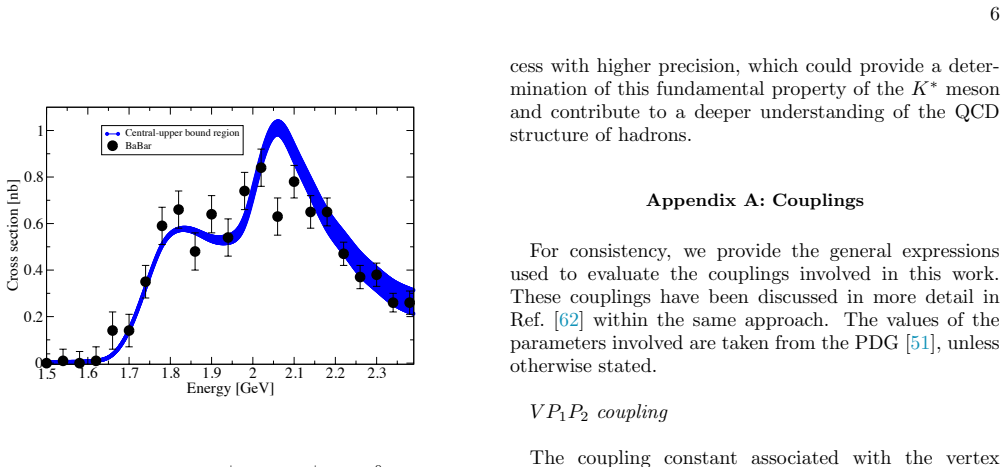
BaBar data on e+e- to K+K- pi0 pi0 production constrains the K* magnetic dipole moment to a central value of 4.5 with an upper bound of 6.3 in units of e/2m_K*.
A machine-rendered reading of the paper's core claim, the machinery that carries it, and where it could break.
Core claim
Within the vector meson dominance framework that includes the relevant resonant contributions below 2.4 GeV, the e+e− → K+K−π0π0 cross section is sensitive to the magnetic dipole moment of the K∗; fitting to BaBar data yields a central value μK∗ = 4.5 and an upper bound μ¯K∗ = 6.3 in units of e/2mK∗.
What carries the argument
The vector meson dominance parametrization of the γ∗ → 2K2π vertex, in which the K* magnetic dipole moment enters the electromagnetic vertex and thereby modifies the amplitude through the K* propagator and decay chains.
If this is right
- The cross section changes measurably when the magnetic dipole moment is varied within the allowed range.
- Higher-precision data would permit the first direct experimental determination of this parameter.
- The resulting value can be compared directly with theoretical calculations from QCD sum rules or lattice methods.
- The same framework can be applied to related channels to tighten the constraint.
Where Pith is reading between the lines
- Extending the analysis to higher energies or additional final states could reduce the model dependence on the resonance list.
- A confirmed value would provide a new benchmark for effective-field-theory descriptions of vector-meson electromagnetic structure.
- Future experiments with better statistics could turn the current upper bound into a two-sided measurement.
Load-bearing premise
The chosen vector meson dominance model plus the specific set of intermediate resonances below 2.4 GeV fully captures the process so that uncertainties in the model do not overwhelm the sensitivity to the K* magnetic dipole moment.
What would settle it
A new measurement of the e+e− → K+K−π0π0 cross section at energies below 2.4 GeV whose energy dependence or absolute normalization deviates from the curve predicted by the extracted central value of the magnetic dipole moment.
Figures


read the original abstract
We explore the sensitivity of the $e^{+} e^{-} \to K^+ K^- 2 \pi^0$ cross section to the magnetic dipole moment (MDM) of the $K^*$ vector meson. We describe the $\gamma^* \to 2K2\pi$ vertex using a vector meson dominance model, including the intermediate resonant contributions relevant for energies below 2.4 GeV. Using BaBar data for this process, we show that this observable is indeed sensitive to the MDM of the $K^*$; we obtain a central value for the MDM of $\mu_{K^*}=4.5$ and an upper bound of $\bar{\mu}_{K^*} = 6.3$, in units of $e/2 m_{K^*}$. We emphasize the need for higher precision data to provide a first data-driven determination of this parameter to confront it with theoretical predictions.
Editorial analysis
A structured set of objections, weighed in public.
Referee Report
Summary. The paper claims that the e^+e^- → K^+ K^- π^0 π^0 cross section is sensitive to the magnetic dipole moment (MDM) of the K^* meson. Using a vector meson dominance model for the γ^* → 2K2π vertex including intermediate resonant contributions below 2.4 GeV, and fitting to BaBar data, they extract a central value μ_{K^*}=4.5 and an upper bound μ-bar_{K^*}=6.3 in units of e/2m_{K^*}, while calling for higher-precision data to enable a first data-driven determination.
Significance. If the VMD model with the chosen resonances accurately describes the process, the work provides a useful demonstration of sensitivity and a first step toward constraining the K^* MDM from data, which could be confronted with theoretical predictions. The emphasis on needing better data is appropriate. However, the significance is reduced because the quoted numbers are obtained by direct fitting of the MDM parameter inside the model rather than an independent prediction.
major comments (3)
- The central extraction of μ_{K^*}=4.5 and the bound 6.3 is performed by fitting the MDM parameter directly to BaBar data within the fixed VMD amplitude; no error bars, χ²/dof, or covariance information is provided, so the statistical support for the quoted sensitivity remains unclear.
- The model for the γ^* → 2K2π vertex fixes a specific set of intermediate resonances below 2.4 GeV without variation or alternative choices; if unmodeled non-resonant backgrounds or additional resonances contribute at comparable level, they can be absorbed into the MDM fit, rendering the central value and bound model artifacts rather than robust data constraints.
- No explicit test is shown of how well the baseline model (MDM set to a reference value such as the naive quark-model expectation) reproduces the BaBar cross-section data before introducing the MDM as a free parameter; this is needed to establish that the sensitivity is not dominated by overall normalization or shape discrepancies.
minor comments (2)
- The abstract and results section should explicitly state the units for the reported MDM values and include a brief comparison to existing theoretical estimates (e.g., from QCD sum rules or lattice calculations) to contextualize the extracted numbers.
- Figures showing the cross section for different MDM values would benefit from shaded uncertainty bands on the data points and a clear legend distinguishing the curves.
Simulated Author's Rebuttal
We thank the referee for the careful reading of our manuscript and the constructive comments. We address each major comment below, indicating where revisions will be made to strengthen the presentation while preserving the focus on sensitivity within the VMD framework.
read point-by-point responses
-
Referee: The central extraction of μ_{K^*}=4.5 and the bound 6.3 is performed by fitting the MDM parameter directly to BaBar data within the fixed VMD amplitude; no error bars, χ²/dof, or covariance information is provided, so the statistical support for the quoted sensitivity remains unclear.
Authors: We agree that the manuscript would benefit from explicit statistical information on the fit. The central value and upper bound were obtained by varying the MDM parameter to best describe the BaBar data points in our model. In the revised version we will add the χ²/dof for the best-fit MDM and for the reference case (MDM set to zero), together with a short discussion of fit quality. Given the limited precision of the existing data, these numbers are intended to illustrate sensitivity rather than constitute a full statistical extraction with covariance matrix. revision: partial
-
Referee: The model for the γ^* → 2K2π vertex fixes a specific set of intermediate resonances below 2.4 GeV without variation or alternative choices; if unmodeled non-resonant backgrounds or additional resonances contribute at comparable level, they can be absorbed into the MDM fit, rendering the central value and bound model artifacts rather than robust data constraints.
Authors: The resonances included are those expected to dominate below 2.4 GeV on the basis of known decay modes and prior analyses of related channels. We acknowledge that fixing the resonance content introduces model dependence and that other contributions could be partially absorbed by the MDM parameter. In the revision we will add an explicit justification for the chosen set and a qualitative assessment of possible systematic effects from omitted terms. The paper’s primary aim remains to demonstrate sensitivity inside this established VMD approach rather than to claim a model-independent result. revision: partial
-
Referee: No explicit test is shown of how well the baseline model (MDM set to a reference value such as the naive quark-model expectation) reproduces the BaBar cross-section data before introducing the MDM as a free parameter; this is needed to establish that the sensitivity is not dominated by overall normalization or shape discrepancies.
Authors: The manuscript already overlays the cross-section predictions for several MDM values, including the baseline case, on the BaBar data. To make the comparison more transparent we will add a dedicated statement and, if space permits, a separate panel quantifying the baseline-model agreement before the MDM is allowed to vary. This will clarify that the improvement with nonzero MDM arises from both normalization and shape. revision: yes
Circularity Check
No significant circularity; standard phenomenological extraction from data
full rationale
The paper constructs a VMD-based amplitude for the γ* → 2K2π vertex, incorporates a fixed set of resonances below 2.4 GeV, and fits the single free parameter μ_K* directly to BaBar cross-section data. No derivation chain, uniqueness theorem, or first-principles result is claimed; the reported central value 4.5 and bound 6.3 are explicitly the output of this fit. No self-citation load-bearing step, ansatz smuggling, or renaming of a known result appears in the provided text. The analysis therefore remains self-contained against external benchmarks and receives the default non-circularity finding.
Axiom & Free-Parameter Ledger
free parameters (1)
- μ_K* =
4.5
axioms (1)
- domain assumption Vector meson dominance adequately describes the γ* to 2K2π vertex including the listed resonant contributions below 2.4 GeV.
Reference graph
Works this paper leans on
-
[1]
from the same data set. The couplingg f0π0π0 = 1.0±0.1 GeV is determined from the decay width of f0 →ππ, where the two pion mode accounts for the total decay width. Similarly, the couplingg σπ 0π0 is de- termined from the corresponding decay width of theσ meson which, together with its mass, is fixed by fitting to the cross section. See appendix A for fur...
-
[2]
S. D. Deser, M. T. Grisaru, and H. Pendleton, eds.,Pro- ceedings, 13th Brandeis University Summer Institute in Theoretical Physics, Lectures On Elementary Particles and Quantum Field Theory: Waltham, MA, USA, June 15 - July 24 1970(MIT, Cambridge, MA, USA, 1970)
work page 1970
-
[3]
S. J. Brodsky and J. R. Hiller, Universal properties of the electromagnetic interactions of spin one systems, Phys. Rev. D46, 2141 (1992)
work page 1992
-
[4]
S. Ferrara, M. Porrati, and V. L. Telegdi,g= 2 as the natural value of the tree-level gyromagnetic ratio of ele- mentary particles, Phys. Rev. D46, 3529 (1992)
work page 1992
-
[5]
Jackiw, G = 2 as a gauge condition, Phys
R. Jackiw, G = 2 as a gauge condition, Phys. Rev. D57, 2635 (1998)
work page 1998
-
[6]
Toledo Sanchez, Structure of radiative interferences and g=2 for vector mesons, Phys
G. Toledo Sanchez, Structure of radiative interferences and g=2 for vector mesons, Phys. Rev. D66, 097301 (2002)
work page 2002
-
[7]
B. R. Holstein, How Large is the ’natural’ magnetic mo- ment?, Am. J. Phys.74, 1104 (2006)
work page 2006
-
[8]
A. Dbeyssi, E. Tomasi-Gustafsson, G. I. Gakh, and C. Adamuscin, Experimental constraint on theρ−me- son form factors in the time–like region, Phys. Rev. C 85, 048201 (2012)
work page 2012
-
[9]
C. Lorce, Electromagnetic properties for arbitrary spin particles: Natural electromagnetic moments from light- cone arguments, Phys. Rev. D79, 113011 (2009)
work page 2009
-
[10]
E. G. Delgado-Acosta, M. Kirchbach, M. Napsuciale, and S. Rodriguez, Electromagnetic multipole moments of ele- mentary spin-1/2, 1, and 3/2 particles, Phys. Rev. D85, 116006 (2012)
work page 2012
-
[11]
Haberzettl, Model-independent form-factor con- straints for electromagnetic spin-1 currents, Phys
H. Haberzettl, Model-independent form-factor con- straints for electromagnetic spin-1 currents, Phys. Rev. D100, 036008 (2019)
work page 2019
-
[12]
A. S. Bagdasaryan, S. V. Esaibegian, and N. L. Ter- Isaakian, Form-factors of mesons and meson resonances at small and intermediate momentum transfersq 2 in the relativistic quark model, Yad. Fiz.42, 440 (1985)
work page 1985
-
[13]
F. Cardarelli, I. L. Grach, I. M. Narodetsky, G. Salme, and S. Simula, Electromagnetic form-factors of the rho meson in a light front constituent quark model, Phys. Lett. B349, 393 (1995)
work page 1995
-
[14]
J. P. B. C. de Melo and T. Frederico, Covariant and light front approaches to the rho meson electromagnetic form- factors, Phys. Rev. C55, 2043 (1997)
work page 2043
-
[15]
D. Melikhov and S. Simula, Electromagnetic form-factors in the light front formalism and the Feynman triangle diagram: Spin 0 and spin 1 two fermion systems, Phys. Rev. D65, 094043 (2002)
work page 2002
-
[16]
Samsonov, Magnetic moment of the rho meson in QCD sum rules: alpha(s) corrections, JHEP12, 061
A. Samsonov, Magnetic moment of the rho meson in QCD sum rules: alpha(s) corrections, JHEP12, 061
-
[17]
T. M. Aliev, I. Kanik, and M. Savci, magnetic moment of the rho meson in qcd light cone sum rules, Phys. Rev. D68, 056002 (2003)
work page 2003
-
[18]
Jaus, Consistent treatment of spin 1 mesons in the light front quark model, Phys
W. Jaus, Consistent treatment of spin 1 mesons in the light front quark model, Phys. Rev. D67, 094010 (2003)
work page 2003
-
[19]
H.-M. Choi and C.-R. Ji, Electromagnetic structure of the rho meson in the light front quark model, Phys. Rev. D70, 053015 (2004)
work page 2004
-
[20]
J. He, B. Julia-Diaz, and Y.-b. Dong, Electromagnetic form-factors of pion and rho in the three forms of rela- tivistic kinematics, Phys. Lett. B602, 212 (2004)
work page 2004
-
[21]
T. Bhagwat, A. ¨Ozpineci, and M. Savcı, Magnetic and quadrupole moments of light spin-1 mesons in light cone qcd sum rules, Physics Letters B678, 470 (2009)
work page 2009
-
[22]
E. P. Biernat and W. Schweiger, Electromagnetic rho- meson form factors in point-form relativistic quantum mechanics, Phys. Rev. C89, 055205 (2014)
work page 2014
-
[23]
Simonis, Magnetic properties of ground-state mesons., The European Physical Journal A52, 90 (2016)
V. Simonis, Magnetic properties of ground-state mesons., The European Physical Journal A52, 90 (2016)
work page 2016
-
[24]
J. P. B. C. de Melo and K. Tsushima, In-Mediumρ- Meson Properties in a Light-Front Approach, Few Body Syst.58, 82 (2017)
work page 2017
-
[25]
A. F. Krutov, R. G. Polezhaev, and V. E. Troitsky, Mag- netic moment of theρmeson in instant-form relativistic quantum mechanics, Phys. Rev. D97, 033007 (2018)
work page 2018
-
[26]
Improved predictions for magnetic moments and M1 decay widths of heavy hadrons
V. Simonis, Improved predictions for magnetic mo- ments and m1 decay widths of heavy hadrons (2018), arXiv:1803.01809 [hep-ph]
work page Pith review arXiv 2018
-
[27]
J. P. B. C. De Melo, Unambiguous Extraction of the Electromagnetic Form Factors for Spin-1 Particles on the Light-Front, Phys. Lett. B788, 152 (2019)
work page 2019
-
[28]
F. T. Hawes and M. A. Pichowsky, Electromagnetic form- factors of light vector mesons, Phys. Rev. C59, 1743 (1999)
work page 1999
-
[29]
M. S. Bhagwat and P. Maris, Vector meson form fac- tors and their quark-mass dependence, Phys. Rev. C77, 025203 (2008)
work page 2008
-
[30]
H. L. L. Roberts, A. Bashir, L. X. Gutierrez-Guerrero, C. D. Roberts, and D. J. Wilson, pi- and rho-mesons, and their diquark partners, from a contact interaction, Phys. Rev. C83, 065206 (2011)
work page 2011
-
[31]
M. Pitschmann, C.-Y. Seng, M. J. Ramsey-Musolf, C. D. Roberts, S. M. Schmidt, and D. J. Wilson, Electric dipole moment of theρmeson, Phys. Rev. C87, 015205 (2013)
work page 2013
-
[32]
Y.-Z. Xu, D. Binosi, Z.-F. Cui, B.-L. Li, C. D. Roberts, S.-S. Xu, and H. S. Zong, Elastic electromagnetic form factors of vector mesons, Phys. Rev. D100, 114038 9 (2019)
work page 2019
-
[33]
Z. Xing, K. Raya, and L. Chang, Quark anomalous mag- netic moment and its effects on theρmeson properties, Phys. Rev. D104, 054038 (2021)
work page 2021
-
[34]
C. Shi, J. Li, P.-L. Yin, and W. Jia, Unpolarized gen- eralized parton distributions of light and heavy vector mesons, Phys. Rev. D107, 074009 (2023)
work page 2023
- [35]
-
[36]
V. Y. Haurysh and V. V. Andreev,ρ-meson form-factors in point form of poincar´ e-invariant quantum mechanics, Few-Body Systems , 29 (2021)
work page 2021
-
[37]
J.-L. Zhang, G.-Z. Kang, and J.-L. Ping,ρmeson gen- eralized parton distributions in the Nambu–Jona-Lasinio model, Phys. Rev. D105, 094015 (2022)
work page 2022
-
[38]
Y.-L. Luan, X.-L. Chen, and W.-Z. Deng, Meson electro- magnetic form factors in an extended nambu–jona-lasinio model including heavy quark flavors, Chinese Physics C 39, 113103 (2015)
work page 2015
-
[39]
D. Djukanovic, E. Epelbaum, J. Gegelia, and U.-G. Meißner, The magnetic moment of theρ-meson, Phys. Lett. B730, 115 (2014)
work page 2014
-
[40]
A. Rojas and G. Toledo,ρmeson magnetic dipole mo- ment from BaBar e+e-→π+π-π0π0 cross section mea- surement, Phys. Rev. D110, 056037 (2024)
work page 2024
-
[41]
J. P. Leeset al.(BaBar), Measurement of the e+e−→π+π−π0π0 cross section using initial-state radi- ation at BABAR, Phys. Rev. D96, 092009 (2017)
work page 2017
-
[42]
J. Abdallah and Others (The DELPHI Collaboration), Measurements of cp-conserving trilinear gauge boson couplingswwv(v≡γ, z) ine +e− collisions at lep2, The European Physical Journal C66, 35 (2010)
work page 2010
-
[43]
Mele, Physics of w bosons at lep, Physics Reports403- 404, 255 (2004)
S. Mele, Physics of w bosons at lep, Physics Reports403- 404, 255 (2004)
work page 2004
-
[44]
A. M. Badalian and Y. A. Simonov, Magnetic moments of mesons, Phys. Rev. D87, 074012 (2013)
work page 2013
-
[45]
F. X. Lee, S. Moerschbacher, and W. Wilcox, Magnetic moments of vector, axial, and tensor mesons in lattice QCD, Phys. Rev. D78, 094502 (2008)
work page 2008
-
[46]
D. Garcia Gudino and G. Toledo Sanchez, Finite width induced modification to the electromagnetic form factors of spin-1 particles, Phys. Rev. D81, 073006 (2010)
work page 2010
-
[47]
J. P. Leeset al.(BaBar), Cross Sections for the Reactions e+e- –>K+ K- pi+pi-, K+ K- pi0pi0, and K+ K- K+ K- Measured Using Initial-State Radiation Events, Phys. Rev. D86, 012008 (2012)
work page 2012
-
[48]
N. M. Kroll, T. D. Lee, and B. Zumino, Neutral Vec- tor Mesons and the Hadronic Electromagnetic Current, Phys. Rev.157, 1376 (1967)
work page 1967
- [49]
-
[50]
T. Fujiwara, T. Kugo, H. Terao, S. Uehara, and K. Ya- mawaki, Nonabelian Anomaly and Vector Mesons as Dynamical Gauge Bosons of Hidden Local Symmetries, Prog. Theor. Phys.73, 926 (1985)
work page 1985
-
[51]
Meißner, Low-Energy Hadron Physics from Effec- tive Chiral Lagrangians with Vector Mesons, Phys
U.-G. Meißner, Low-Energy Hadron Physics from Effec- tive Chiral Lagrangians with Vector Mesons, Phys. Rept. 161, 213 (1988)
work page 1988
-
[52]
Navaset al.(Particle Data Group), Review of particle physics, Phys
S. Navaset al.(Particle Data Group), Review of particle physics, Phys. Rev. D110, 030001 (2024)
work page 2024
-
[53]
K. J. Kim and Y.-S. Tsai, MAGNETIC DIPOLE AND ELECTRIC QUADRUPOLE MOMENTS OF W+- ME- SON, Phys. Rev. D7, 3710 (1973)
work page 1973
-
[54]
K. Hagiwara, R. D. Peccei, D. Zeppenfeld, and K. Hikasa, Probing the Weak Boson Sector in e+ e- —>W+ W-, Nucl. Phys. B282, 253 (1987)
work page 1987
-
[55]
J. F. Nieves and P. B. Pal, Electromagnetic properties of neutral and charged spin 1 particles, Phys. Rev. D55, 3118 (1997)
work page 1997
-
[56]
G. Gounariset al., Triple gauge boson couplings, in AGS / RHIC Users Annual Meeting(1996) arXiv:hep- ph/9601233
-
[57]
U. Baur and D. Zeppenfeld, Finite width effects and gauge invariance in radiativeWproductions and decay, Phys. Rev. Lett.75, 1002 (1995)
work page 1995
-
[58]
E. N. Argyres, W. Beenakker, G. J. van Oldenborgh, A. Denner, S. Dittmaier, J. Hoogland, R. Kleiss, C. G. Papadopoulos, and G. Passarino, Stable calculations for unstable particles: Restoring gauge invariance, Phys. Lett. B358, 339 (1995)
work page 1995
- [59]
-
[60]
G. Lopez Castro and G. Toledo Sanchez, Gauge invari- ance and finite width effects in radiative two pion tau lepton decay, Phys. Rev. D61, 033007 (2000)
work page 2000
-
[61]
Kumar, Covariant phase-space calculations of n-body decay and production processes, Phys
R. Kumar, Covariant phase-space calculations of n-body decay and production processes, Phys. Rev.185, 1865 (1969)
work page 1969
-
[62]
G. Peter Lepage, A new algorithm for adaptive multidi- mensional integration, Journal of Computational Physics 27, 192 (1978)
work page 1978
-
[63]
G. ´Avalos, A. Rojas, M. S´ anchez, and G. Toledo, Role of theρ(1450) in low-energy observables from an analysis in the meson dominance approach, Phys. Rev. D107, 056006 (2023)
work page 2023
discussion (0)
Sign in with ORCID, Apple, or X to comment. Anyone can read and Pith papers without signing in.