Mix-CALADIN: A Distributed Algorithm for Consensus Mixed-Integer Optimization
Pith reviewed 2026-05-10 10:56 UTC · model grok-4.3
The pith
Mix-CALADIN extends CALADIN to solve distributed consensus problems with Boolean variables and supplies convergence guarantees for convex and nonconvex cases.
A machine-rendered reading of the paper's core claim, the machinery that carries it, and where it could break.
Core claim
Mix-CALADIN extends the Consensus Augmented Lagrangian Alternating Direction Inexact Newton (CALADIN) framework by incorporating specialized techniques for handling Boolean variables without relying on local mixed-integer solvers, and proves convergence for both convex and nonconvex mixed-integer consensus optimization problems under the assumption that the objective functions are Lipschitz continuous.
What carries the argument
The Mix-CALADIN algorithm, which augments the CALADIN framework with Boolean-variable handling rules inside an augmented Lagrangian alternating-direction iteration.
Load-bearing premise
The objective functions satisfy Lipschitz continuity.
What would settle it
A concrete counterexample consisting of a distributed consensus problem with Lipschitz-continuous objectives where the Mix-CALADIN iterates fail to converge would falsify the claimed guarantees.
Figures


read the original abstract
This paper addresses distributed consensus optimization problems with mixed-integer variables, with a specific focus on Boolean variables. We introduce a novel distributed algorithm that extends the Consensus Augmented Lagrangian Alternating Direction Inexact Newton (CALADIN) framework by incorporating specialized techniques for handling Boolean variables without relying on local mixed-integer solvers. Under the mild assumption of Lipschitz continuity of the objective functions, we establish rigorous convergence guarantees for both convex and nonconvex mixed-integer programming problems. Numerical experiments demonstrate that the proposed algorithm achieves competitive performance compared to existing approaches while providing rigorous convergence guarantees.
Editorial analysis
A structured set of objections, weighed in public.
Referee Report
Summary. The paper introduces Mix-CALADIN, a distributed algorithm extending the CALADIN framework to solve consensus optimization problems with mixed-integer (specifically Boolean) variables. It handles Boolean variables via specialized techniques that avoid local mixed-integer solvers. Under the assumption of Lipschitz continuity of the objective functions, the manuscript claims rigorous convergence guarantees for both convex and nonconvex mixed-integer programming problems, supported by numerical experiments showing competitive performance relative to existing methods.
Significance. If the stated convergence results hold, the work provides a valuable contribution to distributed optimization by delivering a scalable algorithm with theoretical guarantees for mixed-integer consensus problems, an area where such guarantees are difficult to obtain. The extension of CALADIN without reliance on local solvers and the coverage of nonconvex cases represent clear strengths. The explicit invocation of a standard Lipschitz assumption to control inexact steps is appropriately highlighted.
minor comments (3)
- [Algorithm description] The description of the Boolean-variable update rules in the algorithm section would benefit from an explicit pseudocode listing or step-by-step enumeration to improve readability and reproducibility.
- [Numerical experiments] Numerical experiments section: the problem dimensions, number of agents, and specific instance generation details are not fully specified, which hinders direct reproduction of the reported competitive performance.
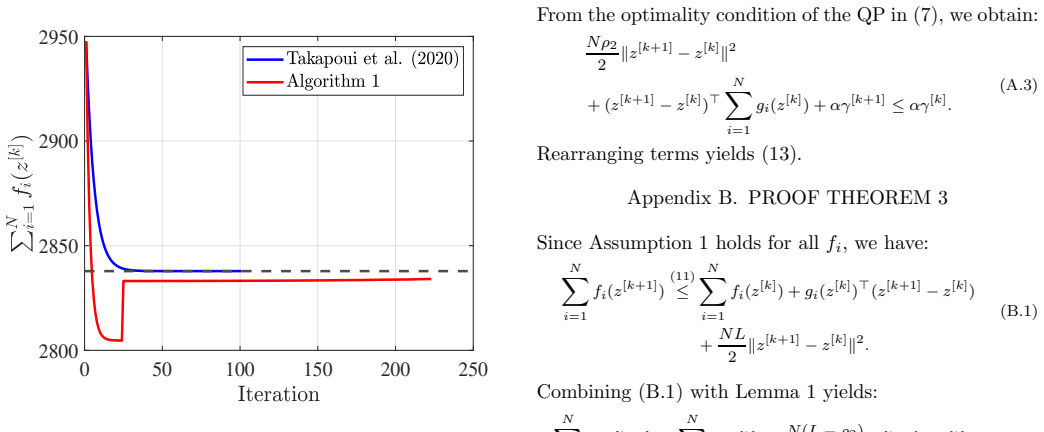
- [Figures] Convergence plots in the experiments would be clearer if they included results from multiple random seeds or error bands rather than single-run trajectories.
Simulated Author's Rebuttal
We thank the referee for the positive assessment of our manuscript and the recommendation for minor revision. The referee summary accurately captures the key elements of Mix-CALADIN, including the extension of the CALADIN framework, handling of Boolean variables without local solvers, and convergence guarantees under Lipschitz continuity for both convex and nonconvex cases.
Circularity Check
No significant circularity; convergence tied to external Lipschitz assumption
full rationale
The paper's central result is a convergence guarantee for the Mix-CALADIN algorithm under the explicit external assumption of Lipschitz continuity of the objective functions. This assumption is standard in the literature for ADMM-style methods and is not derived from or fitted to the algorithm's outputs. The extension for Boolean variables is described without reducing any key step to self-citation chains, self-definitional loops, or renaming of known results. The derivation remains self-contained against external benchmarks, with no load-bearing internal reductions.
Axiom & Free-Parameter Ledger
axioms (1)
- domain assumption Lipschitz continuity of the objective functions
Forward citations
Cited by 1 Pith paper
-
Distributed and Decentralized Optimization Algorithms via Consensus ALADIN
The paper proposes Consensus ALADIN (C-ALADIN) algorithms that solve distributed consensus optimization with global convergence for convex problems and local convergence for non-convex ones, including a decentralized ...
Reference graph
Works this paper leans on
-
[1]
Alavian, A. and Rotkowitz, M.C. (2017). Improving ADMM-based optimization of mixed integer objectives. In 2017 51st Annual Conference on Information Sci- ences and Systems (CISS) , 1–6. IEEE. Camisa, A., Notarnicola, I., and Notarstefano, G. (2021). Distributed primal decomposition for large-scale MILPs. IEEE Transactions on Automatic Control , 67(1), 413–
work page 2017
-
[2]
Conforti, M., Cornu´ ejols, G., and Zambelli, G. (2014). Integer Programming, volume
work page 2014
-
[3]
Springer. Dhingra, N.K. (2025). An ADMM-inspired algorithm for sensor selection and scheduling with routing constraints. In 2025 American Control Conference (ACC) , 1611–
work page 2025
-
[4]
IEEE. Dong, S. and Xia, W. (2024). A distributed algorithm for large-scale multi-agent MINLPs. In 2024 IEEE 63rd Conference on Decision and Control (CDC) , 3266–3271. IEEE. Doostmohammadian, M., Aghasi, A., Pirani, M., Nekouei, E., Zarrabi, H., Keypour, R., Rikos, A.I., and Johans- son, K.H. (2025). Survey of distributed algorithms for resource allocation...
-
[5]
Murray, A., Faulwasser, T., Hagenmeyer, V., Villanueva, M.E., and Houska, B. (2021). Partially distributed outer approximation. Journal of Global Optimization , 80(3), 523–550. Murray, A. and Hagenmeyer, V. (2020). Convergence of mixed-integer ALADIN. In Proceedings of the 4th In- ternational Conference on Algorithms, Computing and Systems, 51–54. Pia, A....
work page 2021
-
[6]
Takapoui, R. (2017). The alternating direction method of multipliers for mixed-integer optimization applications . Ph.D. thesis, Stanford University. Takapoui, R., Moehle, N., Boyd, S., and Bemporad, A. (2020). A simple effective heuristic for embedded mixed- integer quadratic programming. International journal of control, 93(1), 2–12. Testa, A., Rucco, A....
work page 2017
discussion (0)
Sign in with ORCID, Apple, or X to comment. Anyone can read and Pith papers without signing in.