Hill's level surfaces in the circular restricted three-body problem solved
Pith reviewed 2026-05-08 14:09 UTC · model grok-4.3
The pith
Hill's level surfaces in the circular restricted three-body problem admit an exact closed-form expression obtained by inverting the Jacobi integral into a cubic equation.
A machine-rendered reading of the paper's core claim, the machinery that carries it, and where it could break.
Core claim
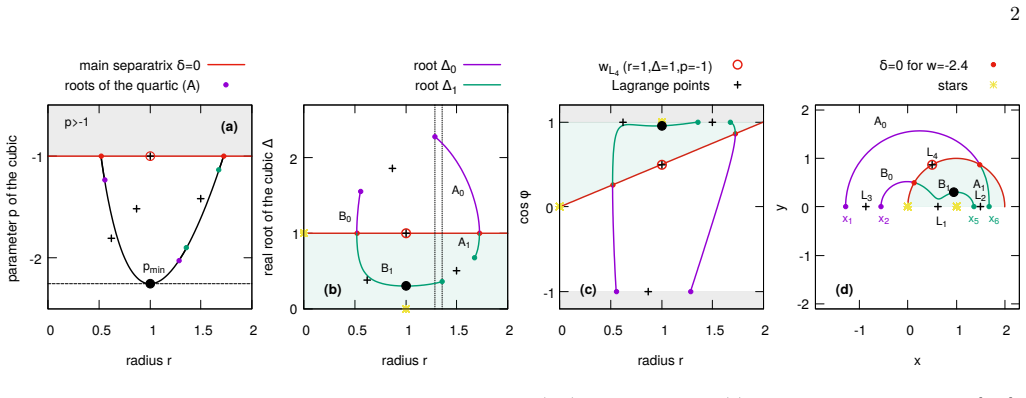
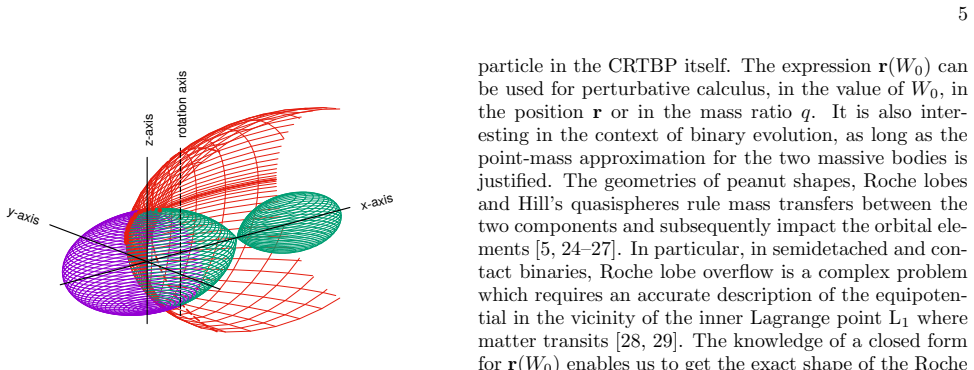
The level sets of the Jacobi integral in the standard CR3BP effective potential can be inverted exactly in the primary-centric spherical coordinate system to give a closed-form expression φ(r, θ) that is deduced from a cubic equation. This equation yields at most two roots on each side of a separatrix and exactly reproduces the tadpole, horseshoe, peanut, Roche lobe, and Hill quasi-sphere geometries.
What carries the argument
The closed-form φ(r, θ) obtained by solving the cubic equation that results from expressing the Jacobi integral level sets in primary-centric spherical coordinates.
If this is right
- The classic patterns of tadpole orbits, horseshoe orbits, peanut shapes, Roche lobes, and Hill's quasi-spheres are generated exactly from the algebraic solution.
- At most two real roots for the polar angle exist on each side of the separatrix for given radial distance and energy level.
- No iterative or numerical methods are required to trace the surfaces once the cubic coefficients are set.
- The derivation applies directly to the standard formulation of the circular restricted three-body problem without additional assumptions.
Where Pith is reading between the lines
- If the cubic inversion holds, it may permit analytic expressions for the locations of equilibrium points or the volumes enclosed by the surfaces.
- This coordinate choice could be tested for similar exact inversions in the elliptic restricted three-body problem or with oblateness terms.
- Exact surfaces would allow direct integration of areas or volumes for stability criteria in multi-body systems.
Load-bearing premise
The Jacobi integral level sets in the standard effective potential can be exactly inverted into a cubic equation in primary-centric spherical coordinates without losing information or introducing hidden approximations.
What would settle it
Plotting the surface from the closed-form φ(r, θ) for a fixed Jacobi constant and comparing it to a numerical contour of the effective potential at the same constant; any systematic deviation would show the expression is inexact.
Figures


read the original abstract
We report the closed-form expression for Hill's surfaces in the circular restricted three-body problem. The solution $\phi(r,\theta)$, derived in the primary-centric spherical coordinate system, is deduced from a cubic equation delivering at most two roots on each side of a separatrix. The famous patterns (tadpole, horseshoe and peanut shapes, Roche lobes and Hill's quasi-spheres) are exactly produced.
Editorial analysis
A structured set of objections, weighed in public.
Referee Report
Summary. The manuscript claims to derive a closed-form expression for Hill's level surfaces (zero-velocity surfaces) in the circular restricted three-body problem by reducing the Jacobi integral to a cubic equation in primary-centric spherical coordinates (r, θ), from which φ(r, θ) is obtained, yielding at most two roots on each side of a separatrix and exactly reproducing the standard shapes (tadpole, horseshoe, peanut, Roche lobes, Hill quasi-spheres).
Significance. An exact algebraic reduction of the CR3BP zero-velocity surfaces to a cubic would be a useful analytical result in celestial mechanics, allowing direct root-finding instead of numerical contouring of the effective potential. The manuscript provides no machine-checked proofs, reproducible code, or falsifiable predictions beyond the abstract claim, so the significance cannot be assessed until the derivation is supplied.
major comments (1)
- [Abstract] Abstract: The central claim that the level sets of the Jacobi integral reduce exactly to a cubic equation in primary-centric spherical coordinates is load-bearing but unsupported. The effective potential is Ω = ½(x² + y²) + (1-μ)/r1 + μ/r2 with r1 = r and r2 = √(r² + 1 - 2r cos γ(θ, φ)); the zero-velocity condition 2Ω = C therefore contains an irrational 1/r2 term. Rationalizing by multiplying through by r² r2 and squaring produces a polynomial of degree at least 6 in r. The manuscript must supply the explicit algebraic steps (including any auxiliary substitution) that reduce this to a cubic without approximation, loss of the r2 contribution, or hidden assumptions, together with direct verification that the resulting surfaces satisfy the original Jacobi integral.
Simulated Author's Rebuttal
We thank the referee for their careful review and for emphasizing the need for explicit algebraic details on the claimed reduction. We will revise the manuscript to supply the full derivation, auxiliary substitution, and verification steps, which we believe will allow the result to be properly assessed while preserving the exact nature of the solution.
read point-by-point responses
-
Referee: [Abstract] Abstract: The central claim that the level sets of the Jacobi integral reduce exactly to a cubic equation in primary-centric spherical coordinates is load-bearing but unsupported. The effective potential is Ω = ½(x² + y²) + (1-μ)/r1 + μ/r2 with r1 = r and r2 = √(r² + 1 - 2r cos γ(θ, φ)); the zero-velocity condition 2Ω = C therefore contains an irrational 1/r2 term. Rationalizing by multiplying through by r² r2 and squaring produces a polynomial of degree at least 6 in r. The manuscript must supply the explicit algebraic steps (including any auxiliary substitution) that reduce this to a cubic without approximation, loss of the r2 contribution, or hidden assumptions, together with direct verification that the resulting surfaces satisfy the original Jacobi integral.
Authors: We agree that the original submission lacked sufficient detail on the algebraic reduction, making the central claim difficult to verify. The manuscript derives φ(r, θ) by transforming the Jacobi integral into primary-centric spherical coordinates (r, θ) and applying an auxiliary substitution that clears the irrational 1/r2 term while retaining its full contribution, yielding a cubic equation whose roots determine the admissible values of φ on each side of the separatrix. In the revised version we will insert a dedicated appendix containing the complete sequence of algebraic manipulations from the zero-velocity condition through the substitution to the final cubic, followed by direct numerical checks confirming that the resulting surfaces satisfy the original Jacobi integral to machine precision for representative values of r, θ, μ, and C. This addition will also address the absence of reproducible code by including a short script that implements the cubic solver and verification. We maintain that the reduction is exact and reproduces the documented shapes without approximation or hidden assumptions. revision: yes
Circularity Check
No circularity; derivation presented as independent inversion of Jacobi integral
full rationale
The abstract and context present the solution φ(r,θ) as deduced from a cubic equation obtained from the standard Jacobi integral level sets in primary-centric spherical coordinates. No load-bearing step is quoted that reduces by construction to a fitted input, self-definition, or self-citation chain. The claim of exact reproduction of known patterns (tadpole, horseshoe, Roche lobes) is offered as a mathematical result rather than a renaming or ansatz smuggled via prior work. Absent explicit equations showing substitution or approximation of the r2 term, no specific reduction to inputs can be exhibited, satisfying the requirement to flag circularity only with direct quotes and demonstrated equivalence.
Axiom & Free-Parameter Ledger
Reference graph
Works this paper leans on
-
[1]
Hill's level surfaces in the circular restricted three-body problem solved
With the standard barycentric frame, the distance between this particle and each star depends explicitly on the mass ratio, which is not optimal here. Instead, we use the primary-centric coordinate system, where one of the stars (the primary, here) stands at the origin (e.g.,[21]). If all lengths are normalized to the binary separationa, then the potentia...
work page internal anchor Pith review Pith/arXiv arXiv 2026
-
[2]
Szebehely,Theory of orbits
V. Szebehely,Theory of orbits. The restricted problem of three bodies.(1982)
1982
-
[3]
A. D. Bruno,The Restricted 3-Body Problem: Plane Pe- riodic Orbits(De Gruyter, Berlin, New York, 1994)
1994
-
[4]
The restricted three- body problem,
C. D. Murray and S. F. Dermott, “The restricted three- body problem,” inSolar System Dynamics(Cambridge University Press, 2000) p. 63–129
2000
-
[5]
J. M. Faidit,Limites et lobes de Roche(Vuibert, 2007)
2007
-
[6]
P. J. Armitage and W. Kley, From Protoplanetary Disks to Planet Formation: Saas-Fee Advanced Course 45. Swiss Society for Astrophysics and Astronomy (2019)
2019
-
[7]
K. B. Bhatnagar and J. M. Chawla, Celestial Mechanics 16, 129 (1977)
1977
-
[8]
A. G. Mavraganis, Astrophys. & Space Science54, 305 (1978)
1978
-
[9]
D. W. Schuerman, Astrophys. J.238, 337 (1980)
1980
-
[10]
K. E. Papadakis, Astrophys. & Space Science232, 337 (1995)
1995
-
[11]
Csataryov´ a, in29th Conference on Variable Star Re- search, edited by J
M. Csataryov´ a, in29th Conference on Variable Star Re- search, edited by J. Dusek and M. Zejda (1998) p. 48
1998
-
[12]
T. J. Kalvouridis, Astrophys. & Space Science319, 105 (2009)
2009
-
[13]
T. Dermine, A. Jorissen, L. Siess, and A. Frankowski, Astron. & Astrophys.507, 891 (2009), arXiv:0907.1229 [astro-ph.SR]
-
[14]
Singh, Astrophys
J. Singh, Astrophys. & Space Science333, 61 (2011)
2011
-
[15]
J. A. Arredondo, J. Guo, C. Stoica, and C. Tamayo, Astrophys. & Space Science341, 315 (2012)
2012
-
[16]
P. P. Eggleton, Astrophys. J.268, 368 (1983)
1983
-
[17]
L. G. Luk’yanov and G. I. Shirmin, Astronomy Letters 33, 550 (2007)
2007
-
[18]
V. G. Szebehely, Astronomical J.68, 147 (1963)
1963
-
[19]
Pathania and T
A. Pathania and T. Medupe, Astrophys. & Space Science 338, 127 (2012)
2012
-
[20]
Plavec and P
M. Plavec and P. Kratochvil, Bulletin of the Astronomi- cal Institutes of Czechoslovakia15, 165 (1964)
1964
-
[21]
S. W. Mochnacki, Astrophys. J. Suppl. Series55, 551 (1984)
1984
-
[22]
Southworth, The Observatory143, 221 (2023), arXiv:2309.15661 [astro-ph.SR]
J. Southworth, The Observatory143, 221 (2023), arXiv:2309.15661 [astro-ph.SR]. 6
-
[23]
Matas, Celestial Mechanics17, 193 (1978)
V. Matas, Celestial Mechanics17, 193 (1978)
1978
-
[24]
Binney and S
J. Binney and S. Tremaine,Galactic dynamics(Prince- ton, NJ, Princeton University Press, 1987, 747 p., 1987)
1987
-
[25]
Paczy´ nski, Acta Astronomica16, 231 (1966)
B. Paczy´ nski, Acta Astronomica16, 231 (1966)
1966
-
[26]
Frank, A
J. Frank, A. King, and D. J. Raine,Accretion Power in Astrophysics: Third Edition(2002)
2002
- [27]
- [28]
-
[29]
P. Marchant, K. M. W. Pappas, M. Gallegos-Garcia, C. P. L. Berry, R. E. Taam, V. Kalogera, and P. Pod- siadlowski, Astron. & Astrophys.650, A107 (2021), arXiv:2103.09243 [astro-ph.SR]
- [30]
-
[31]
J. Cehula and O. Pejcha, Mon. Not. of the Royal Astr. Society524, 471 (2023), arXiv:2303.05526 [astro-ph.SR]
-
[32]
E. A. Antokhina, Sov. Astron.32, 608 (1988)
1988
-
[33]
Physics Of Eclipsing Binaries. II. Towards the Increased Model Fidelity
A. Prˇ sa, K. E. Conroy, M. Horvat, H. Pablo, A. Ko- choska, S. Bloemen, J. Giammarco, K. M. Hambleton, and P. Degroote, Astrophys. J. Suppl. Series227, 29 (2016), arXiv:1609.08135 [astro-ph.SR]
work page Pith review arXiv 2016
-
[34]
M. ˇCokina, M. Fedurco, and ˇS. Parimucha, Astron. & Astrophys.652, A156 (2021), arXiv:2106.10116 [astro- ph.IM]
-
[35]
Introduction,
R. B. King, “Introduction,” inBeyond the Quartic Equa- tion(Birkh¨ auser Boston, Boston, 1996) pp. 1–5. Appendix A: Intersection with the axis of the binary Forcing cosϕ=±1 in (5) furnishes a relationship be- tweenr,θ,qandw, but we cannot use the depressed cubic to get ∆. In order to describe the fullx-axis, we setr=ϵ 1xand ∆ =ϵ 2(1−x), whereϵ 1 =±1 (sign...
1996
discussion (0)
Sign in with ORCID, Apple, or X to comment. Anyone can read and Pith papers without signing in.