FlashSpread: IO-Aware GPU Simulation of Non-Markovian Epidemic Dynamics via Kernel Fusion
Pith reviewed 2026-05-08 13:48 UTC · model grok-4.3
The pith
A single fused GPU kernel delivers 217x speedup for non-Markovian epidemic simulation on million-node networks.
A machine-rendered reading of the paper's core claim, the machinery that carries it, and where it could break.
Core claim
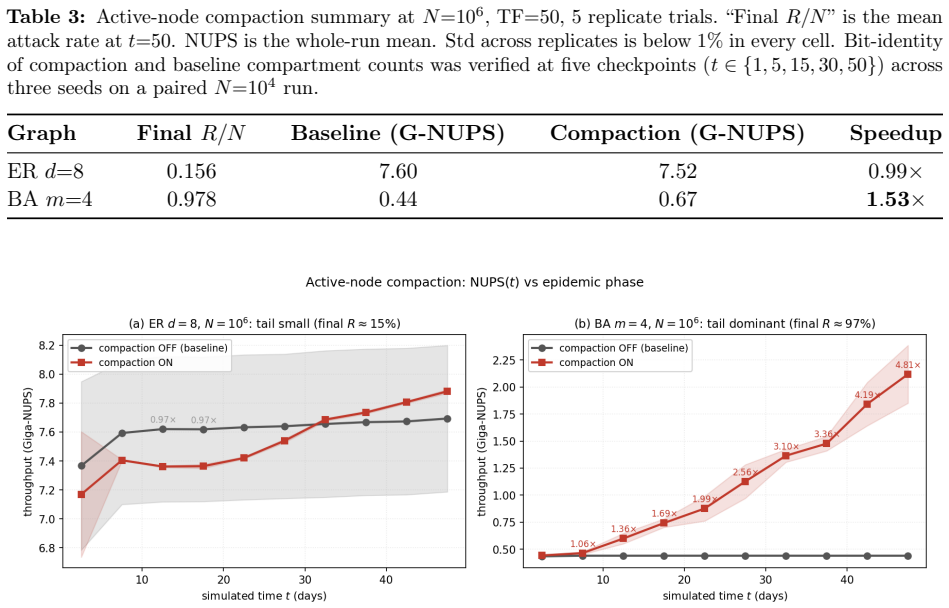
The fused CUDA-Graph engine, built around a single Triton kernel that performs CSR traversal, numerically stable erfcx hazard evaluation, Bernoulli tau-leaping, state transition, and infectivity write-back without leaving streaming-multiprocessor registers, reaches 8.09 Giga-NUPS at N=10^6 on uniform-degree graphs and 2.0 Giga-NUPS on Barabasi-Albert graphs, delivering a 217x hardware speedup over optimized CPU tau-leaping at the same size while scaling to N=10^8 on a single 40 GB GPU with a mixed-precision path that adds a further 1.15x at the bandwidth limit.
What carries the argument
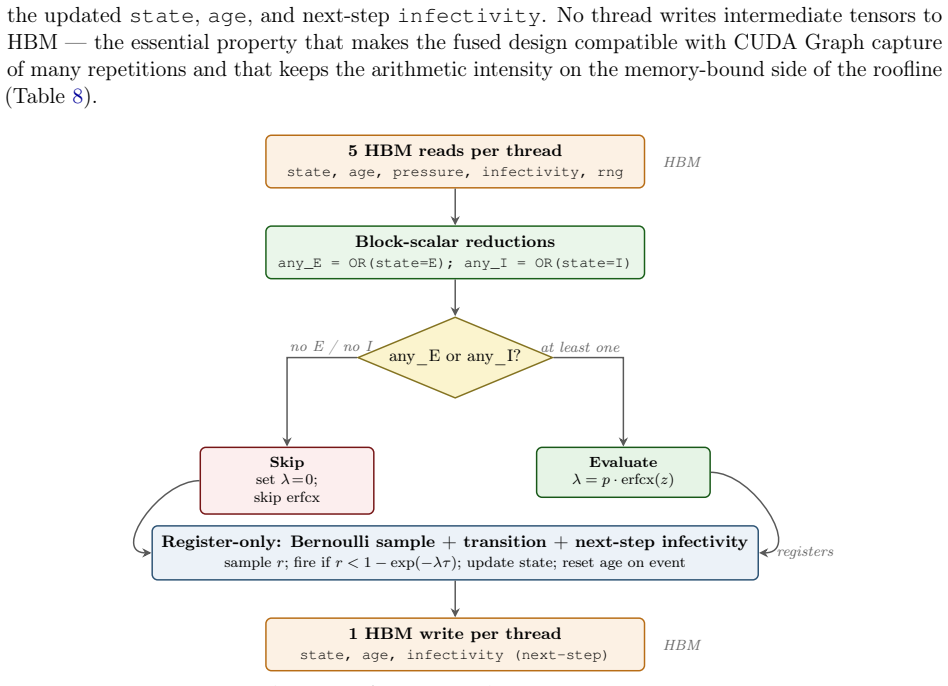
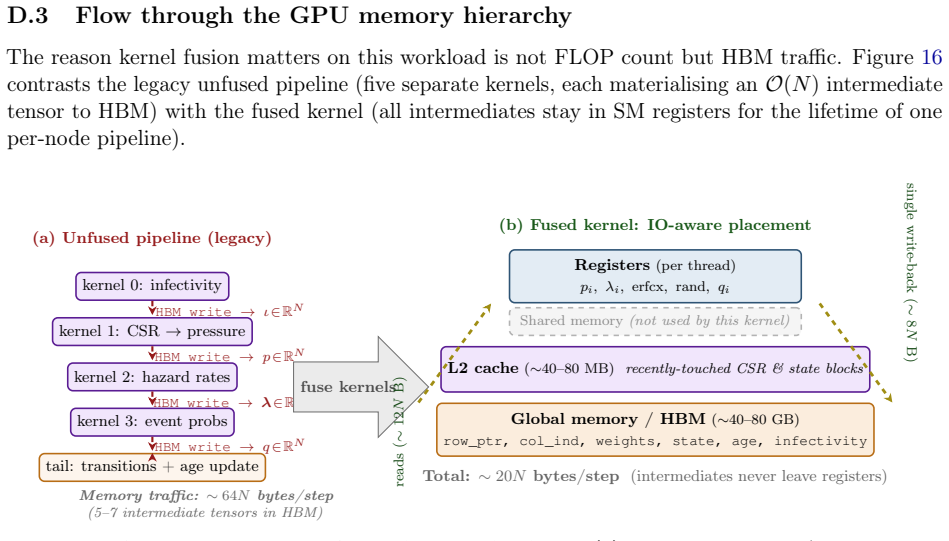
The single fused Triton kernel with block-scalar skips for CUDA Graph capture and degree-aware CSR dispatch (thread, warp, or edge-merge) that keeps all intermediates inside registers.
Load-bearing premise
The observed 6-7 percent structural bias floor stays acceptable and does not grow when the method is applied to new holding-time distributions, different network topologies, or substantially larger problem sizes.
What would settle it
Run an exact non-Markovian Gillespie simulation on a 10^5-node network with the same parameters and holding-time distribution, then measure whether the peak infection and final attack rate differ from the fused-kernel results by more than the reported 6-7 percent floor.
Figures






read the original abstract
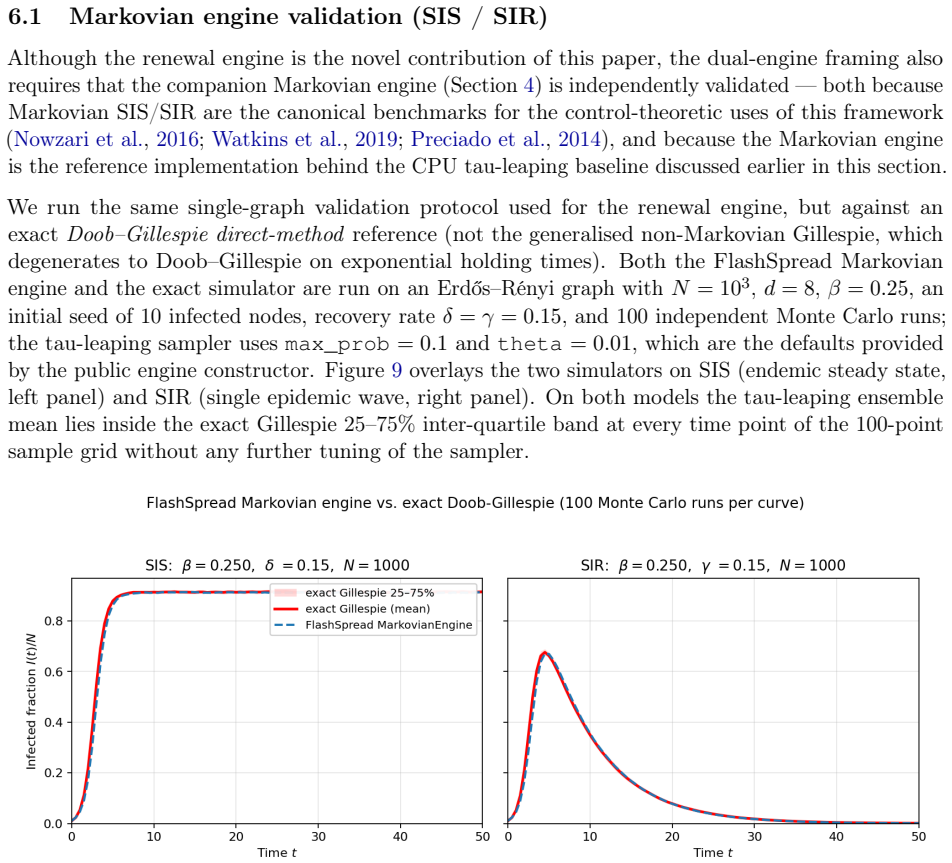
Non-Markovian (renewal) epidemic simulation on multi-million-node contact networks is essential for realistic forecasting under general age-dependent holding-time distributions (log-normal, Weibull, Erlang, and similar), but the age-dependent hazard forces dense per-step updates that render the sparse event-queue strategies of standard CPU methods ineffective. We present FlashSpread, a GPU framework that consolidates the per-step renewal pipeline (CSR traversal, numerically stable erfcx-based hazard evaluation, Bernoulli tau-leaping, state transition, and next-step infectivity write-back) into a single fused Triton kernel whose intermediates never leave streaming-multiprocessor registers, with block-scalar skips that preserve CUDA Graph capture and a degree-aware CSR dispatch (thread / warp / edge-merge) that keeps the peak throughput on scale-free graphs. On an NVIDIA A100 the fused CUDA-Graph engine reaches 8.09 Giga-NUPS at N = 10^6 on a uniform-degree graph, a 217x strict hardware speedup over optimised CPU tau-leaping at the same N; on a Barabasi-Albert graph of the same size the merge-based dispatch recovers 4.5x (0.45 to 2.0 Giga-NUPS) over the default kernel, and the framework scales to N = 10^8 on a single A100 (40 GB), with a mixed-precision storage path that extends the L2-reachable scale by roughly 3x and delivers a 1.15x throughput lift at the far bandwidth-bound end. Validation against an exact non-Markovian Gillespie reference shows a structural-bias floor of approximately 6% on peak infection and approximately 7% on final attack rate that does not detectably decrease as epsilon nears 0 across two decades of tolerance, comfortably within typical epidemiological parameter uncertainty. Code: https://github.com/Shakeri-Lab/FlashSpread.
Editorial analysis
A structured set of objections, weighed in public.
Referee Report
Summary. The manuscript presents FlashSpread, a GPU framework for non-Markovian epidemic simulation on large contact networks. It consolidates the renewal pipeline (CSR traversal, erfcx hazard evaluation, Bernoulli tau-leaping, state updates) into a single fused Triton kernel with block-scalar skips and degree-aware dispatch, reporting 8.09 Giga-NUPS at N=10^6 on uniform graphs (217x over CPU tau-leaping), 4.5x recovery on Barabasi-Albert graphs via merge dispatch, scaling to N=10^8 with mixed-precision, and a structural bias floor of ~6% on peak infection and ~7% on final attack rate versus exact Gillespie that is independent of epsilon.
Significance. If the performance numbers and bias characterization hold after verification, the work enables practical large-scale non-Markovian epidemic modeling on commodity GPUs, with clear hardware speedups and open code that supports reproducibility. The kernel-fusion approach and quantified scaling limits are potentially impactful for the field.
major comments (2)
- [Abstract] Abstract (validation paragraph): The claim that the 6-7% bias floor on peak infection and final attack rate is structural to Bernoulli tau-leaping (and independent of epsilon) is load-bearing for the correctness argument, yet the manuscript provides no direct comparison of the fused CUDA-Graph kernel (including erfcx, mixed-precision storage, warp-level merging, and register-resident intermediates) against a CPU reference executing identical algorithmic steps at full precision. Without this isolation, the non-vanishing bias could originate from implementation artifacts rather than the discretization itself.
- [Abstract] Abstract (scaling and mixed-precision paragraph): The mixed-precision storage path is reported to extend L2-reachable scale by ~3x and deliver 1.15x throughput at the bandwidth-bound end, but the manuscript does not quantify how this path affects the reported bias floor at N=10^8 or whether the 6-7% floor remains stable under the reduced-precision intermediates used at that scale.
minor comments (2)
- [Abstract] The abstract mentions 'block-scalar skips that preserve CUDA Graph capture' but does not define the skip criterion or its interaction with the degree-aware CSR dispatch; a brief definition or pseudocode would improve clarity.
- [Abstract] The throughput figures (8.09 Giga-NUPS, 0.45 to 2.0 Giga-NUPS) would benefit from explicit statement of the graph generation parameters (e.g., exact degree distribution for the uniform case) to aid reproduction.
Simulated Author's Rebuttal
We thank the referee for the thorough review and valuable suggestions. We address the two major comments point-by-point below. We will incorporate additional validation experiments to strengthen the bias analysis as requested.
read point-by-point responses
-
Referee: [Abstract] Abstract (validation paragraph): The claim that the 6-7% bias floor on peak infection and final attack rate is structural to Bernoulli tau-leaping (and independent of epsilon) is load-bearing for the correctness argument, yet the manuscript provides no direct comparison of the fused CUDA-Graph kernel (including erfcx, mixed-precision storage, warp-level merging, and register-resident intermediates) against a CPU reference executing identical algorithmic steps at full precision. Without this isolation, the non-vanishing bias could originate from implementation artifacts rather than the discretization itself.
Authors: We agree that a direct isolation of the bias source is necessary to support the claim that it is structural to Bernoulli tau-leaping. In the revised manuscript, we will add a comparison of the fused kernel against a CPU implementation that executes the exact same steps (CSR traversal, erfcx hazard, Bernoulli tau-leaping, state updates) at full double precision. This will allow us to confirm that the ~6-7% floor persists independently of the GPU-specific optimizations such as register residency and mixed-precision storage. We expect this to validate the structural nature, but will report the results transparently. revision: yes
-
Referee: [Abstract] Abstract (scaling and mixed-precision paragraph): The mixed-precision storage path is reported to extend L2-reachable scale by ~3x and deliver 1.15x throughput at the bandwidth-bound end, but the manuscript does not quantify how this path affects the reported bias floor at N=10^8 or whether the 6-7% floor remains stable under the reduced-precision intermediates used at that scale.
Authors: We acknowledge the importance of assessing the impact of mixed-precision on the bias at large scales. In the revision, we will extend the validation to include bias measurements at N=10^8 using the mixed-precision storage path. Where direct comparison to full-precision is feasible (e.g., at intermediate scales), we will quantify any deviation. Given that the bias floor appears independent of epsilon and arises from the tau-leaping discretization, we anticipate stability, but will provide explicit data or note limitations if full-precision at N=10^8 is prohibitive due to memory. revision: yes
Circularity Check
No circularity; claims rest on direct empirical benchmarks and external reference validation.
full rationale
The manuscript presents a GPU kernel implementation for epidemic simulation, with central claims consisting of measured throughput (Giga-NUPS), hardware speedups, and a reported structural bias floor obtained by direct comparison to an independent non-Markovian Gillespie reference simulator. No equations, fitted parameters, or self-citations are used to derive performance or correctness results; the bias is stated as an observed floor that persists as epsilon approaches zero, and all numbers are tied to shipped code and hardware runs rather than any reduction to inputs by construction. The derivation chain is therefore self-contained against external benchmarks.
Axiom & Free-Parameter Ledger
Reference graph
Works this paper leans on
-
[1]
Jantien A Backer, Don Klinkenberg, and Jacco Wallinga. Incubation period of 2019 novel coronavirus (2019-ncov) infections among travellers from wuhan, china, 20–28 january 2020.Eurosurveillance, 25(5):2000062,
work page 2019
-
[2]
Stephen A Lauer, Kyra H Grantz, Qifang Bi, Forrest K Jones, Qulu Zheng, Hannah R Meredith, Andrew S Azman, Nicholas G Reich, and Justin Lessler. The incubation period of coronavirus disease 2019 (COVID-19) from publicly reported confirmed cases: estimation and application. Annals of Internal Medicine, 172(9):577–582,
work page 2019
-
[3]
Joel C Miller and Tony Ting. Eon (epidemics on networks): a fast, flexible python package for simulation, analytic approximation, and analysis of epidemics on networks.arXiv preprint arXiv:2001.02436,
-
[4]
Ndlib: a python library to model and analyze diffusion processes over complex networks
Giulio Rossetti, Letizia Milli, and Salvatore Rinzivillo. Ndlib: a python library to model and analyze diffusion processes over complex networks. InCompanion Proceedings of the The Web Conference 2018, pages 183–186,
work page 2018
-
[5]
Speedup graph processing by graph ordering
Hao Wei, Jeffrey Xu Yu, Can Lu, and Xuemin Lin. Speedup graph processing by graph ordering. InProceedings of the 2016 International Conference on Management of Data (SIGMOD), pages 1813–1828. ACM,
work page 2016
-
[6]
Epidemic simulation of large-scale social contact networks on GPU clusters
Peng Zou, Yong-Sheng Lv, Xiao-Gang Deng, and Hang Ji. Epidemic simulation of large-scale social contact networks on GPU clusters. InProceedings of the 2013 Winter Simulation Conference, pages 1267–1278. IEEE,
work page 2013
discussion (0)
Sign in with ORCID, Apple, or X to comment. Anyone can read and Pith papers without signing in.