Societal Complexity and Physical Power
Pith reviewed 2026-05-11 00:57 UTC · model grok-4.3
The pith
Physical power, economic activity and societal complexity are linked in expanding civilizations
A machine-rendered reading of the paper's core claim, the machinery that carries it, and where it could break.
Core claim
Physical power, economic activity and societal complexity are linked, and this connection can be illustrated with a simple intuitive model based on systems dynamics.
What carries the argument
A simple intuitive model based on systems dynamics that illustrates the linkages between physical power, economic activity, and societal complexity.
If this is right
- If the linkages hold, continued expansion of civilization requires corresponding increases in physical power to support higher economic activity and complexity.
- Economic activity functions as an intermediary that connects physical power inputs to the growth of societal complexity.
- Limits on available physical power would directly constrain the feasible level of societal complexity.
Where Pith is reading between the lines
- The illustration implies that policies reducing energy throughput would need to anticipate effects on overall societal scale.
- The model could be tested by comparing power consumption data against complexity indicators such as infrastructure density or information processing capacity in different historical periods.
Load-bearing premise
That physical power, economic activity, and societal complexity are meaningfully linked in a way that allows a simple systems dynamics model to usefully illustrate their relationships without additional empirical validation or detailed mechanisms.
What would settle it
Empirical measurements across multiple societies that show no consistent correlation between physical power consumption rates and independent metrics of societal complexity.
Figures
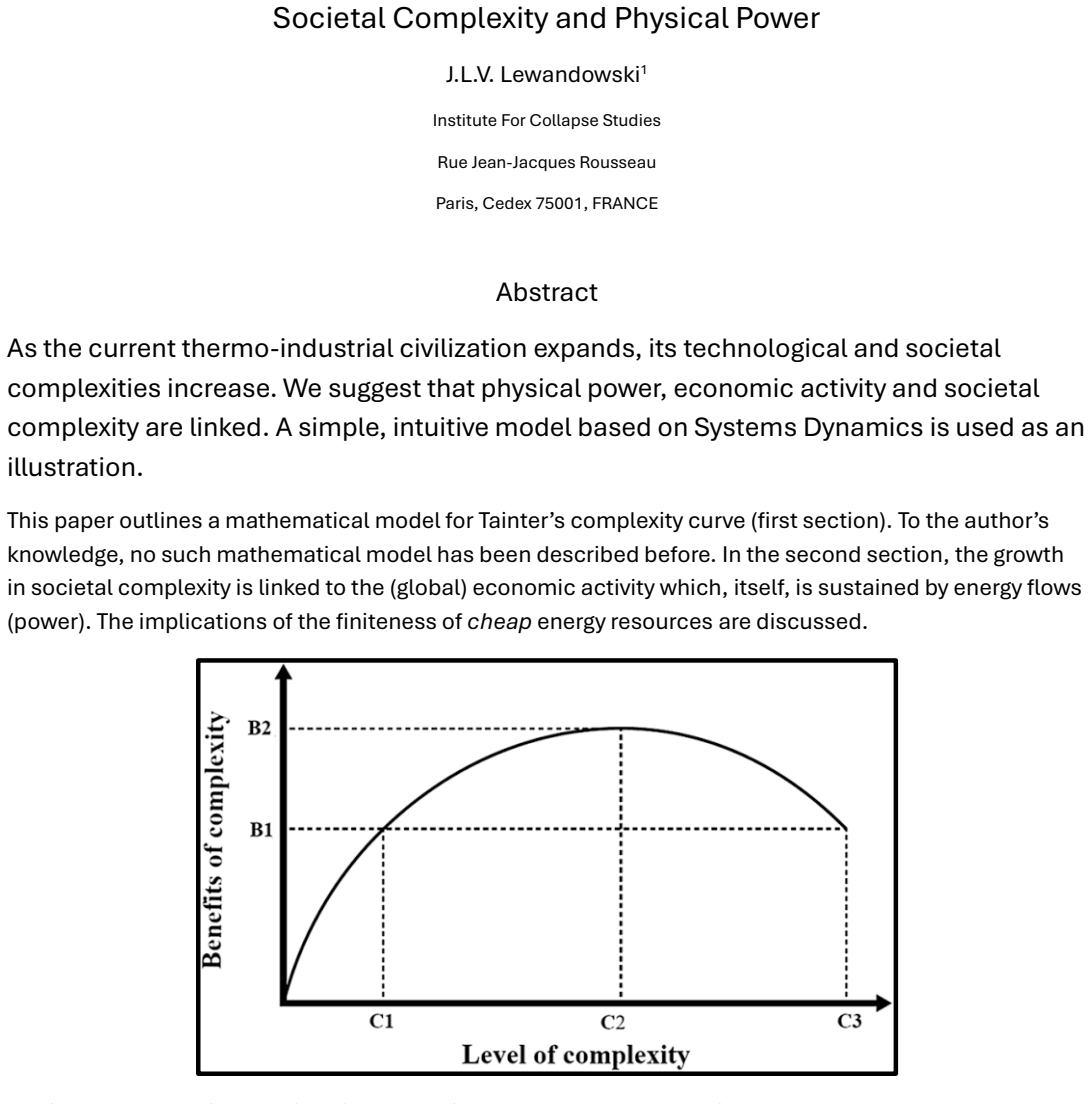


read the original abstract
As the current thermo-industrial civilization expands, its technological and societal complexities increase. We suggest that physical power, economic activity and societal complexity are linked. A simple, intuitive model based on Systems Dynamics is used as an illustration.
Editorial analysis
A structured set of objections, weighed in public.
Referee Report
Summary. The manuscript suggests that physical power, economic activity, and societal complexity are linked as thermo-industrial civilization expands, and states that a simple, intuitive systems-dynamics model is used as an illustration of this linkage.
Significance. A substantiated linkage between physical power (energy), economic activity, and societal complexity could inform studies of societal dynamics and sustainability. However, the manuscript provides no model specification, equations, parameters, outputs, or validation, so no concrete result or prediction is available to assess.
major comments (1)
- Abstract: The central claim relies on a systems-dynamics illustration of the linkage between physical power, economic activity, and societal complexity, yet the manuscript supplies no stocks, flows, differential equations, auxiliary variables, parameter values, or simulation trajectories. Without these elements it is impossible to determine whether the model demonstrates the claimed relationship or assumes it by construction.
Simulated Author's Rebuttal
We thank the referee for their review and for highlighting the need for greater transparency in the model. The manuscript is intended as a short conceptual note linking physical power, economic activity, and societal complexity via a simple systems-dynamics illustration. We agree that the current version does not supply sufficient technical detail for independent assessment and will revise accordingly.
read point-by-point responses
-
Referee: Abstract: The central claim relies on a systems-dynamics illustration of the linkage between physical power, economic activity, and societal complexity, yet the manuscript supplies no stocks, flows, differential equations, auxiliary variables, parameter values, or simulation trajectories. Without these elements it is impossible to determine whether the model demonstrates the claimed relationship or assumes it by construction.
Authors: We accept this criticism. The present manuscript describes the model only qualitatively as 'simple' and 'intuitive' without providing its stocks, flows, equations, parameters, or outputs. This was an oversight in the initial submission. In the revised version we will add a dedicated section that specifies the system-dynamics structure (stocks and flows), the governing differential equations, chosen parameter values, and representative simulation trajectories so that readers can evaluate whether the claimed linkage is demonstrated or assumed. revision: yes
Circularity Check
No derivation chain or model equations presented; claim is a suggestion only
full rationale
The paper states that physical power, economic activity and societal complexity are linked and that a simple systems-dynamics model is used as an illustration, but supplies no stocks, flows, auxiliary variables, differential equations, parameter values, or output trajectories. Without any explicit derivation, fitted parameters, or first-principles steps, no load-bearing claim can be reduced to its inputs by construction. The abstract framing as a suggestion rather than a derived result precludes circularity analysis. This is the expected non-finding for a manuscript that offers no mathematical content to inspect.
Axiom & Free-Parameter Ledger
Reference graph
Works this paper leans on
-
[1]
Power, Depletion and Energy Quality Model of Thermo-industrial Civilization
Lewandowski, J. ‘Power, Depletion and Energy Quality Model of Thermo-industrial Civilization’ available at https://arxiv.org/abs/2604.26165
work page internal anchor Pith review Pith/arXiv arXiv
-
[2]
L.M.A. Bettencourt, J. Lobo, D. Helbing, C. Kühnert, G.B. West, ‘Growth, innovation, scaling, and the pace of life in cities’, Proceedings National Academy of Sciences U.S.A. 104 (17) 7301-7306 (2007)
work page 2007
-
[3]
C.A. Hidalgo, R. Hausmann, ‘The building blocks of economic complexity’, Proceedings National Academy of Sciences U.S.A., 106 (26) 10570-10575 (2009)
work page 2009
-
[4]
Crafts, N., Gianni T, '‘Les Trente Glorieuses’: From the Marshall Plan to the Oil Crisis' , in Dan Stone (ed.), The Oxford Handbook of Postwar European History (2012; online edition, Oxford Academic, 18 Sept
work page 2012
discussion (0)
Sign in with ORCID, Apple, or X to comment. Anyone can read and Pith papers without signing in.