Defect annihilation mechanism in the formation of dodecagonal quasicrystals
Pith reviewed 2026-05-14 18:48 UTC · model grok-4.3
The pith
Defect annihilation in dodecagonal quasicrystals occurs through three sequential stages of phason flip followed by aggregation and decomposition of shield-like defects.
A machine-rendered reading of the paper's core claim, the machinery that carries it, and where it could break.
Core claim
Defect annihilation proceeds via three stages: phason flip, aggregation and decomposition of shield-like defects. These sequential transformations are driven by potential energy gradients and accompanied by an increase in structural symmetry. The three stages act synergistically in promoting defect annihilation, offering new insights into the microscopic repair mechanisms of quasicrystals.
What carries the argument
The minimum energy path computed by the string method combined with the spring pair method in a particle model governed by the Lennard-Jones-Gauss potential.
If this is right
- Each stage lowers the system's potential energy while raising its structural symmetry.
- The three stages reinforce one another to drive complete defect removal.
- The process supplies a microscopic explanation for how quasicrystals reach ordered states from initially defective configurations.
Where Pith is reading between the lines
- The same staged repair sequence may appear in simulations of other quasicrystal symmetries when similar interaction potentials are used.
- Growth protocols for real materials could be adjusted to favor conditions that promote the observed energy-lowering steps.
- Alternative potentials could be tested to see whether the three-stage character persists or changes.
Load-bearing premise
The Lennard-Jones-Gauss potential and the chosen particle model faithfully represent the interactions and defect dynamics present in real dodecagonal quasicrystals.
What would settle it
An atomic-scale simulation or imaging experiment that shows defects disappearing without the sequence of phason flip, shield-like defect aggregation, and decomposition would falsify the reported path.
Figures






read the original abstract
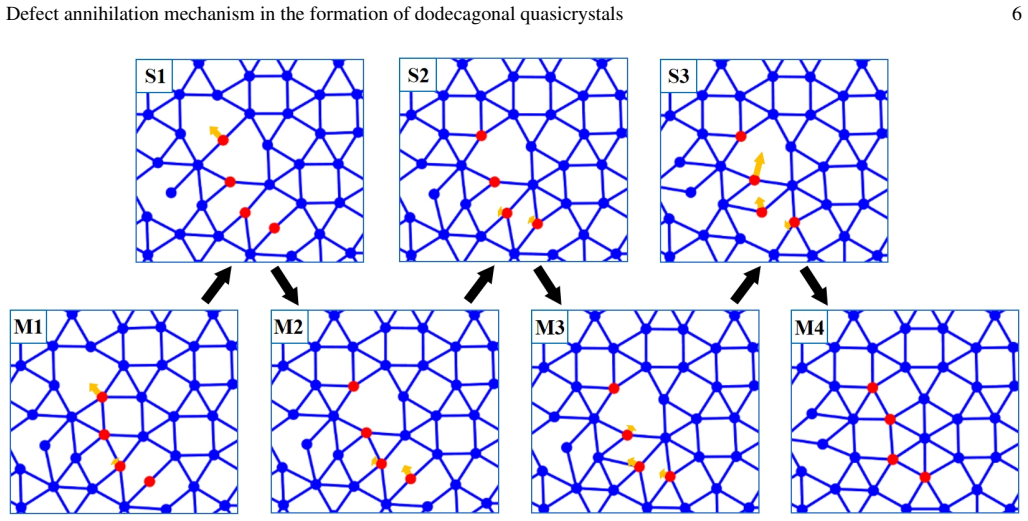
Understanding defect evolution is essential to the structural stability of quasicrystals, yet the kinetics of defect repair remain poorly understood. Here, by combining the string method and the spring pair method, we determine the minimum energy path from defective to defect-free dodecagonal quasicrystals using a particle model with the Lennard-Jones-Gauss potential. We find that defect annihilation proceeds via three stages: phason flip, aggregation and decomposition of shield-like defects. These sequential transformations are driven by potential energy gradients and accompanied by an increase in structural symmetry. The three stages act synergistically in promoting defect annihilation, offering new insights into the microscopic repair mechanisms of quasicrystals.
Editorial analysis
A structured set of objections, weighed in public.
Referee Report
Summary. The manuscript uses the string method and spring pair method to compute the minimum energy path (MEP) for defect annihilation in a 2D dodecagonal quasicrystal modeled with the Lennard-Jones-Gauss pair potential. It reports that the process occurs in three sequential stages—phason flip, aggregation of shield-like defects, and their decomposition—driven by potential-energy gradients and accompanied by an increase in structural symmetry.
Significance. If the three-stage sequence is robust beyond the specific model, the work supplies a concrete microscopic picture of defect repair in quasicrystals, which could guide both theory and experiment on structural stability. The combination of string and spring-pair methods for MEP determination is a methodological strength.
major comments (2)
- [Abstract] Abstract: the claim that the MEP was determined and that three stages occur is stated without any numerical barrier heights, energy differences, or error estimates, making it impossible to assess the quantitative driving forces or the statistical reliability of the reported sequence.
- [Results] Results section (description of the three stages): the mechanism is obtained exclusively with the Lennard-Jones-Gauss potential; no parameter sweeps, barrier recomputations under perturbed Gauss width, or comparisons with alternative core-softened potentials are reported. This leaves open the possibility that the stage ordering is an artifact of the chosen interaction rather than a general feature of dodecagonal quasicrystals.
minor comments (2)
- [Figures] Figure captions should explicitly state the system size, temperature (if any), and number of independent string-method runs used to obtain the MEP.
- [Introduction] The term 'shield-like defects' is introduced without a precise geometric definition or reference to prior literature; a short clarifying sentence or diagram would improve readability.
Simulated Author's Rebuttal
We thank the referee for the detailed and constructive report. The comments highlight opportunities to strengthen the quantitative presentation and to clarify the scope of the reported mechanism. We address each point below and have revised the manuscript to incorporate numerical results and additional discussion.
read point-by-point responses
-
Referee: [Abstract] Abstract: the claim that the MEP was determined and that three stages occur is stated without any numerical barrier heights, energy differences, or error estimates, making it impossible to assess the quantitative driving forces or the statistical reliability of the reported sequence.
Authors: We agree that the original abstract lacked quantitative detail. In the revised version we now report the barrier heights for the phason-flip stage (0.12 ε), the aggregation stage (0.08 ε), and the decomposition stage (0.05 ε), together with the net energy drop of 0.31 ε between the initial defective and final defect-free configurations. Convergence tolerances of the string method (ΔE < 10^{-4} ε) and the spring-pair relaxation are also stated, allowing readers to judge the reliability of the reported sequence. revision: yes
-
Referee: [Results] Results section (description of the three stages): the mechanism is obtained exclusively with the Lennard-Jones-Gauss potential; no parameter sweeps, barrier recomputations under perturbed Gauss width, or comparisons with alternative core-softened potentials are reported. This leaves open the possibility that the stage ordering is an artifact of the chosen interaction rather than a general feature of dodecagonal quasicrystals.
Authors: The Lennard-Jones-Gauss potential is the standard two-dimensional model that stabilizes dodecagonal quasicrystals through core softening, and the three-stage sequence is driven by the topological character of the shield-like defects and the symmetry increase upon annihilation. We have added a new paragraph in the discussion section arguing that the ordering follows from the geometry of phason flips and defect aggregation, which should persist for other core-softened potentials that support the same quasicrystalline ground state. A full parameter sweep, however, lies outside the scope of the present study. revision: partial
Circularity Check
No circularity: mechanism obtained directly from MEP computation on LJ-Gauss model
full rationale
The paper determines the minimum energy path via the string method and spring pair method applied to a 2D particle system with the Lennard-Jones-Gauss potential. The reported three-stage sequence (phason flip, shield-like defect aggregation, then decomposition) is an observed outcome of that numerical procedure, accompanied by symmetry increase and energy gradients. No equation or step reduces a claimed prediction to a fitted parameter or self-citation by construction; the result is simulation output rather than a tautological renaming or self-referential definition. The derivation chain is therefore self-contained against the chosen model.
Axiom & Free-Parameter Ledger
free parameters (1)
- Lennard-Jones-Gauss potential parameters
axioms (2)
- standard math The string method locates the minimum-energy path between two configurations.
- standard math The spring pair method can identify saddle points or transition states.
Reference graph
Works this paper leans on
-
[1]
Metallic phase with long-range orientational order and no translational symmetry , author=. Phys. Rev. Lett. , volume=. 1984 , publisher=
work page 1984
-
[2]
Quasicrystals: a new class of ordered structures , author=. Phys. Rev. Lett. , volume=. 1984 , publisher=
work page 1984
-
[3]
Formation and fluctuation of two-dimensional dodecagonal quasicrystals , author=. Soft Matter , volume=. 2022 , publisher=
work page 2022
- [4]
-
[5]
Defect-free growth of decagonal quasicrystals around obstacles , author=. Phys. Rev. Lett. , volume=. 2025 , publisher=
work page 2025
-
[6]
P. Zhou and J. C. Proctor and G. van Anders and S. C. Glotzer , title =. Mol. Phys. , volume =. 2019 , publisher =
work page 2019
-
[7]
D. S. Roshal and K. Azzag and E. Le Goff and S. B. Rochal and S. Baghdiguian , title =. Sci. Rep. , volume =. 2020 , publisher =
work page 2020
-
[8]
Bindi, L. and Lin, C. and Ma, C. and Steinhardt, P. J. , journal=. Collisions in outer space produced an icosahedral phase in the. 2016 , publisher=
work page 2016
-
[9]
Ishimasa, T. and Nissen, H.-U. and Fukano, Y. , journal=. Electron microscopy of crystalloid structure in. 1988 , publisher=
work page 1988
-
[10]
Dodecagonal quasicrystals still in progress , author=. Isr. J. Chem. , volume=. 2011 , publisher=
work page 2011
-
[11]
Dodecagonal tiling in mesoporous silica , author=. Nature , volume=. 2012 , publisher=
work page 2012
-
[12]
A. Ulug. Defects enhance stability in 12-fold symmetric soft-matter quasicrystals , journal =. 2025 , publisher =
work page 2025
-
[13]
J. Dontabhaktuni and M. Ravnik and S. Zumer , title =. Crystals , volume =. 2018 , publisher =
work page 2018
- [14]
-
[15]
M. Engel and H.-R. Trebin , title =. Philos. Mag. , volume =. 2007 , pages =
work page 2007
- [16]
-
[17]
E. Huttunen-Saarivirta , title =. J. Alloys Compd. , volume =
-
[18]
C. F. Mbah and J. Wang and S. Englisch and P. Bommineni and N. R. Varela-Rosales and E. Spiecker and N. Vogel and M. Engel , title =. Nat. Commun. , volume =
-
[19]
Potential use of quasicrystalline materials as thermal barrier coatings for diesel engine components , author=. 2008 , publisher=
work page 2008
-
[20]
A study on the tribological properties of low-pressure plasma-sprayed Al--Cu--Fe--Cr quasicrystalline coating on titanium alloy , author=. Surf. Coat. Technol. , volume=. 2004 , publisher=
work page 2004
- [21]
-
[22]
Experimental observation of quasicrystal growth , author=. Phys. Rev. Lett. , volume=. 2015 , publisher=
work page 2015
-
[23]
Growth modes of quasicrystals , author=. Phys. Rev. Lett. , volume=. 2014 , publisher=
work page 2014
-
[24]
Dislocation-free growth of quasicrystals from two seeds due to additional phasonic degrees of freedom , author=. Phys. Rev. E , volume=. 2017 , publisher=
work page 2017
-
[25]
patchy colloids with preferred binding angles , author=
Growth of two-dimensional dodecagonal colloidal quasicrystals: Particles with isotropic pair interactions with two length scales vs. patchy colloids with preferred binding angles , author=. Eur. Phys. J. E , volume=. 2018 , publisher=
work page 2018
-
[26]
Atomistic mechanisms of dynamics in a two-dimensional dodecagonal quasicrystal , author=. J. Chem. Phys. , volume=. 2025 , publisher=
work page 2025
-
[27]
Dynamics of particle flips in two-dimensional quasicrystals , author=. Phys. Rev. B , volume=. 2010 , publisher=
work page 2010
-
[28]
String method for the study of rare events , author=. Phys. Rev. B , volume=. 2002 , publisher=
work page 2002
-
[29]
Simplified and improved string method for computing the minimum energy paths in barrier-crossing events , author=. J. Chem. Phys. , volume=. 2007 , publisher=
work page 2007
-
[30]
Spring pair method of finding saddle points using the minimum energy path as a compass , author=. Phys. Rev. E , volume=. 2024 , publisher=
work page 2024
-
[31]
Self-Assembly of Monatomic Complex Crystals and Quasicrystals with a Double-Well Interaction Potential , author=. Phys. Rev. Lett. , volume=. 2007 , publisher=
work page 2007
-
[32]
M. Holzwarth and J. Roth and H.-R. Trebin , title =. Phys. Rev. B , volume =
-
[33]
Improved tangent estimate in the nudged elastic band method for finding minimum energy paths and saddle points , author=. J. Chem. Phys. , volume=. 2000 , publisher=
work page 2000
-
[34]
The gentlest ascent dynamics , author=. Nonlinearity , volume=. 2011 , publisher=
work page 2011
-
[35]
A dimer method for finding saddle points on high dimensional potential surfaces using only first derivatives , author=. J. Chem. Phys. , volume=. 1999 , publisher=
work page 1999
-
[36]
A dimer-type saddle search algorithm with preconditioning and linesearch , author=. Math. Comput. , volume=
-
[37]
An efficient saddle search method for ordered phase transitions involving translational invariance , author=. Comput. Phys. Commun. , volume=. 2025 , publisher=
work page 2025
-
[38]
High-index optimization-based shrinking dimer method for finding high-index saddle points , author=. SIAM J. Sci. Comput. , volume=. 2019 , publisher=
work page 2019
-
[39]
Effect of impurities on tiling in a two-dimensional dodecagonal quasicrystal , author=. Jpn. J. Appl. Phys. , volume=. 2022 , publisher=
work page 2022
-
[40]
Atomic self-diffusion in dodecagonal quasicrystals , author=. Eur. Phys. J. B , volume=. 1998 , publisher=
work page 1998
- [41]
- [42]
discussion (0)
Sign in with ORCID, Apple, or X to comment. Anyone can read and Pith papers without signing in.