Nonreciprocal impurity scattering as a probe for pairing symmetries in kagome superconductors
Pith reviewed 2026-05-19 18:57 UTC · model grok-4.3
The pith
Two magnetic impurities produce distinct spectral patterns that identify time-reversal symmetry breaking in kagome superconductor pairings.
A machine-rendered reading of the paper's core claim, the machinery that carries it, and where it could break.
Core claim
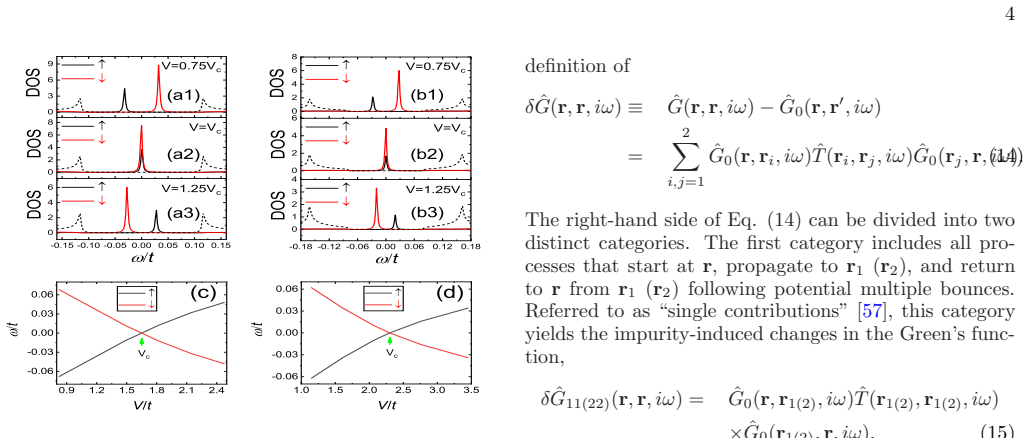
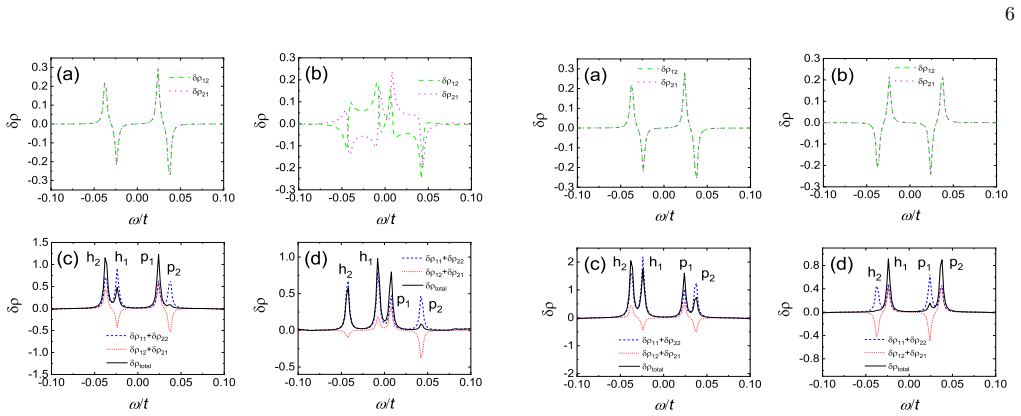
Using representative models of on-site s-wave and TRSB d_x2-y2 + i d_xy-wave pairings, the authors demonstrate that while single magnetic impurities yield similar LDOS for both, two impurities lead to distinct patterns. Time-reversal symmetry in s-wave pairing enforces equivalent forward and backward scattering for all configurations, causing YSR state pair disappearance along the impurity connecting line. In the TRSB pairing, this holds only for inversion-symmetric configurations.
What carries the argument
Nonreciprocal impurity scattering arising from broken time-reversal symmetry, manifested in the configuration-dependent equivalence of scattering directions between two magnetic impurities.
If this is right
- Distinct LDOS patterns from two impurities are resolvable in STM experiments for different pairings.
- Provides a direct method to discriminate TRSB and non-TRSB superconducting pairing symmetries in kagome materials.
- Offers an alternative probe of superconducting nonreciprocity that circumvents ambiguities in conventional critical current techniques.
- Addresses ambiguities from sublattice interference and CDW entanglement with superconductivity.
Where Pith is reading between the lines
- This approach may help resolve pairing symmetry questions in other vanadium-based or kagome systems.
- Could be tested by varying impurity distances and positions in actual STM experiments.
- Implies that nonreciprocity in scattering can serve as a general signature of TRSB in superconductors.
- Extensions might include considering non-magnetic impurities or lattice effects for more realistic models.
Load-bearing premise
The on-site s-wave and d plus id pairings are representative of the pairings in the actual kagome materials, and magnetic exchange dominates the impurity scattering.
What would settle it
STM observation of whether YSR state pairs disappear for all two-impurity configurations or only for inversion-symmetric ones would confirm or refute the distinction between the pairings.
Figures



read the original abstract
The superconducting (SC) pairing symmetry and its link to time-reversal symmetry breaking (TRSB) in the vanadium-based kagome superconductors remain unresolved, with ambiguities stemming from sublattice interference and charge-density-wave (CDW) entanglement with superconductivity. Using two representative SC pairings, i.e., the conventional on-site $s$-wave and the TRSB $d_{x^2-y^2}+id_{xy}$-wave, as a model study, we theoretically show that while single magnetic impurity yield qualitatively identical spectral behavior of local density of states (LDOS) for these two symmetries, two magnetic impurities give rise to distinct LDOS patterns. For the conventional on-site $s$-wave pairing, time-reversal symmetry (TRS) enforces equivalent forward and backward scattering between two impurities across all impurity configurations, leading to near disappearance of a Yu-Shiba-Rusinov (YSR) state pair along the line connecting the two impurities. However, for the TRSB $d_{x^2-y^2}+id_{xy}$-wave pairing, this scattering equivalence holds only for inversion-symmetric impurity configurations, with a pair of YSR disappearance restricted to this case. These distinct spectral features are resolvable in scanning tunneling microscopy (STM) experiments, providing a direct avenue to discriminate TRSB and non-TRSB SC pairing symmetries in kagome superconductors and an alternative method to probe SC nonreciprocity that circumvents the ambiguities of conventional critical current-based techniques.
Editorial analysis
A structured set of objections, weighed in public.
Referee Report
Summary. The manuscript presents a model study of magnetic impurity scattering in kagome superconductors to distinguish pairing symmetries. Using tight-binding BdG Hamiltonians with on-site s-wave and TRSB d_{x^2-y^2}+id_{xy} pairings, single-impurity LDOS spectra are shown to be qualitatively similar, while two-impurity configurations produce distinct patterns: TRS enforces equivalent forward/backward scattering (and consequent near-disappearance of a YSR pair along the connecting line) for all geometries in the s-wave case, but only for inversion-symmetric geometries in the d+id case. These STM-resolvable features are proposed as a discriminator for TRSB versus non-TRSB pairing that circumvents sublattice and CDW ambiguities.
Significance. If the configuration-dependent LDOS distinctions prove robust, the work supplies a concrete, symmetry-based STM protocol for probing pairing symmetry and nonreciprocity in AV3Sb5-type materials, complementing critical-current measurements. The explicit comparison of two representative Hamiltonians without adjustable parameters is a strength.
major comments (2)
- [theoretical framework / model Hamiltonian] The model Hamiltonian (defined in the theoretical framework section) employs pure on-site s-wave and d_{x^2-y^2}+id_{xy} pairings without CDW order or sublattice interference. The abstract itself identifies these as sources of ambiguity in the real materials; it is therefore necessary to show that the reported TRS-enforced scattering equivalence and the restriction of YSR disappearance to inversion-symmetric configurations survive the additional scattering channels and band reconstruction introduced by CDW. This directly affects the central claim that the method circumvents those ambiguities.
- [two-impurity LDOS calculations] In the two-impurity LDOS results, the forward/backward scattering equivalence is attributed to TRS for s-wave across all configurations but only to inversion symmetry for d+id. An explicit symmetry analysis of the impurity matrix elements on the kagome lattice (including how the d+id phase structure breaks the equivalence for non-inversion geometries) would make the origin of the distinction more transparent and testable.
minor comments (2)
- [results / figure captions] The phrase 'near disappearance' of the YSR pair is used repeatedly; a quantitative measure of the residual spectral weight (e.g., integrated intensity or peak height ratio) in the relevant figures would strengthen the presentation.
- [methods / computational details] A brief statement on the range of impurity strengths and distances explored would help readers assess how generic the reported patterns are.
Simulated Author's Rebuttal
We thank the referee for their careful reading of our manuscript, positive assessment of its significance, and constructive suggestions. We address each major comment below and indicate the revisions we plan to incorporate.
read point-by-point responses
-
Referee: The model Hamiltonian (defined in the theoretical framework section) employs pure on-site s-wave and d_{x^2-y^2}+id_{xy} pairings without CDW order or sublattice interference. The abstract itself identifies these as sources of ambiguity in the real materials; it is therefore necessary to show that the reported TRS-enforced scattering equivalence and the restriction of YSR disappearance to inversion-symmetric configurations survive the additional scattering channels and band reconstruction introduced by CDW. This directly affects the central claim that the method circumvents those ambiguities.
Authors: We appreciate the referee's point that a more complete treatment including CDW order would strengthen applicability to real kagome materials. Our manuscript is explicitly framed as a minimal model study that isolates the role of TRS versus TRSB in the pairing symmetry itself. The central claim is that the resulting configuration-dependent LDOS distinctions provide a symmetry-based discriminator independent of the specific microscopic details that generate ambiguities in other probes. We agree that explicit verification with CDW would be desirable; however, incorporating a specific CDW reconstruction would require additional assumptions about its structure and strength, which themselves remain under debate. We will add a clarifying paragraph in the discussion section emphasizing the scope of the model and arguing that the TRS-enforced equivalence is a general consequence of the pairing symmetry that should remain qualitatively robust against CDW-induced band reconstruction, provided the CDW does not itself break time-reversal symmetry. revision: partial
-
Referee: In the two-impurity LDOS results, the forward/backward scattering equivalence is attributed to TRS for s-wave across all configurations but only to inversion symmetry for d+id. An explicit symmetry analysis of the impurity matrix elements on the kagome lattice (including how the d+id phase structure breaks the equivalence for non-inversion geometries) would make the origin of the distinction more transparent and testable.
Authors: We agree that an explicit symmetry analysis would enhance the clarity and testability of the reported distinction. In the revised manuscript we will insert a new subsection (or expanded paragraph within the theoretical framework) that analyzes the impurity scattering matrix elements under the point-group symmetries of the kagome lattice. This will explicitly demonstrate how time-reversal symmetry enforces forward/backward equivalence for arbitrary impurity separations in the s-wave case, while the momentum-dependent phase winding of the d+id pairing lifts this equivalence except when the impurity pair is related by inversion. We expect this addition to make the microscopic origin of the LDOS patterns more transparent without altering the numerical results. revision: yes
Circularity Check
No circularity: explicit model comparison of independent BdG Hamiltonians
full rationale
The paper computes LDOS spectra from two distinct tight-binding BdG Hamiltonians, one for on-site s-wave pairing and one for TRSB d_{x^2-y^2}+id_{xy} pairing. The reported distinction—that TRS enforces forward/backward scattering equivalence (and YSR-pair disappearance) for all two-impurity geometries in the s-wave case but only inversion-symmetric geometries in the d+id case—follows directly from solving the impurity scattering problem in each Hamiltonian separately. No parameters are fitted to data and then presented as predictions, no self-citations supply load-bearing uniqueness theorems, and no ansatz is smuggled in. The derivation remains self-contained within the stated model assumptions and explicit symmetry analysis.
Axiom & Free-Parameter Ledger
axioms (1)
- domain assumption The superconducting state can be modeled by either on-site s-wave or d+id pairing on the kagome lattice.
Lean theorems connected to this paper
-
IndisputableMonolith/Foundation/RealityFromDistinction.leanreality_from_one_distinction unclear?
unclearRelation between the paper passage and the cited Recognition theorem.
Using two representative SC pairings, i.e., the conventional on-site s-wave and the TRSB d_{x^2-y^2}+id_{xy}-wave, as a model study, we theoretically show that while single magnetic impurity yield qualitatively identical spectral behavior of local density of states (LDOS) for these two symmetries, two magnetic impurities give rise to distinct LDOS patterns.
-
IndisputableMonolith/Cost/FunctionalEquation.leanwashburn_uniqueness_aczel unclear?
unclearRelation between the paper passage and the cited Recognition theorem.
For the conventional on-site s-wave pairing, time-reversal symmetry (TRS) enforces equivalent forward and backward scattering between two impurities across all impurity configurations
What do these tags mean?
- matches
- The paper's claim is directly supported by a theorem in the formal canon.
- supports
- The theorem supports part of the paper's argument, but the paper may add assumptions or extra steps.
- extends
- The paper goes beyond the formal theorem; the theorem is a base layer rather than the whole result.
- uses
- The paper appears to rely on the theorem as machinery.
- contradicts
- The paper's claim conflicts with a theorem or certificate in the canon.
- unclear
- Pith found a possible connection, but the passage is too broad, indirect, or ambiguous to say the theorem truly supports the claim.
Reference graph
Works this paper leans on
-
[1]
Inversion-Symmetric Impurities When both impurities occupy the same A-sublattice sites, they are related by inversion symmetry with re- spect to their midpoint. This implies that the system remains invariant under the interchange of r1 and r2 5 about this midpoint [see Fig. 1(c), (d)]. Consequently, the scattering loop r → r1 → r2 → r is identical to its ...
-
[2]
Inversion Symmetry-Breaking Impurities When two impurities reside on the distinct A- and C- sublattice sites as presented in Fig. 1(e), no inversion center is associated with this pair of impurities. Con- sequently, no well-defined symmetric or antisymmetric YSR states can be formed. Furthermore, since interstitial sites for the A and C sublattices share t...
-
[3]
Y. Ran, M. Hermele, P. A. Lee, and X.-G. Wen, Projected-wave-function study of the spin- 1/ 2 heisenberg model on the kagom´ e lattice, Phys. Rev. Lett. 98, 117205 (2007)
work page 2007
-
[4]
H. C. Jiang, Z. Y. Weng, and D. N. Sheng, Density ma- trix renormalization group numerical study of the kagome antiferromagnet, Phys. Rev. Lett. 101, 117203 (2008)
work page 2008
-
[5]
S. Yan, D. A. Huse, and S. R. White, Spin-liquid ground state of the S = 1/ 2 kagome heisenberg antiferromagnet, Science 332, 1173 (2011)
work page 2011
-
[6]
S. Depenbrock, I. P. McCulloch, and U. Schollw¨ ock, Nature of the spin-liquid ground state of the S = 1 / 2 heisenberg model on the kagome lattice, Phys. Rev. Lett. 109, 067201 (2012)
work page 2012
-
[7]
T.-H. Han, J. S. Helton, S. Chu, D. G. Nocera, J. A. Rodriguez-Rivera, C. Broholm, and Y. S. Lee, Fraction- alized excitations in the spin-liquid state of a kagome- lattice antiferromagnet, Nature 492, 406 (2012) . 8
work page 2012
-
[8]
Y.-C. He, D. N. Sheng, and Y. Chen, Chiral spin liq- uid in a frustrated anisotropic kagome heisenberg model, Phys. Rev. Lett. 112, 137202 (2014)
work page 2014
-
[9]
H. J. Liao, Z. Y. Xie, J. Chen, Z. Y. Liu, H. D. Xie, R. Z. Huang, B. Normand, and T. Xiang, Gapless spin-liquid ground state in the S = 1 / 2 kagome antiferromagnet, Phys. Rev. Lett. 118, 137202 (2017)
work page 2017
-
[10]
Z. Feng, Z. Li, X. Meng, W. Yi, Y. Wei, J. Zhang, Y.-C. Wang, W. Jiang, Z. Liu, S. Li, F. Liu, J. Luo, S. Li, G.-q. Zheng, Z. Y. Meng, J.-W. Mei, and Y. Shi, Gapped spin-1/2 spinon excitations in a new kagome quantum spin liquid compound Cu 3Zn(OH)6FBr, Chinese Physics Letters 34, 077502 (2017)
work page 2017
-
[11]
P. Khuntia, M. Velazquez, Q. Barth´ elemy, F. Bert, E. Kermarrec, A. Legros, B. Bernu, L. Messio, A. Zorko, and P. Mendels, Gapless ground state in the archety- pal quantum kagome antiferromagnet ZnCu 3(OH)6Cl2, Nature Physics 16, 469 (2020)
work page 2020
-
[12]
W.-H. Ko, P. A. Lee, and X.-G. Wen, Doped kagome system as exotic superconductor, Phys. Rev. B 79, 214502 (2009)
work page 2009
-
[13]
S.-L. Yu and J.-X. Li, Chiral superconducting phase and chiral spin-density-wave phase in a hubbard model on the kagome lattice, Phys. Rev. B 85, 144402 (2012)
work page 2012
-
[14]
M. L. Kiesel and R. Thomale, Sublattice in- terference in the kagome hubbard model, Phys. Rev. B 86, 121105 (2012)
work page 2012
-
[15]
M. L. Kiesel, C. Platt, and R. Thomale, Unconventional fermi surface instabilities in the kagome hubbard model, Phys. Rev. Lett. 110, 126405 (2013)
work page 2013
-
[16]
W.-S. Wang, Z.-Z. Li, Y.-Y. Xiang, and Q.-H. Wang, Competing electronic orders on kagome lattices at van hove filling, Phys. Rev. B 87, 115135 (2013)
work page 2013
- [17]
- [18]
-
[19]
J. Wen, A. R¨ uegg, C.-C. J. Wang, and G. A. Fi- ete, Interaction-driven topological insulators on the kagome and the decorated honeycomb lattices, Phys. Rev. B 82, 075125 (2010)
work page 2010
-
[20]
E. Tang, J.-W. Mei, and X.-G. Wen, High- temperature fractional quantum hall states, Phys. Rev. Lett. 106, 236802 (2011)
work page 2011
-
[21]
G. Xu, B. Lian, and S.-C. Zhang, Intrinsic quantum anomalous hall effect in the kagome lattice cs 2limn3f12, Phys. Rev. Lett. 115, 186802 (2015)
work page 2015
-
[22]
L. Ye, M. Kang, J. Liu, F. von Cube, C. R. Wicker, T. Suzuki, C. Jozwiak, A. Bostwick, E. Rotenberg, D. C. Bell, L. Fu, R. Comin, and J. G. Checkelsky, Mas- sive dirac fermions in a ferromagnetic kagome metal, Nature 555, 638 (2018)
work page 2018
-
[23]
D. F. Liu, A. J. Liang, E. K. Liu, Q. N. Xu, Y. W. Li, C. Chen, D. Pei, W. J. Shi, S. K. Mo, P. Dudin, T. Kim, C. Cacho, G. Li, Y. Sun, L. X. Yang, Z. K. Liu, S. S. P. Parkin, C. Felser, and Y. L. Chen, Magnetic weyl semimetal phase in a kagom´ e crystal, Science 365, 1282 (2019)
work page 2019
-
[24]
J.-X. Yin, W. Ma, T. A. Cochran, X. Xu, S. S. Zhang, H.-J. Tien, N. Shumiya, G. Cheng, K. Jiang, B. Lian, Z. Song, G. Chang, I. Belopolski, D. Multer, M. Litske- vich, Z.-J. Cheng, X. P. Yang, B. Swidler, H. Zhou, H. Lin, T. Neupert, Z. Wang, N. Yao, T.-R. Chang, S. Jia, and M. Z. Hasan, Quantum-limit chern topological magnetism in TbMn 6Sn6, Nature 583, ...
work page 2020
-
[25]
A. R¨ uegg and G. A. Fiete, Fractionally charged topological point defects on the kagome lattice, Phys. Rev. B 83, 165118 (2011)
work page 2011
-
[26]
S. V. Isakov, S. Wessel, R. G. Melko, K. Sengupta, and Y. B. Kim, Hard-core bosons on the kagome lat- tice: Valence-bond solids and their quantum melting, Phys. Rev. Lett. 97, 147202 (2006)
work page 2006
-
[27]
H. Zhao, H. Li, B. R. Ortiz, S. M. L. Teicher, T. Park, M. Ye, Z. Wang, L. Balents, S. D. Wil- son, and I. Zeljkovic, Cascade of correlated elec- tron states in the kagome superconductor CsV 3Sb5, Nature 599, 216 (2021)
work page 2021
-
[28]
H. Li, T. T. Zhang, T. Yilmaz, Y. Y. Pai, C. E. Mar- vinney, A. Said, Q. W. Yin, C. S. Gong, Z. J. Tu, E. Vescovo, C. S. Nelson, R. G. Moore, S. Murakami, H. C. Lei, H. N. Lee, B. J. Lawrie, and H. Miao, Ob- servation of unconventional charge density wave with- out acoustic phonon anomaly in kagome superconductors AV3Sb5 (A = Rb, Cs), Phys. Rev. X 11, 031...
work page 2021
-
[29]
B. R. Ortiz, S. M. L. Teicher, L. Kautzsch, P. M. Sarte, N. Ratcliff, J. Harter, J. P. C. Ruff, R. Seshadri, and S. D. Wilson, Fermi surface mapping and the nature of charge-density-wave order in the kagome superconductor CsV3Sb5, Phys. Rev. X 11, 041030 (2021)
work page 2021
-
[30]
C. M. III, D. Das, J.-X. Yin, H. Liu, R. Gupta, Y.-X. Jiang, M. Medarde, X. Wu, H. C. Lei, J. Chang, P. Dai, Q. Si, H. Miao, R. Thomale, T. Neupert, Y. Shi, R. Khasanov, M. Z. Hasan, H. Luetkens, and Z. Guguchia, Time-reversal symmetry- breaking charge order in a kagome superconductor, Nature 602, 245 (2022)
work page 2022
-
[31]
Y.-X. Jiang, J.-X. Yin, M. M. Denner, N. Shumiya, B. R. Ortiz, G. Xu, Z. Guguchia, J. He, M. S. Hossain, X. Liu, J. Ruff, L. Kautzsch, S. S. Zhang, G. Chang, I. Belopol- ski, Q. Zhang, T. A. Cochran, D. Multer, M. Litskevich, Z.-J. Cheng, X. P. Yang, Z. Wang, R. Thomale, T. Ne- upert, S. D. Wilson, and M. Z. Hasan, Unconventional chiral charge order in kag...
work page 2021
-
[32]
C. Guo, C. Putzke, S. Konyzheva, X. Huang, M. Gutierrez-Amigo, I. Errea, D. Chen, M. G. Vergniory, C. Felser, M. H. Fischer, T. Neupert, and P. J. W. Moll, Switchable chiral transport in charge-ordered kagome metal CsV 3Sb5, Nature 611, 461 (2022)
work page 2022
-
[33]
L. Nie, K. Sun, W. Ma, D. Song, L. Zheng, Z. Liang, P. Wu, F. Yu, J. Li, M. Shan, D. Zhao, S. Li, B. Kang, Z. Wu, Y. Zhou, K. Liu, Z. Xiang, J. Ying, Z. Wang, T. Wu, and X. Chen, Charge-density-wave- driven electronic nematicity in a kagome superconductor, Nature 604, 59 (2022)
work page 2022
-
[34]
H. Li, H. Zhao, B. R. Ortiz, T. Park, M. Ye, L. Ba- lents, Z. Wang, S. D. Wilson, and I. Zeljkovic, Rotation symmetry breaking in the normal state of a kagome su- perconductor KV 3Sb5, Nature Physics 18, 265 (2022)
work page 2022
-
[35]
H. Chen, H. Yang, B. Hu, Z. Zhao, J. Yuan, Y. Xing, G. Qian, Z. Huang, G. Li, Y. Ye, S. Ma, S. Ni, H. Zhang, Q. Yin, C. Gong, Z. Tu, H. Lei, H. Tan, S. Zhou, C. Shen, X. Dong, B. Yan, Z. Wang, and H.-J. Gao, Roton pair density wave in a strong-coupling kagome superconduc- tor, Nature 599, 222 (2021)
work page 2021
-
[36]
B. R. Ortiz, S. M. L. Teicher, Y. Hu, J. L. Zuo, P. M. Sarte, E. C. Schueller, A. M. M. Abeykoon, M. J. 9 Krogstad, S. Rosenkranz, R. Osborn, R. Seshadri, L. Ba- lents, J. He, and S. D. Wilson, Csv 3sb5: A ̥ 2 topologi- cal kagome metal with a superconducting ground state, Phys. Rev. Lett. 125, 247002 (2020)
work page 2020
-
[37]
C. Mu, Q. Yin, Z. Tu, C. Gong, H. Lei, Z. Li, and J. Luo, S-wave superconductivity in kagome metal CsV 3Sb5 re- vealed by 121/ 123Sb NQR and 51V NMR measurements, Chin. Phys. Lett. 38, 077402 (2021)
work page 2021
-
[38]
W. Duan, Z. Nie, S. Luo, F. Yu, B. R. Ortiz, L. Yin, H. Su, F. Du, A. Wang, Y. Chen, X. Lu, J. Ying, S. D. Wilson, X. Chen, Y. Song, and H. Yuan, Node- less superconductivity in the kagome metal CsV 3Sb5, Sci. China-Phys. Mech. Astron. 64, 107462 (2021)
work page 2021
-
[39]
Y. Zhong, J. Liu, X. Wu, Z. Guguchia, J.-X. Yin, A. Mine, Y. Li, S. Najafzadeh, D. Das, C. M. III, R. Khasanov, H. Luetkens, T. Suzuki, K. Liu, X. Han, T. Kondo, J. Hu, S. Shin, Z. Wang, X. Shi, Y. Yao, and K. Okazaki, Nodeless electron pairing in CsV 3Sb5-derived kagome superconductors, Nature 617, 488 (2023)
work page 2023
-
[40]
Y. Xie, N. Chalus, Z. Wang, W. Yao, J. Liu, Y. Yao, J. S. White, L. M. DeBeer-Schmitt, J.-X. Yin, P. Dai, and M. R. Eskildsen, Conventional superconductivity in the doped kagome superconductor Cs(V 0.86Ta0.14)3Sb5 from vortex lattice studies, Nat. Commun. 15, 6467 (2024)
work page 2024
-
[41]
Y. Wu, Q. Wang, X. Zhou, J. Wang, P. Dong, J. He, Y. Ding, B. Teng, Y. Zhang, Y. Li, C. Zhao, H. Zhang, J. Liu, Y. Qi, K. Watanabe, T. Taniguchi, and J. Li, Non- reciprocal charge transport in topological kagome super- conductor CsV3Sb5, npj Quantum Mater. 7, 105 (2022)
work page 2022
-
[42]
Z. Guguchia, C. Mielke, D. Das, R. Gupta, J.-X. Yin, H. Liu, Q. Yin, M. H. Christensen, Z. Tu, C. Gong, N. Shumiya, M. S. Hossain, T. Gamsakhurdashvili, M. Elender, P. Dai, A. Amato, Y. Shi, H. C. Lei, R. M. Fernandes, M. Z. Hasan, H. Luetkens, and R. Khasanov, Tunable unconventional kagome super- conductivity in charge ordered RbV 3Sb5 and KV 3Sb5, Natur...
work page 2023
-
[43]
Y. Wang, S.-Y. Yang, P. K. Sivakumar, B. R. Ortiz, S. M. L. Teicher, H. Wu, A. K. Srivastava, C. Garg, D. Liu, S. S. P. Parkin, E. S. Toberer, T. McQueen, S. D. Wilson, and M. N. Ali, Anisotropic proximity-induced su- perconductivity and edge supercurrent in kagome metal, K1− xV3Sb5, Science Advances 9, eadg7269 (2023)
work page 2023
-
[44]
T. Le, Z. Pan, Z. Xu, J. Liu, J. Wang, Z. Lou, X. Yang, Z. Wang, Y. Yao, C. Wu, and X. Lin, Superconduct- ing diode effect and interference patterns in kagome CsV3Sb5, Nature 630, 64 (2024)
work page 2024
-
[45]
H. Deng, G. Liu, Z. Guguchia, T. Yang, J. Liu, Z. Wang, Y. Xie, S. Shao, H. Ma, W. Li` ege, F. Bourdarot, X.- Y. Yan, H. Qin, C. M. III, R. Khasanov, H. Luetkens, X. Wu, G. Chang, J. Liu, M. H. Christensen, A. Kreisel, B. M. Andersen, W. Huang, Y. Zhao, P. Bourges, Y. Yao, P. Dai, and J.-X. Yin, Evidence for time- reversal symmetry-breaking kagome superco...
work page 2024
-
[46]
H.-M. Jiang, S.-L. Yu, and X.-Y. Pan, Electronic struc- ture and spin-lattice relaxation in superconducting vor- tex states on the kagome lattice near van hove filling, Phys. Rev. B 106, 014501 (2022)
work page 2022
-
[47]
S. C. Holbæk, M. H. Christensen, A. Kreisel, and B. M. Andersen, Unconventional superconductiv- ity protected from disorder on the kagome lattice, Phys. Rev. B 108, 144508 (2023)
work page 2023
-
[48]
Y. Dai, A. Kreisel, and B. M. Andersen, Existence of hebel-slichter peak in unconventional kagome supercon- ductors, Phys. Rev. B 110, 144516 (2024)
work page 2024
-
[49]
H.-M. Jiang, W.-Q. Dong, S.-L. Yu, and Z. D. Wang, Possible frustrated superconductivity in kagome super- conductors, Phys. Rev. B 112, 134512 (2025)
work page 2025
-
[50]
Yu, Boundstate in superconductors with paramagnetic impurities, Acta Phys
L. Yu, Boundstate in superconductors with paramagnetic impurities, Acta Phys. Sin. 21, 75 (1965)
work page 1965
-
[51]
Shiba, Classical spins in superconductors, Prog
H. Shiba, Classical spins in superconductors, Prog. Theor. Phys. 40, 435 (1968)
work page 1968
-
[52]
A. I. Rusinov, On the theory of gapless supercon- ductivity in alloys containing paramagnetic impurities, Sov. Phys. JETP 29, 1101 (1969)
work page 1969
-
[53]
P. W. Anderson, Theory of dirty superconductors, Journal of Physics and Chemistry of Solids 11, 26 (1959)
work page 1959
-
[54]
A. Sakurai, Comments on super- conductors with magnetic impurities, Progress of Theoretical Physics 44, 1472 (1970)
work page 1970
-
[55]
D. K. Morr and N. A. Stavropoulos, Quantum interference between impurities: Creating novel many-body states in s-wave superconductors, Phys. Rev. B 67, 020502 (2003)
work page 2003
-
[56]
M. I. Salkola, A. V. Balatsky, and J. R. Schri- effer, Spectral properties of quasiparticle excitations induced by magnetic moments in superconductors, Phys. Rev. B 55, 12648 (1997)
work page 1997
-
[57]
Y. B. Bazaliy and B. A. Jones, Magnetic impurity in a superconductor: Local phase transitions and finite size effects, Journal of Applied Physics 87, 5561 (2000)
work page 2000
-
[58]
A. I. Rusinov, Superconductivity near a Paramagnetic Impurity, JETP Lett. 9, 146 (1969)
work page 1969
-
[59]
P. Ding, T. Schwemmer, C. H. Lee, X. Wu, and R. Thomale, Hyperbolic fringe signal for twin impurity quasiparticle interference, Phys. Rev. Lett. 130, 256001 (2023)
work page 2023
discussion (0)
Sign in with ORCID, Apple, or X to comment. Anyone can read and Pith papers without signing in.