Evolutionary Extreme Learning Machine of ab-initio Energy Landscapes for Crystal Structure Prediction using Manta Ray Optimization with Levy Flight
Pith reviewed 2026-05-20 14:01 UTC · model grok-4.3
The pith
Manta ray foraging optimization with Levy flight selects input weights for extreme learning machines that predict formation energies of binary crystal compounds.
A machine-rendered reading of the paper's core claim, the machinery that carries it, and where it could break.
Core claim
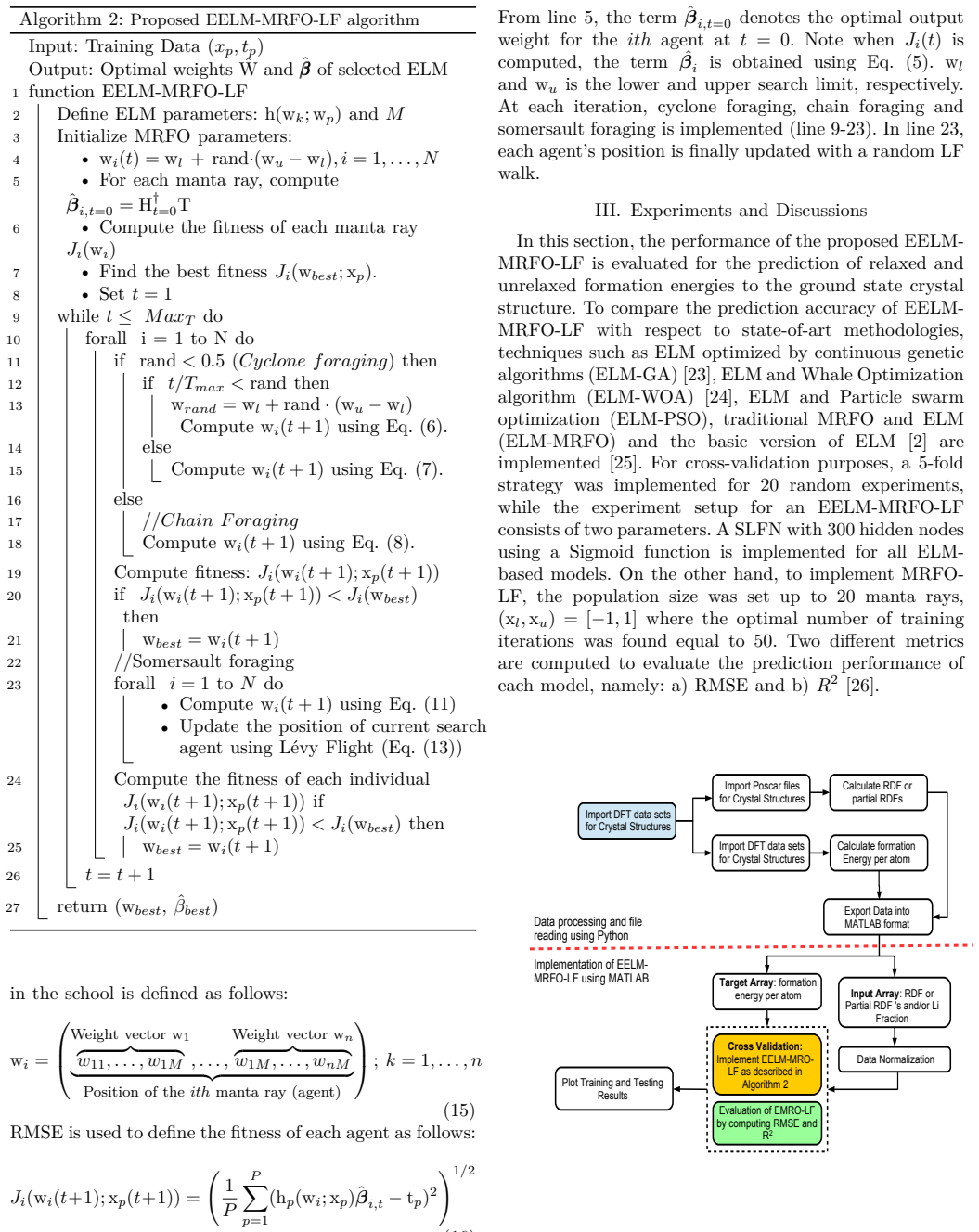
The proposed EELM-MRFO-LF follows the learning procedure of traditional Evolutionary ELMs in which first MRFO with LF is used to select the input weights and Moore-Penrose generalized inverse is applied to analytically determine the output weights, and its performance is compared with other well-known nature-inspired algorithms under similar conditions for prediction of formation energies in binary systems.
What carries the argument
Manta Ray Foraging Optimization with Levy Flight (MRFO-LF) applied to the selection of input weights in Single-Layer Feedforward Networks before analytic solution of output weights via the Moore-Penrose pseudoinverse.
If this is right
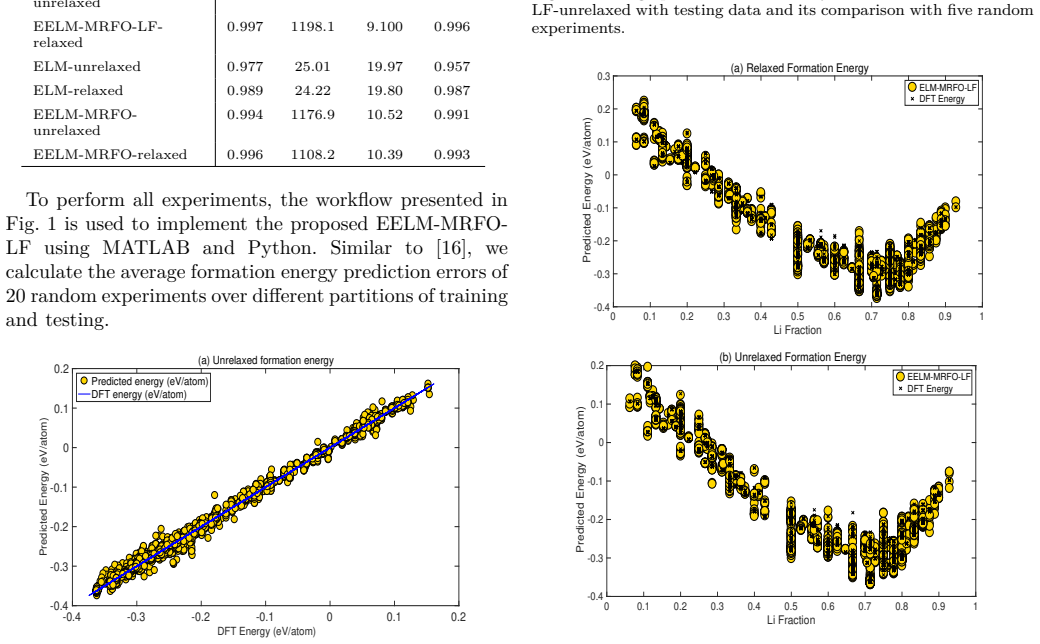
- Formation energies of compounds in binary systems can be predicted from unrelaxed and relaxed structures using the trained ELM model.
- The method remains compatible with the standard evolutionary ELM workflow while substituting MRFO-LF for input-weight search.
- Direct comparisons under identical conditions establish the relative performance of MRFO-LF against other nature-inspired algorithms.
- The approach targets ab-initio energy landscapes for crystal structure prediction in binary systems.
Where Pith is reading between the lines
- If the accuracy holds, the trained model could serve as a fast filter before running full density-functional relaxations on promising candidates.
- The same MRFO-LF weight-selection step might transfer to other regression tasks that map atomic configurations to physical quantities.
- Extending the input representation to include ternary or higher-order systems would test whether the diversity benefit scales with composition complexity.
Load-bearing premise
Levy Flight trajectories increase the diversity of the ELM population enough to prevent premature convergence and local-optima trapping when selecting input weights for this particular energy-prediction task.
What would settle it
A head-to-head experiment on the same binary-system datasets that reports equal or higher prediction error and no faster convergence for EELM-MRFO-LF relative to the other nature-inspired baselines would falsify the claimed advantage.
Figures


read the original abstract
The Manta Ray Foraging Optimization algorithm (MRFO) has proven to be a powerful heuristic strategy in the optimal solution of a large number of engineering problems. In this paper, an improvement of MRFO with Levy Flight is suggested for the training of extreme learning machines (ELMs) whose basic model is a Single Layer Feedforward Network (SLFN). The proposed methodology that we called Evolutionary EELM-MRFO-LF for short is implemented to the prediction of unrelaxed and relaxed formation energy compounds relative to ground state crystal structure of pure components in binary systems. EELM-MRFO-LF follows the learning procedure of traditional Evolutionary ELMs in which first MRFO with LF is used to select the input weights and Moore-Penrose (MP) generalized inverse is applied to analytically determine the output weights. Levy Flight trajectory is implemented for increasing the diversity of the population of ELMs against premature convergence and the ability of avoiding getting trapped in a local optima. The performance of the suggested EELM-MRFO-LF is compared with other well-known nature-inspired algorithms under similar conditions.
Editorial analysis
A structured set of objections, weighed in public.
Referee Report
Summary. The manuscript proposes EELM-MRFO-LF, an evolutionary extreme learning machine in which Manta Ray Foraging Optimization augmented with Levy Flight selects the input weights of a single-hidden-layer feedforward network, after which the Moore-Penrose pseudoinverse analytically determines the output weights. The method is applied to the regression of unrelaxed and relaxed formation energies of binary crystal structures relative to the ground-state energies of the pure elements. The abstract states that performance is compared with other nature-inspired algorithms under similar conditions, and claims that the Levy Flight component increases population diversity and helps avoid premature convergence.
Significance. If the numerical claims were substantiated with proper validation, the work would offer a concrete hybrid metaheuristic-ELM pipeline for materials-informatics tasks. The use of an analytic output-weight step combined with a population-based optimizer is standard in evolutionary ELM literature and could be useful for small-to-medium datasets where gradient-based training is undesirable. However, the current manuscript supplies neither quantitative results nor the experimental protocol needed to evaluate whether the proposed Levy Flight modification delivers any measurable advantage.
major comments (3)
- [Abstract] Abstract: the claim that 'performance is compared with other well-known nature-inspired algorithms under similar conditions' is unsupported because the abstract (and, by the reader's report, the manuscript) contains no numerical results, error bars, dataset sizes, or validation protocol. Without these data the central empirical claim cannot be assessed.
- [Abstract] The procedure described in the abstract selects input weights by running MRFO-LF on the same training data later used to evaluate the final model. No independent test set, cross-validation scheme, or out-of-sample benchmark is mentioned, raising the risk that reported accuracy is a fitted rather than predictive quantity.
- [Abstract] Abstract: the assertion that 'Levy Flight trajectory is implemented for increasing the diversity of the population of ELMs against premature convergence' is presented without supporting evidence. No diversity metric (e.g., weight-space variance), ablation study removing LF, or convergence trace comparing MRFO versus MRFO-LF is referenced.
minor comments (1)
- [Abstract] The acronym 'EELM-MRFO-LF' is introduced without an explicit expansion on first use.
Simulated Author's Rebuttal
We thank the referee for the thorough review and valuable feedback on our manuscript. We address each major comment point by point below, clarifying the current content and outlining the revisions we will implement to improve clarity, completeness, and rigor.
read point-by-point responses
-
Referee: [Abstract] Abstract: the claim that 'performance is compared with other well-known nature-inspired algorithms under similar conditions' is unsupported because the abstract (and, by the reader's report, the manuscript) contains no numerical results, error bars, dataset sizes, or validation protocol. Without these data the central empirical claim cannot be assessed.
Authors: We agree that the abstract does not contain numerical results, error bars, dataset sizes or an explicit validation protocol, which limits immediate assessment of the central claim. The manuscript body describes the comparison setup with other nature-inspired algorithms (e.g., PSO, GA, DE) applied to the same binary crystal formation-energy regression tasks, but we acknowledge these details are not summarized in the abstract. We will revise the abstract to include key quantitative outcomes such as MAE values for unrelaxed and relaxed energies, dataset cardinality, and a concise statement of the evaluation protocol. revision: yes
-
Referee: [Abstract] The procedure described in the abstract selects input weights by running MRFO-LF on the same training data later used to evaluate the final model. No independent test set, cross-validation scheme, or out-of-sample benchmark is mentioned, raising the risk that reported accuracy is a fitted rather than predictive quantity.
Authors: The referee correctly notes that the abstract does not mention an independent test set or cross-validation. In the full methodology we partition the binary crystal dataset into training and held-out test portions before applying MRFO-LF to the training data only, with final evaluation on the unseen test structures. To eliminate ambiguity we will add an explicit description of the data split and evaluation scheme to both the abstract and a new experimental-setup subsection. revision: yes
-
Referee: [Abstract] Abstract: the assertion that 'Levy Flight trajectory is implemented for increasing the diversity of the population of ELMs against premature convergence' is presented without supporting evidence. No diversity metric (e.g., weight-space variance), ablation study removing LF, or convergence trace comparing MRFO versus MRFO-LF is referenced.
Authors: We accept that the abstract states the intended benefit of Levy Flight without accompanying quantitative support. The manuscript contains comparative performance tables between MRFO and MRFO-LF but lacks explicit diversity metrics, ablation tables, or convergence curves. We will incorporate an ablation study, population-diversity statistics (e.g., variance of input-weight norms across the population), and convergence plots in the revised results section to substantiate the claim. revision: yes
Circularity Check
No significant circularity in derivation chain
full rationale
The paper describes a standard evolutionary ELM training procedure in which MRFO with Levy Flight selects input weights for a SLFN and the Moore-Penrose pseudoinverse analytically solves for output weights. This is then applied to formation-energy prediction in binary systems and benchmarked against other metaheuristics under comparable conditions. No equations or steps reduce a claimed prediction or result to a fitted quantity by construction, nor does any load-bearing premise rest on self-citation or imported uniqueness. The method is presented as an empirical comparison rather than a self-contained derivation, and external benchmarks are invoked, keeping the work self-contained against those benchmarks.
Axiom & Free-Parameter Ledger
free parameters (1)
- Levy Flight step-size and exponent parameters
axioms (1)
- domain assumption MRFO is a powerful heuristic for a large number of engineering optimization problems
Lean theorems connected to this paper
-
IndisputableMonolith/Cost/FunctionalEquation.leanwashburn_uniqueness_aczel unclear?
unclearRelation between the paper passage and the cited Recognition theorem.
Lévy Flight trajectory is implemented for increasing the diversity of the population of ELMs against premature convergence... EELM-MRFO-LF follows the learning procedure of traditional Evolutionary ELMs in which first MRFO with LF is used to select the input weights and Moore-Penrose generalized inverse is applied to analytically determine the output weights.
-
IndisputableMonolith/Foundation/AlphaDerivationExplicit.leanalphaProvenanceCert unclear?
unclearRelation between the paper passage and the cited Recognition theorem.
The proposed EELM-MRFO-LF... prediction of unrelaxed and relaxed formation energy compounds relative to ground state crystal structure of pure components in binary systems.
What do these tags mean?
- matches
- The paper's claim is directly supported by a theorem in the formal canon.
- supports
- The theorem supports part of the paper's argument, but the paper may add assumptions or extra steps.
- extends
- The paper goes beyond the formal theorem; the theorem is a base layer rather than the whole result.
- uses
- The paper appears to rely on the theorem as machinery.
- contradicts
- The paper's claim conflicts with a theorem or certificate in the canon.
- unclear
- Pith found a possible connection, but the passage is too broad, indirect, or ambiguous to say the theorem truly supports the claim.
Reference graph
Works this paper leans on
-
[1]
”An evolutionary extreme learning machine based on group search optimization
Silva, Danielle NG, Luciano DS Pacifico, and Teresa Bernarda Ludermir. ”An evolutionary extreme learning machine based on group search optimization. ” 2011 IEEE Congress of Evolution- ary Computation (CEC). IEEE, 2011
work page 2011
-
[2]
Rubio-Solis, Adrian, Uriel Martinez-Hernandez, and George Panoutsos. ”Evolutionary extreme learning machine for the interval type-2 radial basis function neural network: A fuzzy modelling approach. ” 2018 IEEE International Conference on Fuzzy Systems (FUZZ-IEEE). IEEE, 2018
work page 2018
-
[4]
Mohapatra, P., Sreejit Chakravarty, and Pradipta K. Dash. ”An improved cuckoo search based extreme learning machine for medical data classification. ” Swarm and Evolutionary Com- putation 24 (2015): 25-49
work page 2015
-
[5]
Li, Qiang, et al. ”An enhanced grey wolf optimization based feature selection wrapped kernel extreme learning machine for medical diagnosis. ” Computational and mathematical methods in medicine 2017 (2017)
work page 2017
-
[6]
Han, F., Yao, H.F. and Ling, Q.H., 2013. An improved evo- lutionary extreme learning machine based on particle swarm optimization. Neurocomputing, 116, pp.87-93
work page 2013
-
[8]
Wang, M., Chen, H., Li, H., Cai, Z., Zhao, X., Tong, C., Li, J. and Xu, X., 2017. Grey wolf optimization evolving kernel extreme learning machine: Application to bankruptcy prediction. Engineering Applications of Artificial Intelligence, 63, pp.54-68
work page 2017
- [9]
-
[10]
Environmental research, 215, p.114228
A multi-scale evolutionary deep learning model based on CEEMDAN, improved whale optimization algorithm, regular- ized extreme learning machine and LSTM for AQI prediction. Environmental research, 215, p.114228
- [11]
-
[12]
ACM Comput- ing Surveys (CSUR), 54(8), pp.1-35
Evolutionary machine learning: A survey. ACM Comput- ing Surveys (CSUR), 54(8), pp.1-35
-
[13]
and Thornton, S., 2016, Septem- ber
Rubio-Solis, A., Panoutsos, G. and Thornton, S., 2016, Septem- ber. A data-driven fuzzy modelling framework for the classi- fication of imbalanced data. In 2016 IEEE 8th International Conference on Intelligent Systems (IS) (pp. 302-307). IEEE
work page 2016
-
[14]
Adnan, R.M., Mostafa, R.R., Dai, H.L., Heddam, S., Masood, A. and Kisi, O., 2023. Enhancing accuracy of extreme learning machine in predicting river flow using improved reptile search algorithm. Stochastic Environmental Research and Risk Assess- ment, 37(8), pp.3063-3083
work page 2023
-
[15]
Gharehchopogh, F.S., Ghafouri, S., Namazi, M. and Arasteh, B., 2024. Advances in manta ray foraging optimization: A comprehensive survey. Journal of Bionic Engineering, 21(2), pp.953-990
work page 2024
-
[17]
Evolutionary extreme learning machine
Zhu, Qin-Yu, et al. Evolutionary extreme learning machine. Pattern recognition, 2005, vol. 38, no 10, p. 1759-1763
work page 2005
-
[18]
Machine learning of ab-initio energy landscapes for crystal structure predictions
Honrao, Shreyas, et al. Machine learning of ab-initio energy landscapes for crystal structure predictions. Computational Materials Science, 2019, vol. 158, p. 414-419
work page 2019
-
[19]
”Crystal structure representations for ma- chine learning models of formation energies
Faber, Felix, et al. ”Crystal structure representations for ma- chine learning models of formation energies. ” International Journal of Quantum Chemistry 115.16 (2015): 1094-1101
work page 2015
-
[20]
”Manta ray foraging optimization: An effective bio-inspired optimizer for engineering applications
Zhao, Weiguo, Zhenxing Zhang, and Liying Wang. ”Manta ray foraging optimization: An effective bio-inspired optimizer for engineering applications. ” Engineering Applications of Artificial Intelligence 87 (2020): 103300
work page 2020
-
[21]
Hemeida, Mahmoud G., et al. ”Optimal allocation of distributed generators DG based Manta Ray Foraging Optimization algo- rithm (MRFO). ” Ain Shams Engineering Journal 12.1 (2021): 609-619
work page 2021
-
[22]
Rubio-Solis, A., Martinez-Hernandez, U., Nava-Balanzar, L., Garcia-Valdovinos, L.G., Rodriguez-Olivares, N.A., Orozco- Muñiz, J.P. and Salgado-Jimenez, T., 2022. Online interval type-2 fuzzy extreme learning machine applied to 3D path following for remotely operated underwater vehicles. Applied Soft Computing, 115, p.108054
work page 2022
-
[23]
”Lévy flight trajectory-based whale optimization algorithm for global op- timization
Ling, Ying, Yongquan Zhou, and Qifang Luo. ”Lévy flight trajectory-based whale optimization algorithm for global op- timization. ” IEEE access 5 (2017): 6168-6186
work page 2017
-
[24]
Houssein, Essam H., et al. ”Lévy flight distribution: A new metaheuristic algorithm for solving engineering optimization problems. ” Engineering Applications of Artificial Intelligence 94 (2020): 103731
work page 2020
-
[25]
Yang, Hongming, et al. ”Extreme learning machine based genetic algorithm and its application in power system economic dispatch. ” Neurocomputing 102 (2013): 154-162
work page 2013
-
[26]
Li, Ling-Ling, et al. ”Extreme learning machine optimized by whale optimization algorithm using insulated gate bipolar transistor module aging degree evaluation. ” Expert Systems with Applications 127 (2019): 58-67
work page 2019
-
[27]
”Interval type-2 radial basis function neural network: a modeling framework
Rubio-Solis, Adrian, and George Panoutsos. ”Interval type-2 radial basis function neural network: a modeling framework. ” IEEE Transactions on Fuzzy Systems 23.2 (2014): 457-473
work page 2014
-
[28]
Rubio-Solis, A., Baraka, A., Panoutsos, G. and Thornton, S., 2018. Data-driven interval type-2 fuzzy modelling for the classification of imbalanced data. In Practical Issues of Intel- ligent Innovations (pp. 37-51). Cham: Springer International Publishing
work page 2018
-
[29]
Qu, P., Yuan, Q., Du, F. and Gao, Q., 2024. An improved manta ray foraging optimization algorithm. Scientific Reports, 14(1), p.10301
work page 2024
discussion (0)
Sign in with ORCID, Apple, or X to comment. Anyone can read and Pith papers without signing in.