Monocular Depth Perception Enhancement Based on Joint Shading/Contrast Model and Motion Parallax (JSM)
Pith reviewed 2026-05-20 14:55 UTC · model grok-4.3
The pith
Adjusting shading, contrast and motion parallax together can strengthen monocular depth perception on ordinary screens.
A machine-rendered reading of the paper's core claim, the machinery that carries it, and where it could break.
Core claim
The paper claims that its Joint Shading/Contrast Model combined with Motion Parallax (JSM) significantly improves both depth volume perception and depth range perception. This enhancement works on any conventional 2D display devices and remains complementary to binocular depth cues used in stereoscopic 3D systems. The framework avoids the need for expensive special devices and addresses visual fatigue issues associated with stereoscopic displays. Qualitative evaluation, ablation study, and subjective user evaluation confirm the advantages.
What carries the argument
The Joint Shading/Contrast Model integrated with motion parallax, which jointly modifies image shading and contrast while incorporating motion-based parallax effects to strengthen monocular depth cues.
If this is right
- Viewers can perceive greater depth volume and range in ordinary 2D content without extra hardware.
- The method applies directly to any conventional display device.
- It can be added to stereoscopic 3D pipelines to strengthen overall depth signals.
- Reliance on specialized 3D equipment may decrease for applications that need depth cues.
- Subjective evaluations indicate the changes produce consistent perceptual benefits.
Where Pith is reading between the lines
- If the model holds across varied content types, it could support real-time depth enhancement in video streaming or mobile apps.
- Pairing the approach with additional monocular cues such as texture or occlusion might produce even stronger depth effects.
- Broad testing across age groups and visual abilities would clarify how widely the improvements apply.
- Use in fields like medical visualization or architectural previews could reduce the need for dedicated 3D hardware.
Load-bearing premise
Adjustments to shading, contrast, and motion parallax will reliably enhance human monocular depth perception without introducing visual artifacts or inconsistent results across different content and viewers.
What would settle it
A controlled user study in which participants view identical scenes with and without JSM processing and report no statistically significant gain in perceived depth volume or range would disprove the central claim.
Figures


read the original abstract
Stereoscopic 3D displays adopt a binocular depth cue to provide depth perception. However, users should be equipped with expensive special devices to appreciate depth perception based on the binocular depth cues. Also, visual fatigue induced by the stereoscopic display is still a challenging open problem. In order to overcome this limitation, this paper proposes a novel framework, JSM, to enhance monocular depth perception, significantly improving both depth volume perception and depth range perception. The proposed framework can not only provide an enhanced depth perception on any conventional 2D display devices, but also it can be applicable to the 3D display devices since it is complementary to binocular depth cues. The qualitative evaluation, ablation study, and subjective user evaluation proved the advantages and practicability of the proposed framework.
Editorial analysis
A structured set of objections, weighed in public.
Referee Report
Summary. The manuscript proposes the JSM framework that combines a joint shading/contrast model with motion parallax to enhance monocular depth perception on conventional 2D displays. It claims significant improvements in both depth volume perception and depth range perception while remaining complementary to binocular cues, thereby avoiding the hardware costs and visual fatigue of stereoscopic displays. Support is provided via qualitative evaluation, an ablation study, and subjective user tests.
Significance. If the enhancements hold under broader testing, the work could offer a practical, hardware-free method for improving depth perception on standard displays and serve as a complement to existing stereo techniques. Credit is due for grounding the approach in established perceptual principles, including an ablation study to isolate component contributions, and for conducting subjective user evaluations.
major comments (2)
- [Evaluation] Evaluation section: The central claim of 'significantly improving' depth volume and range perception rests on qualitative results and subjective user tests, yet no quantitative metrics (e.g., depth estimation error, perceived depth scores with standard deviations), statistical tests, or participant counts are reported. This makes it impossible to assess robustness or rule out viewer/content variability.
- [Methods] Methods and results: The assumption that joint shading/contrast adjustments plus motion parallax produce reliable, artifact-free gains on arbitrary 2D content lacks supporting failure-case analysis or cross-content consistency checks. Without these, the weakest assumption (reliable enhancement without inconsistencies) remains untested at the level needed to support the broad applicability claim.
minor comments (1)
- [Abstract] Abstract: The description of the evaluation ('qualitative evaluation, ablation study, and subjective user evaluation') could be expanded with at least one key quantitative outcome or participant detail to better preview the strength of evidence.
Simulated Author's Rebuttal
We thank the referee for the detailed and constructive comments on our manuscript. We address each of the major comments below and indicate the revisions we plan to make.
read point-by-point responses
-
Referee: [Evaluation] Evaluation section: The central claim of 'significantly improving' depth volume and range perception rests on qualitative results and subjective user tests, yet no quantitative metrics (e.g., depth estimation error, perceived depth scores with standard deviations), statistical tests, or participant counts are reported. This makes it impossible to assess robustness or rule out viewer/content variability.
Authors: We appreciate this observation. Our evaluation emphasizes qualitative demonstrations and subjective user studies because the goal is to enhance perceived depth on 2D displays, which is inherently perceptual. Depth estimation error metrics are not applicable here as we do not generate or refine depth maps but rather modulate shading, contrast, and parallax for perceptual effect. However, we agree that reporting participant details and statistical analysis would strengthen the presentation. In the revised manuscript, we will specify the number of participants in the user study, provide mean perceived depth scores along with standard deviations, and include appropriate statistical tests to assess significance. This addresses concerns about robustness and variability. revision: yes
-
Referee: [Methods] Methods and results: The assumption that joint shading/contrast adjustments plus motion parallax produce reliable, artifact-free gains on arbitrary 2D content lacks supporting failure-case analysis or cross-content consistency checks. Without these, the weakest assumption (reliable enhancement without inconsistencies) remains untested at the level needed to support the broad applicability claim.
Authors: We acknowledge that demonstrating reliability across diverse content is important for broad claims. The current manuscript includes an ablation study and qualitative results on various examples, but we agree that explicit failure-case analysis and consistency checks would be beneficial. In the revision, we will add a discussion of potential limitations and failure modes, such as artifacts in high-contrast scenes or inconsistencies with certain motion types, along with additional examples showing performance on a wider range of content to better substantiate the applicability. revision: yes
Circularity Check
No significant circularity detected in derivation or claims
full rationale
The paper presents a JSM framework that applies established perceptual principles for shading, contrast, and motion parallax to enhance monocular depth cues on 2D displays. Support comes from qualitative results, an ablation study, and subjective user evaluations rather than any closed mathematical derivation. No equations, parameter fits, or self-citations are shown that reduce the central claims to tautological inputs or prior author work by construction. The approach is self-contained against external benchmarks of human perception and does not rely on load-bearing self-referential steps.
Axiom & Free-Parameter Ledger
axioms (1)
- domain assumption Manipulating shading, contrast, and motion parallax in 2D images can enhance human monocular depth perception.
Reference graph
Works this paper leans on
-
[1]
However, the traditional display technologies can only display images with limited depth perception
Introduction Depth perception is the key visual abilit y for humans to perceive the world in 3D, especially the distance between objects. However, the traditional display technologies can only display images with limited depth perception. In order to overcome this limitation, in recent decades, many methods an d devices have been developed to provide enha...
-
[2]
The proposed JSM framework The proposed JSM framework consists of the depth analysis module, shading/contrast retargeting module, and motion parallax module, as depicted in Fig. 1 . The depth analysis module estimates the pixel -wise depth information to determine foreground and background. The shading/contrast retargeting and motion parallax modules are ...
-
[3]
The images were collected from the public Middlebury [ 18] dataset and our own generated dataset
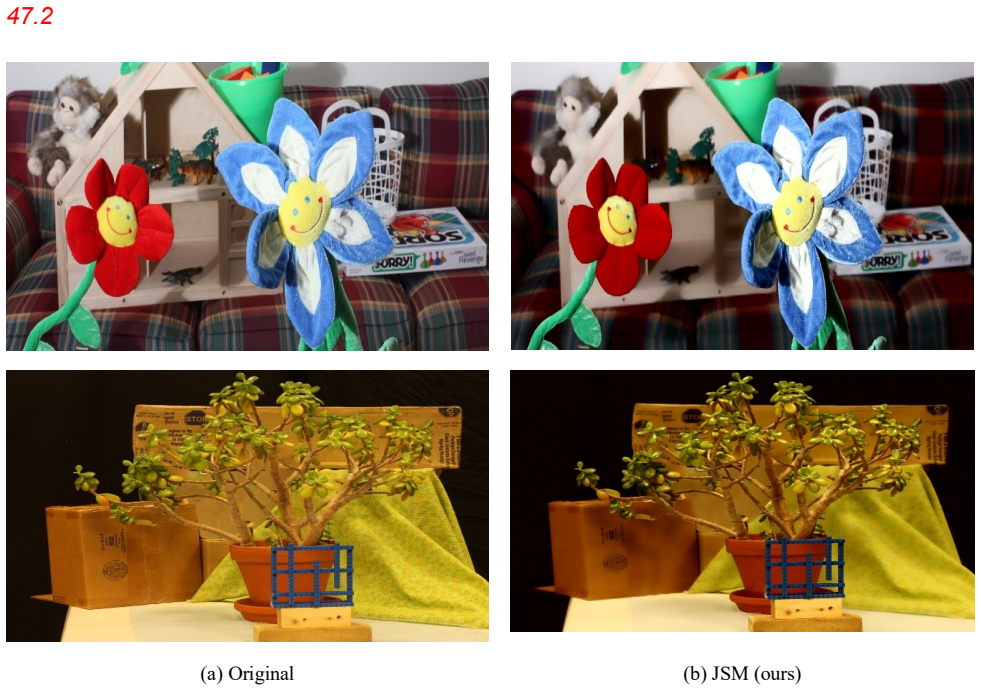
Experimental Results In order to evaluate the proposed framework, we conducted the qualitative evaluation, ablation study, and subjective user evaluation on the natural images and automotive cluster images. The images were collected from the public Middlebury [ 18] dataset and our own generated dataset. All the images were resized to 1920x1080 and process...
-
[4]
Interative 3 -DTV-concepts and key technologies,
C. Fehn , R. Barre, and S. Pastoor, “Interative 3 -DTV-concepts and key technologies,” Proceedings of the IEEE, Special Issue on 3 -D Technologies for Imaging & Display, Vol. 94, No. 3, p. 524 -538, 2006
work page 2006
-
[5]
P. Kauff et al., Depth map creation and image -based rendering for advanced 3DTV services providing interoperability and scalability,” Signal Processing Image Communication, Vol. 22, No. 2, pp. 217 -234, 2007
work page 2007
-
[6]
N.A. Dodgson, “Autostereoscopic 3D displays,” Computer, Vol. 38, No. 8, pp. 31-36, 2005
work page 2005
-
[7]
Visual discomfort and visual fatigue of stereoscopic displays: A review,
M. Lambooij, M. Fortuin, I. Heynderickx, and W. Ijsselsteijn, “Visual discomfort and visual fatigue of stereoscopic displays: A review,” Journal of imaging science and technology, Vol. 53, No. 3, 30201-1, 2009
work page 2009
-
[8]
T. Bando, A. Iijima, and S. Yano, “Visual fatigue caused by stereoscopic images and the search for the requirement to prevent them: A review,” Displays, Vol. 33, No. 2, pp. 76 -83, 2012
work page 2012
-
[9]
Improved depth perception of sin gle-view images,
J. Jung et al., “Improved depth perception of sin gle-view images,” ICTI TEEEC, 2010
work page 2010
-
[10]
Depth -Stretch: Enhancing Depth PerceptionWithout Depth,
H. Hel -Or et al., “Depth -Stretch: Enhancing Depth PerceptionWithout Depth,” IEEE CVPRW, 2017
work page 2017
-
[11]
S. Narasimhan and S. Nayar, “Vision and the atmosphere,” International Journal of Computer Vision, Vol. 48, No. 3, pp. 233–254, 2002
work page 2002
-
[12]
R. Fattal, “Single image dehazing,” ACM Transactions on Graphics, Vol. 27, No. 3, pp. 72:1–72:9, 2008
work page 2008
-
[13]
Langford’s Basic Photography: The Guide for Serious Photographers,
M. Langford, A. Fox, and R. Smith, “Langford’s Basic Photography: The Guide for Serious Photographers,” Focal Press, 2010
work page 2010
-
[14]
Obtaining shape from shading information,
B. K. Horn, “Obtaining shape from shading information,” MIT press, 1989
work page 1989
-
[15]
3D Unsharp Masking for Scene Coherent Enhancement,
T. Ritschel, K. Smith, M. Ihrke, T. Grosch, K. Myszkowski, and H. Seidel, “3D Unsharp Masking for Scene Coherent Enhancement,” ACM Transactions on Graphics, Vol. 27, No. 3, 2008
work page 2008
-
[16]
Improving shape depiction under arbitrary rendering,
R. Vergne, R. Pacanowski, P. Barla, X. Granier, and C. Shlick, “Improving shape depiction under arbitrary rendering,” IEEE Transactions on Visual ization and Comput er Graphics, Vol. 17, No. 8, pp. 1071–1081, 2011
work page 2011
-
[17]
Non -photorealistic, depth -based image editing,
J. Lopez-Moreno, J. Jimenez, S. Hadap, K. Anjyo, E. Reinhard, and D. Gutierrez, “Non -photorealistic, depth -based image editing,” Computers and Graphics, Vol. 35, pp. 99 –111, 2011
work page 2011
-
[18]
Contrast and depth perception: Effects of texture contrast and area contrast,
S. Ichihara, N. Kitagawa, and H. Akutsu, “Contrast and depth perception: Effects of texture contrast and area contrast,” Perception, Vol. 36, pp. 686-695, 2007
work page 2007
-
[19]
H. Easa, R. Mantiuk, and I. Lim, Evaluation of monocular depth cues on a high -dynamic-range display for visualisation,” ACM Transactions on Applied Perception, Vol. 10, No. 3, pp. 16, 2013
work page 2013
- [20]
-
[21]
High -resolution stereo dat asets with subpixel - accurate ground truth,
D. Schastein et al., “High -resolution stereo dat asets with subpixel - accurate ground truth,” GCPR, 2014. (a) ˅ ˅ ˅ ˅ (b) ˅ ˅ ˅ (c) ˅ ˅ (d) ˅
work page 2014
discussion (0)
Sign in with ORCID, Apple, or X to comment. Anyone can read and Pith papers without signing in.