Sampling Noise and Optimized Measurement Distribution in Imaginary-Time Quantum Dynamics Simulations
Pith reviewed 2026-05-21 07:10 UTC · model grok-4.3
The pith
Allocating measurements by minimizing error cost in equations of motion cuts total shots by more than half in variational quantum dynamics.
A machine-rendered reading of the paper's core claim, the machinery that carries it, and where it could break.
Core claim
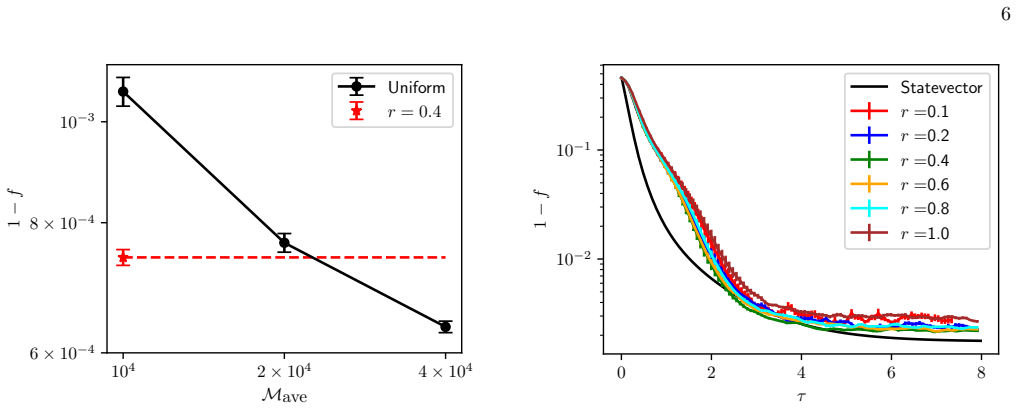
In variational quantum dynamics simulations of imaginary-time evolution, measurement-distribution strategies that allocate shots by minimizing a cost function characterizing the error in solving the equation of motion improve state fidelity and reduce total measurement cost by more than a factor of two compared with uniform shot distributions; best performance occurs when a minimum number of shots is still guaranteed for every circuit.
What carries the argument
The cost function that estimates the error in solving the equations of motion, which is minimized to decide how many shots to assign to each circuit.
If this is right
- Tikhonov regularization stabilizes the equations of motion reliably under sampling noise.
- A hybrid strategy that reserves a fraction of shots for uniform distribution across all circuits yields the highest fidelity.
- The optimized allocation supplies concrete guidelines for making variational quantum dynamics and ground-state preparation more measurement-efficient on near-term devices.
Where Pith is reading between the lines
- The same cost-function approach to shot allocation could be tested in real-time variational dynamics simulations.
- The method may generalize to other variational quantum algorithms that solve linear systems or evolve states iteratively.
- On hardware, one could monitor the correlation between the cost-function proxy and observed update errors to refine the allocation rule dynamically.
Load-bearing premise
The cost function used to decide shot allocation accurately predicts the actual error that appears in the solved equations of motion after finite-shot sampling.
What would settle it
Run the full imaginary-time VQDS procedure on actual quantum hardware for the same Ising models, compare final state fidelity and total shots used between the optimized allocation and a uniform baseline, and check whether the reported factor-of-two reduction in measurements for equivalent fidelity is observed.
Figures



read the original abstract
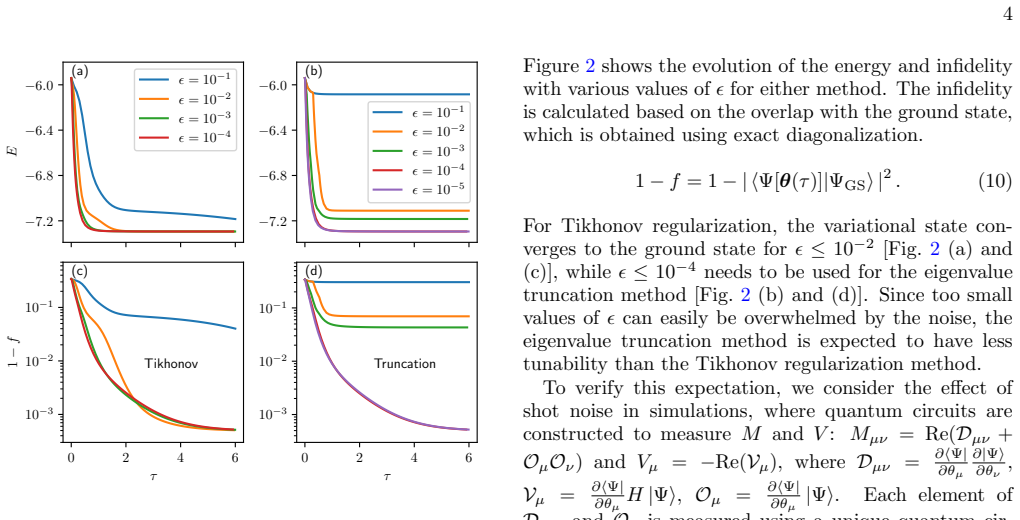
Variational quantum dynamics simulations (VQDS) provide a promising route to simulate real- and imaginary-time quantum dynamics on noisy intermediate-scale quantum devices using fixed-depth circuits. However, their practical performance is strongly limited by sampling noise arising from a finite number of circuit measurements. In this work, we systematically investigate the impact of sampling noise on VQDS, with a focus on ground-state preparation in one-dimensional Ising spin models using imaginary time evolution. We compare different regularization strategies for stabilizing the equations of motion and show that Tikhonov regularization provides robust performance in noisy imaginary-time evolution. We then benchmark measurement-distribution strategies that allocate shots by minimizing a cost function that characterizes the error in solving the equation of motion. Using noisy circuit simulations, we demonstrate that such optimized shot allocation can significantly improve state fidelity and reduce the total measurement cost by more than a factor of two compared to uniform shot distributions. We observe that the best results are found if a sufficiently large number of measurements is guaranteed for all circuits, suggesting that a finite fraction of shots should be distributed evenly. Our results provide practical guidelines for implementing measurement-efficient variational quantum dynamics and ground-state preparation on near-term quantum hardware.
Editorial analysis
A structured set of objections, weighed in public.
Referee Report
Summary. The manuscript examines sampling noise effects in variational quantum dynamics simulations (VQDS) for imaginary-time evolution applied to ground-state preparation in one-dimensional Ising models. It compares regularization approaches for the equations of motion, identifies Tikhonov regularization as robust under noise, and introduces measurement-distribution strategies that allocate shots by minimizing a cost function characterizing the error in solving the linear system. Noisy circuit simulations demonstrate that optimized allocation improves state fidelity and reduces total measurement cost by more than a factor of two relative to uniform distributions, with best performance when a minimum number of shots is ensured for every circuit.
Significance. If the reported gains hold under the stated conditions, the work supplies concrete, practical guidelines for measurement-efficient VQDS on NISQ hardware. The factor-of-two cost reduction and the observation that a hybrid uniform-plus-optimized allocation performs best are directly relevant to resource-constrained ground-state preparation tasks.
major comments (2)
- [Results section / fidelity curves] Results section (figures showing fidelity vs. imaginary time and vs. total shots): the fidelity curves lack error bars and the text does not state the number of independent noisy-circuit runs that were averaged. Without these statistics the claimed factor-of-two cost reduction and fidelity improvement cannot be assessed for statistical significance.
- [Optimized measurement distribution / cost-function definition] Section describing the optimized shot-allocation procedure and the cost-function definition: the cost function bounds the instantaneous error in the linear solve at each discrete imaginary-time step. The manuscript does not quantify how well this per-step proxy correlates with the integrated state error after many successive regularized updates. Because Tikhonov regularization renders the update map nonlinear and because shot noise on different Pauli strings is correlated through the shared circuit, the monotonic relation between the proxy and final fidelity is not guaranteed; an explicit correlation plot or ablation over step count would be required to support generalization of the reported gains.
minor comments (2)
- [Abstract] The abstract states there is 'no comparison against an analytic error'; if such a comparison exists in the supplementary material or an appendix, it should be referenced explicitly in the main text.
- [Methods / regularization] Notation for the Tikhonov parameter and the cost-function weights should be introduced once and used consistently; currently the same symbol appears to be reused in different contexts.
Simulated Author's Rebuttal
We thank the referee for their positive summary and constructive major comments, which have helped clarify the presentation of our results. We address each point below and have revised the manuscript to incorporate additional statistical reporting and validation of the cost-function proxy.
read point-by-point responses
-
Referee: Results section (figures showing fidelity vs. imaginary time and vs. total shots): the fidelity curves lack error bars and the text does not state the number of independent noisy-circuit runs that were averaged. Without these statistics the claimed factor-of-two cost reduction and fidelity improvement cannot be assessed for statistical significance.
Authors: We agree that error bars and the number of independent runs are necessary to evaluate statistical significance. In the revised manuscript we have added error bars (standard error of the mean) to all fidelity curves in the Results section and explicitly stated in the text and figure captions that each data point is averaged over 10 independent noisy-circuit simulations. With these statistics the reported fidelity gains and factor-of-two cost reduction remain statistically significant, as the error bars for optimized versus uniform allocations do not overlap at the relevant shot counts. revision: yes
-
Referee: Section describing the optimized shot-allocation procedure and the cost-function definition: the cost function bounds the instantaneous error in the linear solve at each discrete imaginary-time step. The manuscript does not quantify how well this per-step proxy correlates with the integrated state error after many successive regularized updates. Because Tikhonov regularization renders the update map nonlinear and because shot noise on different Pauli strings is correlated through the shared circuit, the monotonic relation between the proxy and final fidelity is not guaranteed; an explicit correlation plot or ablation over step count would be required to support generalization of the reported gains.
Authors: The referee correctly notes that the per-step cost function is only a proxy and that Tikhonov regularization plus shared-circuit noise correlations could weaken its relation to final fidelity. To address this we have added a new supplementary figure that directly plots the cumulative proxy error against final state infidelity across a range of imaginary-time step counts and noise levels. The plot shows a strong positive correlation (Pearson coefficient > 0.8), and the optimized allocation continues to produce lower final infidelity even after many nonlinear updates. A short discussion of this correlation and the effect of noise correlations has also been inserted in the main text. revision: yes
Circularity Check
No significant circularity; results from direct simulation of cost-minimizing allocation
full rationale
The paper defines a cost function directly from the linear system (equation of motion) to allocate shots, then validates the resulting fidelity gains and cost reductions via explicit noisy circuit simulations on Ising models. No parameter is fitted to the final fidelity metric and then reused as a prediction; the Tikhonov regularization and shot-allocation strategy are applied forward in simulation without self-referential closure. The reported factor-of-two improvement is an empirical outcome of the simulation protocol rather than a quantity forced by construction or by a self-citation chain.
Axiom & Free-Parameter Ledger
free parameters (1)
- Tikhonov regularization parameter
axioms (1)
- domain assumption The variational ansatz remains expressive enough that the imaginary-time flow converges to the ground state when the equations of motion are solved accurately.
Reference graph
Works this paper leans on
-
[1]
A. W. Sandvik, Computational studies of quantum spin systems, AIP Conference Proceedings1297, 135 (2010), https://aip.scitation.org/doi/pdf/10.1063/1.3518900
-
[2]
S. R. White, Density matrix formulation for quantum renormalization groups, Phys. Rev. Lett.69, 2863 (1992)
work page 1992
-
[3]
T. c. v. Prosen and M. ˇZnidariˇ c, Is the efficiency of classi- cal simulations of quantum dynamics related to integra- bility?, Phys. Rev. E75, 015202 (2007)
work page 2007
-
[4]
Lloyd, Universal quantum simulators, Science273, 1073 (1996)
S. Lloyd, Universal quantum simulators, Science273, 1073 (1996)
work page 1996
-
[5]
A. M. Childs and N. Wiebe, Hamiltonian simulation us- ing linear combinations of unitary operations, Quantum Inf. Comput.12, 901 (2012)
work page 2012
-
[6]
G. H. Low and I. L. Chuang, Optimal Hamiltonian Sim- ulation by Quantum Signal Processing, Phys. Rev. Lett. 118, 010501 (2017)
work page 2017
-
[7]
G. H. Low and I. L. Chuang, Hamiltonian Simulation by Qubitization, Quantum3, 163 (2019)
work page 2019
-
[8]
J. Haah, M. B. Hastings, R. Kothari, and G. H. Low, Quantum Algorithm for Simulating Real Time Evolution of Lattice Hamiltonians, SIAM J. Comput. , FOCS18 (2021)
work page 2021
-
[9]
A. M. Childs, D. Maslov, Y. Nam, N. J. Ross, and Y. Su, Toward the first quantum simulation with quan- tum speedup, PNAS115, 9456 (2018)
work page 2018
-
[10]
D. W. Berry, A. M. Childs, and R. Kothari, Hamilto- nian Simulation with Nearly Optimal Dependence on all Parameters, in2015 IEEE 56th Annual Symposium on Foundations of Computer Science(2015) pp. 792–809
work page 2015
-
[11]
Preskill, Quantum Computing in the NISQ era and beyond, Quantum2, 79 (2018)
J. Preskill, Quantum Computing in the NISQ era and beyond, Quantum2, 79 (2018)
work page 2018
-
[12]
E. A. Martinez, C. A. Muschik, P. Schindler, D. Nigg, A. Erhard, M. Heyl, P. Hauke, M. Dalmonte, T. Monz, P. Zoller, and et al., Real-time dynamics of lattice gauge theories with a few-qubit quantum computer, Nature 534, 516–519 (2016)
work page 2016
-
[13]
H. Lamm and S. Lawrence, Simulation of nonequilibrium dynamics on a quantum computer, Physical Review Let- ters121, 10.1103/physrevlett.121.170501 (2018)
- [14]
-
[15]
P. Frey and S. Rachel, Realization of a discrete time crys- tal on 57 qubits of a quantum computer, Sci. Adv.8, eabm7652 (2022)
work page 2022
-
[16]
Y. Kim, C. J. Wood, T. J. Yoder, S. T. Merkel, J. M. Gambetta, K. Temme, and A. Kandala, Scalable error mitigation for noisy quantum circuits produces competi- tive expectation values, Nat. Phys.19, 752 (2023)
work page 2023
-
[17]
I.-C. Chen, B. Burdick, Y.-X. Yao, P. P. Orth, and T. Iadecola, Error-mitigated simulation of quantum many-body scars on quantum computers with pulse-level control, Phys. Rev. Res.4, 043027 (2022)
work page 2022
-
[18]
Y. Kim, A. Eddins, S. Anand, K. X. Wei, E. van den Berg, S. Rosenblatt, H. Nayfeh, Y. Wu, M. Zaletel, K. Temme, and A. Kandala, Evidence for the utility of quantum computing before fault tolerance, Nature618, 500 (2023)
work page 2023
-
[19]
I.-C. Chen, K. Pollock, Y.-X. Yao, P. P. Orth, and T. Iadecola, Problem-tailored simulation of energy trans- port on noisy quantum computers, Quantum8, 1545 (2024)
work page 2024
-
[20]
E. Chertkov, Y.-H. Chen, M. Lubasch, D. Hayes, and M. Foss-Feig, Robustness of near-thermal dynamics on digital quantum computers, Phys. Rev. Res.8, 013255 (2026)
work page 2026
- [21]
-
[22]
X. Yuan, S. Endo, Q. Zhao, Y. Li, and S. C. Benjamin, Theory of variational quantum simulation, Quantum3, 191 (2019)
work page 2019
-
[23]
Y.-X. Yao, N. Gomes, F. Zhang, C.-Z. Wang, K.-M. Ho, T. Iadecola, and P. P. Orth, Adaptive variational quan- tum dynamics simulations, PRX Quantum2, 030307 (2021)
work page 2021
-
[24]
S.-H. Lin, R. Dilip, A. G. Green, A. Smith, and F. Poll- mann, Real- and imaginary-time evolution with com- pressed quantum circuits, PRX Quantum2, 010342 (2021)
work page 2021
-
[25]
F. Barratt, J. Dborin, M. Bal, V. Stojevic, F. Pollmann, and A. G. Green, Parallel quantum simulation of large systems on small NISQ computers, npj Quantum Inf7, 1 (2021)
work page 2021
-
[26]
S. Barison, F. Vicentini, and G. Carleo, An efficient quantum algorithm for the time evolution of param- eterized circuits, arXiv:2101.04579 10.22331/q-2021-07- 28-512 (2021)
-
[27]
M. Benedetti, M. Fiorentini, and M. Lubasch, Hardware- efficient variational quantum algorithms for time evolu- tion, Phys. Rev. Res.3, 033083 (2021)
work page 2021
-
[28]
R. Mansuroglu, T. Eckstein, L. N¨ utzel, S. A. Wilkinson, and M. J. Hartmann, Classical Variational Optimization of Gate Sequences for Time Evolution of Translational In- variant Quantum Systems, arXiv:2106.03680 [quant-ph] (2021), arXiv:2106.03680 [quant-ph]
-
[29]
N. F. Berthusen, T. V. Trevisan, T. Iadecola, and P. P. Orth, Quantum dynamics simulations beyond the coher- ence time on noisy intermediate-scale quantum hardware by variational Trotter compression, Phys. Rev. Research 4, 023097 (2022)
work page 2022
-
[30]
S. McArdle, T. Jones, S. Endo, Y. Li, S. C. Benjamin, and X. Yuan, Variational ansatz-based quantum simula- tion of imaginary time evolution, npj Quantum Inf.5, 75 9 (2019)
work page 2019
- [31]
- [32]
- [33]
-
[34]
Y. Atia and D. Aharonov, Fast-forwarding of Hamiltoni- ans and exponentially precise measurements, Nat Com- mun8, 1572 (2017)
work page 2017
-
[35]
C. Cirstoiu, Z. Holmes, J. Iosue, L. Cincio, P. J. Coles, and A. Sornborger, Variational fast forwarding for quan- tum simulation beyond the coherence time, npj Quantum Inf.6, 82 (2020)
work page 2020
- [36]
-
[37]
E. K¨ okc¨ u, D. Camps, L. Bassman, J. K. Freericks, W. A. de Jong, R. Van Beeumen, and A. F. Kemper, Algebraic compression of quantum circuits for Hamiltonian evolu- tion, Phys. Rev. A105, 032420 (2022)
work page 2022
-
[38]
L. Bassman, R. Van Beeumen, E. Younis, E. Smith, C. Iancu, and W. A. de Jong, Constant-depth circuits for dynamic simulations of materials on quantum com- puters, Materials Theory6, 13 (2022)
work page 2022
- [39]
-
[40]
S. Gulania, B. Peng, Y. Alexeev, and N. Govind, Quan- tum time dynamics of 1D-Heisenberg models employ- ing the Yang-Baxter equation for circuit compression (2021), arXiv:2112.01690 [cond-mat, physics:physics, physics:quant-ph]
- [41]
-
[42]
H. R. Grimsley, S. E. Economou, E. Barnes, and N. J. Mayhall, An adaptive variational algorithm for exact molecular simulations on a quantum computer, Nat. Commun.10, 3007 (2019)
work page 2019
-
[43]
H. L. Tang, V. Shkolnikov, G. S. Barron, H. R. Grim- sley, N. J. Mayhall, E. Barnes, and S. E. Economou, Qubit-adapt-vqe: An adaptive algorithm for construct- ing hardware-efficient ans¨ atze on a quantum processor, PRX Quantum2, 020310 (2021)
work page 2021
-
[44]
Y. S. Yordanov, V. Armaos, C. H. W. Barnes, and D. R. M. Arvidsson-Shukur, Qubit-excitation-based adaptive variational quantum eigensolver, Commun. Phys.4, 228 (2021)
work page 2021
-
[45]
J. C. Getelina, N. Gomes, T. Iadecola, P. P. Orth, and Y.-X. Yao, Adaptive variational quantum minimally en- tangled typical thermal states for finite temperature sim- ulations, SciPost Phys.15, 102 (2023)
work page 2023
-
[46]
I.-C. Chen, J. C. Getelina, K. Pollock, A. Khindanov, S. Sen, Y.-X. Yao, and T. Iadecola, Classical and quan- tum simulations of 1+1-dimensionalZ 2 gauge theory at finite temperature and density, Communications Physics 8, 10.1038/s42005-025-02281-0 (2025)
- [47]
- [48]
- [49]
-
[50]
M. Mootz and Y.-X. Yao, Efficient berry phase calcu- lation via adaptive variational quantum computing ap- proach, APL Quantum3, 016111 (2026)
work page 2026
-
[51]
H. Chen, N. Gomes, S. Niu, and W. A. d. Jong, Adaptive variational simulation for open quantum systems, Quan- tum8, 1252 (2024)
work page 2024
-
[52]
H. Alipanah, F. Zhang, Y.-X. Yao, R. Thompson, N. Nguyen, J. Liu, P. Givi, B. J. McDermott, and J. J. Mendoza-Arenas, Quantum dynamics simulation of the advection-diffusion equation, Phy. Rev. Res.7, 043318 (2025)
work page 2025
-
[53]
M. B. Hastings, An area law for one-dimensional quan- tum systems, Journal of Statistical Mechanics: Theory and Experiment2007, P08024 (2007)
work page 2007
- [54]
-
[55]
U. Schollw¨ ock, The density-matrix renormalization group in the age of matrix product states, Annals of Physics 326, 96 (2011)
work page 2011
- [56]
- [57]
-
[58]
J. M. K¨ ubler, A. Arrasmith, L. Cincio, and P. J. Coles, An Adaptive Optimizer for Measurement-Frugal Varia- tional Algorithms, Quantum4, 263 (2020)
work page 2020
-
[59]
O. Crawford, B. v. Straaten, D. Wang, T. Parks, E. Campbell, and S. Brierley, Efficient quantum measure- ment of Pauli operators in the presence of finite sampling error, Quantum5, 385 (2021)
work page 2021
-
[60]
A. Arrasmith, L. Cincio, R. D. Somma, and P. J. Coles, Operator sampling for shot-frugal optimization in varia- tional algorithms (2020), arXiv:2004.06252 [quant-ph]
-
[61]
A. Gresch and M. Kliesch, Guaranteed efficient energy estimation of quantum many-body Hamiltonians using ShadowGrouping, Nat Commun16, 689 (2025)
work page 2025
-
[62]
T. Eckstein, R. Mansuroglu, S. Wolf, L. N¨ utzel, S. Tasler, M. Kliesch, and M. J. Hartmann, Shot-noise reduction for lattice hamiltonians, PRX Quantum7, 020303 (2026)
work page 2026
-
[63]
B. van Straaten and B. Koczor, Measurement cost of metric-aware variational quantum algorithms, PRX Quantum2, 030324 (2021)
work page 2021
-
[64]
M. J. S. Beach, R. G. Melko, T. Grover, and T. H. Hsieh, Making trotters sprint: A variational imaginary time 10 ansatz for quantum many-body systems, Phys. Rev. B 100, 094434 (2019)
work page 2019
- [65]
- [66]
-
[67]
McLachlan, A variational solution of the time- dependent schrodinger equation, Mol
A. McLachlan, A variational solution of the time- dependent schrodinger equation, Mol. Phys.8, 39 (1964)
work page 1964
- [68]
- [69]
-
[70]
A. N. Tikhonov, On the stability of inverse problems, in Dokl. Akad. Nauk SSSR, Vol. 39 (1943) pp. 195–198
work page 1943
-
[71]
P. C. Hansen, Truncated singular value decomposition so- lutions to discrete ill-posed problems with ill-determined numerical rank, SIAM J. Sci. & Stat. Comput.11, 503 (1990)
work page 1990
-
[72]
F. Zhang, C.-Z. Wang, T. Iadecola, P. P. Orth, and Y.-X. Yao, Adaptive variational quantum dynamics simulations with compressed circuits and fewer measurements, Phys. Rev. B111, 094310 (2025). Appendix A: Cost function and the derivative with respect to raw measurements A shot-allocating strategy is determined by minimizing a cost function (C) subject to ...
work page 2025
-
[73]
V ariance of ˙θ Eq. 11 defines the cost function as the sum of the variances of all the elements of ˙θ, the solution to the equations of motion in Eq. 3:C= P µ σ2 ˙θµ . Since ˙θµ =P ν M −1 µν Vν, we have: ∂ ˙θµ ∂Vα = X ν M −1 µν ∂Vν ∂Vα =M −1 µα ,(A6) 11 and ∂ ˙θµ ∂Mαβ = X ν ∂M −1 µν ∂Mαβ Vν =− X νµ′ν′ M −1 µν′ ∂Mν′µ′ ∂Mαβ M −1 µ′νVν =− X ν M −1 µα M −1 β...
-
[74]
V ariance of|Ψ(t+δt)⟩ We can write the update rule of the variational parameters asf µ[t] =θ µ[t] +δθ µ[t] forδθ µ[t] =P ν M −1 µν Vνδtand use this to write one time step of the variational ansatz, Eq. (8), as |Ψ(θ[t+δt])⟩= NθY µ=1 e−iPµfµ[t] |ψ0⟩,(A9) where note that we have dispensed with the layered form of the ansatz (see Eq. 8) and nowµ= 1, . . . , N...
-
[75]
V ariance ofL 2 Using ˙θµ =P ν M −1 µν Vν, the minimizedL 2 can be written as (see Eq. 4): L2 =− X µν VµM −1 µν Vν + 2varθH .(A16) The last term stands for the variance of the energy, which does not depend onMorV. The derivative with respect toV α: ∂L2 ∂Vα =−2 X µ M −1 αµ Vµ =−2 ˙θα .(A17) The derivative with respect toM αβ: ∂L2 ∂Mαβ =− X µν Vµ ∂M −1 µν ∂...
discussion (0)
Sign in with ORCID, Apple, or X to comment. Anyone can read and Pith papers without signing in.