Formation of intermediate-mass black holes in young massive clusters detected with JWST: analytic mass estimates
Pith reviewed 2026-05-21 07:15 UTC · model grok-4.3
The pith
Analytic models show JWST high-redshift clusters form intermediate-mass black holes of 100 to 4000 solar masses.
A machine-rendered reading of the paper's core claim, the machinery that carries it, and where it could break.
Core claim
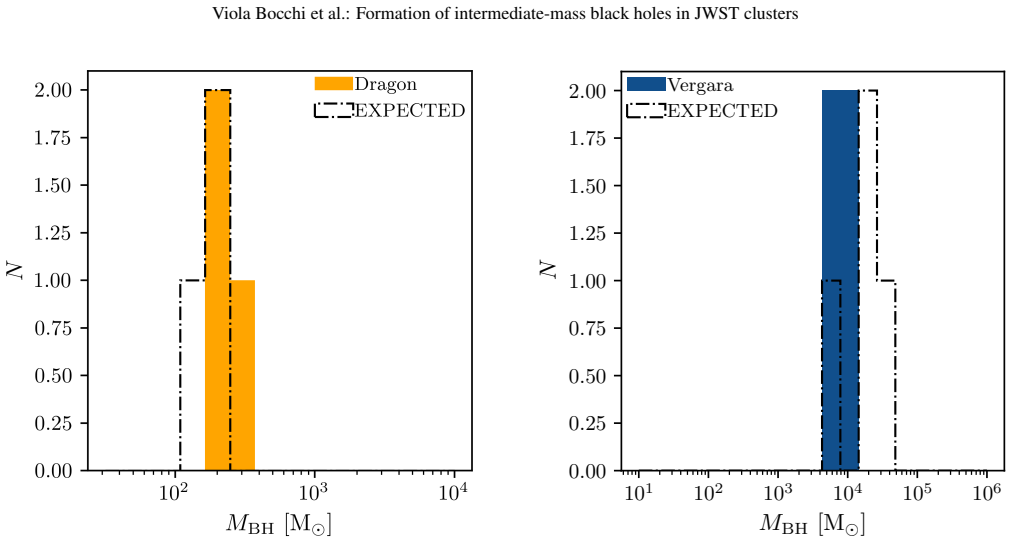
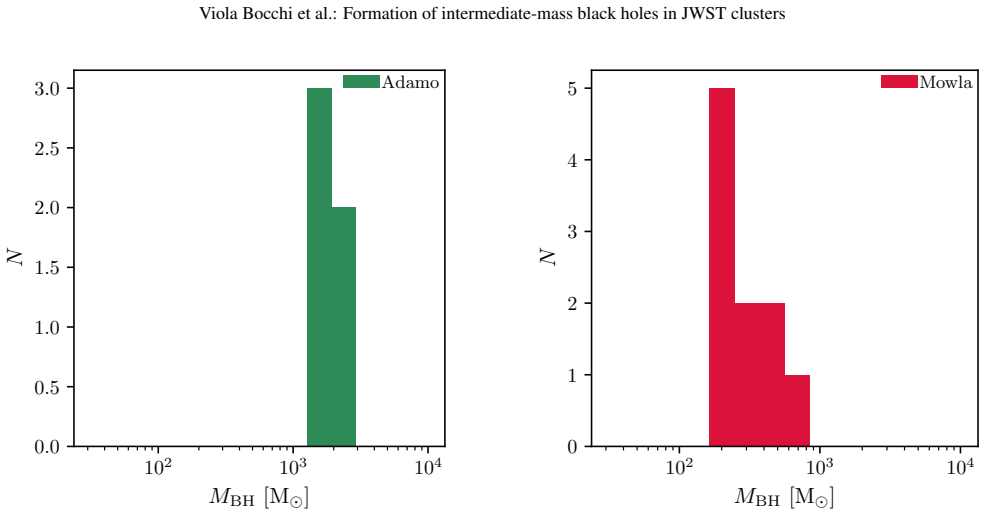
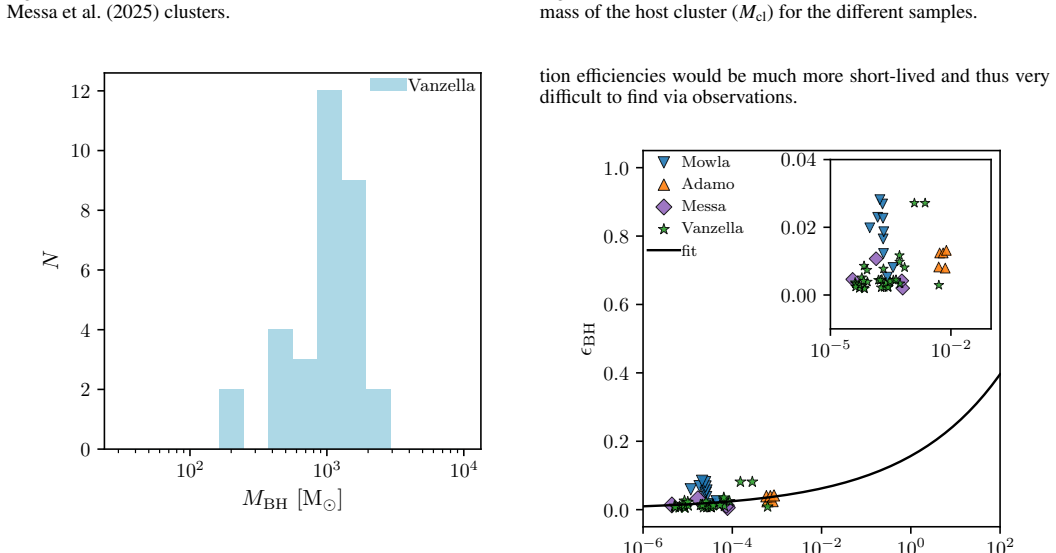
We estimate the masses of intermediate-mass black holes formed via runaway stellar collisions in young massive clusters detected by JWST using a Fokker-Planck model together with an analytical framework for runaway collisions and mass loss through winds. Our estimates yield typical IMBH masses in the range of approximately 100 to 4000 solar masses, implying typical formation efficiencies on the few percent level. The extreme compactness of the Cosmic Gems clusters with half-mass radii near 1 parsec facilitates the formation of black hole seeds with high masses of 1600 to 2700 solar masses. Low metallicity below 0.02 solar is a critical factor for retaining the seed mass against stellar winds
What carries the argument
The analytic framework for runaway stellar collisions and mass loss through winds, applied through a Fokker-Planck model to calculate IMBH masses in compact high-redshift clusters.
If this is right
- These clusters can supply black hole seeds heavy enough to grow into the supermassive black holes already observed at high redshift.
- Formation efficiencies of only a few percent mean that a small fraction of each cluster's mass ends up in the central black hole.
- The most compact systems with half-mass radii near 1 parsec reach the upper end of the mass range, 1600 to 2700 solar masses.
- Low metallicity is required to keep stellar winds from stripping mass and thereby to achieve the higher seed masses.
Where Pith is reading between the lines
- If the estimates hold, many early galaxies likely contained such compact clusters as sites for rapid black hole growth.
- Dynamical or photometric signatures of these seeds could be searched for in the same JWST fields.
- Applying the same approach to larger samples of high-redshift clusters would give a statistical prediction for the total number of heavy seeds.
Load-bearing premise
The analytic model for runaway collisions and wind mass loss that matches simulations of smaller nearby clusters also remains accurate for these much more massive, lower-metallicity, high-redshift systems.
What would settle it
Direct N-body simulations of a 10^6 solar-mass cluster with 1-parsec radius and metallicity 0.01 solar would produce final IMBH masses differing by more than a factor of two from the analytic prediction of roughly 2000 solar masses.
Figures


read the original abstract
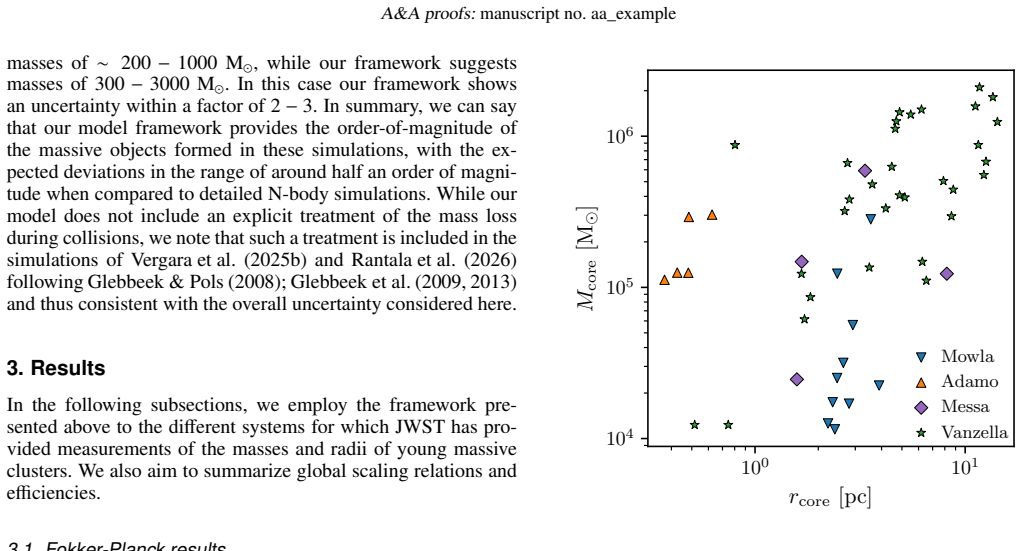
The James Webb Space Telescope (JWST) has revealed a population of dense stellar systems at high redshift, including the "Cosmic Gems" arc ($z \sim 10.2$) and the "Firefly Sparkle" ($z \sim 8.3$). With masses in the range of $10^5$~M$_\odot$-$10^7$M$_\odot$ and half-mass radii in the range from $\sim0.4$-$15$ pc, these systems are ideally suited to form intermediate-mass black holes (IMBHs) via collision-based models. While direct N-body simulations are unfeasible for such a large population and given the high masses in many of the clusters, we estimate the IMBH masses formed via runaway stellar collisions in these specific environments utilizing a Fokker-Planck model together with an analytical framework for runaway collisions and mass loss through winds, which has been validated against direct N-body simulations of compact star clusters. We apply this model to a sample of massive high-redshift clusters observed with JWST. Our estimates yield typical IMBH masses in the range of $\sim10^2$ M$_\odot$ {\bf up to $\sim4\times 10^3$ M$_\odot$,} implying typical formation efficiencies on the few percent level. The extreme compactness of the Cosmic Gems clusters ($R_h \sim 1$ pc) facilitates the formation of black hole seeds with high masses of $1600-2700 {\rm M}_\odot$. Low metallicity ($Z \lesssim 0.02 \, {\rm Z}_\odot$) is a critical factor for retaining the seed mass against stellar winds. We further demonstrate that the efficiencies obtained here are consistent with expectations based on direct N-body simulations. Our results suggest that these dense, metal-poor clusters are viable factories for heavy seeds, capable of growing into the supermassive black holes observed in the early Universe.
Editorial analysis
A structured set of objections, weighed in public.
Referee Report
Summary. The manuscript applies a Fokker-Planck model combined with an analytic treatment of runaway stellar collisions and wind-driven mass loss to estimate IMBH formation in JWST-detected high-redshift clusters with masses 10^5–10^7 M⊙ and half-mass radii 0.4–15 pc. The framework, previously validated against direct N-body simulations, yields typical IMBH masses of ∼10²–4×10³ M⊙ at few-percent formation efficiencies, with 1600–2700 M⊙ seeds favored in the compact, low-metallicity (Z ≲ 0.02 Z⊙) Cosmic Gems systems. The authors conclude these clusters are viable factories for heavy black-hole seeds capable of growing into early supermassive black holes.
Significance. If the scaling of collision rates and wind losses remains accurate when extrapolated to the higher-mass, lower-metallicity regime, the work supplies a computationally efficient route to IMBH mass estimates for an entire population of JWST clusters where full N-body integrations are infeasible. It supplies concrete, observationally testable predictions and explicitly checks consistency with existing N-body expectations, which is a methodological strength.
major comments (2)
- §3 (Model and Validation): The analytic framework is stated to have been validated against direct N-body runs of compact clusters, yet the manuscript provides no explicit statement of the mass range or metallicity range of those validation simulations. Because the quoted IMBH masses (e.g., 1600–2700 M⊙ for Cosmic Gems) and efficiencies rest directly on the collision-runaway timescale and the wind-mass-loss prescription, the absence of a demonstration that these scalings remain valid at cluster masses increased by 1–2 orders of magnitude and at Z ≲ 0.02 Z⊙ constitutes a load-bearing uncertainty.
- §4–5 (Application and Results): No sensitivity tests or error propagation are shown for key inputs (initial mass function, binary fraction, exact metallicity, or half-mass radius) when the model is applied to the JWST sample. The central numerical claims (typical masses ∼10²–4×10³ M⊙, efficiencies at the few-percent level) therefore lack quantified robustness against plausible variations in the high-mass, low-Z regime.
minor comments (2)
- Abstract: The half-mass radius is denoted both as Rh and R_h; a single consistent symbol should be adopted throughout.
- Abstract: The upper bound “up to ∼4×10³ M⊙” should be clarified as the sample maximum or the upper end of a typical range.
Simulated Author's Rebuttal
We appreciate the referee's detailed feedback on our manuscript. The comments highlight important aspects for strengthening the presentation of our analytic model and its application to JWST observations. We respond to each major comment below.
read point-by-point responses
-
Referee: §3 (Model and Validation): The analytic framework is stated to have been validated against direct N-body runs of compact clusters, yet the manuscript provides no explicit statement of the mass range or metallicity range of those validation simulations. Because the quoted IMBH masses (e.g., 1600–2700 M⊙ for Cosmic Gems) and efficiencies rest directly on the collision-runaway timescale and the wind-mass-loss prescription, the absence of a demonstration that these scalings remain valid at cluster masses increased by 1–2 orders of magnitude and at Z ≲ 0.02 Z⊙ constitutes a load-bearing uncertainty.
Authors: We agree that an explicit statement of the validation ranges is necessary. In the revised manuscript, we will include details on the mass range and metallicity range of the N-body validation simulations, along with references to the relevant prior work. We will also discuss the applicability of the scalings to the JWST clusters' parameter space. While direct N-body validation for the entire range is not feasible, the model has been shown to reproduce N-body results in the regime of compact clusters. revision: partial
-
Referee: §4–5 (Application and Results): No sensitivity tests or error propagation are shown for key inputs (initial mass function, binary fraction, exact metallicity, or half-mass radius) when the model is applied to the JWST sample. The central numerical claims (typical masses ∼10²–4×10³ M⊙, efficiencies at the few-percent level) therefore lack quantified robustness against plausible variations in the high-mass, low-Z regime.
Authors: We concur that sensitivity tests would enhance the robustness of our results. In the revised manuscript, we will add sensitivity analyses for the key parameters mentioned, including variations in the initial mass function, binary fraction, metallicity, and half-mass radius. These will be presented in a new figure or table in §4 or an appendix, showing the impact on the estimated IMBH masses and formation efficiencies. This will allow readers to assess the quantified robustness of our central claims. revision: yes
- The direct demonstration of model validity through N-body simulations at cluster masses of 10^6–10^7 M⊙ and metallicities Z ≲ 0.02 Z⊙, as full N-body integrations are computationally infeasible for such systems.
Circularity Check
No significant circularity detected in derivation chain
full rationale
The paper applies an externally validated Fokker-Planck plus analytic runaway-collision and wind-loss framework to the observed JWST cluster parameters (masses 10^5-10^7 M⊙, radii ~0.4-15 pc, low Z) to compute IMBH seed masses and efficiencies. The framework is cited as validated against independent direct N-body simulations of compact clusters, and the present work only demonstrates consistency of the resulting efficiencies with those N-body expectations. No parameters are fitted to the JWST data inside this paper, no predictions reduce to inputs by construction, and no self-citation chain is invoked to forbid alternatives or smuggle ansatzes. The derivation therefore remains self-contained against external benchmarks.
Axiom & Free-Parameter Ledger
axioms (1)
- domain assumption The Fokker-Planck description of runaway stellar collisions plus analytic wind mass loss remains valid for clusters with masses 10^5-10^7 M⊙ and half-mass radii ~0.4-15 pc at Z ≲ 0.02 Z⊙.
Lean theorems connected to this paper
-
IndisputableMonolith/Foundation/RealityFromDistinction.leanreality_from_one_distinction unclear?
unclearRelation between the paper passage and the cited Recognition theorem.
We use a high-accuracy finite-element method for the Fokker–Planck equation... PhaseFlow... together with an analytical framework for runaway collisions and mass loss through winds, which has been validated against direct N-body simulations of compact star clusters.
-
IndisputableMonolith/Cost/FunctionalEquation.leanwashburn_uniqueness_aczel unclear?
unclearRelation between the paper passage and the cited Recognition theorem.
˙Macc ≈ 0.03× Mcore / trelax,core ... log10(˙Mwind) = −9.13 + 2.1 log10(MVMS) + 0.74 log10(Z/Z⊙)
What do these tags mean?
- matches
- The paper's claim is directly supported by a theorem in the formal canon.
- supports
- The theorem supports part of the paper's argument, but the paper may add assumptions or extra steps.
- extends
- The paper goes beyond the formal theorem; the theorem is a base layer rather than the whole result.
- uses
- The paper appears to rely on the theorem as machinery.
- contradicts
- The paper's claim conflicts with a theorem or certificate in the canon.
- unclear
- Pith found a possible connection, but the passage is too broad, indirect, or ambiguous to say the theorem truly supports the claim.
Reference graph
Works this paper leans on
- [1]
-
[2]
Adamo, A., Bradley, L. D., Vanzella, E., et al. 2024, Nature, 632, 513
work page 2024
-
[3]
Akins, H. B., Casey, C. M., Lambrides, E., et al. 2025, ApJ, 991, 37 Alister Seguel, P. J., Schleicher, D. R. G., Boekholt, T. C. N., Fellhauer, M., &
work page 2025
-
[4]
Klessen, R. S. 2020, MNRAS, 493, 2352 Arca Sedda, M., Kamlah, A. W. H., Spurzem, R., et al. 2023, MNRAS, 526, 429
work page 2020
- [5]
-
[6]
Begelman, M. C. & Shlosman, I. 2009, ApJ, 702, L5
work page 2009
-
[7]
Binney, J., Tremaine, S., & Freeman, K. 2009, Physics Today, 62, 56
work page 2009
-
[8]
Boekholt, T. C. N., Schleicher, D. R. G., Fellhauer, M., et al. 2018, MNRAS, 476, 366
work page 2018
- [9]
- [10]
- [11]
-
[12]
Chang, J. S. & Cooper, G. 1970, Journal of Computational Physics, 6, 1
work page 1970
- [13]
-
[14]
Chworowsky, K., Finkelstein, S. L., Boylan-Kolchin, M., et al. 2024, AJ, 168, 113
work page 2024
- [15]
-
[16]
2025, arXiv e-prints, arXiv:2511.07578
Dekel, A., Dutta Chowdhury, D., Lapiner, S., et al. 2025, arXiv e-prints, arXiv:2511.07578
- [17]
-
[18]
M., Colpi, M., & Portegies Zwart, S
Devecchi, B., V olonteri, M., Rossi, E. M., Colpi, M., & Portegies Zwart, S. 2012, MNRAS, 421, 1465
work page 2012
-
[19]
2025, arXiv e-prints, arXiv:2509.20453
Escala, A., Zimmermann, L., Valdebenito, S., et al. 2025, arXiv e-prints, arXiv:2509.20453
-
[20]
S., Wang, L., Tanikawa, A., Hirai, Y ., & Saitoh, T
Fujii, M. S., Wang, L., Tanikawa, A., Hirai, Y ., & Saitoh, T. R. 2024, Science, 384, 1488
work page 2024
-
[21]
Gaete, B., Schleicher, D. R. G., Lupi, A., et al. 2024, A&A, 690, A378
work page 2024
-
[22]
Glebbeek, E., Gaburov, E., de Mink, S. E., Pols, O. R., & Portegies Zwart, S. F. 2009, A&A, 497, 255
work page 2009
-
[23]
Glebbeek, E., Gaburov, E., Portegies Zwart, S., & Pols, O. R. 2013, MNRAS, 434, 3497
work page 2013
- [24]
-
[25]
Greene, J. E., Labbe, I., Goulding, A. D., et al. 2024, ApJ, 964, 39 Grudi´c, M. Y ., Hafen, Z., Rodriguez, C. L., et al. 2023, MNRAS, 519, 1366
work page 2024
-
[26]
A., Pacucci, F., & Kocevski, D
Guia, C. A., Pacucci, F., & Kocevski, D. D. 2024, Research Notes of the Ameri- can Astronomical Society, 8, 207 Gürkan, M. A., Freitag, M., & Rasio, F. A. 2004, ApJ, 604, 632
work page 2024
-
[27]
Inayoshi, K. & Haiman, Z. 2014, MNRAS, 445, 1549 Jeˇrábková, T., Zonoozi, A. H., Kroupa, P., et al. 2018, A&A, 620, A39
work page 2014
-
[28]
Katz, H., Sijacki, D., & Haehnelt, M. G. 2015, MNRAS, 451, 2352
work page 2015
- [29]
-
[30]
2026, in Encyclopedia of Astro- physics, V olume 2, V ol
Kroupa, P., Gjergo, E., Jerabkova, T., & Yan, Z. 2026, in Encyclopedia of Astro- physics, V olume 2, V ol. 2, 173–210
work page 2026
-
[31]
2020, MNRAS, 498, 5652 Labbé, I., van Dokkum, P., Nelson, E., et al
Kroupa, P., Subr, L., Jerabkova, T., & Wang, L. 2020, MNRAS, 498, 5652 Labbé, I., van Dokkum, P., Nelson, E., et al. 2023, Nature, 616, 266
work page 2020
-
[32]
A., Bovino, S., Grassi, T., Schleicher, D
Latif, M. A., Bovino, S., Grassi, T., Schleicher, D. R. G., & Spaans, M. 2015, MNRAS, 446, 3163
work page 2015
-
[33]
A., Omukai, K., Habouzit, M., Schleicher, D
Latif, M. A., Omukai, K., Habouzit, M., Schleicher, D. R. G., & V olonteri, M. 2016, ApJ, 823, 40
work page 2016
-
[34]
Latif, M. A. & Schleicher, D. R. G. 2015, A&A, 578, A118
work page 2015
-
[35]
Latif, M. A., Schleicher, D. R. G., Schmidt, W., & Niemeyer, J. 2013, MNRAS, 433, 1607
work page 2013
-
[36]
Liempi, M., Schleicher, D. R. G., Benson, A., Escala, A., & Vergara, M. C. 2025, A&A, 694, A42
work page 2025
-
[37]
Lupi, A., Colpi, M., Devecchi, B., Galanti, G., & V olonteri, M. 2014, MNRAS, 442, 3616
work page 2014
- [38]
-
[39]
Matthee, J., Naidu, R. P., Brammer, G., et al. 2024, ApJ, 963, 129
work page 2024
-
[40]
2025, arXiv e-prints, arXiv:2507.18705
Messa, M., Vanzella, E., Loiacono, F., et al. 2025, arXiv e-prints, arXiv:2507.18705
- [41]
-
[42]
2025, arXiv e-prints, arXiv:2509.02664
Pacucci, F., Hernquist, L., & Fujii, M. 2025, arXiv e-prints, arXiv:2509.02664
-
[43]
Plummer, H. C. 1911, MNRAS, 71, 460 Portegies Zwart, S. F. & McMillan, S. L. W. 2002, ApJ, 576, 899 Ramírez-Galeano, L., Charbonnel, C., Fragos, T., et al. 2025, A&A, 699, A223
work page 1911
-
[44]
Rantala, A., Lahén, N., Naab, T., Escobar, G. J., & Iorio, G. 2025, MNRAS, 543, 2130
work page 2025
- [45]
-
[46]
2026, arXiv e-prints, arXiv:2601.07917
Rantala, A., Naab, T., Lahén, N., et al. 2026, arXiv e-prints, arXiv:2601.07917
-
[47]
Reinoso, B., Schleicher, D. R. G., Fellhauer, M., Klessen, R. S., & Boekholt, T. C. N. 2018, A&A, 614, A14
work page 2018
-
[48]
Reinoso, B., Schleicher, D. R. G., Fellhauer, M., Leigh, N. W. C., & Klessen, R. S. 2020, A&A, 639, A92
work page 2020
-
[49]
2026, arXiv e-prints, arXiv:2602.02141
Roman-Garza, J., Fragos, T., Charbonnel, C., et al. 2026, arXiv e-prints, arXiv:2602.02141
-
[50]
Sakurai, Y ., Yoshida, N., Fujii, M. S., & Hirano, S. 2017, MNRAS, 472, 1677
work page 2017
-
[51]
Sassano, F., Schneider, R., Valiante, R., et al. 2021, MNRAS, 506, 613
work page 2021
-
[52]
Schleicher, D. R. G., Reinoso, B., & Klessen, R. S. 2023, MNRAS, 521, 3972
work page 2023
-
[53]
Schleicher, D. R. G., Reinoso, B., Latif, M., et al. 2022, MNRAS, 512, 6192
work page 2022
-
[54]
Schleicher, D. R. G., Spaans, M., & Glover, S. C. O. 2010, ApJ, 712, L69
work page 2010
-
[55]
Shapiro, S. L. 2005, ApJ, 620, 59
work page 2005
-
[56]
A., Reinoso, B., Schleicher, D
Solar, P. A., Reinoso, B., Schleicher, D. R. G., Klessen, R. S., & Banerjee, R. 2025, A&A, 699, A64
work page 2025
-
[57]
Somerville, R. S., Yung, L. Y . A., Lancaster, L., et al. 2025, arXiv e-prints, arXiv:2505.05442
-
[58]
1987, Dynamical evolution of globular clusters
Spitzer, L. 1987, Dynamical evolution of globular clusters
work page 1987
-
[59]
Suazo, M., Prieto, J., Escala, A., & Schleicher, D. R. G. 2019, ApJ, 885, 127
work page 2019
- [60]
-
[61]
Vanzella, E., Claeyssens, A., Welch, B., et al. 2023, ApJ, 945, 53
work page 2023
-
[62]
2025, arXiv e-prints, arXiv:2507.18699
Vanzella, E., Messa, M., Adamo, A., et al. 2025, arXiv e-prints, arXiv:2507.18699
- [63]
- [64]
-
[65]
C., Askar, A., Flammini Dotti, F., et al
Vergara, M. C., Askar, A., Flammini Dotti, F., et al. 2025a, arXiv e-prints, arXiv:2508.14260
-
[66]
Vergara, M. C., Askar, A., Kamlah, A. W. H., et al. 2025b, arXiv e-prints, arXiv:2505.07491
-
[67]
Vergara, M. C., Escala, A., Schleicher, D. R. G., & Reinoso, B. 2023, MNRAS, 522, 4224
work page 2023
-
[68]
Vergara, M. C., Schleicher, D. R. G., Escala, A., et al. 2024, A&A, 689, A34
work page 2024
-
[69]
Vergara, M. Z. C., Schleicher, D. R. G., Boekholt, T. C. N., et al. 2021, A&A, 649, A160
work page 2021
-
[70]
Vink, J. S. 2018, A&A, 615, A119
work page 2018
- [71]
-
[72]
Yoshida, N., Omukai, K., & Hernquist, L. 2008, Science, 321, 669
work page 2008
-
[73]
2025, arXiv e-prints, arXiv:2510.25830, doi: 10.48550/arXiv.2510.25830
Zhang, Y ., Ding, X., Yang, L., et al. 2025, arXiv e-prints, arXiv:2510.25830 Article number, page 11
discussion (0)
Sign in with ORCID, Apple, or X to comment. Anyone can read and Pith papers without signing in.