Spatio-spectral vector light created by optical activity in rubidium vapor
Pith reviewed 2026-05-21 07:03 UTC · model grok-4.3
The pith
Optical activity in rubidium vapor converts frequency shifts into rotations of a vector vortex beam's intensity pattern at 98 mrad per MHz.
A machine-rendered reading of the paper's core claim, the machinery that carries it, and where it could break.
Core claim
The central claim is that a pump beam induces macroscopic magnetization in rubidium vapor, producing uniform but frequency-dependent circular dichroism and birefringence; when a vector vortex probe traverses this medium its spatially varying polarization state maps the optical activity onto the transverse intensity distribution in a chosen polarization component, so that a frequency shift appears as a measurable rotation of the observed image, reaching 98 mrad per MHz on resonance.
What carries the argument
The vector vortex probe beam whose spatially varying polarization state maps the medium's uniform, frequency-dependent circular birefringence and dichroism onto the transmitted intensity pattern.
If this is right
- Spatially resolved polarization spectroscopy can be performed by recording the probe intensity profile after transmission.
- Frequency detuning is directly converted into an angular rotation of the observed image, enabling a new readout method for spectral shifts.
- Correlations are generated between the frequency, polarization, and spatial degrees of freedom in the output light.
- The same setup can be used for high-precision spectroscopy or magnetometry by monitoring the image rotation.
- Hybrid entanglement between spatial and spectral modes may be produced in the transmitted vector light.
Where Pith is reading between the lines
- The rotation sensitivity might be increased by choosing higher-order vortex beams whose polarization gradients are steeper.
- Similar mappings could appear in other optically active media, allowing the technique to be transferred beyond rubidium.
- Combining the image rotation with an external magnetic field scan would test whether the method yields spatially resolved magnetometry.
- The generated spatio-spectral correlations could be characterized with quantum tomography to check for entanglement resources.
Load-bearing premise
The pump creates a macroscopic magnetization that produces uniform circular dichroism and birefringence across the probe beam profile without absorption or higher-order nonlinearities dominating the observed rotation.
What would settle it
If the intensity pattern in the selected polarization component shows no rotation when the probe frequency is scanned across resonance, or if the rotation angle fails to scale linearly with detuning near resonance, the claimed frequency-to-image mapping would be refuted.
Figures

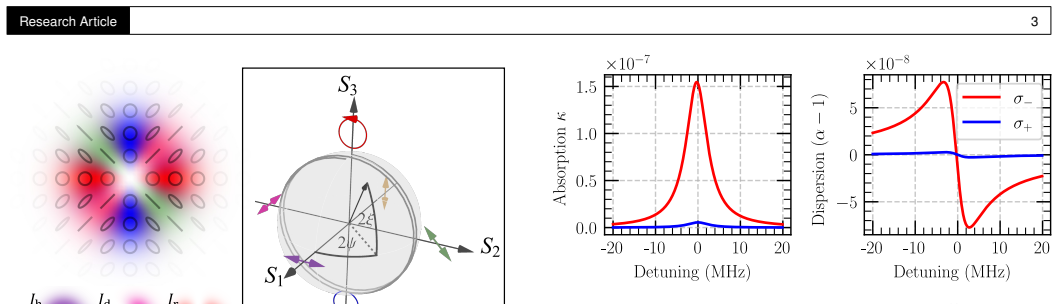


read the original abstract
We demonstrate a pump-probe scheme in which an atomic vapor is optically pumped with circularly polarized light and probed with a vector vortex beam. The pump induces a macroscopic magnetization in the medium, which gives rise to frequency-dependent circular dichroism and birefringence. The vortex probe, characterized by spatially varying polarization, maps this optical activity onto the spatial structure of the transmitted light, thereby generating correlations between the frequency, polarization, and spatial degrees of freedom. Measuring the intensity profile in a suitable polarization component then allows us to perform spatially resolved polarization spectroscopy. We demonstrate the translation of frequency shifts into an image rotation, observing on resonance a rotation in the order of 98 mrad per MHz. These findings may find applications in high-precision spectroscopy, magnetometry, and the generation of hybrid entanglement.
Editorial analysis
A structured set of objections, weighed in public.
Referee Report
Summary. The manuscript describes a pump-probe experiment in rubidium vapor in which a circularly polarized pump induces macroscopic magnetization and associated frequency-dependent circular dichroism and birefringence. A vector vortex probe beam with spatially varying polarization maps this optical activity onto the transmitted intensity profile, enabling spatially resolved polarization spectroscopy. The central experimental result is the observation of an image rotation of order 98 mrad per MHz on resonance, which the authors attribute to the translation of frequency shifts into spatial rotations via the induced optical activity.
Significance. If the reported rotation is shown to arise primarily from birefringence rather than intensity modulation by dichroism, the work offers a compact method for converting spectral information into spatial image rotations. This could support applications in precision spectroscopy and magnetometry. The use of vector vortex beams to generate spatio-spectral correlations is a clear strength, though the manuscript does not yet include machine-checked derivations or fully reproducible data-processing pipelines.
major comments (2)
- [Abstract and §4] Abstract and §4 (Results): The reported 98 mrad/MHz rotation is presented without error bars, without a quantitative bound on optical depth, and without an explicit comparison of the measured pattern to a birefringence-only model. This leaves open the possibility that differential absorption from the imaginary part of the susceptibility produces an apparent rotation via intensity modulation.
- [§3] §3 (Experimental setup): No statement is given that absorption was negligible or corrected for, nor is there a control measurement (e.g., linear polarization probe or off-resonance data) that isolates the real-part contribution to the observed image rotation.
minor comments (2)
- [Figure 3] Figure 3 caption: the polarization analyzer orientation relative to the probe's local polarization basis should be stated explicitly to allow readers to reproduce the intensity-pattern rotation measurement.
- [§4] Notation: the definition of the rotation angle extracted from the intensity profile is not given in equation form; adding a short expression relating the fitted rotation to the measured Stokes parameters would improve clarity.
Simulated Author's Rebuttal
We thank the referee for their careful reading of our manuscript and for the constructive comments. We have revised the manuscript to include error bars, a bound on the optical depth, and additional control measurements and model comparisons to address the concerns about distinguishing birefringence from dichroism effects. Our detailed responses to each major comment are provided below.
read point-by-point responses
-
Referee: [Abstract and §4] Abstract and §4 (Results): The reported 98 mrad/MHz rotation is presented without error bars, without a quantitative bound on optical depth, and without an explicit comparison of the measured pattern to a birefringence-only model. This leaves open the possibility that differential absorption from the imaginary part of the susceptibility produces an apparent rotation via intensity modulation.
Authors: We agree that the original presentation lacked these quantitative details. In the revised version, we have added error bars to the reported rotation rate of 98 mrad/MHz, obtained from statistical analysis of multiple experimental runs. We also provide a quantitative bound on the optical depth, which we measured to be less than 0.1 at the probe frequency. Furthermore, we have included an explicit comparison of the observed intensity pattern to a theoretical model based only on the real part of the susceptibility (circular birefringence). This model reproduces the rotational behavior accurately. In contrast, a model relying solely on the imaginary part (circular dichroism) predicts intensity modulations without the characteristic rotation of the polarization pattern, which does not match our data. We have added this analysis to §4 and updated the abstract accordingly. revision: yes
-
Referee: [§3] §3 (Experimental setup): No statement is given that absorption was negligible or corrected for, nor is there a control measurement (e.g., linear polarization probe or off-resonance data) that isolates the real-part contribution to the observed image rotation.
Authors: We have revised §3 to explicitly state that absorption was low and that we corrected for any residual effects using measured transmission spectra. To isolate the real-part contribution, we have added control experiments: measurements with a linearly polarized probe beam show no image rotation, indicating that the effect requires the spatially varying polarization of the vector vortex and arises from birefringence rather than simple absorption. Additionally, off-resonance data demonstrate that the rotation disappears away from resonance, consistent with the dispersive nature of the birefringence. These controls are now presented in the revised manuscript. revision: yes
Circularity Check
Experimental observation with no self-referential derivation chain
full rationale
The manuscript reports a direct experimental measurement of image rotation (98 mrad/MHz on resonance) in a pump-probe setup using a vector vortex probe in optically pumped rubidium vapor. The central result is presented as an observed correlation between frequency, polarization, and spatial structure arising from induced circular dichroism and birefringence. No equations, models, or derivations are supplied that define the reported rotation in terms of itself, fit parameters to a subset of the same data and then relabel the output as a prediction, or invoke self-citations as the sole justification for a uniqueness claim. The derivation chain is therefore self-contained against external benchmarks and does not reduce to its inputs by construction.
Axiom & Free-Parameter Ledger
axioms (1)
- domain assumption Circularly polarized pumping creates a macroscopic magnetization that produces frequency-dependent circular dichroism and birefringence.
Reference graph
Works this paper leans on
-
[1]
Vectorial light–matter interaction: Exploring spatially structured complex light fields,
J. Wang, F . Castellucci, and S. Franke-Arnold, “Vectorial light–matter interaction: Exploring spatially structured complex light fields,” AVS Quantum Sci.2, 031702 (2020)
work page 2020
-
[2]
Cylindrical vector beams for rapid polarization-dependent measurements in atomic systems,
F . K. Fatemi, “Cylindrical vector beams for rapid polarization-dependent measurements in atomic systems,” Opt. Express19, 25143–25150 (2011)
work page 2011
-
[3]
Atomic compass: De- tecting 3d magnetic field alignment with vector vortex light,
F . Castellucci, T. W. Clark, A. Selyem,et al., “Atomic compass: De- tecting 3d magnetic field alignment with vector vortex light,” Phys. Rev. Lett.127, 233202 (2021)
work page 2021
-
[4]
Thermal atomic compass based on radially polarized beam,
G. Cai, K. Tian, and Z. Wang, “Thermal atomic compass based on radially polarized beam,” LASER & PHOTONICS REVIEWS18(2024)
work page 2024
-
[5]
Visualization of magnetic fields with cylindrical vector beams in a warm atomic vapor,
S. Qiu, J. Wang, F . Castellucci,et al., “Visualization of magnetic fields with cylindrical vector beams in a warm atomic vapor,” Photon. Res.9, 2325–2331 (2021)
work page 2021
-
[6]
Interaction of vector light beams with atoms exposed to a time-dependent magnetic field,
S. Ramakrishna, R. P . Schmidt, A. A. Peshkov,et al., “Interaction of vector light beams with atoms exposed to a time-dependent magnetic field,” Phys. Rev. A110, 043101 (2024)
work page 2024
-
[7]
Experimental realization of optical storage of vector beams of light in warm atomic vapor,
Y .-H. Y e, M.-X. Dong, Y .-C. Yu,et al., “Experimental realization of optical storage of vector beams of light in warm atomic vapor,” Opt. Lett.44, 1528–1531 (2019)
work page 2019
-
[8]
Optical memory for arbitrary perfect Poincaré states in an atomic ensemble,
L. Zeng, Y .-H. Y e, M.-X. Dong,et al., “Optical memory for arbitrary perfect Poincaré states in an atomic ensemble,” Opt. Lett.48, 477–480 (2023)
work page 2023
-
[9]
Efficient coherent optical storage of multi-dimensional states in cold atom ensembles,
X. Y ang, J. Wang, S. Qiu,et al., “Efficient coherent optical storage of multi-dimensional states in cold atom ensembles,” Photonics Res.13, 1747–1755 (2025)
work page 2025
-
[10]
Storage and retrieval of optical skyrmions with topological characteristics
J. Wang, X. Y ang, Y . Chen,et al., “Storage and retrieval of optical skyrmions with topological characteristics,” arXiv, arXiv:2512.20378 (2025)
work page internal anchor Pith review Pith/arXiv arXiv 2025
-
[11]
Shaping cold-atom clouds with a vortex beam,
A. Bertoluzza, S. Lorenz, P . Hampp,et al., “Shaping cold-atom clouds with a vortex beam,” Phys. Rev. A113, 023102 (2026)
work page 2026
-
[12]
Visualizing strongly focused 3D light fields in an atomic vapor,
S. Svensson, C. R. Higgins, D. Pizzey,et al., “Visualizing strongly focused 3D light fields in an atomic vapor,” Optica12, 1553–1559 (2025)
work page 2025
-
[13]
Correlating space, wavelength, and polarization of light: Spatiospectral vector beams,
L. Kopf, R. Barros, and R. Fickler, “Correlating space, wavelength, and polarization of light: Spatiospectral vector beams,” ACS Photonics11, 241–246 (2024)
work page 2024
-
[14]
Towards higher-dimensional structured light,
C. He, Y . Shen, and A. Forbes, “Towards higher-dimensional structured light,” Light. Sci. &; Appl.11(2022)
work page 2022
-
[15]
H. Rubinsztein-Dunlop, A. Forbes, M. V. Berry,et al., “Roadmap on structured light,” J. Opt.19, 013001 (2017)
work page 2017
-
[16]
Spatiotemporal optical vortices: Principles of description and basic properties,
A. Bekshaev, “Spatiotemporal optical vortices: Principles of description and basic properties,” APL Photonics9(2024)
work page 2024
-
[17]
Creation and detection of optical modes with spatial light modulators,
A. Forbes, A. Dudley, and M. McLaren, “Creation and detection of optical modes with spatial light modulators,” Adv. Opt. Photonics8, 200 (2016)
work page 2016
-
[18]
Optical spin-to-orbital angular momentum conversion in inhomogeneous anisotropic media,
L. Marrucci, C. Manzo, and D. Paparo, “Optical spin-to-orbital angular momentum conversion in inhomogeneous anisotropic media,” Phys. Rev. Lett.96, 163905 (2006)
work page 2006
-
[19]
Sharper focus for a radially polarized light beam,
R. Dorn, S. Quabis, and G. Leuchs, “Sharper focus for a radially polarized light beam,” Phys. Rev. Lett.91, 233901 (2003)
work page 2003
-
[20]
Optically spatial information selection with hybridly polarized beam in atomic vapor,
J. Wang, X. Y ang, Y . Li,et al., “Optically spatial information selection with hybridly polarized beam in atomic vapor,” Photonics Res.6, 451– 456 (2018). Publisher: Optica Publishing Group
work page 2018
-
[21]
Magnetic-field-induced rotation of light with orbital angular momentum,
S. Shi, D.-S. Ding, Z.-Y . Zhou,et al., “Magnetic-field-induced rotation of light with orbital angular momentum,” Appl. Phys. Lett.106(2015)
work page 2015
-
[22]
Theory of Saturated-Absorption Line Shapes,
S. Haroche and F . Hartmann, “Theory of Saturated-Absorption Line Shapes,” Phys. Rev. A6, 1280–1300 (1972)
work page 1972
-
[23]
Frequency-stabilized diode laser with the Zeeman shift in an atomic vapor,
K. L. Corwin, Z.-T. Lu, C. F . Hand,et al., “Frequency-stabilized diode laser with the Zeeman shift in an atomic vapor,” Appl. Opt.37, 3295– 3298 (1998)
work page 1998
-
[24]
Doppler-Free Laser Polarization Spec- troscopy,
C. Wieman and T. W. Hänsch, “Doppler-Free Laser Polarization Spec- troscopy,” Phys. Rev. Lett.36, 1170–1173 (1976)
work page 1976
-
[25]
Polarization spectroscopy of rubidium atoms: Theory and experiment,
H. D. Do, G. Moon, and H.-R. Noh, “Polarization spectroscopy of rubidium atoms: Theory and experiment,” Phys. Rev. A77, 032513 (2008)
work page 2008
-
[26]
Polarization spec- Research Article 7 troscopy of an excited state transition in Rubidium,
N. F . Almuhawish, S. Chen, L. A. Downes,et al., “Polarization spec- Research Article 7 troscopy of an excited state transition in Rubidium,” OSA Continuum4, 2598–2605 (2021). Publisher: Optica Publishing Group
work page 2021
-
[27]
Polarization spec- troscopy of a closed atomic transition: applications to laser frequency locking,
C. P . Pearman, C. S. Adams, S. G. Cox,et al., “Polarization spec- troscopy of a closed atomic transition: applications to laser frequency locking,” J. Phys. B: At. Mol. Opt. Phys.35, 5141 (2002)
work page 2002
-
[28]
Atomic photoex- citation as a tool for probing purity of twisted light modes,
R. P . Schmidt, S. Ramakrishna, A. A. Peshkov,et al., “Atomic photoex- citation as a tool for probing purity of twisted light modes,” Phys. Rev. A109, 033103 (2024)
work page 2024
-
[29]
A. E. Siegman,Lasers(University science books, 1986)
work page 1986
-
[30]
L. D. Landau and E. M. Lifshitz,Electrodynamics of Continuous Media (Pergamon, New Y ork, 1984)
work page 1984
-
[31]
V. Lucarini, K.-E. Peiponen, J. J. Saarinen, and E. M. Vartiainen, Kramers-Kronig relations in optical materials research(Springer, 2005)
work page 2005
-
[32]
Optics in terms of observable quantities,
E. Wolf, “Optics in terms of observable quantities,” Il Nuovo Cimento (1943-1954)12, 884–888 (1954)
work page 1943
-
[33]
Polarization and the stokes parameters,
W. H. McMaster, “Polarization and the stokes parameters,” Am. J. Phys. 22, 351–362 (1954)
work page 1954
- [34]
discussion (0)
Sign in with ORCID, Apple, or X to comment. Anyone can read and Pith papers without signing in.