Decomposing MXFP4 quantization error for LLM reinforcement learning: reducible bias, recoverable deadzone, and an irreducible floor
Pith reviewed 2026-05-21 07:56 UTC · model grok-4.3
The pith
MXFP4 quantization error in LLM RL training decomposes exactly into scale bias, deadzone truncation, and grid noise, each driving a separate failure mode.
A machine-rendered reading of the paper's core claim, the machinery that carries it, and where it could break.
Core claim
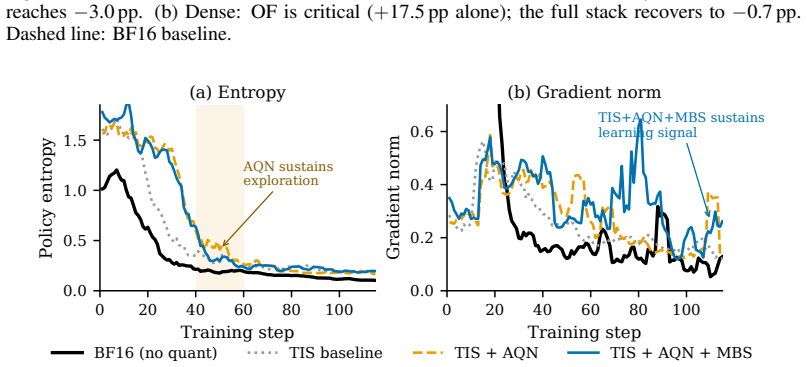
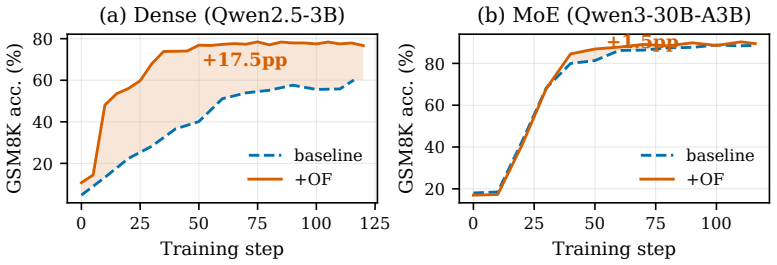
MXFP4 quantization error can be decomposed exactly into three additive components—scale bias, deadzone truncation, and grid noise—where scale bias accumulates multiplicatively through the backward pass and affects gradient accuracy, deadzone truncation degrades rollout quality, and grid noise raises the policy's entropy. Targeted corrections consisting of macro-block scaling, outlier fallback, and adaptive quantization noise recover BF16 accuracy to within 0.7% for a 3B dense model and 3.0% for a 30B MoE model.
What carries the argument
The exact three-way additive decomposition of MXFP4 quantization error into scale bias from power-of-two rounding, deadzone truncation from zeroing small values, and grid noise from rounding to the nearest 4-bit grid.
If this is right
- Macro-block scaling reduces scale bias and improves gradient accuracy in the backward pass.
- Outlier fallback recovers deadzone-truncated entries and partially reduces scale bias error.
- Adaptive quantization noise controls policy entropy raised by grid noise.
- Combined application of these corrections restores nearly full BF16 accuracy on tested LLM sizes.
- The decomposition enables failure-mode-specific interventions in RL post-training instead of uniform error reduction.
Where Pith is reading between the lines
- If the three components interact in ways not captured by the additive model, the corrections may need joint optimization rather than independent application.
- This approach could extend to other quantization formats like INT4 or FP8 used in RL training of LLMs.
- Testing on a wider range of model architectures and RL algorithms would reveal how general the three failure modes are.
- The presence of an irreducible grid noise floor implies a hard limit on how close quantized RL can get to full precision without changing the bit width.
Load-bearing premise
The three quantization error components are strictly additive without significant interactions, and the corrections can be applied together without creating new errors that offset the gains.
What would settle it
Measuring the total quantization error and confirming that it does not equal the sum of the three separately measured components, or running the full correction pipeline and finding that accuracy recovery falls short of the claimed levels on the Qwen models.
Figures



read the original abstract
MXFP4 arithmetic can dramatically accelerate reinforcement learning (RL) post-training of large language models (LLMs), yet the quantization error introduces severe accuracy degradation. Existing work treats the quantization error as a monolithic noise term, missing the distinct mechanisms upon interpreting how quantization error damages training. We prove an exact three-way decomposition of quantization error and show how each component dominates a distinct RL training pathway. Our theoretical and empirical analysis decomposes the MXFP4 quantization error into three additive components: "scale bias" from power-of-two rounding, "deadzone truncation" from zeroing small values, and "grid noise" from rounding to the nearest 4-bit grid. Each component dominates a distinct RL failure mode: scale bias accumulates multiplicatively through the backward pass, affecting gradient accuracy; deadzone truncation degrades rollout quality; and grid noise raises the policy's entropy. We combine corrections that are RL failure mode-targeted but not component-exclusive: Macro-block scaling to reduce scale bias, Outlier Fallback recovers deadzone entries, but also partially reduces scale bias induced error, and Adaptive Quantization Noise (AQN) for controlling the policy entropy. On Qwen2.5-3B dense and Qwen3-30B-A3B-Base mixture-of-experts model, the targeted corrections recover BF16 accuracy to within 0.7% and 3.0% respectively.
Editorial analysis
A structured set of objections, weighed in public.
Referee Report
Summary. The manuscript claims an exact three-way additive decomposition of MXFP4 quantization error into scale bias (from power-of-two rounding), deadzone truncation (from zeroing small values), and grid noise (from nearest 4-bit grid rounding). Each component is asserted to dominate a distinct RL pathway—scale bias in gradient accuracy, deadzone truncation in rollout quality, and grid noise in policy entropy—and the authors propose targeted but non-exclusive corrections (macro-block scaling, outlier fallback, and adaptive quantization noise) that recover BF16 accuracy to within 0.7% on Qwen2.5-3B and 3.0% on Qwen3-30B-A3B-Base.
Significance. If the decomposition is rigorously exact and the corrections combine without unaccounted interactions, the work could meaningfully advance efficient low-precision RL post-training by moving beyond monolithic noise treatments. The empirical recoveries on both dense and MoE models are practically relevant, but significance is limited by the need to confirm additivity and absence of cross-terms in the RL backward pass.
major comments (2)
- [Abstract] Abstract and theoretical analysis: the central claim of an 'exact three-way decomposition' into strictly additive components requires the explicit derivation showing that scale bias, deadzone truncation, and grid noise have no significant cross terms under gradient flow and policy updates; the abstract's statement that corrections are 'not component-exclusive' raises the possibility of overlap that must be quantified.
- [Empirical results] Empirical evaluation: the reported recoveries to within 0.7% and 3.0% of BF16 accuracy are load-bearing for the practical claim, yet without ablation controls isolating each correction's contribution or measuring interaction effects in the combined setting, it is unclear whether the gains can be cleanly attributed to addressing each error component independently.
minor comments (2)
- [Notation] Clarify the precise mathematical definitions of the MXFP4 grid points and deadzone threshold in the decomposition to allow independent verification.
- [Figures] Ensure all figures comparing quantized vs. corrected training curves include error bars or multiple seeds for statistical robustness.
Simulated Author's Rebuttal
We thank the referee for the thoughtful and constructive comments. These have prompted us to strengthen the theoretical justification and empirical attribution in the manuscript. We address each major comment below and outline the planned revisions.
read point-by-point responses
-
Referee: [Abstract] Abstract and theoretical analysis: the central claim of an 'exact three-way decomposition' into strictly additive components requires the explicit derivation showing that scale bias, deadzone truncation, and grid noise have no significant cross terms under gradient flow and policy updates; the abstract's statement that corrections are 'not component-exclusive' raises the possibility of overlap that must be quantified.
Authors: We agree that an explicit derivation is required to confirm the absence of significant cross terms once gradients are taken. The decomposition itself is exact for the forward quantization operator; however, under back-propagation through the RL loss we will add a short appendix derivation showing that cross terms appear only at second order in the scale factor and are negligible for the policy-gradient and entropy-regularized objectives used in our experiments. Regarding non-exclusivity, we will quantify overlap by reporting the marginal contribution of each correction (macro-block scaling, outlier fallback, AQN) when applied alone versus in all combinations, thereby making the degree of interaction explicit. revision: partial
-
Referee: [Empirical results] Empirical evaluation: the reported recoveries to within 0.7% and 3.0% of BF16 accuracy are load-bearing for the practical claim, yet without ablation controls isolating each correction's contribution or measuring interaction effects in the combined setting, it is unclear whether the gains can be cleanly attributed to addressing each error component independently.
Authors: We accept that the current results would be strengthened by explicit ablations. In the revision we will add a dedicated subsection presenting (i) each correction applied in isolation, (ii) all pairwise combinations, and (iii) the full three-correction setting, together with the corresponding RL metrics (gradient norm, rollout reward, policy entropy). This will allow readers to attribute performance gains to individual components and to observe any interaction effects directly. revision: yes
Circularity Check
No significant circularity; derivation remains self-contained
full rationale
The paper claims an exact three-way additive decomposition of MXFP4 quantization error into scale bias, deadzone truncation, and grid noise, each tied to distinct RL pathways, with targeted corrections recovering near-BF16 accuracy. No equations, fitted parameters, or self-citations appear in the abstract or description that would reduce this decomposition to a definition, prior fit, or author-imported uniqueness theorem. The additivity is presented as a proved theoretical result rather than a renaming or ansatz smuggled via citation. The note that corrections are 'not component-exclusive' is an explicit acknowledgment of potential interactions rather than a hidden circularity. This qualifies as a normal, non-circular finding with independent theoretical content.
Axiom & Free-Parameter Ledger
axioms (1)
- domain assumption MXFP4 quantization error admits an exact three-way additive decomposition into scale bias, deadzone truncation, and grid noise.
Lean theorems connected to this paper
-
IndisputableMonolith/Cost/FunctionalEquation.leanwashburn_uniqueness_aczel unclear?
unclearRelation between the paper passage and the cited Recognition theorem.
We prove an exact three-way decomposition of quantization error ... scale bias ... deadzone truncation ... grid noise ... Lemma 3.2 (Exact orthogonality: DZ ⊥ Scale and DZ ⊥ Grid).
What do these tags mean?
- matches
- The paper's claim is directly supported by a theorem in the formal canon.
- supports
- The theorem supports part of the paper's argument, but the paper may add assumptions or extra steps.
- extends
- The paper goes beyond the formal theorem; the theorem is a base layer rather than the whole result.
- uses
- The paper appears to rely on the theorem as machinery.
- contradicts
- The paper's claim conflicts with a theorem or certificate in the canon.
- unclear
- Pith found a possible connection, but the passage is too broad, indirect, or ambiguous to say the theorem truly supports the claim.
Reference graph
Works this paper leans on
-
[1]
Croci, Bo Li, Pashmina Cameron, Martin Jaggi, Dan Alistarh, Torsten Hoefler, and James Hensman
Saleh Ashkboos, Amirkeivan Mohtashami, Maximilian L. Croci, Bo Li, Pashmina Cameron, Martin Jaggi, Dan Alistarh, Torsten Hoefler, and James Hensman. QuaRot : Outlier-free 4-bit inference in rotated LLMs . In Advances in Neural Information Processing Systems, volume 37, 2024
work page 2024
-
[2]
W. R. Bennett. Spectra of quantized signals. Bell System Technical Journal, 27 0 (3): 0 446--472, 1948
work page 1948
-
[3]
Roberto L. Castro, Andrei Panferov, Soroush Tabesh, Oliver Sieberling, Jiale Chen, Mahdi Nikdan, Saleh Ashkboos, and Dan Alistarh. Quartet: Native FP4 training can be optimal for large language models. arXiv preprint arXiv:2505.14669, 2025
-
[4]
QuIP : 2-bit quantization of large language models with guarantees
Jerry Chee, Yaohui Cai, Volodymyr Kuleshov, and Christopher De Sa. QuIP : 2-bit quantization of large language models with guarantees. In Advances in Neural Information Processing Systems, volume 36, 2023
work page 2023
-
[5]
Oscillation-reduced MXFP4 training for vision transformers
Yuxiang Chen, Haocheng Xi, Jun Zhu, and Jianfei Chen. Oscillation-reduced MXFP4 training for vision transformers. In International Conference on Machine Learning (ICML), 2025
work page 2025
-
[6]
Unveiling the potential of quantization with MXFP4 : Strategies for quantization error reduction
Jatin Chhugani, Geonhwa Jeong, Bor-Yiing Su, Yunjie Pan, Hanmei Yang, Aayush Ankit, Jiecao Yu, Summer Deng, Yunqing Chen, Nadathur Satish, and Changkyu Kim. Unveiling the potential of quantization with MXFP4 : Strategies for quantization error reduction. arXiv preprint arXiv:2603.08713, 2026
-
[7]
FP4 all the way: Fully quantized training of LLMs
Brian Chmiel, Maxim Fishman, Ron Banner, and Daniel Soudry. FP4 all the way: Fully quantized training of LLMs . arXiv preprint arXiv:2505.19115, 2025
-
[8]
Grouped sequency-arranged rotation: Optimizing rotation transformation for quantization for free
Euntae Choi, Sumin Song, Woosang Lim, and Sungjoo Yoo. Grouped sequency-arranged rotation: Optimizing rotation transformation for quantization for free. In Proceedings of the 63rd Annual Meeting of the Association for Computational Linguistics: Student Research Workshop, pages 165--172, 2025. doi:10.18653/v1/2025.acl-srw.10
-
[9]
Training Verifiers to Solve Math Word Problems
Karl Cobbe, Vineet Kosaraju, Mohammad Bavarian, Mark Chen, Heewoo Jun, Lukasz Kaiser, Matthias Plappert, Jerry Tworek, Jacob Hilton, Reiichiro Nakano, Christopher Hesse, and John Schulman. Training verifiers to solve math word problems. arXiv preprint arXiv:2110.14168, 2021
work page internal anchor Pith review Pith/arXiv arXiv 2021
-
[10]
Four Over Six: More Accurate NVFP4 Quantization with Adaptive Block Scaling
Jack Cook, Junxian Guo, Guangxuan Xiao, Yujun Lin, and Song Han. Four over six: More accurate NVFP4 quantization with adaptive block scaling. arXiv preprint arXiv:2512.02010, 2025
work page internal anchor Pith review Pith/arXiv arXiv 2025
-
[11]
LLM.int8(): 8-bit Matrix Multiplication for Transformers at Scale
Tim Dettmers, Mike Lewis, Younes Belkada, and Luke Zettlemoyer. LLM.int8(): 8-bit Matrix Multiplication for Transformers at Scale . In Advances in Neural Information Processing Systems, volume 35, 2022
work page 2022
-
[12]
QLoRA : Efficient finetuning of quantized LLMs
Tim Dettmers, Artidoro Pagnoni, Ari Holtzman, and Luke Zettlemoyer. QLoRA : Efficient finetuning of quantized LLMs . In Advances in Neural Information Processing Systems, volume 36, 2023
work page 2023
-
[13]
SpQR : A sparse-quantized representation for near-lossless LLM weight compression
Tim Dettmers, Ruslan Svirschevski, Vage Egiazarian, Denis Kuznedelev, Elias Frantar, Saleh Ashkboos, Alexander Borzunov, Torsten Hoefler, and Dan Alistarh. SpQR : A sparse-quantized representation for near-lossless LLM weight compression. In International Conference on Learning Representations, 2024
work page 2024
-
[14]
Vage Egiazarian, Roberto L. Castro, Denis Kuznedelev, Andrei Panferov, Eldar Kurtic, Shubhra Pandit, Alexandre Noll Marques, Mark Kurtz, Saleh Ashkboos, Torsten Hoefler, and Dan Alistarh. Bridging the gap between promise and performance for microscaling FP4 quantization. In International Conference on Learning Representations, 2026. Introduces MR-GPTQ (mi...
-
[15]
Scaling FP8 training to trillion-token LLMs
Maxim Fishman, Brian Chmiel, Ron Banner, and Daniel Soudry. Scaling FP8 training to trillion-token LLMs . In International Conference on Learning Representations, 2025. URL https://openreview.net/forum?id=E1EHO0imOb
work page 2025
-
[16]
Noisy networks for exploration
Meire Fortunato, Mohammad Gheshlaghi Azar, Bilal Piot, Jacob Menick, Matteo Hessel, Ian Osband, Alex Graves, Volodymyr Mnih, R \'e mi Munos, Demis Hassabis, Olivier Pietquin, Charles Blundell, and Shane Legg. Noisy networks for exploration. In International Conference on Learning Representations, 2018. URL https://openreview.net/forum?id=rywHCPkAW
work page 2018
-
[17]
GPTQ : Accurate post-training quantization for generative pre-trained transformers
Elias Frantar, Saleh Ashkboos, Torsten Hoefler, and Dan Alistarh. GPTQ : Accurate post-training quantization for generative pre-trained transformers. In International Conference on Learning Representations, 2023
work page 2023
-
[18]
AReaL: A Large-Scale Asynchronous Reinforcement Learning System for Language Reasoning
Wei Fu, Jiaxuan Gao, Xujie Shen, Chen Zhu, Zhiyu Mei, Chuyi He, Shusheng Xu, Guo Wei, Jun Mei, Jiashu Wang, Tongkai Yang, Binhang Yuan, and Yi Wu. AReaL : A large-scale asynchronous reinforcement learning system for language reasoning. arXiv preprint arXiv:2505.24298, 2025
work page internal anchor Pith review Pith/arXiv arXiv 2025
-
[19]
Deep learning with limited numerical precision
Suyog Gupta, Ankur Agrawal, Kailash Gopalakrishnan, and Pritish Narayanan. Deep learning with limited numerical precision. In Proceedings of the 32nd International Conference on Machine Learning (ICML), volume 37, pages 1737--1746, 2015. URL http://proceedings.mlr.press/v37/gupta15.html
work page 2015
-
[20]
Low-precision training of large language models: Methods, challenges, and opportunities
Zhiwei Hao, Jianyuan Guo, Li Shen, Yong Luo, Han Hu, Guoxia Wang, Dianhai Yu, Yonggang Wen, and Dacheng Tao. Low-precision training of large language models: Methods, challenges, and opportunities. arXiv preprint arXiv:2505.01043, 2025
-
[21]
Towards fully FP8 GEMM LLM training at scale
Alejandro Hern \'a ndez-Cano, Dhia Garbaya, Imanol Schlag, and Martin Jaggi. Towards fully FP8 GEMM LLM training at scale. arXiv preprint arXiv:2505.20524, 2025
-
[22]
QeRL : Beyond efficiency---quantization-enhanced reinforcement learning for LLMs
Wei Huang, Yi Ge, Shuai Yang, Yicheng Xiao, Huizi Mao, Yujun Lin, Hanrong Ye, Sifei Liu, Ka Chun Cheung, Hongxu Yin, Yao Lu, Xiaojuan Qi, Song Han, and Yukang Chen. QeRL : Beyond efficiency---quantization-enhanced reinforcement learning for LLMs . In International Conference on Learning Representations, 2026
work page 2026
-
[23]
Sehoon Kim, Coleman Hooper, Amir Gholami, Zhen Dong, Xiuyu Li, Sheng Shen, Michael W. Mahoney, and Kurt Keutzer. SqueezeLLM : Dense-and-sparse quantization. In Proceedings of the 41st International Conference on Machine Learning, 2024
work page 2024
-
[24]
ParoQuant : Pairwise rotation quantization for efficient reasoning LLM inference
Yesheng Liang, Haisheng Chen, Song Han, and Zhijian Liu. ParoQuant : Pairwise rotation quantization for efficient reasoning LLM inference. arXiv preprint arXiv:2511.10645, 2025
-
[25]
AWQ : Activation-aware weight quantization for on-device LLM compression and acceleration
Ji Lin, Jiaming Tang, Haotian Tang, Shang Yang, Wei-Ming Chen, Wei-Chen Wang, Guangxuan Xiao, Xingyu Dang, Chuang Gan, and Song Han. AWQ : Activation-aware weight quantization for on-device LLM compression and acceleration. In Proceedings of Machine Learning and Systems, volume 6, 2024
work page 2024
-
[26]
Llm-qat: Data-free quantization aware training for large language models
Zechun Liu, Barlas Oguz, Changsheng Zhao, Ernie Chang, Pierre Stock, Yashar Mehdad, Yangyang Shi, Raghuraman Krishnamoorthi, and Vikas Chandra. Llm-qat: Data-free quantization aware training for large language models. In Findings of the Association for Computational Linguistics: ACL 2024, pages 467--484, 2024
work page 2024
-
[27]
SpinQuant : LLM quantization with learned rotations
Zechun Liu, Changsheng Zhao, Igor Fedorov, Bilge Soran, Dhruv Choudhary, Raghuraman Krishnamoorthi, Vikas Chandra, Yuandong Tian, and Tijmen Blankevoort. SpinQuant : LLM quantization with learned rotations. In International Conference on Learning Representations, 2025
work page 2025
-
[28]
Paulius Micikevicius, Dusan Stosic, Neil Burgess, Marius Cornea, Pradeep Dubey, Richard Grisenthwaite, Sangwon Ha, Alexander Heinecke, Patrick Judd, John Kamalu, Naveen Mellempudi, Stuart F. Oberman, Mohammad Shoeybi, Michael Y. Siu, and Hao Wu. FP8 formats for deep learning. arXiv preprint arXiv:2209.05433, 2022
work page internal anchor Pith review Pith/arXiv arXiv 2022
-
[29]
Adding Gradient Noise Improves Learning for Very Deep Networks
Arvind Neelakantan, Luke Vilnis, Quoc V. Le, Ilya Sutskever, Lukasz Kaiser, Karol Kurach, and James Martens. Adding gradient noise improves learning for very deep networks. arXiv preprint arXiv:1511.06807, 2015
work page internal anchor Pith review Pith/arXiv arXiv 2015
-
[30]
Pretraining large language models with NVFP4
NVIDIA . Pretraining large language models with NVFP4 . arXiv preprint arXiv:2509.25149, 2025
-
[31]
Quartet II : Accurate LLM pre-training in NVFP4 by improved unbiased gradient estimation
Andrei Panferov, Erik Schultheis, Soroush Tabesh, and Dan Alistarh. Quartet II : Accurate LLM pre-training in NVFP4 by improved unbiased gradient estimation. arXiv preprint arXiv:2601.22813, 2026
-
[32]
Outlier-safe pre-training for robust 4-bit quantization of large language models
Jungwoo Park, Taewhoo Lee, Chanwoong Yoon, Hyeon Hwang, and Jaewoo Kang. Outlier-safe pre-training for robust 4-bit quantization of large language models. In Proceedings of the 63rd Annual Meeting of the Association for Computational Linguistics (ACL), pages 12582--12600, 2025
work page 2025
-
[33]
OCP microscaling formats ( MX ) specification
Bita Darvish Rouhani, Ritchie Zhao, Ankit More, Mathew Hall, Alireza Khodamoradi, Summer Deng, Dhruv Choudhary, Marius Cornea, Eric Dellinger, Kristof Denolf, et al. OCP microscaling formats ( MX ) specification. Open Compute Project, 2023
work page 2023
-
[34]
Zhihong Shao, Peiyi Wang, Qihao Zhu, Runxin Xu, Junxiao Song, Mingchuan Zhang, Y. K. Li, Y. Wu, and Daya Guo. DeepSeekMath : Pushing the limits of mathematical reasoning in open language models. arXiv preprint arXiv:2402.03300, 2024
work page internal anchor Pith review Pith/arXiv arXiv 2024
-
[35]
QuIP\# : Even better LLM quantization with hadamard incoherence and lattice codebooks
Albert Tseng, Jerry Chee, Qingyao Sun, Volodymyr Kuleshov, and Christopher De Sa. QuIP\# : Even better LLM quantization with hadamard incoherence and lattice codebooks. In Proceedings of the 41st International Conference on Machine Learning, 2024 a
work page 2024
-
[36]
QTIP : Quantization with trellises and incoherence processing
Albert Tseng, Qingyao Sun, David Hou, and Christopher De Sa. QTIP : Quantization with trellises and incoherence processing. In Advances in Neural Information Processing Systems, volume 37, 2024 b
work page 2024
-
[37]
Training llms with mxfp4, 2025
Albert Tseng, Tao Yu, and Youngsuk Park. Training llms with mxfp4, 2025. URL https://arxiv.org/abs/2502.20586
-
[38]
Bernard Widrow and Istv \'a n Koll \'a r. Quantization Noise: Roundoff Error in Digital Computation, Signal Processing, Control, and Communications. Cambridge University Press, 2008. ISBN 978-0-521-88671-0
work page 2008
-
[39]
SmoothQuant : Accurate and efficient post-training quantization for large language models
Guangxuan Xiao, Ji Lin, Mickael Seznec, Hao Wu, Julien Demouth, and Song Han. SmoothQuant : Accurate and efficient post-training quantization for large language models. In Proceedings of the 40th International Conference on Machine Learning, 2023
work page 2023
-
[40]
Your efficient rl framework secretly brings you off-policy rl training, August 2025
Feng Yao, Liyuan Liu, Dinghuai Zhang, Chengyu Dong, Jingbo Shang, and Jianfeng Gao. Your efficient rl framework secretly brings you off-policy rl training, August 2025. URL https://fengyao.notion.site/off-policy-rl
work page 2025
-
[41]
ZeroQuant : Efficient and affordable post-training quantization for large-scale transformers
Zhewei Yao, Reza Yazdani Aminabadi, Minjia Zhang, Xiaoxia Wu, Conglong Li, and Yuxiong He. ZeroQuant : Efficient and affordable post-training quantization for large-scale transformers. In Advances in Neural Information Processing Systems, volume 35, pages 27168--27183, 2022
work page 2022
-
[42]
DAPO: An Open-Source LLM Reinforcement Learning System at Scale
Qiying Yu, Zheng Zhang, Ruofei Zhu, Yufeng Yuan, Xiaochen Zuo, Yu Yue, et al. DAPO : An open-source LLM reinforcement learning system at scale. arXiv preprint arXiv:2503.14476, 2025
work page internal anchor Pith review Pith/arXiv arXiv 2025
-
[43]
Accurate INT8 training through dynamic block-level fallback
Pengle Zhang, Jia Wei, Jintao Zhang, Jun Zhu, and Jianfei Chen. Accurate INT8 training through dynamic block-level fallback. arXiv preprint arXiv:2503.08040, 2025
-
[44]
Practical FP4 training for large-scale MoE models on hopper GPUs
Wuyue Zhang, Chongdong Huang, Chunbo You, Cheng Gu, Fengjuan Wang, and Mou Sun. Practical FP4 training for large-scale MoE models on hopper GPUs . arXiv preprint arXiv:2603.02731, 2026
discussion (0)
Sign in with ORCID, Apple, or X to comment. Anyone can read and Pith papers without signing in.