Excitation-Energy-Selective Control of Hot-Carrier Cooling via a Resonant Optical-Phonon Bottleneck in Graphene
Pith reviewed 2026-05-21 06:43 UTC · model grok-4.3
The pith
Hot carriers in graphene cool an order of magnitude slower when excited by photons between 0.42 and 0.48 eV due to a resonant optical-phonon bottleneck.
A machine-rendered reading of the paper's core claim, the machinery that carries it, and where it could break.
Core claim
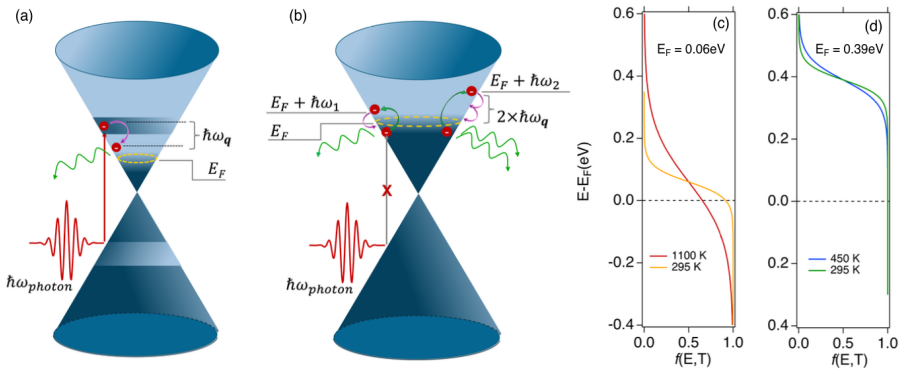
Within a narrow spectral window of 0.42 to 0.48 eV the carrier lifetime increases by an order of magnitude relative to the few-picosecond cooling observed at other energies. This anomalous slowdown originates from a resonant enhancement of the optical-phonon lifetime that produces accumulation and reabsorption of hot optical phonons, thereby suppressing energy transfer to the lattice. All measured behaviors are reproduced inside a unified carrier-phonon energy-balance framework in which excitation-energy-dependent changes in the effective optical-phonon decay pathway control the cooling rate.
What carries the argument
Resonant optical-phonon bottleneck that lengthens phonon lifetime, causes hot-phonon accumulation, and enables reabsorption by carriers.
If this is right
- Hot-carrier lifetime can be extended selectively by tuning excitation photon energy into the 0.42-0.48 eV window.
- The effective optical-phonon decay channel changes with excitation energy and thereby sets the cooling rate.
- Energy transfer from carriers to the lattice is suppressed when hot phonons are reabsorbed.
- The same energy-balance model unifies the dynamics across the full 0.22-0.73 eV range studied.
Where Pith is reading between the lines
- Device designs that rely on prolonged hot-carrier effects could deliberately use this narrow excitation window to reduce lattice heating.
- Analogous resonant phonon bottlenecks may appear in other two-dimensional materials at energies set by their optical-phonon frequencies.
- Varying the substrate or adding electrostatic gating could shift the resonance window and test the phonon-decay pathway picture.
Load-bearing premise
The non-monotonic energy dependence and lifetime jump arise from resonant lengthening of the optical-phonon lifetime and reabsorption rather than from measurement artifacts or other unaccounted mechanisms in the mid-IR pump and THz probe experiment.
What would settle it
Direct time-resolved measurement of optical-phonon population at 0.45 eV excitation that shows no increase in phonon lifetime or accumulation while carrier cooling remains slow would rule out the resonant-bottleneck explanation.
Figures



read the original abstract
Understanding and controlling hot-carrier relaxation in graphene is crucial for advancing ultrafast optoelectronic and terahertz technologies. Here, we investigate carrier cooling dynamics in monolayer and bilayer graphene using mid-infrared pump pulses (0.22-0.73 eV) and terahertz probe pulses. We uncover a pronounced, reproducible, and non-monotonic dependence of the carrier relaxation time on excitation photon energy. Remarkably, within a narrow spectral window (0.42 to 0.48 eV), the carrier lifetime increases by an order of magnitude compared to a few picosecond-scale cooling observed at other energies. We show that this anomalous slowdown originates from a resonant enhancement of the optical-phonon lifetime, causing accumulation and reabsorption of hot optical phonons that suppress energy transfer to the lattice. All observed behaviors are captured within a unified carrier-phonon energy-balance framework, where excitation-energy-dependent variations of the effective optical-phonon decay pathway govern the cooling dynamics. These findings demonstrate excitation-energy-selective control of hot-carrier relaxation in graphene and provide new insight into non-equilibrium carrier-phonon interactions near the optical-phonon bottleneck.
Editorial analysis
A structured set of objections, weighed in public.
Referee Report
Summary. The manuscript reports mid-IR pump (0.22-0.73 eV) and THz probe experiments on monolayer and bilayer graphene that reveal a reproducible, non-monotonic dependence of hot-carrier relaxation time on excitation energy. Within the narrow window 0.42-0.48 eV the lifetime increases by an order of magnitude relative to the few-picosecond cooling seen elsewhere; the authors attribute this to resonant enhancement of the optical-phonon lifetime that produces hot-phonon accumulation and reabsorption, thereby suppressing energy transfer to the lattice. All observations are stated to be captured by a single carrier-phonon energy-balance framework in which the effective optical-phonon decay pathway is excitation-energy dependent.
Significance. If the mechanism is confirmed, the work supplies a concrete route to excitation-energy-selective control of hot-carrier cooling in graphene, with direct relevance to ultrafast optoelectronics and THz devices. The experimental observation of the pronounced non-monotonic feature and the construction of a unified framework that reproduces the full data set constitute the principal strengths.
major comments (2)
- The central claim that the order-of-magnitude lifetime increase originates uniquely from resonant optical-phonon lifetime enhancement and subsequent reabsorption is load-bearing. The manuscript must explicitly demonstrate that energy-dependent experimental factors (initial carrier density, absorption cross-section, or THz-probe sensitivity to different hot-carrier distributions) do not produce the observed peak; without such controls or quantitative modeling the attribution remains an assumption whose failure would undermine the selective-control conclusion.
- In the carrier-phonon energy-balance framework the effective optical-phonon decay pathway is introduced as an excitation-energy-dependent quantity that is adjusted to reproduce the non-monotonic lifetimes. Because this constitutes the sole free parameter listed in the model, the manuscript should provide independent justification (e.g., comparison to measured or calculated phonon-decay rates outside the fitting window) rather than relying on post-hoc variation to fit the data.
minor comments (2)
- The abstract states that the lifetime increase occurs 'within a narrow spectral window (0.42 to 0.48 eV)' but does not report the experimental energy resolution or uncertainty on these bounds; adding this information would strengthen the reproducibility claim.
- Figure captions and axis labels should explicitly indicate whether the plotted relaxation times are extracted from single-exponential fits or from a more detailed model, and whether error bars represent statistical or systematic uncertainty.
Simulated Author's Rebuttal
We are grateful to the referee for the detailed and insightful comments on our manuscript. The points raised help to clarify the robustness of our conclusions regarding the resonant optical-phonon bottleneck in graphene. Below we provide point-by-point responses to the major comments, and we will incorporate revisions to address them.
read point-by-point responses
-
Referee: The central claim that the order-of-magnitude lifetime increase originates uniquely from resonant optical-phonon lifetime enhancement and subsequent reabsorption is load-bearing. The manuscript must explicitly demonstrate that energy-dependent experimental factors (initial carrier density, absorption cross-section, or THz-probe sensitivity to different hot-carrier distributions) do not produce the observed peak; without such controls or quantitative modeling the attribution remains an assumption whose failure would undermine the selective-control conclusion.
Authors: We acknowledge the importance of ruling out potential experimental artifacts. In our carrier-phonon energy-balance model, the initial carrier density is calculated based on the absorbed pump energy, which depends on the excitation energy through the absorption coefficient. To address this explicitly, we will add in the revised manuscript a dedicated section and supplementary figures that quantify the initial carrier density and hot-carrier distribution for each excitation energy, normalized to the same absorbed fluence where possible. Additionally, we have modeled the THz probe sensitivity assuming different carrier temperatures and distributions, demonstrating that the observed lifetime enhancement cannot be explained by these factors alone. The non-monotonic feature emerges only when the optical-phonon decay time is allowed to vary resonantly. These quantitative controls will be included to strengthen the attribution. revision: yes
-
Referee: In the carrier-phonon energy-balance framework the effective optical-phonon decay pathway is introduced as an excitation-energy-dependent quantity that is adjusted to reproduce the non-monotonic lifetimes. Because this constitutes the sole free parameter listed in the model, the manuscript should provide independent justification (e.g., comparison to measured or calculated phonon-decay rates outside the fitting window) rather than relying on post-hoc variation to fit the data.
Authors: We agree that independent justification for the energy dependence of the effective optical-phonon decay is necessary. The variation is physically motivated by the resonance condition when the excitation energy matches twice the optical phonon energy or enables specific scattering channels leading to longer-lived phonons. In the revised manuscript, we will include a new figure and discussion comparing the fitted effective decay rates to independent literature values and theoretical calculations of optical phonon lifetimes in graphene as a function of energy or momentum. Outside the narrow window of 0.42-0.48 eV, our fitted values align well with reported decay times of approximately 1-2 ps, while within the window they increase significantly, consistent with the bottleneck effect. This comparison provides the requested justification beyond the fit to our data. revision: yes
Circularity Check
No significant circularity; experimental observation drives the claim with independent model framework
full rationale
The paper reports a direct experimental finding of non-monotonic carrier lifetime versus excitation energy in mid-IR pump THz probe measurements on graphene, with the order-of-magnitude slowdown isolated to the 0.42-0.48 eV window. The carrier-phonon energy-balance framework is invoked only to unify and attribute the observed behaviors to excitation-energy-dependent optical-phonon decay pathways after the data are presented. No quoted equation or step reduces the central result to a fitted parameter by construction, a self-citation chain, or a renamed ansatz; the framework remains an interpretive overlay whose parameters are not shown to be adjusted post-hoc to force the resonance interpretation. The derivation chain is therefore self-contained against the external experimental benchmark.
Axiom & Free-Parameter Ledger
free parameters (1)
- effective optical-phonon decay pathway
axioms (1)
- domain assumption Carrier-phonon energy-balance framework accurately describes the system
Lean theorems connected to this paper
-
IndisputableMonolith/Cost/FunctionalEquation.leanwashburn_uniqueness_aczel unclear?
unclearRelation between the paper passage and the cited Recognition theorem.
The ultrafast carrier dynamics are modeled using an extended two-temperature model that explicitly accounts for a non-equilibrium population of strongly coupled optical phonons... Ce dTe/dt = S(t) − Ge-op(Te − Top) − Gbg(Te − Tl), Cop dTop/dt = Ge-op(Te − Top) − Cop/τop (Top − Tl)
-
IndisputableMonolith/Foundation/RealityFromDistinction.leanreality_from_one_distinction unclear?
unclearRelation between the paper passage and the cited Recognition theorem.
All observed behaviors are captured within a unified carrier-phonon energy-balance framework, where excitation-energy-dependent variations of the effective optical-phonon decay pathway govern the cooling dynamics.
What do these tags mean?
- matches
- The paper's claim is directly supported by a theorem in the formal canon.
- supports
- The theorem supports part of the paper's argument, but the paper may add assumptions or extra steps.
- extends
- The paper goes beyond the formal theorem; the theorem is a base layer rather than the whole result.
- uses
- The paper appears to rely on the theorem as machinery.
- contradicts
- The paper's claim conflicts with a theorem or certificate in the canon.
- unclear
- Pith found a possible connection, but the passage is too broad, indirect, or ambiguous to say the theorem truly supports the claim.
Reference graph
Works this paper leans on
-
[1]
Bonaccorso, F., Sun, Z., Hasan, T. and Ferrari, A. C. Graphene photonics and optoelectronics. Nat. Photonics 4, 611-622 (2010)
work page 2010
-
[2]
Wang, F., Zhang, Y., Tian, C., Girit, C., Zettl, A., Crommie, M., and Shen, Y. R. Gate-variable optical transitions in graphene. Science 320, 206-209 (2008)
work page 2008
-
[3]
Basov, D. N., Fogler, M. M., & Garc \' a de Abajo, F. J. Polaritons in van der Waals materials. Science 354, aag1992 (2016)
work page 2016
-
[4]
Novoselov, K. S., Geim, A. K., Morozov, S. V., Jiang D., Zhang Y., Dubonos S. V., Grigorieva I. V., and Firsov, A. A. Electric field effect in atomically thin carbon films. Science 306, 666-669 (2004)
work page 2004
-
[5]
Castro Neto, A. H., Guinea, F., Peres, N. M. R., Novoselov, K. S. and Geim, A. K. The electronic properties of graphene. Rev. Mod. Phys. 81, 109-162 (2009)
work page 2009
-
[6]
Das Sarma, S., Adam, S., Hwang, E. H., and Rossi, E. Electronic transport in two-dimensional graphene. Rev. Mod. Phys. 83, 407-470 (2011)
work page 2011
-
[7]
P., Ropers, C., Knorr, A., and Elsaesser, T
Breusing, M., Kuehn, S., Winzer, T., Mali \'c , E., Milde, F., Severin, N., Rabe, J. P., Ropers, C., Knorr, A., and Elsaesser, T. Ultrafast nonequilibrium carrier dynamics in a single graphene layer. Phys. Rev. B 83, 153410 (2011)
work page 2011
-
[8]
C., Ulstrup, S., Cilento, F., Crepaldi, A., Zacchigna, M., Cacho, C., Turcu, I
Johannsen, J. C., Ulstrup, S., Cilento, F., Crepaldi, A., Zacchigna, M., Cacho, C., Turcu, I. C. E., Springate, E., Fromm, F., Raidel, C., Seyller, T., Parmigiani, F., Grioni, M., and Hofmann, P. Direct view of hot carrier dynamics in graphene. Phys. Rev. Lett. 111, 027403 (2013)
work page 2013
-
[9]
C., Mitrano, M., Cacho, C., and Turcu I
Gierz, I., Petersen, J. C., Mitrano, M., Cacho, C., and Turcu I. C. E. Snapshots of non-equilibrium Dirac carrier distributions in graphene. Nat. Mater. 12, 1119-1124 (2013)
work page 2013
-
[10]
Lazzeri, M. and Mauri, F. Nonadiabatic Kohn anomaly in a doped graphene monolayer. Phys. Rev. Lett. 97, 266407 (2006)
work page 2006
-
[11]
Phonon anharmonicities in graphite and graphene
Bonini N., Lazzeri M., Marzari N., and Mauri F. Phonon anharmonicities in graphite and graphene. Phys. Rev. Lett. 99, 176802 (2007)
work page 2007
-
[12]
Bistritzer R., and MacDonald A. H. Electronic cooling in graphene. Phys. Rev. Lett. 102, 206410 (2009)
work page 2009
-
[13]
Viljas, J. K. and Heikkil \"a , T. T. Electron-phonon heat transfer in monolayer and bilayer graphene. Phys. Rev. B 81, 245404 (2010)
work page 2010
-
[14]
Kampfrath, T., Perfetti, L., Schapper, F., Frischkorn C., and Wolf M. Strongly Coupled Optical Phonons in the Ultrafast Dynamics of the Electronic Energy and Current Relaxation in Graphite. Phys. Rev. Lett. 95, 187403 (2005)
work page 2005
-
[15]
A., Schneider, H., and Helm, M
Winnerl, S., Orlita, M., Plochocka, P., Kossacki, P., Potemski, M., Winzer, T., Malic, E., Knorr, A., Sprinkle, M., Berger, C., de Heer, W. A., Schneider, H., and Helm, M. Carrier relaxation in epitaxial graphene photoexcited near the Dirac point. Phys. Rev. Lett. 107, 237401 (2011)
work page 2011
-
[16]
Ulbricht, R., Hendry, E., Shan, J., Heinz, T. F., and Bonn M. Carrier dynamics in semiconductors studied with time-resolved terahertz spectroscopy. Rev. Mod. Phys. 83, 543-586 (2011)
work page 2011
-
[17]
M., Shivaraman, S., Chandrashekhar, M., Rana, F., and Spencer, M
Dawlaty, J. M., Shivaraman, S., Chandrashekhar, M., Rana, F., and Spencer, M. G. Measurement of ultrafast carrier dynamics in epitaxial graphene. Appl. Phys. Lett. 92, 042116 (2008)
work page 2008
-
[18]
Tielrooij, K. J., Song, J. C. W., Jensen, S. A., Centeno, A., Pesquera, A., Zurutuza Elorza, A., Bonn, M., Levitov, L. S. and Koppens, F. H. L. Photoexcitation cascade and multiple hot-carrier generation in graphene. Nat. Phys. 9, 248-252 (2013)
work page 2013
-
[19]
Sharma S., Myers-Ward R. L., Gaskill K. D., and Chatzakis I. Ultrafast hot-carrier cooling in quasi-freestanding bilayer graphene with hydrogen intercalated atoms. Nanoscale Adv. 5, 485 (2023)
work page 2023
-
[20]
Shi S.-F., Tang T.-T., Zeng B., Ju L., Zhou Q., Zettl A., and Wang F. Controlling Graphene Ultrafast Hot Carrier Response from Metal-like to Semiconductor-like by Electrostatic Gating. Nano Lett. 14, 1578-1582 (2014)
work page 2014
-
[21]
Tomadin, A., Hornett, S. M., Wang, H. I., Alexeev E. M., Candini A., Coletti C., Turchinovich D., Kl \"a ui, M., Bonn, M., Koppens, F. H. L., Hendry, E., Polini, M., and Tielrooij, K. J. The ultrafast dynamics and conductivity of photoexcited graphene at different Fermi energies. Sci. Adv. 4, eaar5313 (2018)
work page 2018
-
[22]
Jnawali, G., Rao, Y., Yan, H., and Heinz, T. F. Observation of a Transient Decrease in Terahertz Conductivity of Single-Layer Graphene Induced by Ultrafast Optical Excitation. Nano Lett. 13, 524-530 (2013)
work page 2013
-
[23]
Frenzel, A. J., Lui, C. H., Shin, Y. C., Kong, J., and Gedik, N. Semiconducting-to-metallic photoconductivity crossover and temperature-dependent Drude weight in graphene. Phys. Rev. Lett. 113, 056602 (2014)
work page 2014
-
[24]
Hale, P. J., Hornett, S. M., Moger, J., Horsell, D. W., and Hendry, E. Hot phonon decay in supported and suspended exfoliated graphene. Phys. Rev. B 83, 121404 (2011)
work page 2011
-
[25]
A., Strait, J., Dawlaty, J., Shivaraman, S., Chandrashekhar, M., Rana, F., and Spencer, M
George, P. A., Strait, J., Dawlaty, J., Shivaraman, S., Chandrashekhar, M., Rana, F., and Spencer, M. G. Ultrafast Optical-Pump Terahertz-Probe Spectroscopy of the Carrier Relaxation and Recombination Dynamics in Epitaxial Graphene. Nano Lett. 8, 4248-4251 (2008)
work page 2008
-
[26]
Hwang, Sharly Fleischer, Nathaniel C
Harold Y. Hwang, Sharly Fleischer, Nathaniel C. Brandt, Bradford G. Perkins Jr., Mengkun Liu, Kebin Fan, Aaron Sternbach, Xin Zhang, Richard D. Averitt, and Keith A. Nelson, A review of nonlinear terahertz spectroscopy of solids. J. Mod. Opt. 62, 1447-1479 (2015)
work page 2015
-
[27]
Dong Sun, Zong-Kwei Wu, Charles Divin, Xuebin Li, Claire Berger, Walt A. de Heer, Phillip N. First, and Theodore B. Norris, Ultrafast Relaxation of Excited Dirac Fermions in Epitaxial Graphene Using Optical Differential Transmission Spectroscopy Phys. Rev. Lett. 101, 157402 (2008)
work page 2008
-
[28]
Impact of Auger processes on carrier dynamics in graphene
Winzer, T., and Mali \'c , E. Impact of Auger processes on carrier dynamics in graphene. Phys. Rev. B 85, 241404 (2012)
work page 2012
-
[29]
C., Schmalian, J., and Wang, J
Li, T., Luo, L., Hupalo, M., Zhang, J., Tringides, M. C., Schmalian, J., and Wang, J. Femtosecond population inversion and stimulated emission of dense Dirac fermions in graphene. Phys. Rev. Lett. 108, 167401 (2012)
work page 2012
-
[30]
Tomadin, A., Brida, D., Cerullo, G., Ferrari, A. C. and Polini, M. Nonequilibrium dynamics of photoexcited electrons in graphene. Phys. Rev. B 88, 035430 (2013)
work page 2013
-
[31]
red same as cite\ Tielrooij\ = (18) Tielrooij, K. J., Song, J. C. W., Jensen, S. A., Centeno, A., Pesquera, A., Zurutuza Elorza, A., Bonn, M., Levitov, L. S. and Koppens, F. H. L
-
[32]
H., Wang, H., Shivaraman, S., Shields, V., Spencer, M
Strait, J. H., Wang, H., Shivaraman, S., Shields, V., Spencer, M. and Rana, F. Very slow cooling dynamics of photoexcited carriers in graphene observed by optical-pump terahertz-probe spectroscopy. Nano Lett. 11, 4902-4906 (2011)
work page 2011
-
[33]
A., Mics, Z., Ivanov, I., Varol, H
Jensen, S. A., Mics, Z., Ivanov, I., Varol, H. S., Turchinovich, D., Koppens, F. H. L., Bonn, M., and Tielrooij, K. J. Competing ultrafast energy relaxation pathways in photoexcited graphene. Nano Lett. 14, 5839-5845 (2014)
work page 2014
-
[34]
Docherty, C. J., Lin, C.-T., Joyce, H. J., Nicholas, R. J., Herz, L. M., Li, L.-J., and Johnston, M. B. Extreme sensitivity of graphene photoconductivity to environmental gases. Nat. Commun. 3, 1228 (2012)
work page 2012
-
[35]
Tse, W.-K. and Das Sarma, S. Energy relaxation of hot Dirac fermions in graphene. Phys. Rev. B 79, 235406 (2009)
work page 2009
-
[36]
Song, J. C. W., Reizer, M. Y., and Levitov, L. S. Disorder-assisted electron-phonon scattering and cooling pathways in graphene. Phys. Rev. Lett. 109, 106602 (2012)
work page 2012
-
[37]
Graham, M. W., Shi, S.-F., Ralph, D. C., Park, J., and McEuen, P. L. Photocurrent measurements of supercollision cooling in graphene. Nat. Phys. 9, 103-108 (2013)
work page 2013
-
[38]
Gabor, N. M., Song, J. C. W., Ma, Q., Nair, N. L., Taychatanapat, T., Watanabe, K., Taniguchi, T., Levitov, L. S., and Jarillo-Herrero, P. Hot carrier-assisted intrinsic photoresponse in graphene. Science 334, 648-652 (2011)
work page 2011
-
[39]
J., Piatkowski, L., Massicotte, M., Woessner, A., Ma, Q., Lee, Y., Myhro, K
Tielrooij, K. J., Piatkowski, L., Massicotte, M., Woessner, A., Ma, Q., Lee, Y., Myhro, K. S., Lau, C. N., Jarillo-Herrero, P., van Hulst, N. F., and Koppens, F. H. L. Generation of photovoltage in graphene on a femtosecond timescale through efficient carrier heating. Nat. Nanotechnol. 10, 437-443 (2015)
work page 2015
-
[40]
Mihnev, M. T., Kadi, F., Divin, C. J., Winzer, T., Lee, S., Liu, C.-H., Zhong Z., Berger, C., de Heer, W. A., Malic, E., Knorr, A., and Norris, T. B. Microscopic origins of the terahertz carrier relaxation and cooling dynamics in graphene. Nat. Comms. 7, 11617 (2016)
work page 2016
-
[41]
Energy Gap Interpretation of Experiments on Infrared Transmission through Superconducting Films
Tinkham, M. Energy Gap Interpretation of Experiments on Infrared Transmission through Superconducting Films. Phys. Rev. 104, 845-846 (1956)
work page 1956
-
[42]
Allen, P. B. Theory of thermal relaxation of electrons in metals. Phys. Rev. Lett. 59, 1460-1463 (1987)
work page 1987
-
[43]
A., Lisowski, M., Bovensiepen, U., Eisaki, H., and Wolf, M
Perfetti, L., Loukakos, P. A., Lisowski, M., Bovensiepen, U., Eisaki, H., and Wolf, M. Ultrafast Electron Relaxation in Superconducting Bi _ 2 Sr _ 2 CaCu _ 2 O _ 8+ by Time-Resolved Photoelectron Spectroscopy. Phys. Rev. Lett. 99, 197001 (2007)
work page 2007
-
[44]
Ishida, Y., Masuda, H., Sakai, H., Ishiwata, S., and Shin, S. Revealing the ultrafast light-to-matter energy conversion before heat diffusion in a layered Dirac semimetal. Phys. Rev. B 93, 100302 (2016)
work page 2016
-
[45]
Anisimov, S. I., Kapeliovich, B. L., and Perelman, T. L. Electron emission from metal surfaces exposed to ultrashort laser pulses. Sov. JETP 39, 375-377 (1974)
work page 1974
-
[46]
Chatzakis I., Electron temperature dependence of the electron-phonon coupling strength in double-wall carbon nanotubes. App. Phys. Let. 103, 043110 (2013)
work page 2013
-
[47]
Nair R. R., Blake P., Grigorenko A. N., Novoselov K. S., Booth T. J., Stauber T., Peres N. M. R., and Geim A. K. Fine structure constant defines visual transparency of graphene. Science 320, 1308 (2008)
work page 2008
-
[48]
Mak, K. F., Sfeir, M. Y., Misewich, J. A. and Heinz, T. F. The evolution of electronic structure in few-layer graphene revealed by optical spectroscopy. Proc. Natl Acad. Sci. USA 107, 14999-15004 (2010)
work page 2010
-
[49]
Mak, K. F., Sfeir, M. Y., Misewich, J. A., and Heinz, T. F. The evolution of electronic structure in few-layer graphene revealed by optical spectroscopy. Proc. Natl Acad. Sci. 107, 14999-15004 (2010)
work page 2010
-
[50]
G. Coslovich, R. P. Smith, S.-F. Shi, J. H. Buss, J. T. Robinson, F. Wang, and R. A. Kaindl, Ultrabroadband THz conductivity of gated graphene in- and out-of-equilibrium. Sci Rep. 15, 13935 (2025)
work page 2025
-
[51]
Sfeir, Yang Wu, Chun Hung Lui, James A
Kin Fai Mak, Matthew Y. Sfeir, Yang Wu, Chun Hung Lui, James A. Misewich, and Tony F. Heinz. Measurement of the Optical Conductivity of Graphene. Phys. Rev. Lett. 101, 196405 (2008)
work page 2008
-
[52]
Mak, K. F., Sfeir, M. Y., Wu, Y., Lui, C. H., Misewich, J. A., and Heinz, T. F. Measurement of the Optical Conductivity of Graphene. Phys. Rev. Lett. 101, 196405 (2008)
work page 2008
-
[53]
Chatzakis, I., Yan, H., Song, D., Berciaud, S., and Heinz , T. F. Temperature dependence of the anharmonic decay of optical phonons in carbon nanotubes and graphite. Phys. Rev. B 83, 205411 (2011)
work page 2011
-
[54]
S., Riedl, C., Krauss, B., von Klitzing, K., Starke, U., and Smet, J
Lee, D. S., Riedl, C., Krauss, B., von Klitzing, K., Starke, U., and Smet, J. H. Raman Spectra of Epitaxial Graphene on SiC and of Epitaxial Graphene Transferred to SiO2. Nano Lett. 8, 4320-4325 (2008)
work page 2008
-
[55]
Daniels, K. M., Jadidi, M. M., Sushkov, A. B., Nath, A., Boyd, A. K., Sridhara, K., Drew, H. D., Murphy, T. E., Myers-Ward, R. L., and Gaskill, D. K. Narrow Plasmon Resonances Enabled by Quasi-Freestanding Bilayer Epitaxial Graphene. 2D Mater. 4, 025034 (2017)
work page 2017
-
[56]
J., Ostler, M., Raidel, C., Wanke, M., Vasiliauskas, R., Yakimova, R., and Seyller, T
Mammadov, S., Ristein, J., Koch, R. J., Ostler, M., Raidel, C., Wanke, M., Vasiliauskas, R., Yakimova, R., and Seyller, T. Polarization Doping of Graphene on Silicon Carbide. 2D Mater. 1, 35003 (2014)
work page 2014
-
[57]
Riedl, C., Coletti, C., Iwasaki, T., Zakharov, A. A., and Starke, U. Quasi-Free-Standing Epitaxial Graphene on SiC Obtained by Hydrogen Intercalation. Phys. Rev. Lett. 103, 246804 (2009)
work page 2009
-
[58]
C., Grubi s i \'c - C abo, A., Yin, Y
Kotsakidis, J. C., Grubi s i \'c - C abo, A., Yin, Y. F., Tadich, A., Myers-Ward, R. L., DeJarld, M., Pavunny, S. P., Currie, M., Daniels, K. M., Liu, C., Edmonds, M. T., Medhekar, N. V., Gaskill, D. K., Vázquez de Parga, A. L., and Fuhrer, M. S. Freestanding N-Doped Graphene via Intercalation of Calcium and Magnesium into the Buffer Layer-SiC(0001) Inter...
work page 2020
-
[59]
Bistritzer, R., and MacDonald, A. H. Electronic cooling in graphene. Phys. Rev. Lett. 102, 206410 (2009)
work page 2009
-
[60]
Song, J. C. W., Reizer, M. Y., and Levitov L. S. Disorder-assisted electron-phonon scattering and cooling pathways in graphene. Phys. Rev. Lett. 109, 106602 (2012)
work page 2012
-
[61]
Sun, D., Wu, Z.-K., Divin, C., Li, X., Berger, C., de Heer, W. A., First, P. N., and Norris, T. B. Ultrafast Relaxation of Excited Dirac Fermions in Epitaxial Graphene Using Optical Differential Transmission Spectroscopy. Phys. Rev. Lett. 101, 157402 (2008)
work page 2008
-
[62]
Kabanov, V. V., and Alexandrov, A. S. Electron relaxation in metals: Theory and exact analytical solutions. Phys. Rev. B 78, 174514 (2008)
work page 2008
-
[63]
Kailath, T. Linear Systems. Prentice-Hall, Inc., Englewood Cliffs, N.J. 07632 (1980)
work page 1980
-
[64]
Zill, D. G., and Cullen, M. R. Differential Equations with Boundary-Value Problems. Cengage Learning, Boston (2013)
work page 2013
-
[65]
Chatzakis I., Yan, H., Song D., Berciaud S., and Heinz T. F. Temperature dependence of the anharmonic decay of optical phonons in carbon nanotubes and graphite. Phys. Rev. B 83, 205411 (2011)
work page 2011
-
[66]
Li, X. et al. Ultrafast carrier dynamics in graphene under high-field excitation. Phys. Rev. B 90, 165429 (2014)
work page 2014
discussion (0)
Sign in with ORCID, Apple, or X to comment. Anyone can read and Pith papers without signing in.