NeSST: A Python Tool for Neutron Spectra and Synthetic Diagnostics in Inertial Confinement Fusion
Pith reviewed 2026-05-21 07:09 UTC · model grok-4.3
The pith
NeSST is a Python tool that constructs primary and singly scattered neutron spectra from ICF implosions using ENDF cross sections, relativistic kinematics, Legendre expansions for asymmetries, and ion-velocity kernels.
A machine-rendered reading of the paper's core claim, the machinery that carries it, and where it could break.
Core claim
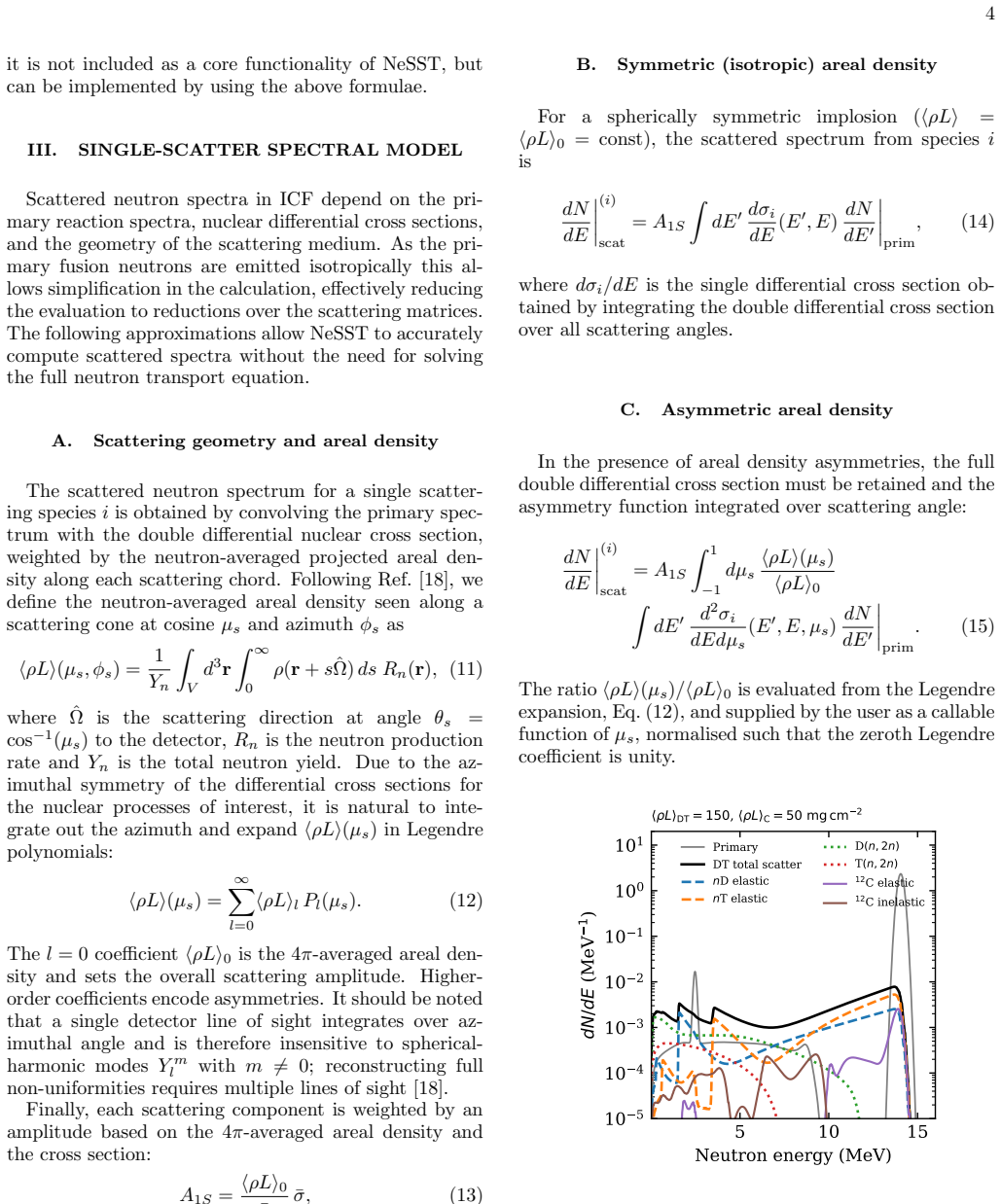
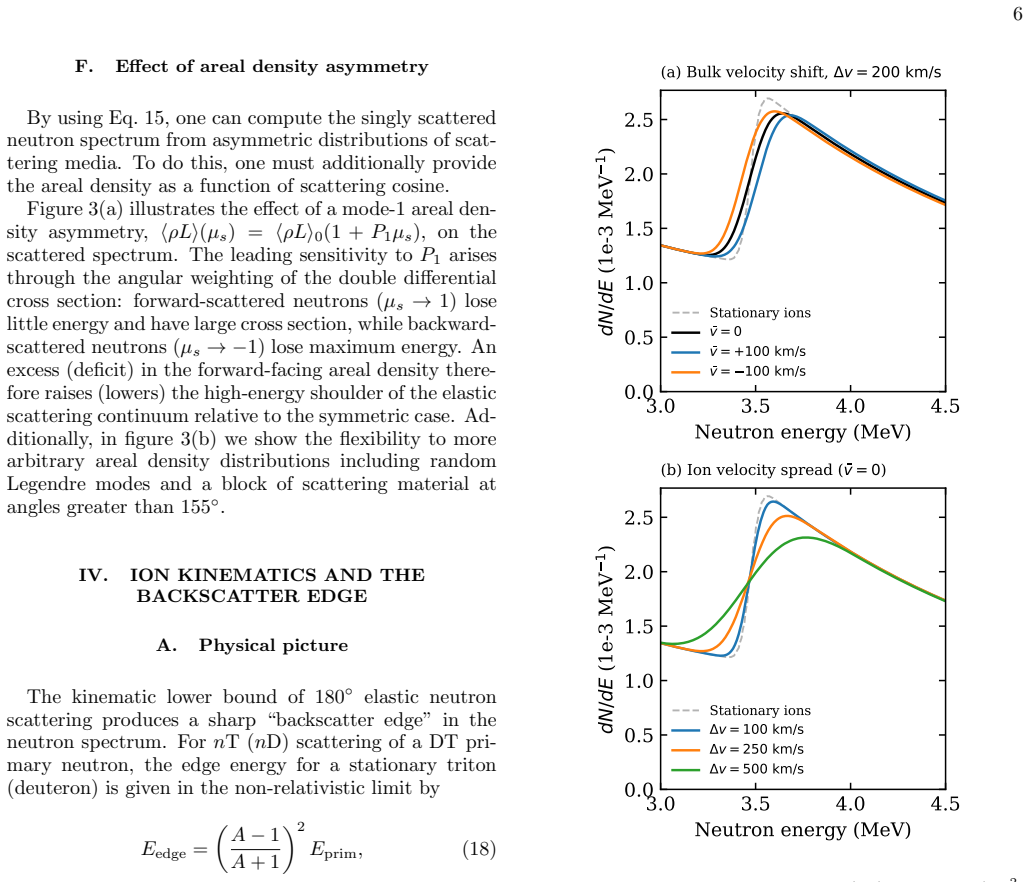
NeSST reads differential and total nuclear cross sections from ENDF libraries to compute elastic scattering such as nD and nT along with inelastic channels like D(n,2n)p and T(n,2n)D for DT fuel and additional ablator materials such as 12C. The code applies relativistic corrections to elastic scattering kinematics, incorporates areal density asymmetries through a Legendre mode expansion of the neutron-averaged projected areal density, handles the effect of scattering ion velocities on the neutron backscatter edge via pre-computed velocity-dependent kernels, and converts the resulting energy spectra into synthetic nToF signals using a full forward model with instrument response functions,能量 -
What carries the argument
NeSST itself, which combines ENDF-sourced cross sections with a single-scattering framework, Legendre expansions for areal-density asymmetries, and pre-computed ion-velocity kernels to generate spectra and synthetic diagnostics.
If this is right
- Spectral signatures of implosion non-uniformities can be computed and fitted directly from measured neutron spectra.
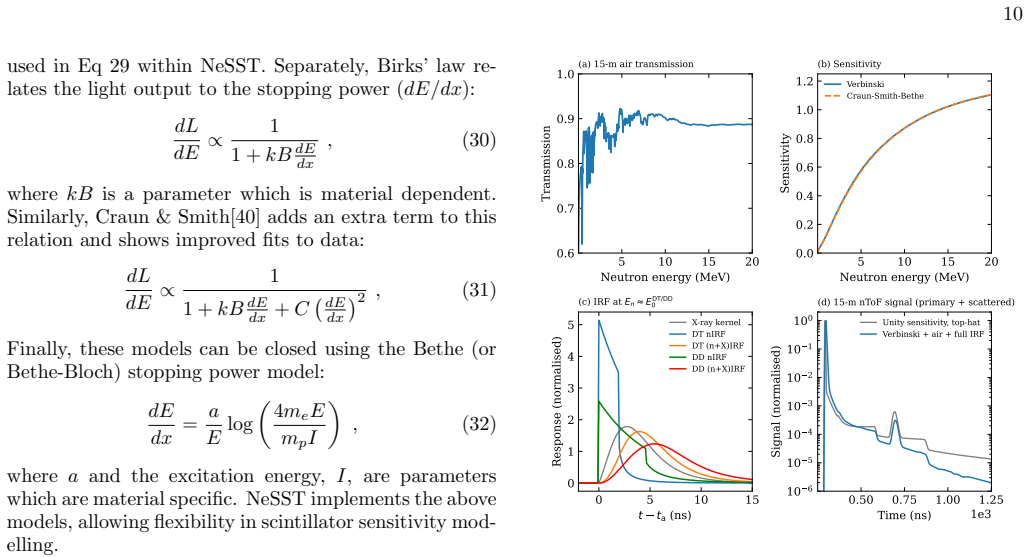
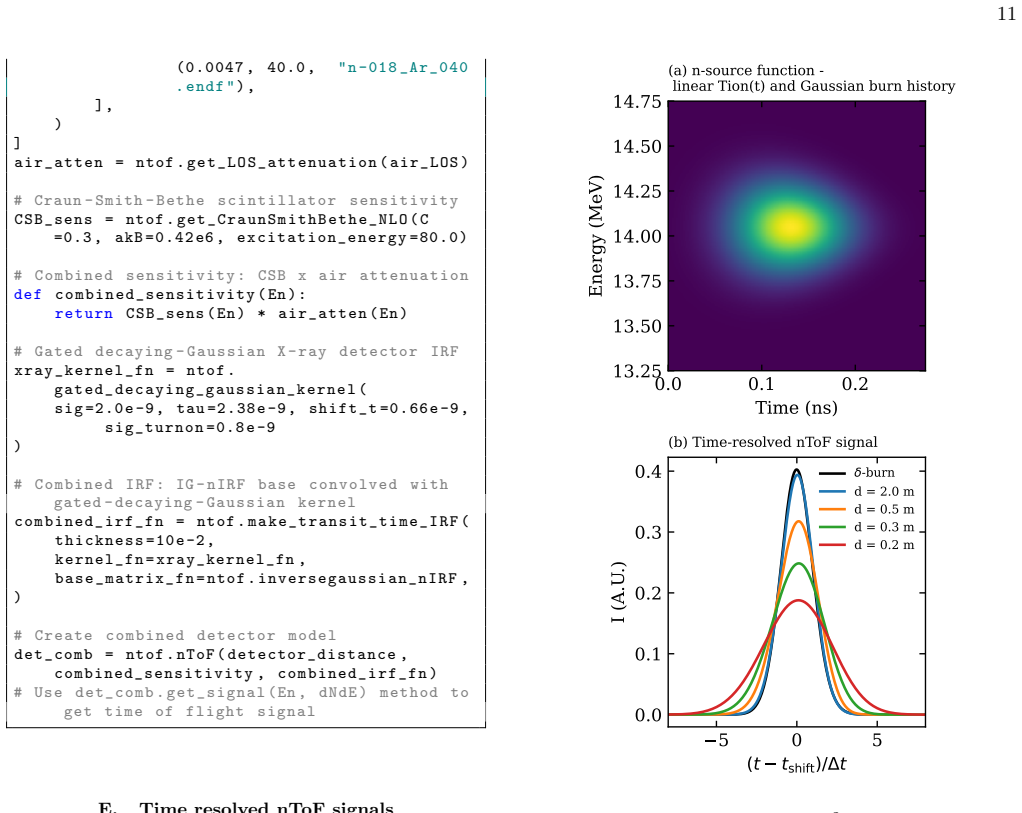
- Synthetic nToF detector signals can be generated that include full instrument response, energy-dependent scintillator sensitivity, and beamline attenuation.
- Scattering contributions from ablator materials such as carbon can be treated in the same framework as fuel scattering.
- Relativistic kinematics improve the modeling of high-energy neutron scattering edges.
Where Pith is reading between the lines
- The open-source release allows rapid iteration on diagnostic interpretation for ongoing ICF experiments at facilities that record nToF data.
- Integration with hydrodynamic simulation outputs could enable parameter studies of how implosion asymmetries translate into observable neutron spectra.
- The modular structure supports extension to additional reaction channels or multi-scatter corrections if experimental data require them.
Load-bearing premise
Single scattering dominates the relevant spectral features and Legendre expansions of neutron-averaged projected areal density plus pre-computed velocity kernels sufficiently capture non-uniformity and backscatter edge effects without requiring full Monte Carlo transport.
What would settle it
A direct comparison of NeSST-generated backscatter edges and asymmetry signatures against full Monte Carlo neutron transport results for the same asymmetric ICF implosion conditions would show clear discrepancies if the single-scattering and Legendre approximations are insufficient.
Figures





read the original abstract
We present the Neutron Scattered Spectra Tool (NeSST), an open-source Python package for rapidly constructing primary and singly scattered neutron spectra from inertial confinement fusion (ICF) implosions. NeSST evaluates primary spectra for deuterium-tritium (DT), deuterium-deuterium (DD) and tritium-tritium (TT) reactions. Differential and total nuclear cross sections are read directly from Evaluated Nuclear Data File (ENDF) libraries. This enables elastic ($n$D, $n$T) and inelastic [D$(n,2n)$p, T$(n,2n)$D] scattering from DT fuel, as well as scattering from additional ablator materials such as $^{12}$C, to be treated within a common framework. Relativistic corrections to elastic scattering kinematics are included. Areal density asymmetries are incorporated through a Legendre mode expansion of the neutron-averaged projected areal density, allowing the spectral signatures of implosion non-uniformities to be computed and fitted. The effect of scattering ion velocities on the neutron backscatter edge shape is handled through pre-computed ion-velocity-dependent scattering kernels. A synthetic neutron time-of-flight (nToF) module converts energy spectra into detector signals with a full forward model that includes configurable instrument response functions (IRFs), energy-dependent scintillator sensitivity, and beamline attenuation. The code is publicly available at https://github.com/aidancrilly/NeSST
Editorial analysis
A structured set of objections, weighed in public.
Referee Report
Summary. The manuscript presents NeSST, an open-source Python package for rapidly constructing primary and singly scattered neutron spectra from ICF implosions. It supports DT, DD, and TT reactions plus ablator materials by reading differential and total cross sections directly from ENDF libraries, incorporates relativistic kinematics for elastic scattering, uses a Legendre mode expansion of the neutron-averaged projected areal density to model asymmetries, employs pre-computed ion-velocity-dependent scattering kernels for the backscatter edge, and includes a configurable synthetic nToF forward model with instrument response functions, scintillator sensitivity, and beamline attenuation.
Significance. If the implementation is accurate within its stated approximations, NeSST would provide a practical, efficient tool for generating synthetic neutron spectra and diagnostics in the ICF community. The open-source release on GitHub and reliance on standard ENDF libraries support reproducibility and community adoption. The handling of implosion non-uniformities via Legendre expansions and velocity effects on the backscatter edge addresses relevant experimental needs for nToF analysis at facilities such as NIF.
major comments (2)
- Scattering model (Methods): The central construction relies on the single-scattering approximation plus Legendre kernels and pre-computed velocity kernels, but no quantitative bound or test is given for the ρR range (e.g., ≳100 mg/cm²) where double scattering begins to fill the backscatter edge and alter down-scattered yield at the few-percent level required for diagnostic use.
- Validation and results sections: The manuscript contains no benchmark comparisons to full Monte Carlo transport codes, no error propagation analysis, and no direct comparison to experimental nToF data, leaving the claim that the generated spectra are 'usable' for diagnostic inference only partially supported.
minor comments (1)
- Code availability statement: While the GitHub link is given, the text would benefit from a short paragraph describing the module structure and providing a minimal usage example for constructing a spectrum with asymmetry modes.
Simulated Author's Rebuttal
We thank the referee for their constructive review and recommendation for minor revision. We address each major comment below and have revised the manuscript to strengthen the presentation of the scattering model and validation aspects while remaining within the scope of a tool-description paper.
read point-by-point responses
-
Referee: Scattering model (Methods): The central construction relies on the single-scattering approximation plus Legendre kernels and pre-computed velocity kernels, but no quantitative bound or test is given for the ρR range (e.g., ≳100 mg/cm²) where double scattering begins to fill the backscatter edge and alter down-scattered yield at the few-percent level required for diagnostic use.
Authors: We agree that an explicit discussion of the single-scattering approximation's range of validity is valuable. In the revised manuscript we have added a dedicated paragraph in the Methods section that cites prior Monte Carlo studies on multiple-scattering contributions in ICF neutron spectra. We state that for the areal-density range typical of current experiments (ρR ≲ 100 mg/cm²) the double-scattering correction to the backscatter edge remains below a few percent, consistent with the diagnostic precision requirements, and we note the approximation's breakdown at higher ρR. This addition provides the requested quantitative context without new calculations. revision: yes
-
Referee: Validation and results sections: The manuscript contains no benchmark comparisons to full Monte Carlo transport codes, no error propagation analysis, and no direct comparison to experimental nToF data, leaving the claim that the generated spectra are 'usable' for diagnostic inference only partially supported.
Authors: The manuscript's primary purpose is to document the NeSST implementation and its underlying physics models rather than to perform an exhaustive validation campaign. We have revised the Results section to include a brief discussion of accuracy expectations based on the ENDF libraries and relativistic kinematics, together with references to earlier literature that benchmarked comparable single-scattering models against Monte Carlo transport codes. Error propagation is facilitated by the code's modular structure, which allows users to propagate uncertainties from the input cross sections; we have clarified this in the text. Direct experimental nToF comparisons lie outside the present scope but are enabled by the synthetic diagnostic module; we have added a forward-looking statement indicating that such comparisons will be pursued in follow-on work. revision: partial
Circularity Check
NeSST tool implements standard external models and data without circular derivations
full rationale
The paper presents NeSST as a forward-modeling Python package that reads differential and total cross sections directly from ENDF libraries, applies relativistic elastic scattering kinematics, uses Legendre expansions of neutron-averaged projected areal density for asymmetries, and employs pre-computed ion-velocity-dependent scattering kernels. All core components are drawn from established nuclear data libraries and standard physics treatments rather than from any self-fitted parameters, internal definitions, or self-citation chains. The synthetic nToF module is likewise a configurable forward operator built on these external inputs. No load-bearing step reduces by construction to its own outputs, satisfying the criteria for a self-contained, non-circular implementation.
Axiom & Free-Parameter Ledger
axioms (2)
- domain assumption ENDF libraries contain accurate differential and total nuclear cross sections for elastic and inelastic scattering on D, T, and C
- domain assumption Singly scattered neutrons dominate the spectral signatures of interest in the relevant energy range
Lean theorems connected to this paper
-
IndisputableMonolith/Cost/FunctionalEquation.leanwashburn_uniqueness_aczel unclear?
unclearRelation between the paper passage and the cited Recognition theorem.
NeSST evaluates primary spectra for DT, DD and TT reactions. Differential and total nuclear cross sections are read directly from ENDF libraries... Legendre mode expansion of the neutron-averaged projected areal density... pre-computed ion-velocity-dependent scattering kernels.
-
IndisputableMonolith/Foundation/AlphaCoordinateFixation.leanJ_uniquely_calibrated_via_higher_derivative unclear?
unclearRelation between the paper passage and the cited Recognition theorem.
The single-scatter contribution dominates over higher-order scattering... approximate second-scatter contribution for higher-ρL conditions
What do these tags mean?
- matches
- The paper's claim is directly supported by a theorem in the formal canon.
- supports
- The theorem supports part of the paper's argument, but the paper may add assumptions or extra steps.
- extends
- The paper goes beyond the formal theorem; the theorem is a base layer rather than the whole result.
- uses
- The paper appears to rely on the theorem as machinery.
- contradicts
- The paper's claim conflicts with a theorem or certificate in the canon.
- unclear
- Pith found a possible connection, but the passage is too broad, indirect, or ambiguous to say the theorem truly supports the claim.
Reference graph
Works this paper leans on
-
[1]
Spectral moments: Ballabio fits As both DT and DD are two-body reactions with two products, reaction kinematics can be used to determine the product energies precisely. Spectral-moment theo- ries have been developed to describe these product spec- tra by exploiting the fact that fusion products are much more energetic than the reacting ions. A full review...
-
[2]
However, there is no simple map- ping from these moments to the accurate spectral shape
Spectral shapes The spectral moments are summary statistics of the full neutron spectrum. However, there is no simple map- ping from these moments to the accurate spectral shape. Instead we use a set of approximate functional forms and validate these against Monte Carlo calculations. The simplest approximation for the primary spectrum is a Gaussian centre...
-
[3]
Elastic scattering Total and differential elastic cross sections fornD,nT and other species are read from Evaluated Nuclear Data File (ENDF)[32] libraries using an in-built ENDF inter- face (making use of the endf-python package). The differ- ential cross section in the centre-of-mass (CoM) frame is represented either as a Legendre polynomial expansion, d...
-
[4]
Inelastic (n,2n) processes The reactions D(n,2n)p and T(n,2n)D are three-body breakup processes that produce a broad, continuous spec- trum of outgoing neutrons within DT fuel. NeSST sup- ports two data formats for the double differential cross section of these processes: •LA W 6 (phase space law): used for T(n,2n)D; the isotropic phase-space distribution...
work page 2018
-
[5]
M. Gatu Johnson, D. T. Casey, J. A. Frenje, C.-K. Li, F. H. S´ eguin, R. D. Petrasso, R. Ashabranner, R. Bionta, S. LePape, M. McKernan, A. Mackinnon, J. D. Kilkenny, J. Knauer, and T. C. Sangster, Measure- ments of collective fuel velocities in deuterium-tritium exploding pusher and cryogenically layered deuterium- tritium implosions on the nif, Physics ...
-
[6]
C. J. Forrest, P. B. Radha, V. Y. Glebov, V. N. Gon- charov, J. P. Knauer, A. Pruyne, M. Romanofsky, T. C. Sangster, M. J. S. III, C. Stoeckl, D. T. Casey, M. Gatu- Johnson, and S. Gardner, High-resolution spectroscopy used to measure inertial confinement fusion neutron spec- tra on omega (invited), Review of Scientific Instruments 83, 10D919 (2012), http...
-
[7]
J. A. Frenje, D. T. Casey, C. K. Li, F. H. S´ eguin, R. D. Petrasso, V. Y. Glebov, P. B. Radha, T. C. Sangster, D. D. Meyerhofer, S. P. Hatchett, S. W. Haan, C. J. Cerjan, O. L. Landen, K. A. Fletcher, and R. J. Leeper, Probing high areal-density cryo- genic deuterium-tritium implosions using downscat- tered neutron spectra measured by the magnetic recoil...
-
[8]
M. Gatu Johnson, D. Schlossberg, B. Appelbe, J. Ball, M. Bitter, D. Casey, A. Celora, L. Ceurvorst, H. Chen, S. Conroy,et al., Learning from each other: Cross-cutting diagnostic development activities between magnetic and inertial confinement fusion, Review of Scientific Instru- ments95(2024)
work page 2024
-
[9]
R. Hatarik, R. C. Nora, B. K. Spears, M. J. Eckart, G. P. Grim, E. P. Hartouni, A. S. Moore, and 15 D. J. Schlossberg, Using multiple neutron time of flight detectors to determine the hot spot velocity, Review of Scientific Instruments89, 10I138 (2018), https://doi.org/10.1063/1.5039372
-
[10]
O. M. Mannion, V. Y. Glebov, C. J. Forrest, J. P. Knauer, V. N. Goncharov, S. P. Regan, T. C. Sangster, C. Stoeckl, and M. Gatu Johnson, Calibration of a neu- tron time-of-flight detector with a rapid instrument re- sponse function for measurements of bulk fluid motion on omega, Review of Scientific Instruments89, 10I131 (2018), https://doi.org/10.1063/1.5037324
-
[11]
A. J. Crilly, B. D. Appelbe, O. M. Mannion, C. J. For- rest, V. Gopalaswamy, C. A. Walsh, and J. P. Chitten- den, Neutron backscatter edge: A measure of the hydro- dynamic properties of the dense dt fuel at stagnation in icf experiments, Physics of Plasmas27, 012701 (2020), https://doi.org/10.1063/1.5128830
- [12]
-
[13]
A. J. Crilly, D. J. Schlossberg, B. D. Appelbe, A. S. Moore, J. Jeet, S. Kerr, M. Rubery, B. Lahmann, S. O’Neill, C. J. Forrest, O. M. Mannion, and J. P. Chit- tenden, Measurements of dense fuel hydrodynamics in the nif burning plasma experiments using backscattered neutron spectroscopy, Physics of Plasmas31, 042701 (2024)
work page 2024
- [14]
-
[15]
V. Gopalaswamy, C. Forrest, R. Betti, D. Patel, A. Crilly, A. Lees, J. Knauer, B. Stanley, L. Ceurvorst, C. Stoeckl, et al., Interpreting scattered neutron spectra on omega cryogenic implosions with measured backgrounds and higher-order scattering, Physics of Plasmas32(2025)
work page 2025
-
[16]
C. Forrest, A. Crilly, A. Schwemmlein, M. Gatu-Johnson, O. Mannion, B. Appelbe, R. Betti, V. Y. Glebov, V. Gopalaswamy, J. Knauer,et al., Measurements of low- mode asymmetries in the areal density of laser-direct- drive deuterium–tritium cryogenic implosions on omega using neutron spectroscopy, Review of Scientific Instru- ments93(2022)
work page 2022
-
[17]
X-5 Monte Carlo Team,MCNP – A General Monte Carlo N-Particle Transport Code, Version 5, Tech. Rep. LA- UR-03-1987 (Los Alamos National Laboratory, 2003)
work page 1987
-
[18]
P. K. Romano, N. E. Horelik, B. R. Herman, A. G. Nel- son, B. Forget, and K. Smith, Openmc: A state-of-the-art monte carlo code for research and development, Annals of Nuclear Energy82, 90 (2015)
work page 2015
-
[19]
F. Weilacher, P. B. Radha, and C. Forrest, Three- dimensional modeling of the neutron spectrum to infer plasma conditions in cryogenic inertial confinement fu- sion implosions, Physics of Plasmas25, 042704 (2018), https://doi.org/10.1063/1.5016856
-
[20]
A. J. Crilly, B. D. Appelbe, K. McGlinchey, C. A. Walsh, J. K. Tong, A. B. Boxall, and J. P. Chittenden, Synthetic nuclear diagnostics for inferring plasma properties of in- ertial confinement fusion implosions, Physics of Plasmas 25, 122703 (2018), https://doi.org/10.1063/1.5027462
-
[21]
A. J. Crilly, B. D. Appelbe, O. M. Mannion, C. J. For- rest, V. Gopalaswamy, C. A. Walsh, and J. P. Chitten- den, Neutron backscatter edge: A measure of the hydro- dynamic properties of the dense DT fuel at stagnation in ICF experiments, Phys. Plasmas27, 012701 (2020)
work page 2020
-
[22]
A. J. Crilly, B. D. Appelbe, O. M. Mannion, C. J. Forrest, and J. P. Chittenden, The effect of areal density asym- metries on scattered neutron spectra in ICF implosions, Phys. Plasmas28, 022710 (2021)
work page 2021
-
[23]
Brysk, Fusion neutron energies and spectra, Plasma Physics15, 611 (1973)
H. Brysk, Fusion neutron energies and spectra, Plasma Physics15, 611 (1973)
work page 1973
-
[24]
L. Ballabio, J. K. Allne, and G. Gorini, Relativistic Cal- culation of Fusion Product Spectra, Nuclear Fusion38, 10.1088/0029-5515/38/11/310 (1998)
-
[25]
C. R. Brune, J. A. Caggiano, D. B. Sayre, A. D. Bacher, G. M. Hale, and M. W. Paris,r-matrix description of particle energy spectra produced by low-energy 3H +3 H reactions, Phys. Rev. C92, 014003 (2015)
work page 2015
-
[26]
D. H. Munro, Interpreting inertial fusion neutron spectra, Nuclear Fusion56, 036001 (2016)
work page 2016
-
[27]
D. H. Munro, J. E. Field, R. Hatarik, J. L. Peterson, E. P. Hartouni, B. K. Spears, and J. D. Kilkenny, Im- pact of temperature-velocity distribution on fusion neu- tron peak shape, Physics of Plasmas24, 056301 (2017), https://doi.org/10.1063/1.4976857
-
[28]
B. D. Appelbe, A. J. Crilly, and C. Pimpirev, General- izing the moments method for primary neutron spectra, High Energy Density Physics52, 101128 (2024)
work page 2024
- [29]
-
[30]
J. Eriksson, A. Hjalmarsson, M. Isoflar, J. Conroy, G. Er- icsson, M. G. Johnson, E. Sund´ en,et al., DRESS: a monte Carlo code for the simulation of diagnostic re- sponse functions in fusion experiments, Comput. Phys. Commun.199, 40 (2016)
work page 2016
-
[31]
M. G. Johnson, C. Forrest, D. Sayre, A. Bacher, J.-L. Bourgade, C. Brune, J. Caggiano, D. Casey, J. Frenje, V. Y. Glebov,et al., Experimental evidence of a vari- ant neutron spectrum from the t (t, 2 n)αreaction at center-of-mass energies in the range of 16–50 kev, Phys- ical review letters121, 042501 (2018)
work page 2018
-
[32]
B. Eriksson, S. Conroy, G. Ericsson, J. Eriksson, A. Hjalmarsson, C. Brune, M. G. Johnson, M. Nocente, S. Fugazza, and M. Rebai, First measurement in a mag- netic confinement fusion experiment of the h 3+ h 3→he 5+ n intermediate two-body resonant reaction, Physical Review C109, 054620 (2024)
work page 2024
-
[33]
B. D. Appelbe, A. J. Crilly, and J. P. Chittenden, Rel- ativistic corrections to the TT neutron spectrum, High Energy Density Phys.19, 29 (2016)
work page 2016
-
[34]
H.-S. Bosch and G. Hale, Improved formulas for fusion cross-sections and thermal reactivities, Nuclear Fusion 32, 611 (1992)
work page 1992
-
[35]
N. V. Kabadi, P. J. Adrian, A. Bose, D. Casey, J. A. Frenje, M. Gatu Johnson, B. Lahmann, O. Mannion, R. D. Petrasso, H. Rinderknecht,et al., A second order yield-temperature relation for accurate inference of burn- averaged quantities in multi-species plasmas, Physics of Plasmas28(2021)
work page 2021
-
[36]
M. Chadwick, P. Obloˇ zinsk´ y, M. Herman, N. Greene, R. McKnight, D. Smith, P. Young, R. MacFarlane, G. Hale, S. Frankle, A. Kahler, T. Kawano, R. Little, D. Madland, P. Moller, R. Mosteller, P. Page, P. Talou, H. Trellue, M. White, W. Wilson, R. Arcilla, C. Dun- ford, S. Mughabghab, B. Pritychenko, D. Rochman, 16 A. Sonzogni, C. Lubitz, T. Trumbull, J. ...
-
[37]
Z. G. Ge, Z. X. Zhao, H. H. Xia, Y. X. Zhuang, T. J. Liu, J. S. Zhang, and H. C. Wu, The updated version of chi- nese evaluated nuclear data library (cendl-3.1), Journal of the Korean Physical Society59(2011)
work page 2011
-
[38]
Deltuva, Deuteron-neutron scattering above the breakup threshold, Phys
A. Deltuva, Deuteron-neutron scattering above the breakup threshold, Phys. Rev. C88, 011601 (2013)
work page 2013
-
[39]
C. J. Forrest, A. Deltuva, W. U. Schr¨ oder, A. V. Voinov, J. P. Knauer, E. M. Campbell, G. W. Collins, V. Y. Glebov, O. M. Mannion, Z. L. Mohamed, P. B. Radha, S. P. Regan, T. C. Sangster, and C. Stoeckl, Deuteron breakup induced by 14-mev neutrons from inertial con- finement fusion, Phys. Rev. C100, 034001 (2019)
work page 2019
-
[40]
R. Hatarik, D. B. Sayre, J. A. Caggiano, T. Phillips, M. J. Eckart, E. J. Bond, C. Cerjan, G. P. Grim, E. P. Hartouni, J. P. Knauer, J. M. Mcnaney, and D. H. Munro, Analysis of the neutron time-of- flight spectra from inertial confinement fusion experi- ments, Journal of Applied Physics118, 184502 (2015), https://doi.org/10.1063/1.4935455
-
[41]
Z. Mohamed, O. Mannion, E. Hartouni, J. Knauer, and C. Forrest, A generalized forward fit for neutron detec- tors with energy-dependent response functions, Journal of Applied Physics128, 214501 (2020)
work page 2020
-
[42]
T. J. Murphy, R. E. Chrien, and K. Klare, Interpretation of neutron time-of-flight signals from current-mode detec- tors, Review of scientific instruments68, 610 (1997)
work page 1997
-
[43]
G. F. Knoll,Radiation detection and measurement(John Wiley & Sons, 2010)
work page 2010
-
[44]
Q. Tang, Z. Song, P. Liu, B. Yu, and J. Yang, Calibra- tion of the sensitivity of the bibenzyl-based scintillation detector to 1–5 MeV neutrons, Nucl. Instrum. Methods Phys. Res. A1068, 169779 (2024)
work page 2024
-
[45]
V. V. Verbinski, W. R. Burrus, T. A. Love, W. Zobel, N. W. Hill, and R. Textor, Calibration of an organic scin- tillator for neutron spectrometry, Nucl. Instrum. Meth- ods65, 8 (1968)
work page 1968
-
[46]
R. Craun and D. Smith, Analysis of response data for sev- eral organic scintillators, Nuclear Instruments and Meth- ods80, 239 (1970)
work page 1970
-
[47]
C. Stoeckl, R. Boni, F. Ehrne, C. Forrest, V. Y. Gle- bov, J. Katz, D. Lonobile, J. Magoon, S. P. Regan, M. Shoup,et al., Neutron temporal diagnostic for high- yield deuterium–tritium cryogenic implosions on omega, Review of Scientific Instruments87(2016)
work page 2016
- [48]
-
[49]
J. Catenacci, D. Constantino, B. Gall, and A. Luttman, Tomographic reconstruction of the neutron time–energy spectrum from a dense plasma focus, IEEE Transactions on Plasma Science48, 3135 (2020)
work page 2020
-
[50]
M. Vlad, A time resolving spectrometry method for par- ticles emitted in intense bursts, Nuclear Instruments and Methods in Physics Research Section A: Acceler- ators, Spectrometers, Detectors and Associated Equip- ment227, 327 (1984)
work page 1984
- [51]
-
[52]
A. Moore, D. Schlossberg, M. Eckart, E. Hartouni, T. Hilsabeck, J. Jeet, S. Kerr, R. Nora, and J. Kilkenny, Constraining time-dependent ion temperature measure- ments in inertial confinement fusion (icf) implosions with an intermediate distance neutron time-of-flight (ntof) de- tector, Review of Scientific Instruments93(2022)
work page 2022
-
[53]
C. R. Harriset al., Array programming with NumPy, Nature585, 357 (2020)
work page 2020
-
[54]
Virtanenet al., SciPy 1.0: Fundamental algorithms for scientific computing in Python, Nat
P. Virtanenet al., SciPy 1.0: Fundamental algorithms for scientific computing in Python, Nat. Methods17, 261 (2020)
work page 2020
-
[55]
Romano, endf-python (2023), accessed 2026-05-13
P. Romano, endf-python (2023), accessed 2026-05-13
work page 2023
-
[56]
J. D. Hunter, Matplotlib: A 2D graphics environment, Comput. Sci. Eng.9, 90 (2007)
work page 2007
discussion (0)
Sign in with ORCID, Apple, or X to comment. Anyone can read and Pith papers without signing in.